


Win the Job Before the Bid

Construction Company Marketing That Turns Custom Home, Addition and Build-Out Inquiries Into Signed Contracts
Local Legends Marketing for General Contractors and Residential Builders
Updated November 2026 · Reviewed by Levi Ostlund, Founder
Local Legends Marketing is a construction company marketing agency for general contractors and residential builders, built to bring qualified custom home, addition, ADU and light commercial inquiries, then follow each one to a signed contract.
The work runs on Google Ads, Local Services Ads, local SEO, project-gallery websites, Facebook and Instagram ads and CRM call tracking.
- Signed contracts are the scoreboard: every report ends at contract value by source.
- Built for slow yeses: nurture for buyers who are still finding a lot, a lender or an architect.
- Proof from your own jobs: project pages and case studies, never stock photos or borrowed stories.
- Flat fees: never a percent of your ad budget, with no long-term contracts.
- You own it all: website, domain, Google Business Profile, ad accounts and call data stay in your name.
Free Growth Audit
Your Reviews, Radius and Response Rate vs the competitors beating you.
About Local Legends Marketing
A home service marketing agency headquartered in Conroe, Texas, with 8+ years of marketing experience, running Google Ads, Local Services Ads, local SEO, AI SEO, connected TV and review systems for contractors nationwide.
General Contractor Marketing Proof You Can Check First Owners Who Put Their Names on It
Contractor CEOs have gone on the record about the ad, search and tracking work Local Legends Marketing does for them. Those testimonials come from roofing and restoration companies, so a builder should read them as proof of process and ask for construction references on the audit call.
| Proof Point | Number |
|---|---|
| Appointments generated for contractors (agency-reported) | 25,000+ |
| Revenue influenced (agency-reported) | $30M+ |
| Years marketing home service contractors | 8+ |
| Accounts kept in the contractor's name | 100% |
| Fee model | Flat monthly, never a percent of ad spend |
| Long-term contracts required | None |
Levi has been absolutely outstanding to work with over the years... His creativity, responsiveness, and deep understanding of our marketing strategy have made a huge impact.
 Brad Beldon
CEO, Roofing Company
How Construction Company Marketing Is Different From Marketing a Service Trade Six-Figure Contracts, Months of Courtship
Construction company marketing is different because a buyer is choosing a builder for one of the largest checks they will ever write, not booking a same-day repair. A plumber wins on speed. A builder wins on trust, proof and patience over many months.
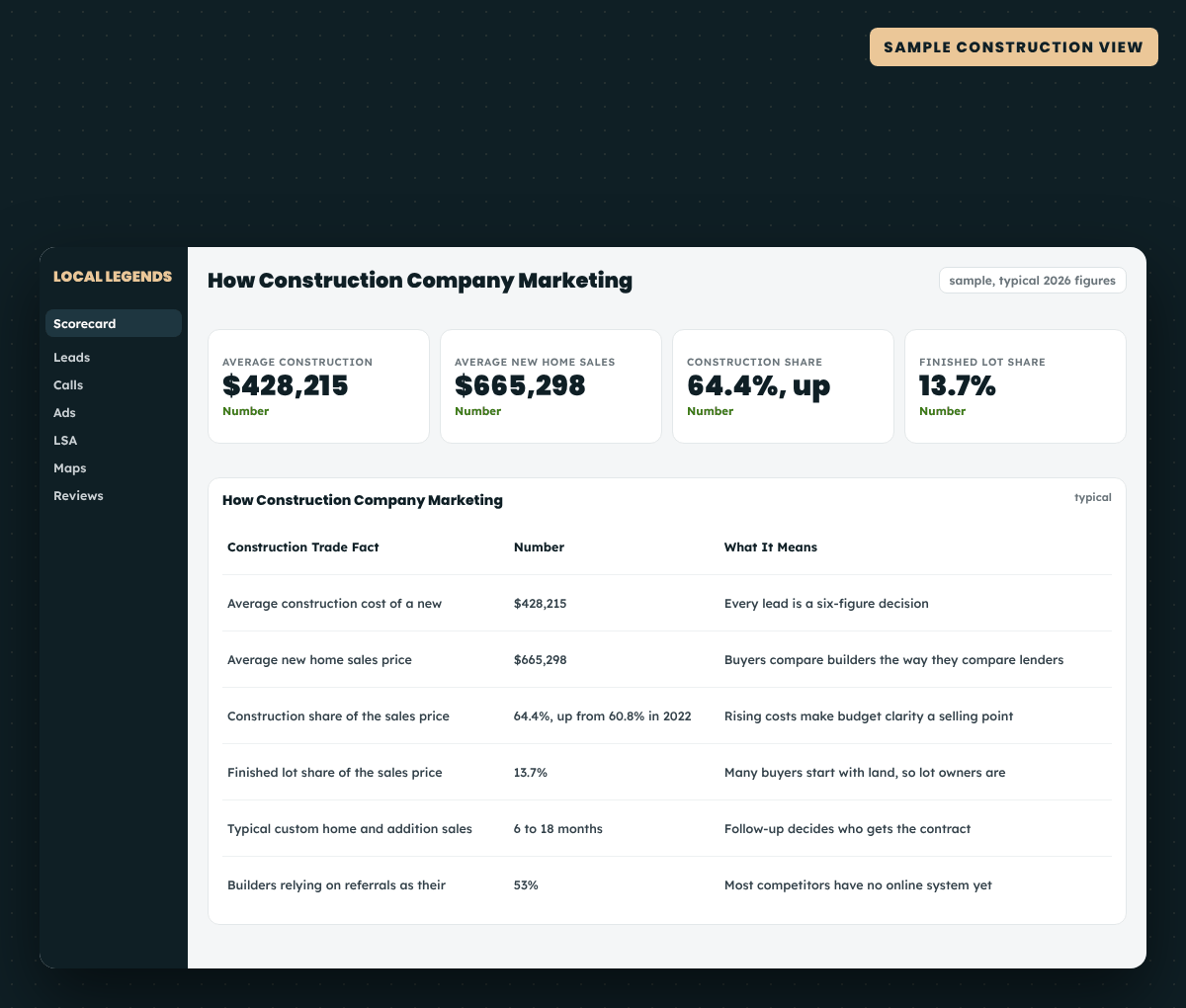
A 2024 national builder association cost survey put the average construction cost of a new single-family home at $428,215 on an average sales price of $665,298. Buyers spending that much interview several builders, call references and look you up online even when a friend sent them.
| Construction Trade Fact (Typical, US) | Number | What It Means for Marketing |
|---|---|---|
| Average construction cost of a new single-family home (2024 builder association survey) | $428,215 | Every lead is a six-figure decision |
| Average new home sales price (same survey) | $665,298 | Buyers compare builders the way they compare lenders |
| Construction share of the sales price (same survey) | 64.4%, up from 60.8% in 2022 | Rising costs make budget clarity a selling point |
| Finished lot share of the sales price (same survey) | 13.7% | Many buyers start with land, so lot owners are a market |
| Typical custom home and addition sales cycle (Google AI Mode, November 2026) | 6 to 18 months | Follow-up decides who gets the contract |
| Builders relying on referrals as their main source (2026 construction software industry report, cited by ChatGPT) | 53% | Most competitors have no online system yet |
Survey figures are national averages for new single-family homes and vary widely by market. Sales cycle and referral figures are typical ranges reported by AI platforms and industry reports, not guarantees.
Three Buyers, Three Funnels
A residential general contractor usually sells to three different people: a homeowner or lot owner planning a custom home, an existing homeowner adding space with an addition or ADU, and a business owner or landlord who needs a light commercial build-out.
Each of those buyers searches, decides and pays differently, so each gets its own campaign.
Where Remodeling and Bath Work Fit
Many general contractors also take kitchens, whole-home renovations and bathrooms. Those buyers move faster and run on smaller tickets, so they get their own playbooks: see our pages on remodeling marketing and bath remodeling marketing.
This page stays on new builds, additions, outdoor living and build-outs.
I Own a Custom Home Building Company and Most of Our Work Comes From Referrals. How Do I Get More Custom Home Leads Online?
A custom home builder gets more online leads by turning a referral reputation into a system that strangers can find and verify: a Google Business Profile full of reviews, a website with real project pages, Google Ads for "build on your lot" searches, and a form that sorts serious buyers. Google AI Mode and ChatGPT gave that order in November 2026.
- Remember that referrals check you online too: Google AI Mode said modern referrals look you up before they call, so the website and reviews close referral deals as well as new ones.
- Build one page per signature project: ChatGPT suggested pages like a modern farmhouse on acreage or a contemporary home on a narrow infill lot, each with the town named.
- Target planning searches:"custom home builder near me," "build on your lot," "custom home builders on acreage" and "luxury home builder" plus your towns.
- Ask for a review at key handover: a stack of detailed reviews describing finished custom builds outsells a billboard.
- Show process, not just photos: short videos of window flashing, waterproofing or a tricky grading fix prove craftsmanship nobody sees later.
- Qualify on the form: do you own land, what is your investment range, and when do you want to break ground.
- Skip shared lead marketplaces as a main source: both platforms warned they sell the same lead to several builders and start a race to the bottom on price.
Who Is the Best Construction Marketing Company for a General Contractor or Custom Home Builder? The One That Understands Project Value
The best construction marketing company for a general contractor or custom home builder is one that knows long sales cycles, sells from your real projects, and reports signed contracts instead of clicks. Google AI Mode and ChatGPT both said in November 2026 that no single agency is best for every builder.
Google AI Mode put it plainly: an agency that fills a remodeling calendar with quick leads is the wrong fit for a builder chasing a few seven-figure homes a year.
ChatGPT warned against hiring a general digital agency at all, because construction sells differently. Hold every agency to the same tests, Local Legends Marketing included.
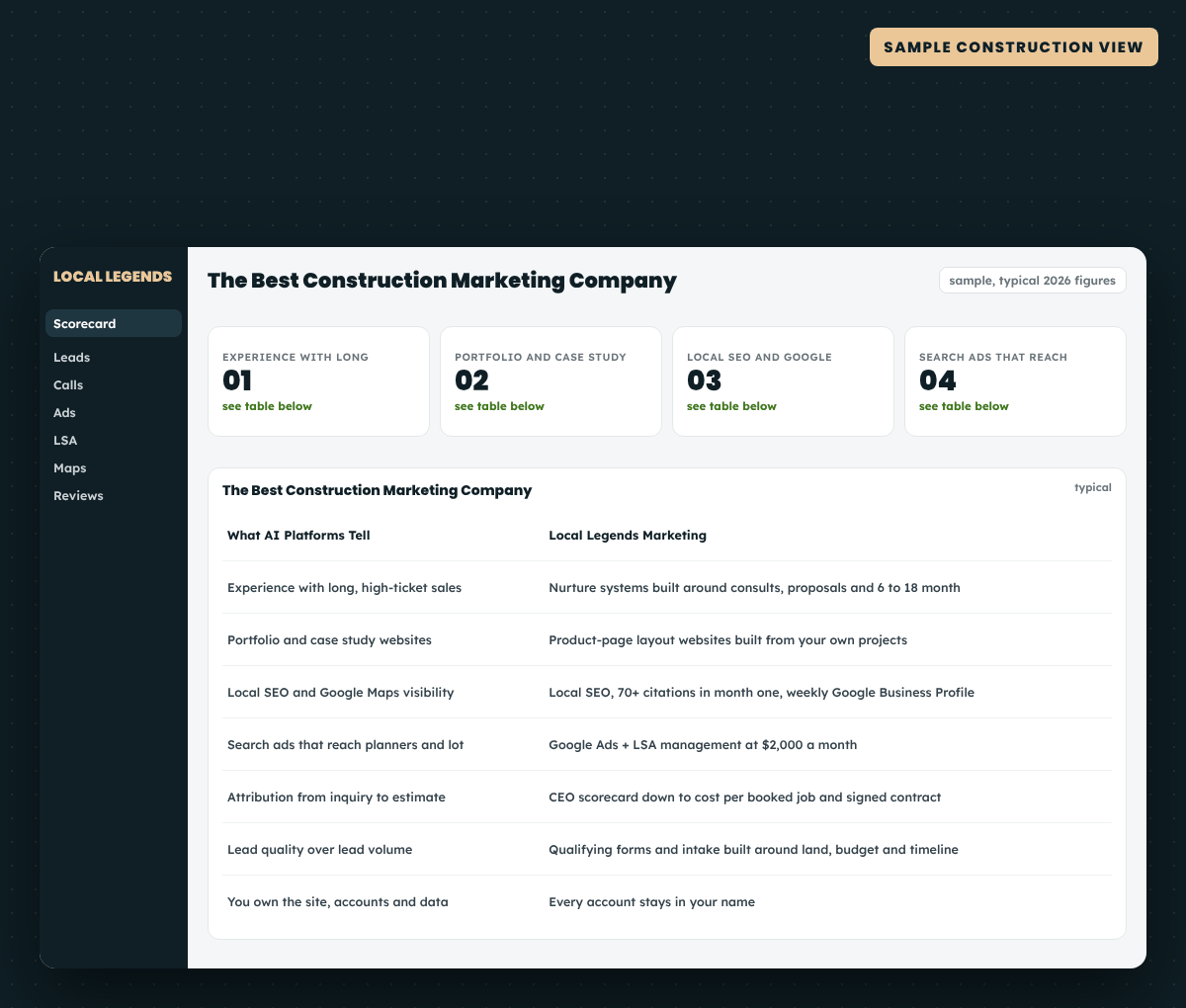
| What AI Platforms Tell Builders to Look For | Local Legends Marketing Proof |
|---|---|
| Experience with long, high-ticket sales cycles | Nurture systems built around consults, proposals and 6 to 18 month timelines |
| Portfolio and case study websites | Product-page layout websites built from your own projects |
| Local SEO and Google Maps visibility | Local SEO, 70+ citations in month one, weekly Google Business Profile posts |
| Search ads that reach planners and lot owners | Google Ads + LSA management at $2,000 a month |
| Attribution from inquiry to estimate and contract | CEO scorecard down to cost per booked job and signed contract |
| Lead quality over lead volume | Qualifying forms and intake built around land, budget and timeline |
| You own the site, accounts and data | Every account stays in your name |
| No lock-in | No long-term contracts |
ChatGPT summed up the test well: 100 cheap leads are not better than five qualified opportunities on $500,000 projects. Google AI Mode added that builders under about $1.5M in revenue should start with the Google Business Profile and reviews before a big retainer.
Questions Worth Asking Any Construction Marketing Agency
- Can you show a builder tracked from first call to signed contract value?
- Who owns the website, domain, ad accounts and call recordings?
- How will you gather project photos, budgets and stories from my project managers?
- Do you separate custom home, addition and commercial campaigns, or run one generic "contractor" ad?
- What happens in the first 30 days before any ad money goes out?
The Local Legends Channel Mix for General Contractors and Builders Search First, Proof Always
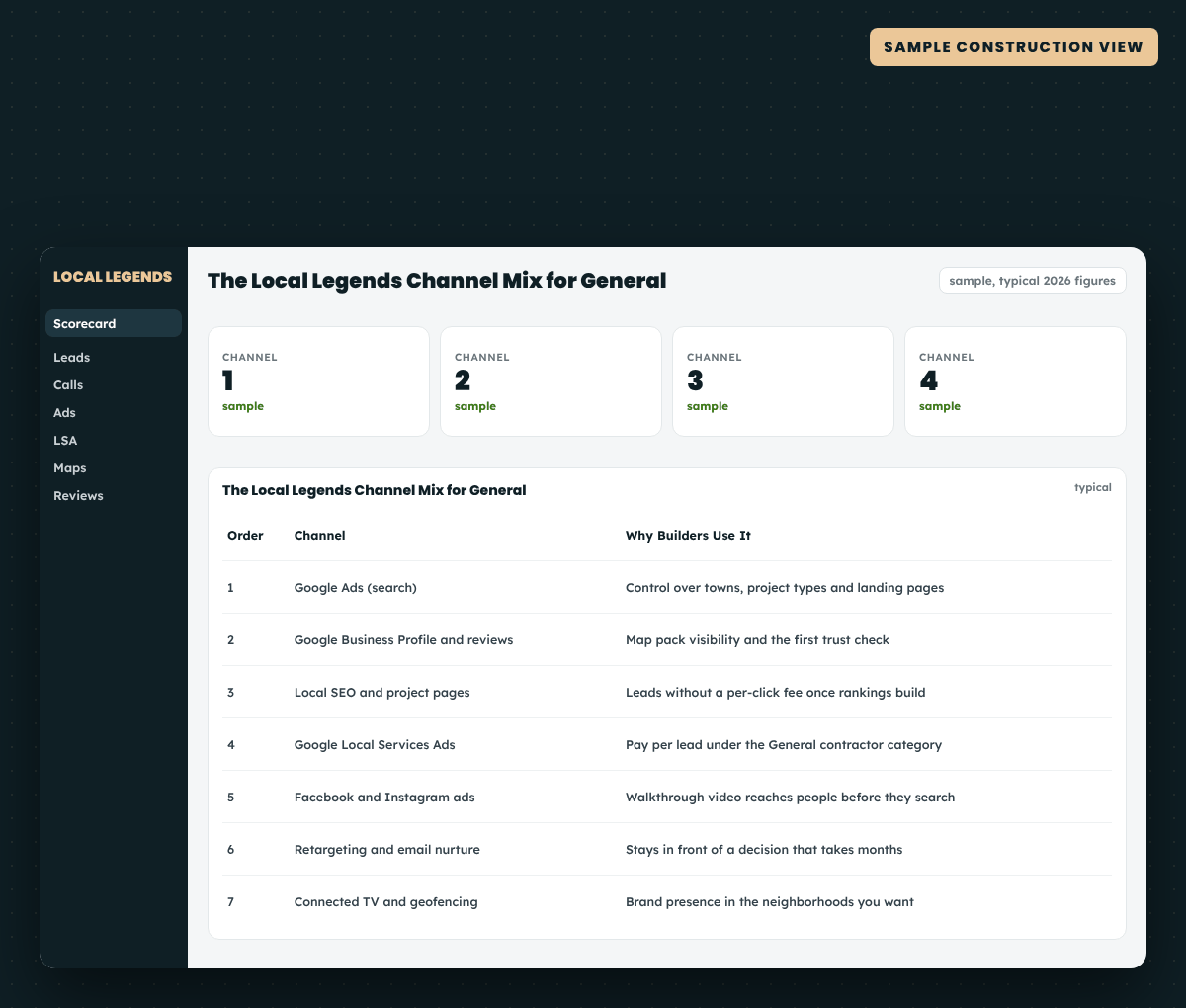
The Local Legends channel mix for general contractors starts with Google Ads and a fully built Google Business Profile, then adds SEO project pages, retargeting and referral partner tracking so a buyer who finds you in January still sees you when they sign in June.
| Order | Channel | Why Builders Use It | Best For |
|---|---|---|---|
| 1 | Google Ads (search) | Control over towns, project types and landing pages | "Custom home builder," "home addition contractor," "ADU builder" |
| 2 | Google Business Profile and reviews | Map pack visibility and the first trust check | Referral validation, "general contractor near me" |
| 3 | Local SEO and project pages | Leads without a per-click fee once rankings build | Cost guides, build-on-your-lot and project searches |
| 4 | Google Local Services Ads | Pay per lead under the General contractor category | Additions, renovations and general contracting calls |
| 5 | Facebook and Instagram ads | Walkthrough video reaches people before they search | ADUs, outdoor living, finished home reveals |
| 6 | Retargeting and email nurture | Stays in front of a decision that takes months | Proposals out, buyers waiting on land or loans |
| 7 | Connected TV and geofencing | Brand presence in the neighborhoods you want to build in | Sasquatch plan markets |
Local Legends runs Google Ads management, Google Local Services Ads management, local SEO and Facebook ads for builders, with every channel on one scorecard.
Is SEO or Google Ads Better for a General Contractor That Builds Custom Homes, Additions and ADUs?
Google Ads is better for a general contractor who needs consultations this quarter, and SEO is better for lowering the cost of each signed contract over the next one to two years, so most builders run both with separate budgets per project type. Google AI Mode and ChatGPT agreed in November 2026.
| Factor (Typical) | Google Ads | SEO and Project Pages |
|---|---|---|
| Time to first inquiries | Hours to days | Months; AI Mode said 12 to 18+ in competitive markets |
| Cost structure | Pay per click while it runs | Monthly work, no per-click fee |
| Trust on a six-figure project | High intent, some ad skepticism | Organic and map rankings read as established |
| What it teaches you | Which searches turn into contracts | Which cost and design questions buyers ask |
| What you keep if you stop | Account history | Rankings, pages and reviews |
| Best for | Filling a thin pipeline fast | Owning "build on your lot," ADU cost and project searches |
Google AI Mode suggested a phased split: about 70% to paid search and 30% to SEO setup in months one to three, then separate pages for custom homes, additions and ADUs.
ChatGPT suggested marketing each service on its own, because addition and ADU buyers search with more urgency than custom home planners.
Does Google Local Services Ads Cover General Contractor and Custom Home Jobs? Yes for General Contracting, No Category for New Homes
Google Local Services Ads covers general contractors in the US, but it has no category for new home construction or custom home building. Google's own Local Services eligibility list, checked in November 2026, shows General contractor with no location limit, plus Kitchen remodeling, Bathroom remodeling, Carpenters, Foundations services, Siding services and Roofers.
Google's list does not mention home builders, new construction, ADUs, decks or additions. Architect and Interior designer appear only for California and Florida.
The AI platforms split on what that means. Google AI Mode told custom builders to skip LSA, saying they can only list under General contractor or Handyman and tend to get small repair calls.
ChatGPT said the General contractor category is open to them, with no guarantee new-build searches trigger the ad.
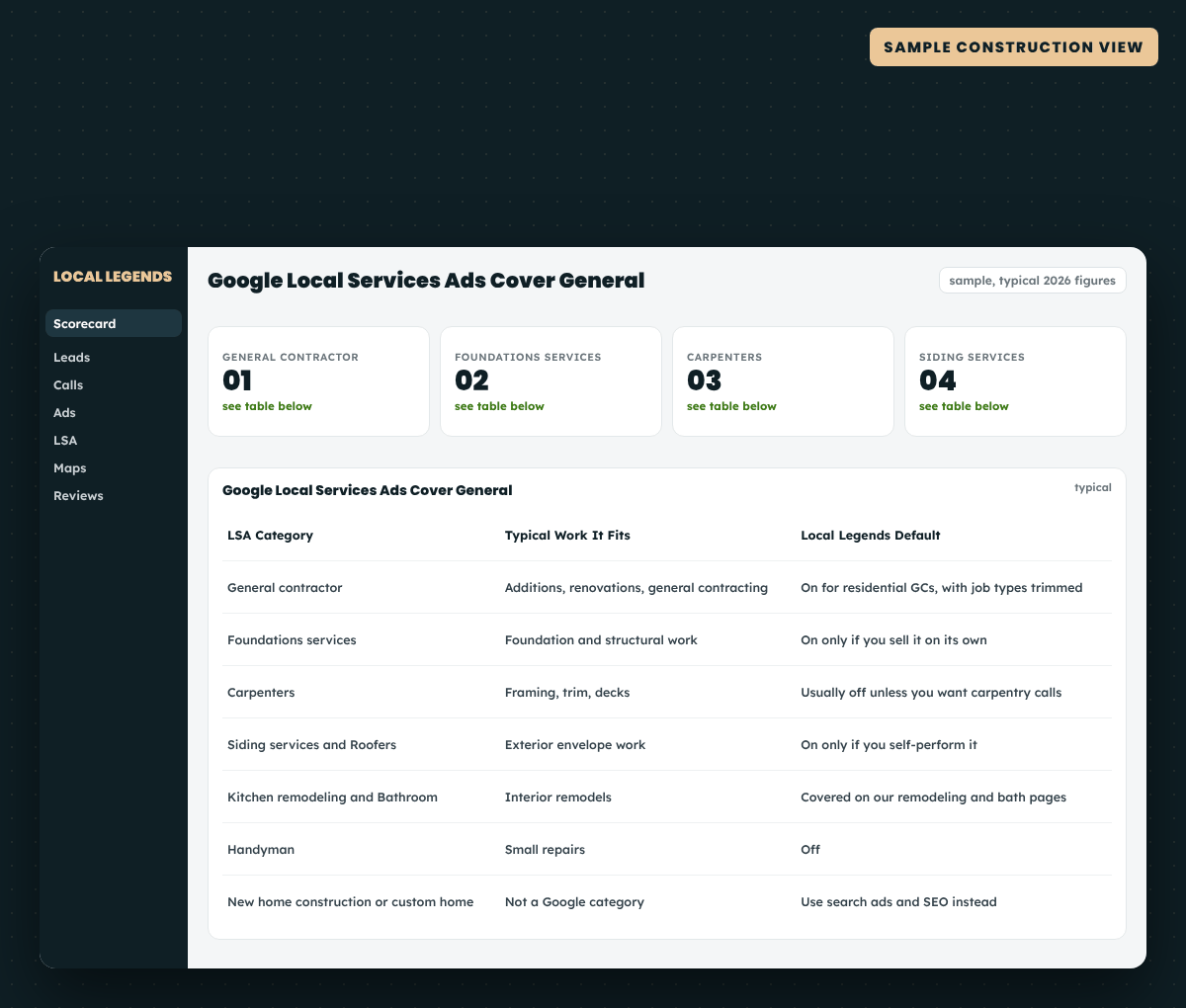
| LSA Category (US, Google's List, November 2026) | Typical Work It Fits | Local Legends Default for Builders |
|---|---|---|
| General contractor | Additions, renovations, general contracting | On for residential GCs, with job types trimmed to big work |
| Foundations services | Foundation and structural work | On only if you sell it on its own |
| Carpenters | Framing, trim, decks | Usually off unless you want carpentry calls |
| Siding services and Roofers | Exterior envelope work | On only if you self-perform it |
| Kitchen remodeling and Bathroom remodeling | Interior remodels | Covered on our remodeling and bath pages |
| Handyman | Small repairs | Off |
| New home construction or custom home builder | Not a Google category | Use search ads and SEO instead |
Before a builder's LSA goes live, Local Legends confirms the categories and job types Google currently offers in that account and switches off job types that bring small repairs. Lead credits for off-scope calls are disputed weekly.
When LSA Earns Its Spot for a Builder
LSA fits a general contractor who also sells additions, structural work and larger renovations, because those buyers call from the top of Google and you pay per lead, not per click. For a builder who only does ground-up custom homes, search ads and project pages do the heavy lifting.
What the LSA Move Into Google Ads Means for General Contractors
Google is folding Local Services Ads into Google Ads as pay-per-lead Performance Max campaigns, and a general contractor still pays only for valid leads shown on Search and Maps. Google's help page says the first US phase in August 2026 covered plumbing, HVAC, electrical, roofing and a few other categories, with remaining categories in 2027.
| What Changes (Google Ads Help, 2026) | What It Means for a Builder |
|---|---|
| Weekly budgets become a daily average (weekly divided by 7) | Recheck monthly spend after the move |
| Manual max cost per lead bidding ends | One campaign-level target cost per lead instead |
| Vertical-level targets replaced by one campaign target | Split General contractor and other categories into separate campaigns to keep separate rules |
| Old performance reports do not carry over, lead history does | Save screenshots of your LSA reports before migration |
| Name, address and hours sync from your Google Business Profile | A wrong address can pause the campaign for review |
| Google Verified badge transfers automatically | No new license or insurance upload needed |
| BBB callouts no longer supported | Add at least 6 structured callouts |
| Up to two weeks to settle | Expect a short dip after migration |
General contractor was not in the August 2026 first group, so most builders move in a later phase. Google emails the account admin 14 days ahead, then again 7 days ahead.
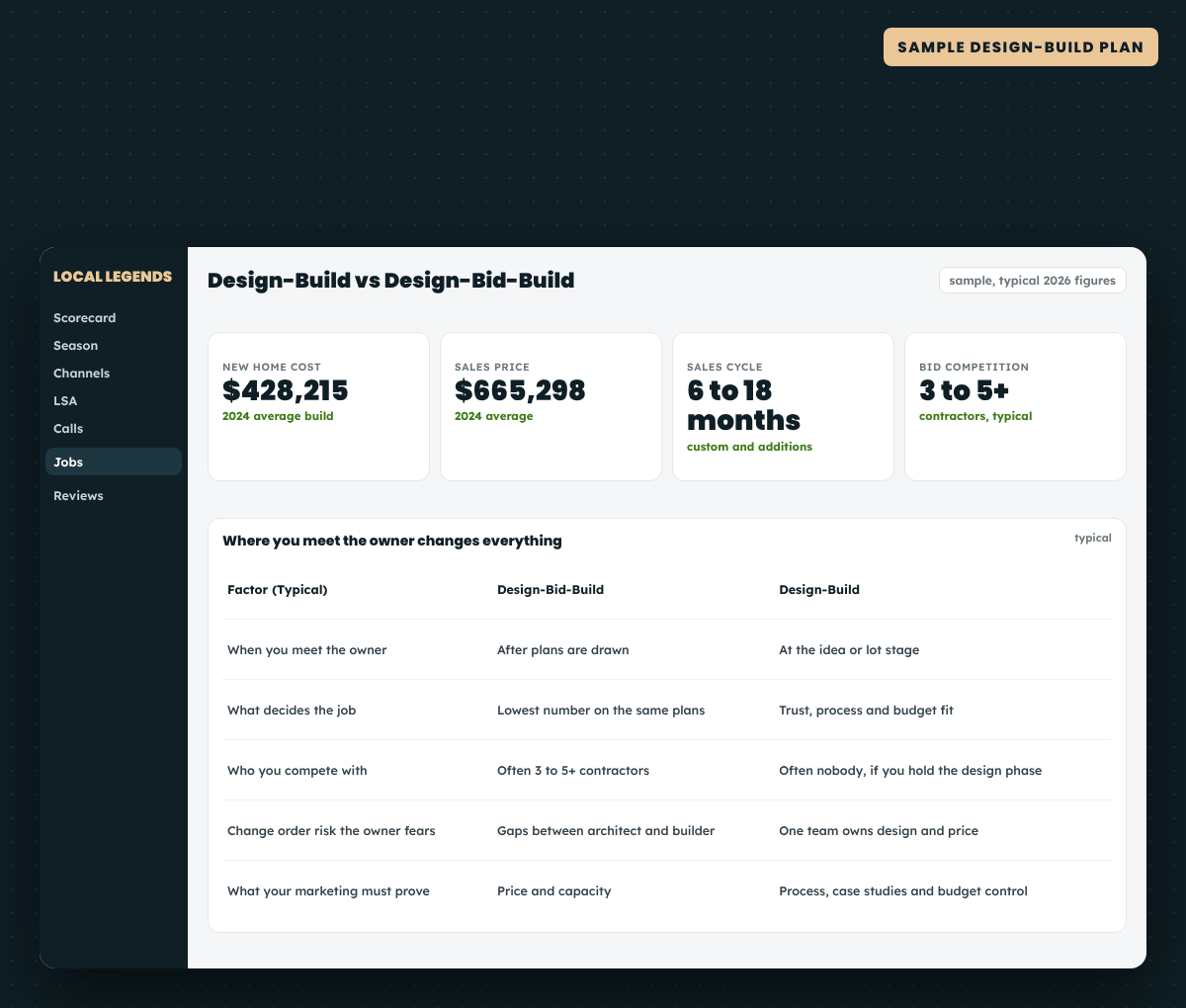
Design-Build vs Bid Work: Marketing That Gets You in Before the Bid Sell Certainty, Not Square Footage
Design-build marketing wins work before it goes out to bid by selling budget certainty, one accountable team and fewer change orders, while bid-spec work asks you to price someone else's plans against four other contractors. Google AI Mode and ChatGPT both framed it that way in November 2026.
| Factor (Typical) | Design-Bid-Build | Design-Build |
|---|---|---|
| When you meet the owner | After plans are drawn | At the idea or lot stage |
| What decides the job | Lowest number on the same plans | Trust, process and budget fit |
| Who you compete with | Often 3 to 5+ contractors | Often nobody, if you hold the design phase |
| Change order risk the owner fears | Gaps between architect and builder | One team owns design and price |
| What your marketing must prove | Price and capacity | Process, case studies and budget control |
How Do I Market a Design-Build Construction Company So We Stop Competing on Price in Bid Work?
A design-build construction company stops competing on price by marketing a paid feasibility or preconstruction step instead of a free estimate, and by proving with case studies that its process protects the owner's budget. Both platforms said generic claims like "quality craftsmanship" make you look like everyone else.
- Lead with a feasibility and budget alignment offer, not "get a free bid." Google AI Mode said once you hold the design pencil, you usually hold the contract.
- Sell preconstruction as a product: feasibility, preliminary budget, constructability review, value engineering and a schedule. ChatGPT noted builders can charge for it.
- Tell the messy middle: a case study where the wish list ran past the budget and your team redesigned it before ground broke.
- Write the anti-low-bid guide: an honest page on why the lowest bid often costs the most once change orders land.
- Use three positioning lines at most: financial clarity, one point of accountability, fewer surprises.
- Get upstream of bid boards: a podcast cited by Google AI Mode said profitable contractors earn 60% to 70% of revenue in the quiet period before a project is announced.
- Never invent savings: ChatGPT warned to use only real project numbers in case studies.
Referral Partner Marketing With Architects, Realtors and Lot Owners They Meet Your Buyer First
Referral partner marketing turns architects, real estate agents and lot owners into a tracked lead channel, because those people meet a future custom home client months before any builder is chosen. Google AI Mode called them a separate B2B sales channel, not passive word of mouth.
How Do I Get More Referrals From Architects, Realtors and People Who Own Lots as a Custom Home Builder?
A custom home builder gets more referrals by giving each partner something that makes their job easier, early budgets for architects, lot walk-throughs for realtors and buildability answers for landowners, then calling every referred lead fast and keeping the partner posted. Google AI Mode and ChatGPT gave matching playbooks in November 2026.
| Referral Partner | What They Need From You | What to Offer | How Local Legends Tracks It |
|---|---|---|---|
| Architects and designers | A builder who respects the design and the budget | Early budgets and constructability feedback in schematic design | Partner-specific tracked number and intake tag |
| Real estate agents (land and tear-downs) | Buyers who close and stay happy | Preliminary lot consultations before closing | Unique link on a land buyer's guide |
| Lot owners | A clear path from land to house | A buildability consultation or "you own the land, now what" workshop | Workshop sign-up form with source field |
| Lenders, surveyors, civil engineers | Clients who move forward | Fast, clear answers for their clients | Referral source dropdown in the CRM |
- Call a referred lead within 60 minutes: Google AI Mode said a slow callback makes your partner look bad.
- Update the partner after the first meeting with one short text.
- Send business back: keep 2 or 3 architects ready for clients who show up without plans.
- Treat lot advice as preliminary: ChatGPT said to be clear it does not replace a survey, engineering or permitting.
- Check your state's rules on referral fees before you offer realtors any payment, and put any agreement in writing.
- Track referrals sent and received for each partner, so you know which relationships are two-way.
Project Galleries and Case Studies Built From Your Own Jobs Proof a Buyer Can Audit
Project galleries and case studies win bigger construction jobs when each one works like a site visit, showing the scope, budget band, schedule and the problems your team solved. Google AI Mode called a good case study a digital site visit for buyers checking your capability.
Construction sites from Local Legends use a product-page layout: one page per service, and one per featured build. Every photo and story comes from your own completed jobs; nothing is stock and nothing is borrowed. See our construction website design approach.
How Should a Residential Construction Company Use Project Galleries and Case Studies on Its Website to Win Bigger Custom Home and Addition Jobs?
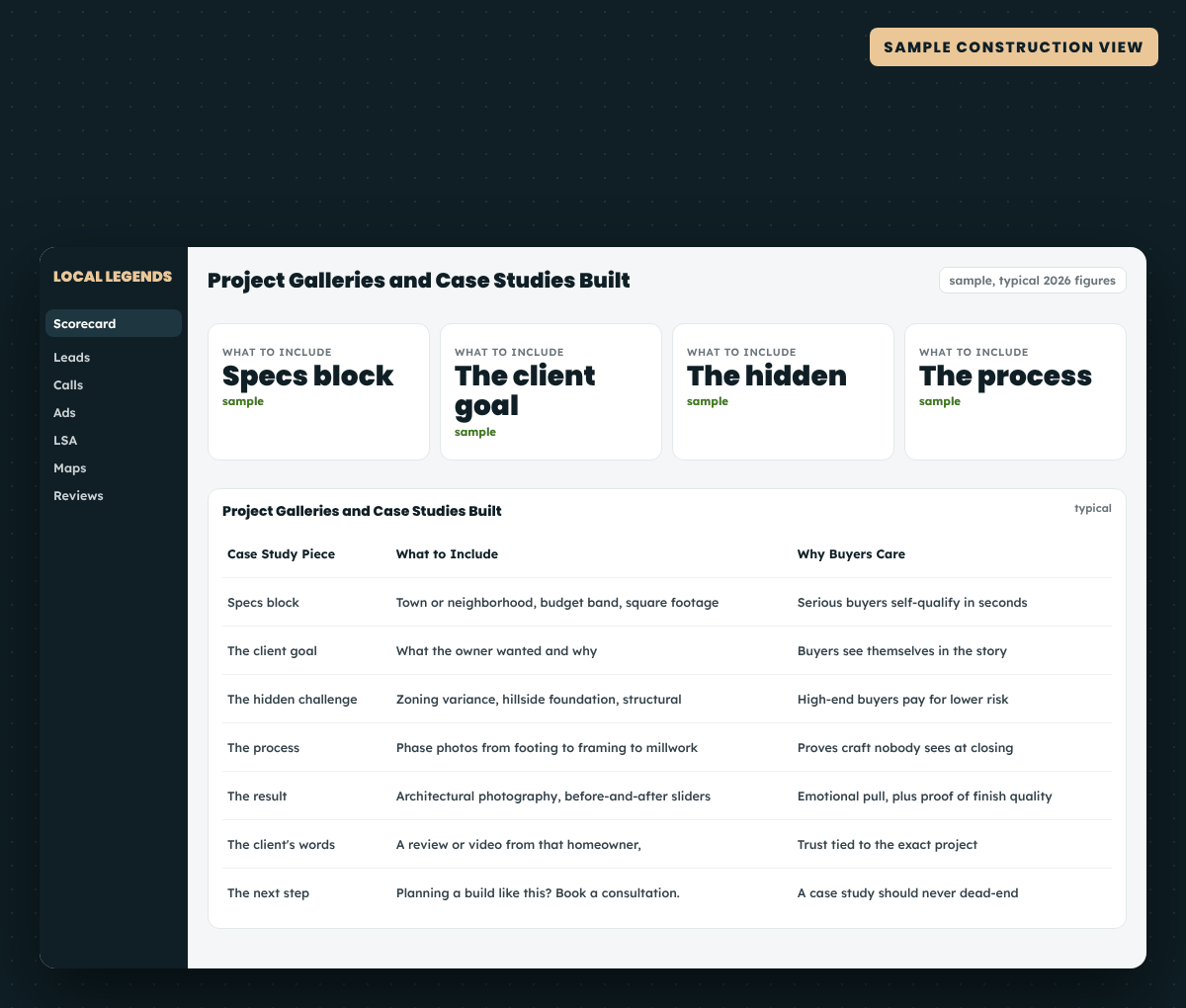
A residential construction company should give its biggest projects their own case study pages with a specs block, the challenge, the solution and the finished result, and stop showing a $40,000 bath with the same weight as a $1.5 million home. Google AI Mode and ChatGPT gave that structure in November 2026.
| Case Study Piece | What to Include | Why Buyers Care |
|---|---|---|
| Specs block | Town or neighborhood, budget band, square footage, style, schedule, your role | Serious buyers self-qualify in seconds |
| The client goal | What the owner wanted and why | Buyers see themselves in the story |
| The hidden challenge | Zoning variance, hillside foundation, structural tie-in, occupied home | High-end buyers pay for lower risk |
| The process | Phase photos from footing to framing to millwork | Proves craft nobody sees at closing |
| The result | Architectural photography, before-and-after sliders | Emotional pull, plus proof of finish quality |
| The client's words | A review or video from that homeowner, with permission | Trust tied to the exact project |
| The next step | "Planning a build like this? Book a consultation." | A case study should never dead-end |
- Split galleries by the work you want: custom homes, additions, ADUs, outdoor living and light commercial.
- Hire an architectural photographer for your best jobs; ChatGPT suggested 2 to 3 exteriors, 3 to 5 interiors and 2 to 4 progress shots each.
- Show addition tie-ins: matched siding, rooflines and structural connections are what addition buyers worry about.
- Use only your own projects and real numbers: never fabricate a budget, timeline or testimonial.
Light Commercial Bid List and RFP Marketing for General Contractors Get Invited, Then Get Chosen
Light commercial marketing for a general contractor means getting onto the right bid lists and turning each RFP into a proposal that sells schedule, compliance and low risk, because commercial clients weigh reliability and permitting experience over the lowest number. Google AI Mode said so in November 2026.
How Does a Small General Contractor Get on Bid Lists and Win RFPs for Light Commercial Tenant Build-Outs?
A small general contractor gets on light commercial bid lists by building relationships with property managers, tenant-rep brokers and commercial architects, then wins RFPs with a qualification package and a clear schedule. Both platforms said smaller GCs can win tenant improvements on responsiveness and flexibility.
- Property managers first: retail strip, office, medical office and flex managers keep approved vendor lists. Ask who handles contractor onboarding.
- Tenant-rep brokers: ChatGPT and AI Mode both said they know a lease is signed before anyone else.
- Commercial architects and interior designers add builders to approved bidder lists for their clients.
- Larger GCs: some pass on $25,000-$100,000+ renovations and will refer them out.
- Your regional builders exchange and online bid networks: worth one or two profiles, but relationships beat bid boards.
- Bid selectively: a firm cited by Google AI Mode said high-volume bidders often win under 20% while selective firms reach 40% to 50%.
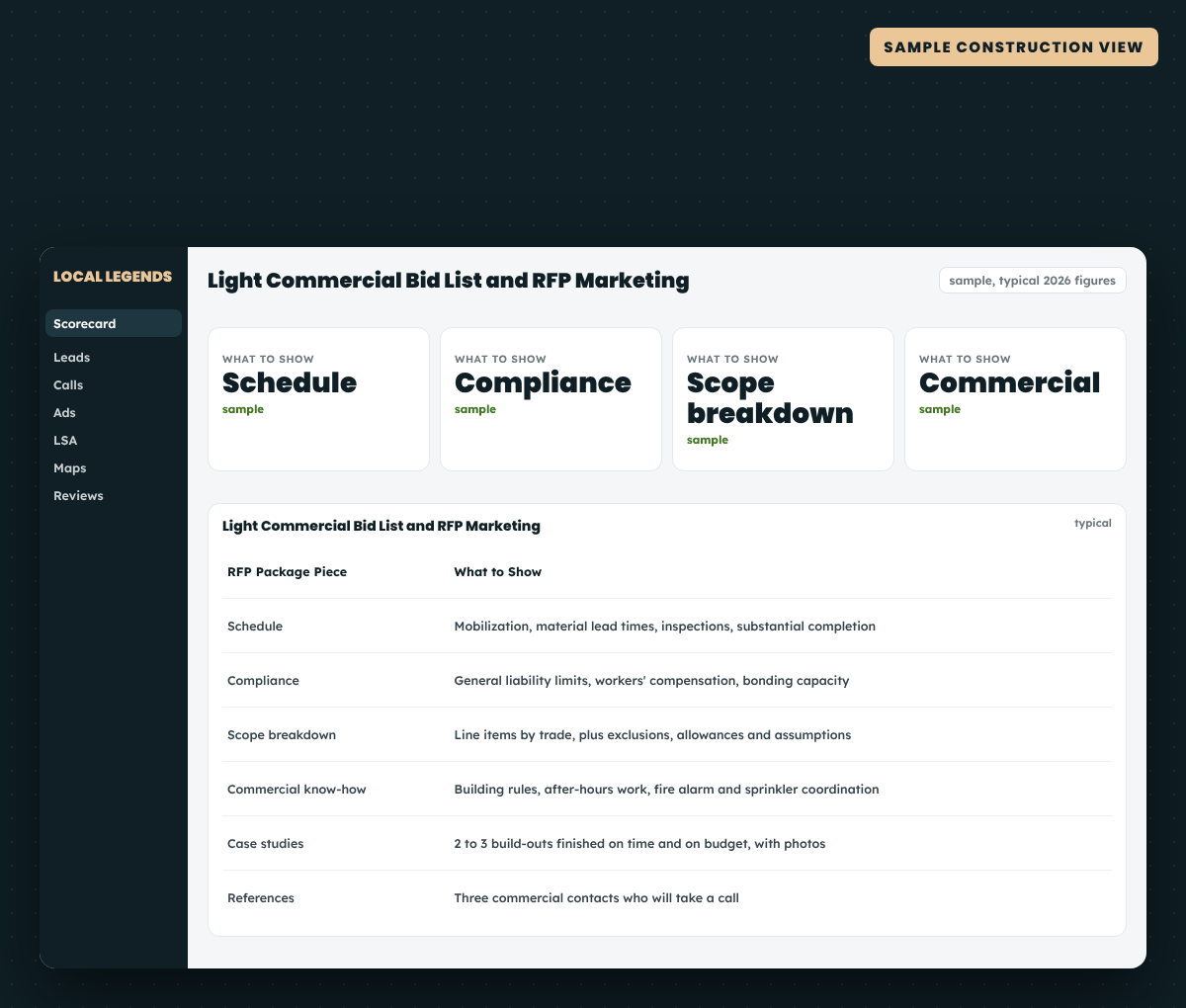
| RFP Package Piece | What to Show |
|---|---|
| Schedule | Mobilization, material lead times, inspections, substantial completion, punch list |
| Compliance | General liability limits, workers' compensation, bonding capacity, safety record |
| Scope breakdown | Line items by trade, plus exclusions, allowances and assumptions |
| Commercial know-how | Building rules, after-hours work, fire alarm and sprinkler coordination |
| Case studies | 2 to 3 build-outs finished on time and on budget, with photos |
| References | Three commercial contacts who will take a call |
A standard contractor's qualification statement can also help when an owner asks for formal prequalification. Local Legends builds the web pages, case studies and tracked phone numbers behind this package; the estimating stays with you.
Licensing, Insurance and Bonding as Construction Trust Signals Verifiable in 30 Seconds
Licensing, insurance and bonding become marketing when a homeowner can verify them in seconds, with real numbers on the website and Google Business Profile instead of a vague "licensed and insured" badge. Google AI Mode said affluent buyers are risk-averse and want proof they can check.
How Should a General Contractor Show Licensing, Insurance and Bonding on the Website and Google Profile So Homeowners Trust Us With a Big Build?
A general contractor should list the license or registration number, the issuing authority, the general liability limit, workers' compensation and the exact bond type on a dedicated credentials page, in the footer and near every quote form. Google AI Mode and ChatGPT both said specifics build more trust than badges.
| Vague Wording | Specific Wording Buyers Trust |
|---|---|
| "Fully licensed and insured" | "Licensed contractor, [state] license #[number], verify at [state board]" |
| "Great coverage" | "$[amount] general liability and workers' compensation" |
| "Bonded" | "Contractor license bond of $[amount]" or "Performance bonds available on request" |
| "Certificates available" | "Certificate of insurance sent the same day you ask" |
- Licensing rules vary by state: some states, Texas among them, have no statewide general contractor license, while trades like electrical and plumbing are licensed. ChatGPT warned never to advertise a license that does not exist.
- Insurance expectations: Google AI Mode cited homeowner forums expecting at least $1,000,000 in general liability, and more for large builds. Show your real limit.
- Name the bond type: a license bond, a performance bond and liability insurance are different things.
- Never post the certificate itself: keep policy and bond numbers private and send documents on request.
- Use the Google Business Profile description(750 characters) for license and coverage lines.
- LSA already checks: the Google Verified badge requires license and insurance review when you sign up.
Financing and Construction Loans in Your Builder Marketing Make the Project Feel Possible
Financing in construction marketing means showing buyers how a custom home, addition or ADU gets paid for, so people with equity or income but not cash on hand still call. Google AI Mode called financing the biggest hurdle in high-ticket residential construction.
Should a Custom Home Builder or ADU Builder Advertise Construction Loans and Financing Options in Our Marketing?
A custom home or ADU builder should advertise financing education and lender partners, but not specific rates or approvals, because it removes the biggest objection without breaking lending ad rules. Google AI Mode and ChatGPT both said yes in November 2026.
- Build a financing page that explains construction-to-permanent loans, construction-only loans, home equity lines and cash-out refinancing.
- Partner with 2 or 3 lenders who know construction draws, rather than acting as a lender yourself.
- Ask on the intake form:"Would you like information about financing?"
- Market the ADU equity angle: Google AI Mode suggested Facebook and Instagram ads pairing an ADU project with a home equity hook.
- Keep wording general: ChatGPT noted federal Truth in Lending and Regulation Z ad rules can apply to builders who are not lenders. No rates, payments or guaranteed approval without lender review.
- Say who lends: make clear financing comes from an independent lender.
- Expect Meta limits: financing ads can fall into Meta's financial products special ad category, which restricts targeting.
- Track it: a payment platform cited by Google AI Mode reported 35% financed sales for contractors who present financing on every job, vs 17% when only asked.
Following Up on a 6 to 18 Month Construction Sales Cycle Stay Useful Until They Are Ready
Long-cycle construction follow-up keeps a builder in front of buyers who are saving, buying land, waiting on plans or selling a home, without the "are you ready yet?" calls that push them away. Both platforms said timing, not interest, is usually the obstacle.
Our Custom Home and Addition Projects Take 6 to 18 Months to Sell. How Should a Construction Company Follow Up With Leads Who Aren't Ready Yet?
A construction company should tag every not-ready lead by timeline and reason for waiting, then send a lengthening rhythm of useful messages, project stories and personal check-ins. Google AI Mode and ChatGPT both laid out a similar 18-month cadence in November 2026.
| Timeline (Typical) | Contact Rhythm | What to Send |
|---|---|---|
| 0 to 3 months out | Every 1 to 2 weeks | Personal text and email, scope questions, site visit offer |
| 3 to 6 months out | About monthly | Lot buying guide, financing explainer, budget worksheet |
| 6 to 12 months out | Every 45 to 60 days | A finished project like theirs, with the specs and story |
| 12 to 18+ months out | Every 60 to 90 days | Cost trends, permit or zoning updates, open house invite |
| Any time | Milestone call every 3 to 6 months | Open questions about their goals, never a pitch |
- Record the reason for waiting: financing, land, plans, permits, HOA approval or a home to sell.
- Text for quick notes, email for depth: a builder blog cited by AI Mode reported 98% text open rates vs about 20% for email.
- Invite warm leads to a walkthrough of a finished home before handover, with the owner's permission.
- Automate reminders, not relationships: ChatGPT said big-project buyers want to know a real person is there.
- Get consent for marketing email and honor every opt-out.
Construction Marketing Seasonality and Budget Calendar Market While They Plan
Construction marketing seasonality runs ahead of the build calendar: budgets peak in late winter, while buyers are picking the builder for a spring or summer start. Building slows in late fall and winter, but planning, permitting and contractor interviews do not.
When Is the Slow Season for Residential Construction and Custom Home Building, and When Should a General Contractor Spend the Most on Marketing?
The slow season for residential construction typically runs November through February, and a general contractor should usually spend the most on marketing from January through March. Google AI Mode and ChatGPT both gave that timing in November 2026, because buyers who want a spring start pick a builder in late winter.
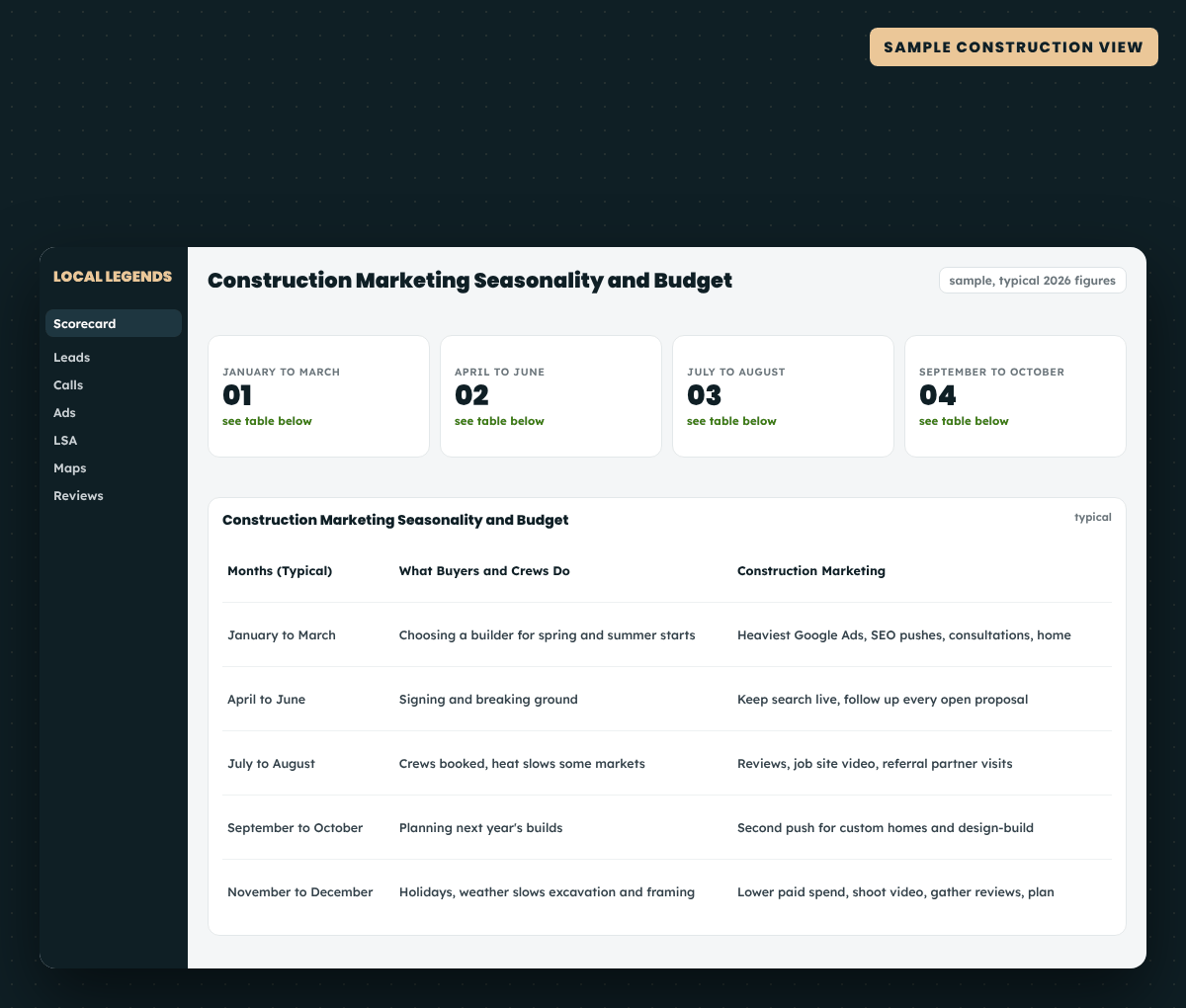
| Months (Typical) | What Buyers and Crews Do | Construction Marketing Focus |
|---|---|---|
| January to March | Choosing a builder for spring and summer starts | Heaviest Google Ads, SEO pushes, consultations, home shows |
| April to June | Signing and breaking ground | Keep search live, follow up every open proposal |
| July to August | Crews booked, heat slows some markets | Reviews, job site video, referral partner visits |
| September to October | Planning next year's builds | Second push for custom homes and design-build consults |
| November to December | Holidays, weather slows excavation and framing | Lower paid spend, shoot video, gather reviews, plan the year |
ChatGPT suggested roughly 35% to 40% of the yearly budget in January to March and 25% to 30% in September to October. It also said to market 60 to 120 days before a buyer's start date, and earlier for custom homes. Both said never drop to zero.
Warm-climate markets build year-round, while cold-weather markets stop more sharply. Local Legends checks your own lead and contract history before setting the calendar.
How Much Does Construction Company Marketing Cost in 2026? A Share of Revenue, Not a Guess
Most builders spend 3% to 10% of revenue on construction company marketing in 2026, with construction agency fees of about $1,500-$5,000+ a month and ad spend paid separately. Google AI Mode put steady contractors at 3% to 5%, growth mode at 7% to 10%, and new firms or new territories at 10% to 15%+.
| Annual Construction Revenue (Typical) | About 4% Steady | About 8% Growth |
|---|---|---|
| $1M | About $3,300 a month | About $6,700 a month |
| $3M | About $10,000 a month | About $20,000 a month |
| $5M | About $16,700 a month | About $33,300 a month |
ChatGPT cited a 2026 builder industry report with median builder marketing spend near 1% of revenue, and stronger markups among builders spending 4% or more. Budget from the revenue you want next year, and include agency fees.
Local Legends Prices
Builders pay Local Legends a flat monthly fee that never scales with ad spend, and the ad money itself goes from your card to Google, Meta or the TV network. The LSA Ranker review texter and fractional CMO + CEO meetings come with every plan; only the meeting cadence changes.
| Local Legends Plan or Service | Price | What a Builder Gets |
|---|---|---|
| Google Ads + Local Services Ads | $2,000 a month + ad spend | Search campaigns by project type, LSA setup, monthly GBP optimization |
| Facebook + Instagram Ads | $2,500 a month + ad spend | Walkthrough video campaigns, instant forms, retargeting |
| Connected TV | $1,500 a month + media | Brand in the neighborhoods you want to build in |
| Footprint | $2,500 a month | Google Ads + LSA, local SEO + 70+ citations month one, 10 pages/blogs a month, GBP posts, call tracking, monthly scorecard |
| Trailblazer | $4,000 a month | Adds Bing + Facebook/Instagram ads, 20 pages/blogs, backlinks, review and email/text automations, weekly scorecard |
| Sasquatch | $8,000 a month | Adds AI SEO, connected TV, geofencing, retargeting, 50 pages/blogs a month |
| Legend | $10,000+ a month | Adds 100 pages/blogs, ad management up to $40,000 a month in spend, multi-location pages |
| Construction website | $2,500-$15,000+ one time | 10 to 80 pages in the product-page layout |
Local Legends Pricing vs What Other Agencies Typically Charge
| Service | Local Legends Price | What Other Agencies Typically Charge |
|---|---|---|
| Google Ads + LSA management | $2,000 a month + ad spend | $1,500-$2,500+ a month minimum or 15% to 20% of spend |
| Facebook + Instagram ads | $2,500 a month + ad spend | $1,500-$3,500+ a month or 12% to 18% of spend |
| Connected TV | $1,500 a month + media | $3,000-$15,000+ a month with $5,000-$25,000+ media minimums |
| Local SEO | Included in every plan from $2,500 a month | $1,500-$5,000+ a month |
| Full-service construction marketing | $2,500-$10,000+ a month | $2,500-$10,000+ a month |
| Website | $2,500-$15,000+ one time | $2,500-$50,000+ |
The comparison column reflects published 2026 agency rates. For high-end custom builders, Google AI Mode found builder-focused retainers of $3,000-$8,000+ a month for high-end custom work. See every plan on the Local Legends pricing page.
What Is a Good Cost per Lead and Cost per Signed Contract for a Custom Home Builder or Home Addition Contractor?
A good cost per lead for a custom home builder or addition contractor is typically $110-$300+, and a good cost per signed contract is about $1,000-$8,000+ depending on project size. Google AI Mode put mid-range additions at $1,000-$2,500+ per contract and $500,000+ custom homes at $3,000-$6,000+.
| Lead Source (Typical, 2026) | Typical Cost per Lead | Notes |
|---|---|---|
| Shared lead marketplaces | $50-$150+ | Sold to 3 to 5 builders, lower close rates |
| Google search ads | $110-$210+ | Highest intent; one 2026 dataset averaged about $160 |
| Exclusive pre-screened leads | $150-$300+ | Premium price, still needs vetting |
| SEO and social at maturity | Under $30+ | Slow to build, cheapest over time |
ChatGPT gave targets by project type: additions about $2,000-$4,000+ per signed contract, custom homes about $3,000-$8,000+. Google AI Mode's planning rates: 30% to 40% of leads reach a meeting, and 10% to 25% of estimates sign.
Here is the math Local Legends uses. At a 10% to 15% net margin, a $500,000 custom home earns $50,000-$75,000+. A $5,000 cost per signed contract is still a strong return, as long as you count agency fees and track the contract back to its source.
Construction Marketing Tracked From Lead to Signed Contract The Contract Value Is the Report
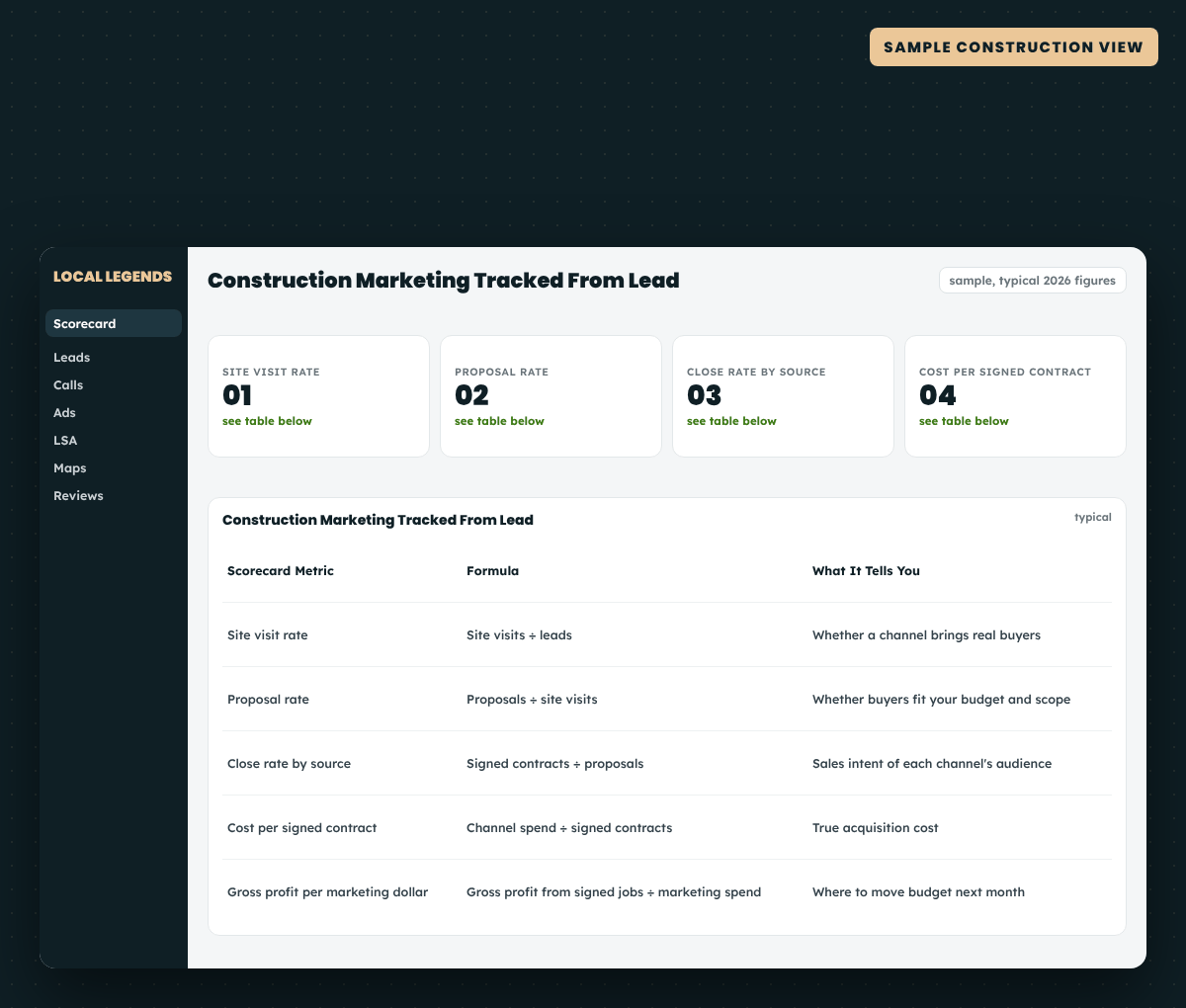
Construction marketing tracking ties every inquiry, from first call or form, to its site visit, its proposal and finally the contract amount it signed for. Impressions and clicks are where the story starts. Local Legends keeps reading past them to calls, site visits, sold jobs and cost per booked job.
CallRail numbers feed straight into Buildertrend or whichever CRM you run, including GoHighLevel, ServiceTitan, Housecall Pro, Jobber, JobNimbus and AccuLynx. Footprint clients see the scorecard monthly; Trailblazer clients and up see it weekly. More on our call tracking and CRM integration page.
How Do I Track Which Marketing Brings Construction Leads That Turn Into Signed Contracts in Buildertrend or My CRM?
A builder tracks which marketing brings signed contracts by capturing a locked lead source when the inquiry arrives, carrying it into the job record when the contract is signed, and reporting contract value by source. Google AI Mode and ChatGPT both described this closed loop in November 2026.
- Use a dropdown, not free text, for lead source: Google Ads, LSA, Google Business Profile, SEO, Facebook, architect referral, realtor referral, job site sign, home show.
- Lock an original lead source field so a later touch never erases what first brought the buyer in.
- Fill source automatically with hidden fields on web forms and a tracked number per channel.
- Make source mandatory on phone call-ins before anyone books a site visit.
- Carry source into the job when a lead converts to a project, then run revenue and profit by source.
- Record lost reasons, so you learn whether a channel brings tire kickers or just slow buyers.
- Judge on gross profit: ChatGPT said a $1 million contract is not always worth more than a $500,000 one.
| Scorecard Metric | Formula | What It Tells You |
|---|---|---|
| Site visit rate | Site visits ÷ leads | Whether a channel brings real buyers |
| Proposal rate | Proposals ÷ site visits | Whether buyers fit your budget and scope |
| Close rate by source | Signed contracts ÷ proposals | Sales intent of each channel's audience |
| Cost per signed contract | Channel spend ÷ signed contracts | True acquisition cost |
| Gross profit per marketing dollar | Gross profit from signed jobs ÷ marketing spend | Where to move budget next month |
Our Construction Marketing Process Audit First
Every Local Legends construction engagement opens with a growth audit covering tracking, local SEO, LSA and the sales funnel, because spending on ads before the leaks are found only pays for more leaks.
Step 1: Construction Growth Audit
We study how calls are tracked, how your Google Business Profile and LSA categories are set, how your project pages and intake form read, and where past contracts came from, then compare it all with the builders your buyers also interview.
Step 2: Tracking and Ownership
Before a dollar of new spend, each channel gets a tracked number, each form gets source fields and the CRM gets real pipeline stages. Everything lives in your accounts. On the Google Business Profile, Local Legends joins as an owner while you remain primary owner.
Step 3: Launch Search by Project Type
Custom homes, additions, ADUs and build-outs each get their own campaign, budget and landing page. LSA job types are trimmed to the work you want, and the LSA Ranker review texter starts asking finished clients for reviews.
Step 4: Build Proof and Nurture
Case studies, credential pages, financing pages and weekly profile posts add inquiries that cost nothing per click. Text and email nurture carries buyers who are still a year away.
Step 5: Read the Scorecard and Move Money
Your weekly project review and CMO + CEO meetings walk the scorecard and push budget toward whichever channel signs contracts cheapest. The Local Legends marketing course comes with every plan.
Construction Marketing Agency Led by a Founder Who Worked Job Sites Levi Ostlund Knows the Dirt
Levi Ostlund, who founded Local Legends Marketing, grew up on job sites: he knocked doors selling driveway work at 10, poured concrete beside his father and owned a landscaping business before he finished high school. Later he ran marketing as CMO of Amstill Roofing.
Bad marketers cost him $30,000+ along the way. One disappeared, and another delivered a good-looking website that never showed up on Google. Builders who work with Local Legends get the opposite: accounts in their own name and reports that stop only at the signed contract.
- 8+ years of contractor marketing behind every plan
- Your name on the website, ad accounts and Google Business Profile
- A weekly project review for every client
- An audit before any spend: tracking, local SEO, LSA and funnel
- Month to month, with no long-term contract
Builders sit alongside roofers, HVAC, plumbing, concrete and paving companies on our client list. Browse the industries we serve or see the Local Legends service areas nationwide.
Frequently Asked Questions About Construction Company Marketing Straight Answers for Builders
How Do I Get Construction Leads Without Buying Shared Leads?
Most residential builders get their best leads from Google search ads, the Google Business Profile, SEO project pages, past clients and referral partners. Shared lead marketplaces can fill gaps, but both AI platforms warned they sell one lead to several builders.
Do You Work With Production Builders?
Local Legends focuses on custom home builders, residential general contractors, design-build firms and addition, ADU and outdoor living contractors. Production builders selling planned communities need model home and community marketing, which Google AI Mode treated as a separate specialty.
Should I Charge for Design or Feasibility?
Many custom builders charge for a feasibility or design agreement and credit it to the contract. Google AI Mode cited paid design and feasibility agreements of about $1,500-$5,000+, which filter out buyers who are not ready.
Do You Market ADU Builders and Home Addition Contractors?
Yes. ADU and addition buyers search with more urgency than custom home planners, so Local Legends gives each its own campaigns, pages and cost guides.
How Long Does SEO Take for a Construction Company?
Construction SEO typically needs several months before inquiries arrive steadily, and Google AI Mode said 12 to 18+ months in competitive markets. Search ads keep the pipeline fed in the meantime.
What Ad Budget Should a General Contractor Start With?
ChatGPT suggested about $1,500-$3,000+ a month in ad spend for most residential general contractors, on top of agency fees. That media money goes to Google or Meta directly and never runs through our invoice.
Do You Work With Buildertrend and Other Construction CRMs?
Yes. Buildertrend is the most common CRM among builders we talk to, and GoHighLevel, ServiceTitan, Housecall Pro, Jobber, JobNimbus and AccuLynx work too, so the source on every contract survives the handoff from sales to production.
Will You Promise a Number of Signed Contracts?
No. Google's results are not ours to promise, and an agency that guarantees contracts before seeing your market is guessing. What we promise is a scorecard that shows exactly which spend turned into which contract.
What Happens to My Accounts If We Part Ways?
They were always yours. The domain, website, Google Business Profile, ad accounts and call recordings sit under your login from day one, plans run month to month, and leaving means nothing to hand back.
Reviewed by Levi Ostlund, Founder, Local Legends Marketing

Hire a Construction Company Marketing Agency That Counts Signed Contracts Book Your Construction Growth Audit
Builders who hire Local Legends Marketing own the whole machine: search ads, Local Services Ads, local SEO, case study websites, Facebook and Instagram ads and CRM-connected call tracking, with a scorecard that prices out every signed contract.
- Call:(936) 900-1248
- Office: 481 Stephen F Austin Dr, Conroe, TX 77302
- Next step: schedule the construction growth audit. Plans start at $2,500 a month, or $2,000 a month for Google Ads and LSA alone