


Sites That Book Inspections

Roofing Website Design That Turns Storm Searches, Replacement Shoppers and Leak Calls Into Booked Roof Inspections You Can Trace to a Signed Roof
Local Legends Marketing Roofing Websites From $2,500, Built by a Former Roofing CMO
Updated November 2026 · Reviewed by Levi Ostlund, Founder
Roofing website design is the planning, writing and building of a roofer's site so a homeowner with a leak, hail damage or a tired roof can see the work, trust the company and book an inspection in under a minute. Local Legends Marketing builds roofing websites around that one booking.
Local Legends charges a one-time fee by page count, from $2,500 for 10 pages up to $15,000 for 80, with no setup fees. Typical agencies charge $2,500-$50,000+ for a build. Call (936) 900-1248 for a roofing website audit.
- Inspection booking on every screen: a sticky call button, a two-step inspection form and a tracked number on every roofing page.
- Pages for the jobs that pay: roof replacement, storm damage, metal, repair and real town pages, each with its own photos and price range.
- Proof a homeowner can check: your crews, trucks, finished roofs, license number, warranty terms and review count, never stock photos.
- Booked and signed on the scorecard: calls and forms followed into JobNimbus or AccuLynx through booked inspections and signed roofs.
- Agency-reported proof: 25,000+ appointments generated and $30M+ in revenue influenced.
Free Growth Audit
Your Reviews, Radius and Response Rate vs the competitors beating you.
About Local Legends Marketing
A home service marketing agency headquartered in Conroe, Texas, with 8+ years of marketing experience, running Google Ads, Local Services Ads, local SEO, AI SEO, connected TV and review systems for contractors nationwide.
Roofing Company Websites Backed by Roofing CEOs Roofing Owners Who Went on Record
Three roofing company CEOs and one restoration CEO have recorded testimonials about working with Local Legends Marketing founder Levi Ostlund on the websites, ads and tracking that feed their sales teams.
| Roofing Website Proof Point | Local Legends Number |
|---|---|
| Appointments generated for contractors (agency-reported) | 25,000+ |
| Revenue influenced (agency-reported) | $30M+ |
| Roofing experience in-house | Founder was CMO of Amstill Roofing |
| Roofing website sizes | 10, 20, 40 or 80 pages |
| Setup fees | None |
| Long-term contracts | None |
Levi has been absolutely outstanding to work with over the years... His creativity, responsiveness, and deep understanding of our marketing strategy have made a huge impact.
 Brad Beldon
CEO, Roofing Company
How Roofing Website Design Differs From a Website for Any Other Trade A Driveway, a Phone and a Five-Figure Decision
A roofing website has to serve two very different visitors at once: the homeowner in the driveway after a storm with a phone in one hand, and the retail buyer comparing roofers for weeks before spending five figures.
Google AI Mode framed roofing website design in November 2026 around a five-second test: where you work, why to trust you and how to get an inspection, all before the visitor thumbs back to the results. ChatGPT called the right site an inspection-booking machine.
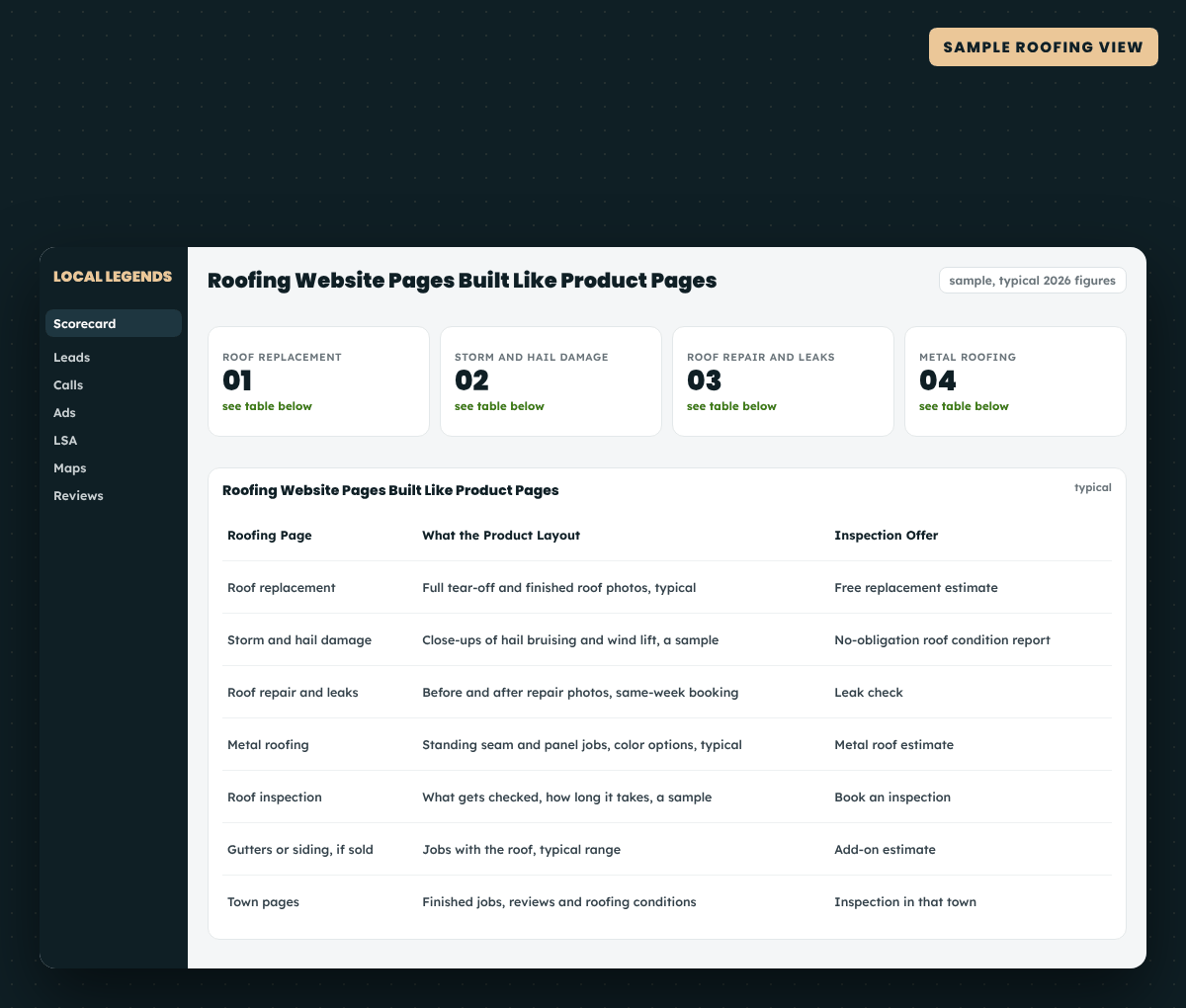
| Roofing Website Pressure (Typical) | What the Design Has to Do |
|---|---|
| Storm weeks bring a burst of mobile visits within days | Stay fast while traffic spikes on cheap shared servers would stall |
| Leak and hail visitors are anxious and on a phone | Put tap-to-call and a short form on the very first screen |
| Retail replacement buyers research for weeks | Show price ranges, materials, financing and warranty terms in writing |
| Out-of-town storm crews borrow local wording | Show a street address, license number and your own crew photos |
| Several states treat a website as advertising for insurance work | Describe damage documentation, never promise a claim result |
| Roof photos come off phones as huge files | Compress images so the gallery stays and the speed stays |
| Most roofing leads phone in instead of filling forms | Put a tracked number on every page, tied to the CRM |
Repair Visitors vs Replacement Visitors
A visitor with water in the ceiling wants a phone number and a same-week visit. A visitor shopping for a new roof wants photos of finished jobs, material choices and a sense of cost. One home page cannot serve both, so each gets its own page and its own offer.
Storm Traffic Hits Weak Hosting First
The week a hail line crosses your towns is the week a slow server freezes. Ask any designer how the hosting, image weight and scripts handle that spike, because a site that loads in calm weather and stalls during the storm loses the calls that matter most.
What Do the Best Roofing Company Websites Have in Common?
The best roofing company websites share real job photos, trust proof beside every button, one page per roofing service and one clear inspection offer. Google AI Mode and ChatGPT drew the same line in November 2026: average roofer sites describe a company, while the best ones prove it on the first screen.
| Average Roofing Website | Top Roofing Website |
|---|---|
| "Welcome to our roofing company" headline | Headline naming the job, the towns and the inspection offer |
| Stock photos of models in clean hard hats | Your crews, wrapped trucks and finished roofs in your towns |
| One "Services" page with a bullet list | A page for replacement, repair, storm, metal and inspections |
| Typed-in testimonials signed "John D." | Live Google review feed with names, dates and stars |
| Contact Us, Learn More and Get a Quote fighting for clicks | One inspection offer repeated in the header, hero, middle and footer |
| Long contact form on a separate page | A short form and a call button on every page |
| A review that sits far from any project | A review placed beside the matching finished roof |
The Roofing Website Inspection Booking Path From First Tap to Booked
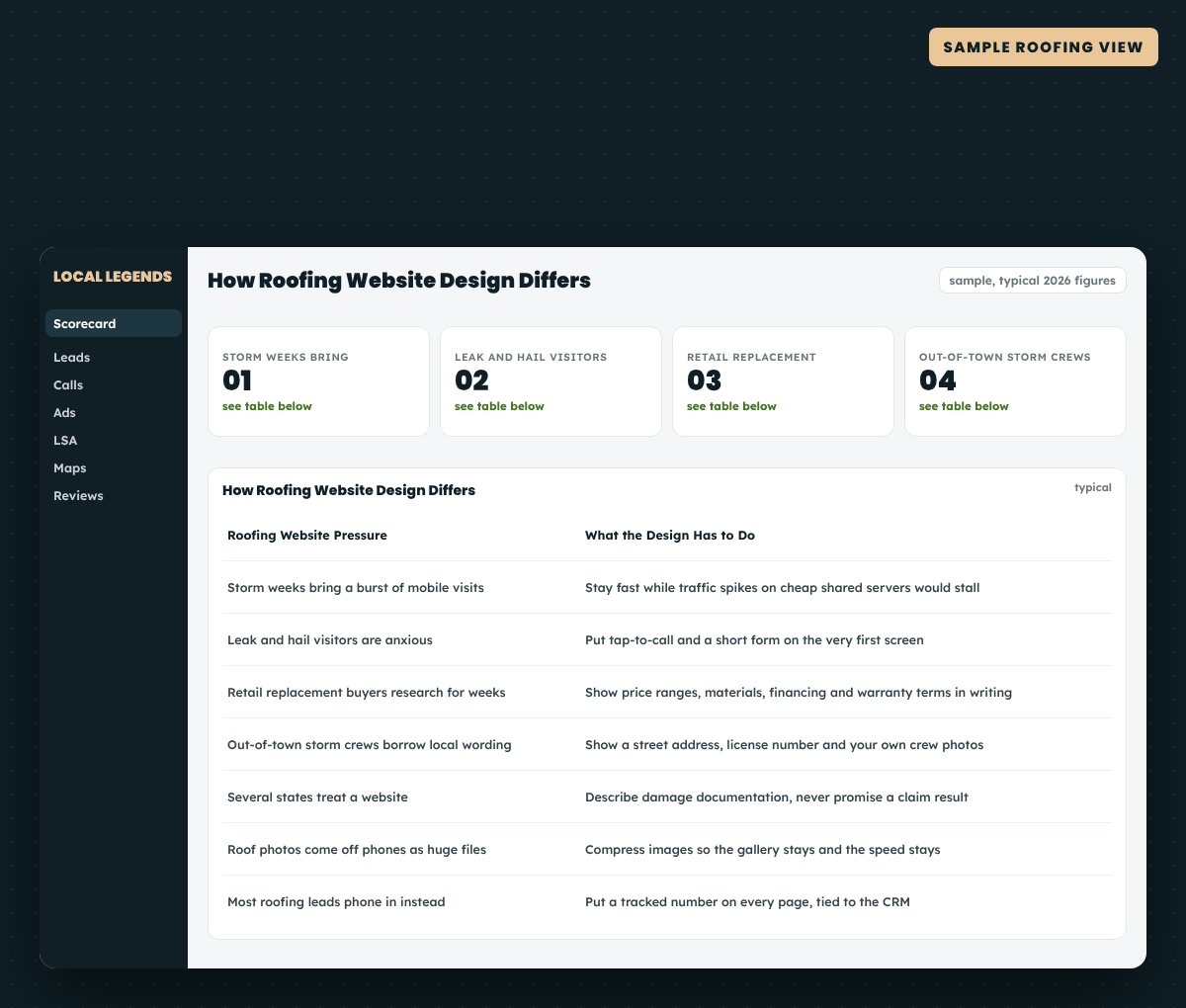
The inspection booking path is the short route a homeowner takes from landing on a roofing page to holding a confirmed inspection time, and every extra field, click or wait along that route costs booked roofs.
| Booking Step | What the Homeowner Sees | What Should Happen Behind It |
|---|---|---|
| 1. First screen | The job, the towns, the star rating and a Book Free Inspection button | Sticky header on desktop, pinned call bar on phones |
| 2. Form step one | Name, phone and the roof problem | Phone captured first so a half-finished form still gets a call back |
| 3. Form step two | Property address, preferred day and an optional photo upload | The address roofers need plus photos of missing shingles or ceiling stains |
| 4. Confirmation | A message that says when the office will call | Instant text and email to the homeowner, alert to your office |
| 5. Office follow-up | A call within minutes, not hours | Lead lands in JobNimbus or AccuLynx with its source attached |
| 6. Reminder | A text the day before the visit | Fewer no-shows on the inspection calendar |
Two Steps or One Short Form?
Google AI Mode recommended a two-step form with the phone number first. ChatGPT preferred one short form with name, phone, ZIP and roof issue. Test both on your own site and keep whichever books more inspections in your market.
Online Scheduling or a Fast Callback?
ChatGPT told roofers to let homeowners pick a real open time instead of sending a generic request. That works when the calendar is kept current. If your estimators book by phone, a two-minute callback promise usually beats a scheduler nobody updates.
What Should My Roofing Company Website Include to Get More Booked Roof Inspections From Homeowners?
A roofing company website books more inspections when it pairs a low-pressure inspection offer with proof, a short form and separate pages for each roofing job. Both AI platforms listed nearly the same must-haves in November 2026.
- An inspection page of its own: what gets checked, whether it is free, how long it takes and the photo report the homeowner receives.
- A sticky call button and a Book Inspection button on every page, pinned to the bottom of the phone screen.
- Optional roof photo upload so the homeowner can show a leak, a missing shingle or a ceiling stain before the visit.
- Separate pages for roof replacement, roof repair, storm and hail damage, metal roofing and inspections.
- A project gallery sorted by town and roof type, with a short caption naming the material and the neighborhood.
- A trust bar under the headline: review count, license number, insurance, manufacturer certifications you hold and warranty years.
- Automatic texts: booking confirmation, a reminder the day before and a follow-up after the inspection.
Roofing Website Pages Built Like Product Pages Every Money Page Sells the Inspection
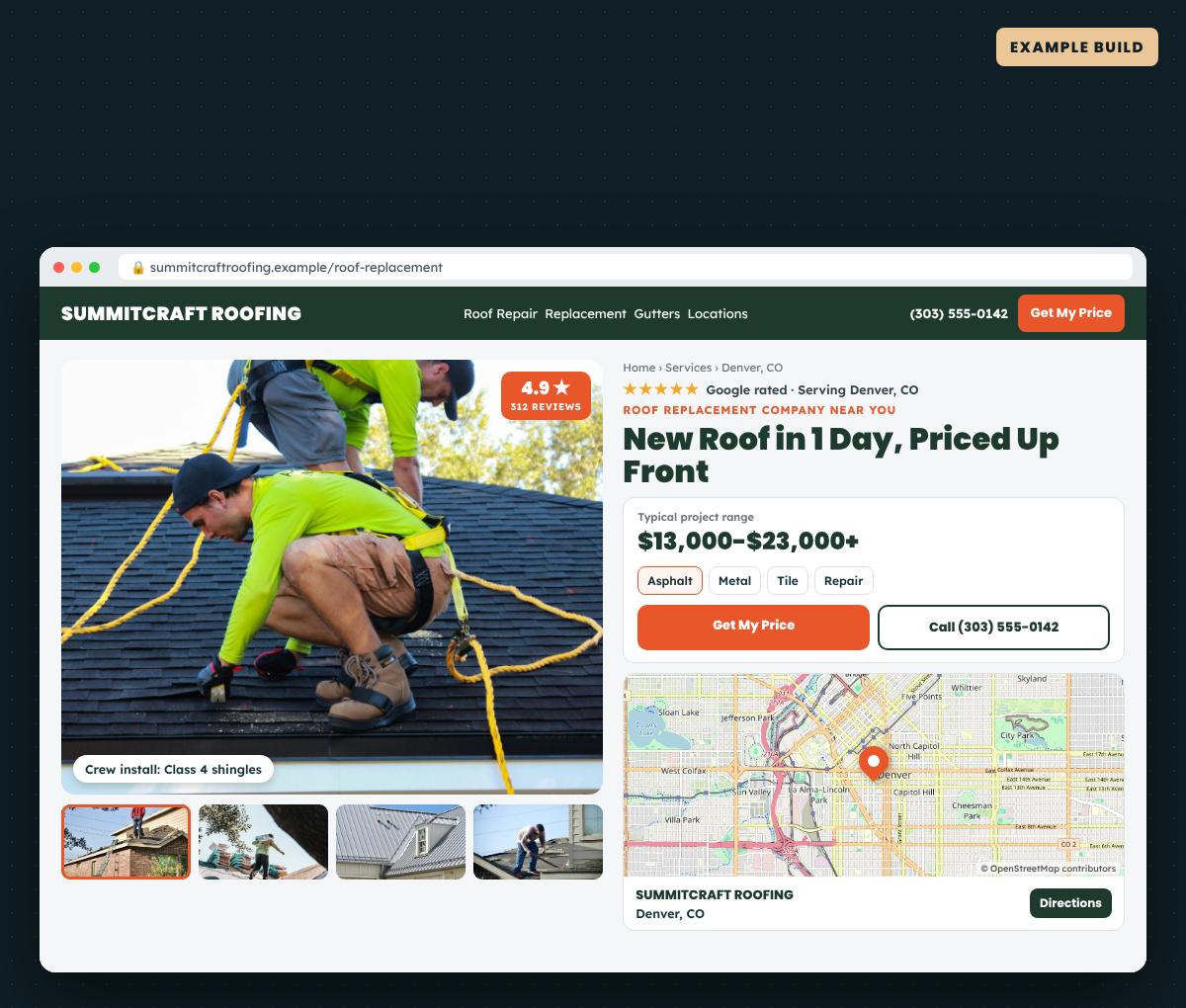
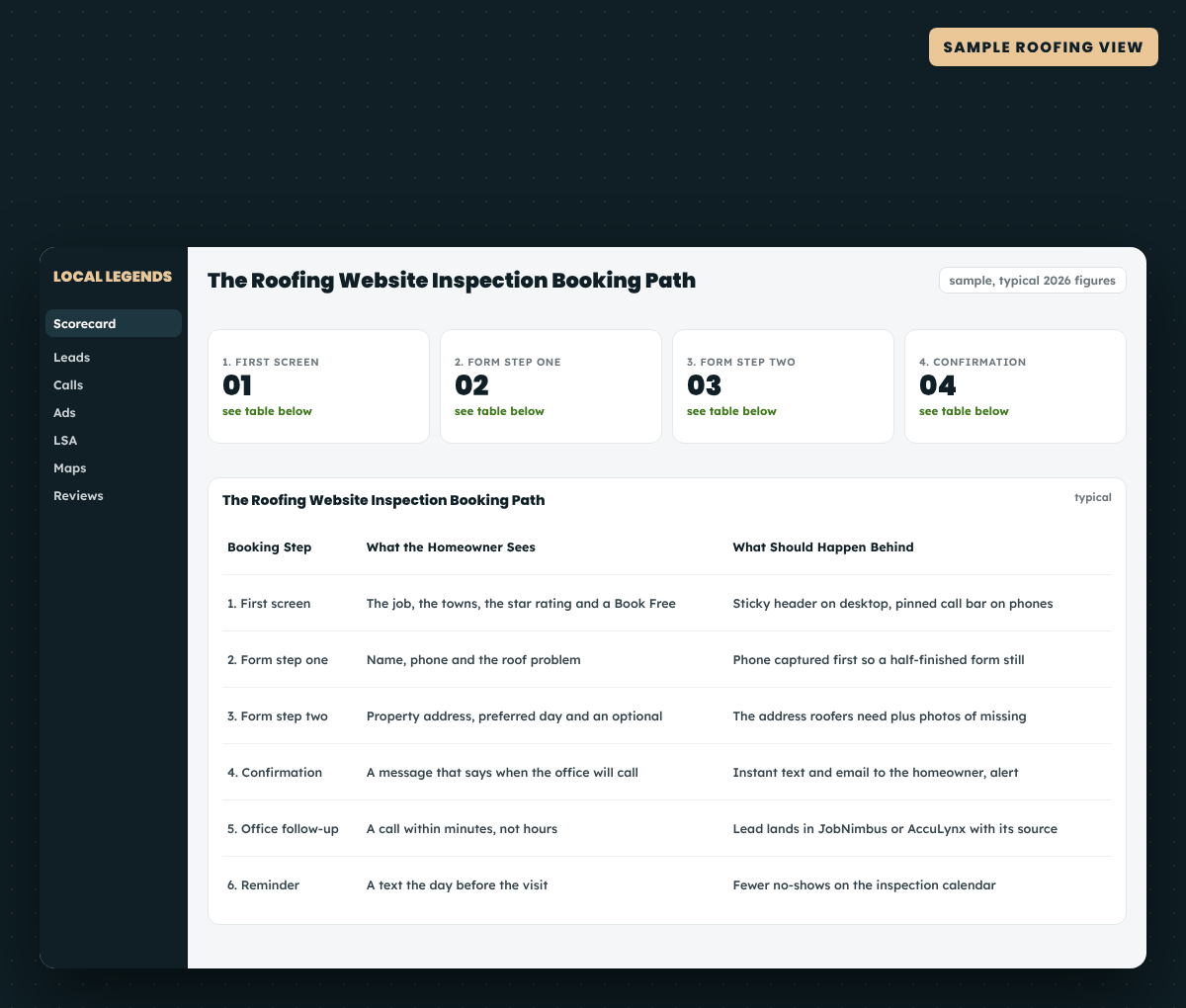
Every Local Legends roofing money page follows the product-page layout: real roof photos fill the left column, while the right column holds a typical price range, shingle or metal choices, the call button and the inspection form. On a phone the photos lead and the call bar stays pinned.
| Roofing Page | What the Product Layout Shows | Inspection Offer on That Page |
|---|---|---|
| Roof replacement | Full tear-off and finished roof photos, typical range, shingle, metal and tile options, financing | Free replacement estimate |
| Storm and hail damage | Close-ups of hail bruising and wind lift, a sample photo report | No-obligation roof condition report |
| Roof repair and leaks | Before and after repair photos, same-week booking | Leak check |
| Metal roofing | Standing seam and panel jobs, color options, typical range | Metal roof estimate |
| Roof inspection | What gets checked, how long it takes, a sample report | Book an inspection |
| Gutters or siding, if sold | Jobs with the roof, typical range | Add-on estimate |
| Town pages | Finished jobs, reviews and roofing conditions in that town | Inspection in that town |
What Goes Into a Roofing Website by Size
| Website Size | Pages a Roofer Usually Gets |
|---|---|
| 10 pages | Home, roof replacement, roof repair, storm damage, roof inspection, one material page, gallery, reviews, about, contact |
| 20 pages | Adds metal, flat or tile pages, financing, gutters, a cost guide and 4 to 6 town pages |
| 40 pages | Adds commercial roofing, more material pages, an insurance process guide and 15 or more town pages |
| 80 pages | Built for several offices or a region, with town pages for each office's area |
Should My Roofing Website Have a Separate Page for Every Town I Serve?
A roofing website should have separate pages only for the towns where you already have jobs, reviews and real local facts to show. ChatGPT suggested starting with your best 5 to 10 towns, and Google AI Mode said the rest can sit on one service area page.
- Run the swap test: if you can trade the town name for another and the page stays true, Google AI Mode calls it a doorway page.
- Rank towns by real work: past jobs, revenue, distance your crews will drive and the reviews you have there.
- Fill each page with that town: finished roofs, local reviews, common roof types and the local permit office.
- Link both ways: service pages link to their towns and town pages link back to the services.
- Never swap text by visitor location: pages that rewrite themselves by IP address look like spam.
Our local SEO team builds the Google Business Profile and citation work those town pages need.
Storm Damage and Insurance Wording on a Roofing Website Document the Damage, Never Sell the Claim
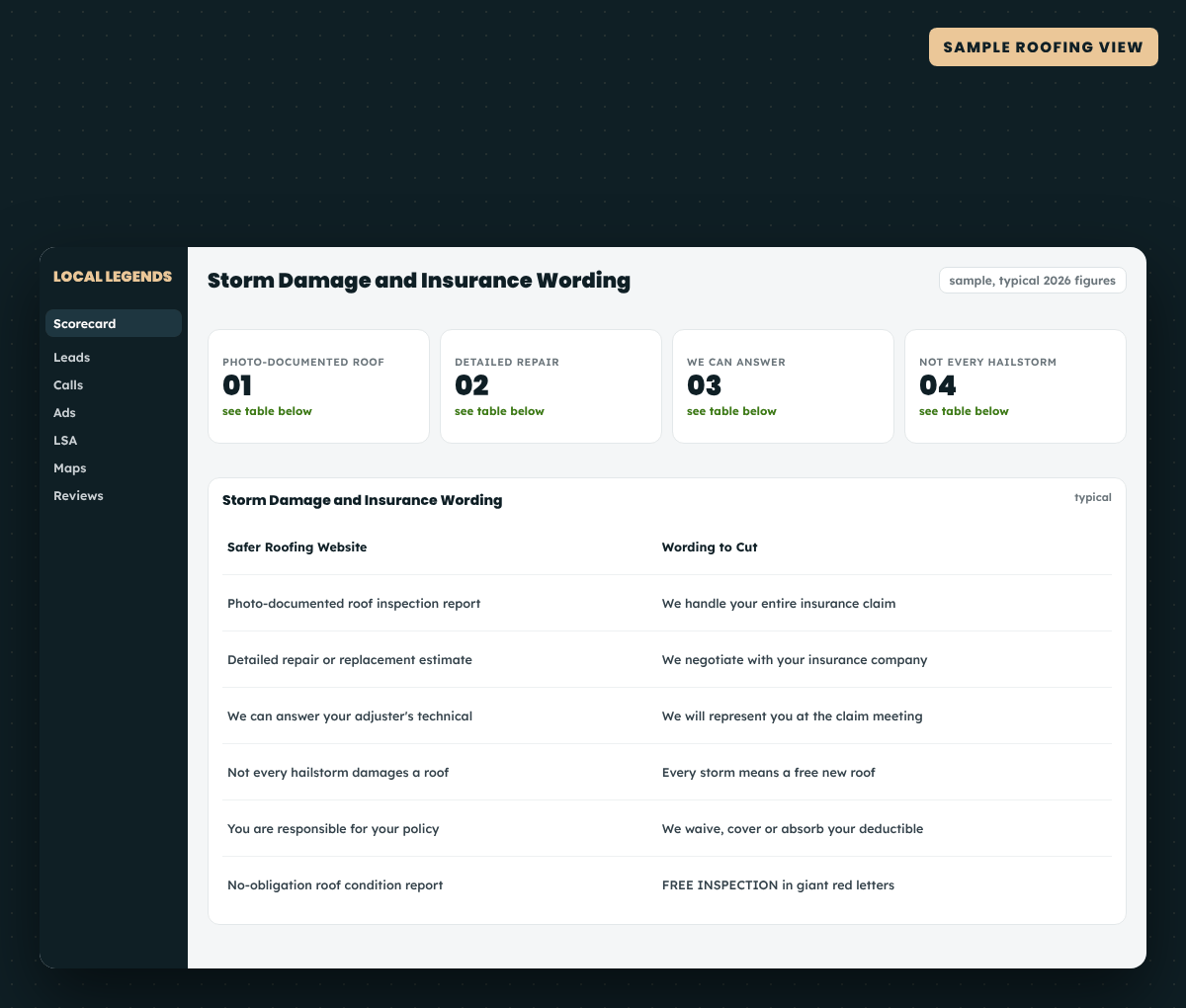
Storm damage pages bring a roofing website its biggest bursts of calls, and they also carry the most legal risk, because several states treat roofing website copy as advertising for insurance work.
The Texas Department of Insurance says a website counts as an advertisement, a roofer may not act as a public adjuster or advertise to adjust claims, and offering to waive or absorb a deductible is illegal.
Florida's 2022 law requires deductible disclosures on ads that urge homeowners to call about a roof claim.
How Should My Roofing Website Talk About Storm Damage, Hail Inspections and Insurance Claims Without Breaking State Rules or Looking Like a Storm Chaser?
A roofing website should present storm work as honest damage documentation and quality repair, and leave claim decisions to the homeowner and the insurer. ChatGPT and Google AI Mode both drew that line in November 2026 and listed the same risky phrases.
| Safer Roofing Website Wording | Wording to Cut |
|---|---|
| Photo-documented roof inspection report | We handle your entire insurance claim |
| Detailed repair or replacement estimate | We negotiate with your insurance company |
| We can answer your adjuster's technical questions about our findings | We will represent you at the claim meeting |
| Not every hailstorm damages a roof | Every storm means a free new roof |
| You are responsible for your policy deductible | We waive, cover or absorb your deductible |
| No-obligation roof condition report | FREE INSPECTION in giant red letters |
Local Proof Storm Chasers Cannot Copy
- A real street address on every page footer, not a P.O. box.
- Your state license or registration number where your state issues one, on the contact page and storm page.
- Crew and truck photos taken in your towns, with the company name visible.
- A calm, no-pressure section explaining written estimates and no door-knock pressure.
- Years in your market and the warranty you will be around to honor.
Write storm copy to fit your state's rules, and check every claim-related line with your own attorney or state regulator.
Should a Roofing Website Show Roof Replacement Prices or an Instant Roof Quote? Show a Range, Explain the Swing
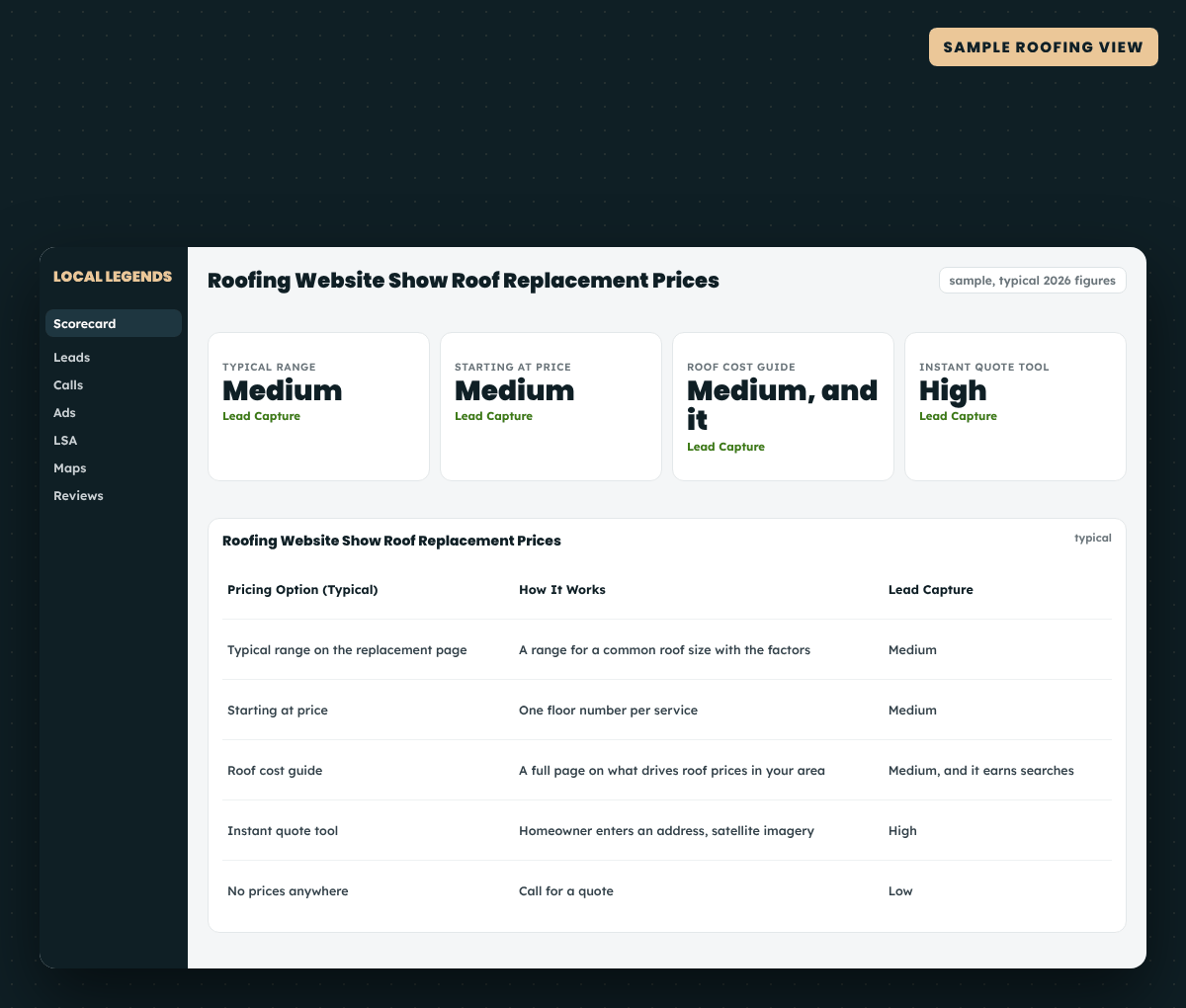
Yes, most roofing websites should show a typical roof replacement price range, and an instant quote tool helps when the office can call back fast. Google AI Mode and ChatGPT both said yes in November 2026, and both warned to label every number as a ballpark, not a bid.
Both platforms said a labeled ballpark range tends to bring in more homeowners than a page that hides price completely, as long as it explains what moves the number.
| Pricing Option (Typical) | How It Works | Lead Capture | Watch Out For |
|---|---|---|---|
| Typical range on the replacement page | A range for a common roof size with the factors that move it | Medium | Update it when material prices shift |
| "Starting at" price | One floor number per service | Medium | Feels like bait if most jobs land far above it |
| Roof cost guide | A full page on what drives roof prices in your area | Medium, and it earns searches | Needs real ranges, not national averages |
| Instant quote tool | Homeowner enters an address, satellite imagery measures the roof, a range appears | High | Monthly software fee and estimates that can miss decking and layers |
| No prices anywhere | "Call for a quote" | Low | Shoppers leave to find a number elsewhere |
What Moves a Roof Price, and Should Say So on the Page
- Roof size and pitch: more squares and steeper slopes mean more labor and safety gear.
- Layers to tear off: a second or third layer of old shingles adds disposal and labor.
- Decking condition: rotted plywood is invisible until the old roof comes off.
- Material: architectural shingles, metal and tile sit in very different ranges.
- Ventilation, flashing and access: chimneys, skylights and tight lots add time.
Gate the Number or Show It?
Google AI Mode said to ask for contact details before showing an instant quote. ChatGPT said to show value first and avoid forcing a phone number. Local Legends usually shows the typical range freely and asks for contact details only for the address-based estimate.
Why Does My Roofing Website Look Nice but Barely Get Calls or Inspection Requests? Usually a Conversion Problem, Sometimes a Measurement Problem
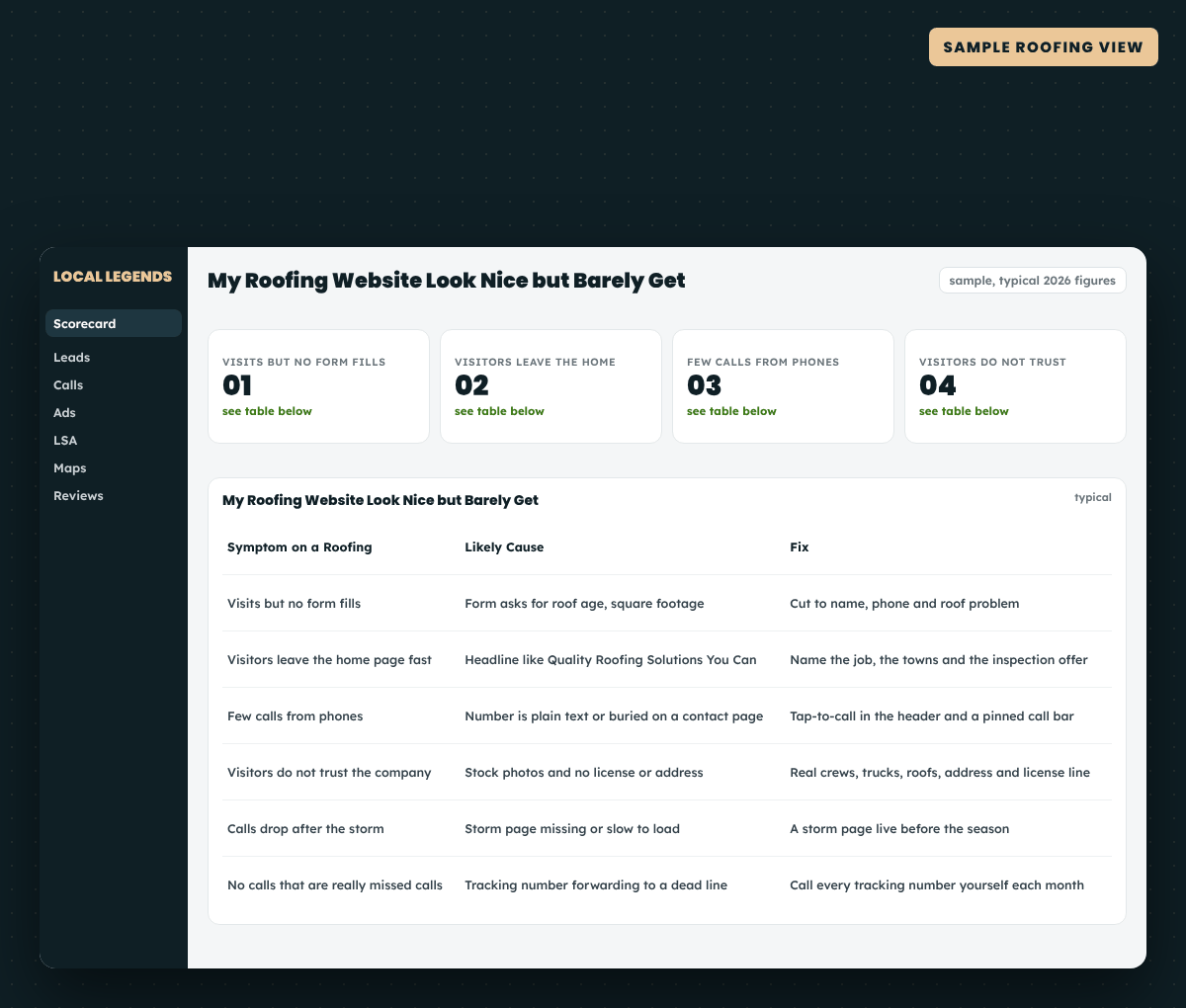
A roofing website that looks nice but stays quiet usually hides the next step, asks for too much, or never earns trust on the first screen. ChatGPT and Google AI Mode both called it a conversion problem in November 2026, and both said most sites can be fixed without a full rebuild.
| Symptom on a Roofing Website | Likely Cause | Fix |
|---|---|---|
| Visits but no form fills | Form asks for roof age, square footage and a timeline | Cut to name, phone and roof problem |
| Visitors leave the home page fast | Headline like "Quality Roofing Solutions You Can Trust" | Name the job, the towns and the inspection offer |
| Few calls from phones | Number is plain text or buried on a contact page | Tap-to-call in the header and a pinned call bar |
| Visitors do not trust the company | Stock photos and no license or address | Real crews, trucks, roofs, address and license line |
| Calls drop after the storm | Storm page missing or slow to load | A storm page live before the season |
| "No calls" that are really missed calls | Tracking number forwarding to a dead line | Call every tracking number yourself each month |
One source Google AI Mode cited put it bluntly: a roofing site with traffic and no calls is often a measurement problem dressed up as a design problem. Check the tracking before you blame the layout.
How Fast Should a Roofing Website Load on a Phone, and What Usually Slows It Down?
A roofing website should put its headline and main photo on a phone screen in about 2.5 seconds or less, Google's "good" line for the main content, and ChatGPT aimed for under 2 seconds. Roofing sites miss that more often than most because of their photos.
- Raw phone photos: uploading gallery shots straight off a phone loads huge files; resize and save them as WebP.
- Missing image sizes: when photos pop in late, the page jumps and the homeowner taps the wrong button.
- Sliders, drone video backgrounds and pop-ups: pretty, heavy and rarely tapped.
- Too many scripts: chat, maps, review widgets, pixels and storm maps that load before the call button.
- Cheap shared hosting: fine on a calm Tuesday, frozen the day after hail.
- Test the right pages: home, roof replacement, storm damage and the inspection page, on mobile data.
Who Is the Best Roofing Website Design Company for a Residential Roofer? The One That Counts Booked Inspections, Not Page Views
The best roofing website design company builds pages for every roofing job and town you sell, tracks calls into your CRM and puts the site and domain in your name. ChatGPT and Google AI Mode used those tests in November 2026 before naming any agency.
ChatGPT warned an owner not to confuse website traffic with booked inspections. Hold every designer to that rule, Local Legends Marketing included, and ask to see booked inspections from live roofing sites.
| What AI Platforms Told Roofers to Require | Local Legends Marketing Proof |
|---|---|
| Built to book inspections, not to win design awards | Product-page layout with the call button and inspection form in the first screen |
| Separate repair, replacement and storm pages | Planned into every website size |
| Real town pages, not copies | Town pages only where you have jobs and reviews |
| Forms and calls flowing into the CRM | CallRail into JobNimbus, AccuLynx or your CRM |
| You own the site, domain and content | Everything stays in your name |
| Roofing experience | Founder was CMO of Amstill Roofing, roofing CEO testimonials |
| No lock-in | No long-term contracts and no setup fees |
Should a Roofing Company Use a Website Builder, a Roofing Template Subscription or an Agency-Built Website?
A brand-new one-truck roofer can start on a website builder, but a roofer who wants Google calls in several towns usually needs a built site it owns. ChatGPT and Google AI Mode agreed on the trade-offs and disagreed only on where subscriptions fit.
| Option (Typical, 2026) | Typical Cost | Typical Launch | Who Owns It | The Catch |
|---|---|---|---|---|
| DIY website builder | $17-$60+ a month plus your time | Days to weeks | You, but you are tied to the platform | You write it all, and town pages rarely get built |
| Roofing template subscription | $99-$499+ a month | 1 to 3 days | Usually the provider | The same words may sit on a roofer two towns over |
| One-page funnel site | Low | Days | Varies | Good for ads, almost never ranks for many jobs and towns |
| Agency or Local Legends build | $2,500-$15,000+ one time at Local Legends | Weeks | You | Higher upfront cost |
Questions to Ask Any Roofing Website Designer
- Show me three live roofing sites and the booked inspections they produced last month.
- Whose name is on the domain registration? It should be your company's.
- Will my storm and replacement pages be written for my towns or copied from another roofer's site?
- How do form leads reach JobNimbus or AccuLynx, and what happens to the tracking numbers if I leave?
- Do you build for another roofer in my towns? Ask before you sign.
How Much Does a Roofing Company Website Cost in 2026? Typical Builds Run $3,000-$12,000+
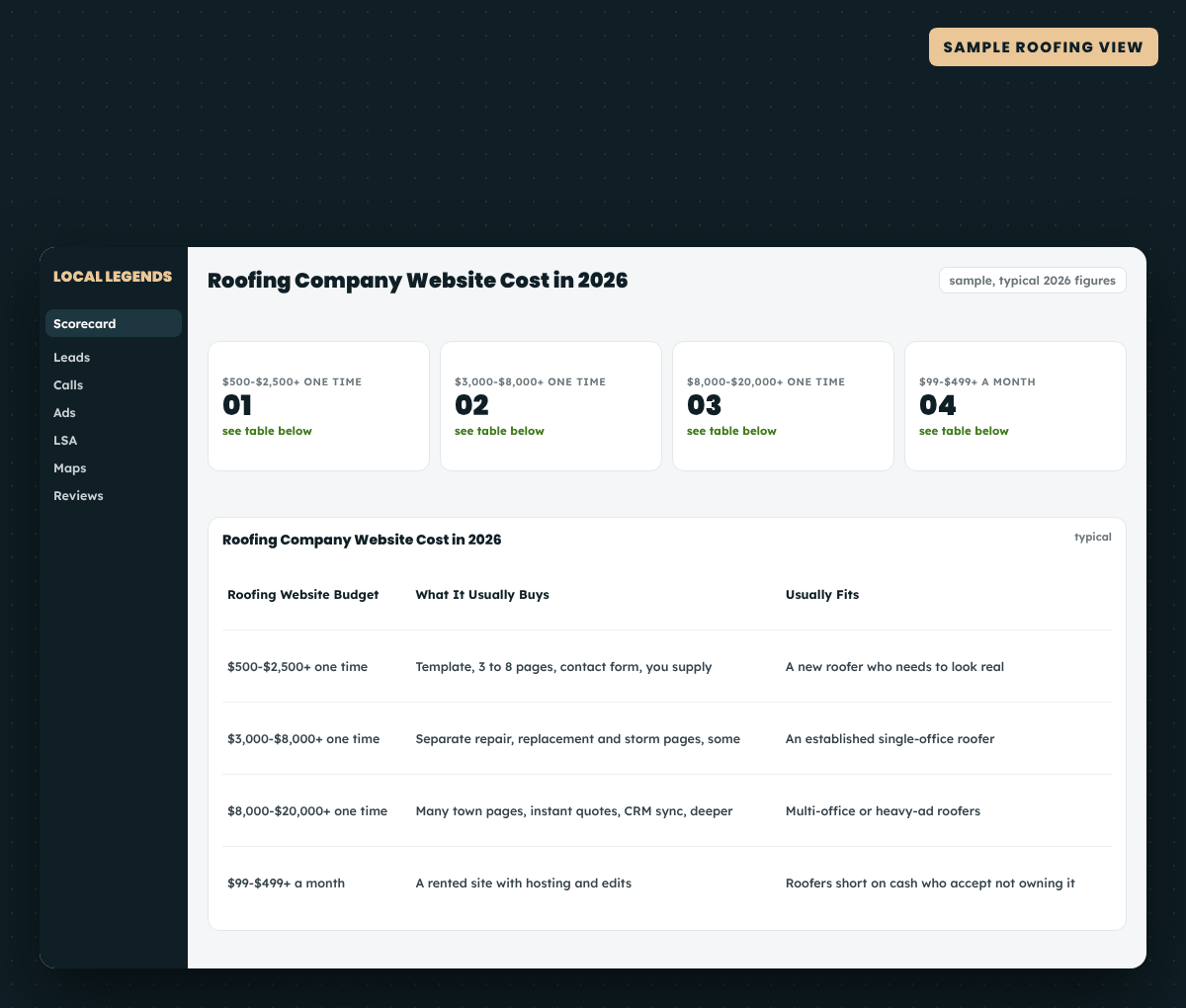
A roofing company website typically costs $3,000-$12,000+ for a one-time professional build in 2026, or $99-$499+ a month on a subscription you usually do not own. Google AI Mode and ChatGPT both landed in those ranges in November 2026.
| Roofing Website Budget (Typical, 2026) | What It Usually Buys | Usually Fits |
|---|---|---|
| $500-$2,500+ one time | Template, 3 to 8 pages, contact form, you supply text and photos | A new roofer who needs to look real |
| $3,000-$8,000+ one time | Separate repair, replacement and storm pages, some town pages, review feed | An established single-office roofer |
| $8,000-$20,000+ one time | Many town pages, instant quotes, CRM sync, deeper content | Multi-office or heavy-ad roofers |
| $99-$499+ a month | A rented site with hosting and edits | Roofers short on cash who accept not owning it |
ChatGPT warned against paying $15,000 just because an agency calls a site custom. Google AI Mode added hosting at $15-$50+ a month and a domain at $10-$20+ a year as the costs to ask about on any quote.
Local Legends Roofing Website Prices
Local Legends Marketing builds roofing websites for a one-time fee by page count, with no setup fees and no long-term contracts.
| Local Legends Roofing Website | One-Time Price | Usually Fits |
|---|---|---|
| 10 pages | $2,500 | One office, core roofing services |
| 20 pages | $5,500 | Core services plus the best 4 to 6 towns |
| 40 pages | $7,500 | Residential and commercial, many towns |
| 80 pages | $15,000 | Several offices or a whole region |
Local Legends Pricing vs What Other Agencies Typically Charge
| Service | Local Legends Price | What Other Agencies Typically Charge |
|---|---|---|
| Roofing website build | $2,500-$15,000+ one time | $2,500-$50,000+ |
| Website rental or subscription | One-time build price, you own the site | $99-$499+ a month |
| Growth plan that keeps adding roofing pages | $2,500-$10,000+ a month, 10 to 100 pages or blogs a month | $2,500-$10,000+ a month full service |
| Google Ads + Local Services Ads management | $2,000 a month flat | $1,500-$2,500+ a month or 15% to 20% of spend |
| Setup fees | None | Often charged |
Every plan and add-on is listed on the Local Legends pricing page.
If I Cancel My Monthly Roofing Website Plan, Do I Lose the Website and Domain?
If you cancel a rented roofing website, the site usually goes offline, and the domain goes with it when the provider registered it in its own account. ChatGPT and Google AI Mode both said paying monthly does not mean you own the site.
- Look up your domain registration and confirm your company is the registrant and you have the login.
- Get your own admin login to the website, not just view access.
- Ask for a full copy of every page, photo and review before you cancel.
- Make yourself owner of Google Analytics, Search Console and your Google Business Profile.
- Read the contract for ownership, buyout and transfer terms, and get answers in writing.
- Move tracking numbers and call recordings into accounts you control.
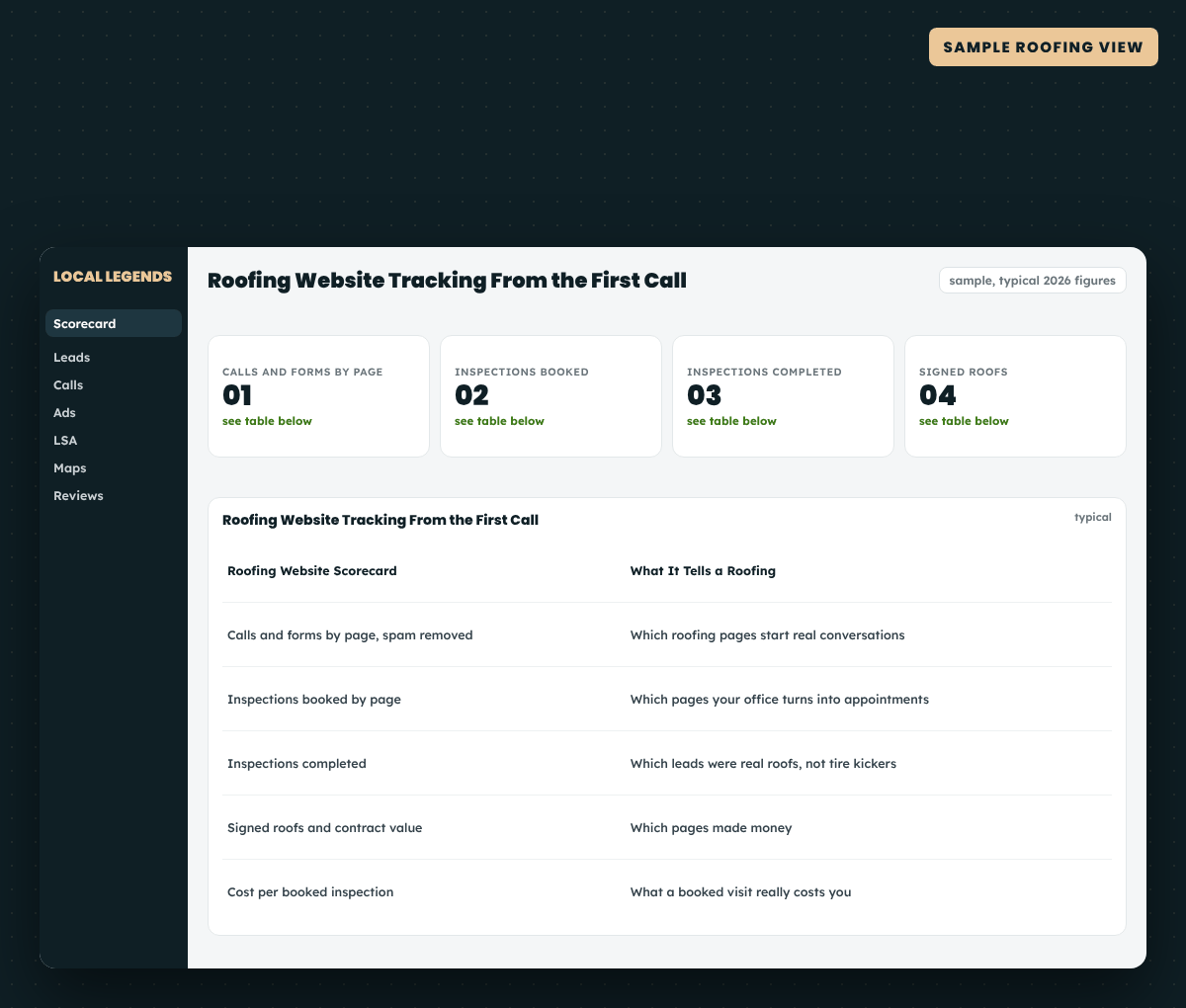
Roofing Website Tracking From the First Call to the Signed Roof The Lead Source Rides Along to the Contract
Roofing website tracking ties every call and form to the page and channel that produced it, then follows that lead through the booked inspection to the signed roof. Visits and rankings are chapter one; the contract is the ending.
| Roofing Website Scorecard Line | What It Tells a Roofing Owner |
|---|---|
| Calls and forms by page, spam removed | Which roofing pages start real conversations |
| Inspections booked by page | Which pages your office turns into appointments |
| Inspections completed | Which leads were real roofs, not tire kickers |
| Signed roofs and contract value | Which pages made money |
| Cost per booked inspection | What a booked visit really costs you |
How Do I Track Which Roofing Website Leads Become Booked Inspections and Signed Roofs in JobNimbus or AccuLynx?
Track roofing website leads by tagging every call and form with its source the moment it arrives, sending it into JobNimbus or AccuLynx, and never letting that source change as the job moves. Both AI platforms gave the same plan in November 2026.
- Tracking numbers that swap by source: organic, Google Ads, Maps and social visitors each see their own number, all ringing your office.
- Hidden form fields that store the source, campaign and landing page with every inspection request.
- A call tracking connection into the CRM: JobNimbus has a CallRail connection, and AccuLynx connects through its own add-on or a connector.
- Matching repeat callers by phone and email so one homeowner does not count as three leads.
- Pipeline stages that mean something: new lead, contacted, inspection booked, inspected, estimate sent, signed, lost.
- A scorecard review monthly on Footprint and weekly from Trailblazer up.
Call tracking is part of every Local Legends growth plan. See our call tracking and CRM integration page for the full wiring.
Roofing Websites That Google and AI Answers Can Read Plain Facts Beat Clever Copy
A roofing website that Google and AI answers can read states its services, towns, credentials and prices in plain text, near the top of each page, in words a homeowner would use. Badges and slogans inside images are invisible to most of them.
- Answer first: each roofing page opens with the service, the town and a typical price range in two sentences.
- Questions as headers:"How much does a roof replacement cost in [town]?" with a stand-alone answer under it.
- RoofingContractor schema with your address, phone, hours and service area.
- Credentials in text: license number, insurance, manufacturer certifications you hold and warranty years.
- Crawlers allowed: ChatGPT and Google AI Mode both said to make sure the site does not block OpenAI's search crawler.
How Do I Get My Roofing Website Recommended by ChatGPT and Google AI Overviews?
A roofing company gets recommended by ChatGPT and Google AI Overviews when its website, Google Business Profile and outside listings all tell the same verifiable story. Google AI Mode said an AI tool sees a brand that exists only on its own website as a risk.
| AI Recommendation Signal | Website Job | Off-Site Job |
|---|---|---|
| Who you are and where you work | Same name, address and phone on every page | Same details on every directory |
| What you do best | One page per roofing service and town | Google Business Profile services and categories |
| Proof | Reviews, crews, finished roofs and credentials in text | Reviews that name the job and the town |
| Fresh facts | Updated lines and dated prices | Recent reviews and profile posts |
| Outside trust | Earned mentions linked from your about page | Manufacturer installer directories, BBB, chamber listings |
AI citation work is part of the Sasquatch plan and up. See our AI SEO page for how it runs.
Roofing Website Redesigns and Launch Timing Launch Before the Hail
A roofing website redesign should keep every page that already brings calls and go live weeks before storm season, because a new site needs time to be crawled and a broken redirect in hail week costs real roofs.
How Do I Redesign My Roofing Website Without Losing My Google Rankings and the Calls I Get Now?
Redesign a roofing website without losing rankings by keeping the URLs and copy of the pages that bring calls, redirecting every changed URL to its closest match, and keeping your tracking numbers working on launch day. ChatGPT and Google AI Mode gave roofers the same order of steps.
- Find the call pages first: pull Search Console and call tracking data; the busiest page is not always the one that books roofs.
- Keep the roof replacement, storm and town URLs that rank, and carry their best paragraphs and photos forward.
- Map a 301 redirect from every old roofing URL that changes to the closest new page.
- Keep the business name unchanged on your Google Business Profile during the redesign, and point it at the right page.
- Carry call tracking scripts and numbers over, then call each one after launch.
- Watch Search Console daily for 30 days for missing pages and dropped calls.
How Long Does It Take to Build a New Roofing Website, and What Do I Need to Give the Designer Before Storm Season?
A new roofing website usually takes 4 to 8 weeks with a designer or agency, and the biggest delay is waiting on the roofer's photos, prices and approvals. ChatGPT planned 3 to 6 weeks plus a buffer, and said rankings take months beyond launch.
| Roofing Website Build Stage (Typical) | Typical Time |
|---|---|
| Audit and page plan | About 1 week |
| Design and writing | 1 to 3 weeks |
| Build, forms and tracking | 1 to 2 weeks |
| Review, fixes and launch | About 1 week |
| Indexing and first rankings | Weeks to months after launch |
- Logins: domain registrar, current website, Google Business Profile and call tracking.
- Business facts: legal name, address, phone, license number, years in business and every town you serve.
- Photos: finished roofs, before and after shots, crews and trucks, named by roof type and town.
- Services and prices: the jobs you want more of and a typical range for each.
- Proof: warranty terms, manufacturer certifications you hold and 5 to 10 favorite reviews.
Our Roofing Website Design Process Audit First
The Local Legends roofing website design process starts with an audit of what your current site, tracking and Google Business Profile already earn, then plans every page before a single headline is written.
Step 1: Roofing Website Audit
Local Legends reviews your pages, speed, forms, tracking numbers, Search Console data and Google Maps rank grids across your towns, so the new site is planned around where you show up and where you do not.
Step 2: Page Map and Booking Path
Roof replacement, storm, repair, material, inspection and town pages get mapped to the jobs you want, along with the inspection offer, form steps and follow-up texts for each.
Step 3: Research and Writing
Each roofing page is researched live on Google, Google AI Mode and ChatGPT for the questions homeowners ask in your towns, then written with your photos, price ranges and credentials.
Step 4: Build, Redirects and Launch
Pages go into the product-page layout, with schema, compressed galleries, call tracking and CRM connections. Redirects, forms and every tracking number are tested on launch day.
Step 5: Track and Keep Building
Booked inspections and signed roofs land on the scorecard. Growth plans keep adding roofing pages every month, a weekly project review keeps it moving, and every engagement includes the Local Legends marketing course.
The full roofing channel mix lives on our roofing marketing page, and builds for every trade live on our contractor website design page.
Roofer Websites Built by a Former Roofing CMO Levi Paid for a Dead Website
Local Legends Marketing founder Levi Ostlund ran marketing from inside a roofing company as CMO of Amstill Roofing, so he has watched what a roofing website does to the phones from the side that pays for it.
Before the agency, Levi lost $30,000+ to marketers. One disappeared, and another handed him a good-looking website that never showed up on Google, which is exactly what this page is built to prevent for roofers.
- Former CMO of Amstill Roofing
- 8+ years marketing home service contractors
- Every account in the roofer's name: domain, website, profile and call data
- Weekly project review meetings on every account
- No setup fees and no long-term contracts
Local Legends builds roofing websites for roofers across the country. See the Local Legends service areas to find your region.
Frequently Asked Questions About Roofing Website Design Quick Answers for Roofing Owners
Do You Build Websites for Commercial Roofing Companies?
Yes, a 40 or 80 page roofing website can carry separate commercial pages for flat, TPO and coating work, with their own inspection offers. Most builds lead with residential replacement and storm work.
Can My Roofing Website Send Leads Straight Into JobNimbus or AccuLynx?
Yes, website forms and tracked calls can create leads in JobNimbus or AccuLynx with the source attached, so your office works them in the CRM it already uses.
Should My Roofing Website Show Financing?
Yes, if you offer financing, show it on the replacement page with accurate terms, since a monthly figure often moves a replacement shopper forward. ChatGPT warned never to post payment amounts without real terms.
Is a One-Page Roofing Website Enough?
A one-page roofing site can work as an ad landing page, but it rarely ranks, because one page cannot target replacement, repair, storm, materials and every town at once.
Should Homeowners Be Able to Upload Roof Photos on My Website?
Yes, an optional photo upload helps your estimator see a leak or missing shingles before the visit. Keep it optional, since many homeowners cannot get a safe photo of their roof.
Does My Roofing Website Need Live Chat or a Text Button?
A click-to-text button usually helps roofing sites, because many homeowners would rather text than call. Chat only helps when a real person answers fast.
Can I Keep My Current Domain and Phone Number?
Yes, Local Legends keeps your domain and main phone number, then adds tracking numbers that ring your office so every source can be measured.
Do I Need Professional Photos Before the Build Starts?
No, clear phone photos of your own jobs, crews and trucks beat stock photos every time. Compress and caption them so the gallery loads fast.
Reviewed by Levi Ostlund, Founder, Local Legends Marketing

Get a Roofing Website That Books Inspections Book Your Roofing Website Audit
Local Legends Marketing builds roofing websites you own, with replacement, storm, repair and town pages, a short inspection booking path, honest price ranges and call tracking that follows each lead to the signed roof.
- Call:(936) 900-1248
- Office: 481 Stephen F Austin Dr, Conroe, TX 77302
- Next step: book your roofing website audit; websites start at $2,500 one time with no setup fees