


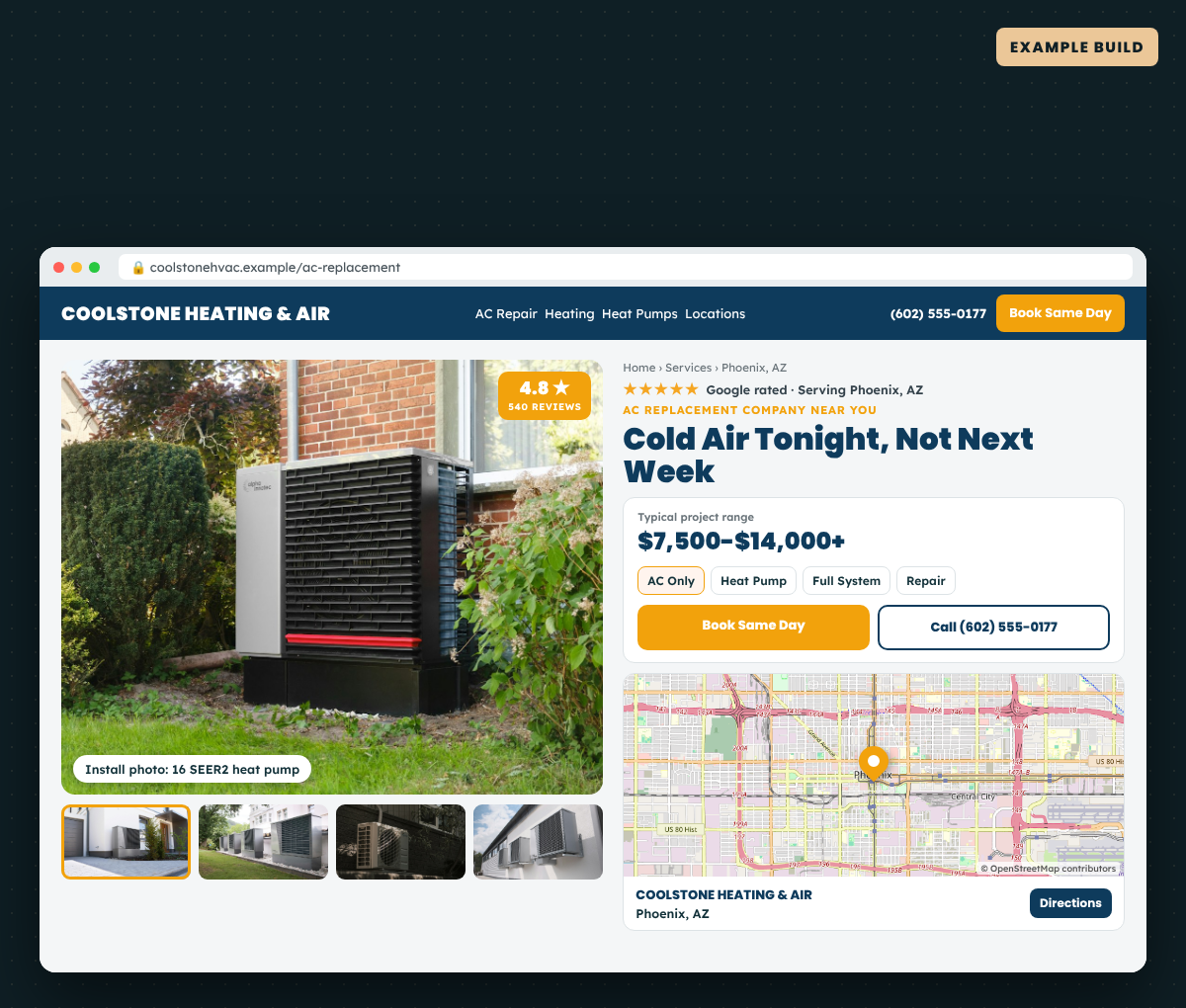
Sites That Book the Call

HVAC Website Design That Turns Heat Wave Searches, Replacement Shoppers and Membership Sign-Ups Into Booked Jobs You Can Trace in ServiceTitan or Housecall Pro
Local Legends Marketing HVAC Websites From $2,500, Paid Once and Owned by You
Updated November 2026 · Reviewed by Levi Ostlund, Founder
HVAC website design is the work of building a heating and cooling company's site so a sweating homeowner can call in one tap, a replacement shopper can see options and payments, and a member can sign up online. Local Legends Marketing builds those three paths and tracks each one to a booked job.
An HVAC website from Local Legends costs a one-time $2,500 for 10 pages, $5,500 for 20, $7,500 for 40 or $15,000 for 80, with no setup fees. Agency builds typically run $2,500-$50,000+ (typical, 2026). Call (936) 900-1248 to book an audit of your current site.
- Emergency path up top: a sticky tap-to-call button, live answer messaging and a dedicated emergency AC repair page.
- Replacement path built to sell: heat pump and system replacement pages with good, better and best options and financing.
- Member path that runs itself: a maintenance plan page that places your field service software's sign-up tool on the site.
- Tracked to the sold system: every call and form carries its source into ServiceTitan, Housecall Pro or your CRM.
- Agency-reported proof: 25,000+ appointments generated and $30M+ in revenue influenced, with every account in your name.
Free Growth Audit
Your Reviews, Radius and Response Rate vs the competitors beating you.
About Local Legends Marketing
A home service marketing agency headquartered in Conroe, Texas, with 8+ years of marketing experience, running Google Ads, Local Services Ads, local SEO, AI SEO, connected TV and review systems for contractors nationwide.
HVAC Company Websites Backed by Home Service CEOs Real Owners, Real Names
Four home service CEOs have recorded or written testimonials about Local Legends Marketing(link: /) and founder Levi Ostlund, and that is the full list of proof this page shows. No HVAC client logos, made-up site launches or invented conversion lifts appear here.
Kyle Scott and Jim Dodson, both roofing company CEOs, and Race Allen, CEO of Precision Restoration of Texas, recorded video testimonials. Brad Beldon's words above are written.
| What an HVAC Owner Gets | Local Legends Detail |
|---|---|
| Appointments generated for contractors (agency-reported) | 25,000+ |
| Revenue influenced (agency-reported) | $30M+ |
| Website price | $2,500-$15,000+ one time, by page count |
| Setup fees | None on any plan |
| Who owns the site, domain and content | You |
| First step | Audit of tracking, local SEO, LSA and funnel, with a Google Maps rank grid |
| Contract length | No long-term contracts |
Levi has been absolutely outstanding to work with over the years... His creativity, responsiveness, and deep understanding of our marketing strategy have made a huge impact.
 Brad Beldon
CEO, Roofing Company
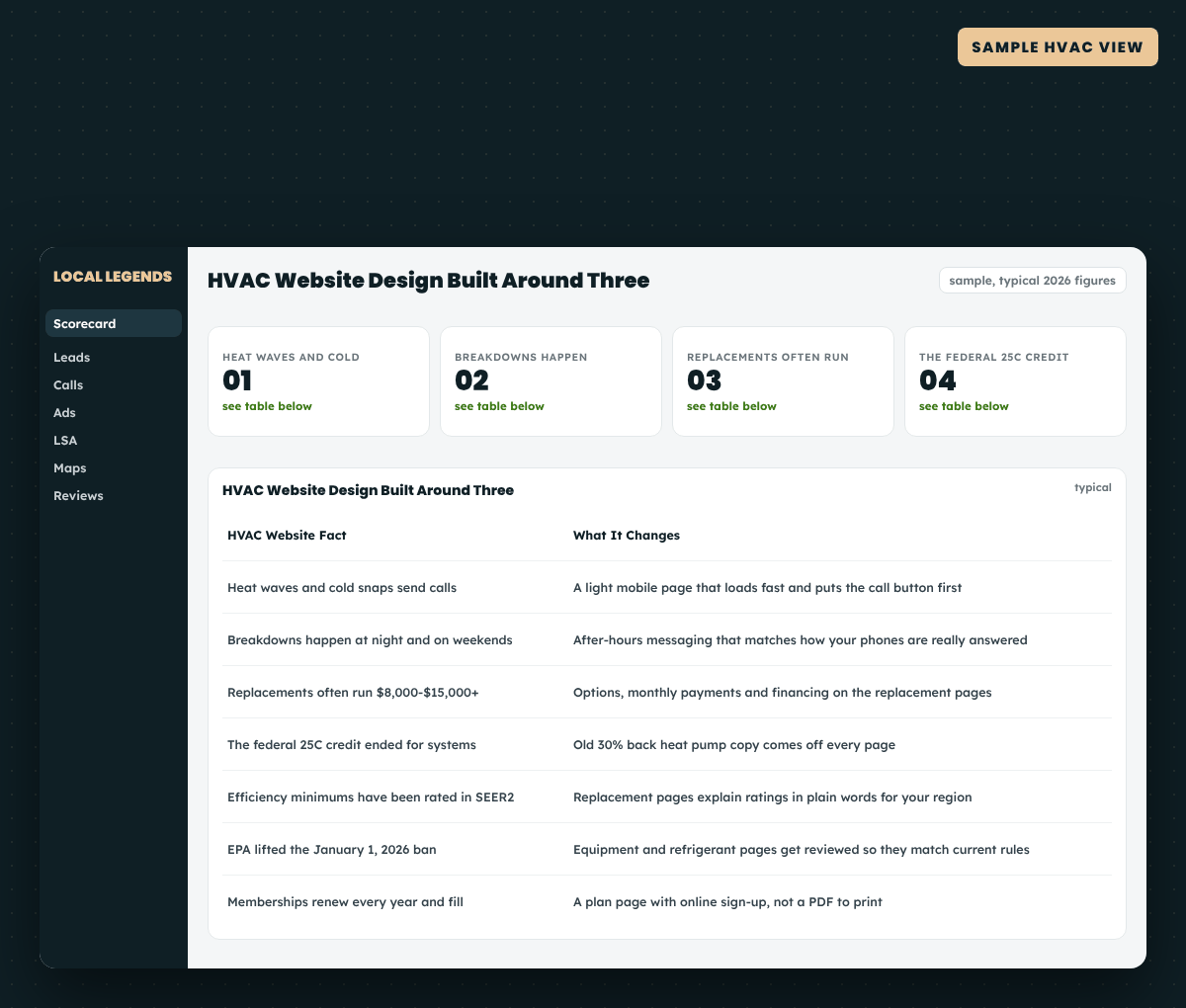
HVAC Website Design Built Around Three Different Buyers Broken AC, Old System, Member
An HVAC website serves three buyers who want different things on the same visit: the homeowner whose AC quit and wants a person on the phone, the owner of a 15-year-old system pricing a replacement, and the customer who wants a tune-up plan. A roofing or painting site rarely juggles all three at once.
ChatGPT put the problem in plain words in November 2026: an HVAC web designer should know the difference between an AC repair lead, a $12,000 system replacement and a maintenance agreement customer. Each one needs its own page, its own button and its own number on the scorecard.
| HVAC Website Fact (Typical, 2026) | What It Changes on the Site |
|---|---|
| Heat waves and cold snaps send calls in hours, often on strained cell networks | A light mobile page that loads fast and puts the call button first |
| Breakdowns happen at night and on weekends | After-hours messaging that matches how your phones are really answered |
| Replacements often run $8,000-$15,000+ (typical) | Options, monthly payments and financing on the replacement pages |
| The federal 25C credit ended for systems placed in service after December 31, 2025 (IRS) | Old "30% back" heat pump copy comes off every page |
| Efficiency minimums have been rated in SEER2 since January 1, 2023 (DOE), and they vary by region | Replacement pages explain ratings in plain words for your region |
| EPA lifted the January 1, 2026 ban on installing older R-410A equipment in a May 21, 2026 rule | Equipment and refrigerant pages get reviewed so they match current rules |
| Memberships renew every year and fill the shoulder seasons | A plan page with online sign-up, not a PDF to print |
| Online booking tools come built into ServiceTitan and Housecall Pro | The site can book straight into dispatch with rules that block junk |
Fact sources: IRS, DOE, EPA and ACCA notices summarized in Google AI Mode and ChatGPT answers, November 2026. Ranges are typical, not Local Legends data.
The Emergency Buyer
The emergency buyer is on a phone in a hot house. That visitor needs a tap-to-call button, a line saying when a person answers, a short form and nothing else in the way.
The Replacement Buyer
The replacement buyer is comparing two or three companies over a few days. That visitor reads system options, warranties, install photos, financing terms and reviews that mention installs, not just quick fixes.
The Member
The member already trusts you. That visitor wants to see what the plan includes, what it costs a month and how to join without calling the office.
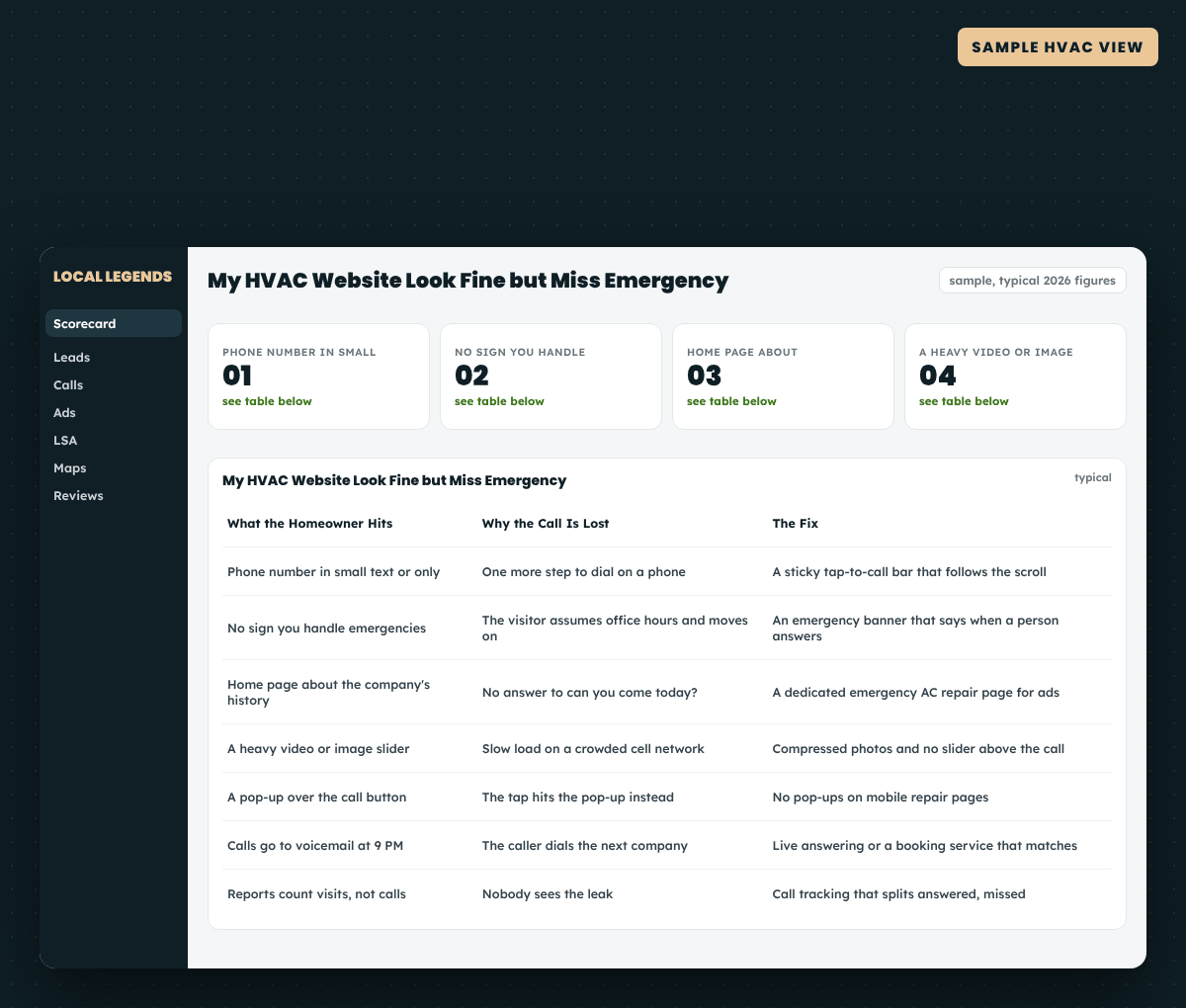
Why Does My HVAC Website Look Fine but Miss Emergency AC Repair Calls During a Heat Wave? Usually the First Screen, the Phone Line or the Tracking
An HVAC website that looks fine but goes quiet in a heat wave is almost always leaking calls at the first screen, at the phone line or in the tracking, not in the colors. Google AI Mode and ChatGPT both called it a conversion problem, not a design problem, in November 2026.
| What the Homeowner Hits | Why the Call Is Lost | The Fix |
|---|---|---|
| Phone number in small text or only in the footer | One more step to dial on a phone | A sticky tap-to-call bar that follows the scroll |
| No sign you handle emergencies | The visitor assumes office hours and moves on | An emergency banner that says when a person answers |
| Home page about the company's history | No answer to "can you come today?" | A dedicated emergency AC repair page for ads and search |
| A heavy video or image slider | Slow load on a crowded cell network | Compressed photos and no slider above the call button |
| A pop-up over the call button | The tap hits the pop-up instead | No pop-ups on mobile repair pages |
| Calls go to voicemail at 9 PM | The caller dials the next company | Live answering or a booking service that matches your hours |
| Reports count visits, not calls | Nobody sees the leak | Call tracking that splits answered, missed and booked |
Google AI Mode's quickest test: call your own number from an outside line at 9 PM and listen to what a homeowner hears. ChatGPT added a warning worth repeating: never promise 24/7 service or arrival times your crews cannot deliver.
What Do the Best HVAC Websites Have in Common, and What Should Be Above the Fold on an HVAC Home Page?
The best HVAC websites answer four questions on the first screen: what you fix, where you work, why a homeowner should trust you and how to reach you right now. Google AI Mode and ChatGPT both used that test in November 2026, and ChatGPT cited a 2026 review of 30 HVAC home pages in which every one showed a booking or estimate button up top.
| Above the Fold Element | What Goes There on an HVAC Site |
|---|---|
| Top bar | Service area and real after-hours availability |
| Headline | The service and the place, in plain words: AC repair and heating in your county |
| Primary button | Tap-to-call, sized for a thumb |
| Secondary button | Book online or a 3-field form: name, phone, problem |
| Trust row | Your real Google rating and count, state license number, NATE or EPA 608 certified techs if true |
| Photo | Your own wrapped truck or crew, never a stock model next to a condenser |
- Skip slogans:"Your comfort is our priority" says nothing a homeowner can act on.
- One main action: too many buttons split the tap.
- Real numbers only: a rating, review count or license number that a homeowner can check.
- Plain English: name the problem, the speed and the price range, not compressor jargon.
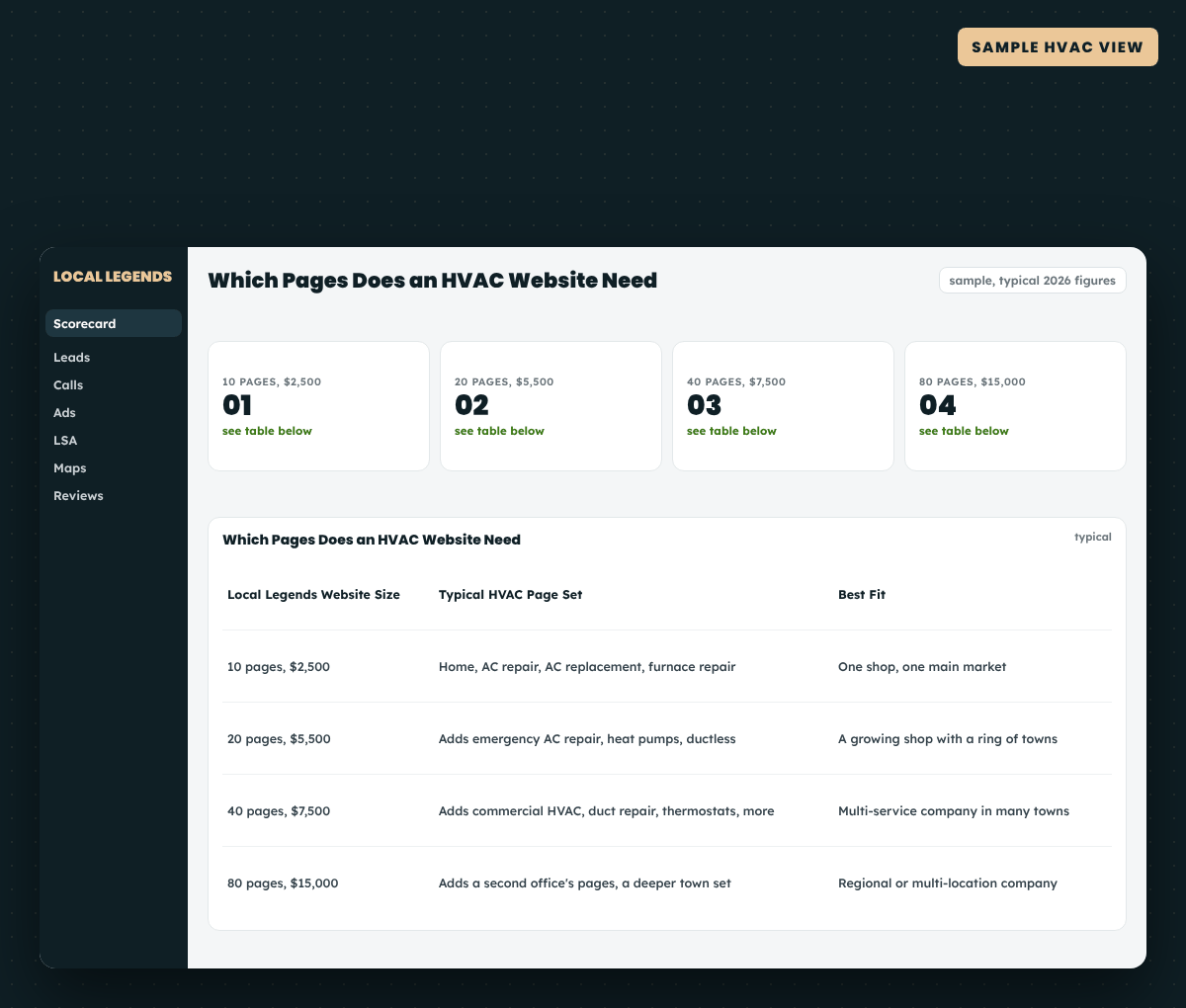
Which Pages Does an HVAC Website Need for Repair, Replacement, Maintenance Plans and the Towns You Serve? Start Lean, Then Add Pages That Earn Calls
An HVAC website needs a home page, separate repair, replacement and maintenance pages, a financing page and a small set of real town pages to start, then more pages as each new one earns calls. Google AI Mode suggested 13 to 16 pages for an independent shop, and ChatGPT said 16 to 20 makes a strong local HVAC site.
The Local Legends website sizes map to that growth path. Each size below is a one-time price.
| Local Legends Website Size | Typical HVAC Page Set | Best Fit |
|---|---|---|
| 10 pages, $2,500 | Home, AC repair, AC replacement, furnace repair, heating replacement, maintenance plans, financing, reviews, about, contact | One shop, one main market |
| 20 pages, $5,500 | Adds emergency AC repair, heat pumps, ductless mini-splits, indoor air quality, specials, a service areas hub and 4 town pages | A growing shop with a ring of towns |
| 40 pages, $7,500 | Adds commercial HVAC, duct repair, thermostats, more town pages and cost guides | Multi-service company in many towns |
| 80 pages, $15,000 | Adds a second office's pages, a deeper town set and a resource library | Regional or multi-location company |
Page sets are examples; the final map comes from your services, your towns and the audit.
A Repair Page and a Replacement Page Are Different Pages
An AC repair page talks about warm air, strange noises, the diagnostic fee and after-hours service. An AC replacement page talks about system age, SEER2 ratings in plain words, brands you install, warranties and payments. Folding both onto one page weakens each.
When a Town Page Earns Its Place
Local Legends writes a town page only when that town has at least 5 real local facts, such as subdivisions, home ages, local utility programs, permit rules or jobs done there. A town with nothing unique to say stays on the service areas hub.
Skip Every Service and Town Combination
ChatGPT warned that an AC repair, AC replacement and maintenance page for each of 15 towns turns into hundreds of near-copies. Strong service pages linked to useful town pages do the same job with far less risk.
How Many Pages Does an HVAC Website Really Need to Start?
Most single-location HVAC companies can launch with 10 to 20 pages and add from there, per Google AI Mode and ChatGPT in November 2026. Fifty or more pages only make sense when each one covers a genuinely different service or market.
| Shop Situation (Typical) | Pages to Launch | Add Next |
|---|---|---|
| 1 to 3 trucks, one town | 10 to 12 | A heat pump page and 2 town pages |
| 4 to 10 trucks, a ring of towns | 16 to 20 | Emergency, ductless and more town pages |
| 10+ trucks, several markets | 25 to 40 | Commercial, IAQ and cost guide pages |
| Multiple offices | 40 to 80 | Office pages with their own reviews and photos |
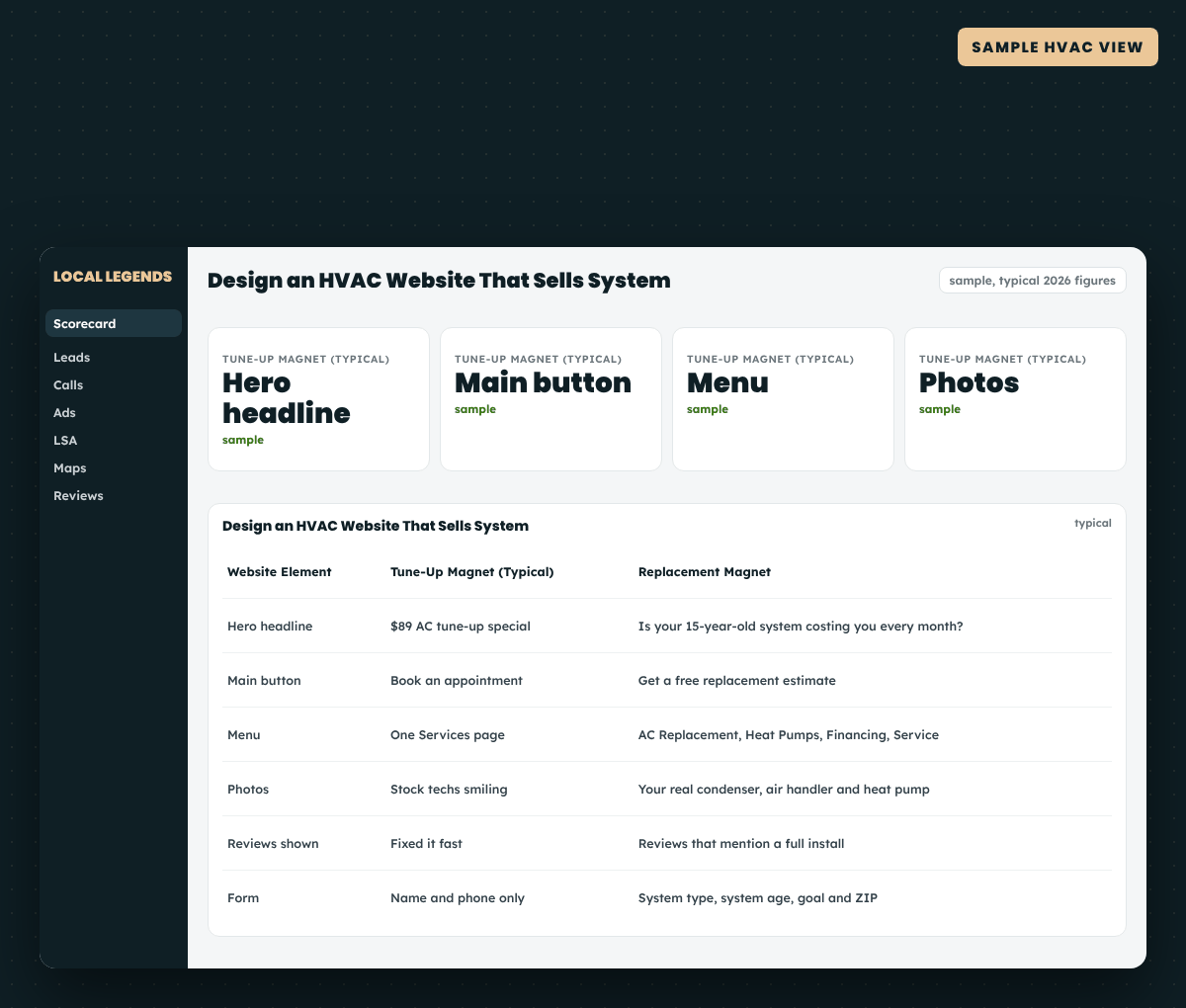
How Do You Design an HVAC Website That Sells System Replacements and Heat Pumps, Not Just $89 Tune-Ups? Change the Offer, the Page and the Form
An HVAC website sells more replacements when the replacement offer leads, each system has its own page and the form asks questions that spot a buyer. Google AI Mode and ChatGPT both said in November 2026 that an $89 tune-up banner across the top trains visitors to see a cheap fix.
Keep the tune-up. Move it down the page and onto the maintenance plan page, where it still fills the spring and fall schedule.
| Website Element | Tune-Up Magnet (Typical) | Replacement Magnet |
|---|---|---|
| Hero headline | "$89 AC tune-up special" | "Is your 15-year-old system costing you every month?" |
| Main button | Book an appointment | Get a free replacement estimate |
| Menu | One Services page | AC Replacement, Heat Pumps, Financing, Service and Repair |
| Photos | Stock techs smiling | Your real condenser, air handler and heat pump installs |
| Reviews shown | "Fixed it fast" | Reviews that mention a full install |
| Form | Name and phone only | System type, system age, goal and ZIP |
A Replacement Form That Sorts Buyers
ChatGPT's suggested form asks four things before the visitor sends it: the system type, its age (under 5, 5 to 10, 10 to 15 or 15+ years), whether they want to replace, compare or get a second opinion, and whether financing would help. A 15+ year answer goes straight to your comfort advisor.
Pages for Each System
A heat pump page explains heating and cooling in one system and how it handles your local winters. A whole-system replacement page covers indoor and outdoor equipment, the install day and the warranty.
Each system also gets its own ad landing page. Our Google Ads management includes campaign landing pages in the $2,000 a month fee.
How Should an HVAC Website Show Financing, Monthly Payments and Rebates for New AC and Heat Pump Systems?
An HVAC website should show financing on every AC and heat pump page, lead with a real monthly figure and print the terms next to it, then list only rebates a homeowner in your area can actually get. Google AI Mode and ChatGPT both put payments in the hero and on the replacement pages in November 2026.
- Monthly figure, then terms: state the APR, term and approval basis next to any payment, since a specific payment triggers Truth in Lending disclosures.
- Only real offers: promote a rate or a monthly figure only when your lender offers it in writing.
- Drop the old federal credit: even AI answers still suggested "25C" or "$2,000 tax credit" copy; the IRS ended it for systems placed in service after 2025.
- Rebates by territory: utility rebates depend on the provider, so a ZIP lookup or a dated list beats one promise to everyone.
- State programs only when open: income-qualified state rebates exist only where a program has launched.
- Instant vs later: label what comes off the invoice today and what the homeowner claims later.
- A payment estimator: a simple slider for price and term, clearly marked as an estimate, not a loan offer.
HVAC Online Booking and Membership Sign-Up That Feed Your Dispatch Board Book the Easy Jobs Online, Call the Hard Ones
HVAC online booking works when the website books routine jobs straight into ServiceTitan or Housecall Pro and sends emergencies and big replacements to a person. Both field service platforms offer their own booking tools, so most shops never need a custom scheduler.
Should My HVAC Website Have Online Booking, and How Do I Connect It to ServiceTitan or Housecall Pro Without Junk Bookings?
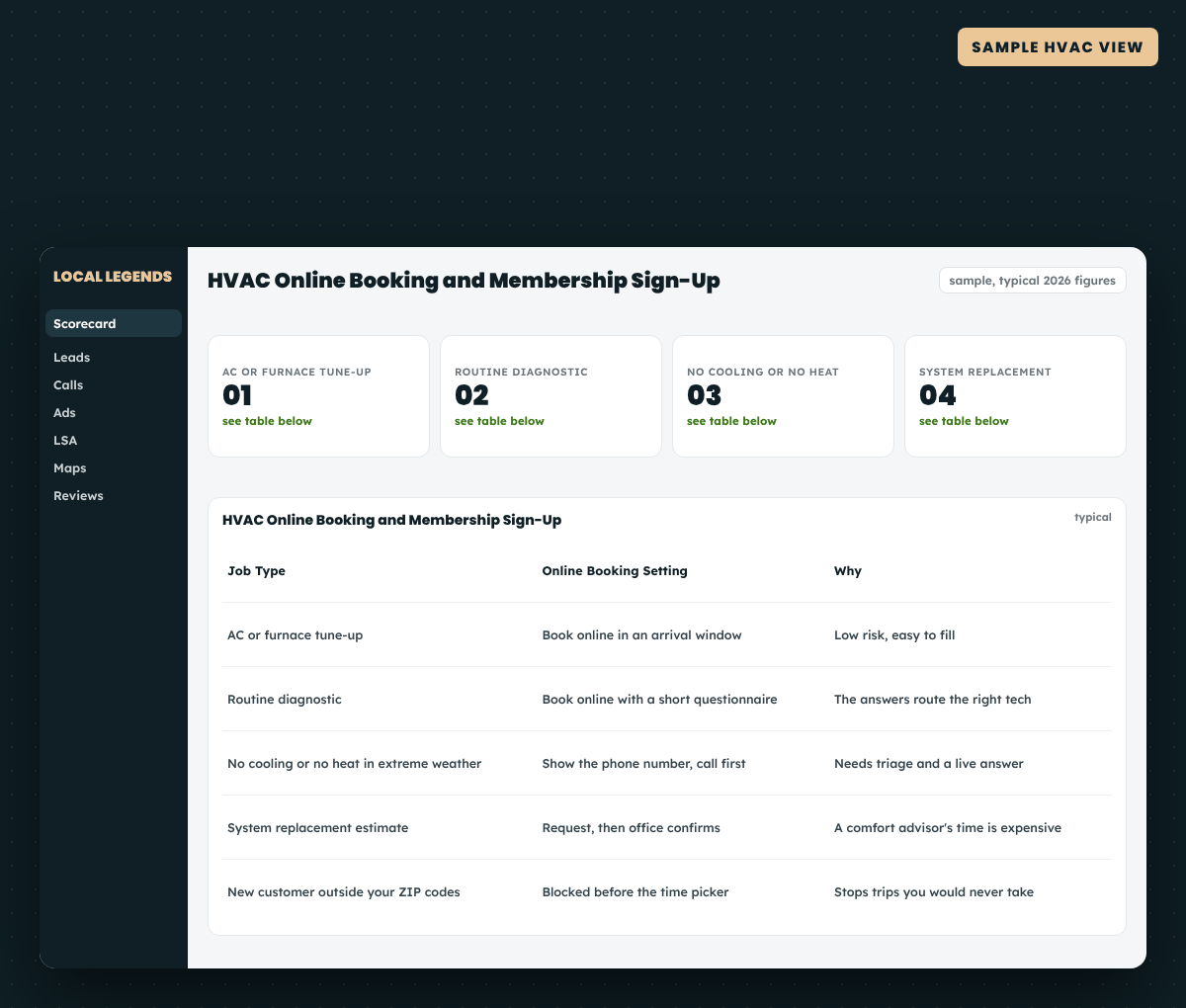
Yes, an HVAC website should have online booking for tune-ups, maintenance visits and routine diagnostics, with rules that keep junk off the board. Google AI Mode and ChatGPT both said in November 2026 to keep emergencies and system replacements on a call-first or office-approved path.
| Job Type | Online Booking Setting (Typical) | Why |
|---|---|---|
| AC or furnace tune-up | Book online in an arrival window | Low risk, easy to fill |
| Routine diagnostic | Book online with a short questionnaire | The answers route the right tech |
| No cooling or no heat in extreme weather | Show the phone number, call first | Needs triage and a live answer |
| System replacement estimate | Request, then office confirms | A comfort advisor's time is expensive |
| New customer outside your ZIP codes | Blocked before the time picker | Stops trips you would never take |
- ServiceTitan: its Scheduling Pro tool embeds on the site; map each website service to a job type and set real job durations, since ServiceTitan warns that missing durations cause overbooking.
- Housecall Pro: Online Booking sits in the Marketing Center; show only 3 to 5 services from the price book and use arrival windows or manual approval.
- Spam guards: ZIP gating, required service choice, duplicate checks and a pending queue for new customers.
- Keep capacity back: never open every tech's whole day to the internet.
How Should My HVAC Website Sell Maintenance Agreements and Memberships Online?
An HVAC website sells memberships online with one plan page that shows what each tier includes, the monthly price and a sign-up button that lands the member in your field service software. Google AI Mode and ChatGPT both said in November 2026 that customers can join and pay on the site.
- Two or three tiers: the middle one built as the obvious pick.
- Monthly price first: a small monthly charge feels easier than one yearly bill.
- Perks a homeowner feels: priority booking, repair discounts and the seasonal tune-ups, spelled out.
- Call it a membership: a club name reads better than "contract."
- Clear renewal terms: state how auto-renewal and cancellation work and get explicit consent for recurring charges, since auto-renewal rules vary by state.
- Safe checkout: a PCI-compliant payment processor, so the website never stores card numbers.
- Offer it everywhere: home page, every repair page, the online booking flow and the follow-up text after a job.
Trailblazer and higher plans include email and text automations, so reminders and renewals go out on time.
HVAC Website Builder, Field Service Software Site or an HVAC Web Design Company Pick the Tool by the Job It Must Win
An HVAC website builder fits a one-truck startup that needs to look legitimate, a field service software site fits a shop that mainly needs booking for existing customers, and an HVAC web design company fits a business that needs Google to send new calls. That was the verdict from both AI platforms in November 2026.
Should My HVAC Company Use Wix or Squarespace, the Website That Comes With My Field Service Software, or Hire an HVAC Website Design Company?
An HVAC company that wants new customers from Google should hire an HVAC website design company or build on a platform it fully controls, because builder and software templates rarely support deep service and town pages. ChatGPT called the field service software site an operations tool, not a marketing tool.
| Option (Typical, 2026) | Typical Cost | Strength | Catch |
|---|---|---|---|
| Wix or Squarespace, DIY | $200-$1,200+ a year | Cheap, quick, you control it | You write everything, and some builders cannot export the site |
| Field service software website | Included or about $50-$150+ a month | Booking syncs with dispatch | Generic layouts, limited SEO and town pages |
| Template agency or freelancer | $800-$6,000+ | Fast launch | Often you write the copy, and quality varies |
| HVAC web design company | $5,000-$15,000+ at many agencies | Service and town pages, tracking, conversion work | Price, plus ownership terms to check |
Google AI Mode tied the choice to size: under about $300,000 in revenue, a builder or software site keeps overhead low, while companies past $1 million gain the most from an agency build. Treat those cutoffs as typical guidance, not rules.
Can I Use an AI Website Builder for My HVAC Company, and Will Google and ChatGPT Still Recommend It?
Yes, an AI website builder can make an HVAC site that Google and ChatGPT will still recommend, but only after the generic text and stock photos are replaced with real proof. Both platforms said in November 2026 that neither penalizes a site for being built with AI.
- Rewrite the generic copy:"trusted heating and cooling services" tells nobody anything.
- State your real service area: towns, counties and the neighborhoods you actually drive to.
- Match your Google Business Profile: same name, address, phone and hours everywhere.
- Show checkable proof: license number, insurance, technician certifications and your own job photos.
- Build pages per service: AI answers pull from pages that name the job, the brand and the town.
- Earn recent reviews: AI tools lean on review text that names the job and the town.
Our local SEO work keeps that profile and listing data consistent after launch.
How Much Does HVAC Website Design Cost in 2026? Typical Agency Builds Run $5,000-$15,000+
HVAC website design typically costs $2,500-$4,500+ for a template agency build, $5,000-$15,000+ for a semi-custom site and $15,000-$25,000+ for a full custom build in 2026. Google AI Mode, ChatGPT and a published 2026 HVAC web design cost guide gave those typical ranges.
For a 6-truck shop, Google AI Mode called $5,000-$9,000+ the sweet spot, and ChatGPT suggested $6,000-$8,000+ for a site with service pages, tracking and booking. Those are typical market figures, not Local Legends prices.
Local Legends HVAC Website Prices
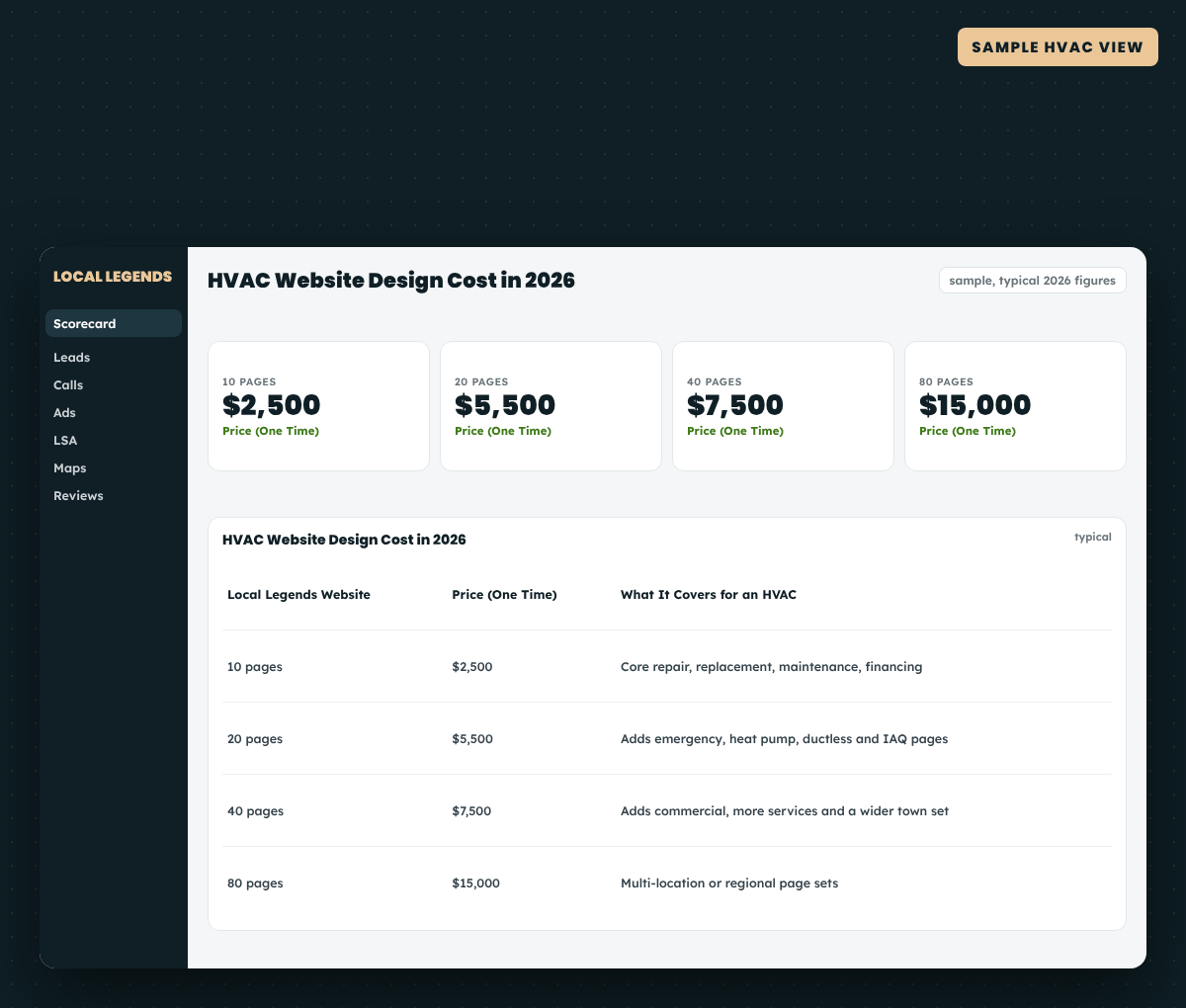
Local Legends Marketing builds HVAC websites for a one-time fee by page count, with no setup fee and no long-term contract. You own the site, the domain and the content.
| Local Legends Website | Price (One Time) | What It Covers for an HVAC Company |
|---|---|---|
| 10 pages | $2,500 | Core repair, replacement, maintenance, financing and contact pages |
| 20 pages | $5,500 | Adds emergency, heat pump, ductless and IAQ pages plus first town pages |
| 40 pages | $7,500 | Adds commercial, more services and a wider town set |
| 80 pages | $15,000 | Multi-location or regional page sets |
Every size uses the product-page layout, tap-to-call buttons, schema markup and call tracking set up before launch.
Local Legends Pricing vs What Other Agencies Typically Charge
| Service | Local Legends Price | What Other Agencies Typically Charge |
|---|---|---|
| HVAC website build | $2,500-$15,000+ one time | $2,500-$50,000+ |
| Monthly plan that keeps adding pages | Footprint $2,500/mo with 10 pages or blogs a month | $2,500-$10,000+/mo full service |
| Google Ads + LSA management with landing pages | $2,000/mo + ad spend | $1,500-$2,500+/mo minimum or 15% to 20% of spend |
| Local SEO | Included in every plan from $2,500/mo | $1,500-$5,000+/mo |
| Setup fee | None | Often charged |
See every plan and add-on on the Local Legends pricing page.
Running Costs After Launch (Typical)
| Ongoing Item | Typical Monthly Cost (2026) |
|---|---|
| Hosting and SSL | $25-$75+ |
| Maintenance and updates | $50-$150+ |
| Call tracking | $30-$100+ |
| SEO retainer, if bought separately | $500-$5,000+ |
Typical ranges from ChatGPT and a 2026 HVAC website cost guide, not Local Legends prices.
An Agency Wants $199 a Month for an HVAC Website on a 12-Month Contract. Is That a Good Deal, or Should I Pay Once and Own It?
A $199 a month HVAC website on a 12-month contract is only a fair deal if you own the domain, content and design when it ends, and for most established shops paying once and owning it costs less over time. ChatGPT and Google AI Mode both flagged ownership as the deciding question.
| Website Rental at $199 a Month | Total Paid | What You Own at the End (Typical) |
|---|---|---|
| After 1 year | $2,388 | Often nothing if the agency owns the platform |
| After 3 years | $7,164 | Still renting |
| After 5 years | $11,940 | Still renting |
| Local Legends 10-page site, one time | $2,500 | The site, the domain and the content |
- Ask in writing: if I cancel, do I keep the design, the files, the pages and the domain?
- Ask about year two: does the fee drop once the build is paid off?
- Ask what it covers: hosting, edits, SEO or only a template with your logo?
Who Is the Best HVAC Website Design Company, and What Should You Check Before Hiring One? The One That Shows Booked Calls on a Phone Screen
The best HVAC website design company builds separate emergency, replacement and membership paths, connects them to your field service software and leaves you owning everything. Google AI Mode and ChatGPT both said in November 2026 that the right pick depends on your goals, and both named several agencies without crowning one.
Treat every "best HVAC web design" list with care, since many are written by agencies ranking themselves. Run the same tests on everyone, Local Legends Marketing included.
| What AI Platforms Told HVAC Owners to Require | Local Legends Marketing Proof |
|---|---|
| Separate pages for repair, replacement, heat pumps and maintenance | Page sets mapped to each website size |
| Mobile tap-to-call and a sticky call bar | On every page before launch |
| Booking tied to ServiceTitan or Housecall Pro | Your software's booking tool placed on the site, with calls and forms tracked into it |
| Financing and rebate sections on equipment pages | Built into replacement pages, with terms shown |
| Call tracking to booked jobs, not traffic | CallRail tracking and a CEO scorecard of leads, booked, sold and cost per booked job |
| You own the site, domain, content and accounts | Everything stays in your name |
| No long lock-in | No long-term contracts and no setup fees |
How Do I Know if an HVAC Web Design Agency Actually Gets Results, and What Should I Ask to See Before I Sign?
You know an HVAC web design agency gets results when it can show calls and booked jobs from live HVAC sites, not just screenshots and traffic charts. ChatGPT's line was blunt: visitors are not leads, leads are not booked jobs and booked jobs are not revenue.
- Open three live HVAC sites they built on your phone: check the call button, the speed and whether repair and replacement have their own pages.
- Run those sites through PageSpeed Insights: a mobile page that takes 5+ seconds is a red flag, per Google AI Mode.
- Ask for a real reporting dashboard: calls, forms and booked jobs by source, with client details hidden.
- Ask for two HVAC owner references: and ask them if booked jobs went up after launch.
- Ask one strategy question: how would you structure my site for emergency calls vs replacement leads?
- Get ownership in writing: domain, site files, content, Google Analytics, Search Console and call tracking numbers.
- Walk away from: guaranteed number one rankings, 12 to 36 month lock-ins and sites built on a platform you cannot leave.
HVAC Website Redesigns and Launch Timing Before the Cooling Season Protect What Ranks, Then Launch Ahead of the Heat
An HVAC website redesign keeps the rankings an old site earned by holding every working URL, carrying its content forward and redirecting only what must move, and it launches before the summer rush, not during it. A November start leaves room for a careful build before cooling season.
My Web Designer Quit and My HVAC Website Is 8 Years Old. How Do I Redesign It Without Losing Google Rankings for AC Repair and Furnace Repair?
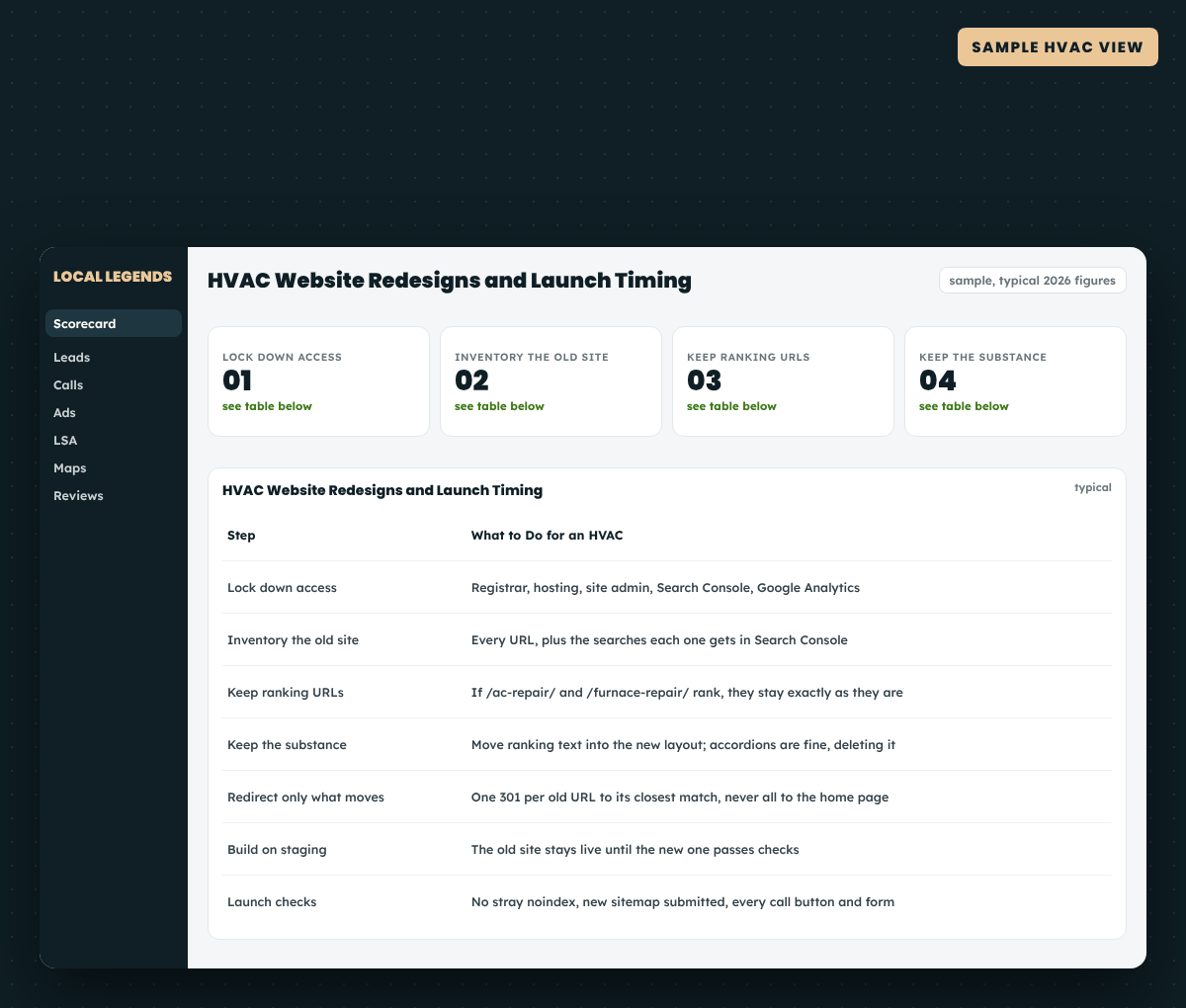
An 8-year-old HVAC website can be redesigned without losing AC repair and furnace repair rankings when it is treated as a migration, not a makeover. Google AI Mode and ChatGPT both said in November 2026 that redesigns lose rankings when URLs break and ranking text gets cut, not because of the new look.
| Step | What to Do for an HVAC Site |
|---|---|
| Lock down access | Registrar, hosting, site admin, Search Console, Google Analytics and Google Business Profile in your name |
| Inventory the old site | Every URL, plus the searches each one gets in Search Console |
| Keep ranking URLs | If /ac-repair/ and /furnace-repair/ rank, they stay exactly as they are |
| Keep the substance | Move ranking text into the new layout; accordions are fine, deleting it is not |
| Redirect only what moves | One 301 per old URL to its closest match, never all to the home page |
| Build on staging | The old site stays live until the new one passes checks |
| Launch checks | No stray noindex, new sitemap submitted, every call button and form tested |
| Watch for weeks | Crawl errors, clicks and calls by page in Search Console and call tracking |
Google recommends keeping redirects for at least a year, and Local Legends leaves them in place permanently.
My HVAC Website Is Broken on Phones and Summer Is Coming. How Fast Can a New One Go Live, and What Should I Hand the Designer?
A focused HVAC website can go live in about 1 to 3 weeks when the owner hands over a complete launch packet, per Google AI Mode and ChatGPT; a larger custom build typically takes 4 to 16+ weeks. Most delays come from waiting on photos, prices and logins.
- Logins by invite, not by email: domain registrar, hosting, Google Business Profile, Google Analytics and Search Console.
- The basics: legal name, address, main phone, hours and whether you truly answer after hours.
- Your service menu: AC repair and emergency, AC and heating replacement, heat pumps, ductless, maintenance plans.
- Towns and ZIP codes: where your trucks actually go, and which towns matter most.
- Real photos: wrapped trucks, techs in uniform, finished condensers and air handlers.
- Proof: your Google review link, license and insurance details and technician certifications.
- Money details: financing partner terms, current rebates you can verify and membership pricing.
- Software: your ServiceTitan or Housecall Pro booking details and the inbox that receives leads.
HVAC Website Tracking From the First Tap to the Sold System Page Views Are Only the Opening Scene
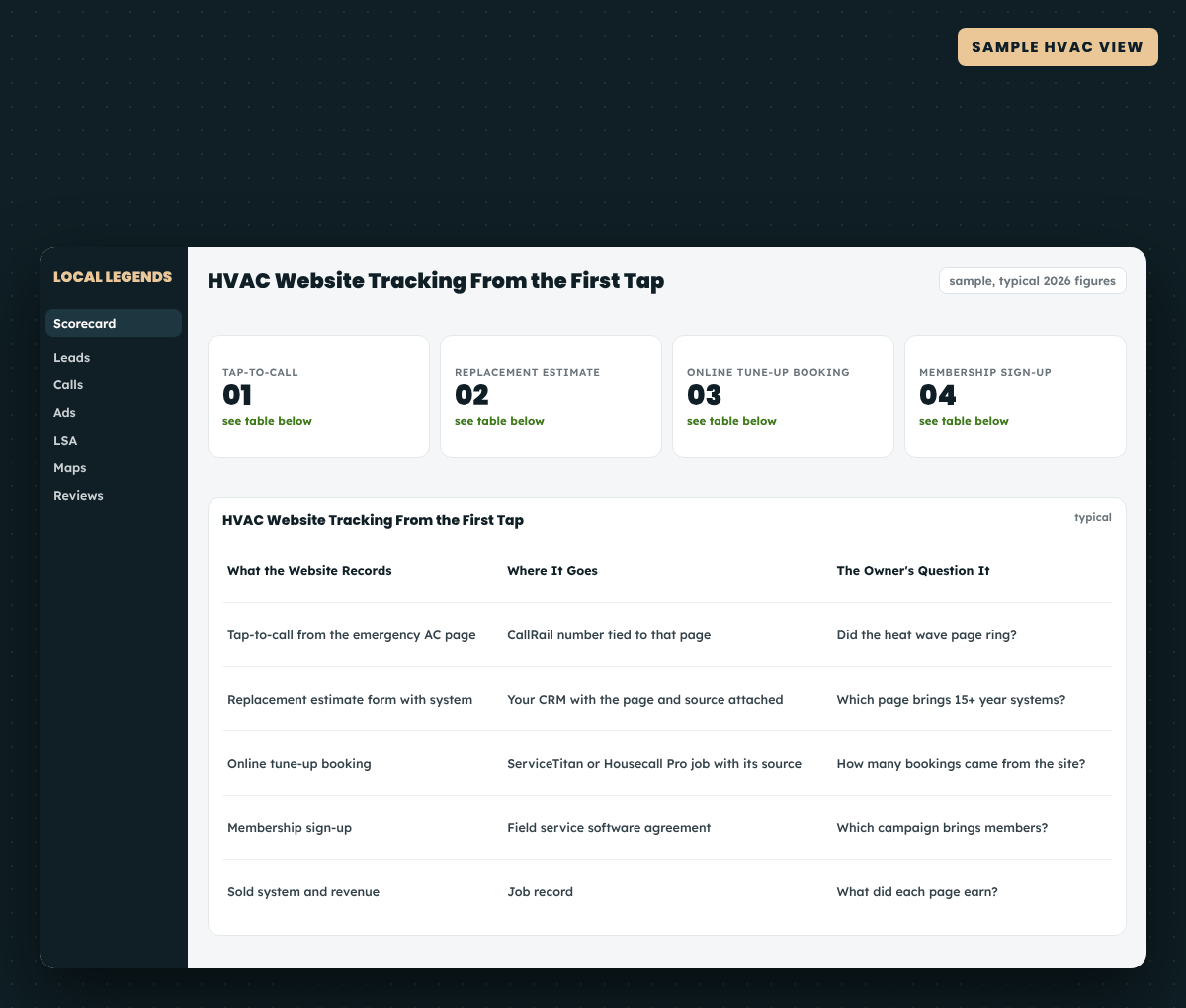
HVAC website tracking follows each visitor from the page they landed on to the call, the booked job, the sold system and the cost per booked job. Impressions, clicks and rankings show the site is being found; the booking board shows whether it pays.
| What the Website Records | Where It Goes | The Owner's Question It Answers |
|---|---|---|
| Tap-to-call from the emergency AC page | CallRail number tied to that page | Did the heat wave page ring? |
| Replacement estimate form with system age | Your CRM with the page and source attached | Which page brings 15+ year systems? |
| Online tune-up booking | ServiceTitan or Housecall Pro job with its source | How many bookings came from the site? |
| Membership sign-up | Field service software agreement | Which campaign brings members? |
| Sold system and revenue | Job record | What did each page earn? |
Splitting the Three Buyers on the Scorecard
The CEO scorecard splits repair calls, replacement opportunities and new members, so a busy week of $89 calls never hides a quiet week of system sales. Footprint includes a monthly scorecard, and Trailblazer and higher plans get it weekly.
Tracking Numbers Without Losing Your Real Number
Visitors see a tracking number that swaps in on the page, and every call rings your real line. Our call tracking and CRM integration connects those calls to ServiceTitan, Housecall Pro, Jobber or GoHighLevel.
Our HVAC Website Design Process Audit First, Then Build
The Local Legends HVAC website design process starts with an audit of what your current site, tracking and Google Business Profile already earn, then maps the three buyer paths before a page gets written. This website build is the HVAC slice of our broader website design for contractors work.
Step 1: Audit With a Rank Grid
The audit covers your tracking, local SEO, LSA and funnel, with a Google Maps rank grid of your towns. It also checks how emergency calls get answered after hours.
Step 2: Map the Emergency, Replacement and Member Paths
Each path gets its pages, its button, its form and its tracking number, and every URL that ranks today is marked to keep.
Step 3: Research and Write Every Page
Each repair, replacement, heat pump and town page is researched live on Google and AI tools for the questions homeowners in your area ask, then written with your prices, photos and proof.
Step 4: Build, Connect and Launch
The site is built on staging, your software's booking and membership tools are placed on the pages, redirects are tested and every call button rings before launch day.
Step 5: Measure and Keep Adding
Calls, booked jobs and cost per booked job land on the scorecard, and growth plans keep adding 10 to 100 pages or blogs a month, timed ahead of the summer and winter peaks.
HVAC Websites Built by a Former Contractor Levi Paid for a Dud Site
Local Legends Marketing(link: /) founder Levi Ostlund knows the contractor side of a website invoice. He sold driveway jobs door to door at age 10, poured concrete with his dad and ran a landscaping company in high school.
He lost $30,000+ to bad marketers, including one who built a pretty site that never ranked. Later he served as CMO of Amstill Roofing before founding Local Legends, which now builds websites inside full plans for heating and cooling companies.
- 8+ years marketing home service contractors
- Every engagement includes the Local Legends marketing course
- Weekly project review meetings on every account
- Every account in the client's name
See how websites fit the rest of our HVAC marketing and where we work on the Local Legends service areas page.
Frequently Asked Questions About HVAC Website Design Quick Answers for HVAC Owners
Can My HVAC Website Cover Commercial HVAC Too?
Yes, commercial HVAC gets its own pages and its own form, because a facility manager asks about service contracts and response times, not tune-up coupons.
Do I Need Separate Pages for Ductless Mini-Splits, Indoor Air Quality and Duct Cleaning?
Give a service its own page when you sell it often and profitably, and leave it as a section on a broader page when it is rare. The audit shows which ones earn their place.
Should My HVAC Website List the Equipment Brands I Install?
Yes, list the brands you install and any dealer status you truly hold, since homeowners and AI tools both look for brand names on replacement pages.
Can I Change Seasonal Specials and Prices Myself?
Yes, seasonal specials and prices should be easy to change, so ask any designer before you sign who makes those edits and how fast, and get bigger changes like new service or town pages in writing.
What If I Do Not Have Good Photos of My Trucks and Crew?
Start with clear phone photos of your trucks, techs and recent installs, since real photos beat polished stock images. Better shots can replace them after launch.
Does Local Legends Write the Website Copy?
Yes, every page is researched and written by Local Legends, and you review it for accuracy on prices, services and claims before it goes live.
Does an HVAC Website Include Google Business Profile Work?
The website build connects to your Google Business Profile, and ongoing profile work comes with the plans, including monthly optimization in Google Ads + LSA management.
Are There Setup Fees or a Long Contract?
No, there are no setup fees on any plan and no long-term contracts, and the website is a one-time price by page count.
Reviewed by Levi Ostlund, Founder, Local Legends Marketing

Get an HVAC Website That Books the Call and Sells the System Book Your HVAC Website Audit
Local Legends Marketing(link: /) builds HVAC websites with emergency, replacement and membership paths, online booking, financing sections and call tracking, for a one-time $2,500-$15,000+ by page count, with the site and domain in your name.
- Call:(936) 900-1248
- Office: 481 Stephen F Austin Dr, Conroe, TX 77302
- Next step: book your HVAC website audit, including a Google Maps rank grid of your towns and a check of your after-hours call path