


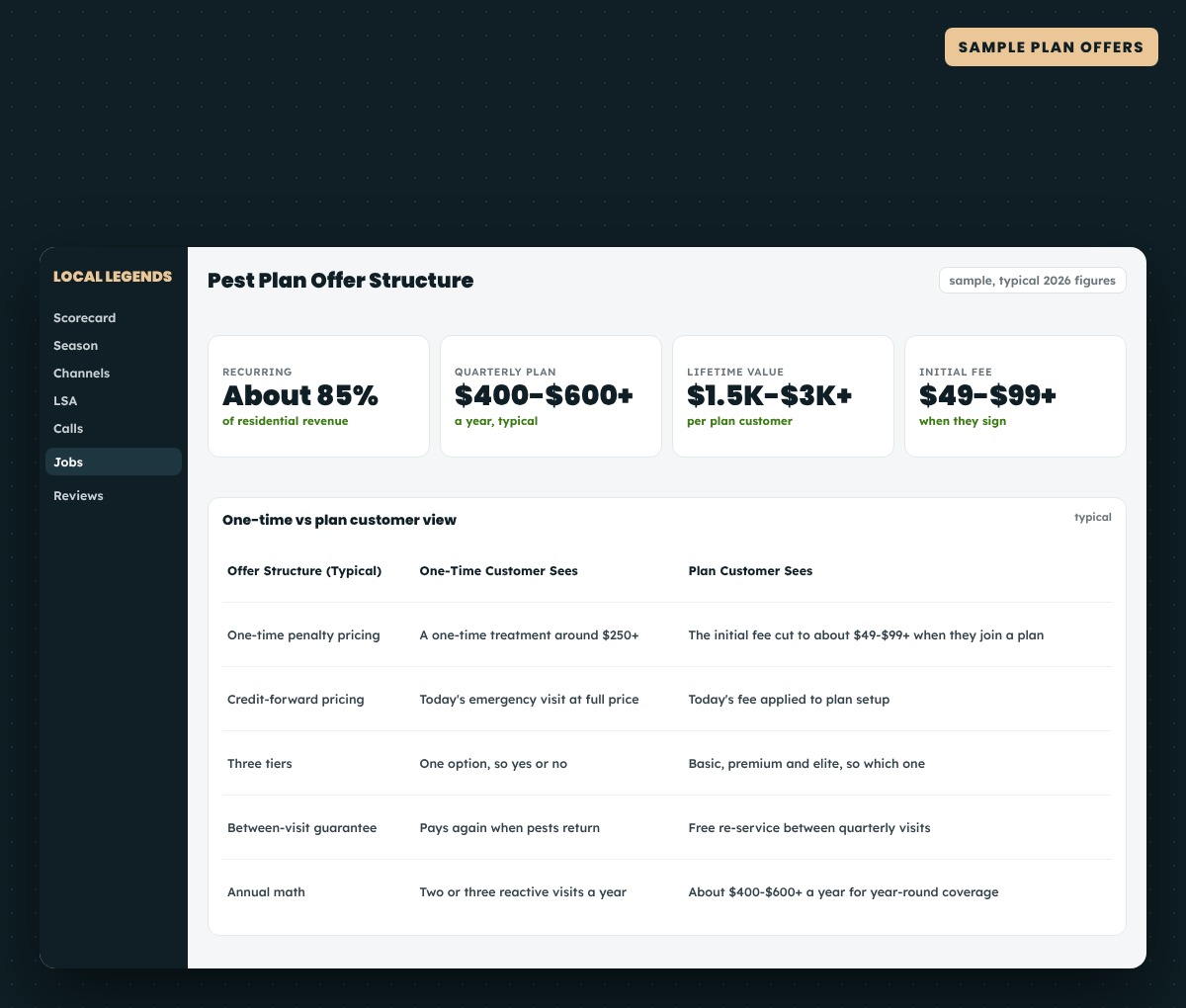
Plans, Not One-Time Visits

Pest Control Marketing That Turns Urgent Bug Calls Into Quarterly Service Plans That Renew Year After Year
Local Legends Marketing for Residential Pest Control Companies
Updated November 2026 · Reviewed by Levi Ostlund, Founder
Local Legends Marketing is a pest control marketing agency that books recurring service plan customers for residential exterminators, using Google Local Services Ads, Google Ads, local SEO, your Google Business Profile, Facebook ads, review requests and call tracking, with every account kept in your name.
Pest control companies typically pay $1,500-$5,000+ a month in agency fees in 2026, plus ad spend. Local Legends runs Google Ads and LSA for a flat $2,000 a month, and growth plans start at $2,500 a month. Call (936) 900-1248 to book a growth audit.
- Plans over one-offs: campaigns are scored on quarterly and monthly plans sold, not on single treatments.
- Fast channels first: Local Services Ads and search ads go live before slower SEO work compounds.
- Built around the pest calendar: budgets move with termite swarms, mosquito season and fall rodents.
- Cost per plan customer: a CEO scorecard follows every call into your routing software and out to renewals.
- Agency-reported proof: 25,000+ appointments generated and $30M+ in revenue influenced, flat fees, no long-term contracts.
Free Growth Audit
Your Reviews, Radius and Response Rate vs the competitors beating you.
About Local Legends Marketing
A home service marketing agency headquartered in Conroe, Texas, with 8+ years of marketing experience, running Google Ads, Local Services Ads, local SEO, AI SEO, connected TV and review systems for contractors nationwide.
Pest Control Marketing Agency Owners Put Their Names Behind CEOs Who Hired Us and Said So
Home service CEOs have attached their real names to their experience with Local Legends Marketing and founder Levi Ostlund, from ad accounts to call tracking.
| Local Legends Proof Point | Number |
|---|---|
| Appointments generated for home service companies (agency-reported) | 25,000+ |
| Revenue influenced (agency-reported) | $30M+ |
| Years marketing home service contractors | 8+ |
| Accounts that stay in the owner's name (site, domain, GBP, ads, call data) | 100% |
| Share of your ad spend taken as a fee | 0%, flat monthly pricing |
Levi has been absolutely outstanding to work with over the years... His creativity, responsiveness, and deep understanding of our marketing strategy have made a huge impact.
 Brad Beldon
CEO, Roofing Company
How Pest Control Marketing Is Different From Other Home Service Trades You Sell a Subscription, Not a Job
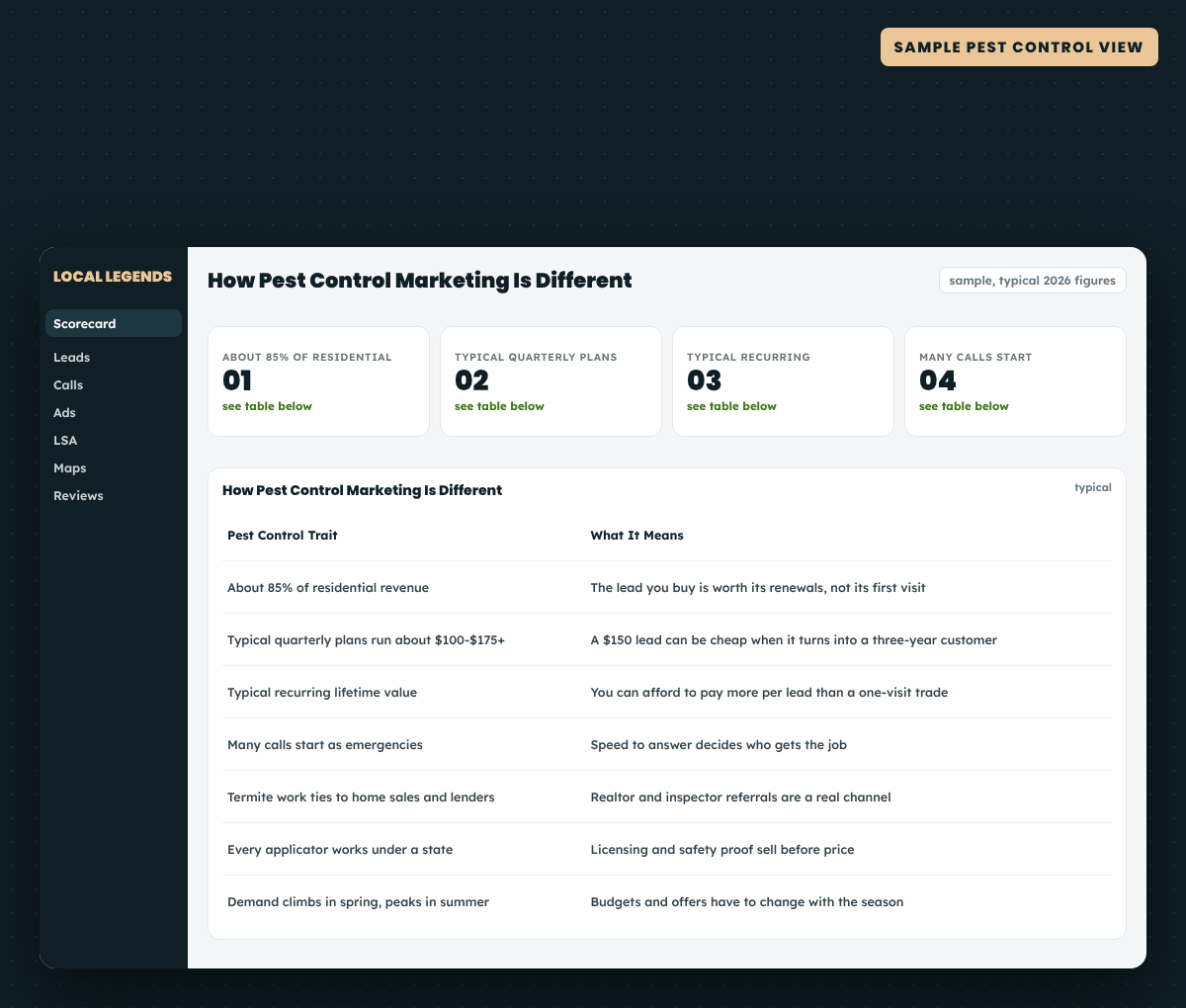
Pest control marketing is different because the money lives in the route, not the first ticket. Industry data for 2025 put U.S. structural pest control revenue at about $13.4 billion, up 6%, and about 85% of residential service revenue came from recurring plans.
| Pest Control Trait (Typical) | What It Means for Marketing |
|---|---|
| About 85% of residential revenue is recurring (2025 industry data) | The lead you buy is worth its renewals, not its first visit |
| Typical quarterly plans run about $100-$175+ a visit, or $400-$600+ a year | A $150 lead can be cheap when it turns into a three-year customer |
| Typical recurring lifetime value of $1,500-$3,000+ | You can afford to pay more per lead than a one-visit trade |
| Many calls start as emergencies (bed bugs, rats, wasps) | Speed to answer decides who gets the job |
| Termite work ties to home sales and lenders | Realtor and inspector referrals are a real channel |
| Every applicator works under a state pesticide license | Licensing and safety proof sell before price |
| Demand climbs in spring, peaks in summer, shifts indoors in fall | Budgets and offers have to change with the season |
| Route density lowers cost per stop | New customers near existing routes are worth more |
Residential pest control companies reached roughly 13.3 million households in 2025, by the same industry count. That is a big market, but each homeowner still picks from three or four names on a screen, usually in a hurry.
What Should My Pest Control Website Show About Our State Pesticide License, Insurance and Pet Safe Treatments?
A pest control website wins trust by showing the license number, the insurance and the safety process in plain words on every key page, because homeowners worry about two things: hiring someone shady and spraying chemicals around their kids and pets.
- State license number in the footer of every page, plus on the about and safety pages, with the license holder's name and category.
- What the license means: one line on who issued it (usually the state department of agriculture or a structural pest board) and that techs train to keep it.
- Insurance stated as a promise: general liability and workers' comp, with a certificate of insurance available on request.
- Treatment safety explained: which products go inside versus outside, re-entry times, and how pets and kids are kept clear.
- A between-visit guarantee:"if pests come back between visits, we come back free" removes the biggest plan objection.
- Real technicians: photos, first names and years in the field, never stock photos of people in hazmat suits.
How Do I Get More Customers to Sign Up for a Quarterly Pest Control Service Plan Instead of One-Time Treatments? Make the Plan the Default Answer
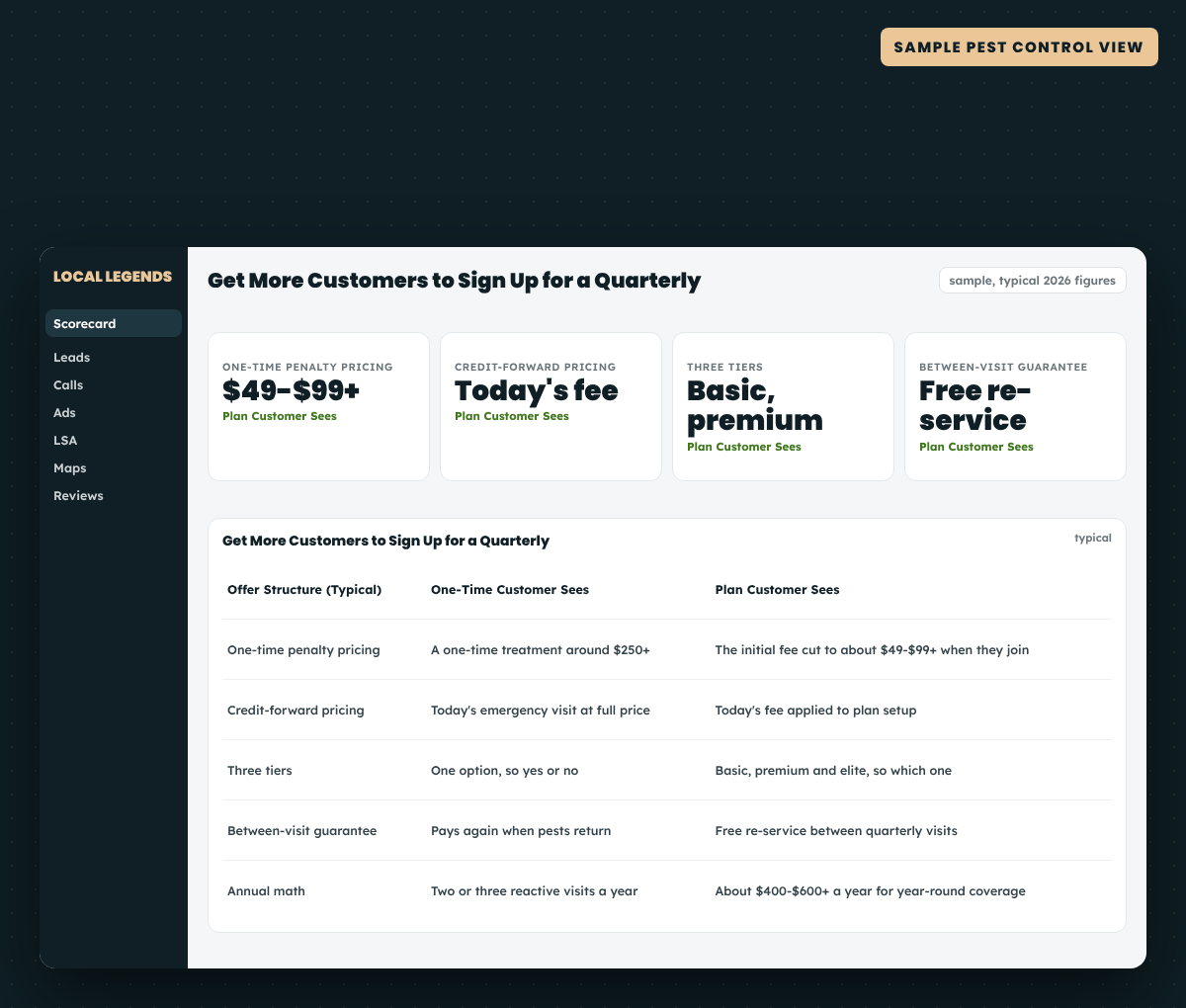
A pest control company sells more quarterly plans by pricing one-time service high, offering the plan as the standard recommendation and pitching it before the technician leaves. Google AI Mode, asked this in November 2026, called 25% to 35% of one-time customers converted to plans within 60 days a healthy target.
| Offer Structure (Typical) | One-Time Customer Sees | Plan Customer Sees |
|---|---|---|
| One-time penalty pricing | A one-time treatment around $250+ | The initial fee cut to about $49-$99+ when they join a plan |
| Credit-forward pricing | Today's emergency visit at full price | Today's fee applied to plan setup |
| Three tiers | One option, so "yes or no" | Basic, premium and elite, so "which one" |
| Between-visit guarantee | Pays again when pests return | Free re-service between quarterly visits |
| Annual math | Two or three reactive visits a year | About $400-$600+ a year for year-round coverage |
A Three-Tier Plan Menu That Sells Itself
- Basic: quarterly exterior perimeter service for ants, spiders and common crawling insects.
- Premium (the one most people pick): inside and outside coverage plus rodent monitoring stations.
- Elite: everything above plus mosquito season service, stinging insects and an annual termite inspection.
The Words Technicians Use at the Door
ChatGPT and AI Mode gave the same advice in different words: sell prevention, not another spray. A tech can say, "We handled the ants today. Bugs move in waves with the seasons, so most of your neighbors keep us on a plan that stops the next wave outside."
The Follow-Up for People Who Say No
- Day of service: a text recap with photos and the plan price, plus a one-tap signup link.
- Day 14: a check-in asking if the problem is gone, with the plan offer again.
- Day 45 to 60: a seasonal note about what pest shows up next in your area, and the plan.
- Every season after: one email or text before each pest wave, sent to every one-time customer.
How Do I Turn One-Time Bed Bug, Rodent and Wasp Calls Into Recurring Service Plan Customers?
Urgent pest calls turn into recurring customers when each pest gets its own "next step" pitch tied to how that pest comes back. AI Mode suggested a rodent exclusion angle, a wasp seasonality angle and a bed bug warranty angle, plus crediting the emergency fee toward the plan.
| Urgent Call | Why It Comes Back | The Recurring Offer |
|---|---|---|
| Mice or rats | Entry points stay open and new rodents follow the cold | Exclusion work plus exterior bait station monitoring on a plan |
| Wasps, hornets, yellow jackets | Queens scout new nest sites every spring | Quarterly eave and soffit treatment in the general plan |
| Bed bugs | They ride back in on luggage and furniture | A monitoring and warranty tier after the cleanout |
| Cockroaches | Indoor colonies rebound without follow-up | Monthly or bi-monthly visits until clear, then quarterly |
| Ants | New colonies arrive each spring and summer | Perimeter plan starting before the next season |
- Mention the plan on the first call, not after the job, so it is part of the estimate.
- Apply today's fee to the plan so joining feels like getting the emergency handled.
- Spell out what the plan covers by pest name, and what it does not, so nobody fears hidden fees.
- Track urgent call types in your CRM to see which pest converts to plans at the best rate.
The Local Legends Channel Mix for Pest Control Companies Which Channels Go Live First, and Why
Local Legends Marketing turns on pest control channels in the order they produce plan customers, starting where a homeowner with a problem is searching today.
| Order | Channel | Why It Sits Here for Exterminators |
|---|---|---|
| 1 | Google Local Services Ads | Pay per lead at the very top of the results, with a verified badge |
| 2 | Google Ads search | Pest-by-pest campaigns for termites, bed bugs and rodents with matching landing pages |
| 3 | Google Business Profile and local SEO | Map Pack calls for "exterminator near me" that cost nothing per click |
| 4 | Pest control website | Converts the traffic from every other channel into calls and plan signups |
| 5 | Reviews | Raises rank and lowers cost per lead on every channel above |
| 6 | Facebook and Instagram ads | Builds plan demand by zip code before the season hits |
| 7 | Email and text nurture | Turns one-time customers and old estimates into plans |
Local Services Ads and Search Ads Together
Google Local Services Ads carry the general pest and urgent calls, and Google Ads management adds the termite, bed bug and exclusion terms you want to control by keyword and send to their own pages.
Local SEO for Every Pest and Every Area
Local SEO builds a page for each pest you treat and each area you cover, with real local pest pressure, so you rank without paying for every click.
Facebook Ads Ahead of the Season
Facebook ads run short videos about local warning signs in the zip codes where your trucks already drive, which builds familiarity and route density.
Do Google Ads Work for Pest Control Companies, and Which Keywords Should I Target?
Google Ads works for pest control companies because most searches come from people with a live pest problem, but only when campaigns stick to hiring keywords and skip the research terms. Both AI Mode and ChatGPT said to split campaigns by service.
| Keyword Group | Example Searches | Why It Earns Budget |
|---|---|---|
| Local hiring terms | pest control near me, exterminator in your city, pest control company plus zip code | Ready to book today |
| Pest problem terms | bed bug treatment, rat removal service, roach exterminator | A specific problem with a specific fix |
| High-ticket terms | termite inspection, termite treatment, rodent exclusion | Bigger tickets and long warranties |
| Seasonal terms | mosquito control service, wasp nest removal | Short windows with clear intent |
| Plan terms | quarterly pest control, monthly pest control service | Buyers already sold on recurring service |
- Skip broad words like "ants," "mice" or "bugs," which pull picture and fact searches, not buyers.
- Use phrase and exact match so you choose the searches you pay for.
- Add negative keywords for DIY, sprays, traps, jobs and "how to."
- Send each pest to its own landing page with the plan offer above the fold.
- Track calls by campaign so you know which pest brings plan customers.
Should I Keep Paying for Shared Pest Control Leads or Run My Own Google Ads?
Most exterminators should shift budget from shared lead marketplaces to their own Local Services Ads and search ads over a few months, comparing cost per plan customer, not cost per lead. AI Mode noted a shared lead often reaches 3 to 5 competing companies at once.
| Factor | Shared Lead Marketplaces | Your Own LSA and Google Ads |
|---|---|---|
| Who else calls the homeowner | Several pest companies | Usually just you |
| What you are paying for | Each lead, booked or not | A valid lead (LSA) or a click (search) |
| Speed needed | Seconds, or someone else wins | Minutes still matter, but less of a race |
| What you build | Very little you keep | Reviews, profile strength, retargeting lists and your own data |
| Best use | A gap filler while your own channels ramp | Long-term plan customer flow |
ChatGPT gave the same advice: do not cancel shared sources overnight. Cut the one with the worst cost per plan customer first, then the next, as your own ads prove out on the scorecard.
Is Google Local Services Ads Worth It for a Pest Control Company, and Which Pest Job Types Does It Cover? Yes, "Pest Control Services" Is an Eligible LSA Category
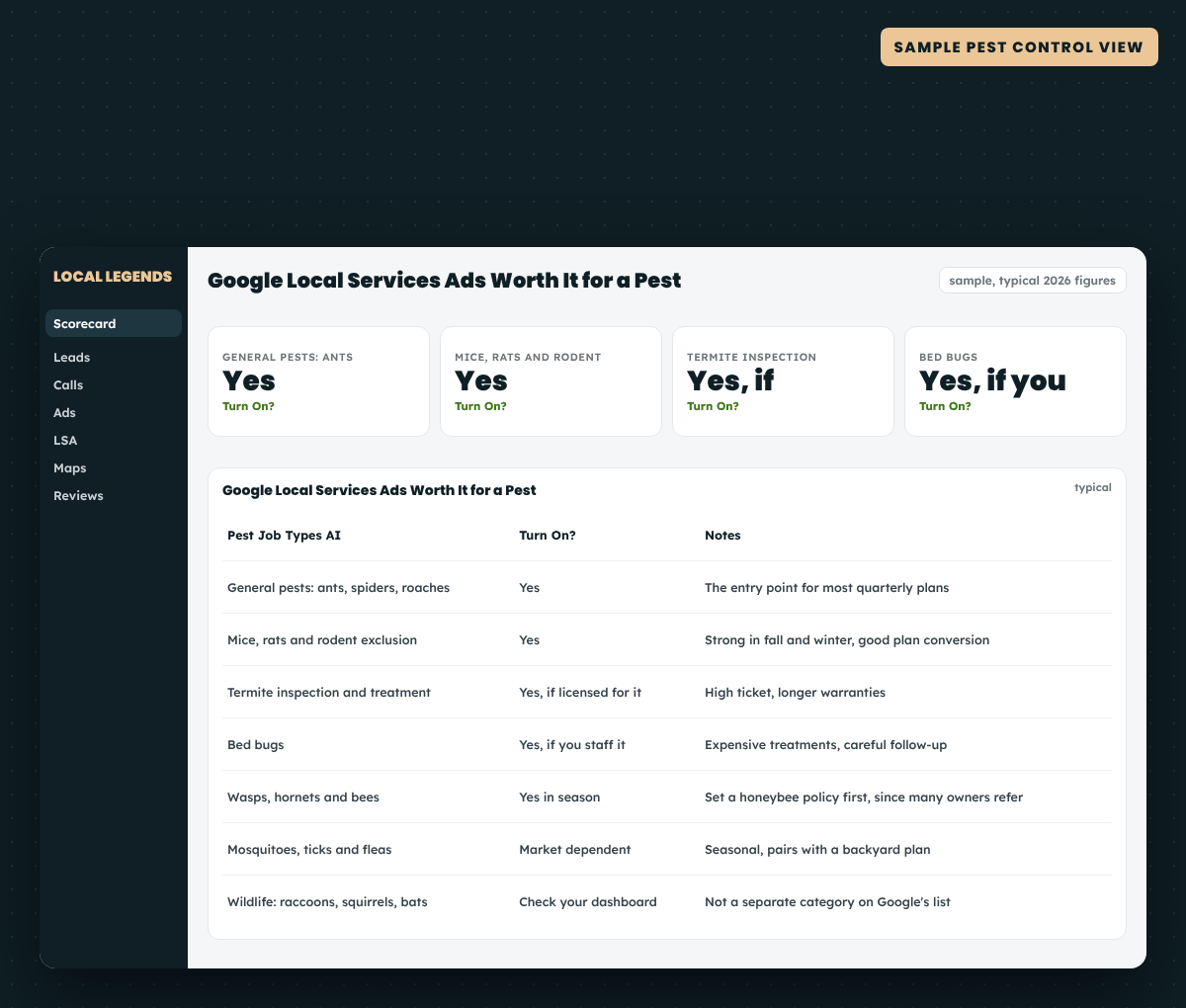
Google Local Services Ads covers pest control: "Pest control services" is on Google's own list of eligible categories, and for most residential exterminators that answer the phone fast, LSA is the first paid channel worth turning on.
Google's category list does not include a separate wildlife or animal control category, so treat raccoons, squirrels, bats and birds as a "check your dashboard" item. AI Mode warned that some markets route wildlife differently and that search ads often beat LSA for wildlife and commercial work.
| Pest Job Types AI Platforms Listed (Typical Setup) | Turn On? | Notes |
|---|---|---|
| General pests: ants, spiders, roaches, silverfish | Yes | The entry point for most quarterly plans |
| Mice, rats and rodent exclusion | Yes | Strong in fall and winter, good plan conversion |
| Termite inspection and treatment | Yes, if licensed for it | High ticket, longer warranties |
| Bed bugs | Yes, if you staff it | Expensive treatments, careful follow-up |
| Wasps, hornets and bees | Yes in season | Set a honeybee policy first, since many owners refer bees out |
| Mosquitoes, ticks and fleas | Market dependent | Seasonal, pairs with a backyard plan |
| Wildlife: raccoons, squirrels, bats, birds | Check your dashboard | Not a separate category on Google's list |
| Commercial pest control | Eligibility varies | Contract work is usually better on search ads and outreach |
ChatGPT made the same point plainly: these are job types to look for during setup, not a promise that every one shows up in your market.
What Does a Pest Control LSA Lead Cost?
Pest control LSA leads typically cost about $25-$65+ in 2026, according to Google AI Mode and ChatGPT, with ChatGPT citing one published benchmark near a $38 median and about a 45% booking rate. Termite and bed bug leads land at the high end.
| Pest Control LSA Benchmark (Typical) | Range |
|---|---|
| General pest lead | About $15-$40+ |
| Rodent lead | About $22-$40+ |
| Bed bug lead | About $25-$45+ |
| Termite lead | About $35-$55+ |
| Booking rate reported by one benchmark | About 45% |
| Ad cost per booked job at that rate | About $84+ before cancellations |
What Google Screens Before Your Pest Ads Run
- Owners and field technicians who serve customers complete a criminal background check where the category requires it; office and support staff do not.
- Licenses: Google asks you to confirm county and city licenses and that every service professional is properly licensed.
- Insurance: the certificate must stay active at least 14 days after you submit it and must show a policy number.
- A failed background check means a 30-day wait to reapply, and a second denial means 180 days.
Answer Fast or Pay for Nothing
AI Mode called slow answering the biggest LSA trap for exterminators: missed calls hurt your ranking and can still bill as leads. Route LSA calls to a live person during the hours you list, and dispute bad leads every week.
How Does the 2026 LSA Move Into Google Ads Affect Pest Control Companies?
Pest control is one of the trades in the first phase of the Local Services Ads move into Google Ads, which Google started in August 2026 for select U.S. storefront service advertisers. Service area businesses without a storefront follow in late 2026.
- Same placements: ads still show only on Google Search and Google Maps, as a pay-per-lead Performance Max campaign.
- Daily budgets: your weekly budget is divided by 7, and monthly spend is capped at about 30.4 times that daily figure.
- No manual bidding: max cost per lead goes away, and one campaign-level target replaces per-trade targets.
- Separate campaigns for termite and general pest if you want each to keep its own cost target.
- Export your history now: historical performance reports do not move over, though leads and call recordings do.
- Badges carry over: a verified business keeps its Google Verified badge automatically.
Local Legends handles LSA setup, job types, weekly lead disputes and the migration under the $2,000 a month Google Ads and LSA plan, and every growth plan adds the LSA Ranker review texter.
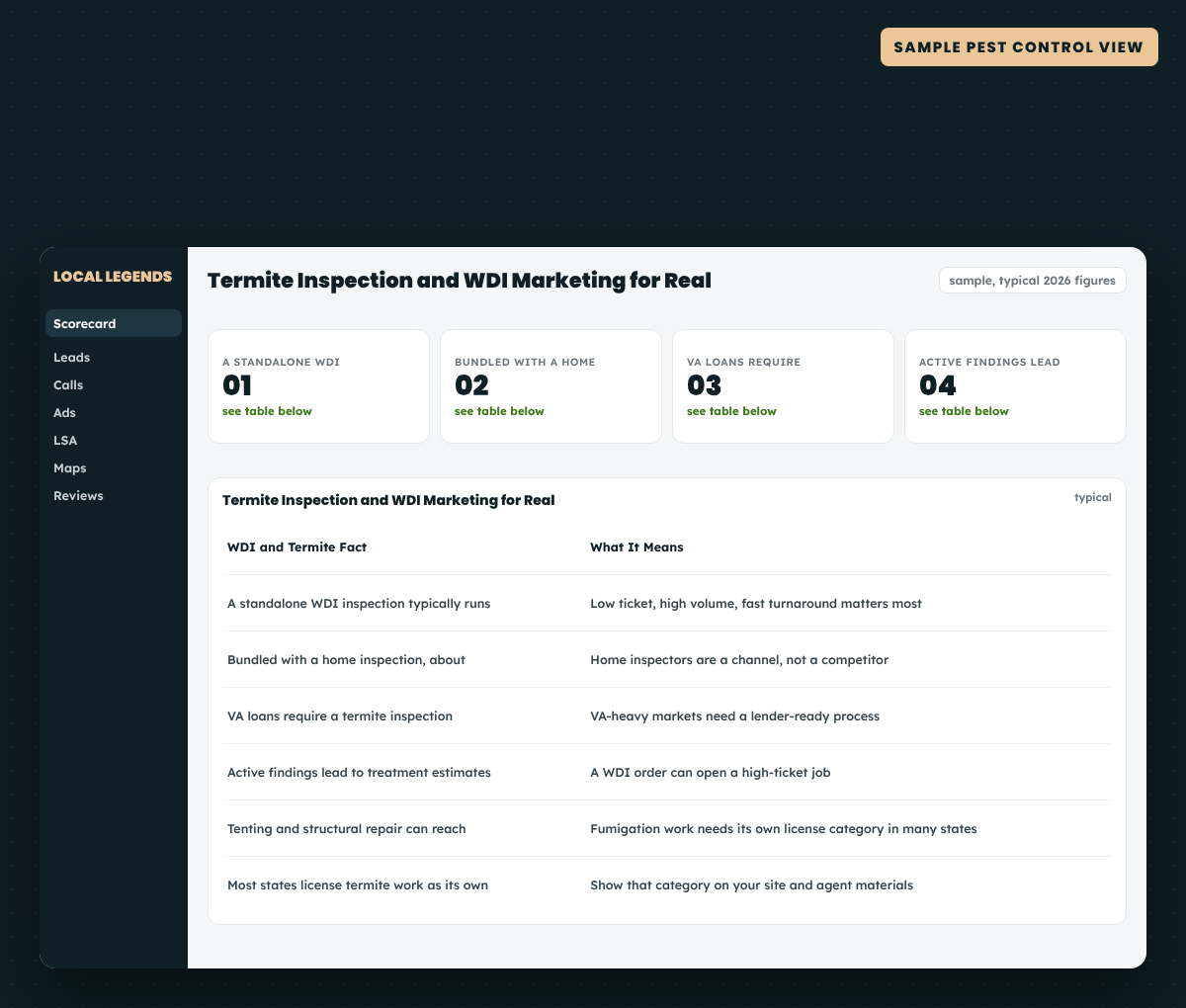
Termite Inspection and WDI Marketing for Real Estate Work Win the Agents and the Inspectors First
Termite and wood destroying insect (WDI) inspections are a referral business, because the order usually comes from a realtor, a lender or a home inspector, not from a homeowner searching. The report most lenders and HUD or VA deals use is the NPMA-33 form, often called a termite letter.
| WDI and Termite Fact (Typical, 2026) | What It Means for Marketing |
|---|---|
| A standalone WDI inspection typically runs $75-$150+ | Low ticket, high volume, fast turnaround matters most |
| Bundled with a home inspection, about $50-$100+ | Home inspectors are a channel, not a competitor |
| VA loans require a termite inspection in termite-active areas | VA-heavy markets need a lender-ready process |
| Active findings lead to treatment estimates around $1,500-$4,000+ | A WDI order can open a high-ticket job |
| Tenting and structural repair can reach $5,000-$15,000+ | Fumigation work needs its own license category in many states |
| Most states license termite work as its own applicator category | Show that category on your site and agent materials |
How Does My Pest Control Company Get More Termite Inspections and WDI Real Estate Inspections From Realtors?
A pest control company earns more WDI orders by being the fastest, easiest inspector for agents to book, because realtors care most about keeping the closing on schedule. AI Mode and ChatGPT both put 24-hour report turnaround and simple online booking at the top.
- Promise 24-hour reports and digital, phone-friendly NPMA-33 copies that agents can forward to lenders.
- Give agents a booking link and a direct text line that skips your main phone queue.
- Target the top 20% of local agents, who handle most listings, plus transaction coordinators.
- Partner with independent home inspectors as their termite subcontractor.
- Teach a short class at brokerage meetings on spotting termite damage before listing.
- Explain findings calmly: treatable problems, clear next steps, a written retreatment process.
- Track every agent as a lead source so you know who sends work and who sends repeat work.
Every WDI with clean results is a chance to offer the new owner a termite monitoring plan and a general pest plan the week they move in.
Should My Pest Control Company Run Door-to-Door Summer Sales or Invest in Inbound Marketing? Both Can Work, but They Build Different Businesses
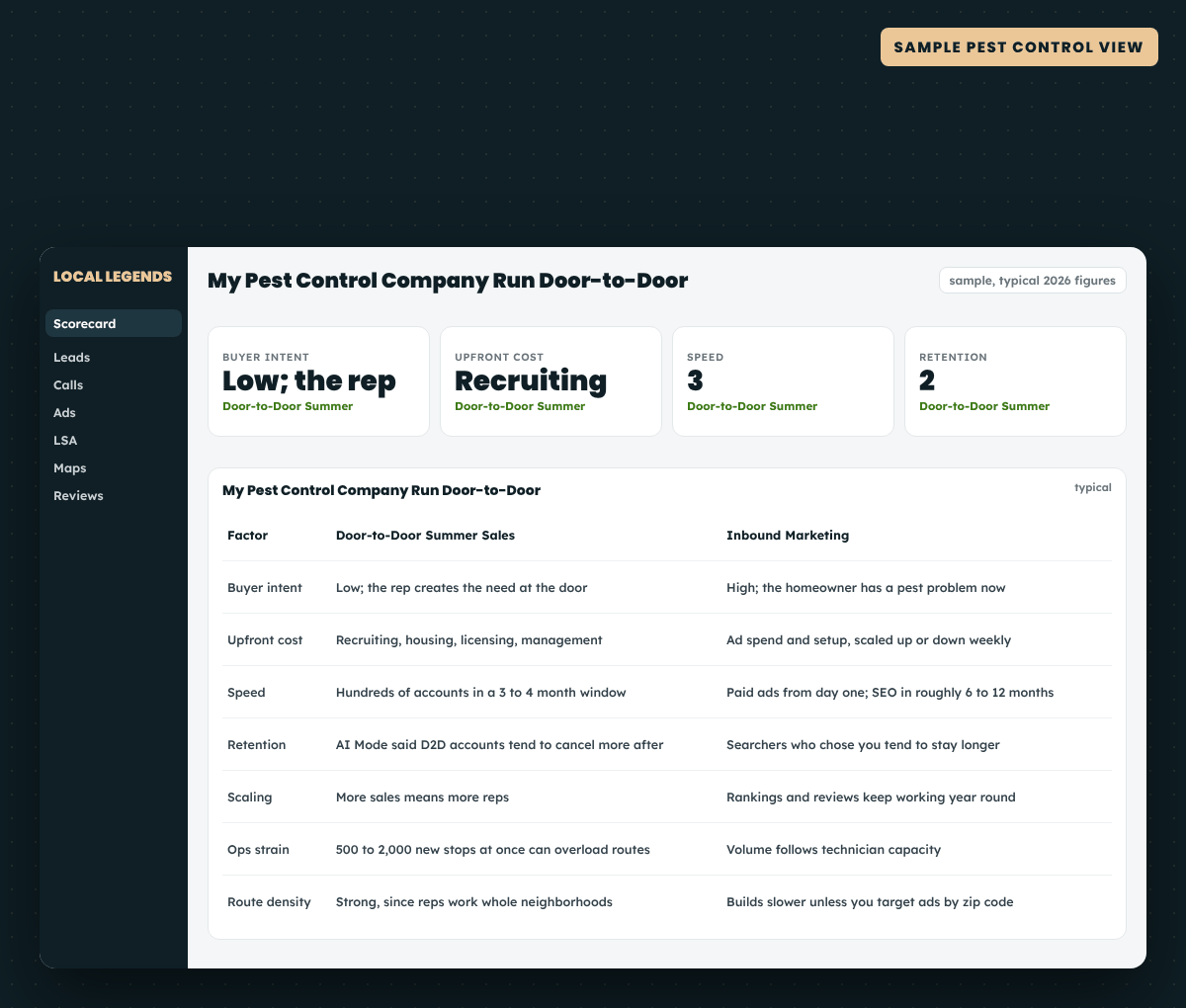
For most pest control companies, inbound marketing (Local Services Ads, Google Ads and SEO) is the steadier base, and a door-to-door summer team is a faster but riskier add-on. AI Mode and ChatGPT reached that same verdict on their own.
| Factor | Door-to-Door Summer Sales | Inbound Marketing |
|---|---|---|
| Buyer intent | Low; the rep creates the need at the door | High; the homeowner has a pest problem now |
| Upfront cost | Recruiting, housing, licensing, management, commissions | Ad spend and setup, scaled up or down weekly |
| Speed | Hundreds of accounts in a 3 to 4 month window | Paid ads from day one; SEO in roughly 6 to 12 months |
| Retention | AI Mode said D2D accounts tend to cancel more after year one | Searchers who chose you tend to stay longer |
| Scaling | More sales means more reps | Rankings and reviews keep working year round |
| Ops strain | 500 to 2,000 new stops at once can overload routes | Volume follows technician capacity |
| Route density | Strong, since reps work whole neighborhoods | Builds slower unless you target ads by zip code |
One owner quoted in a 2024 trade magazine story put his door success rate at about 10% to 15% of people spoken to. Commission plans often claw back pay on cancellations inside 60 days and pay a bonus at 90 days or 6 months.
When a Door-to-Door Team Makes Sense
- Your routes have room for a sudden wave of new stops without hurting service.
- You have managers who know how to recruit, train and keep summer reps honest.
- You measure retained accounts, not contracts signed, and pay reps the same way.
- Your local permit rules allow it, since many towns require a solicitor permit.
How Inbound Supports a Door Team
Reps close more when homeowners already know the truck. Facebook ads by zip code, strong reviews and a clear website mean the homeowner who Googles your name at the door finds proof, not silence.
Pest Control Marketing Seasonality: Termite Swarms, Mosquito Season and Fall Rodents A 12-Month Pest Marketing Calendar
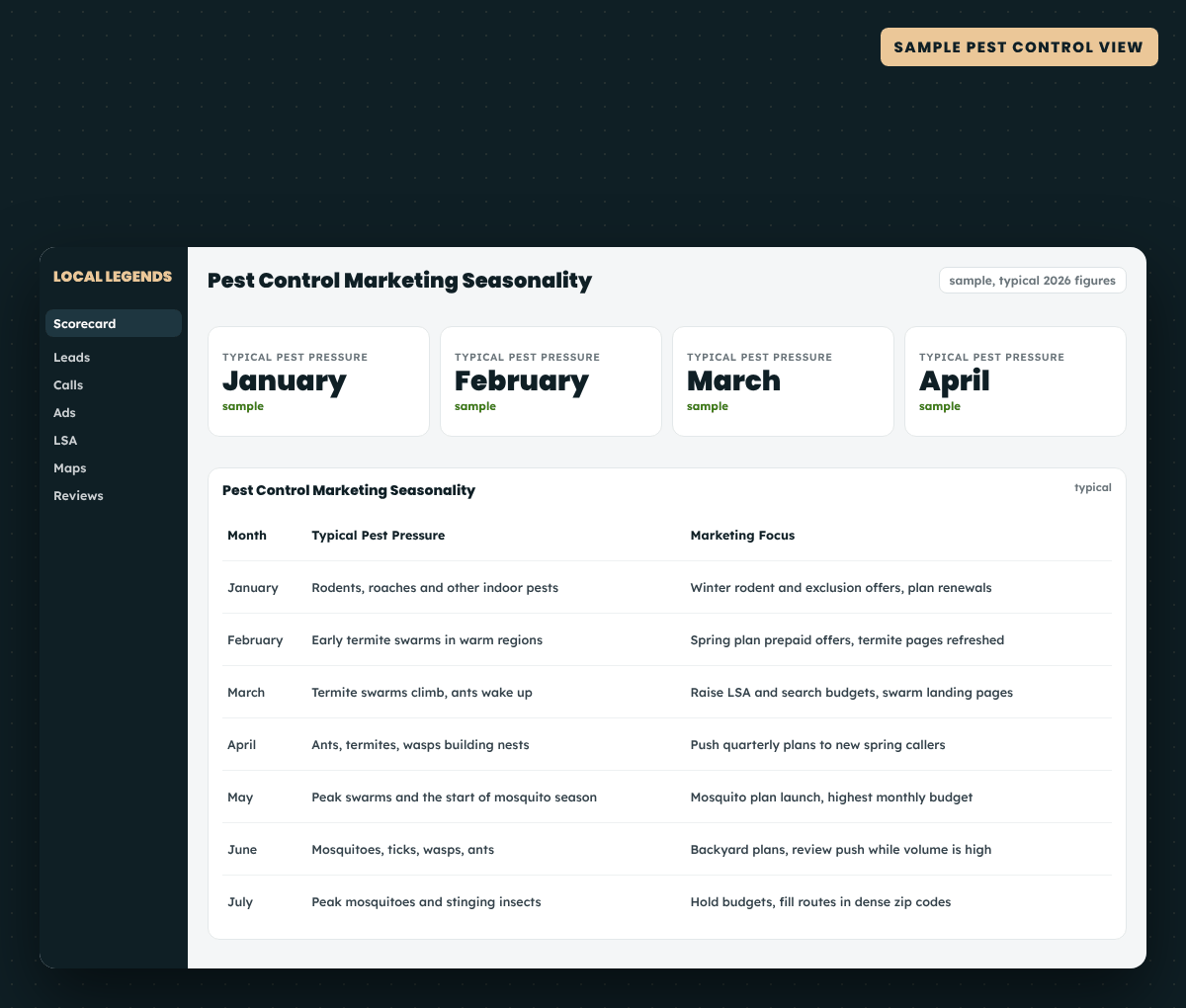
Pest control demand follows the weather: termites swarm in spring, mosquitoes and stinging insects peak in summer, and rodents push indoors in fall and winter. Trade guides put termite swarm season from late February through June, with the peak in March through May.
| Month | Typical Pest Pressure | Marketing Focus |
|---|---|---|
| January | Rodents, roaches and other indoor pests | Winter rodent and exclusion offers, plan renewals |
| February | Early termite swarms in warm regions | Spring plan prepaid offers, termite pages refreshed |
| March | Termite swarms climb, ants wake up | Raise LSA and search budgets, swarm landing pages |
| April | Ants, termites, wasps building nests | Push quarterly plans to new spring callers |
| May | Peak swarms and the start of mosquito season | Mosquito plan launch, highest monthly budget |
| June | Mosquitoes, ticks, wasps, ants | Backyard plans, review push while volume is high |
| July | Peak mosquitoes and stinging insects | Hold budgets, fill routes in dense zip codes |
| August | Late summer ants, wasps and fleas | Convert one-time summer calls to plans |
| September | Rodents start looking for shelter | Fall rodent and exclusion campaigns begin |
| October | Rodents and overwintering pests move in | Exclusion jobs, retention texts before late fall churn |
| November | Rodents and indoor pests | Winter inspection offers, thank-you notes to plan customers |
| December | Quietest month in many markets | Retention, reviews, SEO and next year's plan |
One pest marketing guide suggested splitting the year about 20% in Q1, 40% in Q2, 25% in Q3 and 15% in Q4, with May's budget near 3.75 times December's. Treat that as a starting shape, then adjust to your own call log.
How Should My Pest Control Company Market by Season and Keep Technicians Busy in the Slow Winter Months?
Winter pest control marketing works when it sells cold-weather pests and labor-heavy jobs instead of general spraying. Industry data cited in trade guides says rodents invade about 21 million U.S. homes each winter, and about 45% of in-home rodent sightings happen in fall and winter.
- Start rodent ads in late September, before the first freeze, not after the calls slow.
- Sell exclusion work: sealing gaps, door sweeps, vent screens and chimney caps fill tech schedules.
- Offer attic and crawl space work if you are equipped, since those tickets run far higher than a spray.
- Market indoor pests that stay active, like roaches and bed bugs, with winter bundles.
- Call every plan customer before late fall, when many cancel because they stop seeing bugs.
- Publish spring content 30 to 60 days before the season so pages rank when searches spike.
How Should My Pest Control Company Market Mosquito and Tick Control to Homeowners?
Mosquito and tick control sells best as a seasonal backyard plan for families, not a single spray. AI Mode advised starting ads the week local temperatures hold near 50 degrees and running the plan roughly April through October.
| Mosquito and Tick Tactic | How It Works |
|---|---|
| Seasonal backyard plan | Monthly visits through the season on one signup |
| Family and pet message | Kids in the yard, cookouts and pets kept safe from ticks |
| Zip code targeting | Facebook ads near homes with big yards and pools |
| Timing by thermometer | Turn ads on as spring temperatures settle, not by calendar date |
| Partner referrals | Landscapers, pool builders and veterinarians |
| Local season pages | "When does tick season start" content written for your area |
Pest Control SEO and the Google Map Pack Relevance and Prominence You Can Control
Pest control SEO wins the Map Pack by strengthening the two signals you control, relevance and prominence, since the searcher's location sets distance. Google AI Overview put noticeable Maps movement at about 3 to 6 months of steady work.
How Does a Pest Control Company Rank Higher in the Google Map Pack for Exterminator Near Me?
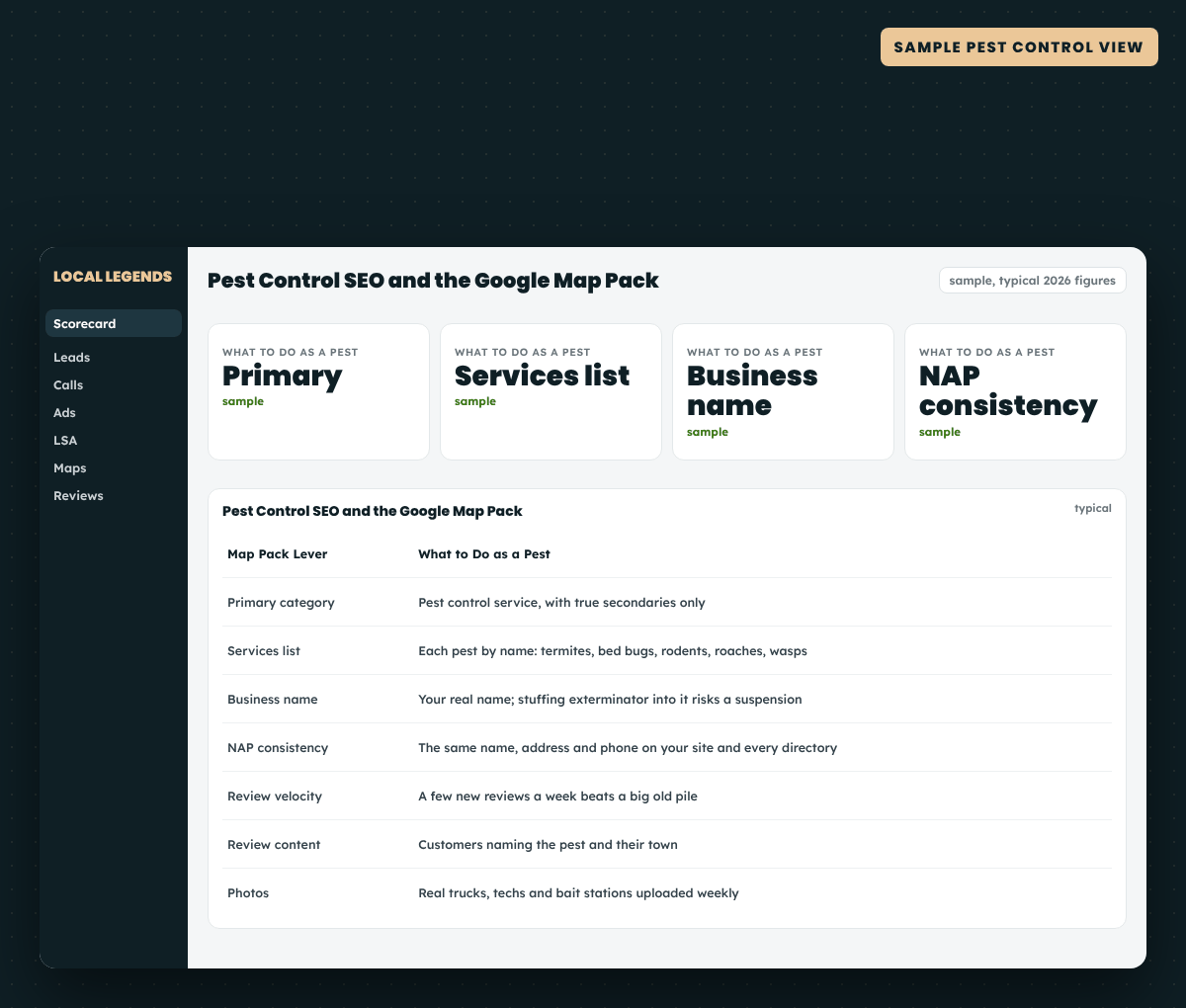
An exterminator ranks higher in the Map Pack with the right primary category, a full services list, steady fresh reviews and city pages that say something real about local pests. AI Mode and ChatGPT both named "Pest control service" as the primary category.
| Map Pack Lever | What to Do as a Pest Control Company |
|---|---|
| Primary category | Pest control service, with true secondaries only |
| Services list | Each pest by name: termites, bed bugs, rodents, roaches, wasps, mosquitoes |
| Business name | Your real name; stuffing "exterminator" into it risks a suspension |
| NAP consistency | The same name, address and phone on your site and every directory |
| Review velocity | A few new reviews a week beats a big old pile |
| Review content | Customers naming the pest and their town |
| Photos | Real trucks, techs and bait stations uploaded weekly |
| City and pest pages | Local pest pressure, housing types and season timing, not swapped city names |
AI Mode noted that a company with 150 reviews earning 2 or 3 new ones each week tends to outrank a rival sitting on 1,000 old ones. Check your reach with a sample Maps rank grid around your office.
Google Business Profile management covers the profile work, and Local Legends is added as an owner while you stay the primary owner.
How Do I Get More Google Reviews for My Pest Control Business?
A pest control company gets more reviews by asking at the moment of relief, by text, with a direct review link. For bed bugs and rodents, AI Mode said to wait for the follow-up visit that confirms the pests are gone; for a wasp nest, ask within an hour or two.
- Text the link, not an email, the same day the job is confirmed done.
- Ask on follow-up visits for infestations, when the homeowner can see the result.
- Ask customers to mention the pest and their town in their own words.
- Have techs ask in person when a customer thanks them at the door.
- Reply to every review within a day, naming the service when it fits.
- Never buy or filter reviews; Google removes them and can restrict the profile.
The LSA Ranker review texter in every Local Legends growth plan sends the ask automatically, and review management keeps replies current.
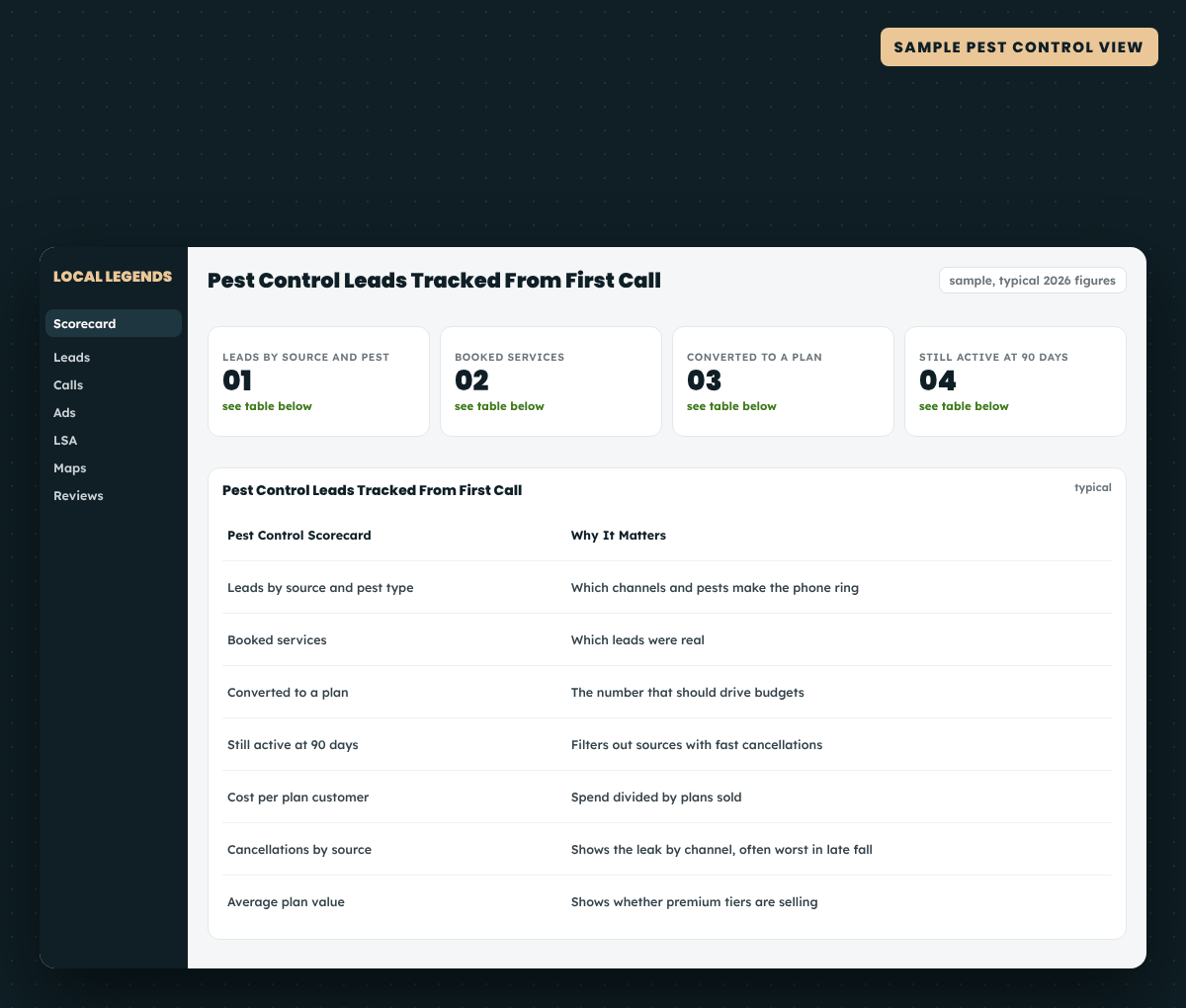
Pest Control Leads Tracked From First Call to Renewed Plan Count the Customers Who Are Still Paying
Pest control marketing should be judged by plan customers still active at 90, 180 and 365 days, not by leads. Impressions, rankings and calls are chapter one; Local Legends tracks them through to booked services, signed plans, renewals and cost per plan customer.
How Do I Track Which Marketing Brings Pest Control Customers Who Stay on a Recurring Plan in FieldRoutes, PestPac or GorillaDesk?
You track recurring customers by stamping a marketing source on every new customer at signup, then reporting active plans and cancellations by that source. AI Mode described FieldRoutes marketing codes filtered by active subscriptions, plus a cancel report grouped by code.
- One tracking number per channel with CallRail, so LSA, search ads, Maps and Facebook calls never blur together.
- A required source field on every new customer, picked from a fixed list, never typed free-hand.
- Hidden source fields on web forms that carry the campaign into your routing software.
- A source for each realtor and inspector who sends WDI work.
- Monthly cohort reports: customers by source still active at 90, 180 and 365 days.
| Pest Control Scorecard Line | Why It Matters |
|---|---|
| Leads by source and pest type | Which channels and pests make the phone ring |
| Booked services | Which leads were real |
| Converted to a plan | The number that should drive budgets |
| Still active at 90 days | Filters out sources with fast cancellations |
| Cost per plan customer | Spend divided by plans sold |
| Cancellations by source | Shows the leak by channel, often worst in late fall |
| Average plan value | Shows whether premium tiers are selling |
Local Legends sets up CallRail and connects it to the CRM stack it supports (ServiceTitan, Housecall Pro, Jobber, GoHighLevel and others) through call tracking and CRM integration, and matches source names to the codes your pest routing software uses.
How Much Does Pest Control Marketing Cost in 2026? Agency Fees, Ad Spend and Cost Per Lead
Pest control marketing typically costs $1,500-$5,000+ a month in agency fees for a growing residential company in 2026, with ad spend paid separately. Those are typical industry ranges, not Local Legends prices.
| Typical Pest Control Agency Option (2026) | Typical Monthly Fee | What It Usually Covers |
|---|---|---|
| Low-cost starter programs | About $200-$300+ | Template site and baseline SEO |
| Single channel management | $1,500-$2,500+ or 15% to 20% of spend | Google Ads or LSA alone |
| Local SEO | $1,500-$5,000+ | Profile, pest and city pages, citations, reviews |
| Full service | $2,500-$10,000+ | Ads, SEO, website, reviews, tracking |
| Websites | $2,500-$50,000+ one time | Small template sites to custom builds |
Local Legends Prices for Pest Control Companies
Local Legends Marketing charges flat monthly fees, never a percentage of ad spend, and you pay Google or Meta for ads directly. Every growth plan includes the LSA Ranker review texter and fractional CMO and CEO meetings.
| Local Legends Plan or Service | Price | What It Means for an Exterminator |
|---|---|---|
| Google Ads + Local Services Ads | $2,000 a month + ad spend | Pest job types, search campaigns by pest, weekly lead disputes, monthly GBP optimization |
| Facebook + Instagram Ads | $2,500 a month + ad spend | Seasonal plan campaigns by zip code |
| Footprint | $2,500 a month | Google Ads + LSA, 10 pages/blogs a month, GBP photo posts twice a week, local SEO + 70+ citations, call tracking, monthly scorecard |
| Trailblazer | $4,000 a month | Adds 20 pages/blogs, Bing and Facebook/Instagram ads, backlinks, review automation, email and text automations, weekly scorecard |
| Sasquatch | $8,000 a month | Adds 50 pages/blogs, AI SEO, connected TV, geofencing, retargeting |
| Legend | $10,000+ a month | Adds 100 pages/blogs, ad management up to $40,000 a month in spend, multi-location pages |
| Website (one time) | $2,500-$15,000+ | 10 to 80 pages with pest and city pages and plan signup paths |
Local Legends Pricing Next to Typical Agency Quotes
Because Local Legends publishes its prices, a pest control owner can line them up against the quotes on the desk.
| Service | Local Legends Price | What Other Agencies Typically Charge |
|---|---|---|
| Google Ads + Local Services Ads management | $2,000 a month + ad spend | $1,500-$2,500+ a month minimum or 15% to 20% of spend |
| Facebook + Instagram ads | $2,500 a month + ad spend | $1,500-$3,500+ a month or 12% to 18% of spend |
| Connected TV | $1,500 a month + media | $3,000-$15,000+ a month retainer with $5,000-$25,000+ media minimums |
| Local SEO | Included in every plan from $2,500 a month | $1,500-$5,000+ a month |
| Social media | Posts included in every plan | $1,000-$4,000+ a month |
| Full service | $2,500-$10,000+ a month | $2,500-$10,000+ a month |
| Website | $2,500-$15,000+ one time | $2,500-$50,000+ |
Every plan and add-on is listed on the Local Legends pricing page.
How Much Should a Pest Control Company Spend on Marketing, and What Is a Good Cost Per Lead?
A typical established pest control company spends about 6.6% of revenue on marketing, per a 2025 industry cost study of 246 companies that AI Mode and ChatGPT both cited, and growth-stage companies often run 7% to 12%. A good blended cost per lead is typically $40-$100+.
| Pest Control Benchmark (Typical, 2026) | Range |
|---|---|
| Marketing spend, established company | About 5% to 7% of revenue |
| Marketing spend, growing company | About 7% to 12% of revenue |
| Local Services Ads cost per lead | About $25-$65+ |
| Google Search Ads cost per lead | About $50-$125+ |
| Facebook ads cost per lead | About $10-$50+, with lower close rates |
| Blended cost per lead | About $40-$100+ |
| Cost to sign one recurring plan customer | About $180-$350+ |
| Recurring plan lifetime value | About $1,500-$3,000+ |
Work it backward from plans. Say you want 30 new plan customers a month, you book 45% of leads and half of booked jobs join a plan. That takes about 135 leads; at a blended $50 per lead, about $6,750 in spend, or about $225 per plan customer worth thousands.
AI Mode added a warning worth repeating: companies that drop below about 5% of revenue on marketing often cannot outrun normal cancellations.
What Is the Best Pest Control Marketing Company for a Residential Pest Control Business? Judge Them by Plans Sold and Accounts You Keep
The best pest control marketing company is the one that runs Local Services Ads and search ads by pest, reports cost per plan customer and leaves every account in your name. AI platforms asked this question gave criteria and shortlists, not one winner.
| What AI Platforms Said to Look For | How Local Legends Answers It |
|---|---|
| Pest control know-how: seasons, route density, urgent calls | Seasonal calendars, zip code targeting and pest-by-pest campaigns |
| Google Maps and Map Pack rankings | Monthly GBP optimization and local SEO in every plan |
| Local Services Ads and Google Ads | $2,000 a month flat for Google Ads + LSA with weekly lead disputes |
| Landing pages that convert | Product-page website design with plan signup paths |
| Tracking calls to revenue | CallRail, source codes and a CEO scorecard to renewals |
| Recurring agreements, not just leads | Plan conversion and 90-day retention on the scorecard |
| You own your website, domain, ads and profile | Every account stays in your name |
An Honest Note for Smaller Companies
AI Mode told owners under about $1 million in revenue to lean on LSA, their Google Business Profile and reviews before paying big retainers. That is fair advice. The Footprint plan exists for that stage, and the growth audit will tell you if you are not ready yet.
Red Flags When Hiring a Pest Control Marketing Agency
- They report leads, never plans sold or cancellations.
- They charge a percentage of ad spend, which rewards spending more, not selling better.
- They own the website or ad account and keep it when you leave.
- They promise rankings or a set number of customers.
- They copy the same city page with only the town name swapped.
- They want a long contract before anything shows up on a scorecard.
Our Pest Control Marketing Process, Step by Step Audit, Track, Launch, Retain
Local Legends Marketing starts every pest control company with an audit, because a broken call path or a weak profile wastes every ad dollar that follows.
Step 1: Growth Audit
We review call tracking, local SEO, Local Services Ads job types and the booking funnel, including review flow, missed calls and how your profile stacks up against nearby exterminators.
Step 2: Tracking and Ownership
CallRail numbers, source fields and campaign codes go in first, and every account is confirmed in your name.
Step 3: Fast Channels Live
LSA and search campaigns launch by pest, pointed at landing pages that lead with the plan offer.
Step 4: Plan Conversion Engine
Follow-up texts, plan tiers, review asks and seasonal emails start working on every one-time customer.
Step 5: Weekly Review and the Pest Calendar
A weekly project review checks leads, plans sold and cancellations, and the season plan sets the next budget move.
Exterminator Marketing From a Founder Who Worked the Field Levi Ostlund Started Before the Agency Did
Local Legends Marketing founder Levi Ostlund knocked on doors to sell driveway jobs at 10 years old, poured concrete with his father and ran a landscaping company in high school, so door work and route work are not theory to him.
He also lost $30,000+ to marketers who let him down, one who vanished and one whose pretty site never ranked. Later, as CMO of Amstill Roofing, he ran marketing for the owner, which is why Local Legends keeps every account in the owner's name.
- 8+ years marketing home service contractors
- Former CMO of Amstill Roofing
- The Local Legends marketing course comes with every engagement
- A weekly project review on every account
- Nationwide reach: see the Local Legends service areas and the other industries we serve
Frequently Asked Questions About Pest Control Marketing Short Answers for Pest Control Owners
Do I Need Someone Answering the Phone Live to Run Local Services Ads?
Yes, live answering matters more for pest control LSA than almost anything else. Google ranks responsive businesses higher, and a missed call can still bill as a lead, so cover your listed hours with a person or a trained answering service.
How Many Google Reviews Does a Pest Control Company Need?
There is no fixed number; steady new reviews matter more than the total. Two or three fresh reviews a week that mention the pest and the town usually beat a large count that stopped growing.
How Long Does Pest Control SEO Take to Work?
Map Pack movement typically shows in about 3 to 6 months, and organic rankings for competitive pest terms often take 6 to 12 months. That is why LSA and search ads run first.
Should a Small Pest Control Company Hire an Agency?
Under about $1 million in revenue, start with LSA, your Google Business Profile and reviews, and hire help when you can measure cost per plan customer. The growth audit will say if paid help makes sense yet.
Do I Keep My Website, Google Business Profile and Ad Accounts If I Leave?
Yes, the website, domain, Google Business Profile, ad accounts and call data stay yours. Local Legends is added as an owner while you remain the primary owner, and there are no long-term contracts.
Will the LSA Move Into Google Ads Change My Pest Ads?
Your ads keep showing on Search and Maps, but the controls change. Export your LSA reports, note your job types and budgets, and split termite from general pest if you want separate cost targets.
Do You Market Commercial Pest Control or Wildlife Removal?
Local Legends focuses on residential pest control, and wildlife can be part of it. Commercial contracts and wildlife work usually run better on search ads and their own landing pages than on LSA.
Which Software Does Your Tracking Work With?
CallRail tracking connects to the CRMs Local Legends supports, including ServiceTitan, Housecall Pro, Jobber and GoHighLevel, and source names are matched to the marketing codes in your pest routing software so reports line up.
What Does the Pest Control Growth Audit Include?
The growth audit covers call tracking, local SEO, Local Services Ads and your funnel, including job types, plan offers, review flow and missed calls.
Reviewed by Levi Ostlund, Founder, Local Legends Marketing

Get Pest Control Marketing That Fills Routes With Plan Customers You Own Book Your Pest Control Growth Audit
Local Legends Marketing builds pest control marketing that answers urgent calls, turns them into quarterly plans and tracks every lead to the customers who renew, all inside accounts you own.
- Call:(936) 900-1248
- Office: 481 Stephen F Austin Dr, Conroe, TX 77302
- Next step: book your growth audit; Google Ads and LSA management is $2,000 a month and growth plans start at $2,500 a month