


Springs to New Doors

Garage Door Marketing That Turns Broken Spring Calls, Opener Swaps and New Door Installs Into Booked Jobs You Own
Local Legends Marketing for Residential Garage Door Companies
Updated November 2026 · Reviewed by Levi Ostlund, Founder
Local Legends Marketing is a garage door marketing agency that gets your trucks the stuck-door calls first, through Google Local Services Ads, Google Ads and the Map Pack, then turns those repair visits into opener and new door sales you can track.
Garage door is a Google Local Services Ads category in the US, so LSA goes live early. Google Ads and LSA management is $2,000 a month plus ad spend, and growth plans start at $2,500 a month. Call (936) 900-1248 to book your audit.
- Emergency calls first: broken springs, snapped cables and doors that will not open drive most first calls.
- Verified before you advertise: Google requires advanced verification for garage door ads, and we get your paperwork ready.
- Real listings win: we teach your team how to report fake garage door listings crowding your map.
- Repair to replacement: every spring call is tracked as a lead for the opener or new door that may follow.
- Agency-reported proof: 25,000+ appointments generated and $30M+ in revenue influenced, with every account in your name.
Free Growth Audit
Your Reviews, Radius and Response Rate vs the competitors beating you.
About Local Legends Marketing
A home service marketing agency headquartered in Conroe, Texas, with 8+ years of marketing experience, running Google Ads, Local Services Ads, local SEO, AI SEO, connected TV and review systems for contractors nationwide.
Garage Door Company Marketing Vouched For by Contractor CEOs What Owners Said on Camera
Home service CEOs have recorded what it was like to hire Local Legends Marketing(link: /) and founder Levi Ostlund to run their ads, search and lead tracking.
Those owners run trades with the same pressure garage door owners know: urgent calls, crowded maps and trucks that need a full board. The weekly CEO scorecard they get shows leads, booked jobs, sold jobs and cost per booked job, not just clicks.
Levi has been absolutely outstanding to work with over the years... His creativity, responsiveness, and deep understanding of our marketing strategy have made a huge impact.
 Brad Beldon
CEO, Roofing Company
How Garage Door Marketing Is Different From Other Home Service Trades Urgent Calls, Fake Listings and a Second Sale
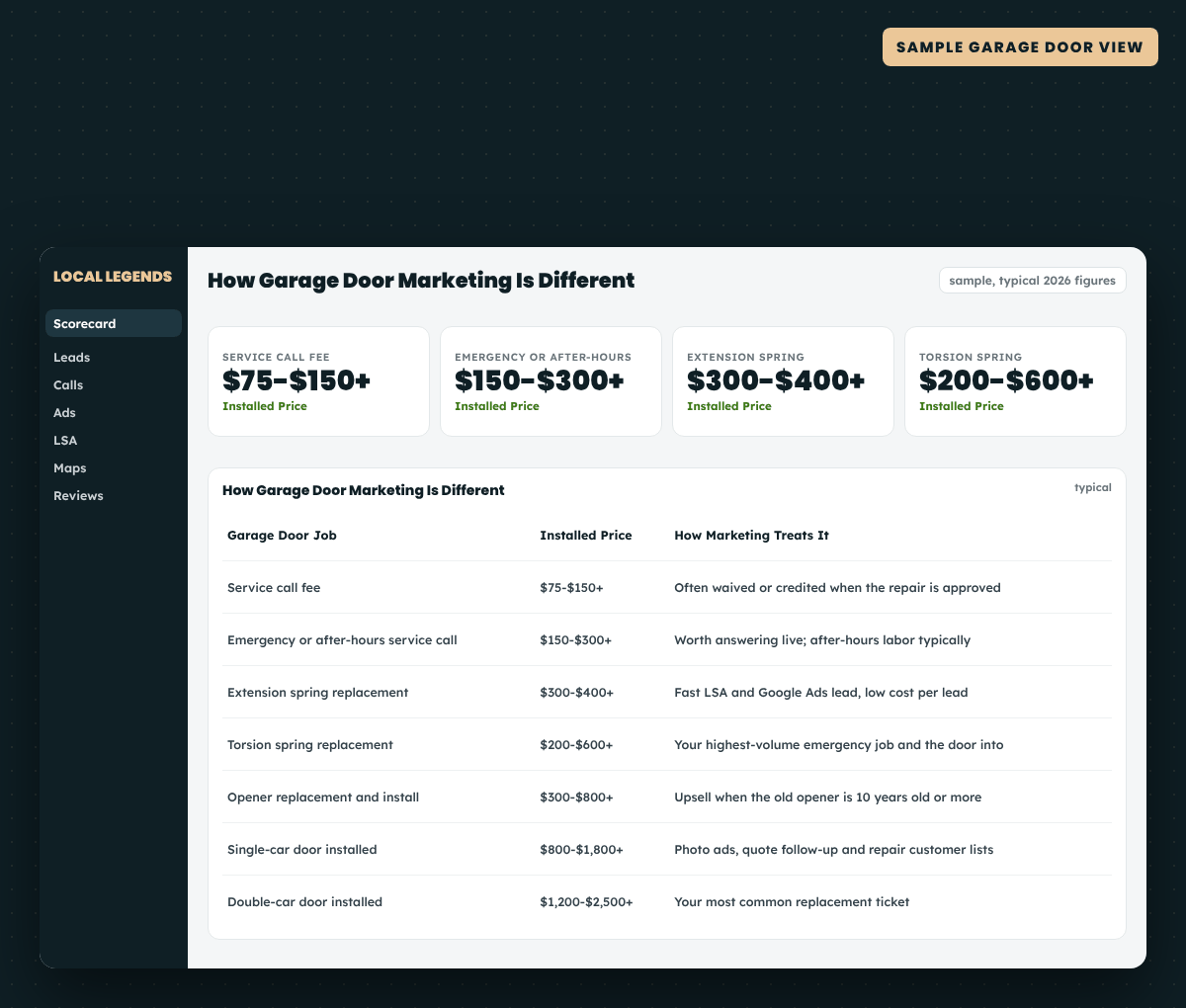
Garage door marketing is different because most first calls are emergencies, the Google map is full of fake listings, and the bigger sale usually comes after the repair. A homeowner with a car stuck inside calls fast and hires whoever answers.
That mix changes the plan. Speed to answer matters more than a pretty brand video, Google screens garage door advertisers harder than most trades, and the profit often sits in the opener or new door a tech recommends on the second visit.
| What Makes Garage Doors Different | What It Means for Your Marketing |
|---|---|
| Broken springs and cables strand cars and homeowners | Calls come fast and go to the first company that answers |
| Torsion springs typically last about 10,000 to 20,000 cycles (2026 cost guides) | Older neighborhoods are full of springs near the end of their life |
| Google restricts garage door repair ads in the US until advanced verification is done | Paperwork and a video interview come before your first ad |
| Garage door is a Google Local Services Ads category, flagged as urgent | LSA screening is stricter, and pay-per-lead calls are worth chasing |
| Fake listings and lead resellers crowd the Map Pack | Real reviews, a verified profile and spam reporting decide who gets seen |
| New doors are a visual, planned purchase | Photo and video ads plus quote follow-up sell installs |
| Cold snaps, heat waves and storms move call volume | Budgets should flex by week, not stay flat all year |
What Is the Average Ticket for Garage Door Spring Repair, Opener Installs and New Garage Doors, and Which Jobs Should My Marketing Focus On?
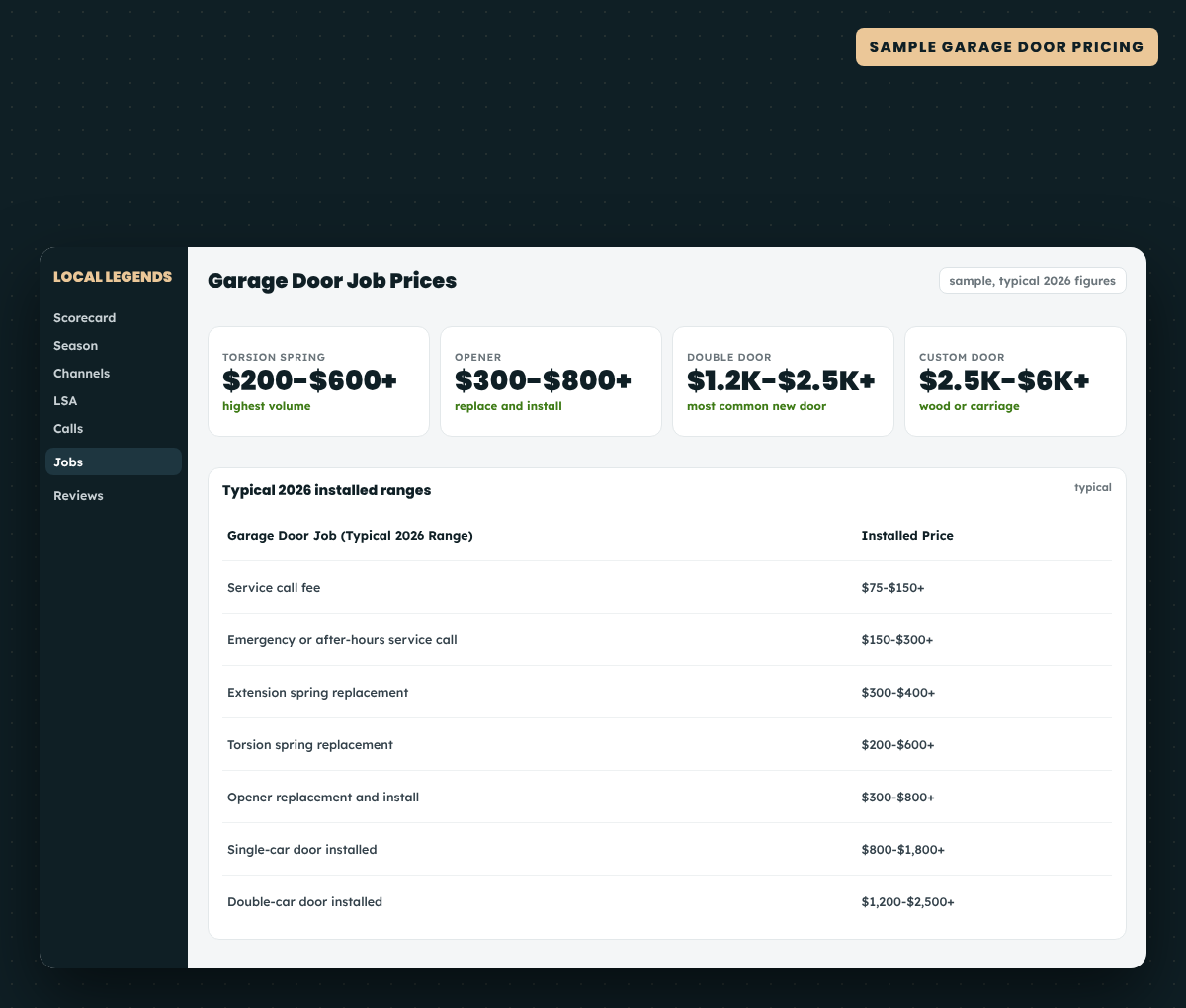
Garage door tickets typically run a few hundred dollars for springs, a few hundred more for openers, and four figures for new doors, based on 2026 consumer cost guides. Marketing should win the spring call cheaply and track it to the bigger sale.
| Garage Door Job (Typical 2026 Range) | Installed Price | How Marketing Treats It |
|---|---|---|
| Service call fee | $75-$150+ | Often waived or credited when the repair is approved |
| Emergency or after-hours service call | $150-$300+ | Worth answering live; after-hours labor typically runs 1.5 to 2 times standard |
| Extension spring replacement | $300-$400+ | Fast LSA and Google Ads lead, low cost per lead |
| Torsion spring replacement | $200-$600+ | Your highest-volume emergency job and the door into the home |
| Opener replacement and install | $300-$800+ | Upsell when the old opener is 10 years old or more |
| Single-car door installed | $800-$1,800+ | Photo ads, quote follow-up and repair customer lists |
| Double-car door installed | $1,200-$2,500+ | Your most common replacement ticket |
| Insulated double door | $1,200-$3,500+ | Sell comfort for attached garages |
| Custom wood or carriage-style door | $2,500-$6,000+ | Visual ads and a portfolio page |
- Spring jobs fill the board: they are frequent and cheap to buy on LSA, so they keep techs busy all year.
- Openers lift the ticket: a 10 to 15-year-old opener on a repair call is a natural upgrade to a Wi-Fi smart opener.
- New doors carry the margin: replacement leads cost more but are worth several repair tickets.
- Commercial overhead doors are their own funnel: Google Local Services Ads does not cover most commercial door work, so it lives in Google Ads and direct outreach.
How Fast Does a Garage Door Company Need to Answer Broken Spring Calls, and What About After-Hours Calls? The Car Is Stuck and They Are Still Dialing
A garage door company needs to answer broken spring calls live, on the first few rings, every hour it advertises. A homeowner with a car trapped behind a dead door does not leave a voicemail; they call the next listing.
Call volume guides for the trade put about 20% to 35% of emergency garage door calls in evenings and weekends, and storm days can raise calls 30% to 80% within a day or two. Google also says how responsive you are to calls feeds where your Local Services Ads show.
- Answer live during ad hours: a missed LSA call costs the lead and can hurt your LSA ranking.
- Match your hours to your coverage: only show 24/7 on Google Business Profile and LSA if a person really answers at 2 AM.
- Use an answering service or on-call rotation: after-hours callers want a time slot, not a callback promise.
- Text back every missed call within a minute: an automatic text holds the caller while your tech calls back.
- Triage in three questions: is the door stuck open or closed, is a car trapped, and can they see a broken spring above the door?
- Give a firm arrival window: a booked time slot tonight stops the homeowner from calling the next company.
- Price emergency visits clearly: say if after-hours service costs more, so the call does not end in a surprise.
- Pause or cut bids when nobody can answer: paying for calls that ring out is the most expensive mistake in this trade.
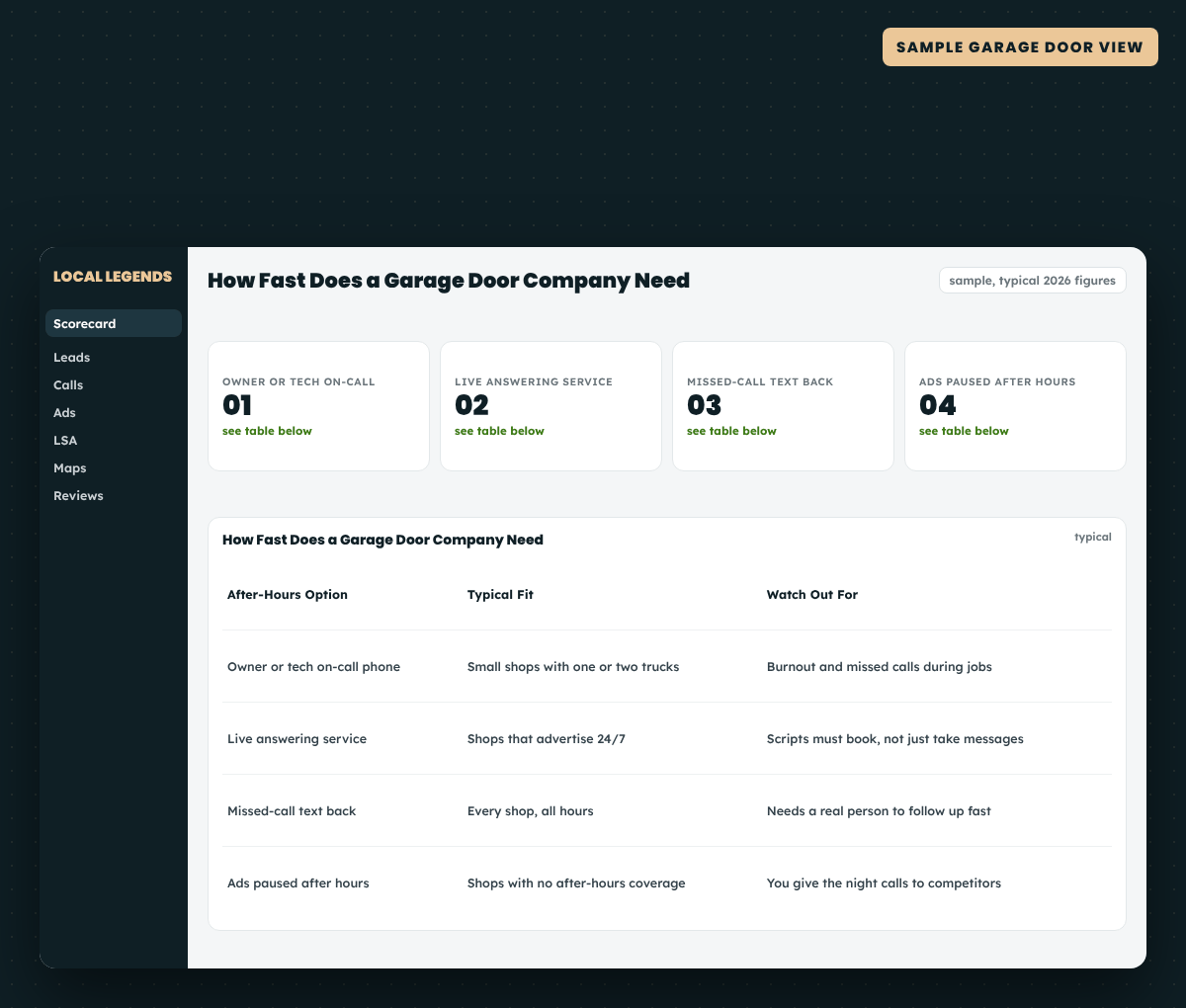
| After-Hours Option | Typical Fit | Watch Out For |
|---|---|---|
| Owner or tech on-call phone | Small shops with one or two trucks | Burnout and missed calls during jobs |
| Live answering service | Shops that advertise 24/7 | Scripts must book, not just take messages |
| Missed-call text back | Every shop, all hours | Needs a real person to follow up fast |
| Ads paused after hours | Shops with no after-hours coverage | You give the night calls to competitors |
How Much Do Missed Garage Door Calls Really Cost?
Missed garage door calls cost more than the repair ticket, because a lost spring call is also a lost opener sale, a lost review and a lost future replacement. The math below uses typical ranges, not a client result.
| Missed-Call Math (Illustrative) | Value |
|---|---|
| Missed emergency calls per week | 5 |
| Typical spring repair ticket | $300+ |
| Lost repair revenue per month | about $6,000+ |
| Share that would have added an opener or new door later | even a few jobs a year adds thousands |
| Local Services Ads ranking impact | lower responsiveness can push your ad down |
The Local Legends Channel Mix for Garage Door Companies What Goes First and Why
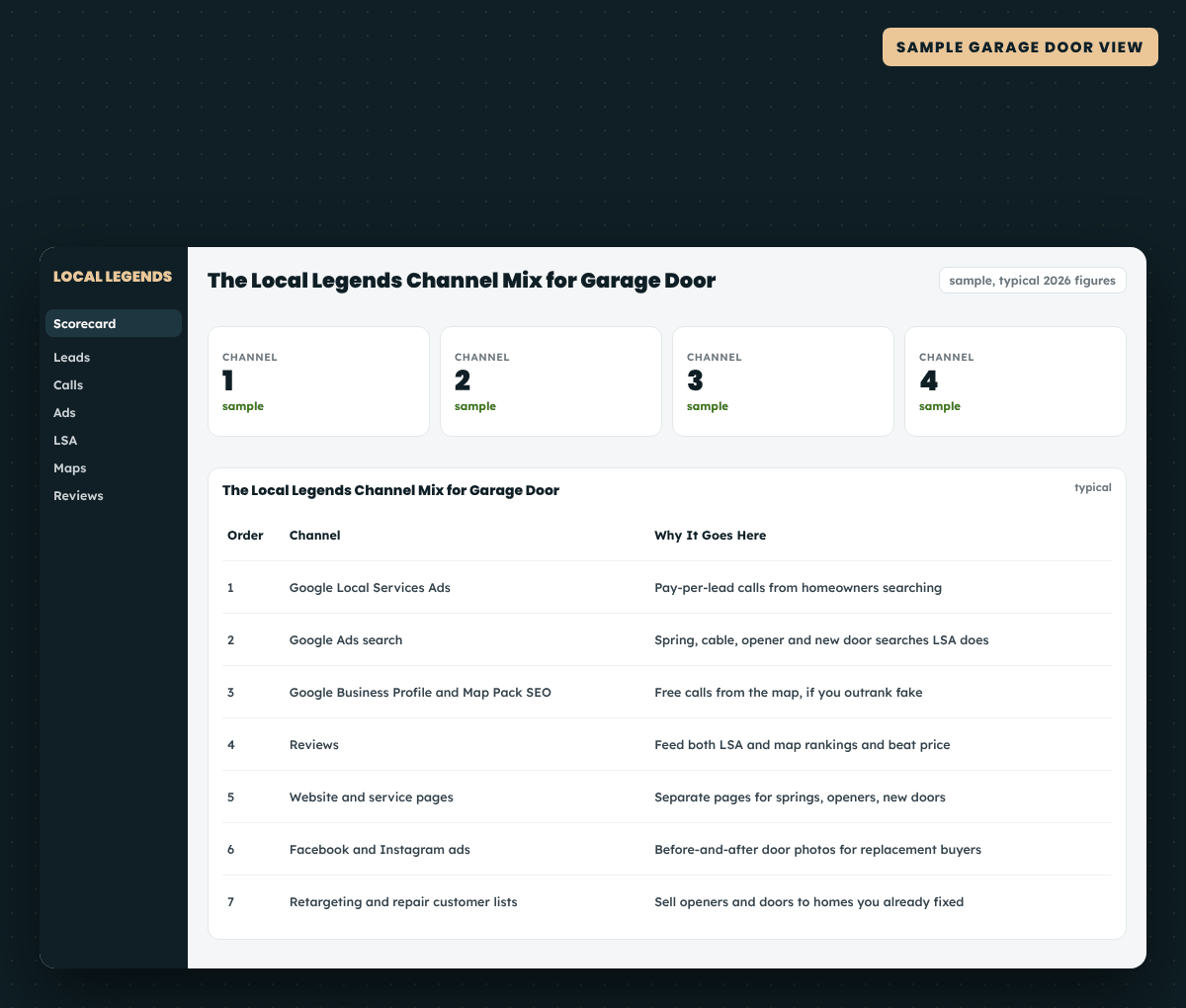
The Local Legends Marketing(link: /) channel mix for garage door companies starts with the channels that catch a stuck door today, then adds the ones that sell new doors next month and keep the phone ringing next year.
| Order | Channel | Why It Goes Here for Garage Doors |
|---|---|---|
| 1 | Google Local Services Ads | Pay-per-lead calls from homeowners searching for repair right now |
| 2 | Google Ads search | Spring, cable, opener and new door searches LSA does not catch |
| 3 | Google Business Profile and Map Pack SEO | Free calls from the map, if you outrank fake listings |
| 4 | Reviews | Feed both LSA and map rankings and beat price shoppers |
| 5 | Website and service pages | Separate pages for springs, openers, new doors and each service area |
| 6 | Facebook and Instagram ads | Before-and-after door photos for replacement buyers |
| 7 | Retargeting and repair customer lists | Sell openers and doors to homes you already fixed |
| 8 | Call tracking and CRM | Proves which channel paid for each sold job |
Google Local Services Ads First
Google Local Services Ads go first for garage door companies because homeowners call straight from the ad and you pay per lead, not per click. Our Google Local Services Ads management covers job types, service areas, hours and lead reviews.
Google Ads Search, After Advanced Verification
Google Ads search fills the gaps LSA leaves, such as new door installs, high-end openers and commercial work. Google requires garage door advertisers in the US to pass advanced verification first, so our Google Ads management starts with that paperwork.
Google Business Profile and Map Pack SEO
Your Google Business Profile is where most free garage door calls start, and it is also where fake listings compete hardest. Our Google Business Profile management keeps categories, services, photos and hours accurate, and local SEO builds the pages and citations behind it.
Going deeper on organic calls: see how we run garage door SEO for spring, opener and new door pages.
Facebook and Instagram for the New Door Buyer
Facebook and Instagram ads sell new garage doors, not emergency repairs. Short videos of a dented, faded door swapped for a new insulated one reach homeowners who were not searching yet, especially in neighborhoods where you just installed.
Should My Garage Door Company Keep Buying Shared Leads or Run Our Own Google Ads?
Most garage door companies do better running their own Local Services Ads and Google Ads than buying shared leads, because a shared lead is sold to several companies at once and the fastest dialer wins. Shared lead marketplaces can still fill gaps while your own channels ramp up.
| Lead Source | How You Pay | Who Else Gets the Lead | Best Use for Garage Doors |
|---|---|---|---|
| Shared lead marketplaces | Per lead, often shared | Several competitors | Filling slow weeks while LSA ramps |
| Google Local Services Ads | Per qualified call or message | Only you | Spring, cable, opener and repair calls |
| Google Ads search | Per click | Only you | New doors, openers, commercial and high-end work |
| Google Business Profile | Free | Only you | Steady calls once reviews and verification are strong |
- Track every source by sold job: a cheap shared lead that never closes costs more than an LSA call that does.
- Step down shared leads slowly: cut them as your own LSA and map calls replace the volume.
- Keep the customer in your CRM: a lead you own can be marketed to again for the next door.
Should My Garage Door Company Invest in SEO or Google Ads First?
Most garage door companies should run Google Local Services Ads and Google Ads first, then build SEO underneath, because ads ring the phone this week and SEO takes months. SEO and your Google Business Profile lower your cost per job over time.
| Question | Google Ads and LSA | SEO and Map Pack |
|---|---|---|
| How fast do calls start? | Days after verification | Typically 3 to 6 months or longer |
| What do you pay for? | Each lead or click | Content, citations, reviews and time |
| Best garage door jobs | Emergency repairs and new door searches | Steady repair calls and brand searches |
| What happens if you stop? | Calls stop | Rankings fade slowly |
| Biggest risk | Paying for calls nobody answers | Fake listings outranking you |
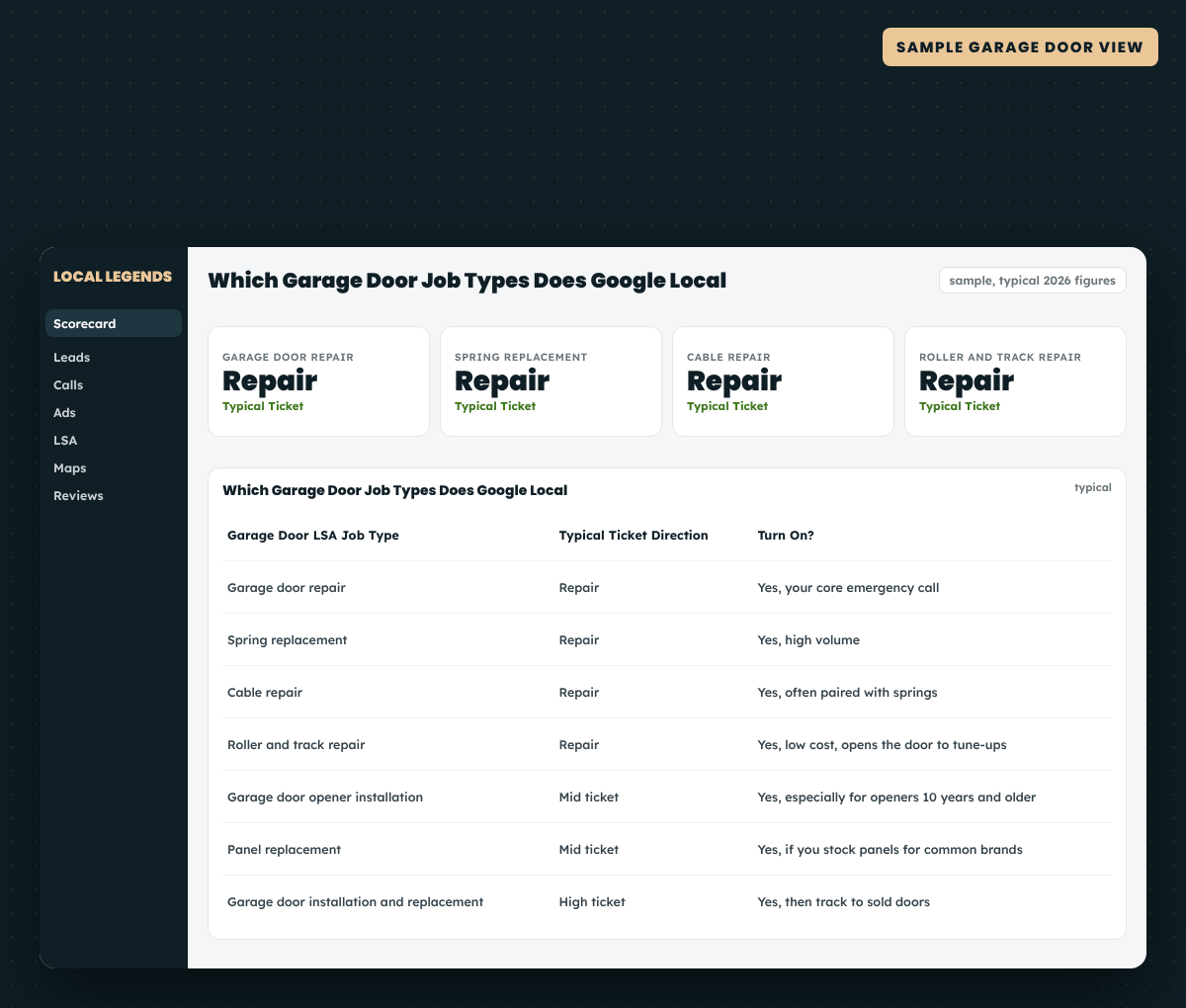
Which Garage Door Job Types Does Google Local Services Ads Cover? Yes, Garage Door Is an LSA Category
Google Local Services Ads covers garage door companies in the US under its "Garage door" category, and Google marks the category as urgent, so screening is stricter than for most trades. Residential repair and installation job types can be turned on one by one.
| Garage Door LSA Job Type | Typical Ticket Direction | Turn On? |
|---|---|---|
| Garage door repair | Repair | Yes, your core emergency call |
| Spring replacement | Repair | Yes, high volume |
| Cable repair | Repair | Yes, often paired with springs |
| Roller and track repair | Repair | Yes, low cost, opens the door to tune-ups |
| Garage door opener installation and repair | Mid ticket | Yes, especially for openers 10 years and older |
| Panel replacement | Mid ticket | Yes, if you stock panels for common brands |
| Garage door installation and replacement | High ticket | Yes, then track to sold doors |
| General maintenance and tune-ups | Low ticket | Optional, good for slow weeks |
- Screening for the Garage door category: a state-level business license where local law requires it, plus owner license, background checks and general liability insurance for select businesses.
- Urgent category rules: service professional background checks and Google's advanced verification apply.
- Badge: businesses that pass carry the Google Verified badge, formerly Google Guaranteed.
- Ranking: review count and rating, how quickly you respond to calls, distance to the searcher and your budget.
- Typical cost per lead: 2026 benchmarks put residential repair LSA leads near $15-$35+, with trade averages around $45-$60+ in early 2026.
Bad Leads and Credits
Google now credits many bad Local Services Ads leads automatically, such as spam, wrong numbers and solicitors. Leads for job types or areas you do not serve usually are not credited, so the fix is keeping job types and service areas tight and reviewing charged leads every week.
Google Is Moving Local Services Ads Into Google Ads. What Does That Mean for My Garage Door Company?
The move of Local Services Ads into Google Ads means your garage door LSA campaign will live inside a Google Ads account as a pay-per-lead campaign, with new budget and bidding rules. Reported phase one in August 2026 named trades like plumbing, HVAC and roofing; garage door was not named.
- Service area businesses without storefronts are slated for a later 2026 phase, which covers most garage door companies.
- Google emails the account admin about 14 days before migration, so make sure the right person gets those emails.
- Weekly budgets become daily budgets, and manual bidding and maximum cost per lead go away.
- Old LSA performance reports do not carry over, so export at least 12 months of lead data before your date.
- Google Verified badges and lead history move over, with leads in a Lead Manager inside Google Ads.
- The new campaign stays keywordless and runs on Search and Maps using your Google Business Profile data.
- Google's automated Target CPA bidding takes over, so a clean, accurate profile and good lead feedback matter more.
How Do I Beat Fake Garage Door Listings and Lead Gen Spam in Google Maps? Real Companies Can Win the Map
You beat fake garage door listings by being the most verified, most reviewed real company near the searcher, and by reporting the fakes with evidence. Garage door has long been one of the most spam-heavy Google Maps categories.
A 2019 Wall Street Journal investigation estimated about 11 million falsely listed businesses on Google Maps on any given day, and garage door repair was one of the examples it reported. In 2020 Google said publicly it was looking into reports of garage door spam on Maps.
The pattern is familiar: lead resellers create many fake profiles across suburbs and ZIP codes, answer under a generic name, then sell the job to whichever crew will take it. Homeowners get surprise prices, and real local companies lose map spots.
The Fake Listing Playbook We Teach
- Spot the signs: keyword-stuffed names, no real address or a virtual office, stock photos, and phone numbers shared across many listings.
- Check the facts: look up the address on Street View, call the number to hear if they answer with a real name, and search your state business registry for the company.
- Suggest an edit: use Google Maps' suggest an edit option to flag a fake name or a business that does not exist.
- File the complaint: for organized spam, Google's Business Redressal Complaint Form accepts a spreadsheet of listings with evidence.
- Keep a log: record every report and its outcome, because removed listings often come back.
- Protect your own profile: keep your real name, real address rules and categories clean, so a competitor report cannot stick to you.
- Show proof of work every week: real photos of your trucks and finished jobs, posted from the job site, are something spam networks rarely keep up.
Local Legends teaches clients this spam reporting process, along with suspension reinstatement and video verification. It is part of how we work with your profile, not a separate service we sell.
Verification Is a Moat
Google's advanced verification is a hassle, and it also keeps fake garage door advertisers out of your ads. It checks your Google Ads account, owner license and business registration, scans for fraud history and includes a video interview, and it typically takes about two weeks.
- Gather documents early: license, registration, insurance and proof of address before you apply.
- Keep pricing honest: Google expects ad prices to include all fees and any offer to say what is included.
- Match names everywhere: the business name on your license, profile, website and trucks should agree.
How Do I Get More Google Reviews for My Garage Door Company, and Does Review Count Really Help Me Rank?
Review count and rating help garage door companies rank in both Local Services Ads and the Map Pack, and fresh reviews that name the job and the town also help homeowners pick you over a lookalike listing. The fastest way to get them is asking on every finished job.
- Ask at the door: the tech asks while the homeowner is watching the door run quietly again.
- Text the link within the hour: our LSA Ranker review texter sends a direct Google review link after the job.
- Ask for detail: encourage customers to mention the spring, opener or new door and their neighborhood.
- Answer every review: thank good ones and reply calmly to bad ones within a day or two.
- Never buy or gate reviews: fake reviews break Google's rules and can get a profile suspended.
Our review management puts the ask, the text and the replies on a schedule so reviews keep coming in every month, not just after a push.
Repair to Replacement Garage Door Marketing The Spring Call Comes First
Repair to replacement marketing turns a garage door repair customer into an opener or new door customer, with honest recommendations on site, follow-up after the visit and ads aimed at homes you already serve.
The repair visit is the cheapest lead you will ever get for a new door. The tech is already in the garage, sees the door's age and condition, and has just earned trust by getting the car out.
How Do I Market My Garage Door Company So More Spring Repair Calls Turn Into New Garage Door Replacements?
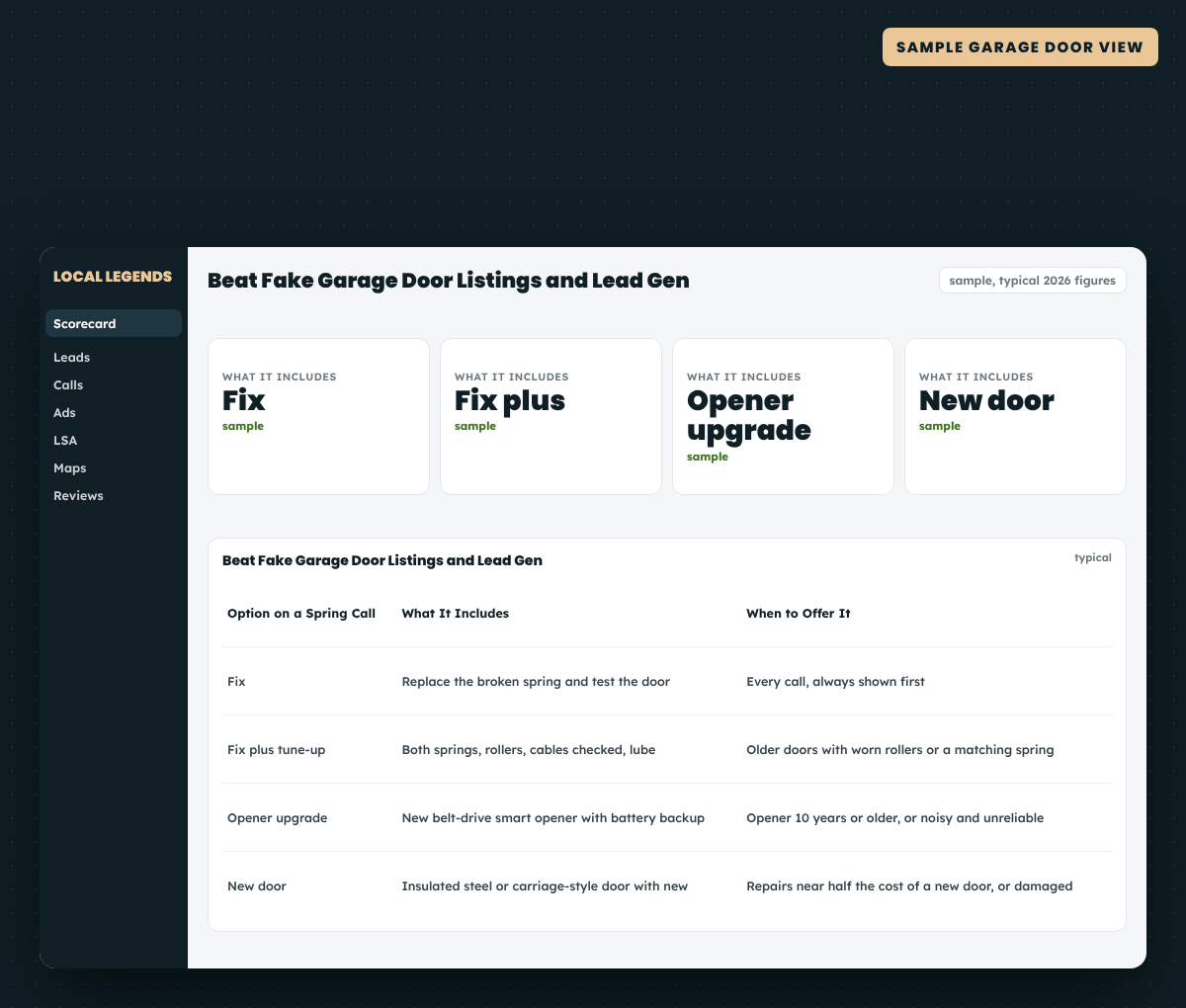
More spring calls turn into replacements when every visit ends with clear options, a written quote and a follow-up plan, instead of a single repair price. The marketing side keeps that quote alive after the truck leaves.
| Option on a Spring Call | What It Includes | When to Offer It |
|---|---|---|
| Fix | Replace the broken spring and test the door | Every call, always shown first |
| Fix plus tune-up | Both springs, rollers, cables checked, lube and balance | Older doors with worn rollers or a matching spring near failure |
| Opener upgrade | New belt-drive smart opener with battery backup | Opener 10 years or older, or noisy and unreliable |
| New door | Insulated steel or carriage-style door with new hardware | Repairs near half the cost of a new door, or damaged sections |
- Plant the seed before arrival: a booking text with a short intro of your tech and a link to new door photos sets up the conversation.
- Show the fix first: homeowners trust a tech who solves the problem before suggesting anything else.
- Explain, do not pressure: show the worn part or the age label; consumer warnings about garage door upsells are common.
- Write every quote down: send door and opener quotes by text and email with photos of the old door.
- Follow up on a schedule: a text after 2 days, a call after a week and a seasonal offer later.
- Retarget repair customers: upload past repair customers to Facebook and Google to show new door photos.
- Track quotes to sales: your CRM should show which spring calls became doors and how long it took.
Garage Door Marketing Seasonality: Cold Snaps, Heat and the Spring Install Season A 12-Month Garage Door Calendar
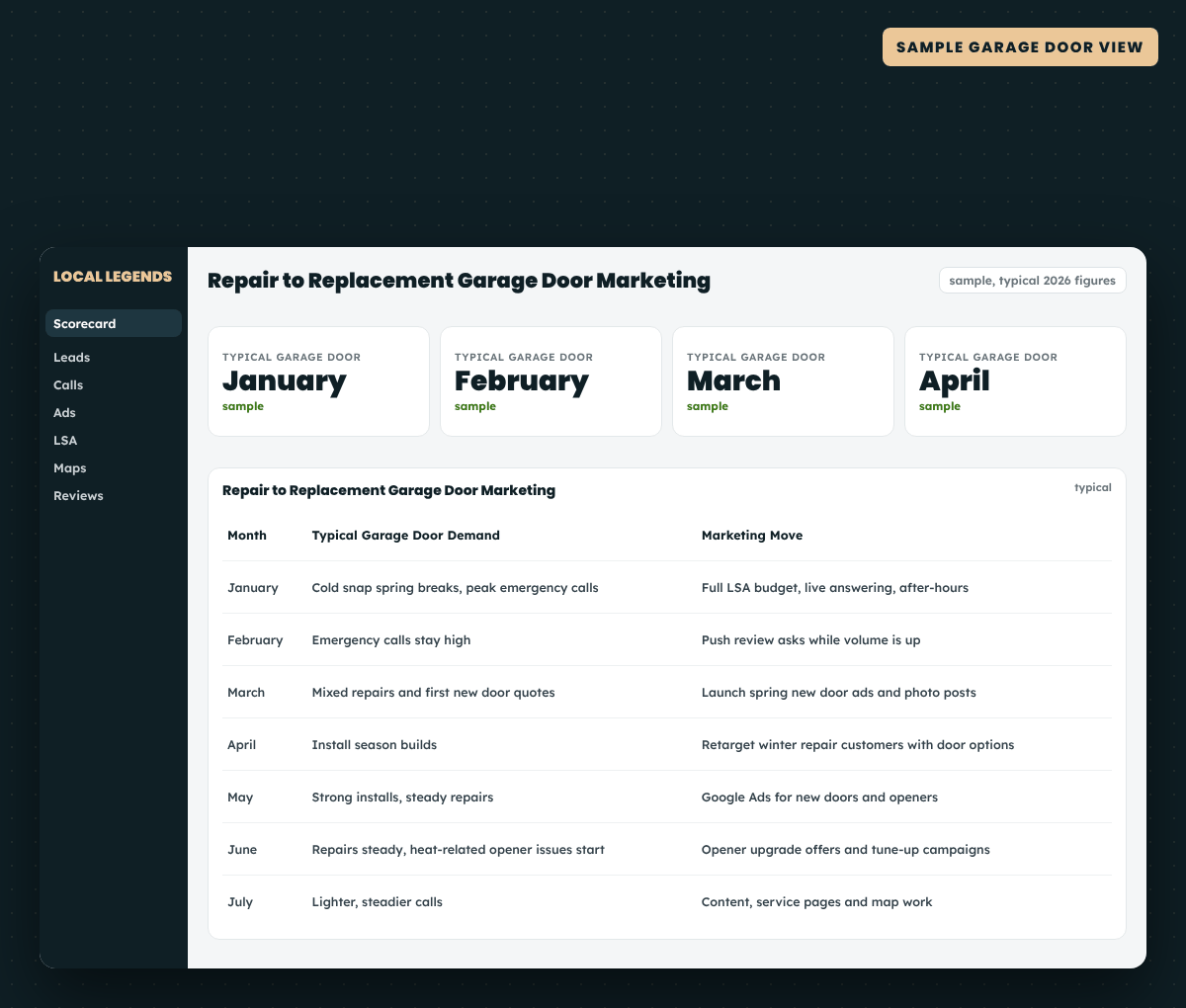
Garage door marketing seasonality follows the weather and your climate, with cold snaps driving emergency spring calls and late spring through early fall bringing moves, renovations and installs. Peak months can run about 2 to 3 times the calls of slow ones.
Sources disagree on which season is busiest. Google AI Mode called May to October the busy season, while trade call-volume guides put the emergency peak in winter cold snaps. Your own last two years of call data settle it for your market.
| Month | Typical Garage Door Demand | Marketing Move |
|---|---|---|
| January | Cold snap spring breaks, peak emergency calls | Full LSA budget, live answering, after-hours coverage |
| February | Emergency calls stay high | Push review asks while volume is up |
| March | Mixed repairs and first new door quotes | Launch spring new door ads and photo posts |
| April | Install season builds | Retarget winter repair customers with door options |
| May | Strong installs, steady repairs | Google Ads for new doors and openers |
| June | Repairs steady, heat-related opener issues start | Opener upgrade offers and tune-up campaigns |
| July | Lighter, steadier calls | Content, service pages and map work |
| August | Heat, move-ins and back to school; slow in some markets | Watch weekly calls, keep LSA on, build SEO |
| September | Mixed, varies by climate | Pre-winter tune-up and spring check offers |
| October | Fall install push begins | New door ads before the holidays |
| November | First freezes in colder states | Raise LSA budgets, confirm after-hours coverage |
| December | Cold snaps and holiday installs | Storm and freeze readiness, year-end door offers |
When Is the Busy Season for Garage Door Repair, and How Should I Adjust My Marketing Budget by Month?
The busy season for garage door repair depends on your climate: cold snaps spike emergency calls in colder states, and late spring through early fall is busiest for many shops, so budgets should flex weekly, not split evenly by month.
Cold thickens grease, shrinks metal and finishes off tired springs, so the first hard freeze often brings a wave of "door will not open" calls. Heat dries out rollers and wears plastic opener gears, and storms knock doors off track.
- Raise LSA budgets before the first freeze: the bump should be live the week cold weather is forecast.
- Keep a storm plan: wind and storm days can bring a surge within 24 to 48 hours.
- Move money to new door ads in spring and fall: those are the planned purchase windows.
- Do not go dark in slow months: keep LSA on and use the quiet time for SEO, pages and reviews.
- Expect LSA costs to move: 2026 benchmarks show LSA leads climbing toward $60-$70+ in busy spring and summer weeks.
- Review the budget weekly: monthly reviews are too slow for a trade that moves with the weather.
Garage Door Marketing Tracked to Sold Jobs Calls Are Chapter One
Garage door marketing is only worth paying for when it ends in sold jobs, so Local Legends tracks every call, form and LSA lead to the job ticket in your field service software. Impressions, rankings and calls are chapter one of the story, not the end.
We set up call tracking with recordings, connect it to your CRM and report cost per booked job and cost per sold job by channel. Our call tracking and CRM integration works with ServiceTitan, Housecall Pro, Jobber and GoHighLevel, among others.
How Do I Track Which Marketing Brings Booked Garage Door Jobs and Revenue in ServiceTitan or Housecall Pro?
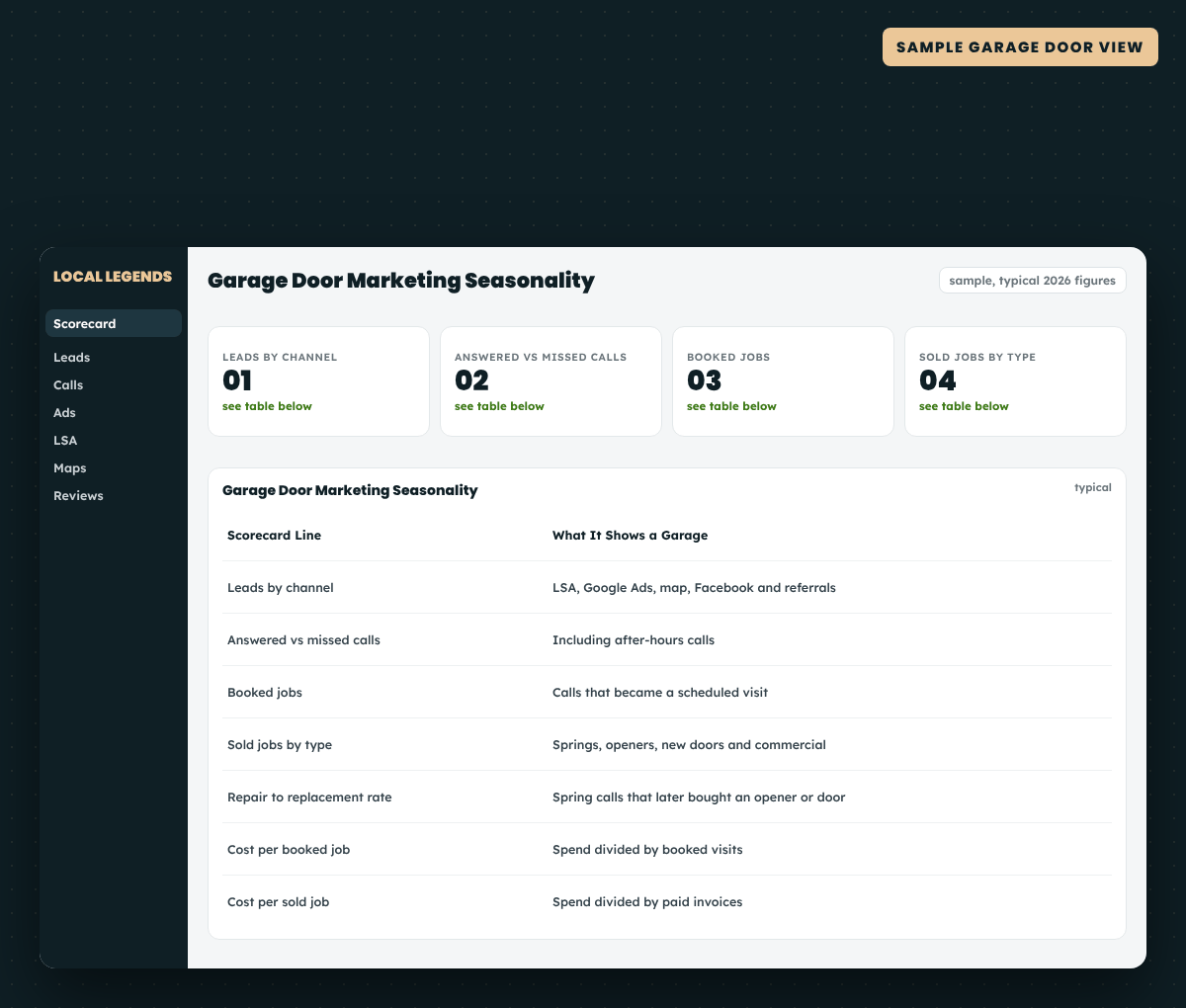
Track garage door marketing to revenue by giving each channel its own tracking number, tagging the lead source on every job and closing the loop when the invoice is paid. Then compare cost per sold job, not cost per lead.
| Scorecard Line | What It Shows a Garage Door Owner |
|---|---|
| Leads by channel | LSA, Google Ads, map, Facebook and referrals |
| Answered vs missed calls | Including after-hours calls |
| Booked jobs | Calls that became a scheduled visit |
| Sold jobs by type | Springs, openers, new doors and commercial |
| Repair to replacement rate | Spring calls that later bought an opener or door |
| Cost per booked job | Spend divided by booked visits |
| Cost per sold job | Spend divided by paid invoices |
| Revenue by channel | Which channel paid for itself |
- One tracking number per channel: LSA, Google Ads, map listing, website and Facebook each get their own.
- Lead source on every job: your CSR picks the source in ServiceTitan or Housecall Pro at booking.
- Link quotes to the first call: so a new door sale credits the spring call that started it.
- Review weekly: the CEO scorecard shows leads, booked, sold and cost per booked job every week on higher plans.
How Much Does Garage Door Marketing Cost in 2026? Fees, Ad Spend and Leads
Garage door marketing typically costs about $500-$3,000+ a month for small and mid-sized companies, with full-service agency packages running up to $10,000+ a month, before ad spend. Those are typical ranges from Google's AI results and published agency pricing in 2026.
Google AI Mode put total monthly cost, ad spend plus agency fees, at about $2,500-$7,500+ for a competitive residential campaign. Budgets typically run 7% to 13% of revenue, with 7% to 8% common for established shops. Ask whether a quote includes ad spend.
Local Legends Prices for Garage Door Companies
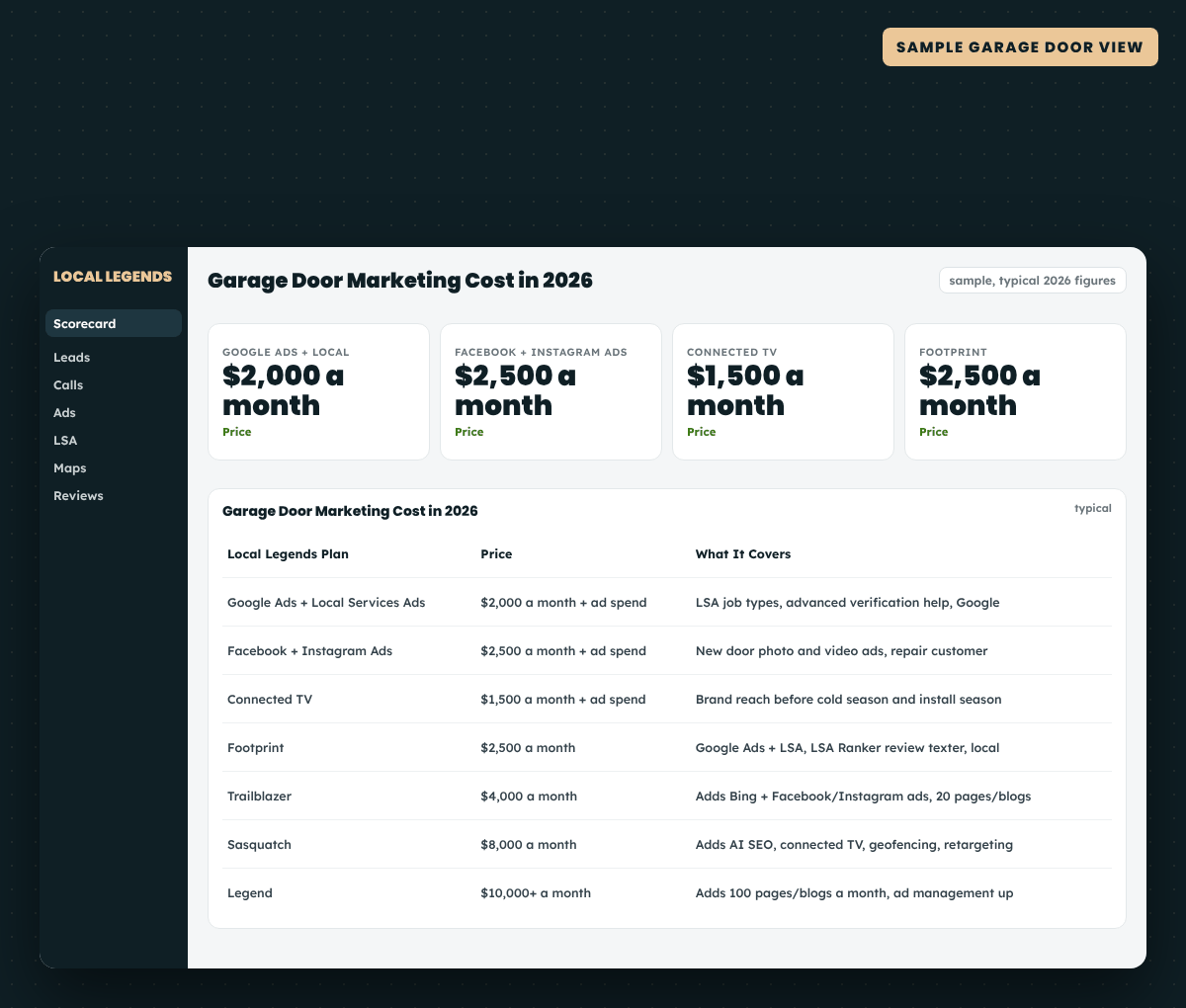
Local Legends Marketing charges flat monthly fees and never takes a percentage of your ad spend. You pay Google, Meta or the TV network directly for ads.
| Local Legends Plan or Service | Price | What It Covers for a Garage Door Company |
|---|---|---|
| Google Ads + Local Services Ads management | $2,000 a month + ad spend | LSA job types, advanced verification help, Google Ads, monthly Google Business Profile optimization |
| Facebook + Instagram Ads | $2,500 a month + ad spend | New door photo and video ads, repair customer retargeting |
| Connected TV | $1,500 a month + ad spend | Brand reach before cold season and install season |
| Footprint | $2,500 a month | Google Ads + LSA, LSA Ranker review texter, local SEO + 70+ citations, 10 pages/blogs a month, call tracking, monthly scorecard |
| Trailblazer | $4,000 a month | Adds Bing + Facebook/Instagram ads, 20 pages/blogs a month, backlinks, review and text automations, weekly scorecard |
| Sasquatch | $8,000 a month | Adds AI SEO, connected TV, geofencing, retargeting, 50 pages/blogs a month |
| Legend | $10,000+ a month | Adds 100 pages/blogs a month, ad management up to $40,000 a month in spend, multi-location pages |
| Website (one time) | $2,500-$15,000+ | 10 to 80 pages in the product-page layout |
Every growth plan comes with the LSA Ranker review texter and fractional CMO + CEO meetings. The plan level sets how often you meet and how much gets built.
Local Legends Pricing Compared With What Other Agencies Typically Charge
Garage door owners can compare Local Legends Marketing's published prices with typical 2026 agency pricing before they sign anything.
| Service | Local Legends Price | What Other Agencies Typically Charge |
|---|---|---|
| Google Ads + LSA management | $2,000 a month + ad spend | $1,500-$2,500+ a month minimum or 15% to 20% of spend |
| Facebook + Instagram ads | $2,500 a month + ad spend | $1,500-$3,500+ a month or 12% to 18% of spend |
| Connected TV | $1,500 a month + ad spend | $3,000-$15,000+ a month retainer with $5,000-$25,000+ media minimums |
| Local SEO | Included in every plan from $2,500 a month | $1,500-$5,000+ a month |
| Full-service garage door marketing | $2,500-$10,000+ a month | $2,500-$10,000+ a month |
| Website | $2,500-$15,000+ one time | $2,500-$50,000+ |
See every plan and add-on on the Local Legends pricing page. There are no long-term contracts.
What Is a Good Cost per Lead for Garage Door Repair on Google Ads and Local Services Ads?
A good cost per lead for garage door repair is typically $20-$50+ on Local Services Ads and $40-$170+ on Google search ads, while new door install leads cost more. Those are 2026 benchmarks from Google AI Mode and published data, and your market and answer rate will move them.
| Garage Door Lead Benchmark (Typical, 2026) | Range |
|---|---|
| LSA lead, residential repair | $15-$50+ |
| LSA trade average, early 2026 | $45-$60+ |
| Google search lead, residential repair | $40-$80+ |
| Google search lead, non-branded average | $115-$175+ |
| Typical close rate, LSA vs Google search | 25% to 40% vs 15% to 25% |
| Google search lead, new door install | $110-$220+ |
| Cost per booked repair job | $80-$220+ |
| Cost per booked replacement | $400-$900+ |
| Commercial overhead door search lead | $300-$600+ |
Cost per sold job settles the argument. A $40 repair lead that books half the time costs about $80 per job on a $300+ spring repair, and the same customer may buy a $1,200+ door later.
Who Is the Best Garage Door Marketing Company for a Residential Repair and Installation Company? The One That Shows Sold Doors, Not Clicks
The best garage door marketing company for a residential repair and installation company understands emergency calls, helps you pass Google's garage door verification, keeps every account in your name and reports cost per sold job. No single agency fits every shop.
Google's AI Overview for "best garage door marketing company" listed a mix of general home service agencies, garage door specialists and software platforms in November 2026.
Several top results were "best agency" lists written by agencies that ranked themselves first, so use the same tests on everyone, Local Legends Marketing included.
| What AI Results Tell Garage Door Owners to Look For | Local Legends Marketing Proof |
|---|---|
| Revenue tracking, not vanity metrics | Weekly CEO scorecard with leads, booked, sold and cost per booked job |
| Industry understanding | Garage door LSA job types, advanced verification and spam reporting built into the plan |
| LSA and Google Ads skill | Google Ads + LSA management at $2,000 a month with weekly lead reviews |
| Transparent pricing | Every price published, flat fees, never a percent of ad spend |
| You own the accounts | Website, domain, Google Business Profile, ad accounts and call data stay in your name |
| No lock-in | No long-term contracts |
| Proof | 25,000+ appointments generated and $30M+ revenue influenced (agency-reported) |
What Questions Should I Ask a Garage Door Marketing Agency Before Signing, and What Red Flags Should I Watch For?
Ask a garage door marketing agency who owns the accounts, how it is paid, how it tracks sold jobs and how it handles fake listings, before you sign. Clear answers to those four questions rule out most bad fits.
- Who owns the Google Business Profile, ad accounts and website? You should be the primary owner of all of them.
- Is the fee flat or a percentage of spend? A percentage can reward spending more, not booking more.
- Will you help with Google's advanced verification? A garage door agency should know the process.
- How do you split emergency repair campaigns from new door campaigns? They need separate budgets, keywords and landing pages.
- Who does the daily work on my account? Meet the person running your ads, not only the one who sold you.
- How do you report? Ask to see a sample report with booked and sold jobs, not just clicks.
- How long is the contract? Long contracts with cancellation fees are a red flag.
Red flags to watch for:
- Shared or resold leads presented as your own.
- Fake reviews, review gating or fake listings offered as a tactic.
- Guaranteed number one rankings.
- No call recordings or tracking numbers.
- An agency that owns your profile or domain and will not hand it over.
Our Garage Door Marketing Process, Step by Step Audit First, Then Build
The Local Legends garage door marketing process starts with an audit of your tracking, map listing, LSA account and website, then builds the channels in the order that books jobs fastest.
Step 1: Garage Door Growth Audit
We check call tracking, Google Business Profile health, LSA job types and service areas, Google Ads setup, website speed and pages, reviews and the fake listings around you.
Step 2: Ownership, Verification and Tracking
We confirm you own every account, prepare advanced verification documents, set up tracking numbers and connect leads to ServiceTitan, Housecall Pro or your CRM.
Step 3: Emergency Channels Live
LSA and Google Ads go live for springs, cables, openers and repairs, with after-hours coverage matched to your real answering hours.
Step 4: Map, Reviews and the New Door Funnel
We build service area pages, start the review texter, add Facebook new door ads and set quote follow-up for repair customers.
Step 5: Weekly Review and the Weather Plan
Every week we review charged leads, booked and sold jobs, and adjust budgets for cold snaps, heat and storms. A project review meeting keeps the work moving.
Every Local Legends client also gets the Local Legends marketing course, so your team understands how LSA, the map and tracking work.
Garage Door Advertising From a Founder Who Worked in the Field Levi Ostlund Learned Marketing the Hard Way
Levi Ostlund founded Local Legends Marketing after years of working in the trades and losing money to bad marketers. He sold driveway jobs door to door at 10, poured concrete with his dad and ran a landscaping company in high school.
He lost $30,000+ to agencies that ghosted him or built pretty websites that never ranked. Later he served as CMO of a large roofing company, and he has spent 8+ years marketing contractors. That is why every Local Legends account stays in the client's name.
Frequently Asked Questions About Garage Door Marketing Quick Answers Before You Call
Should My Garage Door Company Focus on Emergency Repairs or High-Ticket Replacements?
Most garage door companies should win emergency repairs first, then sell replacements to those customers, because repair calls are cheaper to buy and give you a trusted visit inside the home. Replacement ads work best once that base is steady.
How Profitable Is a Garage Door Business?
Garage door businesses can be very profitable when techs stay busy and repair visits lead to openers and doors, but margins depend on answer rate, ticket mix and cost per sold job. Tracking those three numbers tells you more than any industry average.
Do I Need Advanced Verification to Run Garage Door Ads on Google?
Yes, Google restricts garage door repair ads in the US until the business passes advanced verification. Expect a review of your license, registration and ads account plus a video interview, typically about two weeks.
Should I Set My Garage Door Hours to 24/7 on Google?
Only set 24/7 hours if a real person answers and can book a visit at any hour. Unanswered after-hours calls waste ad money and can lower your LSA ranking.
Should I Hire an Agency or Run Garage Door Marketing In-House?
Many owners run marketing in-house until ad spend and call volume grow, then hire an agency to manage LSA, Google Ads, the map and tracking. If you hire one, keep every account in your own name.
Do You Market Commercial Overhead Door Companies?
Yes, Local Legends works with residential and commercial door companies, and we keep commercial campaigns separate, since LSA covers little commercial work and those buyers compare bids over longer sales cycles.
Do You Take a Percentage of My Ad Spend?
No, Local Legends charges flat monthly fees. Google Ads and Local Services Ads management is $2,000 a month plus ad spend, and you pay Google directly.
Do I Keep My Accounts If I Leave?
Yes, your website, domain, Google Business Profile, ad accounts and call data stay in your name. Local Legends is added as an owner on your profile while you stay the primary owner, and there are no long-term contracts.
Local Legends Marketing works with garage door companies nationwide from its office in Conroe, Texas. See the other industries we serve and the Local Legends service areas.
Reviewed by Levi Ostlund, Founder, Local Legends Marketing

Get Garage Door Marketing That Books the Repair and Sells the Door Book Your Garage Door Growth Audit
Local Legends Marketing(link: /) builds garage door marketing around the stuck-door call and the new door that follows it, with Google Local Services Ads, Google Ads, Map Pack SEO, reviews and every call tracked to the sold job, all in accounts you own.
- Call:(936) 900-1248
- Office: 481 Stephen F Austin Dr, Conroe, TX 77302
- Next step: book your growth audit; Google Ads and LSA management is $2,000 a month and growth plans start at $2,500 a month