


Construction Company Websites by Local Legends

General Contractor Website Design That Shows Your Builds, Explains Your Process and Turns Project Inquiries Into Signed Contracts
Construction Company Websites by Local Legends Marketing
Updated November 2026 · Reviewed by Levi Ostlund, Founder
General contractor website design from Local Legends Marketing builds a page for every project type you sell, from custom homes and additions to remodels and light commercial build-outs, each with captioned project photos, a price range, the steps of your process and a consultation request form.
Typical construction website designs run $3,000-$30,000+ in 2026, depending on who builds them. Local Legends builds websites for a one-time fee by page count, from $2,500 for 10 pages to $15,000 for 80 pages, and you own the site and the domain.
- A page per project type: custom homes, additions, ADUs, kitchens, whole-home remodels and tenant build-outs each get their own page.
- Galleries with captions: every project shows the scope, the town and the problem your crew solved.
- Forms that qualify: project type, property location, timing and budget range reach your estimator or your CRM.
- Tracked to the contract: calls and forms keep their source through consultation, estimate and signed contract.
- Agency-reported proof: 25,000+ appointments generated and $30M+ in revenue influenced, with every account in your name.
Free Growth Audit
Your Reviews, Radius and Response Rate vs the competitors beating you.
About Local Legends Marketing
A home service marketing agency headquartered in Conroe, Texas, with 8+ years of marketing experience, running Google Ads, Local Services Ads, local SEO, AI SEO, connected TV and review systems for contractors nationwide.
Construction Website Design Is Different From a Service Trade Website A Long Decision Needs a Deeper Site
Construction website design has to carry a buyer through a decision that takes months, not minutes, because a homeowner planning a $400,000 custom home or a $150,000 addition reads, compares and returns many times before asking for a consultation.
A plumber's site wins on a tap-to-call button during an emergency. A general contractor's site wins on proof: finished projects, named team members, a clear process and enough cost context that the buyer feels safe reaching out. The site is the first sales meeting.
What Changes for a General Contractor
- Fewer, bigger leads: one signed addition can be worth more than a month of service calls.
- Longer research: buyers look at galleries, process pages and reviews over several visits.
- More decision makers: spouses, architects, lenders and sometimes a homeowners association weigh in.
- Qualification matters: the form should screen out projects you do not build before your estimator drives out.
For the full channel plan behind the site, see our construction marketing(link: /industries/construction/) page.
What Do the Best Construction Company Websites Have in Common?
The best construction company websites share real project photos, named team members, full-name testimonials, a phone number above the fold and a portfolio sorted by project type or area. Google AI Mode added in November 2026 that top sites put context on every project instead of a bare photo grid.
- Real project photos: finished work from your own jobs, never stock images.
- Named people: the owner, project managers and estimators with their roles.
- Testimonials with names: reviews a buyer can believe and check.
- Contact without scrolling: a visible phone number and a clear consultation button.
- Portfolio by type: galleries split into custom homes, additions, remodels and commercial work.
- Trust details: license numbers, insurance, warranties and years in business.
General Contractor Website Pages by Project Type One Page per Project You Sell
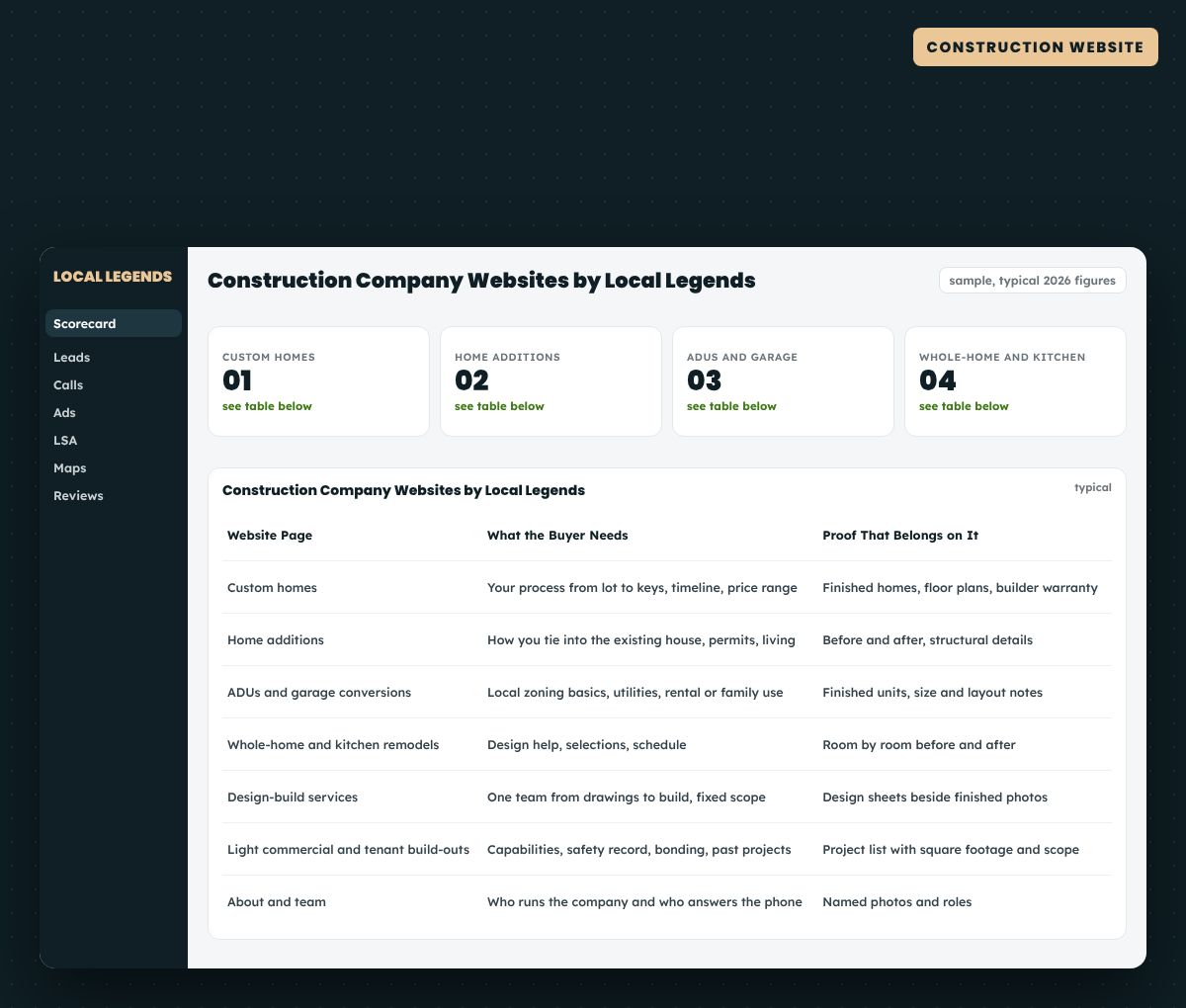
A general contractor website should give each project type its own page, because "home addition contractor" and "custom home builder" are different searches by different buyers. A single "Services" page listing everything ranks for none of them.
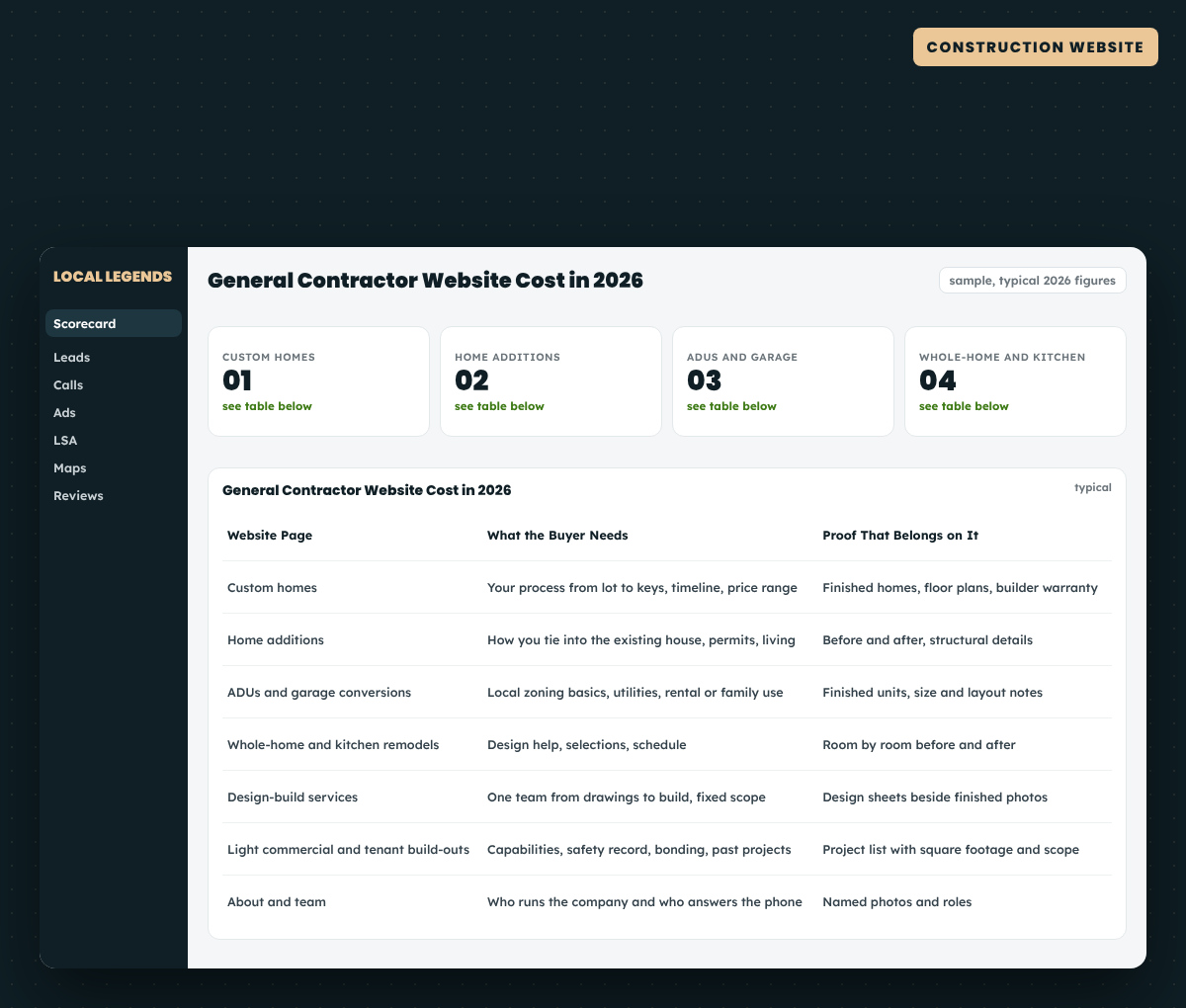
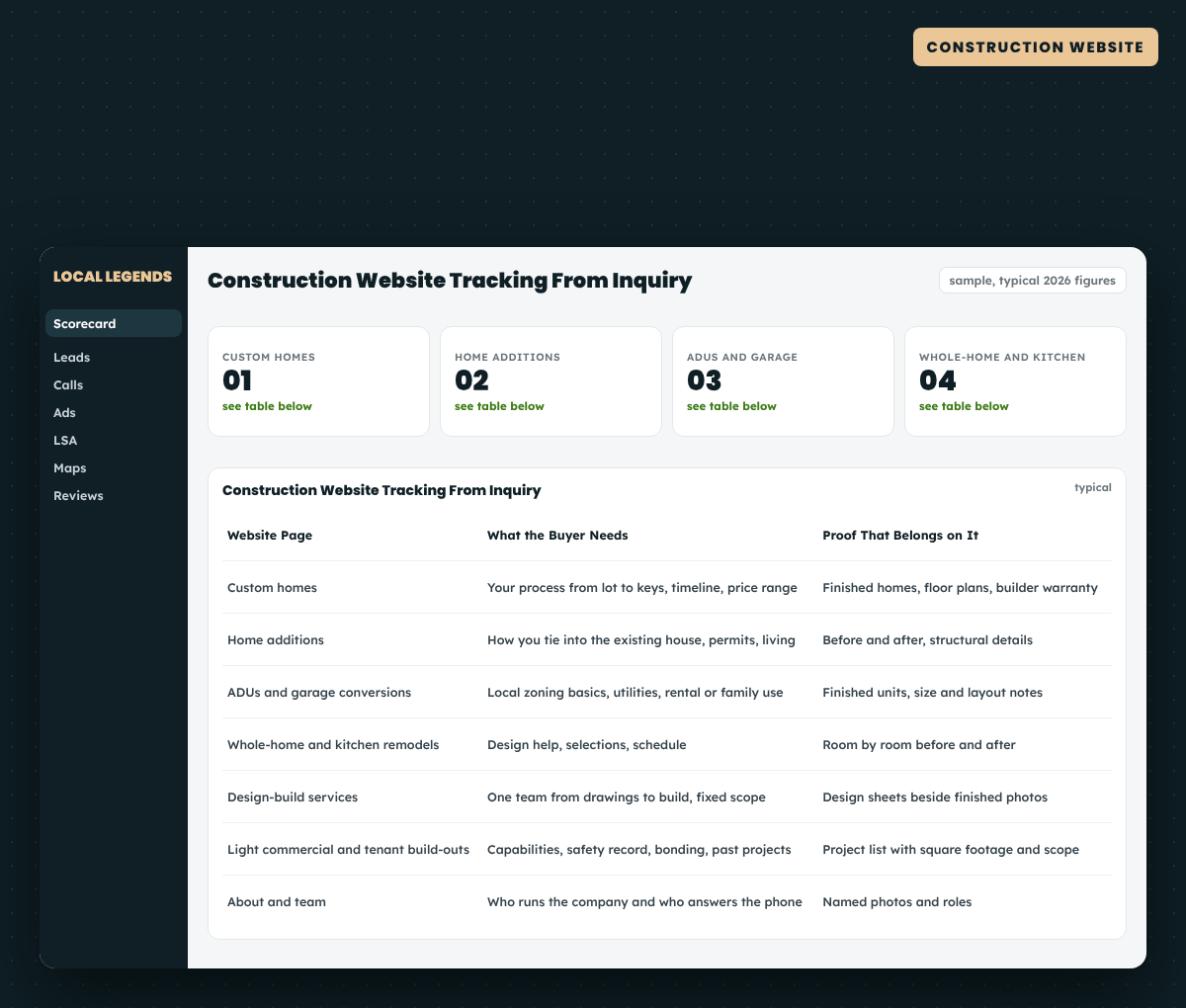
| Website Page | What the Buyer Needs to See | Proof That Belongs on It |
|---|---|---|
| Custom homes | Your process from lot to keys, timeline, price range context | Finished homes, floor plans, builder warranty |
| Home additions | How you tie into the existing house, permits, living through it | Before and after, structural details |
| ADUs and garage conversions | Local zoning basics, utilities, rental or family use | Finished units, size and layout notes |
| Whole-home and kitchen remodels | Design help, selections, schedule | Room by room before and after |
| Design-build services | One team from drawings to build, fixed scope | Design sheets beside finished photos |
| Light commercial and tenant build-outs | Capabilities, safety record, bonding, past projects | Project list with square footage and scope |
| About and team | Who runs the company and who answers the phone | Named photos and roles |
| Licenses, insurance and warranty | License type and number, insurance types, warranty terms | Numbers buyers can verify, certificates on request |
Each page is built in the Local Legends product-page layout: project photos on one side and the price context, options, call button and consultation form on the other. See our contractor website design(link: /services/website-design/) page for how the layout works.
Service Area Pages for Builders
A builder who works in several towns can add a page for each one, but only for towns where the team can write 5+ real local facts, such as lot sizes, permit offices and home styles. A town without them is covered on a nearby page instead.
Should a General Contractor Have Separate Pages for Custom Homes, Additions, Remodels and Commercial Work?
Yes, a general contractor should have a separate page for each project type it wants to sell, because each one answers a different search and a different set of buyer questions.
- Separate pages rank:"ADU builder" and "kitchen remodel contractor" each need their own page to show up.
- Separate pages convert: the gallery, price context and process match the buyer's project.
- Separate pages track: you can see which project type brings the most consultations.
- Skip what you do not sell: a page for work you turn down only brings the wrong calls.
Construction Website Images and Project Galleries That Win Bigger Jobs Captions Turn Photos Into Proof
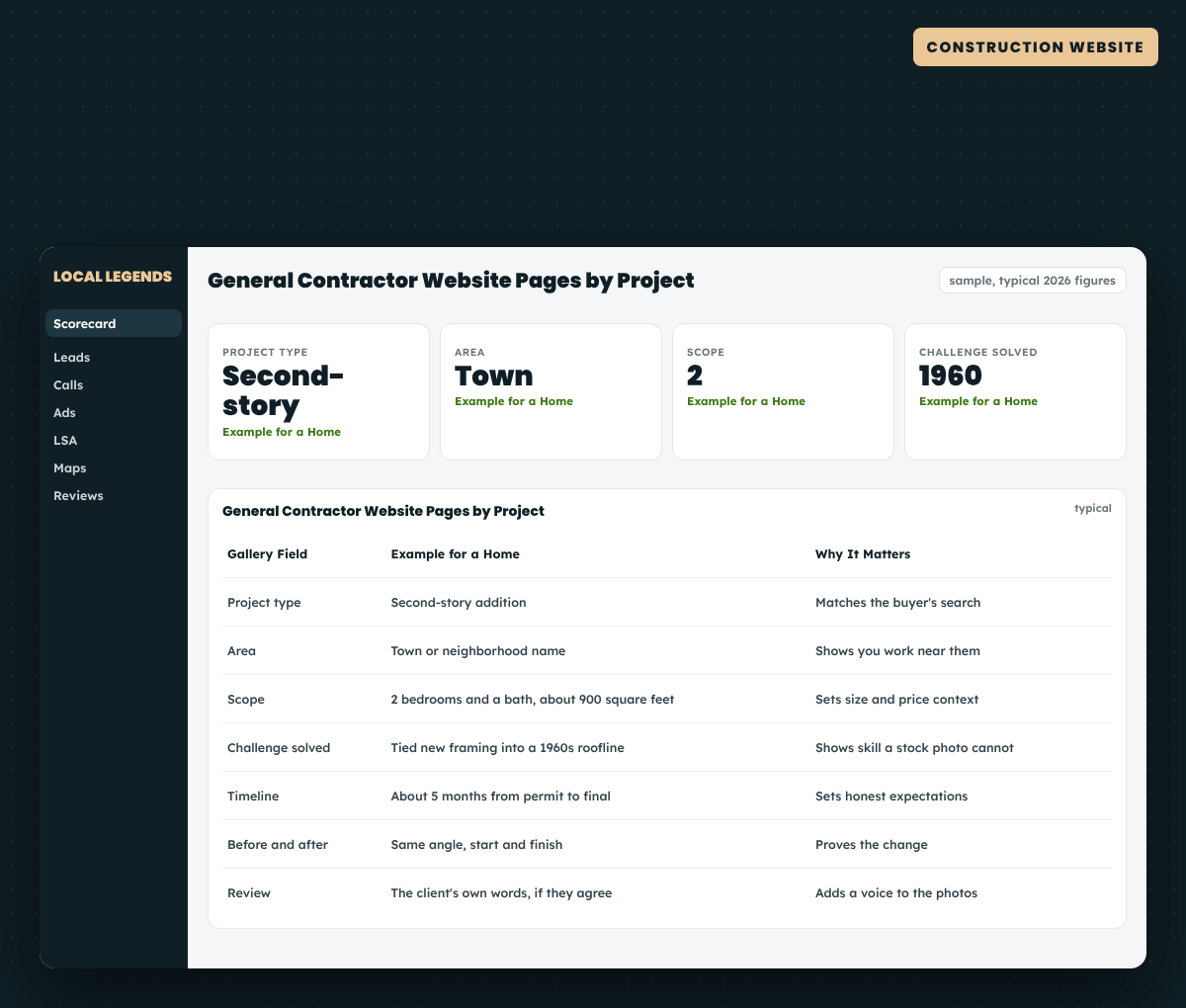
Construction website images sell the job when every project photo carries a caption that names the scope, the area and the challenge your team solved. A gallery of unlabeled pictures looks nice, while a captioned project reads like a case study a buyer can trust.
| Gallery Field | Example for a Home Addition | Why It Matters |
|---|---|---|
| Project type | Second-story addition | Matches the buyer's search |
| Area | Town or neighborhood name | Shows you work near them |
| Scope | 2 bedrooms and a bath, about 900 square feet | Sets size and price context |
| Challenge solved | Tied new framing into a 1960s roofline | Shows skill a stock photo cannot |
| Timeline | About 5 months from permit to final | Sets honest expectations |
| Before and after | Same angle, start and finish | Proves the change |
| Review | The client's own words, if they agree | Adds a voice to the photos |
Photos to Capture on Every Job
- Before: the site or room from 2 or 3 fixed angles.
- During: framing, structure and the details that get covered up later.
- After: the same angles as the before shots, in good light.
- People: your crew and project manager on site, with their permission.
Real Photos Only
Local Legends builds galleries from your own jobs. Stock photos and AI-made project images break trust the moment a buyer visits a real job or meets the real crew.
How Should I Show Project Photos and a Portfolio on My Construction Company Website?
Show your portfolio as a filterable gallery that links to a dedicated page for each major project, with captions and the strongest finished work on the home page. Google AI Mode recommended that structure over a single scrolling wall of photos.
- Sort by type: custom homes, additions, remodels and commercial as gallery filters.
- Give big jobs their own page: each major project gets its own address with the full story.
- Map your work: a simple project map shows buyers you build near them.
- Lead with your best: three standout projects on the home page.
- Keep it fast: compressed images so galleries load quickly on a phone.
- Add alt text: a description of each photo with the project type and area.
- Update often: a new finished project every month keeps the site current.
Should a Custom Home Builder Put Prices or Cost per Square Foot on the Website? Show Ranges and Explain What Moves Them
A custom home builder should show price ranges and explain what moves them, rather than a single cost per square foot, because one number with no context either scares buyers off or sets an expectation the project cannot meet. Google AI Mode said a raw per-square-foot figure backfires because site conditions, finishes and builders' own definitions vary, and suggested total project ranges instead.
- Give a range by project type: a starting point for additions, remodels and custom homes in your market.
- Explain the swing: lot conditions, size, finishes, structure and site work.
- Separate what is included: design, permits, site prep and allowances.
- Invite the next step: a consultation where your estimator explains the estimate for that project.
Why Ranges Help the Right Buyers
A price range screens out buyers whose budget does not fit before your estimator spends a day on a site visit. The buyers who stay are the ones ready to talk about their project.
Construction Landing Page and Consultation Forms That Qualify Leads Ask Enough to Respond Well
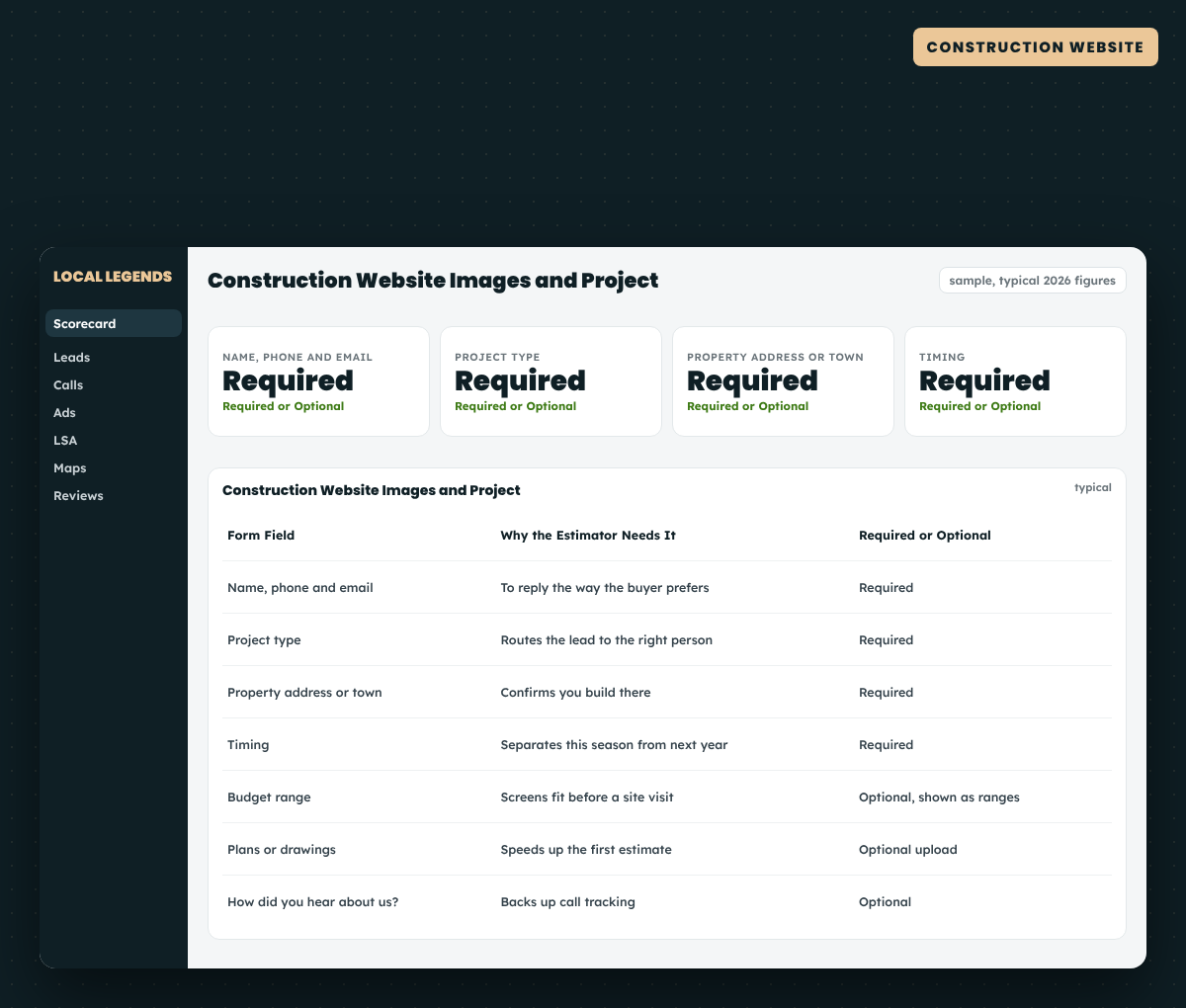
A construction landing page or consultation form should ask for the project type, property location, timing and budget range, so your estimator can respond with useful next steps instead of a phone tag game. Short forms bring more inquiries, and a few qualifying fields bring better ones.
| Form Field | Why the Estimator Needs It | Required or Optional |
|---|---|---|
| Name, phone and email | To reply the way the buyer prefers | Required |
| Project type | Routes the lead to the right person | Required |
| Property address or town | Confirms you build there | Required |
| Timing | Separates this season from next year | Required |
| Budget range | Screens fit before a site visit | Optional, shown as ranges |
| Plans or drawings | Speeds up the first estimate | Optional upload |
| How did you hear about us? | Backs up call tracking | Optional |
Where the Lead Goes Next
Every form and tracked call goes to your CRM, not a shared inbox, with an owner assigned. Local Legends connects forms and call tracking to Buildertrend, JobNimbus, GoHighLevel and other CRMs, so each lead lands with a named owner instead of a shared inbox.
Should My Construction Website Use a Project Inquiry Form or Online Consultation Booking?
Most general contractors do best with a project inquiry form first, with consultation booking offered after the project is screened, because direct booking can fill your calendar with site visits that do not fit. Google AI Mode recommended that hybrid for custom and high-ticket work.
- Inquiry form first: screens project type, location and timing before a site visit.
- Booking after screening: offer times once the project fits, so your estimator controls the calendar.
- Phone always visible: many buyers still prefer to call.
- Fast follow-up: a reply the same business day keeps the lead warm.
License, Insurance and Bonding Details on a General Contractor Website Make Trust Easy to Check
A general contractor website should state its exact license type and number, its insurance coverage and its bonding status in the footer, on forms and on a trust page, instead of a vague "licensed, bonded and insured" line. Google AI Mode gave that advice in November 2026.
- License number: in the footer and on the trust page, with the issuing board named.
- Insurance: the coverage types you carry; share certificates on request instead of posting them publicly.
- Bonding: for commercial and public work where owners ask for it.
- Warranty: what is covered, for how long, and how to make a claim.
- Memberships and awards: only real ones the company holds.
How Do I Get My Light Commercial Construction Work Found on My Website?
A general contractor who wants light commercial work should add a capabilities page with project types, square footage ranges, safety practices and a prequalification packet a property manager can download. Google AI Mode said commercial copy should shift from homeowner emotion to reducing the owner's business risk, such as downtime and schedule.
- Capabilities statement: services, crews and project sizes you take on.
- Project list: past build-outs with scope and square footage.
- Safety and bonding: the documents commercial owners request.
- Bid request form: a separate form for RFQs and plans.
Why Does My Construction Company Website Get Few Leads? Usually a Proof or Path Problem
A construction company website usually gets few leads because it hides the proof, buries the next step or never shows up for project type searches. Most of those causes can be fixed without starting over.
- No project type pages: one services page cannot rank for each kind of build.
- Weak gallery: few photos, no captions and nothing recent.
- No next step: no visible phone, no consultation button, no form on mobile.
- Slow on a phone: large uncompressed photos make buyers leave.
- No tracking: nobody can tell which pages produce consultations.
- No local signals: the towns you build in never appear on the site.
Website Builder, Template or Construction Website Design Agency Match the Tool to Your Growth
A small builder can launch on a website builder or template, while a general contractor competing for bigger projects in several towns usually needs a construction website design agency that writes the pages, builds the galleries and tracks the leads. Google AI Mode put a hired designer at about $2,500-$8,500+ upfront.
Showcase reviews of contractor websites in 2026 found that many strong builder sites run on simple website builders. The platform matters less than the pages, the photos and the tracking behind it.
Should My Construction Company Use a Website Builder or Hire a Website Designer?
A construction company should use a website builder when it is new and serves one area, and hire a website designer when it needs project type pages, town pages and lead tracking to grow.
- Use a builder if: you have a few services, one area and time to write and update it.
- Use an industry template if: you want something fast and accept the same layout others use.
- Hire a designer if: you sell several project types in several towns.
- Hire a designer if: you need forms and calls tracked into your CRM.
- Check ownership either way: the domain and site should be in your name.
How Much Does a General Contractor Website Cost in 2026? Typical Builds Run $3,000-$30,000+
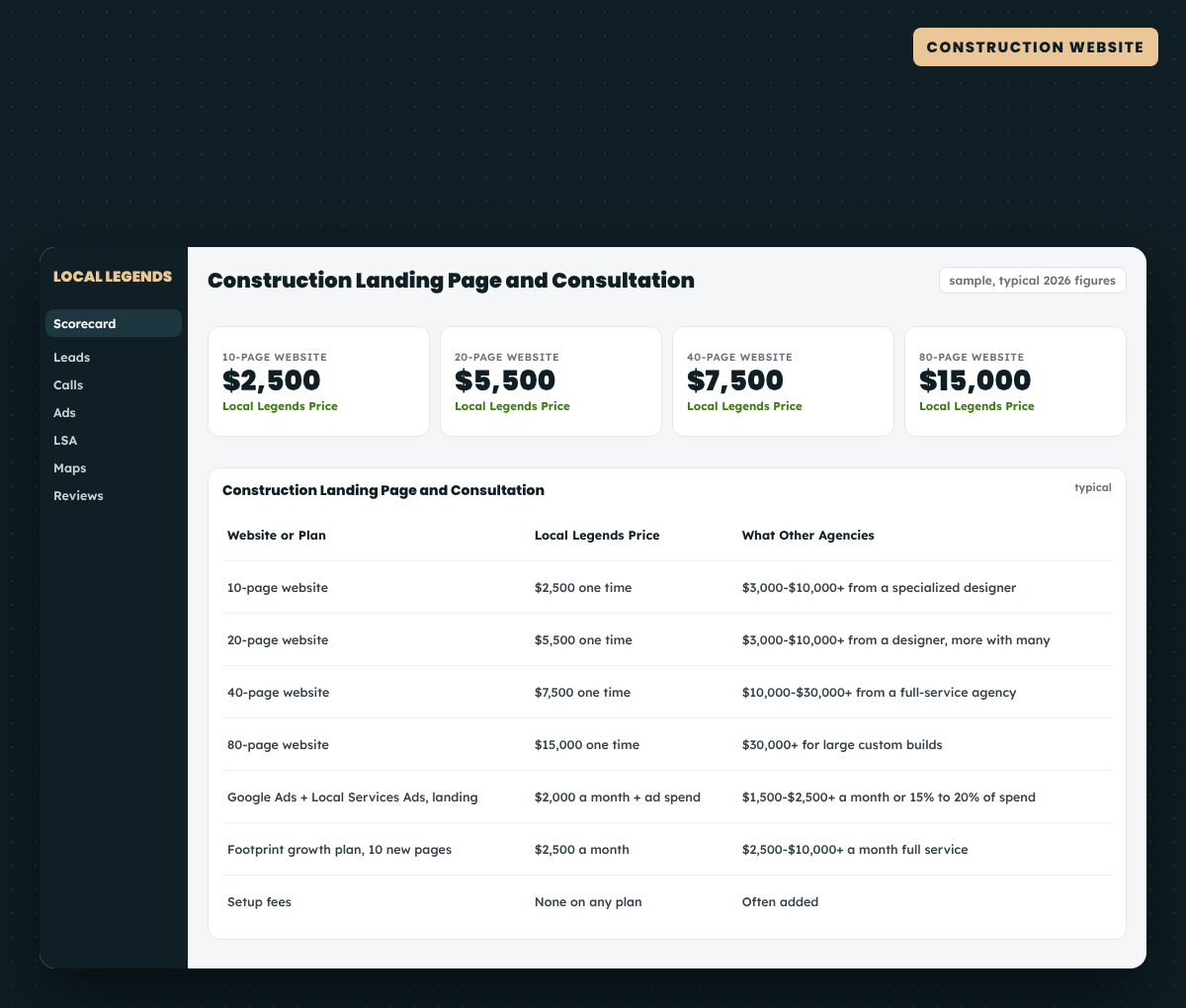
A general contractor website typically costs $3,000-$10,000+ from a specialized designer and $10,000-$30,000+ from a full-service agency in 2026. Google AI Mode gave those typical ranges in November 2026, with do-it-yourself builders under $500+ upfront; they are not Local Legends prices.
| Website or Plan | Local Legends Price | What Other Agencies Typically Charge |
|---|---|---|
| 10-page website | $2,500 one time | $3,000-$10,000+ from a specialized designer |
| 20-page website | $5,500 one time | $3,000-$10,000+ from a designer, more with many pages |
| 40-page website | $7,500 one time | $10,000-$30,000+ from a full-service agency |
| 80-page website | $15,000 one time | $30,000+ for large custom builds |
| Google Ads + Local Services Ads, landing pages included | $2,000 a month + ad spend | $1,500-$2,500+ a month or 15% to 20% of spend |
| Footprint growth plan, 10 new pages or blogs a month | $2,500 a month | $2,500-$10,000+ a month full service |
| Setup fees | None on any plan | Often added |
See every plan and add-on on the Local Legends pricing(link: /pricing/) page.
What Moves the Price of a Construction Website
- Page count: each project type and town page adds work.
- Gallery size: large captioned portfolios take longer to build.
- Writing: pages written from research cost more than filler, and rank better.
- Integrations: CRM routing, booking calendars and call tracking.
Is a $2,500 Website Enough for a General Contractor?
A $2,500, 10-page website is enough for a general contractor who sells two or three project types in one main area, with room to add pages later. A builder selling many project types across several towns usually fits the 20 or 40 page sizes.
- 10 pages: home, about, 3 to 4 project types, gallery, trust page, contact.
- 20 pages: adds more project types and the main towns you build in.
- 40 pages: a full multi-town, multi-service builder site.
- 80 pages: regional builders with several offices.
Construction Website Tracking From Inquiry to Signed Contract The Source Stays With the Lead
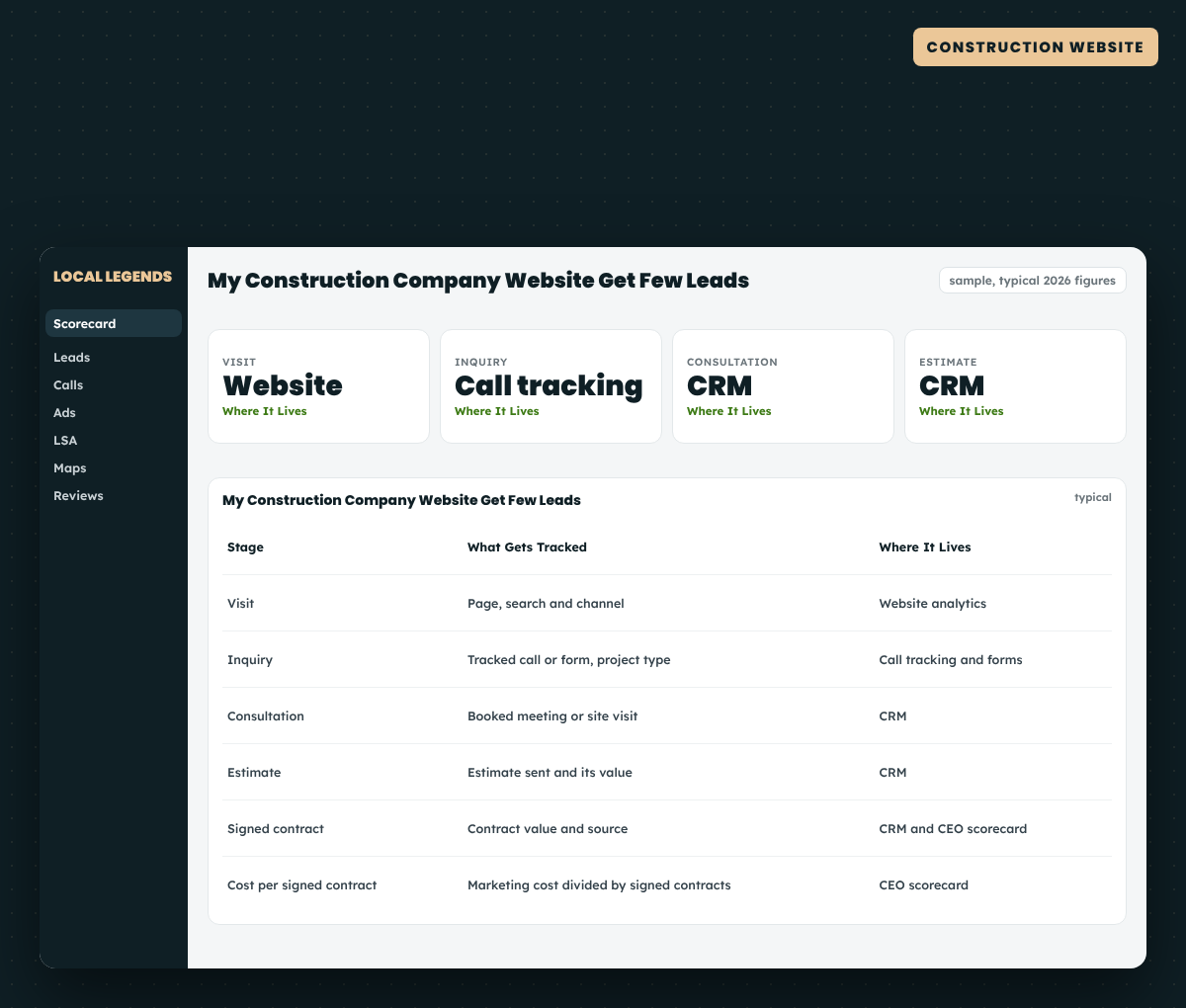
Construction website tracking follows each call and form from the first inquiry through the consultation, the estimate and the signed contract, so you can see which pages and channels produce real projects. Traffic and rankings are the start of that report, not the end.
| Stage | What Gets Tracked | Where It Lives |
|---|---|---|
| Visit | Page, search and channel | Website analytics |
| Inquiry | Tracked call or form, project type | Call tracking and forms |
| Consultation | Booked meeting or site visit | CRM |
| Estimate | Estimate sent and its value | CRM |
| Signed contract | Contract value and source | CRM and CEO scorecard |
| Cost per signed contract | Marketing cost divided by signed contracts | CEO scorecard |
Call tracking connects to Buildertrend, ServiceTitan, Housecall Pro, JobNimbus, AccuLynx, Jobber and GoHighLevel. See our call tracking and CRM integration(link: /services/call-tracking-crm/) page for how the source rides along to the contract.
Construction Websites That Google and AI Answers Can Read Clear Facts Beat Clever Copy
A construction website gets found on Google and quoted in AI answers when each page states plain facts about the project type, the area, the process and the price range, in short sections with clear headings.
How Do I Get My Construction Company Website Found on Google and Recommended in AI Answers?
A construction company gets found and recommended when its site has a page for each project type and area, and its business details and reviews match across the web. Google AI Mode said AI tools verify a company across directories and read review text for project details.
- Answer early: the first lines of each page say what you build, where and for whom.
- Use structure: question headings, short paragraphs, lists and tables.
- Add real details: square footage, timelines and price context from your projects.
- Fix your listings: a complete Google Business Profile and consistent details everywhere.
- Earn detailed reviews: ask clients to mention the project type and town in their words.
See our local SEO(link: /services/local-seo/) and AI SEO(link: /services/ai-seo/) pages for the work that happens off the website.
Redesigning Without Losing Rankings
A redesign keeps the pages that rank today at the same address, or redirects each old address to its closest new page. The team maps every old URL before launch and checks Search Console after it.
Our General Contractor Website Design Process Audit, Map, Build, Launch, Track
The Local Legends website process for general contractors starts with an audit of your current site, your Google Business Profile and the builders your buyers compare you with.
Step 1: Website Audit
Tracking, local SEO, Google Maps rank grids and your lead path are checked first, along with the project types and towns your site is missing.
Step 2: Page Map and Gallery Plan
Every project type, town and trust page gets planned, and your best projects are picked for the galleries.
Step 3: Research, Write and Build
Each page is researched and written for its search, then built in the product-page layout with forms and tracking.
Step 4: Launch, Redirect and Track
Old URLs are redirected, forms and calls are tested into your CRM, and the scorecard starts counting consultations and contracts.
Construction Websites Built by a Founder Who Worked Job Sites Levi Ostlund Paid for a Site That Never Ranked
Local Legends Marketing(link: /) founder Levi Ostlund poured concrete with his dad and ran a landscaping company in high school, so the company was built by someone who has stood on a job site waiting for the phone to ring. [SOURCE: Levi Ostlund founder story, Local Legends brief, Nov 2026]
Levi lost $30,000+ to bad marketers before founding the agency, including one who built a good-looking website that never ranked. Every Local Legends website is now planned around searches, project proof and tracked leads for that reason. [SOURCE: Levi Ostlund founder story, Local Legends brief, Nov 2026]
- 8+ years marketing contractors, including time as CMO of Amstill Roofing
- Every engagement includes the Local Legends marketing course
- Weekly project review meetings on every account
- Your site, domain and data stay in your name
Local Legends Marketing Client Reviews and Testimonials Contractor CEOs on Record
Contractor CEOs have gone on record about working with Local Legends and Levi Ostlund, including the written testimonial below and three video testimonials on the Local Legends home page. [SOURCE: Local Legends home page testimonials, Nov 2026]
Levi has been absolutely outstanding to work with over the years... His creativity, responsiveness, and deep understanding of our marketing strategy have made a huge impact." Brad Beldon, CEO, Roofing Company. Read on the Local Legends home page
- Kyle Scott, CEO, Roofing Company (video testimonial)
- Jim Dodson, CEO, Roofing Company (video testimonial)
- Race Allen, CEO, Precision Restoration of Texas (video testimonial)
- Brad Beldon, CEO, Roofing Company (written testimonial)
Frequently Asked Questions About General Contractor Website Design Quick Answers for Builders
How Long Does It Take to Build a Construction Company Website?
A construction company website typically takes 1 week to 3 months, and full custom builds with many pages often run 6 to 12+ weeks. Google AI Mode said gathering project photos and details causes most delays, so start there.
Do I Own My Construction Website and Domain?
Yes, Local Legends builds your website for a one-time fee, and the site, domain, content and photos stay in your name. There are no long-term contracts.
Can You Use My Existing Project Photos?
Yes, your own project photos are the best images a construction website can have. The team picks the strongest ones, writes captions and alt text and asks for new shots where a gallery is thin.
Do You Build Websites for Design-Build Firms and ADU Builders?
Yes, Local Legends builds websites for design-build firms, custom home builders, home addition and ADU builders, remodelers and light commercial contractors nationwide.
Does a Construction Website Need a Blog?
A blog helps a construction website when it answers buyer questions such as permits, timelines and costs. The growth plans add 10 to 100 new pages or blogs a month after launch.
Will My Website Connect to Buildertrend?
Yes, forms and tracked calls can route into Buildertrend and other construction CRMs, so every lead keeps its source through the signed contract.
Do I Need a New Website to Run Google Ads?
Not always, but ads perform better when each one lands on a page for that project type. Google Ads + Local Services Ads management at $2,000 a month includes the landing pages for its campaigns.
Where Does Local Legends Build Construction Websites?
Local Legends builds construction company websites for builders nationwide. See the Local Legends service areas(link: /locations/) page for the markets the team covers.
Reviewed by Levi Ostlund, Founder, Local Legends Marketing

Get a General Contractor Website That Wins Bigger Projects Book Your Free Website Audit
Local Legends Marketing(link: /) builds construction company websites with project type pages, captioned galleries and forms that qualify, then tracks each lead to the signed contract. Websites start at $2,500 one time, with no setup fees and no long-term contracts.
- Call:(936) 900-1248
- Office: 481 Stephen F Austin Dr, Conroe, TX 77302
- Next step: book your free website audit and get a page map for your project types