


What Pages Should a Kitchen and Bath

Home Remodel Websites That Turn Kitchen, Bath and Whole-Home Browsers Into Booked Design Consultations, With Project Case Studies, Price Guidance and Financing Built Into Every Page
Local Legends Marketing Remodeling Websites From $2,500, Owned by You
Updated November 2026 · Reviewed by Levi Ostlund, Founder
Home remodel websites from Local Legends Marketing are built so a homeowner can judge fit before calling: each kitchen, bath, addition and whole-home page pairs real project photos with a price guide, the steps of your process, financing and a short consultation request.
Remodeling websites cost a one-time $2,500 for 10 pages, $5,500 for 20, $7,500 for 40 or $15,000 for 80, with no setup fees. Google's AI Overview listed typical 2026 agency builds for remodelers at $5,000-$18,000+, and subscription sites at $49-$449+ a month.
- A page for each project type: kitchens, bathrooms, basements, additions and whole-home renovations each rank on their own.
- Case studies, not photo dumps: before, during and after images with the town, scope and timeline.
- Price guidance that filters: tiers and budget bands so the consults you book can afford the work.
- Every consult counted: call and form tracking tied to booked consultations and signed contracts.
- Agency-reported track record: 25,000+ appointments generated and $30M+ in revenue influenced.
Free Growth Audit
Your Reviews, Radius and Response Rate vs the competitors beating you.
About Local Legends Marketing
A home service marketing agency headquartered in Conroe, Texas, with 8+ years of marketing experience, running Google Ads, Local Services Ads, local SEO, AI SEO, connected TV and review systems for contractors nationwide.
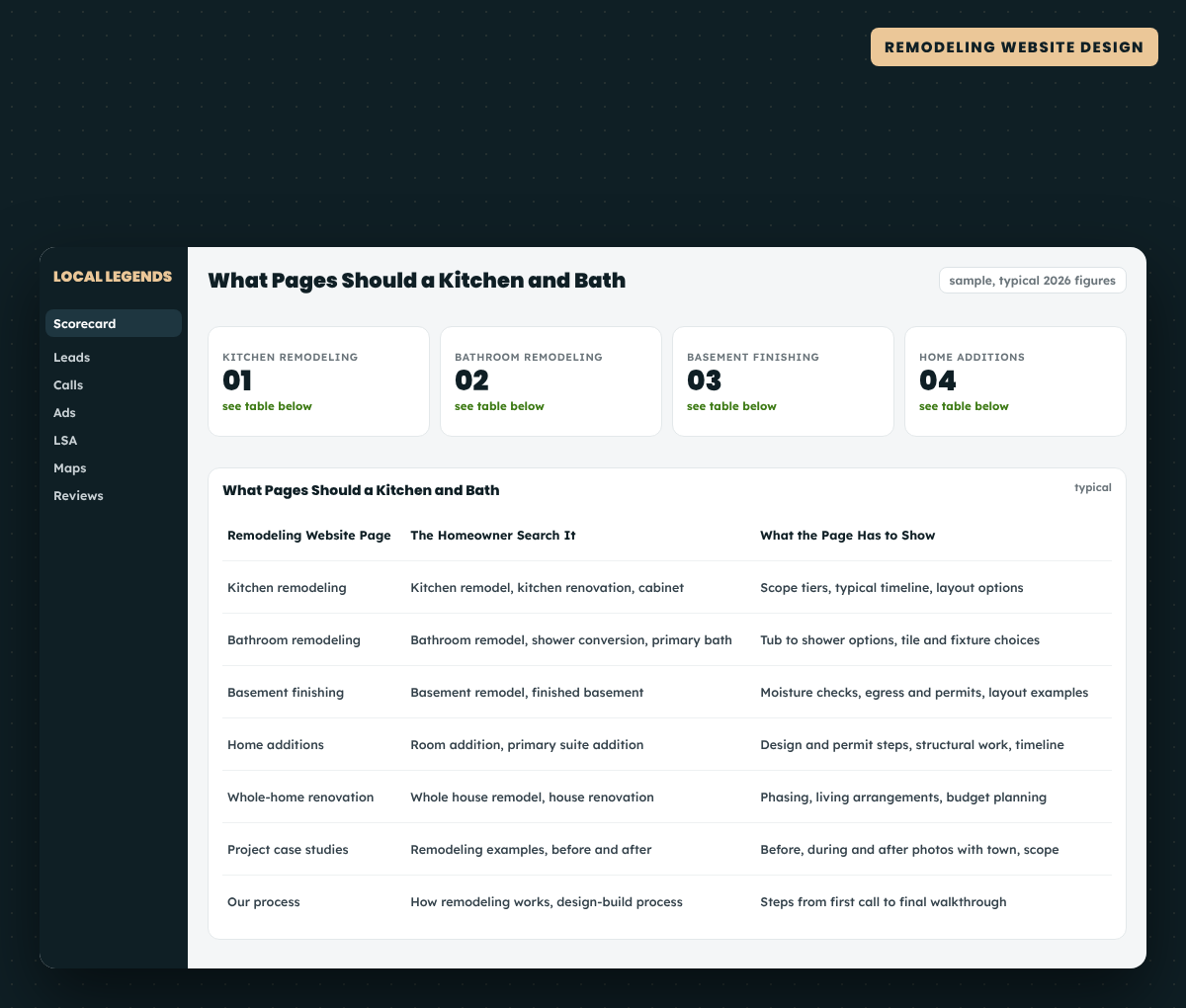
What Pages Should a Kitchen and Bath Remodeling Website Have to Get More Consultations? One Page per Project Worth Selling
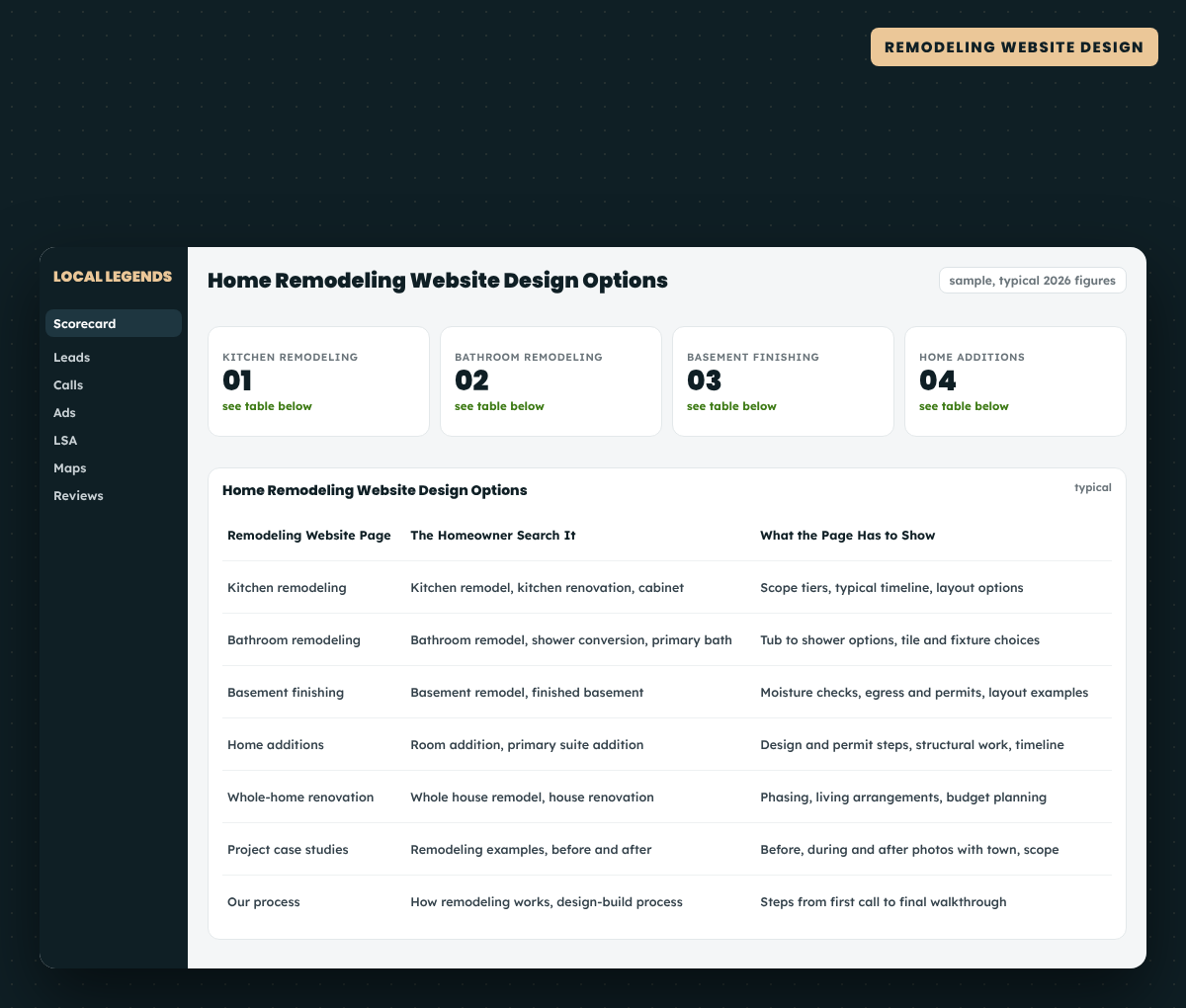
A kitchen and bath remodeling website gets more consultations when each major project type has its own page, the portfolio is organized as case studies and the consult request takes under a minute, Google's AI Overview said in November 2026. A single "Services" page cannot rank for both kitchen and bathroom searches.
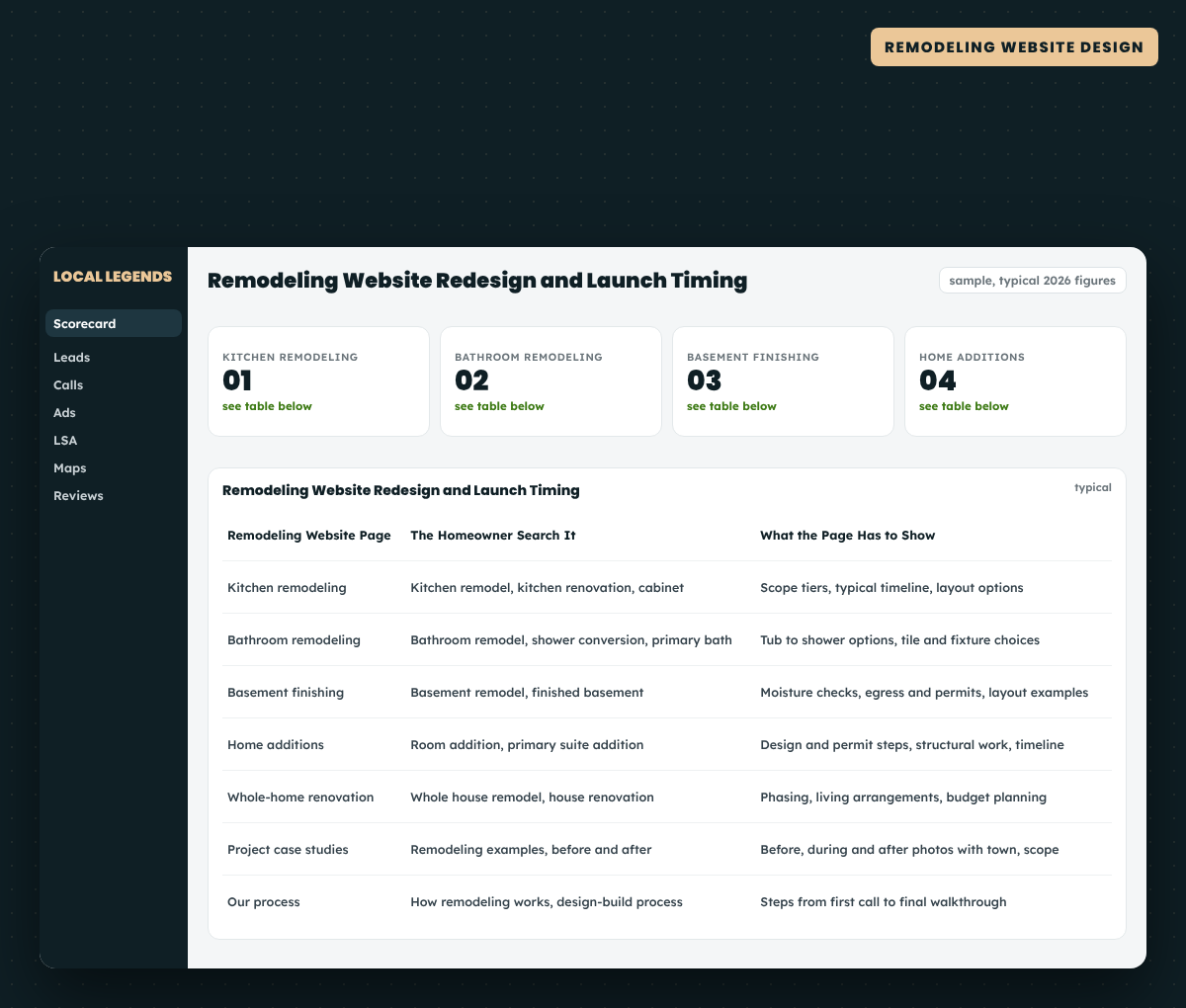
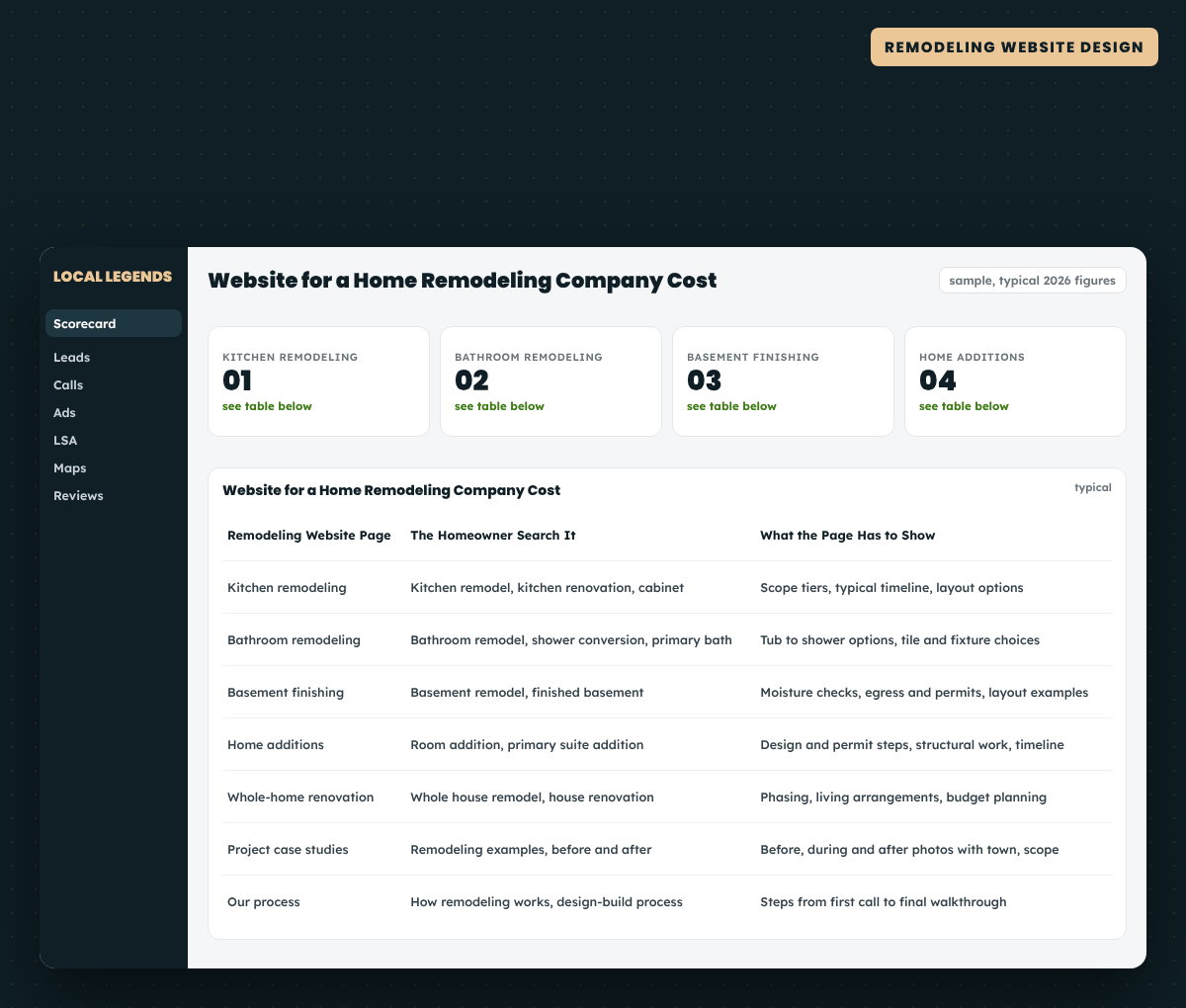
| Remodeling Website Page | The Homeowner Search It Answers | What the Page Has to Show |
|---|---|---|
| Kitchen remodeling | Kitchen remodel, kitchen renovation, cabinet and countertop upgrade | Scope tiers, typical timeline, layout options, consult button |
| Bathroom remodeling | Bathroom remodel, shower conversion, primary bath renovation | Tub to shower options, tile and fixture choices, accessibility features |
| Basement finishing | Basement remodel, finished basement | Moisture checks, egress and permits, layout examples |
| Home additions | Room addition, primary suite addition | Design and permit steps, structural work, timeline |
| Whole-home renovation | Whole house remodel, house renovation | Phasing, living arrangements, budget planning |
| Project case studies | Remodeling examples, before and after | Before, during and after photos with town, scope and timeline |
| Our process | How remodeling works, design-build process | Steps from first call to final walkthrough |
| Financing | Remodel financing, monthly payments | Payment options and how to apply |
| Service area pages | Remodeler in a specific town | Only towns with 5+ real local facts and real projects |
| About, licensing and reviews | Licensed remodeling contractor | License and insurance details, team photos, Google reviews |
Why Kitchens and Baths Need Separate Pages
Kitchen and bathroom buyers search, compare and budget differently. Separate pages let each one carry its own photos, price guide and questions, and they give Google a clear page to rank for each project type.
How Many Pages a Remodeling Website Should Start With
A remodeler doing kitchens and baths in one county can launch with 10 pages: home, kitchen, bath, case studies, process, financing, about, reviews, contact and one strong town page. Firms adding basements, additions and several towns usually need 20 to 40.
My Remodeling Company Website Gets Traffic but No Consultation Requests. What Should I Fix First?
A remodeling website with visitors but no consultation requests should first check who those visitors are and whether the forms and phone links work on a phone, Google's AI Overview advised in November 2026. Readers of idea articles are often months from hiring, while kitchen page visitors are close.
- Submit a test request on mobile and desktop and confirm it reaches your inbox and CRM.
- Send ad traffic to the matching project page, not the home page.
- Check service area: traffic from outside your towns will never book.
- Move the consult button and phone number into the first screen of every project page.
- Cut the form to name, phone, project type and budget band.
- Add call tracking so you can see which pages produce booked consults.
Project Photos and Before and After Case Studies on a Renovation Website Show the Transformation and the Build
A renovation website earns consultations when each featured project reads as a case study with matched-angle before, during and after photos, the town, a cost range, the timeline and a consult button, which is the format Google's AI Overview recommended in November 2026 over an unlabeled photo grid.
Plan the Photo Shoot Before Demolition
Take the before photos from the corners you will use for the after photos, so the two line up. A few progress shots of framing, plumbing rough-in, tile layout or cabinet leveling show the craftsmanship homeowners never see once the walls close.
The Case Study Template
- Headline: the room, the change and the town, such as an open-concept kitchen in a 1970s ranch.
- The starting point: what the homeowner wanted fixed or changed.
- The plan: layout changes, materials and design choices.
- The build: timeline in weeks and any permit or structural step.
- The result: after photos and the homeowner's own review.
- Next step: a "Plan a project like this" consultation button.
Link Every Case Study to Its Service Page
Each kitchen case study links to the kitchen remodeling page, and the kitchen page shows its three best case studies. That two-way link helps homeowners move from inspiration to a request, and it tells Google which page covers which project.
Should My Bathroom Remodel Website Have Separate Pages for Each City We Serve?
A bathroom remodel website should build separate city pages only for the towns where the company has real local proof, Google's AI Overview said in November 2026, such as finished remodels, local reviews and permit or housing details. Smaller towns belong on one service area page.
- Build a city page when you have finished bathrooms, photos and reviews in that town.
- Build one when homeowners search for that town by name rather than the nearby hub.
- Build one when local permits, HOA rules or home styles change how the work is done.
- Skip it when the only difference would be the city name swapped into a template.
- Local Legends writes town pages only for towns with 5+ real local facts.
Price Ranges, Budget Questions and Financing on a Remodeling Website Help Homeowners Qualify Themselves
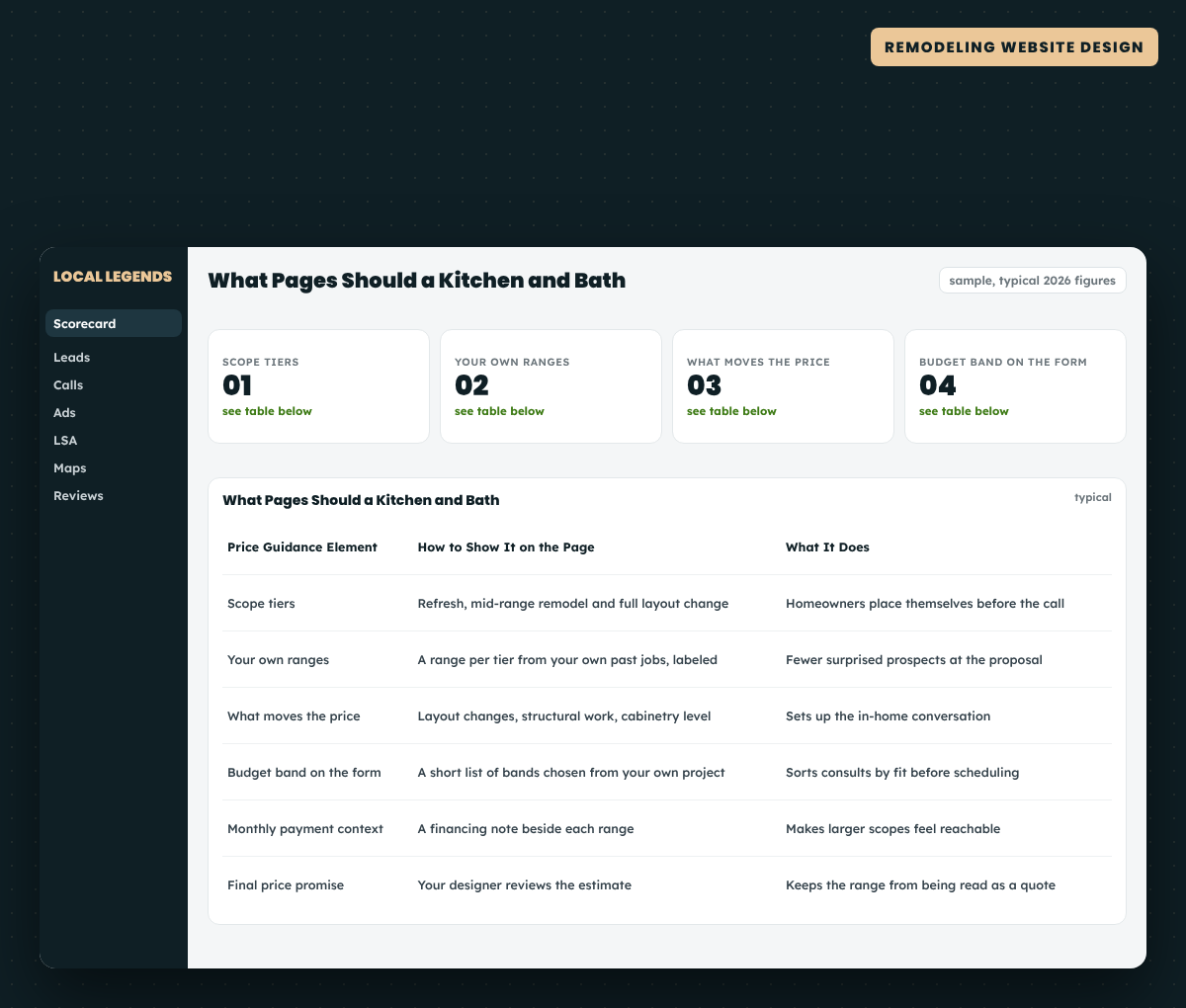
A remodeling website should show price guidance for kitchen and bathroom remodels, Google's AI Overview answered in November 2026, because realistic ranges help homeowners self-qualify, build trust and filter out budgets that do not fit before your designer drives to the house.
| Price Guidance Element | How to Show It on the Page | What It Does for Your Sales Team |
|---|---|---|
| Scope tiers | Refresh, mid-range remodel and full layout change, each described in plain words | Homeowners place themselves before the call |
| Your own ranges | A range per tier from your own past jobs, labeled as a typical range | Fewer surprised prospects at the proposal |
| What moves the price | Layout changes, structural work, cabinetry level, tile and permits | Sets up the in-home conversation |
| Budget band on the form | A short list of bands chosen from your own project mix | Sorts consults by fit before scheduling |
| Monthly payment context | A financing note beside each range | Makes larger scopes feel reachable |
| Final price promise | Your designer reviews the estimate with the homeowner before work begins | Keeps the range from being read as a quote |
Why Ranges Beat Hiding the Price
Google's AI Overview noted that hiding prices behind a contact form can make a remodeler look evasive. A range published from your own jobs answers the first question every homeowner has, and the consult becomes a conversation about scope instead of sticker shock.
Should My Remodeling Website Have a Cost Calculator or a Budget Question on the Form to Filter Tire Kickers?
A budget question on the consultation form usually filters better than a standalone cost calculator, Google's AI Overview said in November 2026, because calculators can draw price shoppers who anchor on a number that hidden conditions and material choices later change.
- Ask for a budget band, the project type and the target start date on the form.
- Use bands from your own projects so the choices match the work you actually do.
- If you add a calculator, label results as a rough starting range and explain what changes them.
- Route low-band requests to a phone call or a smaller-scope offer instead of an in-home visit.
- Track which bands sign so the form keeps improving.
How Should My Remodeling Company Website Present Financing for Kitchen and Bathroom Remodels?
A remodeling website should present financing early, beside the price guidance, and turn large totals into monthly payment context, Google's AI Overview advised in November 2026, with a financing link in the main menu and a page that explains how the application works.
- Add "Financing" to the main navigation so it is visible from every page.
- Explain each option your lending partners offer in plain words.
- Show monthly context next to each scope tier on the kitchen and bath pages.
- State that the lender sets the terms, and keep the wording consistent with the lender's materials.
- Mention financing in proposals so the website and the sales conversation match.
Home Remodeling Website Design Options: Builder, Design Platform or Agency? Ownership Decides the Long-Term Cost
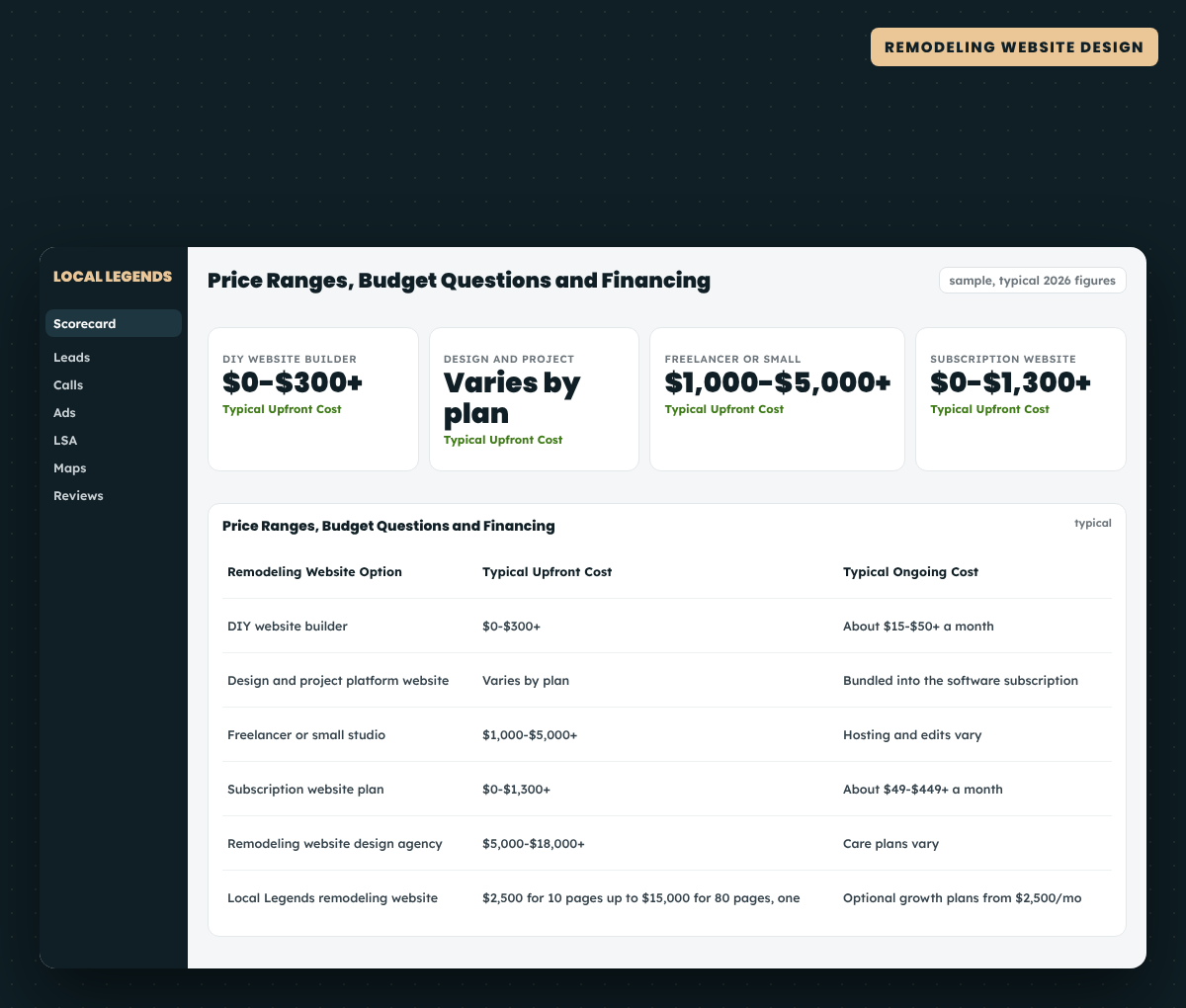
A remodeling company can build on a DIY website builder, use a site that comes with a design and project management platform, hire a freelancer or work with a remodeling website design agency, and Google's AI Overview said the right choice depends on budget, growth stage and how much control over local search the company wants.
| Remodeling Website Option | Typical Upfront Cost | Typical Ongoing Cost | Who Owns It |
|---|---|---|---|
| DIY website builder | $0-$300+ | About $15-$50+ a month | You, but you build and update it yourself |
| Design and project platform website | Varies by plan | Bundled into the software subscription | Tied to the subscription, check the terms |
| Freelancer or small studio | $1,000-$5,000+ | Hosting and edits vary | Usually you, check the contract |
| Subscription website plan | $0-$1,300+ | About $49-$449+ a month | Often the vendor until a buyout term ends |
| Remodeling website design agency | $5,000-$18,000+ | Care plans vary | Usually you, check the contract |
| Local Legends remodeling website | $2,500 for 10 pages up to $15,000 for 80 pages, one time | Optional growth plans from $2,500/mo | You own the domain, site, content and photos |
Typical ranges are compiled from Google AI Overview captures in November 2026, not Local Legends data. [SOURCE: Google AI Overview captures, "How much does a website for a home remodeling company cost in 2026", Nov 27 2026]
The Three-Year Math on a Rented Site
A $300 monthly website plan adds up to $10,800 over three years. If the site stays with the vendor when the plan ends, a remodeler pays again to rebuild the pages and photos that were already ranking.
Should My Remodeling Company Use a Design Platform Website, a Website Builder or a Custom Website?
A website builder fits a new remodeler on a tight budget, a design platform site fits a design-heavy firm that wants bundled project and client tools, and a custom site fits an established company competing for local search, Google's AI Overview summarized in November 2026.
- Website builder: fast and inexpensive, but you write, shoot and update everything yourself.
- Design platform site: convenient alongside the software, but check what happens to the site if you cancel.
- Custom remodeling site: full control of pages, case studies, tracking and local SEO.
- Whichever you pick: keep the domain in your company's own registrar account.
What Should a Remodeling Company Ask a Web Designer Before Signing So We Own the Website?
A remodeling company should ask questions that put the domain, hosting, site files and design files in its own name from the first day, Google's AI Overview advised in November 2026, since a designer who holds those accounts can lock you out or charge to release them.
- Is the domain registered in our company's registrar account, with our login and DNS access?
- Who owns the hosting and the CMS, and do we get a full administrator login?
- Do we keep the design files, copy and project photos if we part ways?
- Is analytics and Search Console set up under our account?
- What happens to the site if we stop a monthly payment?
- Can we see remodeling or home service sites you have built?
Making a Remodeling Website Rank for Kitchen Remodel Near Me Searches The Website and the Profile Work Together
A remodeling website ranks for "kitchen remodel near me" when its project pages and town pages support a strong Google Business Profile, Google's AI Overview said in November 2026, because Google weighs proximity, relevance and prominence for local searches and shows the Map Pack above organic results.
Google Business Profile
Local SEO[LINK: /services/local-seo/] sets the primary category, such as kitchen remodeler, adds services like cabinetry and countertops, posts project photos and requests reviews. Each profile service should link to its matching page on the site.
Google Ads Landing Pages
Google Ads management[LINK: /services/ppc/] sends kitchen and bath searches to the matching project page, and the $2,000 a month Google Ads + LSA package includes the campaign landing pages.
Call Tracking and Your CRM
Call tracking and CRM integration[LINK: /services/call-tracking-crm/] ties each website call and form to a consult and a signed contract in Buildertrend, JobNimbus, ServiceTitan, Housecall Pro, Jobber, AccuLynx or GoHighLevel.
Email and Text Follow-Up
Remodel buyers often take weeks to decide. Email and text nurture[LINK: /services/email-marketing/] sends project stories and financing reminders to consult requests that have not signed.
How Do I Get ChatGPT and Google AI to Recommend My Home Remodeling Company?
AI tools recommend remodeling companies they can clearly identify and verify, Google's AI Overview said in November 2026, so the website, Google Business Profile and directories should share identical details and state the niche and service area in plain words.
- Match your name, address, phone and website URL on every listing.
- Say what you do and where at the top of the home page, such as kitchen and bathroom remodeling in your county.
- Answer real homeowner questions on each project page in short, quotable paragraphs.
- Earn detailed reviews that name the room, the town and the result.
- Publish case studies that AI tools can cite as proof of the work.
What Are the Best Websites for Home Remodeling Ideas, and Should My Company Be on Them?
Homeowners browse design inspiration sites, home improvement media sites and pro directories while they plan, and the search results for "home remodel websites" in November 2026 were led by exactly those. A remodeler's own site has to win the visit that comes after the browsing.
- Keep a complete, current profile on the directories homeowners in your area use.
- Post the same best projects there and on your own case study pages.
- Point every profile back to your site, where the price guide and consult request live.
- Ask happy clients for Google reviews first, since those feed your Map Pack listing.
Remodeling Website Redesign and Launch Timing Keep Rankings, Then Improve
A remodeling website redesign keeps its rankings by auditing what already brings leads, preserving those URLs, mapping every changed URL to a one-to-one 301 redirect and checking indexing and tracking at launch, the steps Google's AI Overview listed in November 2026.
- Export top pages from Search Console, including kitchen, bath and town pages and the galleries that convert.
- Protect pages that produce consults, even if their traffic is modest.
- List links from suppliers, manufacturers and local groups so those pages keep their URLs.
- Rebuild each page in the new layout with more case studies and price guidance.
- Launch with redirects and tracking live the same day.
- Watch Search Console weekly for missing pages after launch.
How Long Does It Take to Build a Remodeling Company Website, and When Should We Launch Before the Busy Season?
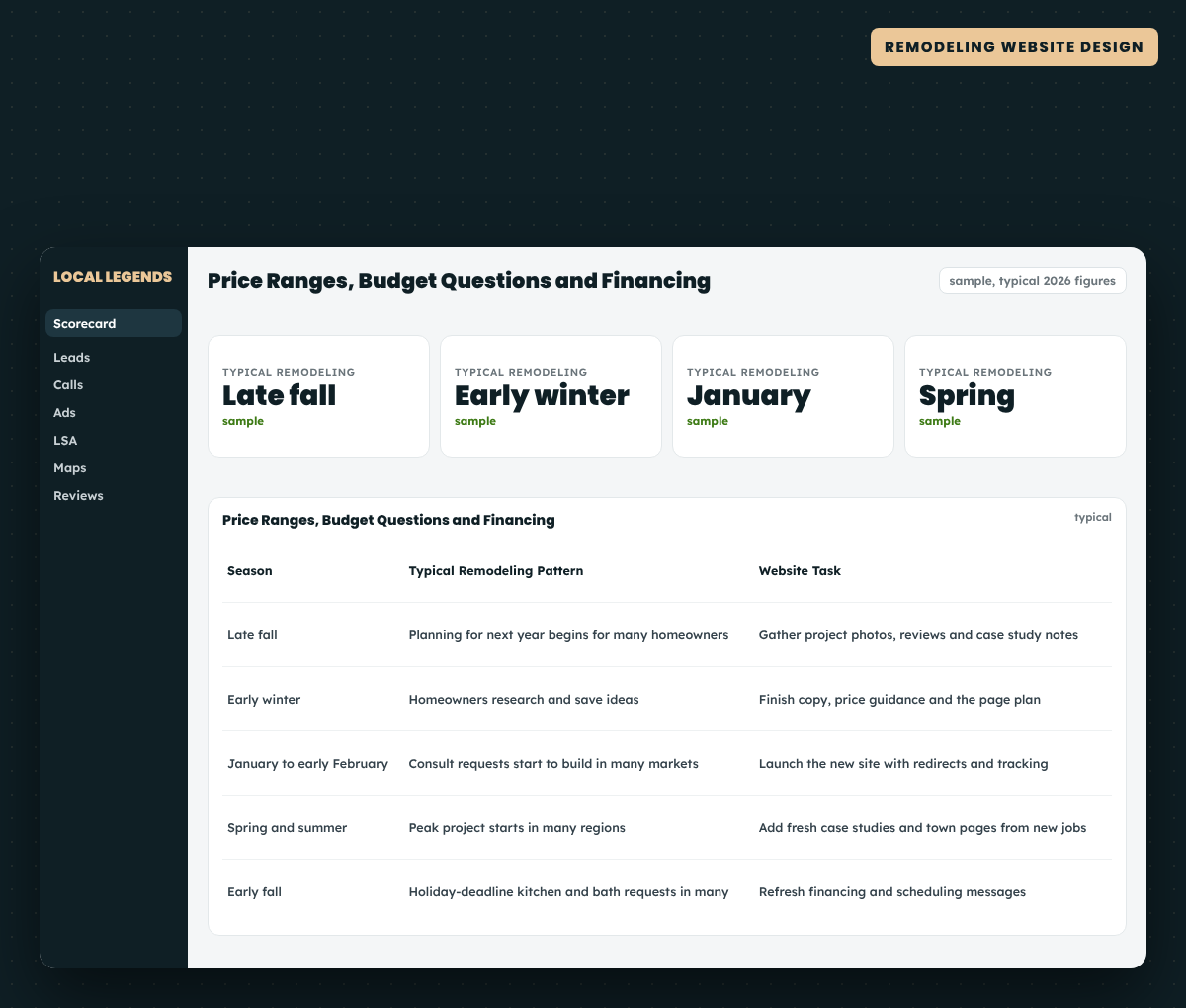
A remodeling company website typically takes 4 to 10 weeks to build, and Google's AI Overview suggested launching by January or early February ahead of the spring and summer remodeling rush in November 2026. Gathering photos, writing copy and reviewing drafts usually take longer than the build itself.
| Season | Typical Remodeling Pattern | Website Task |
|---|---|---|
| Late fall | Planning for next year begins for many homeowners | Gather project photos, reviews and case study notes |
| Early winter | Homeowners research and save ideas | Finish copy, price guidance and the page plan |
| January to early February | Consult requests start to build in many markets | Launch the new site with redirects and tracking |
| Spring and summer | Peak project starts in many regions | Add fresh case studies and town pages from new jobs |
| Early fall | Holiday-deadline kitchen and bath requests in many markets | Refresh financing and scheduling messages |
Why Paid Search Bridges the First Months
Google's AI Overview noted that organic rankings often take 4 to 6 months to build momentum after launch. Google Ads and Local Services Ads send homeowners to the new project pages while rankings grow.
How Much Does a Website for a Home Remodeling Company Cost? One-Time Prices by Page Count
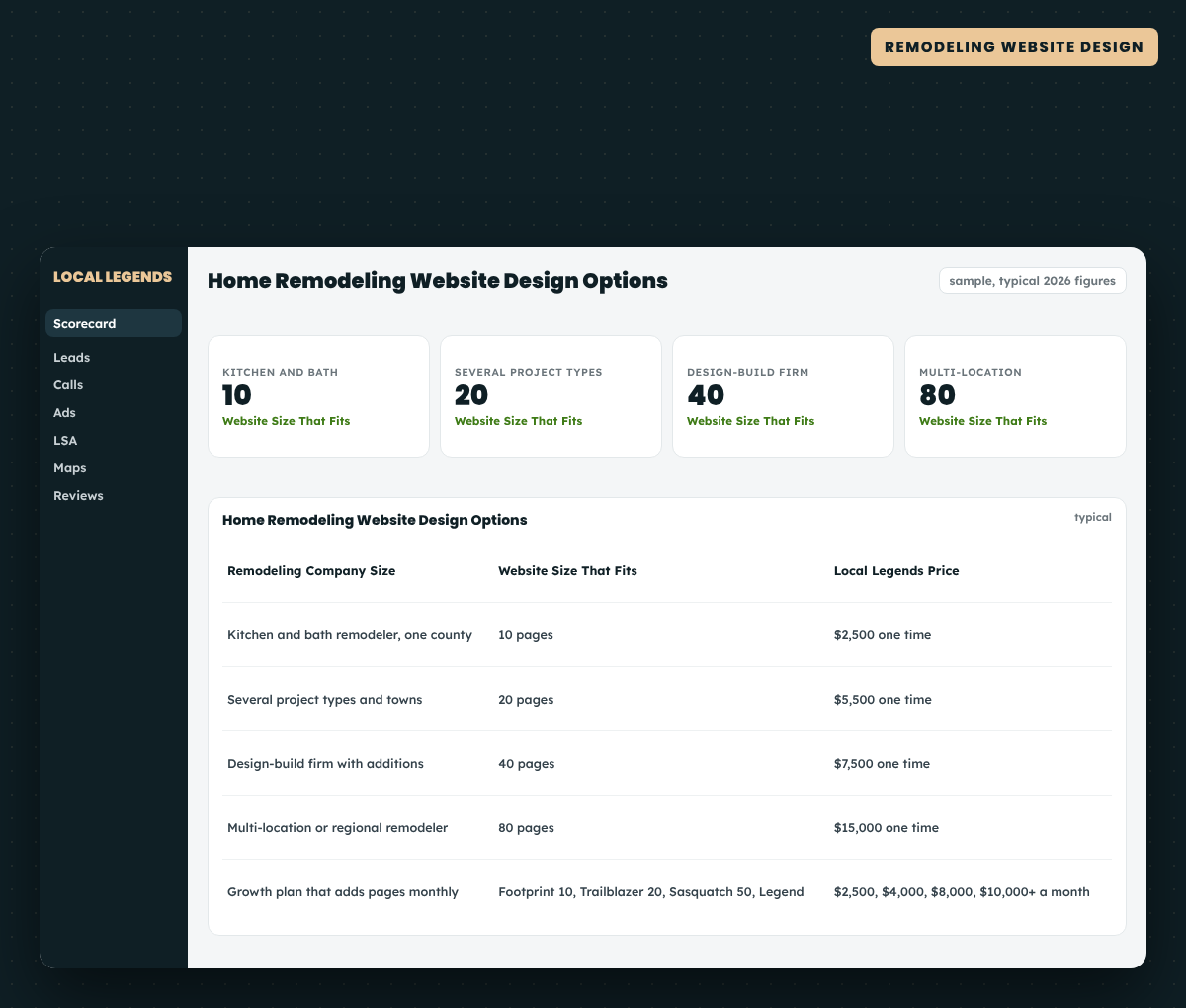
A Local Legends remodeling website costs $2,500 for 10 pages, $5,500 for 20, $7,500 for 40 or $15,000 for 80, paid once, while Google's AI Overview put typical 2026 agency builds for remodelers at $5,000-$18,000+ and custom portfolio builds at up to $30,000+.
| Remodeling Company Size | Website Size That Fits | Local Legends Price | What Other Agencies Typically Charge |
|---|---|---|---|
| Kitchen and bath remodeler, one county | 10 pages | $2,500 one time | $5,000-$18,000+ |
| Several project types and towns | 20 pages | $5,500 one time | $5,000-$18,000+ |
| Design-build firm with additions and whole-home work | 40 pages | $7,500 one time | $5,000-$18,000+ |
| Multi-location or regional remodeler | 80 pages | $15,000 one time | $18,000-$30,000+ |
| Growth plan that adds pages monthly | Footprint 10, Trailblazer 20, Sasquatch 50, Legend 100 pages a month | $2,500, $4,000, $8,000, $10,000+ a month | $2,500-$10,000+ a month full service |
No plan has a setup fee or a long-term contract. Every plan and add-on is listed on the Local Legends pricing[LINK: /pricing/] page.
Is a 10-Page Website Enough for a Small Kitchen and Bath Remodeler?
A 10-page site is enough for a kitchen and bath remodeler in one county when its pages cover the two main project types, case studies, process, financing and reviews. More project types and towns are added as the company grows.
- Start with home, kitchen, bath, case studies, process, financing, about, reviews, contact and one town page.
- Add basement, addition and whole-home pages as those projects grow.
- Add town pages only where you have real projects and local facts.
- Move to a growth plan when you want new pages and case studies every month.
Who Is the Best Website Design Company for Home Remodeling Contractors? Score Every Designer on the Same Tests
There is no single best website design company for remodelers, Google's AI Overview said in November 2026; the right one depends on budget, size and goals. The tests below come from what the AI Overview and the top-ranking remodeling pages stressed.
- Remodeling focus: examples of kitchen, bath and design-build sites, not only restaurants or retail.
- Case study structure: galleries organized by project with before, during and after photos.
- Price guidance: a plan for ranges, budget bands and financing on the pages.
- Local search: project pages and town pages tied to the Google Business Profile.
- Tracking: calls and forms tied to booked consults and signed contracts.
- Ownership: domain, hosting, files and photos in your company's name.
How Local Legends Answers Those Tests
Local Legends Marketing[LINK: /] builds remodeling websites in a product-page layout with case studies, price guidance, financing and tracking, and the remodeler owns every page. The site plugs into the rest of the remodeling marketing[LINK: /industries/remodeling/] plan and the full contractor website design services[LINK: /services/website-design/].
Our Remodeling Website Design Process Audit to Signed Contract
The Local Legends remodeling website process starts with an audit of the current site, rankings and consult flow, then builds each page around the projects the company wants more of.
Step 1: Website and Rankings Audit
A review of current pages, rankings, the Google Business Profile, tracking and the sales funnel, including Google Maps rank grids across the service area. [SOURCE: Levi Ostlund confirmation, Nov 10 2026]
Step 2: Page Plan and Photo List
Project pages for kitchens, baths, basements, additions and whole-home work, a case study list from your best jobs and town pages only where a town has 5+ real local facts.
Step 3: Build in the Product-Page Layout
Each page gets your project photos, price guidance, financing context, a consult button and a short form.
Step 4: Launch With Redirects and Tracking
Old URLs are redirected, tracked numbers and forms go live and every account stays in your company's name.
Step 5: Measure Consults and Contracts
Calls and forms are tracked to booked consultations and signed contracts, and growth plans add new pages and case studies each month.
Every engagement includes the Local Legends marketing course. Remodelers are served nationwide; see Local Legends service areas[LINK: /locations/].
Remodeling Websites From a Founder Who Paid for One That Never Ranked
Levi Ostlund grew up selling driveway jobs, pouring concrete with his father and running a high school landscaping business before he became CMO of Amstill Roofing. One of the marketers who cost him more than $30,000 built a good-looking site that never ranked. [SOURCE: BRIEF.md founder history, Nov 2026]
That experience is why every Local Legends remodeling website is built to rank, to book consults and to stay in the owner's name.
Local Legends Marketing Reviews From Contractor CEOs Contractor Owners on the Record
Contractor CEOs have recorded what it is like to work with Local Legends Marketing[LINK: /], and their testimonials appear on the Local Legends site. No remodeling-specific case studies are claimed on this page.
Levi has been absolutely outstanding to work with over the years... His creativity, responsiveness, and deep understanding of our marketing strategy have made a huge impact." Brad Beldon, CEO, Roofing Company. See it on locallegends.marketing
- Kyle Scott, CEO, Roofing Company (video testimonial)
- Jim Dodson, CEO, Roofing Company (video testimonial)
- Race Allen, CEO, Precision Restoration of Texas (video testimonial)
Frequently Asked Questions About Home Remodel Websites Answers for Remodeling Company Owners
What Is the Best DIY Website Builder for a Remodeling Company?
A DIY builder can work for a brand-new remodeler, but a builder only helps if you have time to write the pages, organize case studies and keep the site current. Whatever you use, keep the domain in your own account.
Does a Remodeling Company Need a Website if It Has a Google Business Profile?
Yes. Homeowners planning a kitchen or bath often check the profile first, then study the website's projects, process and price guidance before requesting a consult.
How Long Does a New Remodeling Website Take to Rank?
Organic rankings for a new or rebuilt remodeling website often take 4 to 6 months to build momentum, Google's AI Overview noted in November 2026. Keeping old URLs that already rank and adding case studies each month shortens the wait.
Can My Remodeling Website List the Cabinet, Tile and Fixture Brands We Install?
Yes, listing the brands you install helps homeowners who search by brand, as long as you list only brands you actually install.
Do You Write the Remodeling Website Content?
Yes, Local Legends writes the page content from your project types, process, photos and reviews, and you approve it before launch.
Will My Remodeling Website Connect to Buildertrend or Our CRM?
Yes, call tracking connects to Buildertrend, JobNimbus, AccuLynx, ServiceTitan, Housecall Pro, Jobber and GoHighLevel, so website consults show up next to the projects they become.
Who Owns the Website if We Stop Working Together?
You do. The domain, website, copy and project photos stay in your company's name.
Is There a Setup Fee or Monthly Contract for a Remodeling Website?
No. The website is a one-time price by page count, with no setup fee and no long-term contract.
Reviewed by Levi Ostlund, Founder, Local Legends Marketing

Get a Remodeling Website That Books Design Consultations Book Your Remodeling Website Audit
Book a free growth audit and Local Legends will review your current remodeling website, rankings and consult tracking, then show which project pages and case studies to build first. You own every page that gets built.
Call (936) 900-1248 or book online to start your remodeling website.