


The Difference Between SEO and SEM
Search Engine Marketing and Search Engine Optimization for Contractors: How Paid Search and Organic SEO Work Together to Book More Roofing, HVAC, Plumbing and Remodeling Jobs
One Search Plan, Two Ways to Win the Page
Updated November 2026 · Reviewed by Levi Ostlund, Founder
Breadcrumb: Home > Learning Center [LINK: /learning-center/] > Search Engine Marketing and Search Engine Optimization
Search engine marketing and search engine optimization are the two ways a contractor shows up on Google: SEM buys a spot at the top with paid ads today, and SEO earns organic and Map Pack rankings that keep producing calls over time. Most home service companies need both.
- SEM: paid placement on Google and Bing, live in days, stops when the budget stops.
- SEO: earned rankings in organic results and the Map Pack, slow to build, compounding once built.
- Together: ads find the keywords that book jobs, and SEO turns those keywords into pages that rank.
- The scoreboard: cost per booked job across both channels, not clicks or rankings alone.
Free Growth Audit
Your Reviews, Radius and Response Rate vs the competitors beating you.
About Local Legends Marketing
A home service marketing agency headquartered in Conroe, Texas, with 8+ years of marketing experience, running Google Ads, Local Services Ads, local SEO, AI SEO, connected TV and review systems for contractors nationwide.
What Is the Difference Between SEO and SEM for a Roofing Company? Rented Visibility Versus Owned Visibility
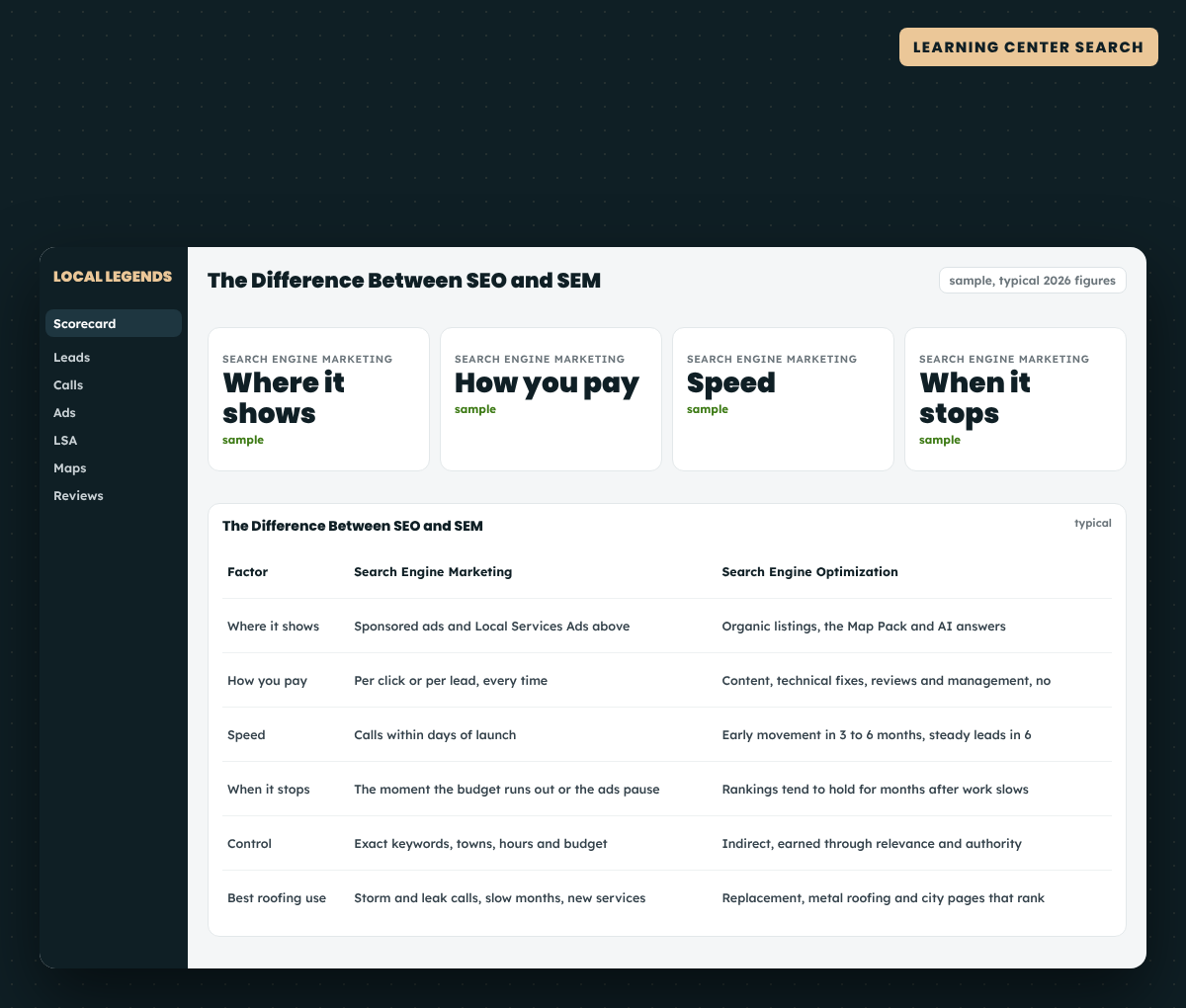
For a roofing company, SEO is the work that earns unpaid rankings in Google's organic results and Map Pack, and SEM is the paid side of search that puts an ad above those results within days. The Google AI Overview framed it in November 2026 as unpaid, long-term placement versus immediate placement that is bought.
Some marketers use SEM as an umbrella for both paid and organic search. In day-to-day contractor marketing, SEM almost always means Google Ads, Microsoft Advertising and Local Services Ads, so this guide uses it that way.
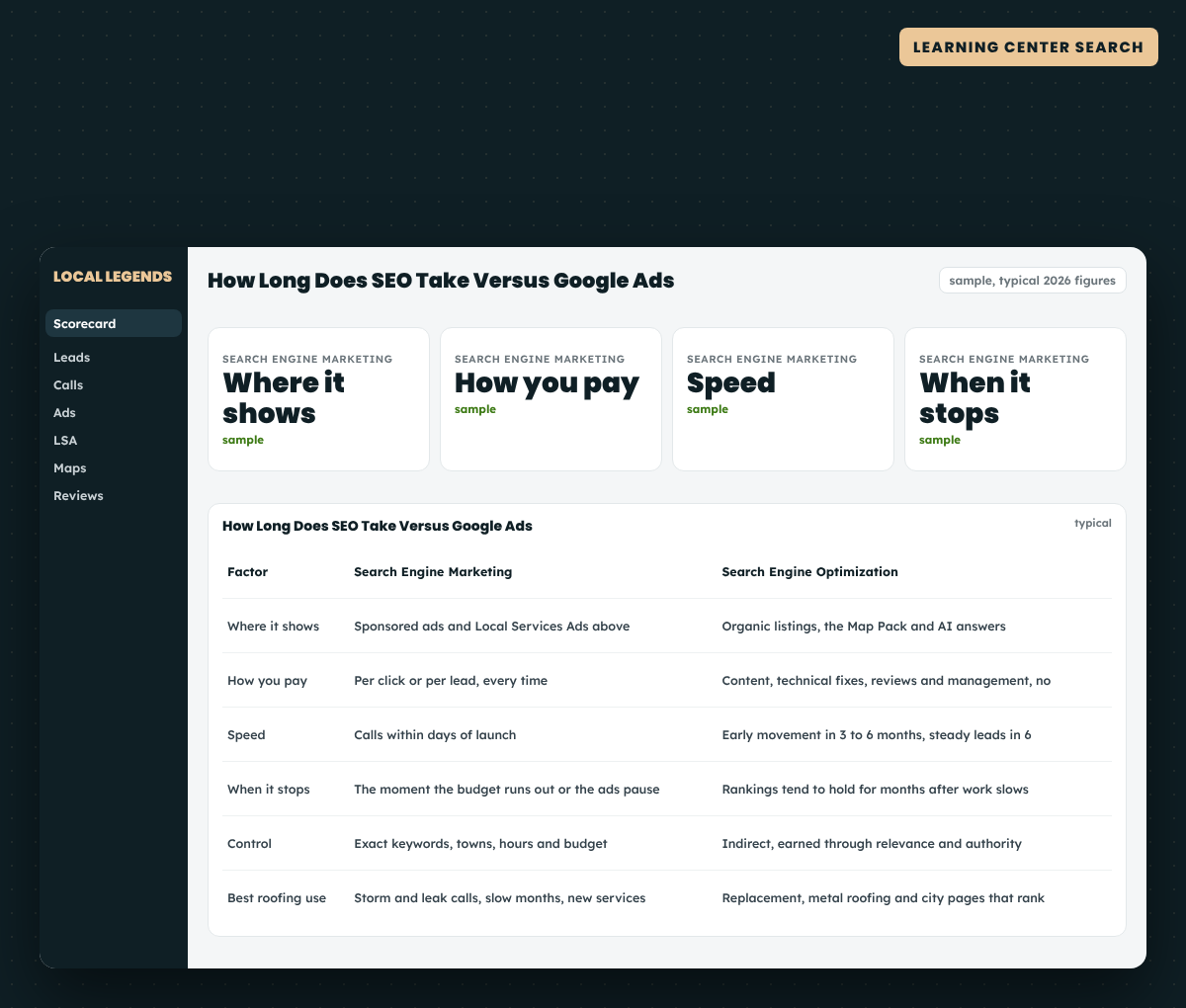
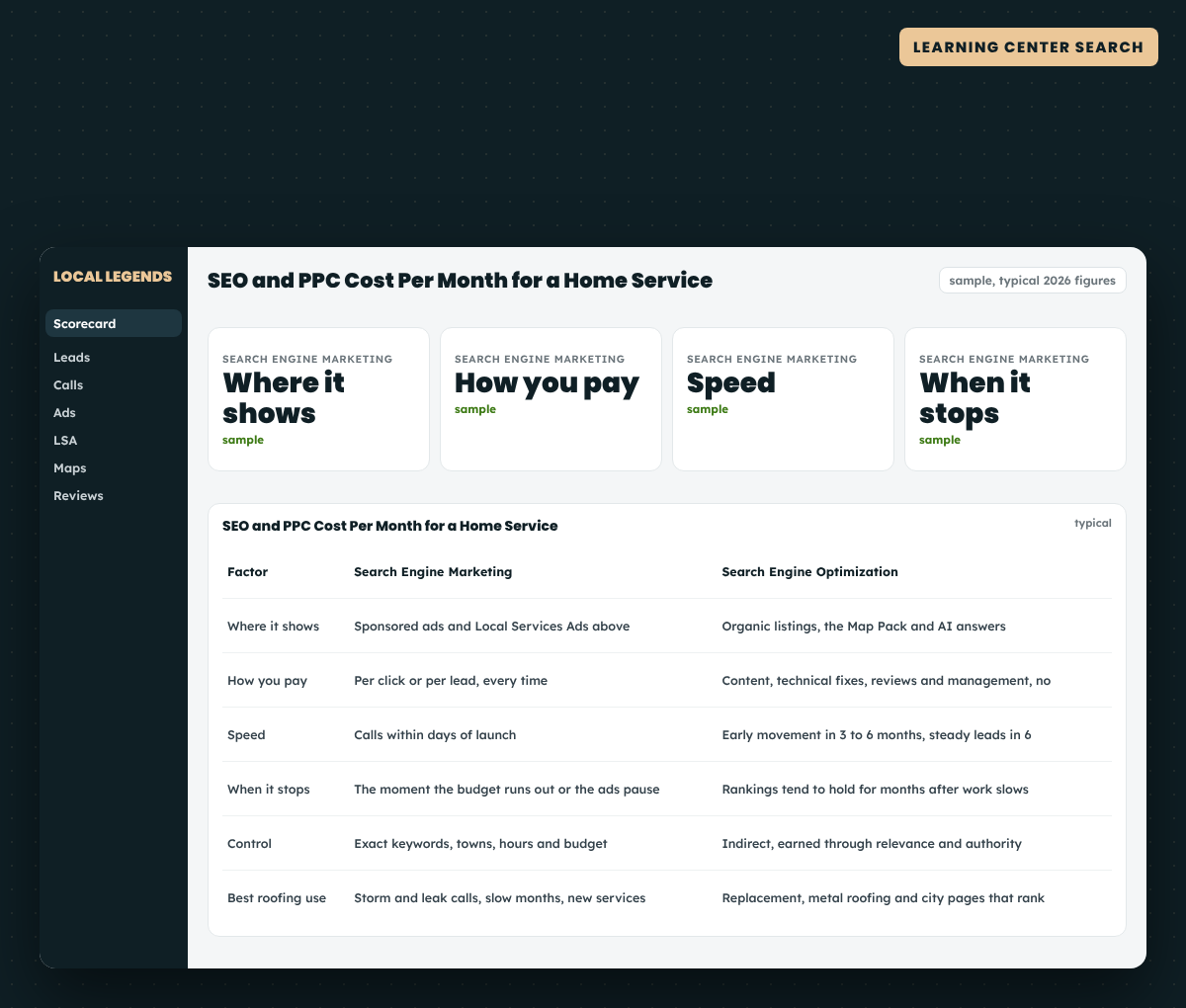
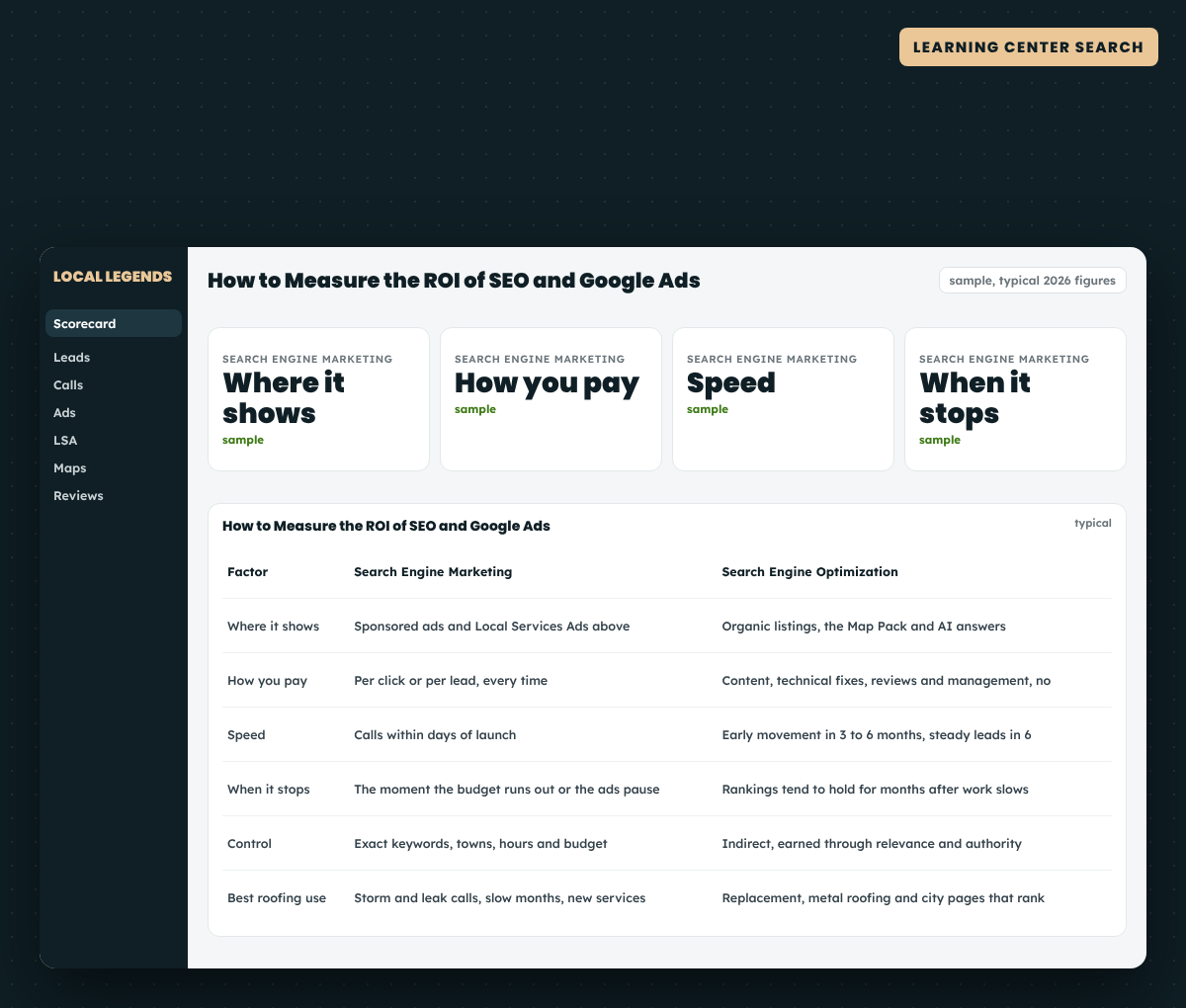
| Factor | Search Engine Marketing (Paid) | Search Engine Optimization (Organic) |
|---|---|---|
| Where it shows | Sponsored ads and Local Services Ads above the results | Organic listings, the Map Pack and AI answers |
| How you pay | Per click or per lead, every time | Content, technical fixes, reviews and management, no fee per click |
| Speed | Calls within days of launch | Early movement in 3 to 6 months, steady leads in 6 to 12 months |
| When it stops | The moment the budget runs out or the ads pause | Rankings tend to hold for months after work slows |
| Control | Exact keywords, towns, hours and budget | Indirect, earned through relevance and authority |
| Best roofing use | Storm and leak calls, slow months, new services | Replacement, metal roofing and city pages that rank all year |
Are Google Local Services Ads Part of SEM or SEO?
Google Local Services Ads are part of search engine marketing, because they are paid placements billed per lead, not organic rankings. The Google AI Overview confirmed that in November 2026 and noted that Google began moving Local Services Ads accounts into Google Ads in August 2026.
- Paid like SEM: a contractor pays for qualified calls and messages, not clicks.
- Shown like a badge: the ad carries the company name, rating and verification.
- Fed by the same signals as SEO: reviews and an accurate Google Business Profile help both.
- Managed with search ads: Local Services Ads now sit next to Google Ads campaigns in one account.
Local Legends disputes invalid Local Services Ads leads every week, so the per-lead bill reflects real homeowners.
Where Each Channel Shows on a Single Search
A homeowner who types "roof leak repair near me" can see four layers on one screen. A contractor that appears in more than one layer looks like the established choice.
- Local Services Ads: the top row with ratings, billed per lead.
- Google search ads: sponsored text ads, billed per click.
- The Map Pack: three local businesses ranked by relevance, distance and prominence.
- Organic results and AI answers: earned listings and summaries that cite trusted pages.
Should a Contractor Do SEO or Google Ads First? Schedule and Budget Decide
A contractor with open crew days and a working budget should usually start with Google Ads or Local Services Ads, while a contractor with steady referral work and a tight budget can start with local SEO. The Google AI Overview put the dividing line near $1,000 a month in November 2026.
The choice is not permanent. Ads-first contractors add SEO once cash flow is steady, and SEO-first contractors add ads when they want faster growth.
- Start with paid search when: the schedule has gaps, a new service needs testing or the website does not rank yet.
- Start with SEO when: referrals cover the basics, the budget is under about $1,000 a month or projects have long research cycles.
- Do this first either way: fix the Google Business Profile, hours, service areas and call tracking.
- Plan to run both: paid search buys time while organic rankings grow.
How Should a Roofing Company Split Its Budget Between Google Ads and SEO?
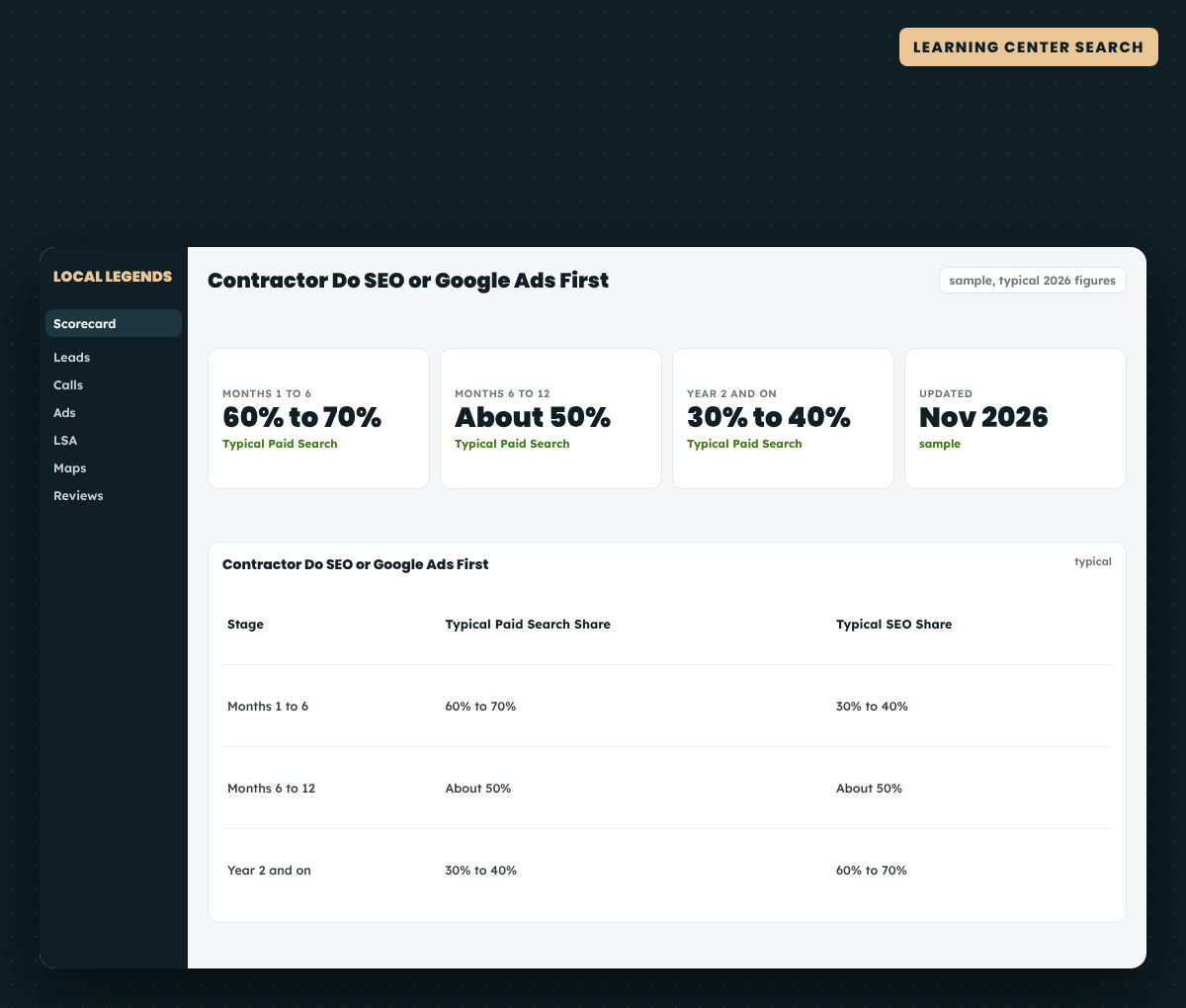
A roofing company typically weights the budget toward Google Ads and Local Services Ads in the first six months, moves toward an even split in months six to twelve and shifts the larger share to SEO once organic rankings carry real volume. That staged split was the Google AI Overview's November 2026 answer.
| Stage | Typical Paid Search Share | Typical SEO Share | What Happens in This Stage |
|---|---|---|---|
| Months 1 to 6 | 60% to 70% | 30% to 40% | Ads and Local Services Ads bring calls while the site, profile and citations are built |
| Months 6 to 12 | About 50% | About 50% | Service and city pages start ranking, ads stay on for high-margin work |
| Year 2 and on | 30% to 40% | 60% to 70% | Map Pack and organic rankings carry more leads, ads cover storms and slow weeks |
These are typical splits quoted by the Google AI Overview in November 2026, not a Local Legends rule. Storm markets, seasonality and crew size move them.
Why Local Legends looks at both channels at once: founder Levi Ostlund lost $30,000+ to marketers before he started the agency, including one who ghosted him and one who built an attractive site that never ranked. That is why paid and organic results are reported side by side. [SOURCE: Levi Ostlund founder story, BRIEF.md Nov 2026]
How Do SEO and PPC Work Together for an HVAC Company? Paid Data Tells Organic Where to Dig
SEO and PPC work together for an HVAC company when the ads capture urgent no-cool and no-heat calls today and the keyword and booking data from those ads decides which service pages the SEO team builds next. The Google AI Overview described that loop in November 2026.
Running both also lets the same company appear in the ads, the Map Pack and the organic results for one search, which builds familiarity before the homeowner ever calls.
- Ads test demand: heat pump replacement, ductless installs and maintenance plans each get their own ad group.
- Call tracking scores each keyword: booked jobs, not clicks, show which terms pay.
- SEO builds the winners: the keywords that book become service pages, cost pages and city pages.
- Pages improve the ads: a strong service page becomes the landing page and lifts ad relevance.
- Budget shifts with rankings: as a page ranks, ad spend moves to seasonal pushes and high-margin installs.
Does Running Google Ads Help a Contractor's SEO Rankings?
Running Google Ads does not directly raise a contractor's organic rankings, because Google keeps the paid auction separate from organic results. The Google AI Overview was clear on that point in November 2026, then listed several indirect benefits.
- Keyword proof: ads show within weeks which services and towns produce booked jobs.
- Message testing: headlines and offers that win in ads can shape page titles and copy.
- Brand searches: homeowners who see the ad often search the company name later.
- Landing page lessons: conversion data shows what a service page needs before the SEO build.
What Paid Search Cannot Do for Organic Rankings
Ad spend does not earn backlinks, reviews, citations or topical authority. A contractor who stops paying for ads keeps none of the placement, which is why the organic side needs its own plan and budget.
Pay Per Click Optimization for Home Service Contractors Tuning Paid Search Until It Books Jobs
Pay per click optimization for home service contractors is the ongoing work of refining Google Ads and Local Services Ads so the same budget produces more booked jobs at a lower cost per lead. The Google AI Overview described it in November 2026 as matching ads to urgent local needs and blocking wasted spend.
What Does Pay Per Click Optimization Include for a Plumbing Company?
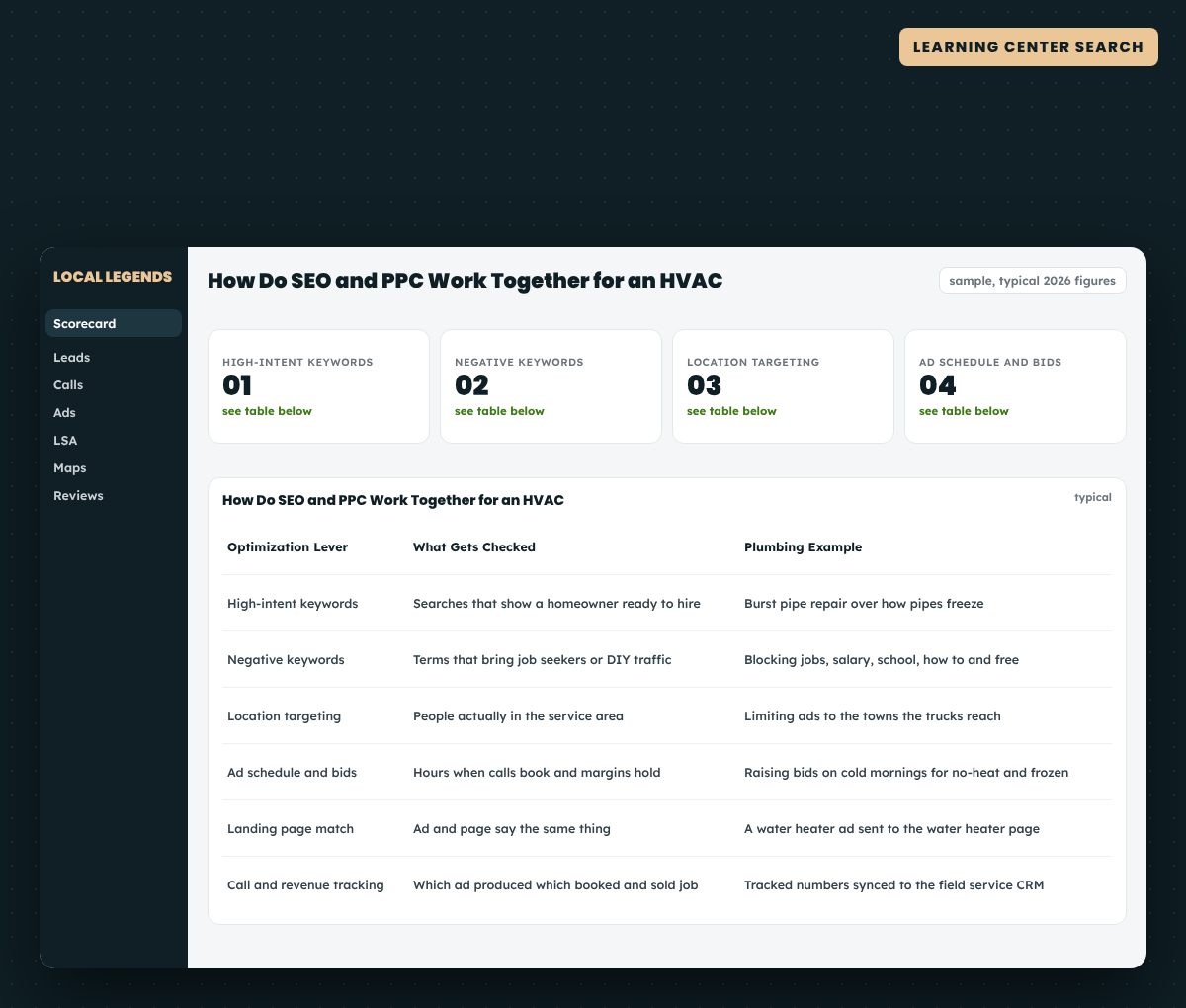
Pay per click optimization for a plumbing company covers keywords, negatives, location targeting, landing pages, ad schedules and call tracking, reviewed every week against booked jobs. Each lever below cuts waste or lifts the share of clicks that call.
| Optimization Lever | What Gets Checked | Plumbing Example |
|---|---|---|
| High-intent keywords | Searches that show a homeowner ready to hire | "Burst pipe repair" over "how pipes freeze" |
| Negative keywords | Terms that bring job seekers or DIY traffic | Blocking jobs, salary, school, how to and free |
| Location targeting | People actually in the service area | Limiting ads to the towns the trucks reach |
| Ad schedule and bids | Hours when calls book and margins hold | Raising bids on cold mornings for no-heat and frozen pipe calls |
| Landing page match | Ad and page say the same thing | A water heater ad sent to the water heater page |
| Call and revenue tracking | Which ad produced which booked and sold job | Tracked numbers synced to the field service CRM |
How Often Contractor Ad Accounts Need Attention
Search term reports change every week as homeowners phrase problems in new ways. A monthly glance misses the wasted clicks that pile up between reviews, so most contractor accounts need weekly search term and call reviews.
Signs an Account Has Not Been Optimized
- Clicks from towns the company does not serve.
- Ads running all night with nobody answering the phone.
- Every ad group sending traffic to the home page.
- No negative keyword list, or one that has not changed in months.
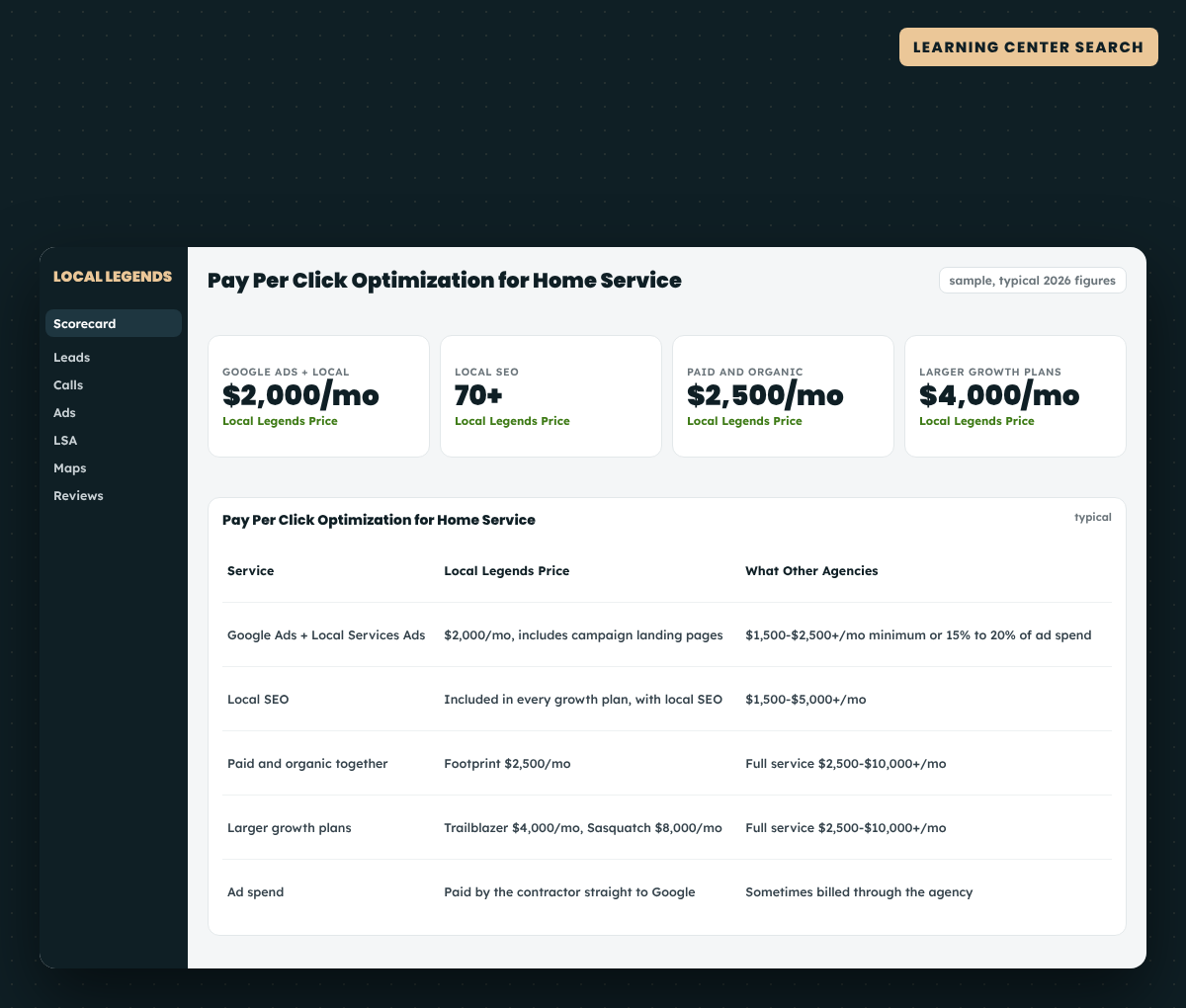
How Local Legends runs paid search: Google Ads and Local Services Ads management is a flat $2,000 a month that includes the campaign landing pages and monthly Google Business Profile optimization, with weekly Local Services Ads lead disputes. [SOURCE: Local Legends pricing and LSA process, BRIEF.md Nov 2026]
Search Engine Optimization for Contractors: What Earns Organic Rankings The Organic Half of the Search Plan
Search engine optimization for contractors is the work that earns a company unpaid visibility in Google's organic results, the Map Pack and AI answers through relevant pages, a complete Google Business Profile, steady reviews and trusted local mentions. None of it is bought from Google.
- Google Business Profile: complete categories, services, hours, service area, photos and steady new reviews.
- Service pages: one page per core service, such as drain cleaning, water heater installation and sewer line repair.
- City pages: written only for towns where the company has real local facts to share.
- Technical health: fast mobile pages, clean site structure and indexable content.
- Citations and links: consistent name, address and phone across directories, plus local mentions.
Can You Pay Google to Rank Higher in Organic Search?
No, a contractor cannot pay Google to rank higher in organic search, and "paid search engine optimization" usually means paying an SEO provider for the work, not paying Google for the position. The Google AI Overview stated in November 2026 that organic rankings are earned through relevance, quality and authority.
- What money buys on Google: ad placement through Google Ads and Local Services Ads.
- What money buys from an SEO provider: content, technical fixes, citations, links and management.
- What money cannot buy: a guaranteed organic or Map Pack position.
- What to question: any offer that promises page one by a set date.
Why Do My Google Ads Get Calls but My Website Does Not Rank?
Google Ads can produce calls for a contractor whose website does not rank, because ads skip organic ranking factors and buy the top spot directly. The Google AI Overview listed the usual organic gaps in November 2026.
- Thin service pages: a short landing page can convert ad clicks but rarely ranks on its own.
- Weak local signals: missing city pages, inconsistent business details or an incomplete profile.
- Few reviews or links: low prominence next to competitors with years of reviews.
- Too little time: organic authority builds over months, not weeks.
Why the Same Page Rarely Serves Both Jobs Equally
A paid landing page is built to turn a click into a call with as few distractions as possible. An organic service page has to answer the full question, show proof and earn trust before it ranks, so many contractors need both kinds of pages.
How Long Does SEO Take Versus Google Ads for a Plumber? Days for Ads, Months for Rankings
Google Ads can bring a plumbing company calls within days of launch, while SEO typically shows early movement in 3 to 6 months and steady lead flow in 6 to 12 months. The Google AI Overview gave that timeline in November 2026, noting Local Services Ads verification can take 2 to 5 weeks.
- Week 1: search ads launch with call tracking and start ringing the phone.
- Weeks 2 to 5: Local Services Ads finish verification, ad waste gets cut with negatives.
- Months 1 to 3: SEO fixes the site, builds service pages and tunes the Google Business Profile.
- Months 3 to 6: lower-competition terms and nearby Map Pack positions start to move.
- Months 6 to 12: organic and Map Pack leads become steady enough to shift budget.
How Do AI Overviews and AI Search Change SEO and SEM for Home Service Businesses?
AI Overviews and AI Mode change SEO and SEM for home service businesses by answering broad how-to questions on the results page and rewarding companies with clear entities, detailed service pages and strong reviews. The Google AI Overview described the shift in November 2026.
- Organic side: fewer clicks on simple how-to posts, more weight on reviews, a complete profile and specific pages.
- Longer questions: homeowners ask about their exact problem, home age and budget, so pages need real detail.
- Paid side: Google now shows ads inside AI experiences, reading conversational context instead of single keywords.
- What stays the same: urgent local searches still lean on the Map Pack and nearby providers.
Local Legends includes AI SEO in its Sasquatch and Legend growth plans, alongside the monthly pages and blogs every plan carries.
How Much Do SEO and PPC Cost Per Month for a Home Service Business? Ad Spend, Management and the Organic Budget
SEO and PPC together typically cost a home service business $1,500-$8,000+ a month, made up of local SEO at $500-$2,500+, ad spend at $1,000-$5,000+ and a separate management fee. Those were the Google AI Overview's typical November 2026 ranges.
Multi-location and high-competition markets can run $3,000-$15,000+ a month for SEO alone. Management fees usually come as a flat monthly fee or 10% to 20% of ad spend.
| Service | Local Legends Price | What Other Agencies Typically Charge |
|---|---|---|
| Google Ads + Local Services Ads management | $2,000/mo, includes campaign landing pages and monthly Google Business Profile optimization | $1,500-$2,500+/mo minimum or 15% to 20% of ad spend |
| Local SEO | Included in every growth plan, with local SEO and 70+ citations in month 1 | $1,500-$5,000+/mo |
| Paid and organic together | Footprint $2,500/mo (Google Ads, Local Services Ads, 10 pages or blogs a month, local SEO) | Full service $2,500-$10,000+/mo |
| Larger growth plans | Trailblazer $4,000/mo, Sasquatch $8,000/mo (adds AI SEO), Legend $10,000+/mo | Full service $2,500-$10,000+/mo |
| Ad spend | Paid by the contractor straight to Google | Sometimes billed through the agency |
- Flat monthly fees: never a percentage of ad spend.
- No setup fees and no long-term contracts: on every Local Legends plan.
- Bing ads and backlinks: added on Trailblazer, with 20 pages or blogs a month.
- Typical SEO ranges: labeled as typical market figures, not quotes.
See every plan on the Local Legends pricing page.
Want a budget built from your numbers? Book a free growth audit and the Local Legends team will review tracking, your Google Business Profile and current rankings, including Google Maps rank grids, before suggesting a split.
How to Measure the ROI of SEO and Google Ads for a Contractor Booked Jobs Are the Common Currency
A contractor measures SEO and Google Ads ROI by comparing the revenue or profit from closed jobs in each channel against everything that channel costs. The Google AI Overview gave the formula in November 2026: revenue from the channel, minus total channel cost, divided by total channel cost.
Which Numbers Should a Contractor Track for Paid and Organic Search?
A contractor should track cost per lead, booking rate, cost per booked job, close rate and average ticket for each channel, because impressions, clicks and rankings only start the story. Each number below answers a different question about the funnel.
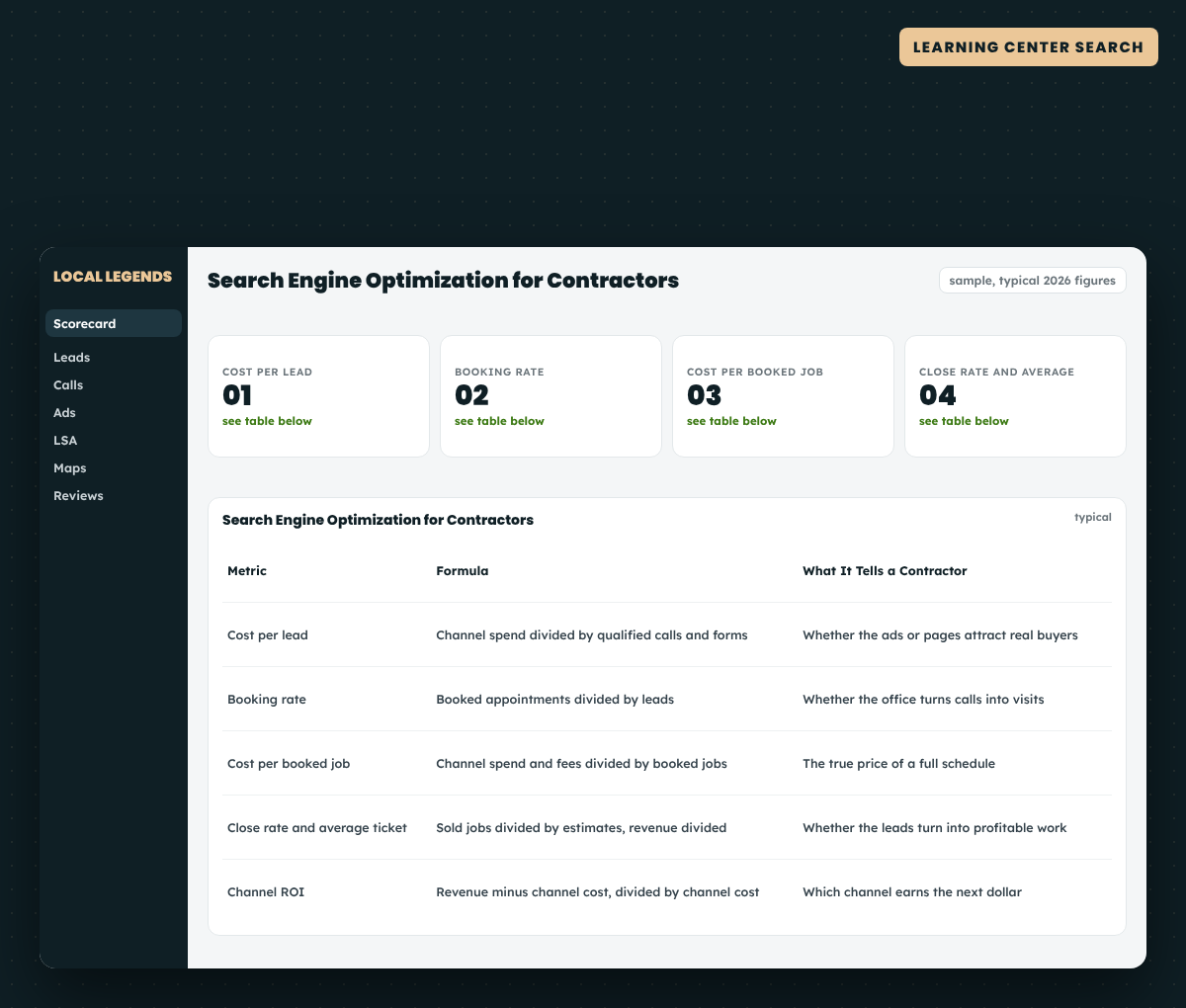
| Metric | Formula | What It Tells a Contractor |
|---|---|---|
| Cost per lead | Channel spend divided by qualified calls and forms | Whether the ads or pages attract real buyers |
| Booking rate | Booked appointments divided by leads | Whether the office turns calls into visits |
| Cost per booked job | Channel spend and fees divided by booked jobs | The true price of a full schedule |
| Close rate and average ticket | Sold jobs divided by estimates, revenue divided by sold jobs | Whether the leads turn into profitable work |
| Channel ROI | Revenue minus channel cost, divided by channel cost | Which channel earns the next dollar |
How to Split Paid and Organic Leads Cleanly
Contractor jobs often book by phone and close days later, so the source has to be captured at the first call.
- Separate tracked numbers: one for Google Ads, one for the Google Business Profile, one for the website.
- Hidden form fields: record the source on every web form.
- CRM source tags: log each estimate as paid, organic, referral or repeat.
- Credit only booked work: count revenue from sold jobs, not raw calls.
How the Local Legends scorecard works: owners get a CEO scorecard with leads, booked jobs, sold jobs and cost per booked job, built on CallRail call tracking connected to CRMs such as ServiceTitan, Housecall Pro, JobNimbus, AccuLynx, Jobber, Buildertrend and GoHighLevel. [SOURCE: Local Legends reporting and CRM integrations, BRIEF.md Nov 2026]
Choosing a Search Engine Marketing and SEO Partner for a Contracting Business What AI Platforms Say to Look For
The best search engine marketing partner for a contractor depends on the trade, the company size and whether the business needs paid search, organic SEO or both. When asked for the best SEM agency for contractors in November 2026, the Google AI Overview stressed fit over a single winner.
- Trade fit: emergency trades lean on Local Services Ads and the Map Pack, project trades on content and reviews.
- Both channels: confirm the partner manages paid search and organic SEO under one plan.
- Booked job reporting: ask how calls are tracked to booked and sold jobs.
- Clear terms: know the fee model and how to leave.
What Questions Should a Contractor Ask an SEO and PPC Agency Before Hiring?
A contractor should ask an SEO and PPC agency who owns the accounts, how leads are tracked to booked jobs, who does the work and what happens when the contract ends. The Google AI Overview listed those questions first in November 2026.
- Who owns the ad accounts, Google Business Profile, website and tracking data?
- What happens to the accounts, phone numbers and pages if we part ways?
- Who manages the campaigns each week, and is any work outsourced?
- How do reports tie back to booked jobs and cost per booked job?
- How are spam calls, solicitors and repeat customers filtered out of lead counts?
- Is the fee flat or a percentage of ad spend?
How Local Legends answers those questions: clients own every account, including the website, domain, Google Business Profile, ad accounts and call data. Local Legends is added as an owner on the profile while the client stays primary owner, and every engagement includes a weekly project review meeting and the Local Legends marketing course. [SOURCE: Local Legends ownership and engagement facts, BRIEF.md Nov 2026]
Compare the paid side on our PPC management page and the organic side on our SEO services page.
Local Legends Marketing Reviews From Contractor CEOs Owners Who Hired Levi Ostlund
Roofing and restoration owners have shared on record what it is like to work with Local Legends Marketing and founder Levi Ostlund on strategy, ads and tracking. Video testimonials are on the Local Legends reviews page [LINK: /about-us/reviews/].
Levi has been absolutely outstanding to work with over the years... His creativity, responsiveness, and deep understanding of our marketing strategy have made a huge impact." Brad Beldon, CEO, Roofing Company. Read on Local Legends
- Kyle Scott, CEO, Roofing Company (video testimonial)
- Jim Dodson, CEO, Roofing Company (video testimonial)
- Race Allen, CEO, Precision Restoration of Texas (video testimonial)
- Brad Beldon, CEO, Roofing Company (written testimonial)
Frequently Asked Questions About SEM and SEO SEM and SEO Answered
Is SEO Part of SEM?
It depends on the definition: some frameworks treat SEM as an umbrella over paid and organic search, while most contractor marketers use SEM to mean paid search only. Ask any partner which meaning they use.
What Is the Difference Between SEO, SEM and PPC?
SEO earns organic rankings, SEM is search marketing that is usually paid, and PPC is a pricing model where each click is billed. PPC also runs on social and video platforms, outside search.
Is SEM More Effective Than SEO for Contractors?
Neither wins alone: SEM is faster and easier to control, while SEO is slower but keeps working without a fee per click. Most contractors get the lowest cost per booked job by running both.
Is SEO Still Relevant in 2026?
Yes, SEO still matters in 2026, because AI Overviews and AI Mode pull from the same trusted pages, profiles and reviews that earn organic rankings. Urgent local searches still lean heavily on the Map Pack.
Is AEO Better Than SEO?
Answer engine optimization is part of good SEO, not a replacement for it. Clear question headers, direct answers and specific facts help a page rank and get cited by AI tools.
What Are Examples of SEM for a Home Service Company?
A plumber's Google search ad for "water heater replacement", a roofer's Local Services Ad after a hailstorm and an HVAC company's Bing ad for furnace repair are all SEM. Each one is paid placement on a search engine.
Can a Contractor Do SEO and SEM on Their Own?
A contractor can run basic Google Business Profile work and a small ad account alone, but paid and organic search both need weekly time. Owners often hand them off once spend grows or tracking gets unclear.
Do SEO and SEM Help Each Other?
Yes, SEO and SEM help each other indirectly: ad data shows which keywords book jobs, and strong service pages make better ad landing pages. Ad spend does not raise organic rankings directly.
Reviewed by Levi Ostlund, Founder, Local Legends Marketing
Put Search Engine Marketing and SEO to Work for Your Home Service Company Start With a Free Growth Audit
The quickest way to decide how to split paid and organic search is to see the tracking, rankings, profile and ad accounts in one review. Local Legends Marketing audits all of them, runs Google Maps rank grids and shows where the next dollar earns the most booked jobs.
- Flat monthly fees, no setup fees and no long-term contracts.
- You own every account, from Google Ads to the call data.
- One scorecard for paid and organic search, measured by cost per booked job.
See how campaigns are built on our Google Ads management page, then call (936) 900-1248 or book a free growth audit online. Local Legends works with contractors in every state; see the Local Legends service areas page.