


Google SEO Optimization and How Does It Work

Google SEO Optimization for Contractors: How Google Search Engine Optimization Works for Roofers, HVAC Companies, Plumbers and Remodelers in 2026
SEO Basics and Techniques Explained by Local Legends Marketing
Updated November 2026 · Reviewed by Levi Ostlund, Founder
Breadcrumb: Home > Learning Center [LINK: /learning-center/] > Google SEO Optimization
Google SEO optimization for a contractor is the work of helping Google find, understand and trust your website and Google Business Profile, so your company appears when nearby homeowners search for your service. It earns unpaid calls from three places on the results page: the Map Pack, the organic links and the AI answers.
- Get found: Google must crawl and index every service and city page.
- Get understood: each page targets one service, one search intent and real local facts.
- Get trusted: reviews, citations, links and a complete Google Business Profile prove you are real.
- Get chosen: fast mobile pages with a visible call button turn the visit into a phone call.
- Get measured: track calls, booked jobs and cost per booked job, not only rankings.
Free Growth Audit
Your Reviews, Radius and Response Rate vs the competitors beating you.
About Local Legends Marketing
A home service marketing agency headquartered in Conroe, Texas, with 8+ years of marketing experience, running Google Ads, Local Services Ads, local SEO, AI SEO, connected TV and review systems for contractors nationwide.
What Is Google SEO Optimization and How Does It Work for a Contractor Website? Google Crawls, Indexes, Then Ranks Your Pages
Google SEO optimization for a contractor website works in three stages: Google's crawler discovers the pages, the index stores what each page is about, and the ranking systems choose which pages to show for each search. A roofing page that never gets crawled can never rank, no matter how well it is written.
Google AI Mode explained in November 2026 that a homeowner searching "plumber near me" sees three kinds of results, and each one runs on different signals. Owners who understand that split stop asking why the website ranks but the phone stays quiet.
- The Map Pack: the three local listings with a map, driven by the Google Business Profile, reviews, distance and prominence.
- Organic links: the website results below the map, driven by page content, technical health and links.
- AI Overviews and AI Mode: summaries that pull passages from pages that answer the question clearly.
What a Local Legends audit checks first: before any SEO work begins, the team reviews call tracking, local SEO, Local Services Ads and the booking funnel, and runs Google Maps rank grids across the service area to see where the company appears today. [SOURCE: Local Legends audit process, confirmed by Levi Ostlund, Founder, Nov 10 2026]
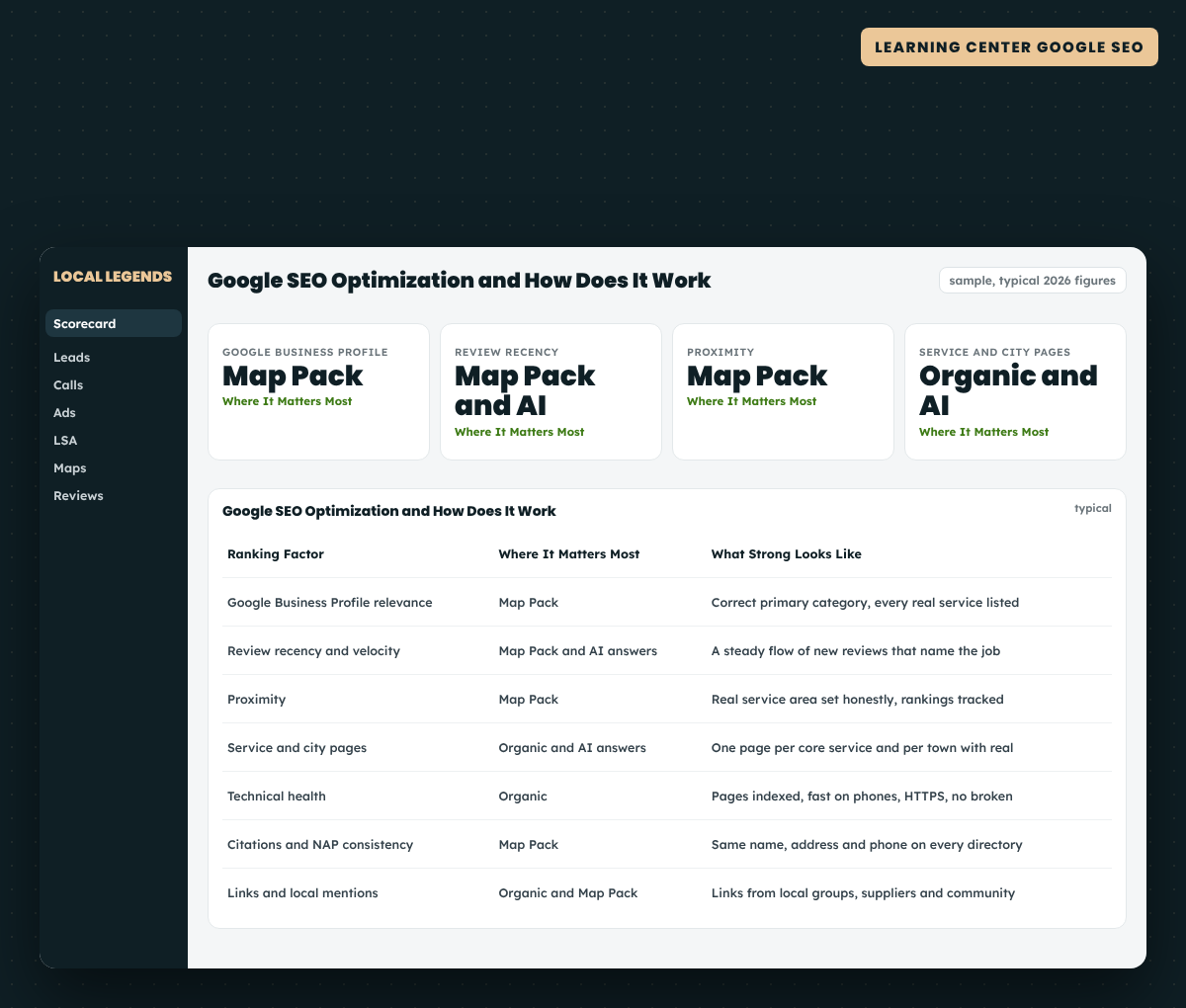
What Are the Most Important Google Ranking Factors for a Home Service Business in 2026?
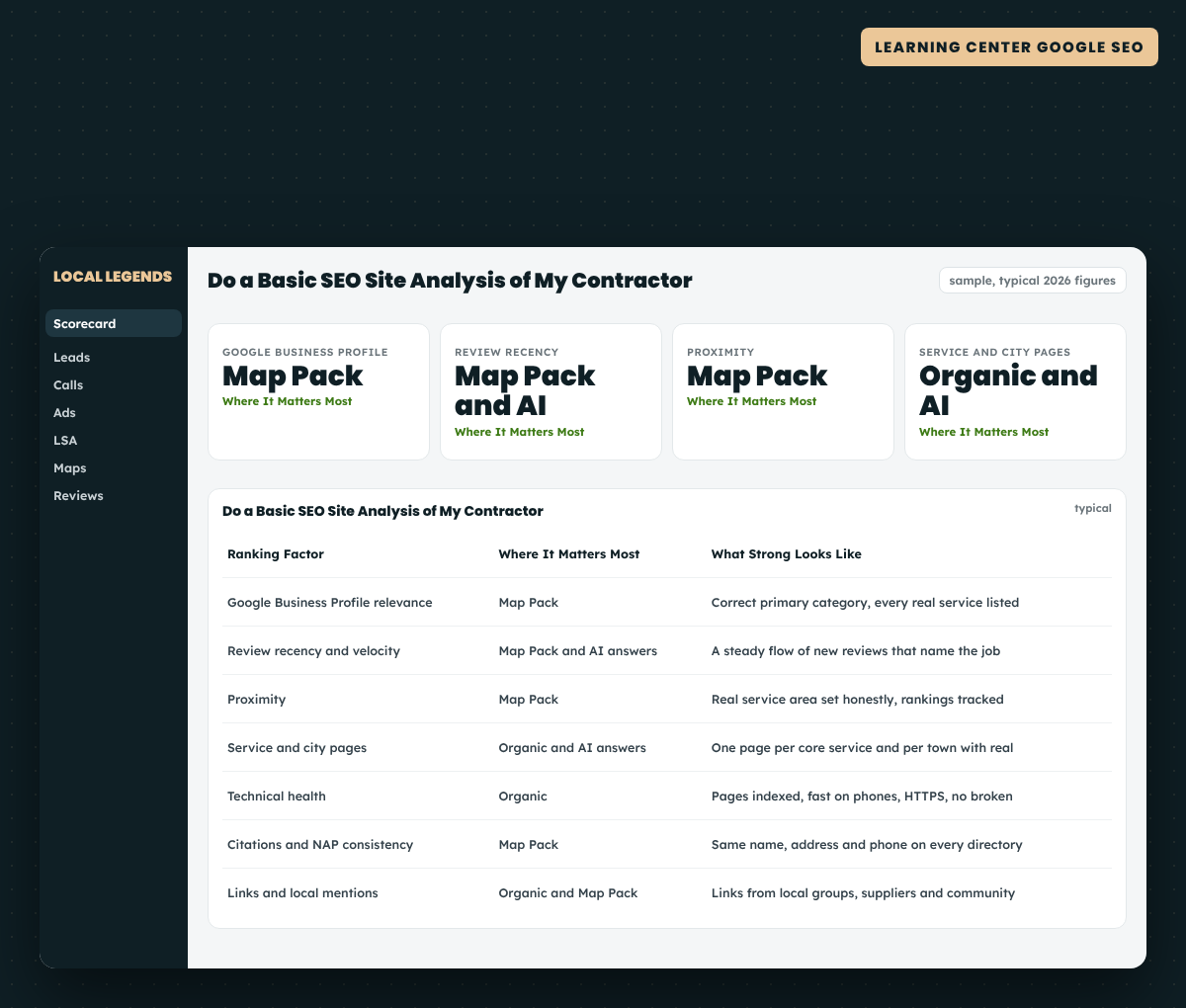
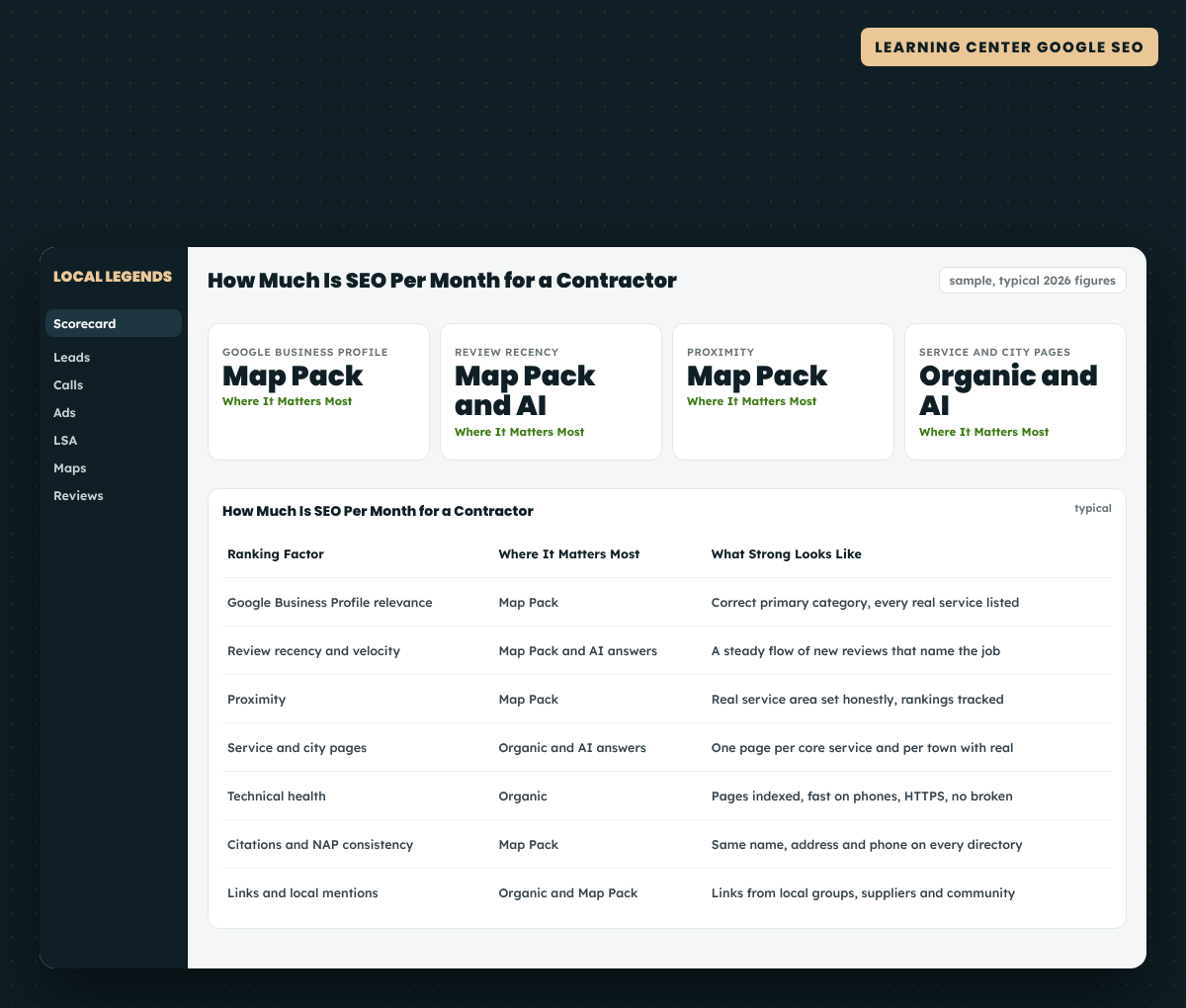
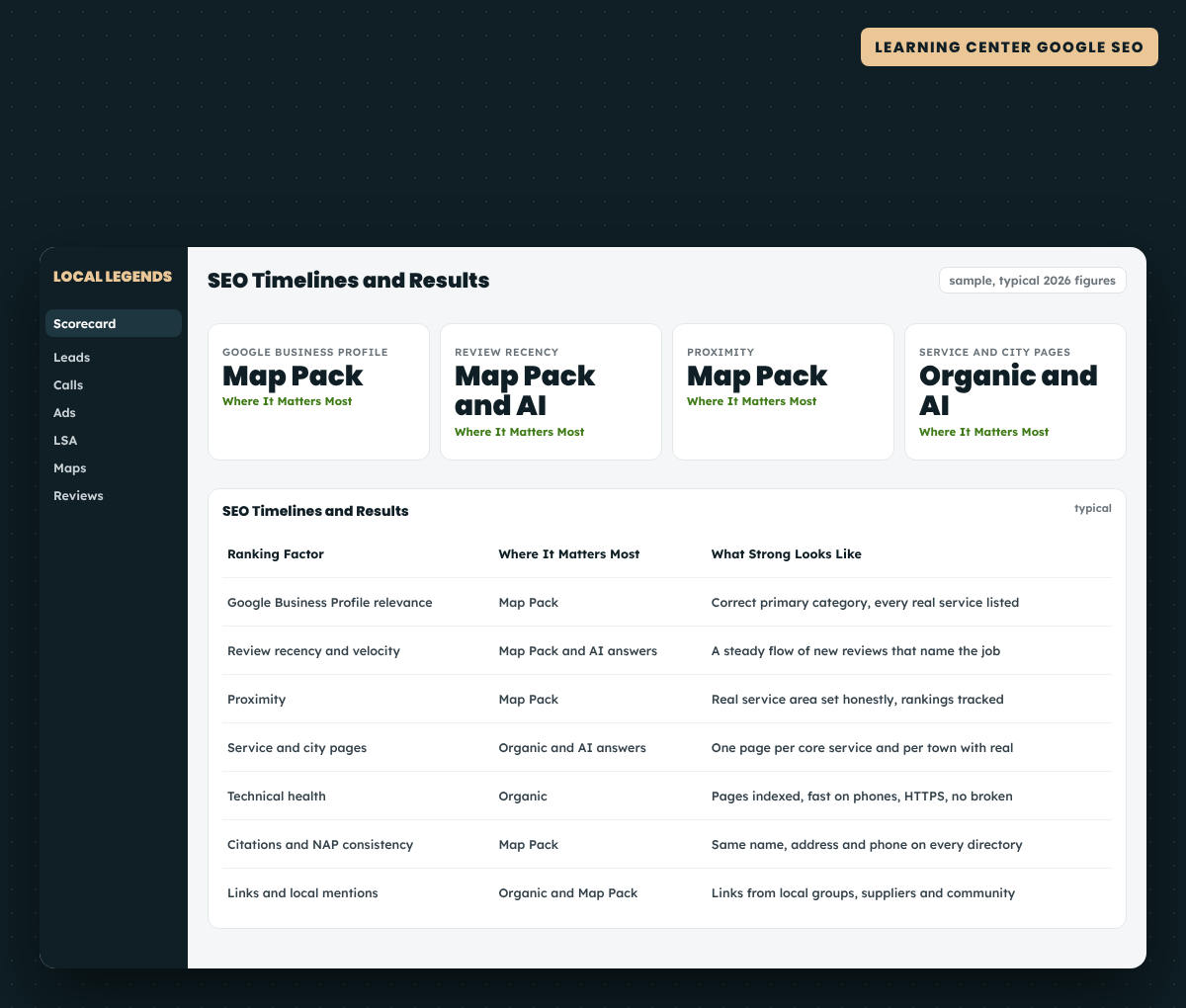
The most important Google ranking factors for a home service business in 2026 are Google Business Profile relevance, review recency and velocity, distance to the searcher, dedicated service and city pages, and a technically healthy mobile site. Google AI Mode ranked the profile and fresh reviews above everything else for local searches.
| Ranking Factor | Where It Matters Most | What Strong Looks Like for a Contractor |
|---|---|---|
| Google Business Profile relevance | Map Pack | Correct primary category, every real service listed, weekly photos |
| Review recency and velocity | Map Pack and AI answers | A steady flow of new reviews that name the job and the town |
| Proximity | Map Pack | Real service area set honestly, rankings tracked by grid |
| Service and city pages | Organic and AI answers | One page per core service and per town with real local facts |
| Technical health | Organic | Pages indexed, fast on phones, HTTPS, no broken links |
| Citations and NAP consistency | Map Pack | Same name, address and phone on every directory |
| Links and local mentions | Organic and Map Pack | Links from local groups, suppliers and community sites |
| Engagement | Map Pack | Calls, direction requests and clicks from the listing |
How the Three Result Types Split the Clicks
Google AI Mode noted that a large share of mobile clicks on local searches go to the map listings and the top ads before a homeowner scrolls to the website links. That is why contractor SEO starts with the profile and the reviews, then the website.
Why a Service-Area Business Ranks Differently
Plumbers, HVAC technicians and roofers who drive to the customer usually hide the street address and set a service area instead. Proximity then centers on the verified business location, so outlying towns are usually won with city pages, reviews from those towns and steady profile activity.
SEO Basics Every Contractor Website and Google Business Profile Needs The Foundation Comes Before Any Technique
SEO basics for a contractor are the handful of settings and pages that every other technique depends on: a verified Google Business Profile, Google Search Console, an XML sitemap, one page per core service and consistent business details everywhere. Skipping them makes advanced work far less effective.
Google's own starter guidance for site owners centers on helping the crawler find pages, writing for the words customers actually use and keeping pages useful. For a home service company, those principles translate into the checklist below.
- Verify and complete the Google Business Profile: primary category, secondary categories only for real work, hours, service area and a business description led by trust signals.
- Connect Google Search Console: submit the sitemap, confirm pages are indexed and watch which searches bring impressions.
- Build one page per core service: roof replacement, roof repair and gutter installation each deserve their own page.
- Add city pages only where they are earned: a page per town you truly serve, built on real local facts.
- Keep the name, address and phone identical: on the website, the profile and every directory listing.
- Make the phone number tappable: on every page, at the top of the screen on mobile.
- Start the review habit: a text with the review link after every finished job.
A Local Legends rule for city pages: the team writes a city page only for a town with 5 or more real local facts, such as housing types, local permit rules or named neighborhoods, so every page gives Google something no other page has. [SOURCE: Local Legends city page rule, confirmed by Levi Ostlund, Founder, Nov 10 2026]
What SEO Basics Should a House Cleaning Business Set Up First?
A house cleaning business should set up its Google Business Profile, a page for each cleaning service and an automatic review request before anything else. Cleaning is a recurring, trust-heavy service, so homeowners compare reviews and photos closely before they invite a team into the house.
- Profile categories: house cleaning service as primary, with real secondary services only.
- Exact business name: the real name only, with no added keywords or city names.
- Service pages: recurring cleaning, deep cleaning, move-out cleaning and any specialty service offered.
- Neighborhoods served: named on the service area pages where the team regularly works.
- Review requests: sent the same day as the first clean, while the result is fresh.
- Photos: real teams, real kitchens and baths, never stock images.
- Clear booking path: a form and a call button on every page.
Google Search Console Basics for Owners
Google Search Console is free and shows which searches your pages appear for, how often they are clicked and which pages Google could not index. An owner who checks the Pages report and the Performance report once a month will catch most problems early.
Three Search Console Reports to Read Monthly
- Performance: queries, impressions, clicks and average position by page.
- Pages: which URLs are indexed and why others are not.
- Core Web Vitals: whether real visitors see slow or unstable pages on phones.
Search Engine Optimization Techniques That Rank Home Service Companies On-Page, Technical, Local and Off-Page Work
Search engine optimization techniques for contractors fall into four groups: on-page content, technical health, local signals and off-page authority. Each group fixes a different weak point, so an audit decides which one deserves the first month of effort.
On-Page SEO Techniques
On-page work makes each page clearly about one service in one place. Google AI Overviews listed descriptive URLs, unique title tags, logical headings and helpful content matched to intent as core on-page techniques in November 2026.
- One topic per page:"water heater replacement" and "drain cleaning" never share a page.
- Title tags and headings: the service and town in plain words, written for people first.
- Answers to real questions: cost, timing, process and warranty in short, direct passages.
- Internal links: service pages linked to related services and to the city pages they serve.
Technical SEO Techniques
Technical SEO keeps the site crawlable, indexable and fast. Common contractor problems include pages blocked by a noindex setting, duplicate city pages, slow image-heavy galleries and old URLs that break after a redesign.
Local SEO Techniques
Local techniques feed the Map Pack: profile categories and services, weekly photo posts, review generation, review replies and consistent citations. Read how this work runs month to month on our local SEO page.
Off-Page SEO Techniques
Off-page authority comes from mentions and links on other sites: local chambers, supplier directories, community sponsorships, trade associations and local news. A few relevant local links usually matter more to a contractor than many unrelated ones.
What SEO Techniques Work Best to Rank an HVAC Company in Google Maps?
The SEO techniques that rank an HVAC company in Google Maps are profile category choices, detailed service listings, steady reviews that mention the service and city, geo-relevant job photos and consistent citations. Google AI Mode added that HVAC demand shifts with the seasons, so profile posts and services should follow it.
- Seasonal focus: promote cooling repair in summer and furnace service in fall through posts and services.
- Every service listed: AC repair, heat pump installation, duct cleaning and maintenance plans as separate services.
- Reviews that name the job: customers mentioning "AC repair in their town" help relevance.
- Real photos weekly: technicians, trucks and installed equipment from actual jobs.
- No keyword stuffing in the business name: Google can suspend profiles that add keywords to the name.
- Rank grids: track positions across the service area, not just at the shop.
Learn how the profile itself is managed on our Google Business Profile management page.
How Do I Optimize Images on My Contractor Website for Google SEO?
Contractors optimize images for Google SEO by uploading original job photos, compressing them into WebP files, naming files with the service, and writing alt text that describes what the photo shows. Google AI Mode called oversized phone photos the most common cause of slow contractor websites.
- Use real photos: before-and-after shots, crews at work and finished projects, never stock.
- Resize before upload: scale photos to the size the page displays.
- Compress and convert: WebP files load much faster than raw phone photos.
- Descriptive file names:"metal-roof-installation-ranch-home.webp", not "IMG_4471.jpg".
- Alt text that describes: the service, the material and what the photo shows, in a sentence.
- Place images near related text: a gutter photo belongs in the gutter section.
What Is Search Intent in SEO and How Should a Remodeling Company Use It? Match Each Page to the Reason Behind the Search
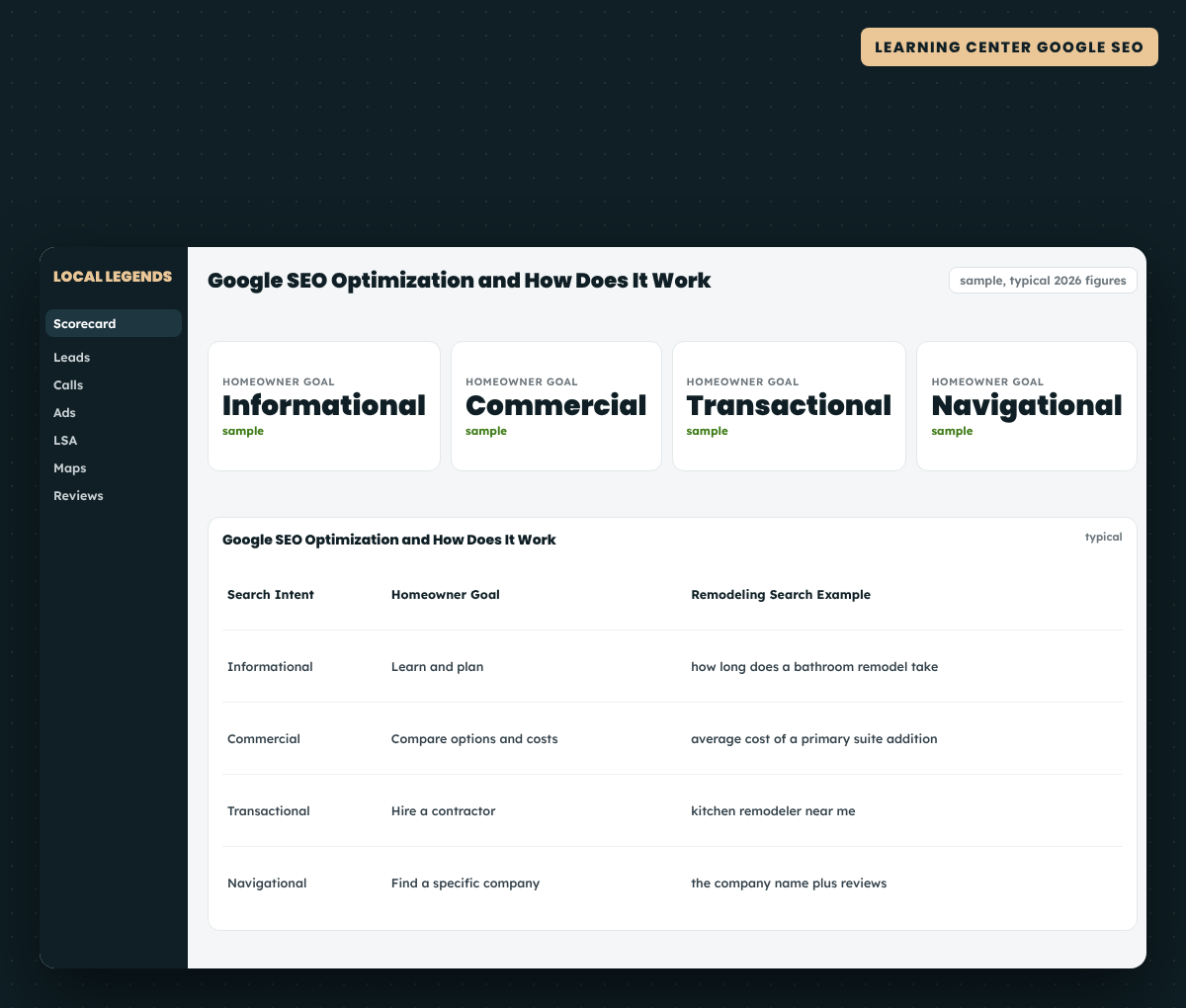
Search intent in SEO is the goal behind a search, and a remodeling company uses it by building the right type of page for each goal instead of forcing every keyword onto a sales page. Google AI Mode described four intents for remodelers in November 2026, from early planning to ready to hire.
| Search Intent | Homeowner Goal | Remodeling Search Example | Best Page Type |
|---|---|---|---|
| Informational | Learn and plan | how long does a bathroom remodel take | Learning guide or blog article |
| Commercial | Compare options and costs | average cost of a primary suite addition | Cost guide or comparison page |
| Transactional | Hire a contractor | kitchen remodeler near me | Service page with a clear call to action |
| Navigational | Find a specific company | the company name plus reviews | Home page, reviews page and Google Business Profile |
Intent also explains why a sales page rarely ranks for "how to" searches. Google tends to show guides for learning searches and service pages for hiring searches, so a remodeler needs both.
How Intent Changes the Page
- Informational pages: answer the question first, then show the company's process and photos.
- Commercial pages: explain price ranges, materials and timelines honestly.
- Transactional pages: lead with the service, the area, proof and the phone number.
- Navigational searches: make sure the profile, reviews and contact page are accurate.
How Do I Do a Basic SEO Site Analysis of My Contractor Website? A One-Hour Check an Owner Can Run
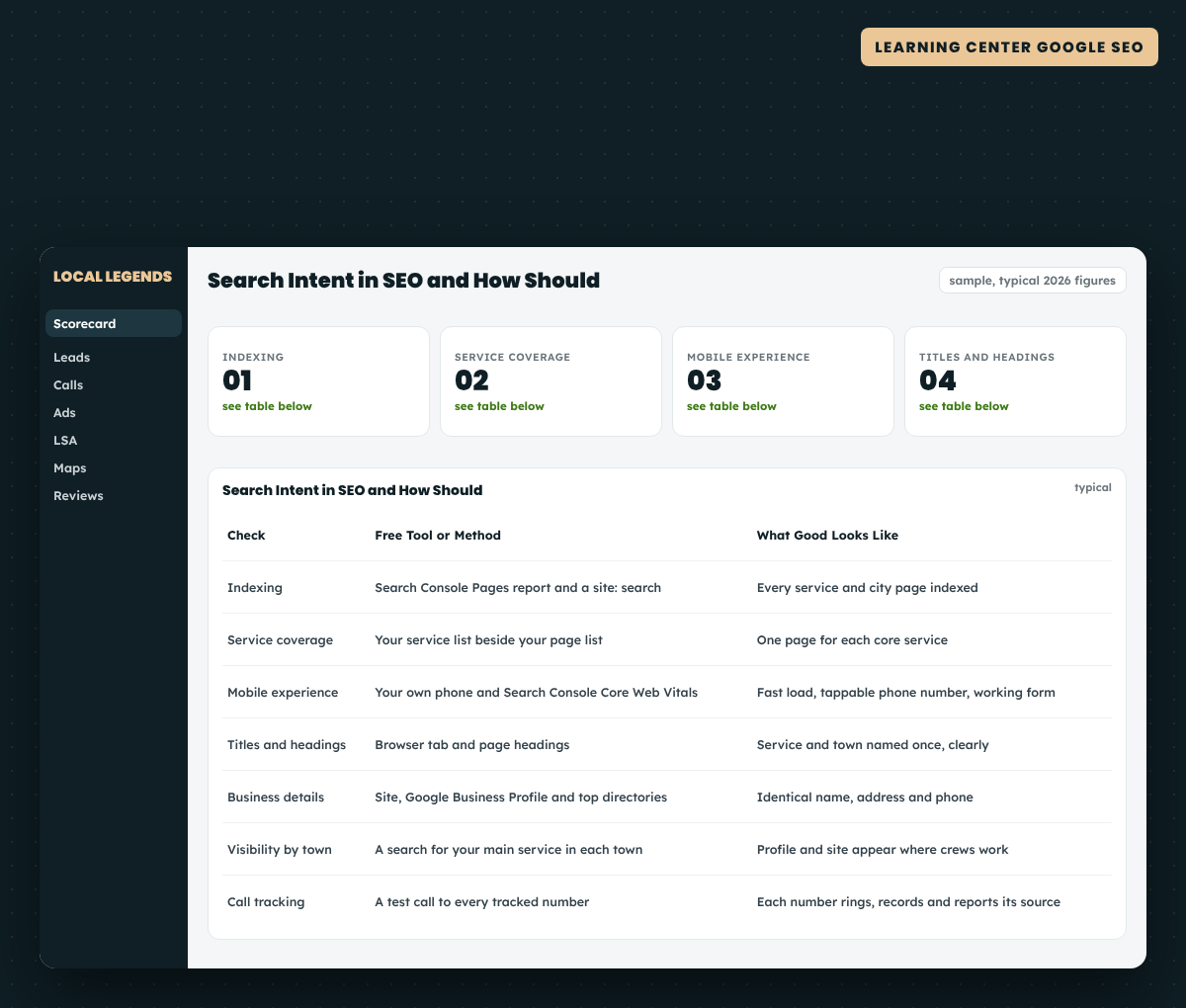
A basic SEO site analysis of a contractor website checks five things: whether Google indexes the pages, whether each service has its own page, whether the site works on a phone, whether the business details match everywhere and whether calls are tracked. An owner can run this check in about an hour with free tools.
| Check | Free Tool or Method | What Good Looks Like |
|---|---|---|
| Indexing | Search Console Pages report and a "site:" search | Every service and city page indexed |
| Service coverage | Your service list beside your page list | One page for each core service |
| Mobile experience | Your own phone and Search Console Core Web Vitals | Fast load, tappable phone number, working form |
| Titles and headings | Browser tab and page headings | Service and town named once, clearly |
| Business details | Site, Google Business Profile and top directories | Identical name, address and phone |
| Visibility by town | A search for your main service in each town | Profile and site appear where crews work |
| Call tracking | A test call to every tracked number | Each number rings, records and reports its source |
The Order to Run the Checks
- Indexing first: a page Google has not indexed cannot rank.
- Coverage second: missing service pages are the most common gap.
- Phone test third: most homeowners arrive on a phone.
- Details and tracking last: they decide whether rankings turn into measured calls.
What the Analysis Usually Finds
Most contractor sites that underperform share a short list of issues: one generic services page, city names stuffed into the footer, missing or duplicate title tags, slow galleries, and no call tracking to show which pages bring calls.
Site Analysis vs SEO Market Analysis
A site analysis looks inward at your own pages. An SEO market analysis looks outward at which competitors hold the Map Pack and page one in each town, how many reviews they have and which pages they rank with. Both shape the plan.
Can I Do My Own SEO for My Contracting Business or Should I Hire Someone? Most Owners Start Hybrid, Then Hand Off the Heavy Work
A contractor can do the SEO basics personally, and many should, but ranking in a competitive metro usually needs more hours and skills than an owner running crews can give every week. Google AI Mode recommended a hybrid approach in November 2026: keep the profile and reviews close, hand off content, technical work and links.
- Doing your own SEO fits best: small towns, light competition and tight budgets.
- Hiring fits best: larger metros, several services and many towns to cover.
- Typical DIY time: 5+ hours a week for 3 to 6 months before results show.
- Typical DIY cost:$0-$200+ a month in tools, plus your hours.
- Typical agency cost:$1,000-$5,000+ a month for contractor SEO.
- The DIY risk: the work stalls in the busy season, exactly when rankings matter.
- The hiring risk: paying for activity that never reaches booked jobs.
These typical time and cost figures come from Google AI Mode and published agency pricing in November 2026. They are not Local Legends figures.
What an Owner Should Always Keep
With an agency, the owner should still hold primary ownership of the profile, domain, website and analytics. Local Legends is added as an owner on client profiles while the client stays primary owner. [SOURCE: Local Legends GBP access policy, confirmed by Levi Ostlund, Founder, Nov 8 2026]
What Does an SEO Company Actually Do Each Month for a Contractor?
An SEO company working for a contractor spends each month on profile activity, new service and city pages, technical fixes, citations, review support, links and reporting. Google AI Mode described the work as recurring monthly cycles rather than a single fix.
- Google Business Profile: posts, photos, service updates and review replies.
- New pages: service pages, city pages and answers to common homeowner questions.
- Technical upkeep: indexing issues, speed, broken links and redirects after changes.
- Citations: listings created or corrected so details match everywhere.
- Links: local and industry mentions earned over time.
- Reporting: rankings, calls and, ideally, booked jobs by source.
What a month looks like at Local Legends: the Footprint plan includes 10 pages or blogs a month, Google Business Profile photo posts twice a week, local SEO with 70+ citations in month one, call tracking and a monthly scorecard. Trailblazer adds 2 to 6 backlinks a month. [SOURCE: Local Legends plan inclusions, BRIEF.md, Nov 2026]
Is Low-Cost or Cheap SEO Worth It for a Small Home Service Business?
Very low-cost SEO, typically $100-$300+ a month, rarely moves a home service business because the work that ranks contractors takes real hours each month. Google AI Mode said in November 2026 that a small budget is usually better spent on doing the basics personally or on pay-per-lead channels.
- Watch for easy keywords: packages that rank terms nobody searches.
- Watch for mass content: thin, near-duplicate pages can hurt more than help.
- Watch for link packages: bulk links from unrelated sites carry risk.
- Better uses of a small budget: do the profile and reviews yourself, buy a one-time audit, or test Local Services Ads.
How Much Is SEO Per Month for a Contractor? Typical Retainers and Local Legends Plans
Google SEO for a contractor typically costs $750-$1,500+ a month in smaller markets, $1,500-$4,000+ for established companies in larger metros and $5,000-$7,500+ for multi-location work. Those tiers come from Google AI Mode in November 2026 and are typical market ranges, not Local Legends prices.
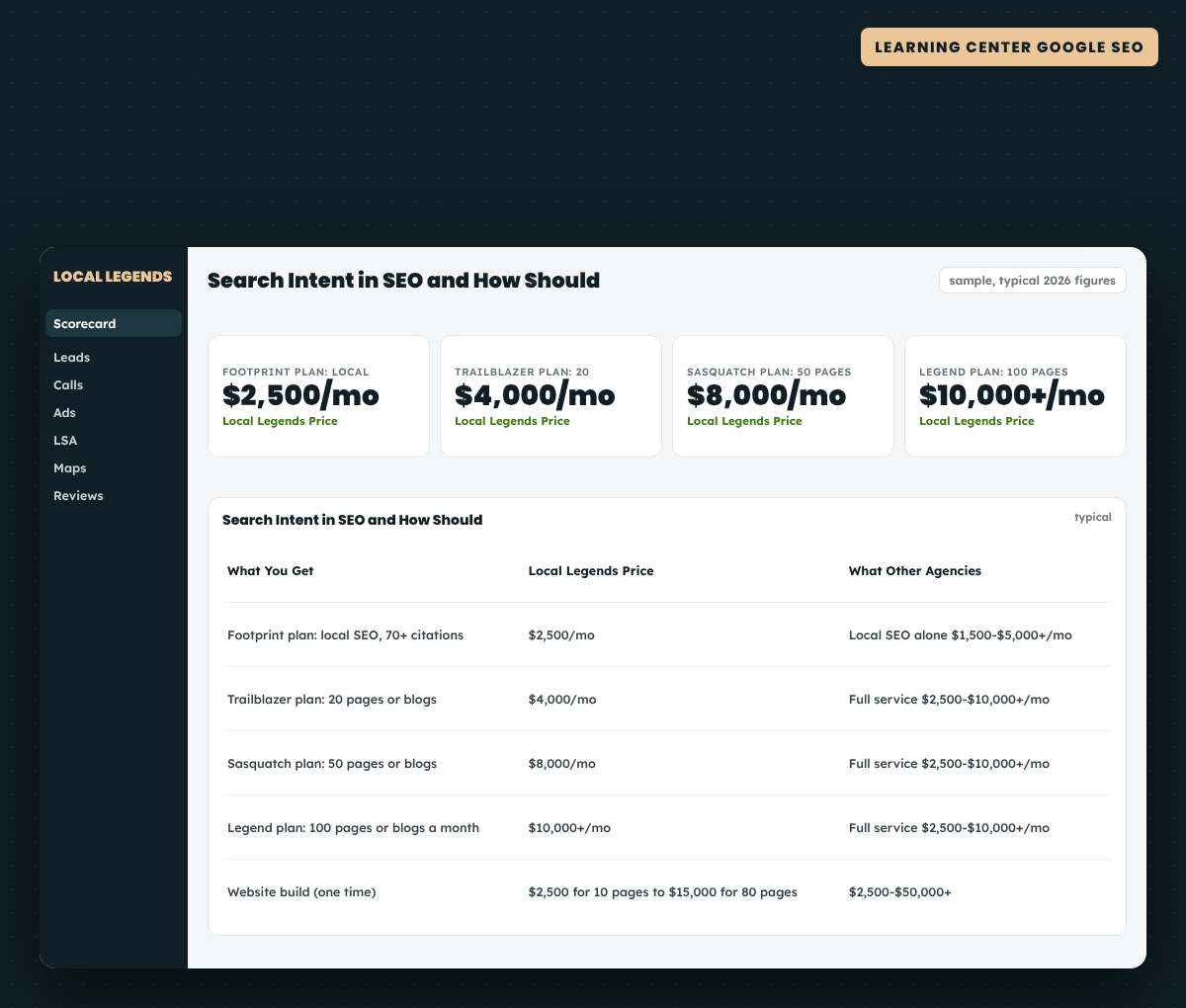
Local Legends Marketing does not sell SEO as a stand-alone retainer. Local SEO, new pages and citations come inside every growth plan, priced as flat monthly fees with no setup fees.
| What You Get | Local Legends Price | What Other Agencies Typically Charge |
|---|---|---|
| Footprint plan: local SEO, 70+ citations month 1, 10 pages or blogs a month, Google Ads + LSA management | $2,500/mo | Local SEO alone $1,500-$5,000+/mo |
| Trailblazer plan: 20 pages or blogs a month, 2 to 6 backlinks a month, weekly scorecard | $4,000/mo | Full service $2,500-$10,000+/mo |
| Sasquatch plan: 50 pages or blogs a month, AI SEO, 6 to 10 backlinks plus PR in month 1 | $8,000/mo | Full service $2,500-$10,000+/mo |
| Legend plan: 100 pages or blogs a month, 8 to 14 backlinks plus quarterly PR, multi-location pages | $10,000+/mo | Full service $2,500-$10,000+/mo |
| Website build (one time) | $2,500 for 10 pages to $15,000 for 80 pages | $2,500-$50,000+ |
Every plan comes with no long-term contracts, and the contractor owns the website, domain, Google Business Profile, ad accounts and call data. Compare every plan and add-on on the Local Legends pricing page.
What Moves the Price of SEO
- Market competition: a dense metro needs more pages, reviews and links than a small town.
- Number of services and towns: each one needs its own pages.
- Starting point: a new domain needs more foundation work than an established site.
- Content volume: pages per month is often the largest cost driver.
Want to know what your market will take? A free growth audit compares your site, profile and reviews with the companies already ranking in your towns before any plan is proposed.
SEO Timelines and Results: How Long Google SEO Takes and How to Know It Works Early Movement Comes Before Steady Calls
Google SEO for a contractor usually shows early movement in 3 to 6 months and steadier lead flow in 6 to 12 months. Google AI Mode gave that range in November 2026 and said market competition, the trade and the website's starting point move it the most.
How Long Does SEO Take to Work for a Contractor?
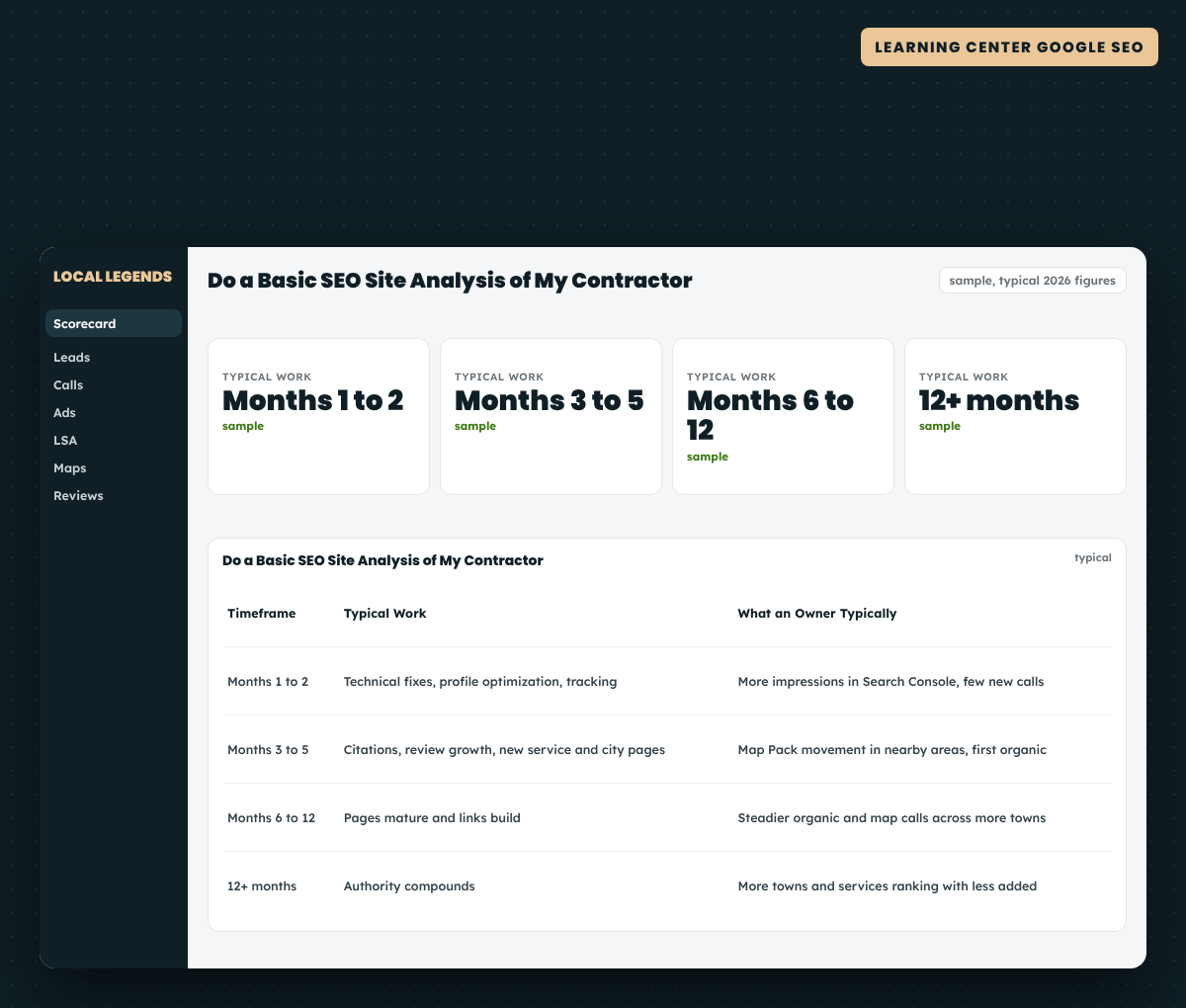
SEO takes most contractors several months because Google needs time to crawl new pages, see consistent signals and build trust in the domain. The timeline below shows what each stage typically involves.
| Timeframe | Typical Work | What an Owner Typically Notices |
|---|---|---|
| Months 1 to 2 | Technical fixes, profile optimization, tracking setup | More impressions in Search Console, few new calls yet |
| Months 3 to 5 | Citations, review growth, new service and city pages | Map Pack movement in nearby areas, first organic calls |
| Months 6 to 12 | Pages mature and links build | Steadier organic and map calls across more towns |
| 12+ months | Authority compounds | More towns and services ranking with less added effort |
These are typical timelines, not promises. A small town with light competition moves faster; a large metro for roofing or HVAC usually takes longer.
How Do I Know If My SEO Company Is Doing a Good Job for My Contracting Business?
An SEO company is doing a good job for a contracting business when it can show more calls and booked jobs from organic and map traffic, not only better rankings. Google AI Mode told owners to ask for work completed, rankings by town and leads by source every month.
- Work you can see: a list of pages published, profile posts and citations built.
- Rankings by town: rank grids across the service area, not one keyword at the office.
- Calls tracked by source: organic and map calls separated from ads.
- Booked and sold jobs: the numbers that decide whether SEO pays.
- Clear ownership: your accounts stay in your name.
- Clear explanations: the team explains what changed and what comes next.
Why Local Legends reports past rankings: founder Levi Ostlund lost $30,000+ to marketers before starting the agency, including a site that looked good and never ranked. Impressions and rankings are chapter one, and every scorecard follows calls through to booked jobs, sold jobs and cost per booked job. [SOURCE: Levi Ostlund founder story, BRIEF.md Nov 2026]
Where SEO Fits in Online Marketing for a Home Service Business Paid Search Fills the Calendar While SEO Matures
SEO is the long-term part of online marketing search engine optimization for contractors, while paid search brings calls in days. Most home service companies need both, in an order that fits their cash flow and season.
SEO vs Google Ads for a Home Service Business: Which Should I Invest in First?
Most home service businesses should start Google Ads or Local Services Ads for immediate calls while SEO builds underneath, then lean more on SEO as organic calls grow. Google AI Mode gave that order in November 2026, noting paid leads can start within days of launch.
- Google Ads and Local Services Ads: calls within days, with a cost on every click or lead.
- SEO: slower to start, but each ranking page keeps producing calls without a click fee.
- Seasonal trades: paid search covers peak weeks; SEO keeps steady work in the off season.
- Shared data: the search terms that convert in ads show which pages SEO should build next.
A weekly habit on Local Legends LSA accounts: the team disputes invalid leads every week and runs the LSA Ranker review texter, and the steady reviews it produces help the Google Business Profile as well as the ads. [SOURCE: Local Legends LSA management service facts, BRIEF.md Nov 2026]
How Do I Get My Contracting Business to Show Up in Google AI Overviews and AI Mode?
A contracting business shows up in Google AI Overviews and AI Mode by publishing pages that answer homeowner questions directly, keeping its profile and reviews strong, and staying consistent across the web. Google AI Mode noted in November 2026 that there is no separate submission form or special AI markup for this.
- Answer first: open each section with a plain answer, then the details.
- Stand-alone passages: each answer should make sense if quoted alone.
- Specific facts: services, towns, materials and real price ranges where you can share them.
- Fresh dates: show when the page was last updated.
- Consistent details: the same business facts on the site, profile and directories.
- Crawlable site: do not block Google from the pages you want cited.
Local Legends builds this work into its SEO service and adds AI SEO in the Sasquatch and Legend plans.
Local Legends Marketing Reviews From Home Service CEOs Owners Who Worked With Levi Ostlund
Roofing and restoration owners have recorded testimonials about working with Local Legends Marketing and founder Levi Ostlund. The videos are on the Local Legends reviews page [LINK: /about-us/reviews/].
Levi has been absolutely outstanding to work with over the years... His creativity, responsiveness, and deep understanding of our marketing strategy have made a huge impact." Brad Beldon, CEO, Roofing Company. Read on Local Legends
- Kyle Scott, CEO, Roofing Company (video testimonial)
- Jim Dodson, CEO, Roofing Company (video testimonial)
- Race Allen, CEO, Precision Restoration of Texas (video testimonial)
- Brad Beldon, CEO, Roofing Company (written testimonial)
Frequently Asked Questions About Google SEO Optimization Google SEO Questions Contractors Ask Most
Is SEO Dead or Still Worth It for Contractors in 2026?
SEO is changing, not dead. AI Overviews and AI Mode answer many basic questions on the results page, but they pull those answers from indexed pages, and homeowners still call companies from the Map Pack and organic results.
Can ChatGPT Do SEO for My Contracting Business?
AI tools can help draft outlines and answer questions, but they cannot verify your local facts, earn reviews, build citations or fix indexing problems. Pages built only from generic AI text rarely add anything Google cannot already find.
What Is the 80/20 Rule in SEO?
The 80/20 rule means a small share of pages and actions usually produces most of the results. For contractors, that is often the Google Business Profile, reviews and the top few service pages.
Is Paying Someone to Do SEO Worth It?
Paying for SEO is worth it when the provider's work can be traced to more calls and booked jobs at a lower cost per booked job than other channels. Ask for that tracking before you sign.
Is Google Search Console Free?
Google Search Console is free for any verified site owner. It shows search queries, clicks, indexing problems and page experience data straight from Google.
Do I Need a Google SEO Tool or SEO Checker?
Free tools from Google cover most of what an owner needs to start: Search Console for search data, the Business Profile dashboard for map activity and a mobile speed test for page experience. Paid tools add competitor data and rank tracking.
What Are the Top SEO Factors for a New Contractor Website?
A new contractor site should focus on getting indexed, one strong page per core service, a complete Google Business Profile and its first steady reviews. Links and city pages build on that foundation.
What Does SEO Mean for a Company That Serves Homeowners?
For a home service company, SEO means showing up when nearby homeowners search for the service you sell, in the map, the organic results and the AI answers. The goal is booked jobs, not traffic alone.
Reviewed by Levi Ostlund, Founder, Local Legends Marketing

Put Google SEO Optimization to Work for Your Home Service Company Start With a Free Growth Audit
The best first step in Google SEO optimization is knowing exactly where your site and profile stand today. Local Legends Marketing checks indexing, service pages, your Google Business Profile, reviews and call tracking, and runs Google Maps rank grids across your service area.
- Flat monthly fees, no setup fees and no long-term contracts.
- Every account in your name, from the domain to the call data.
- A scorecard that follows each call to the booked and sold job.
Call (936) 900-1248 or book a free growth audit online. Local Legends works with contractors in every state; see the Local Legends service areas page.