


A Search Plan Built Around Jobs, Towns

SEO Strategy for Contractors: How Roofers, HVAC Companies, Plumbers and Remodelers Plan Search So Google Searches Become Booked Jobs
A Search Plan Built Around Jobs, Towns and Proof
Updated November 2026 · Reviewed by Levi Ostlund, Founder
Breadcrumb: Home > Learning Center [LINK: /learning-center/] > SEO Strategy
An SEO strategy for a contractor is the written plan that decides which jobs, which towns and which searches the company will win on Google, Google Maps and AI answers, and in what order. Tactics like posts and pages only work when that plan comes first.
- Goal first: the target is booked and sold jobs, with rankings and traffic as early signals.
- Local first: for most trades, the Map Pack and "near me" searches carry the urgent calls.
- Pages second: one page per core service, plus city pages only where real local facts exist.
- Proof throughout: reviews, job photos, prices and credentials give Google and AI tools something to trust.
- Measured monthly: calls, booked jobs and cost per booked job decide what stays in the plan.
Free Growth Audit
Your Reviews, Radius and Response Rate vs the competitors beating you.
About Local Legends Marketing
A home service marketing agency headquartered in Conroe, Texas, with 8+ years of marketing experience, running Google Ads, Local Services Ads, local SEO, AI SEO, connected TV and review systems for contractors nationwide.
What Is an SEO Strategy for a Home Service Contractor? A Plan for Which Searches to Win and Why
An SEO strategy for a home service contractor is a local search plan aimed at getting the business into the Google Map Pack and organic results when nearby homeowners need a repair, a replacement or an emergency visit. It centers on proximity, high-intent searches, reviews and a website that turns visits into calls.
Google's AI Overview in November 2026 framed the general version the same way: a strategy that lines up technical site health, content grouped by search intent, authority building and AI search visibility around clear business goals.
Strategy, Tactics and SEO Services Are Different Things
- Strategy: the choices about which services, towns and searches matter most, and in what order.
- Tactics: the specific moves, such as a new water heater page or a citation cleanup.
- SEO services: the monthly work an agency or staff member does to carry out the tactics.
- Reporting: the feedback loop that tells you whether the strategy needs to change.
How SEO Services Fit Inside the Strategy
A strong SEO services strategy assigns every monthly task to a goal in the plan. If a task cannot be tied to a service, a town or a measurable result, it is busywork. That simple test keeps a contractor from paying for activity instead of progress.
Local SEO vs Organic SEO Strategy for a Roofing Company: Which Matters More?
For a roofing company, local SEO usually comes first because homeowners with a leak or storm damage look at Google Maps listings before anything else, and organic SEO comes second to build long-term authority across the whole service area.
- Local SEO wins the urgent call: the Map Pack is driven by relevance, distance and prominence.
- Organic SEO wins the research phase: homeowners comparing metal roofs, shingle brands or replacement costs read website pages.
- They feed each other: strong service pages help the Business Profile rank, and reviews help pages convert.
- Outer towns need pages: the Map Pack favors the area near the office, so organic town pages carry farther areas.
How to Build an SEO Marketing Strategy for a Contractor Step by Step Seven Decisions Made in Order
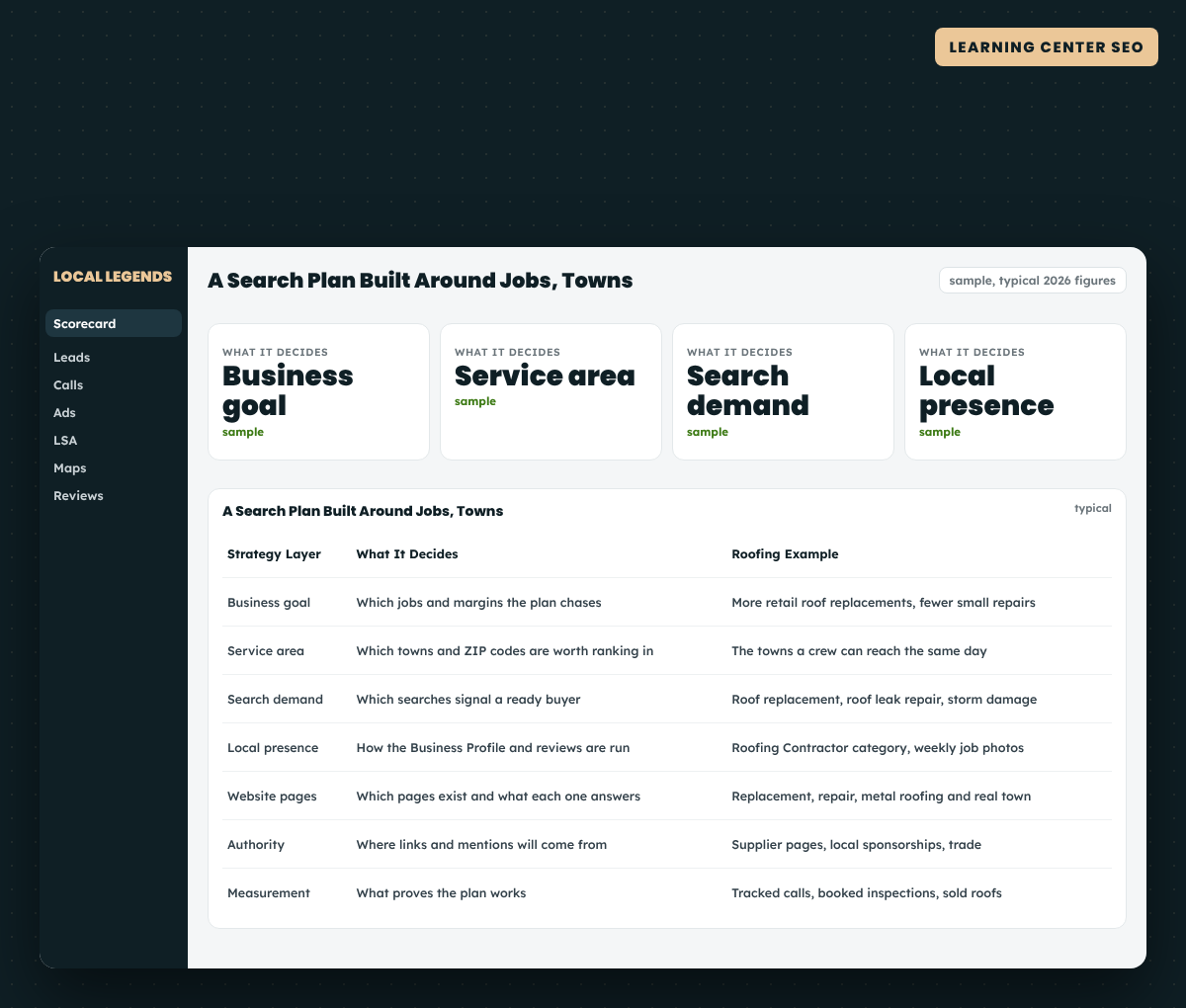
A contractor builds an SEO marketing strategy by deciding the goal, the service area, the target searches, the local presence, the page plan, the authority plan and the measurement plan, in that order. Skipping ahead to tactics is the most common reason a plan stalls.
Step 1: Set the Goal in Booked Jobs
Write the goal the way the owner talks about the business: "20 more replacement inspections a month" or "fill the winter schedule with furnace installs." A goal stated in jobs lets every later decision be checked against it.
Step 2: Draw the Real Service Area
List the towns and ZIP codes the crews can actually serve with good margins. A plumber who reaches three suburbs in 30 minutes should not build a plan around a county an hour away.
Why Radius Shapes the Whole Plan
Google weighs distance heavily in local results, so a Business Profile rarely ranks well far from its address. The strategy decides early which towns the profile can win and which will need their own website pages.
The 3 R's Behind a Local Legends Plan
Local Legends Marketing frames local growth around three R's on its home page: Reviews, Radius and Response Rate. Each one becomes a line in the strategy: how reviews are earned, which radius is targeted and how fast leads are answered.
Step 3: Map the Searches That Signal a Ready Buyer
Group searches by intent: urgent problem searches ("AC not cooling"), service searches ("water heater replacement"), town searches and research searches ("metal roof vs shingles"). The strategy focuses first on the groups closest to a phone call.
Step 4: Plan the Local Presence
Decide the Business Profile categories, the services list, the photo cadence, the review request process and the citation cleanup. These choices drive the Map Pack more than anything on the website.
Step 5: Plan the Pages
Build a page map: one page per core service, supporting pages for common problems and questions, and town pages only where the company can say something true and specific about that place.
Step 6: Plan the Authority
Name where links and mentions will come from: suppliers, manufacturers, local sponsorships, community groups and trade associations. Relevant local links usually beat a large pile of unrelated ones.
Step 7: Decide How Success Will Be Measured
Set up call tracking, form tracking and a way to match leads to booked and sold jobs before the work starts. Without this step, the strategy can only be judged by rankings.
Why Local Legends plans from the sold job backward: Founder Levi Ostlund lost more than $30,000 to marketers before starting Local Legends, including a website that looked good and never ranked. That experience is why every plan here is judged by booked and sold jobs, not by activity. [SOURCE: Levi Ostlund founder story, Local Legends brief, confirmed Nov 2026]
How Does a Plumber Rank for "Plumber Near Me"? A Near Me SEO Strategy
A near me SEO strategy for a plumber works on Google's three local ranking factors, relevance, distance and prominence, across both the Map Pack and the organic results, because "near me" searches come from homeowners who usually want help soon.
- Relevance:"Plumber" as the primary category, with secondary categories and a full services list for drain cleaning, water heaters and gas lines.
- Distance: an accurate service area limited to places the trucks can reach quickly.
- Prominence: a steady flow of recent reviews, consistent listings and local links.
- The website: fast mobile service pages with a tap-to-call button and real job photos.
- Response rate: answered calls, because a ranking that rings to voicemail books nothing.
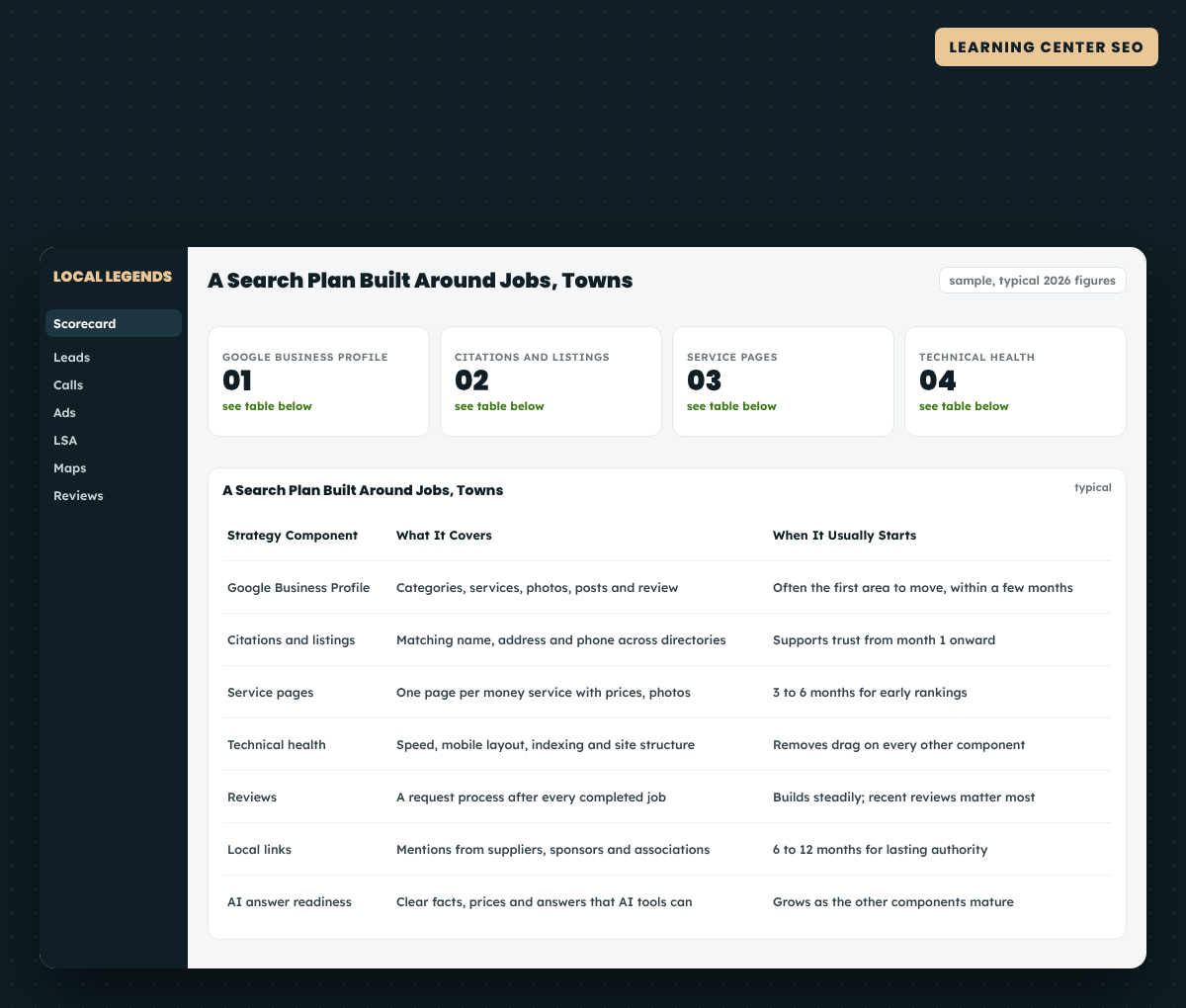
What an SEO Strategy for a Plumbing Company Should Include in 2026 The Components and When Each One Pays Off
A 2026 SEO strategy for a plumbing company should include Business Profile management, service pages, technical health, reviews, local links, AI answer readiness and call tracking, each with a clear owner and a timeline. Google's AI Overview stressed local map visibility, high-intent pages, review velocity and mobile conversion.
| Strategy Component | What It Covers | When It Usually Starts Paying Off | Plumbing Example |
|---|---|---|---|
| Google Business Profile | Categories, services, photos, posts and review replies | Often the first area to move, within a few months | Plumber category plus drain cleaning and water heater services |
| Citations and listings | Matching name, address and phone across directories | Supports trust from month 1 onward | Same business name on every listing |
| Service pages | One page per money service with prices, photos and reviews | 3 to 6 months for early rankings | Separate pages for water heaters, drains and sewer lines |
| Technical health | Speed, mobile layout, indexing and site structure | Removes drag on every other component | Pages load fast on a phone in a flooded basement |
| Reviews | A request process after every completed job | Builds steadily; recent reviews matter most | A text request sent the day the job closes |
| Local links | Mentions from suppliers, sponsors and associations | 6 to 12 months for lasting authority | Supplier dealer page and a youth league sponsor page |
| AI answer readiness | Clear facts, prices and answers that AI tools can quote | Grows as the other components mature | A page that answers "how much does a water heater cost" |
| Call tracking | Tracked numbers tied to the CRM | Needed before results can be proven | Calls matched to booked and sold jobs |
What Content Should a Contractor Website Publish for SEO?
A contractor website should publish dedicated service pages and genuinely unique city pages first, then use blog articles to answer the questions homeowners ask before they hire, with each page carrying real photos, reviews and clear next steps.
- Service pages: one per core service, explaining scope, typical cost ranges and who the service is for.
- Problem pages:"furnace short cycling" or "roof leaking around a skylight," written for urgent searches.
- City pages: only for towns where the company works and can share real local details.
- Cost and comparison articles: repair versus replace, material choices and price explainers.
- Project stories: real jobs with photos, the problem and the result.
The City Page Rule Local Legends Follows
City pages need real facts: the Local Legends team writes a city page only for a town with 5 or more real local facts, which keeps every town page useful instead of a copy with a new name. [SOURCE: Local Legends city page rule, Local Legends brief, confirmed Nov 10 2026]
How Does a House Cleaning Business Use Its Google Business Profile in an SEO Strategy?
A house cleaning business uses its Google Business Profile as the center of its local SEO strategy by claiming it under the real business name, choosing House Cleaning Service as the primary category, listing every service and keeping reviews and posts current.
- Real name only: adding keywords to the business name can put the profile at risk of suspension.
- Accurate categories: secondary categories only for services the company actually offers, such as move-out or deep cleaning.
- Service area: the neighborhoods and towns the team regularly cleans.
- Fresh activity: weekly posts and real photos of finished rooms, with client permission.
- Review replies: a short, personal reply to every review.
How Local Legends handles profile access: Local Legends is added as an owner on a client's Google Business Profile while the client stays the primary owner and keeps ownership of the profile. [SOURCE: Local Legends GBP access policy, Local Legends brief, confirmed Nov 8 2026]
Learn how the profile work is run month to month on the Google Business Profile management page.
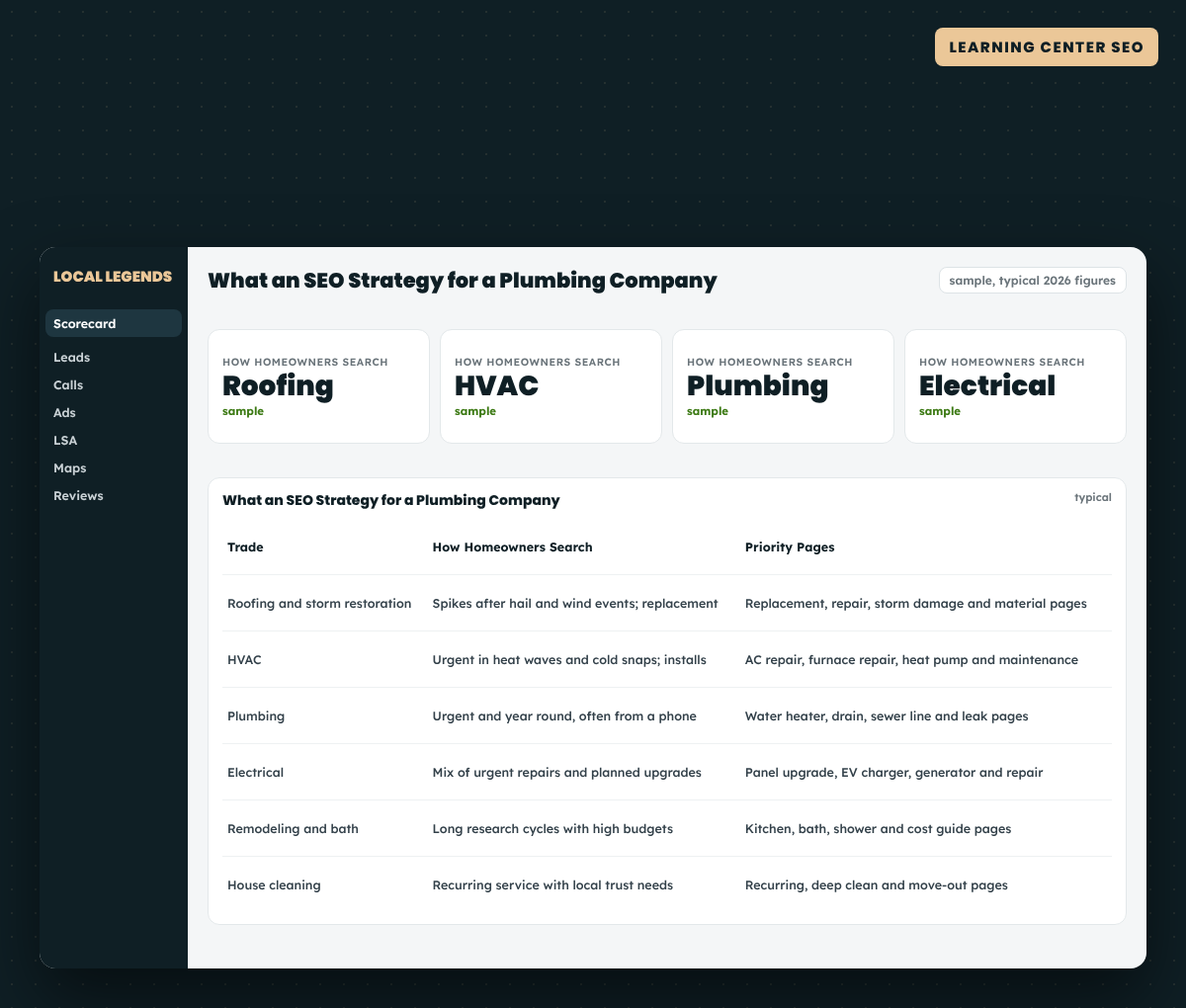
SEO Strategy by Trade for Roofing, HVAC, Plumbing, Electrical and Remodeling Companies One Framework, Different Demand Patterns
Every trade uses the same seven-decision framework, but the priorities change with how homeowners search for that trade. A roofer's demand spikes after storms, an HVAC company's follows the weather, and a remodeler sells long-research projects.
| Trade | How Homeowners Search | Priority Pages | Local Presence Focus | Key Number to Watch |
|---|---|---|---|---|
| Roofing and storm restoration | Spikes after hail and wind events; replacement research takes weeks | Replacement, repair, storm damage and material pages | Job photos of finished roofs and steady reviews | Booked inspections and sold replacements |
| HVAC | Urgent in heat waves and cold snaps; installs researched in shoulder seasons | AC repair, furnace repair, heat pump and maintenance plan pages | Seasonal posts and fast review requests after service calls | Calls answered and system sales |
| Plumbing | Urgent and year round, often from a phone | Water heater, drain, sewer line and leak pages | Emergency hours shown accurately and a tight radius | Booked calls and average ticket |
| Electrical | Mix of urgent repairs and planned upgrades | Panel upgrade, EV charger, generator and repair pages | Licensing details and photos of clean installs | Estimates booked for upgrades |
| Remodeling and bath | Long research cycles with high budgets | Kitchen, bath, shower and cost guide pages | Project galleries and detailed reviews | Design consults and signed contracts |
| House cleaning | Recurring service with local trust needs | Recurring, deep clean and move-out pages | Reviews that mention reliability and named cleaners | Recurring clients added |
Why Timing Matters by Trade
A page needs time to be found and trusted, so seasonal work is planned ahead. An HVAC company publishes its AC repair improvements in spring, and a roofer has storm damage pages and photos in place before the storm season starts.
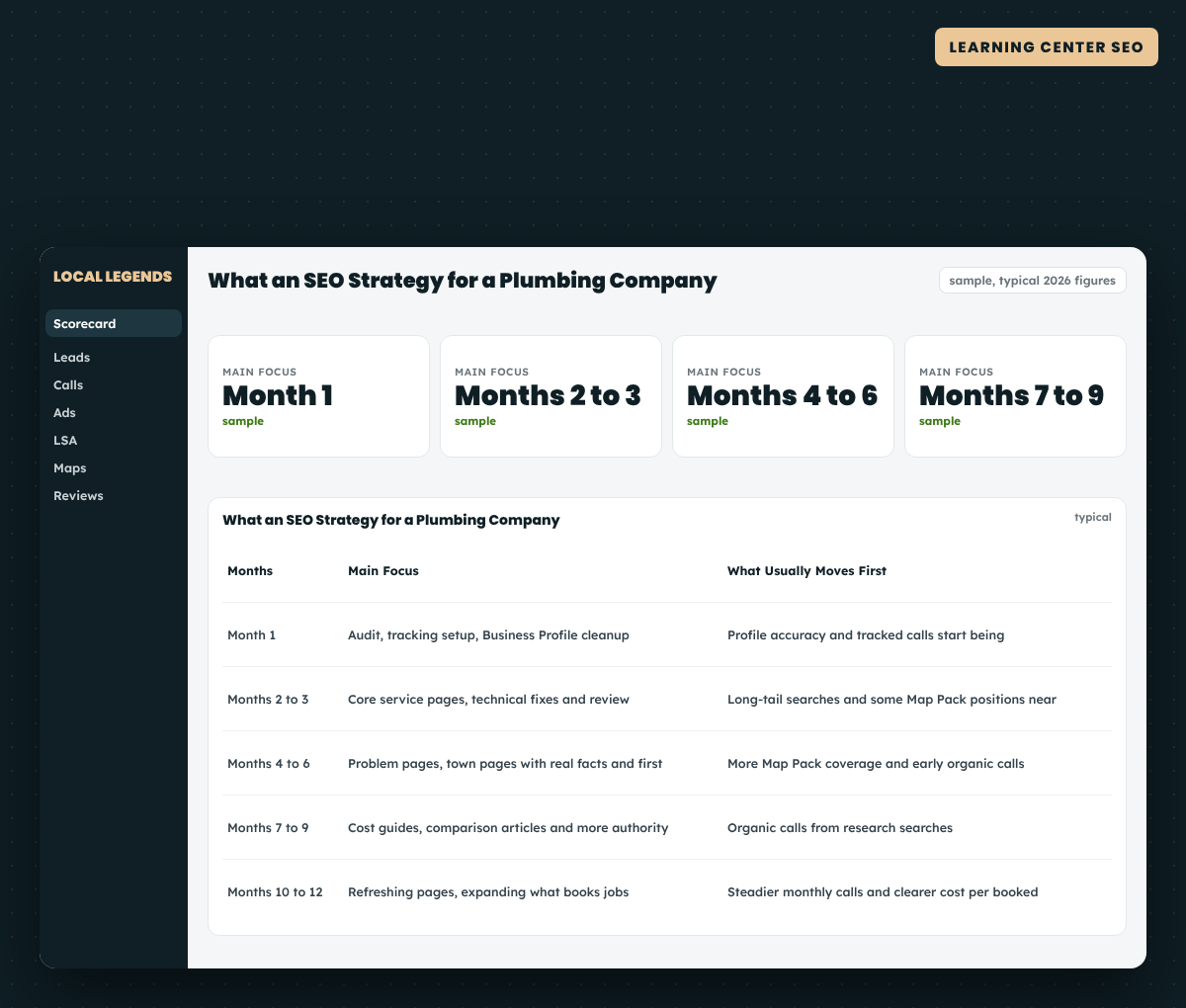
How Long Does an SEO Strategy Take to Work for a Local Contractor? A Realistic 12-Month Roadmap
For a local contractor, an SEO strategy typically shows early ranking movement in 3 to 6 months and steadier lead flow in 6 to 12 months, and a competitive metro market can take 12 months or longer, according to Google's AI Overview in November 2026.
Google's own Search Central guide says changes can take effect in a few hours or take several months, and it suggests waiting a few weeks before judging a change.
| Months | Main Focus | What Usually Moves First |
|---|---|---|
| Month 1 | Audit, tracking setup, Business Profile cleanup and citations | Profile accuracy and tracked calls start being counted |
| Months 2 to 3 | Core service pages, technical fixes and review process | Long-tail searches and some Map Pack positions near the office |
| Months 4 to 6 | Problem pages, town pages with real facts and first local links | More Map Pack coverage and early organic calls |
| Months 7 to 9 | Cost guides, comparison articles and more authority | Organic calls from research searches |
| Months 10 to 12 | Refreshing pages, expanding what books jobs and cutting what does not | Steadier monthly calls and clearer cost per booked job |
Should a Contractor Start With SEO or Google Ads First?
A contractor who needs booked jobs this month and has budget to compete usually starts Google Ads first, while a contractor with steady work and a longer timeline can lead with SEO, especially the Business Profile. Many run both, using ads data to choose SEO targets.
- Ads first when: the schedule has open slots now and leads can be tracked to signed jobs.
- SEO first when: the budget is small, the work is steady and the owner can wait several months.
- Both when: ads cover the months SEO needs to build, then spend shifts as organic calls grow.
- Use the data: the searches that produce booked jobs in ads are strong targets for SEO pages.
How AI Search Changes SEO Strategy for Home Service Businesses Becoming the Named Answer
AI search moves home service SEO strategy from chasing short keywords toward becoming a trusted, easily verified answer in AI Overviews, AI Mode and AI assistants, while local SEO fundamentals still anchor visibility.
What AI Tools Need From a Contractor
- Direct answers: pages that answer full questions about cost, repair versus replace and timelines.
- Consistent facts: the same name, address, phone, services and hours everywhere online.
- Real proof: recent reviews that name the job, real photos and stated credentials.
- Clear structure: headings, short paragraphs, lists and tables that are easy to quote.
- Mentions elsewhere: trade directories, local news and associations that confirm the business exists.
What Stays the Same
The Business Profile, service pages and town pages still feed the AI answers. A contractor that skips the fundamentals to chase AI visibility usually ends up with neither. Local Legends includes AI SEO in its Sasquatch and Legend plans for companies ready for that layer.
How to Measure Whether a Contractor SEO Strategy Is Working From Search Console Data to Cost Per Booked Job
A contractor measures an SEO strategy by following search visibility through to tracked calls, booked jobs, sold jobs and cost per booked job, because impressions and rankings are only the first chapter of the story.
- Visibility: impressions and positions in Google Search Console, plus Google Maps rank grids across the service area.
- Engagement: visits to service pages and clicks on the call button.
- Leads: tracked calls and form fills, with spam and out-of-area requests removed.
- Bookings: how many of those leads became scheduled appointments.
- Sales: sold jobs and revenue matched back to organic search and the Business Profile.
- Efficiency: cost per booked job compared with ads and lead services.
What Local Legends Reports
Audits and scorecards here: every Local Legends engagement starts with an audit of tracking, local SEO, Local Services Ads and the sales funnel, including Google Maps rank grids, and clients get a CEO scorecard showing leads, booked, sold and cost per booked job. [SOURCE: Local Legends audit and scorecard process, Local Legends brief, confirmed Nov 10 2026]
Questions to Ask at Every Monthly Review
- Which services and towns produced booked jobs this month?
- Which pages gained visibility but produced no calls, and why?
- Were any calls missed, and how quickly were leads answered?
- What will change next month based on these numbers?
How Much Do SEO Strategy Services Cost for a Contractor? Typical Retainers Next to Local Legends Plans
Monthly SEO strategy and management services for a contractor typically cost $1,500-$3,500+ a month, with basic local plans around $500-$1,500+ and multi-location or highly competitive campaigns reaching $3,500-$7,500+ a month. Local SEO retainers at agencies typically run $1,500-$5,000+ a month.
| SEO Strategy Level | What Other Agencies Typically Charge | What Local Legends Includes |
|---|---|---|
| Basic local plan, one market | $500-$1,500+/mo | Not sold alone; local SEO is part of every growth plan |
| Established contractor, competitive local | $1,500-$3,500+/mo | Footprint, $2,500/mo: Google Ads + LSA, local SEO with 70+ citations in month 1, 10 pages or blogs a month, GBP photo posts 2x a week, call tracking, monthly scorecard |
| Multi-channel growth | $2,500-$5,000+/mo | Trailblazer, $4,000/mo: 20 pages or blogs a month, 2 to 6 backlinks a month, Bing and Facebook/Instagram ads, weekly scorecard |
| SEO with AI SEO and PR | $3,500-$7,500+/mo | Sasquatch, $8,000/mo: 50 pages or blogs a month, AI SEO, 6 to 10 backlinks and PR in month 1, connected TV and geofencing |
| Multi-location | $7,500+/mo | Legend, $10,000+/mo: 100 pages or blogs a month, 8 to 14 backlinks, quarterly PR, multi-location city pages |
| Setup fee | Often charged | $0 on every plan, with no long-term contracts |
What Drives the Price of an SEO Strategy
- Market competition: a dense metro needs more pages and links than a small town.
- Number of services and towns: each one adds pages and tracking.
- Starting point: a site with technical problems needs cleanup before growth work.
- Channels included: plans that also manage ads, social posts or connected TV cost more.
Every Local Legends plan includes the LSA Ranker review texter, call tracking and fractional CMO and CEO meetings, and ad spend is paid by the client directly to the platform. Compare every plan on the Local Legends pricing page.
How to Choose an SEO Strategy Company for a Remodeling or Contracting Business What to Look For Before You Sign
The right SEO strategy company for a remodeling or contracting business focuses on local buyer intent, high-value project leads and measurable return, rather than generic traffic or rankings alone. Homeowners spending on a kitchen or roof compare carefully, so the plan has to build trust early.
- Trade experience: the company can explain how searches differ for your trade.
- A written plan: a clear strategy for services, towns and pages before monthly work begins.
- Ownership in your name: website, domain, Business Profile, analytics and call data.
- Reporting on jobs: calls, booked appointments and sold work, not just traffic charts.
- Clear terms: contract length, cancellation and what happens to your content if you leave.
What Questions Should I Ask an SEO Company Before Hiring It for My Contracting Business?
Ask an SEO company about its experience with contractors, how it targets your real service area, what it delivers each month, how it reports leads and who owns your accounts and website, and get the answers in writing so proposals can be compared side by side.
- Have you helped other home service companies, and can I speak with one?
- Do you work with any competitors in my service area?
- How will you decide which services and towns to target first?
- What exactly gets done each month, and who does it?
- How do you report calls, booked jobs and cost per booked job?
- Who owns the website, domain, Business Profile and tracking numbers?
Can a Small Contractor Run Its Own SEO Strategy or Should It Hire an Agency?
A small contractor can run much of its own local SEO, and many use a mix: the owner handles the Business Profile, photos and review requests while a specialist handles technical work, page writing and links.
- Do it yourself when: budget is tight and someone has steady weekly time for the profile and reviews.
- Hire help when: the market is competitive, the site has technical problems or the owner's time is worth more on jobs.
- Learn either way: knowing the basics makes it easier to judge any agency's work.
How Local Legends Answers These Questions
Local Legends Marketing starts every engagement with an audit, keeps clients as owners of their website, domain, Business Profile, ad accounts and call data, charges no setup fees and uses no long-term contracts.
Every engagement includes the Local Legends marketing course and a weekly project review meeting. See how the work is run on the SEO services and local SEO pages.
Local Legends Marketing Reviews From Contractor CEOs Owners Who Worked With Levi
Roofing and restoration CEOs have shared what working with Local Legends Marketing has been like.
Levi has been absolutely outstanding to work with over the years... His creativity, responsiveness, and deep understanding of our marketing strategy have made a huge impact." Brad Beldon, CEO, Roofing Company. Read more reviews
- Kyle Scott, CEO, Roofing Company (video testimonial)
- Jim Dodson, CEO, Roofing Company (video testimonial)
- Race Allen, CEO, Precision Restoration of Texas (video testimonial)
Agency-reported totals: 25,000+ appointments generated and $30M+ in revenue influenced.
Frequently Asked Questions About SEO Strategy for Contractors Quick Answers to What Contractors Ask Next
What Is the 80/20 Rule in SEO?
The 80/20 rule in SEO means a small share of pages, services or searches usually produces most of the results, so a contractor's strategy puts most of its effort into the few services and towns that book the most profitable jobs.
Is SEO Dead or Evolving in 2026?
SEO is evolving, not dead, because AI Overviews and AI assistants still draw on websites, Business Profiles and reviews, and homeowners still search Google Maps when something breaks.
What Are the Top 5 SEO Strategies for a Contractor?
The five that matter most for most contractors are a complete Business Profile, a steady review process, one strong page per core service, a fast mobile website and relevant local links, all measured with call tracking.
What Are the Three C's of SEO?
The three C's are a common shorthand for content, code and credibility: useful pages, a technically sound website and trust signals such as reviews and links.
What Does an SEO Strategy Template Include?
A useful template lists the goal, the service area, the target searches by intent, the page map, the local presence plan, the authority plan and the reporting plan, with an owner and a date for each line.
Does Having a Google Business Profile Help With SEO?
Yes, a complete and active Google Business Profile is one of the strongest local SEO assets a contractor has, because it drives Map Pack visibility for nearby searches.
Is Local SEO Worth It for a Small Contractor?
Local SEO is usually worth it for a small contractor that can take on more work and stay with the plan for several months, since the calls keep coming after the work is done.
How Often Should a Contractor Update Its SEO Strategy?
Review the strategy every month against booked jobs and refresh the full plan at least every 6 to 12 months, or sooner after a new service, a new town or a major Google change.
Reviewed by Levi Ostlund, Founder, Local Legends Marketing

Get an SEO Strategy Built Around Your Trade and Your Towns Start With a Free Growth Audit
Local Legends will review your Business Profile, website, Google Maps rank grids and call tracking, then show which services and towns your SEO strategy should win first.
- Call:(936) 900-1248
- Office: 481 Stephen F Austin Dr, Conroe, TX 77302
- Next step: book your free growth audit and get a written SEO plan for your trade and service area