


SEO Keywords for a Roofing Company and Why Do

SEO and Keywords for Contractors: What SEO Keywords Are, How to Pick Good Ones and Where They Go on a Roofing, HVAC or Plumbing Website
A Plain Keyword Guide From Local Legends Marketing
Updated November 2026 · Reviewed by Levi Ostlund, Founder
Breadcrumb: Home > Learning Center [LINK: /learning-center/] > SEO and Keywords
SEO and keywords work together like a job and its materials: keywords are the exact words homeowners type into Google, and SEO is the work of building pages that answer those words better than anyone else in your towns. For a contractor, the best keywords pair a service or a problem with a place.
- Service keywords:"roof replacement", "water heater installation", "panel upgrade".
- Problem keywords:"AC blowing warm air", "basement leak after rain", "garage door won't close".
- Place keywords: the real towns and neighborhoods your crews drive to every week.
- One page, one job: each page targets one main keyword and a few close variations.
- Calls, not clicks: the right keyword is the one that books jobs, which is why calls get tracked.
Free Growth Audit
Your Reviews, Radius and Response Rate vs the competitors beating you.
About Local Legends Marketing
A home service marketing agency headquartered in Conroe, Texas, with 8+ years of marketing experience, running Google Ads, Local Services Ads, local SEO, AI SEO, connected TV and review systems for contractors nationwide.
What Are SEO Keywords for a Roofing Company and Why Do They Matter? The Words Homeowners Type When the Roof Leaks
SEO keywords for a roofing company are the search phrases homeowners use when they need a roofer, such as "roof repair", "roof replacement cost" or "roofer near me", plus the city or neighborhood they live in. Google matches those words to the pages and profiles that answer them best.
Google AI Overviews described the strongest roofing keywords in November 2026 as high-intent terms that join a service or a problem with a local or urgency modifier. In plain terms, the homeowner already knows what is wrong and where they live, and the keyword says both.
Keywords matter because Google cannot rank a page for a job the page never mentions. A roofer whose site only talks about "quality craftsmanship" while homeowners search "hail damage roof repair" gives Google nothing to match.
What Types of Keywords Should a Contractor Know?
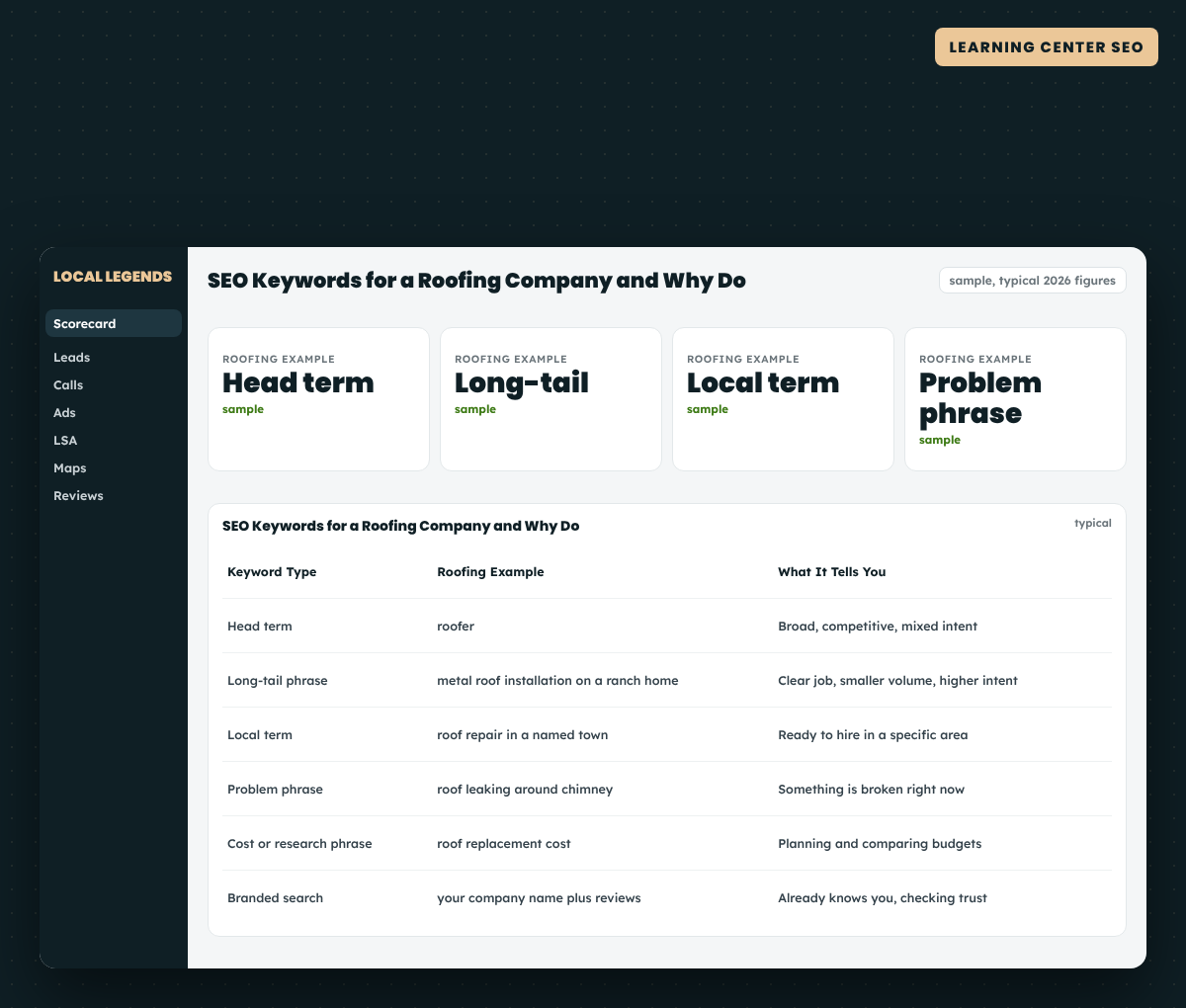
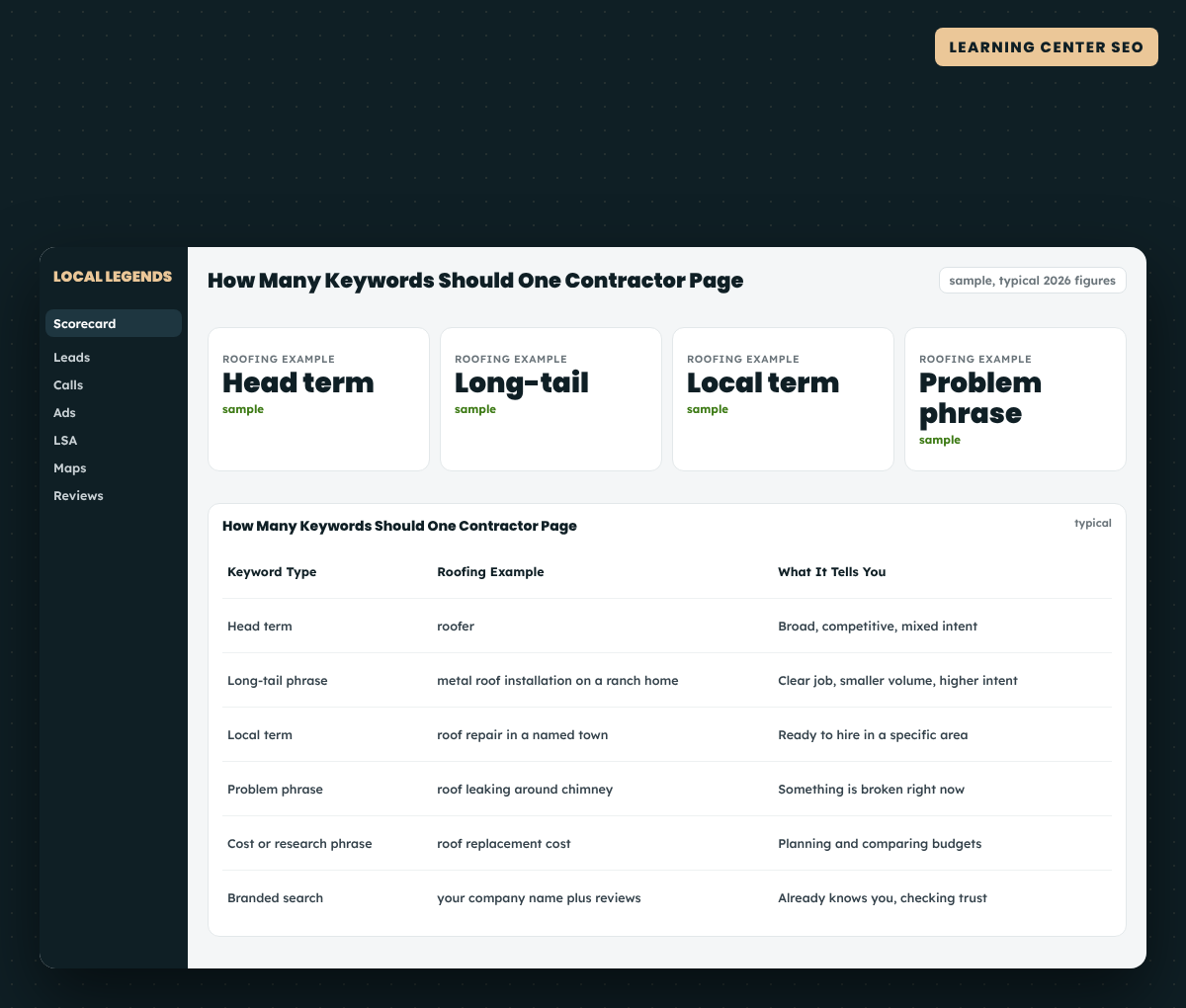
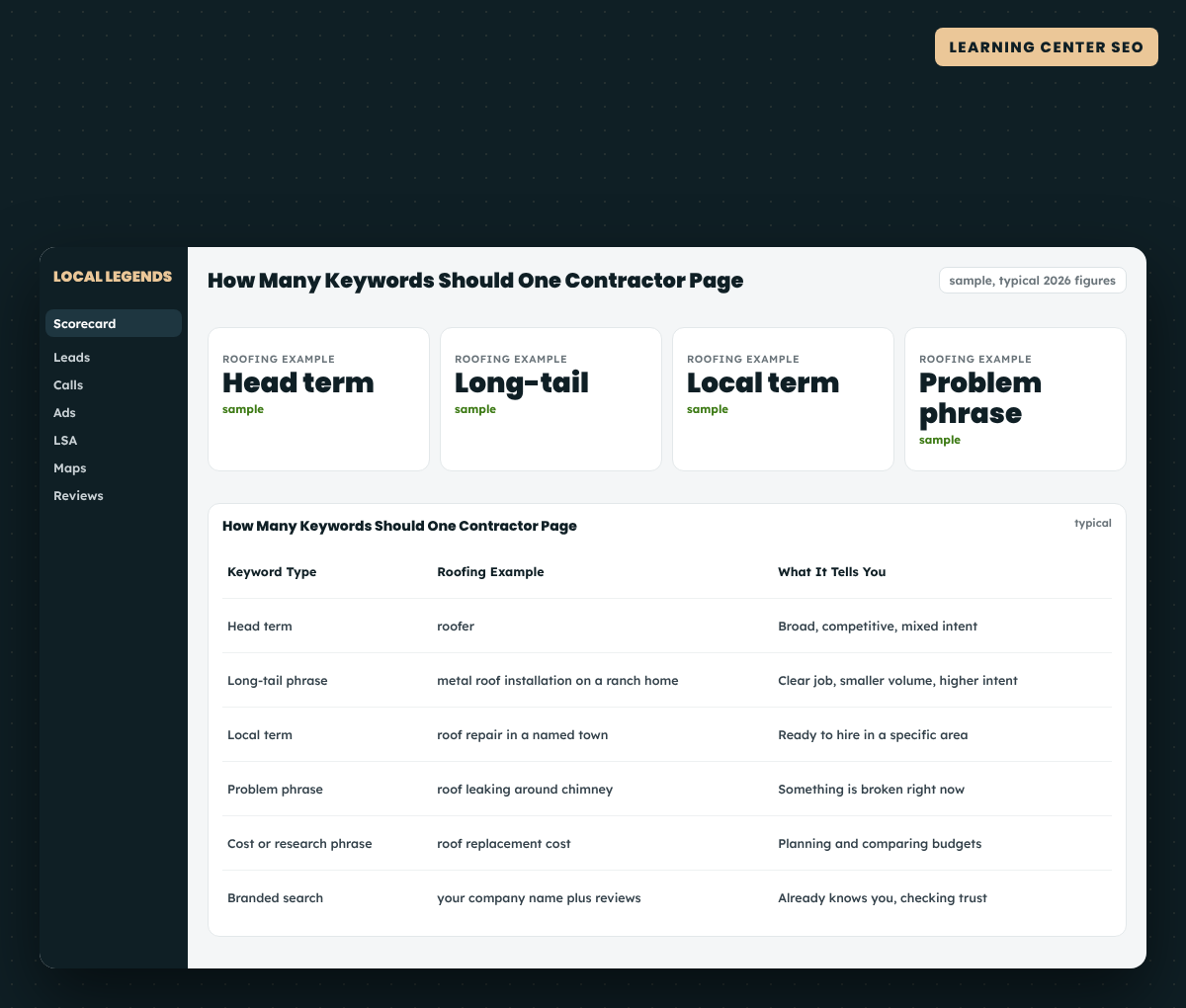
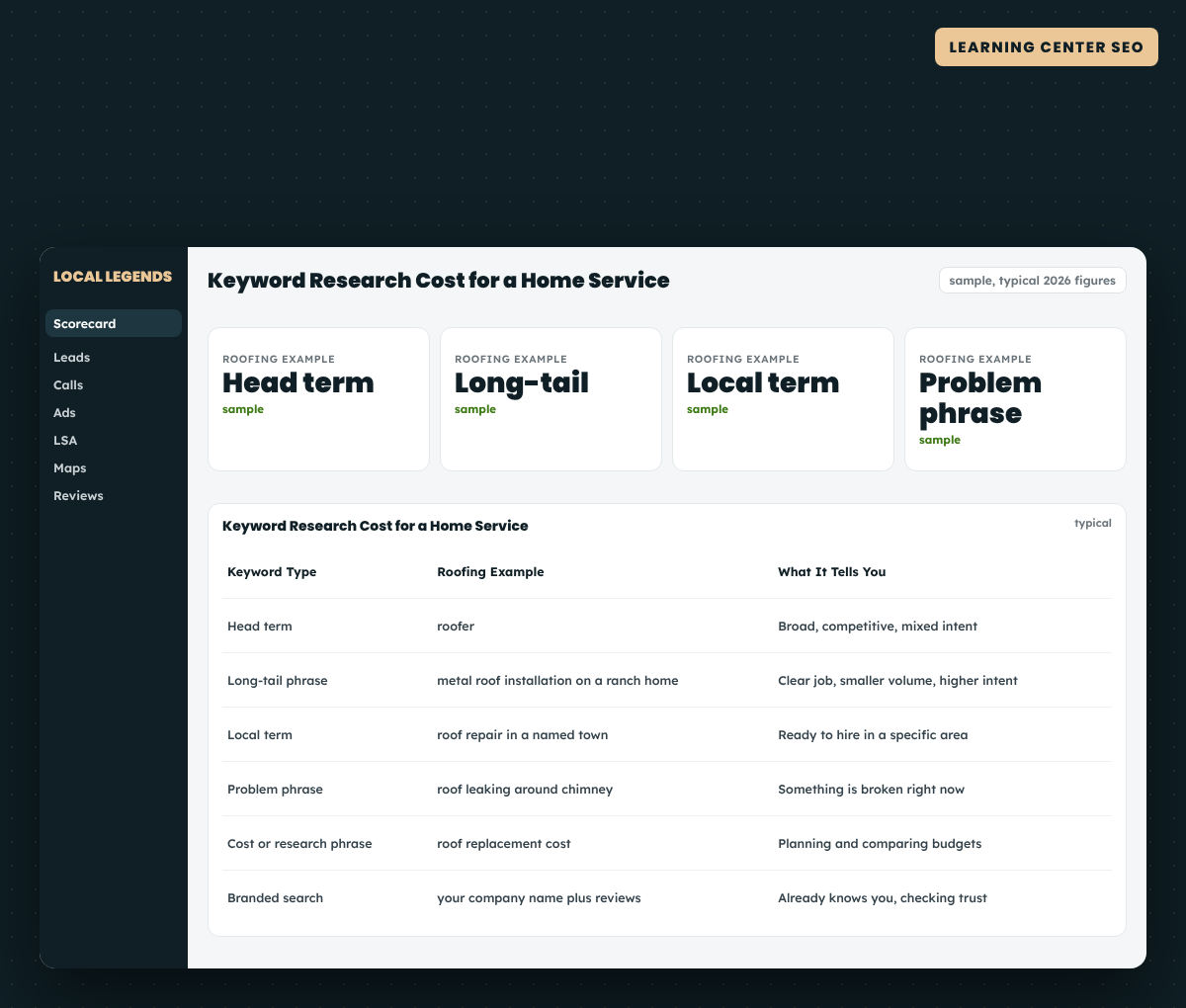
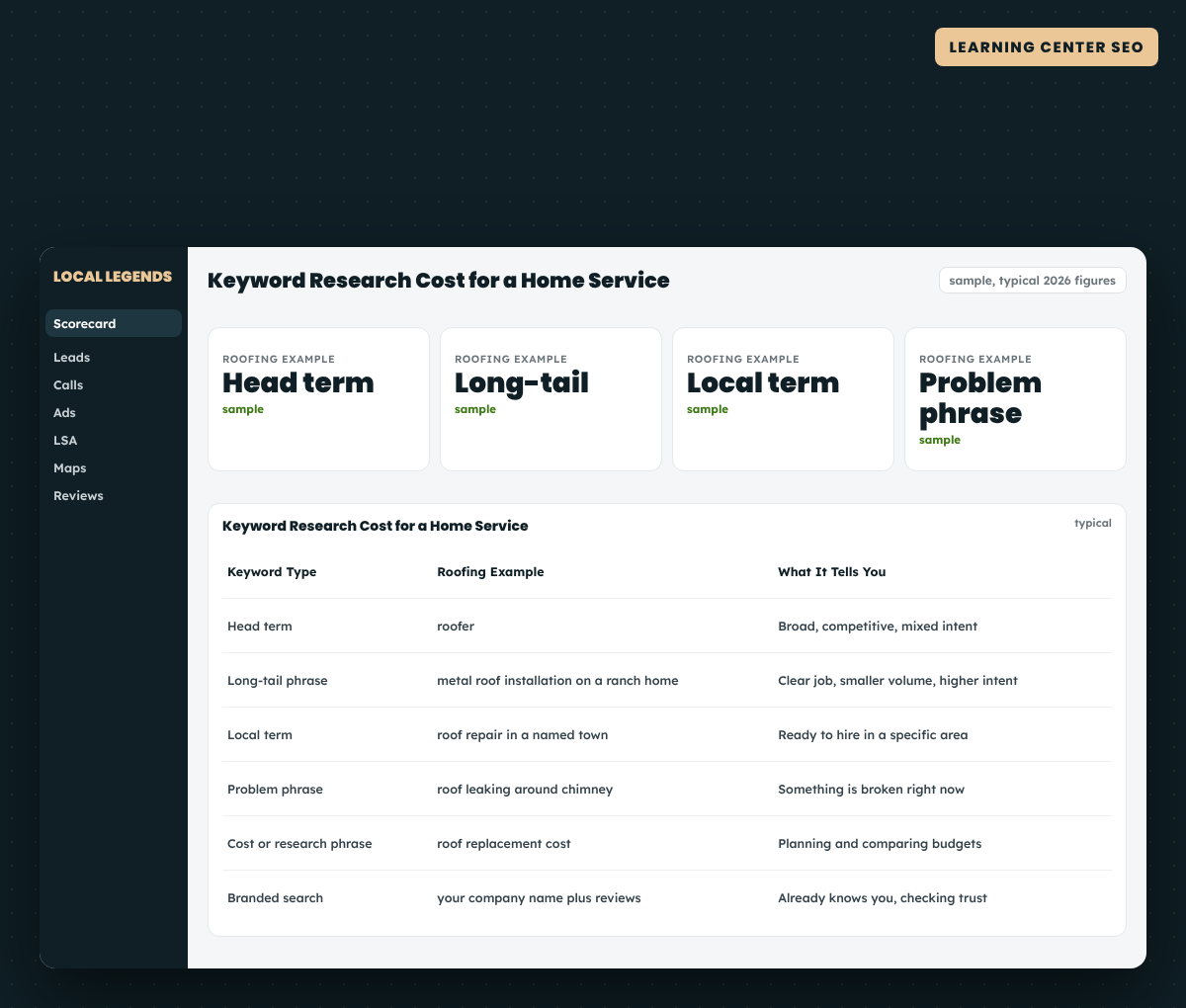
Contractors should know six keyword types: head terms, long-tail phrases, local terms, problem phrases, cost and research phrases, and branded searches. Each type signals a different stage of the homeowner's decision and belongs on a different kind of page.
| Keyword Type | Roofing Example | What It Tells You | Best Page for It |
|---|---|---|---|
| Head term | roofer | Broad, competitive, mixed intent | Home page and the Google Business Profile |
| Long-tail phrase | metal roof installation on a ranch home | Clear job, smaller volume, higher intent | Dedicated service page |
| Local term | roof repair in a named town | Ready to hire in a specific area | City page or service page with local facts |
| Problem phrase | roof leaking around chimney | Something is broken right now | Service page or a learning article that links to it |
| Cost or research phrase | roof replacement cost | Planning and comparing budgets | Cost guide page |
| Branded search | your company name plus reviews | Already knows you, checking trust | Home page, reviews page and profile |
Head Terms vs Long-Tail Phrases
Head terms like "roofer" or "plumber" bring the most searches and the hardest competition, because directories and large brands chase them too. Long-tail phrases bring fewer searches, but the homeowner behind them usually knows exactly what job needs doing.
Why Long-Tail Phrases Win for Smaller Contractors
A company with a young website can rarely outrank established sites on a head term in year one. It can rank for "tile roof repair after a windstorm" much sooner, and that searcher is far closer to calling.
What Are Long-Tail Keywords for a Home Service Business?
Long-tail keywords for a home service business are longer, specific phrases, usually three or more words, that describe an exact problem, service, urgency or place. Google AI Overviews noted they carry less competition and attract homeowners who are closer to hiring.
- Plumbing:"tankless water heater installation cost", "slab leak repair", "sewer camera inspection".
- HVAC:"AC blowing warm air repair", "furnace short cycling", "heat pump replacement".
- Electrical:"200 amp panel upgrade", "EV charger installation in a garage".
- Remodeling:"walk-in shower conversion", "small kitchen remodel timeline".
- House cleaning:"move-out cleaning for a rental", "deep cleaning before a holiday".
- Garage doors:"broken torsion spring replacement", "garage door opener installation".
What Are Good SEO Keywords for a Plumbing Business and Other Trades? Good Keywords Match the Jobs You Want More Of
Good SEO keywords for a plumbing business are the phrases tied to jobs the company actually wants, in towns the crews actually serve, with intent strong enough that the searcher is ready to call. A keyword with big volume and no job behind it is a poor keyword.
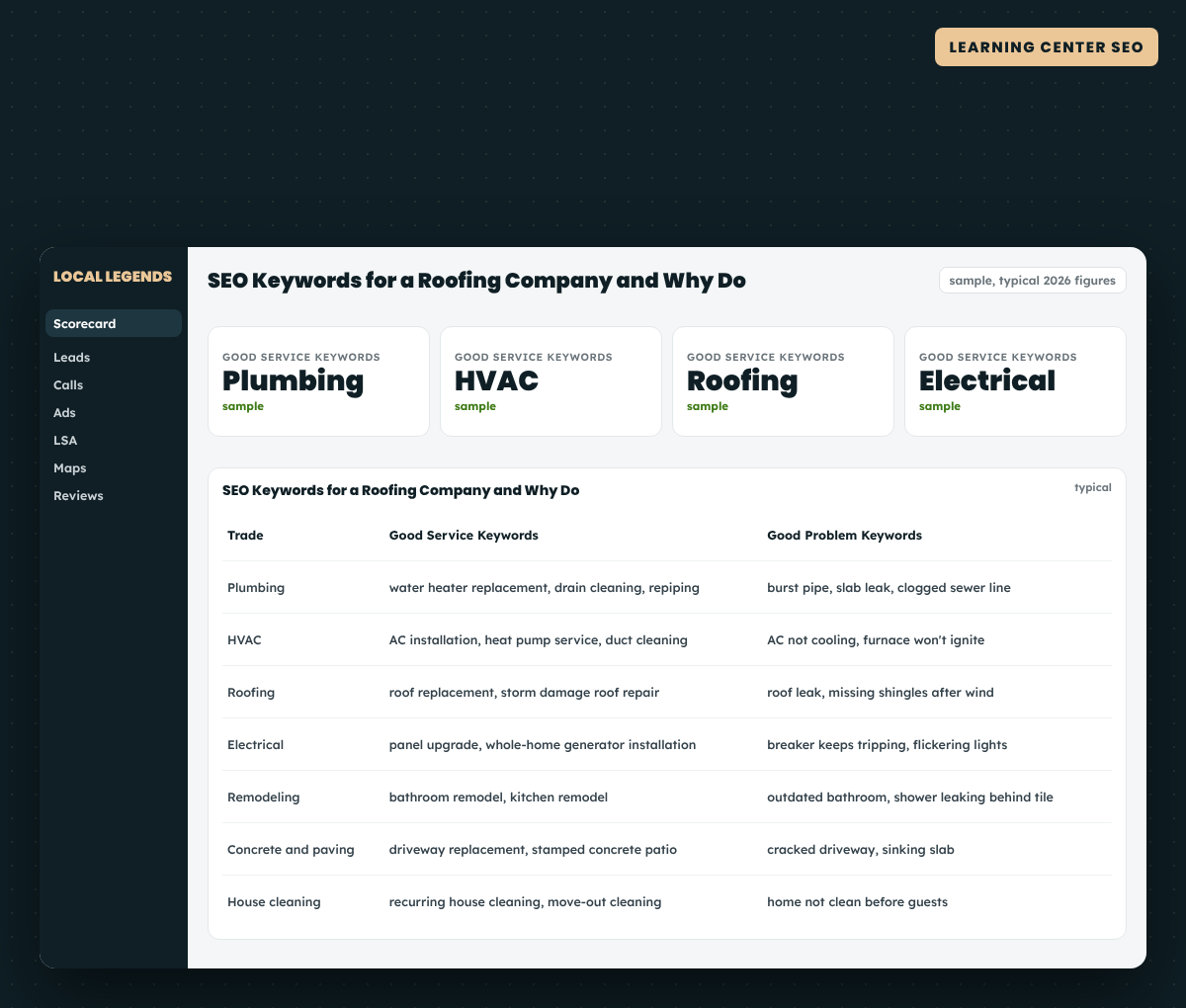
Google AI Overviews grouped plumbing keywords in November 2026 into core local terms, emergency terms and high-value installation terms such as water heaters, repiping and sewer line replacement. The same pattern works for every trade.
| Trade | Good Service Keywords | Good Problem Keywords | Good Cost Keywords |
|---|---|---|---|
| Plumbing | water heater replacement, drain cleaning, repiping | burst pipe, slab leak, clogged sewer line | tankless water heater installation cost |
| HVAC | AC installation, heat pump service, duct cleaning | AC not cooling, furnace won't ignite | AC replacement cost |
| Roofing | roof replacement, storm damage roof repair | roof leak, missing shingles after wind | roof replacement cost per square |
| Electrical | panel upgrade, whole-home generator installation | breaker keeps tripping, flickering lights | panel upgrade cost |
| Remodeling | bathroom remodel, kitchen remodel | outdated bathroom, shower leaking behind tile | bathroom remodel cost |
| Concrete and paving | driveway replacement, stamped concrete patio | cracked driveway, sinking slab | concrete driveway cost |
| House cleaning | recurring house cleaning, move-out cleaning | home not clean before guests | house cleaning prices |
Four Tests Every Good Keyword Passes
- Job fit: the keyword describes work you do and want more of.
- Place fit: the searcher lives where your crews already drive.
- Intent fit: the wording shows a need, not idle curiosity.
- Winnable: the pages ranking now are ones your site can realistically beat.
Keywords Worth Skipping
- Jobs you turn down: ranking for small repairs you refer out fills the phone with the wrong calls.
- Towns you rarely serve: distant cities bring leads your schedule cannot handle.
- Do-it-yourself searches:"how to fix a running toilet yourself" rarely becomes a booked job.
What Is Search Intent for Keywords at a Local Service Business?
Search intent for a local service business is the reason behind the search: learning about a problem, comparing companies, hiring right now or finding a specific business. Google AI Overviews said in November 2026 that matching each keyword to its intent is what turns local searchers into leads.
- Hiring now:"emergency plumber" or "AC repair" plus a town belongs on a service page with a call button.
- Comparing:"best roofers" plus a town belongs on pages with reviews, credentials and process.
- Learning:"why is my furnace short cycling" belongs in a learning article that links to the service.
- Finding you: your company name plus "reviews" belongs on an accurate profile and reviews page.
How Do I Find the Right Keywords for My HVAC Company Website? Start With Real Customer Words, Then Check the Data
The right keywords for an HVAC company website come from three places: the words customers use on the phone, what Google suggests as they type, and the searches your site already appears for in Google Search Console. Data tools come after that list, not before it.
Google AI Overviews made the same point in November 2026: homeowners rarely type the trade's own jargon, they type what is broken. Nobody searches "HVAC contractor" at midnight; they search "no heat" and the town.
- List every service and system: repair, installation, maintenance and replacement for each system you work on.
- Write down customer phrases: pull the exact words from call recordings, estimates and reviews.
- Type each seed into Google: note the autocomplete suggestions and the Related Searches at the bottom.
- Read Google Search Console: see which queries already bring impressions to your site.
- Check Google Business Profile insights: see which searches showed your listing.
- Check seasonal demand: plan cooling pages before summer and heating pages before fall.
- Group by page: put every phrase that means the same job into one group.
What a Local Legends audit adds before any keyword list: the team reviews call tracking, local SEO, Local Services Ads and the booking funnel, and runs Google Maps rank grids across the service area to see where the company already shows up. [SOURCE: Local Legends audit process, confirmed by Levi Ostlund, Founder, Nov 10 2026]
Is Google Keyword Planner Free for Contractors Doing SEO?
Google Keyword Planner is free for contractors once they create a Google Ads account, and no ad spend is required to open it. Google AI Overviews noted in November 2026 that accounts without active spend usually see search volume as broad ranges instead of exact numbers.
- Built for ads first: its competition rating reflects advertiser bidding, not organic difficulty.
- Still useful for SEO: it shows relative demand between phrases and seasonal swings.
- Pair it with Search Console: Keyword Planner shows the market, Search Console shows your own site.
- Use your service area: set the location to the towns you serve, not the whole country.
Free Google Keyword Sources Every Owner Can Use
- Google autocomplete: the suggestions that appear as you type a service.
- Related Searches: the phrases at the bottom of the results page.
- Google Search Console: your real queries, clicks and positions.
- Google Business Profile performance: the searches that showed your listing.
- Google Trends: whether demand for a service is rising, falling or seasonal.
How Many Keywords Should One Contractor Page Target and How Do You Map Them? One Primary Keyword Per Page, Supported by Its Close Cousins
One contractor page should target one primary keyword plus a small group of closely related variations that share the exact same intent. Google AI Overviews put that group at roughly 2 to 10 secondary phrases in November 2026.
How Do You Map Keywords to Pages on a Contractor Website?
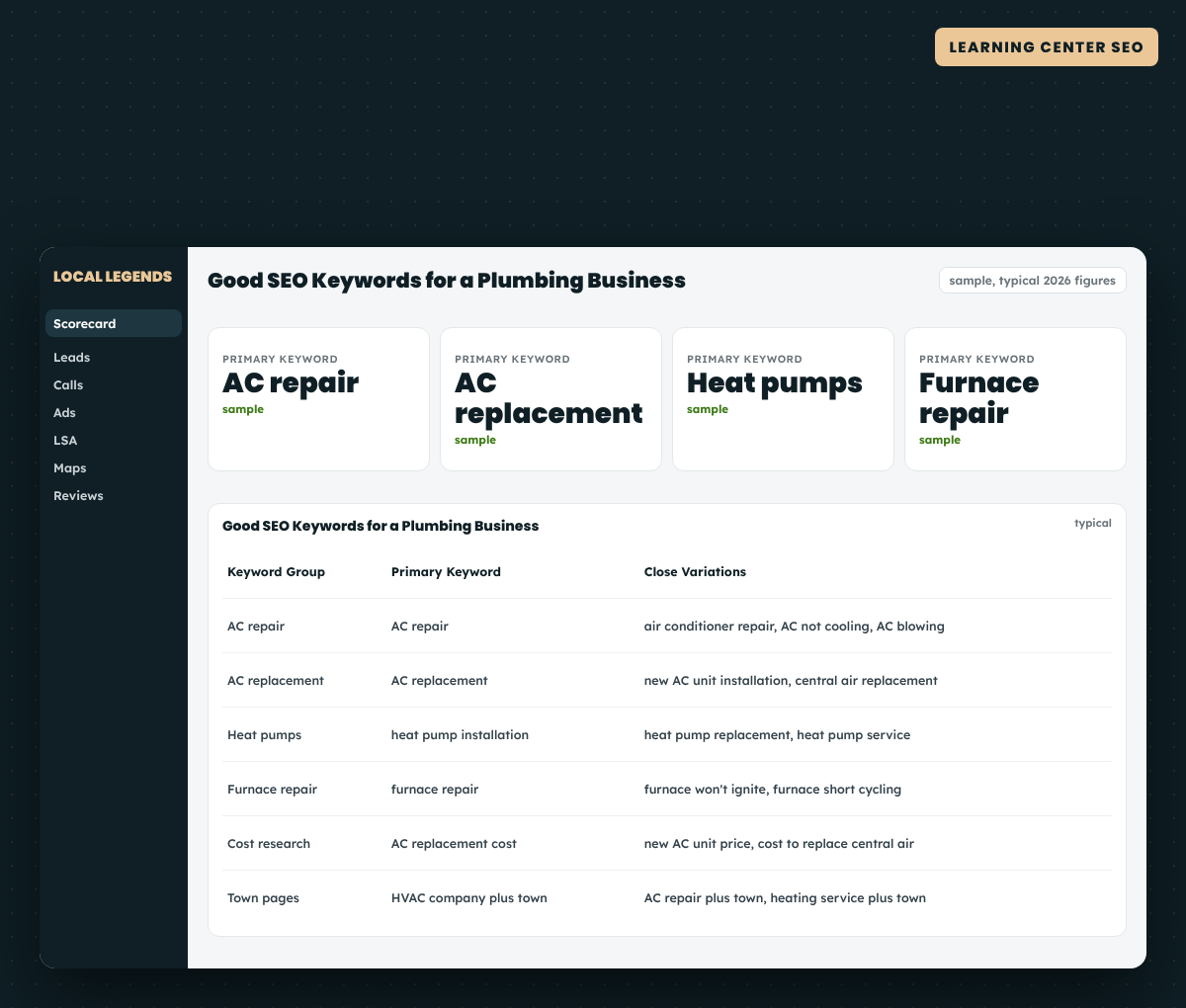
Keyword mapping assigns every keyword group to exactly one page, so two pages never compete for the same search and every important job has a home. The map below shows how a typical HVAC company splits its keywords.
| Keyword Group | Primary Keyword | Close Variations | Page It Lives On |
|---|---|---|---|
| AC repair | AC repair | air conditioner repair, AC not cooling, AC blowing warm air | AC repair page |
| AC replacement | AC replacement | new AC unit installation, central air replacement | AC replacement page |
| Heat pumps | heat pump installation | heat pump replacement, heat pump service | Heat pump page |
| Furnace repair | furnace repair | furnace won't ignite, furnace short cycling | Furnace repair page |
| Cost research | AC replacement cost | new AC unit price, cost to replace central air | AC replacement cost guide |
| Town pages | HVAC company plus town | AC repair plus town, heating service plus town | One page per earned town |
Signs Two Pages Are Competing for One Keyword
- Rankings swap: one week page A shows, the next week page B shows.
- Neither page climbs: both sit on page two for months.
- Search Console shows both: two URLs earn impressions for the same query.
How to Fix Competing Pages
Merge the weaker page into the stronger one, redirect the old URL, and give the surviving page the full keyword group. Then make sure no other page uses that primary keyword in its title.
When Two Similar Services Deserve Two Pages
Keep two pages when the jobs, prices and customers truly differ, such as roof repair and roof replacement. Merge them when the only difference is wording, such as "drain cleaning" and "drain unclogging".
How Local Legends handles town keywords: the team writes a city page only for a town with 5 or more real local facts, such as housing types, local permit rules or named neighborhoods, so a town keyword never lands on a thin copy of another page. [SOURCE: Local Legends city page rule, confirmed by Levi Ostlund, Founder, Nov 10 2026]
Where Should I Put Keywords on My Contractor Website? A Few Spots Do Most of the Work
Keywords belong in a contractor page's title tag, main heading, URL, opening paragraph, a few subheadings and image alt text, then naturally in the body where they fit. Google AI Overviews listed those same spots in November 2026 and stressed writing for people first.
Google's own starter guide for site owners says the meta keywords tag is ignored and that keyword stuffing is against its spam policies. It also encourages anticipating the different words readers use, which is why variations beat repetition.
- Title tag: the service and the place near the front, written for a person scanning results.
- Main heading: one clear H1 that says what the page is about.
- URL: short, readable words such as /roof-repair/, not random numbers.
- First paragraph: the main keyword early, then a direct answer.
- Subheadings: close variations and real homeowner questions.
- Image alt text: a plain description of what the job photo shows.
- Internal links: descriptive link text such as "water heater replacement", never "click here".
Can Keyword Stuffing Hurt My Roofing Website Rankings?
Keyword stuffing can hurt a roofing website's rankings, because repeating "roof repair" or dozens of town names unnaturally breaks Google's spam policies and reads badly to homeowners. Google AI Overviews listed lower rankings, manual actions and diluted location signals as the risks in November 2026.
- Town lists in the footer: a wall of 40 city names helps no reader.
- The same phrase in every sentence: homeowners leave, and Google notices.
- Hidden or tiny text: an old trick that now invites penalties.
- Keywords in the business name on the profile: Google can suspend the listing.
- The better approach: cover the topic fully with natural variations and real job details.
Do Near Me Keywords Help Contractors Rank in Google?
"Near me" keywords do not help much when stuffed into a page, because Google treats "near me" as a location signal and matches the searcher to nearby relevant businesses on its own. Google AI Overviews said in November 2026 that proximity, categories, services and reviews drive those results.
- What drives near me results: distance, the profile's primary category, listed services and steady reviews.
- What to write instead: real town and neighborhood names where you truly work.
- Where near you can fit: natural phrasing in a heading such as "a roofer near you".
- What to avoid: repeating "near me" across every paragraph.
Google SEO Keywords on the Google Business Profile and in AI Answers Keywords Reach Past the Website
Google SEO keywords matter on the Google Business Profile and in AI answers, not only on the website, because the Map Pack and AI Overviews draw on the profile, reviews and page passages. The words a homeowner types shape all three result types.
Should I Put Keywords in My Google Business Profile as a Contractor?
A contractor should put keywords in the Google Business Profile's services, service descriptions, business description and posts, but never in the business name unless they are part of the real registered name. Google AI Overviews warned in November 2026 that adding keywords to the name can get a profile suspended.
- Business name: exactly as it appears on signs, trucks and invoices.
- Primary category: the most specific match for your main work.
- Services list: every real job as its own service, with a short plain description.
- Business description: what you do and who you serve, in natural language.
- Posts and photos: completed jobs described in normal sentences with real photos.
- Review replies: thank the customer and mention the job naturally where it fits.
Read how the profile itself is managed on our local SEO page.
Do Keywords Still Matter for SEO in 2026 With AI Overviews?
Keywords still matter for SEO in 2026, but exact-match repetition matters far less than covering the whole topic clearly for the person searching. Google AI Overviews said keywords now reveal intent and shape topic clusters, titles and URLs, while AI systems read meaning.
- Keywords set the topic: they still decide what each page is about.
- Coverage wins citations: AI answers pull passages that answer a question completely.
- Questions are keywords too: a homeowner's full question is a long-tail search.
- Commercial terms keep their clicks: hiring and comparison searches still send visitors.
Local Legends adds AI SEO in the Sasquatch and Legend plans; see the SEO service page for how page work and profile work fit together.
How Long Does It Take a Contractor to Rank for a New Keyword? Specific Phrases Move First, Broad Terms Take Longer
A local contractor typically sees early ranking movement for a new keyword in 3 to 6 months and steadier placement in 6 to 12+ months. Google AI Overviews added in November 2026 that long-tail or low-competition phrases can move in 30 to 90 days, especially in the Map Pack.
- Months 1 to 2: Google crawls the new pages and impressions start to show.
- Months 3 to 6: specific service and town phrases begin to hold.
- Months 6 to 12+: broader terms and nearby towns follow as authority grows.
- Large metros: competitive trades can take 9 to 18+ months.
These are typical ranges reported by Google AI Overviews, not promises. The trade, the market and the website's starting point move them the most.
How Do I Know Which SEO Keywords Are Bringing Phone Calls to My Plumbing Business?
A plumbing business learns which keywords bring phone calls by pairing dynamic call tracking with Google Search Console and page analytics, because Google hides most individual organic keywords from call logs. Google AI Overviews described this method in November 2026.
- Tracking numbers by source: organic visitors see a different number than ad visitors.
- Calls tied to landing pages: the water heater page's calls show which keyword group pays.
- Search Console by page: shows which queries brought visitors to that page.
- Booked and sold jobs: tie each call to the job in the CRM to see real revenue.
Why Local Legends reports past rankings: founder Levi Ostlund lost $30,000+ to marketers before starting the agency, including a site that looked good and never ranked. Rankings are chapter one, and every scorecard follows calls through to booked jobs, sold jobs and cost per booked job. [SOURCE: Levi Ostlund founder story, BRIEF.md Nov 2026]
Local Legends connects CallRail call tracking to CRMs such as ServiceTitan, Housecall Pro, JobNimbus, AccuLynx, Jobber, Buildertrend and GoHighLevel, so a keyword's value shows up as booked work.
How Much Does Keyword Research Cost for a Home Service Business? One-Time Projects, Retainers and Local Legends Plans
Keyword research for a small home service business typically costs $99-$1,500+ as a one-time project, $50-$300+ an hour for consulting, or $0-$500+ a month for do-it-yourself tools. Those figures come from Google AI Overviews in November 2026 and are typical market ranges, not Local Legends prices.
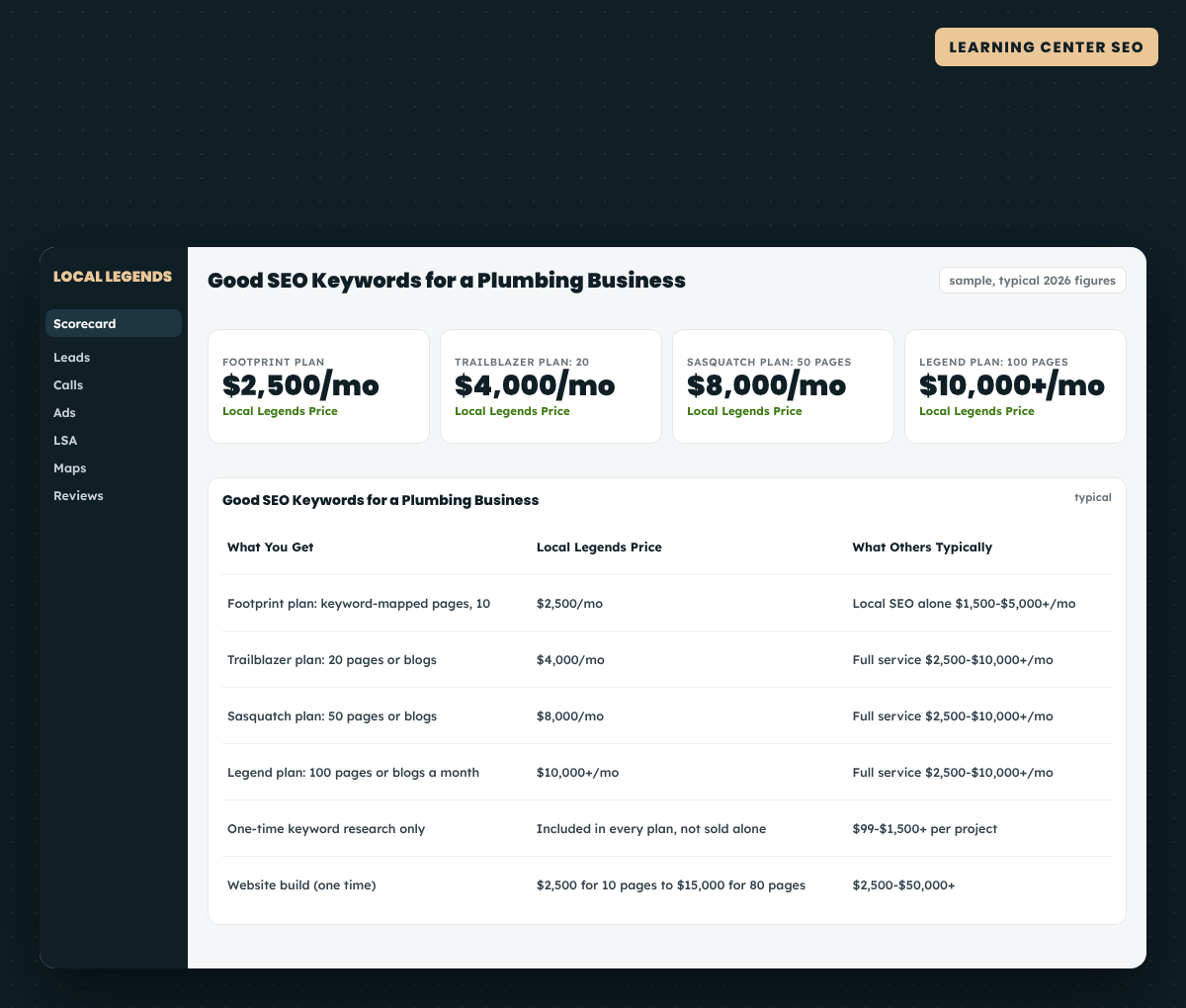
Most contractors never buy keyword research alone. It usually comes inside an ongoing SEO retainer, which agencies typically price at $1,500-$5,000+ a month for local SEO. Local Legends Marketing includes keyword research, mapping and the pages themselves in every growth plan.
| What You Get | Local Legends Price | What Others Typically Charge |
|---|---|---|
| Footprint plan: keyword-mapped pages, 10 pages or blogs a month, local SEO with 70+ citations month 1, Google Ads + LSA management | $2,500/mo | Local SEO alone $1,500-$5,000+/mo |
| Trailblazer plan: 20 pages or blogs a month, 2 to 6 backlinks a month, weekly scorecard | $4,000/mo | Full service $2,500-$10,000+/mo |
| Sasquatch plan: 50 pages or blogs a month, AI SEO, 6 to 10 backlinks plus PR in month 1 | $8,000/mo | Full service $2,500-$10,000+/mo |
| Legend plan: 100 pages or blogs a month, 8 to 14 backlinks plus quarterly PR, multi-location and city pages | $10,000+/mo | Full service $2,500-$10,000+/mo |
| One-time keyword research only | Included in every plan, not sold alone | $99-$1,500+ per project |
| Website build (one time) | $2,500 for 10 pages to $15,000 for 80 pages | $2,500-$50,000+ |
Every plan comes with no setup fees and no long-term contracts, and the contractor owns the website, domain, Google Business Profile, ad accounts and call data. Compare every plan and add-on on the Local Legends pricing page.
What Moves the Cost of Keyword Work
- Number of services: each core service needs its own keyword group and page.
- Number of towns: each real town page needs its own local research.
- Market competition: dense metros need deeper competitor checks.
- Content volume: the research only pays off when the pages get written.
Want to see which keywords your site is missing? A free growth audit compares your pages, profile and rank grids with the companies already showing up in your towns before any plan is proposed.
Learn how the monthly pages get written on our content marketing page.
Local Legends Marketing Reviews From Home Service CEOs Owners Who Worked With Levi Ostlund
Roofing and restoration owners have recorded testimonials about working with Local Legends Marketing and founder Levi Ostlund. The videos are on the Local Legends reviews page [LINK: /about-us/reviews/].
Levi has been absolutely outstanding to work with over the years... His creativity, responsiveness, and deep understanding of our marketing strategy have made a huge impact." Brad Beldon, CEO, Roofing Company. Read on Local Legends
- Kyle Scott, CEO, Roofing Company (video testimonial)
- Jim Dodson, CEO, Roofing Company (video testimonial)
- Race Allen, CEO, Precision Restoration of Texas (video testimonial)
- Brad Beldon, CEO, Roofing Company (written testimonial)
Frequently Asked Questions About SEO and Keywords Keyword Questions Contractors Ask Most
What Is an Example of an SEO Keyword for a Contractor?
"Water heater replacement" is a service keyword, "water heater leaking from the bottom" is a problem keyword, and "water heater replacement cost" is a cost keyword. Add a real town and each one becomes a local keyword.
Are Keywords and SEO the Same Thing?
Keywords and SEO are not the same thing. Keywords are the search phrases; SEO is the broader work of pages, technical health, the Google Business Profile, reviews and links that earns a ranking for those phrases.
Does Google Still Use the Meta Keywords Tag?
Google does not use the meta keywords tag for ranking. Its starter guide for site owners says so directly, so time is better spent on titles, headings and useful content.
What Is Keyword Difficulty and Should a Small Contractor Care?
Keyword difficulty is a 0 to 100 score from SEO tools that estimates how hard a phrase is to rank for. A small contractor should treat it as a secondary filter and favor local, high-intent phrases first.
How Do I Create SEO Keywords for a New Service?
Start with the words customers use when they call about that service, then check Google autocomplete and Related Searches for the variations. Group the results and give the service its own page.
Can I Do My Own Keyword Research as a Contractor?
Yes, an owner can do basic keyword research with free Google tools in a few hours. The harder part is writing and maintaining a page for every keyword group, month after month.
Is SEO Hard to Learn for a Business Owner?
The basics of SEO and keywords are learnable in a few weeks. Every Local Legends engagement includes the Local Legends marketing course, so owners understand what is being built and why.
Should Every Keyword Get Its Own Page?
No, only every keyword group gets its own page. Phrases that mean the same job belong together on one page; different jobs, prices or customers deserve separate pages.
Reviewed by Levi Ostlund, Founder, Local Legends Marketing

Turn SEO and Keywords Into Booked Jobs for Your Home Service Company Start With a Free Growth Audit
The fastest way to put SEO and keywords to work is to see which jobs and towns your site already covers and which ones it misses. Local Legends Marketing checks your pages, Google Business Profile, call tracking and Google Maps rank grids across your service area.
- A keyword map that gives every core service and earned town one page.
- Monthly pages written to that map inside every growth plan.
- A scorecard that follows each call to the booked and sold job.
Call (936) 900-1248 or book a free growth audit online. Local Legends works with contractors in every state; see the Local Legends service areas page.