


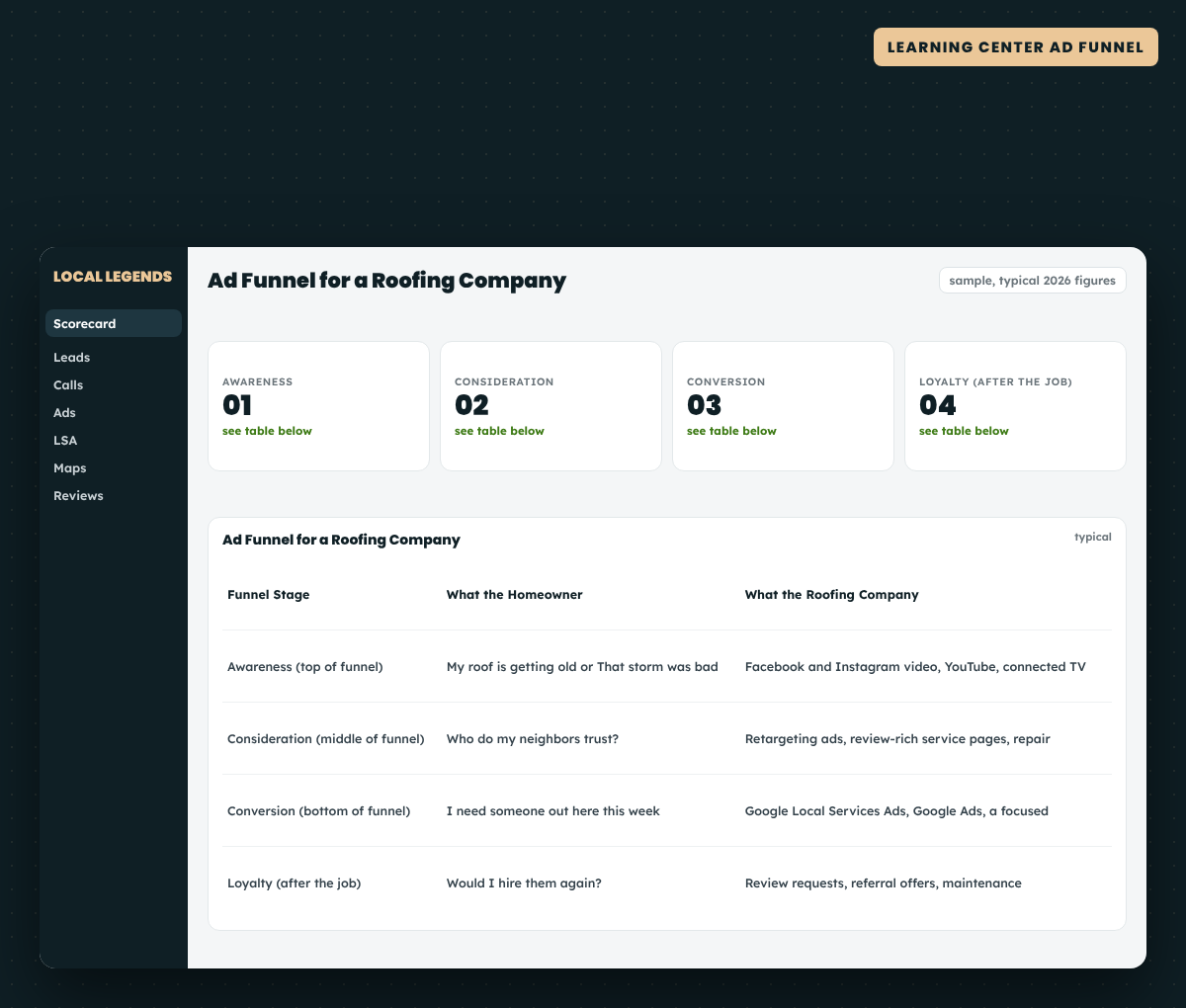
Ad Funnel for a Roofing Company
Ad Funnel Guide for Home Service Contractors: How the Marketing Funnel Turns Ads Into Calls, Booked Estimates and Sold Roofing, HVAC and Plumbing Jobs
Build a Contractor Funnel That Ends at a Sold Job
Updated November 2026 · Reviewed by Levi Ostlund, Founder
Breadcrumb: Home > Learning Center [LINK: /learning-center/] > Ad Funnel
An ad funnel is the path a homeowner takes from first seeing a contractor's ad to calling, booking an estimate and signing, with a different ad, page or follow-up built for each step. For roofers, HVAC companies and plumbers, the funnel only counts if it ends in sold work.
- Awareness: homeowners learn your name before they need you.
- Consideration: they compare you against two or three other companies.
- Conversion: they call, book or request an estimate.
- Loyalty: they leave a review, join a maintenance plan and refer neighbors.
Free Growth Audit
Your Reviews, Radius and Response Rate vs the competitors beating you.
About Local Legends Marketing
A home service marketing agency headquartered in Conroe, Texas, with 8+ years of marketing experience, running Google Ads, Local Services Ads, local SEO, AI SEO, connected TV and review systems for contractors nationwide.
What Is an Ad Funnel for a Roofing Company? Four Stages, One Path to a Signed Contract
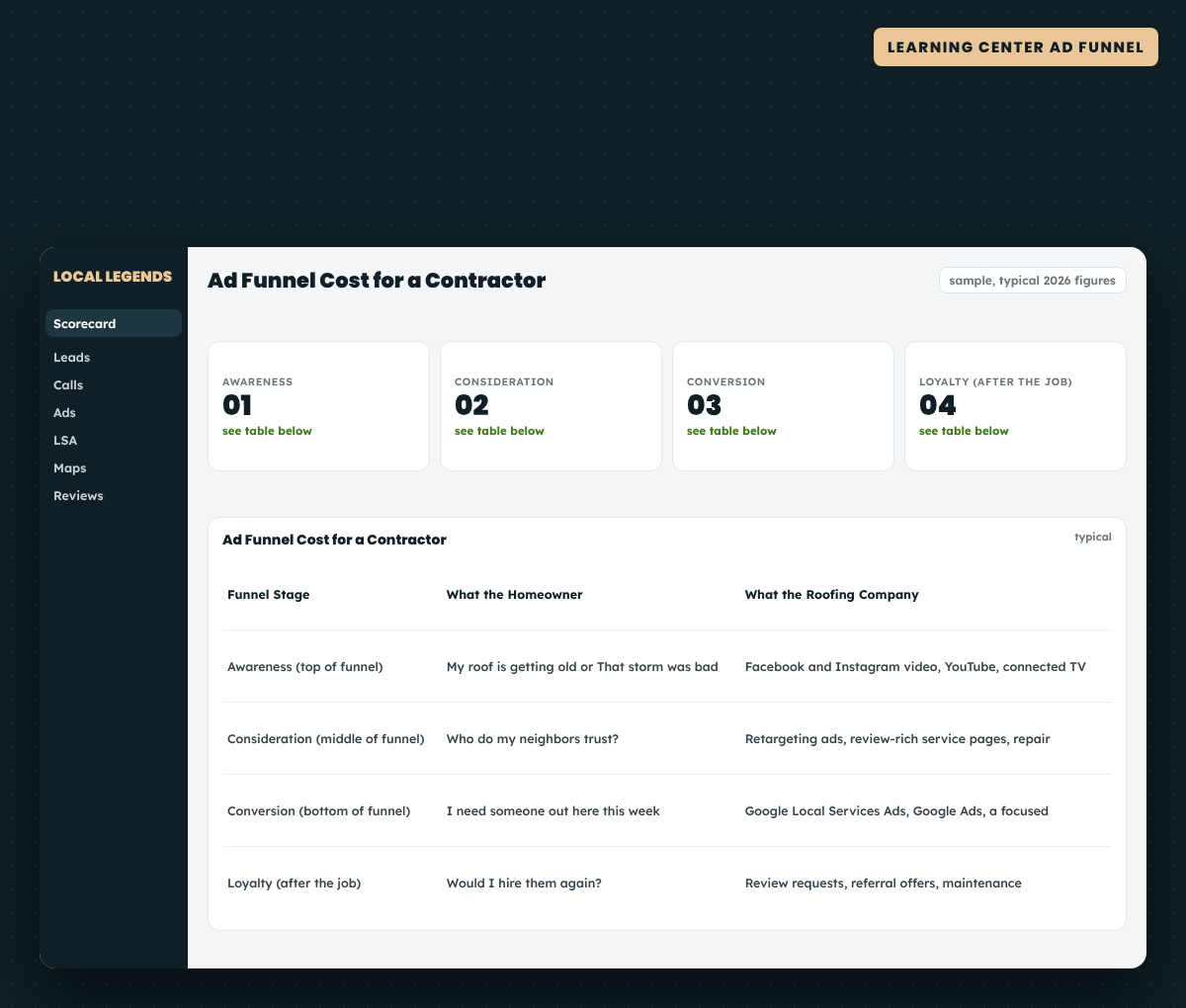
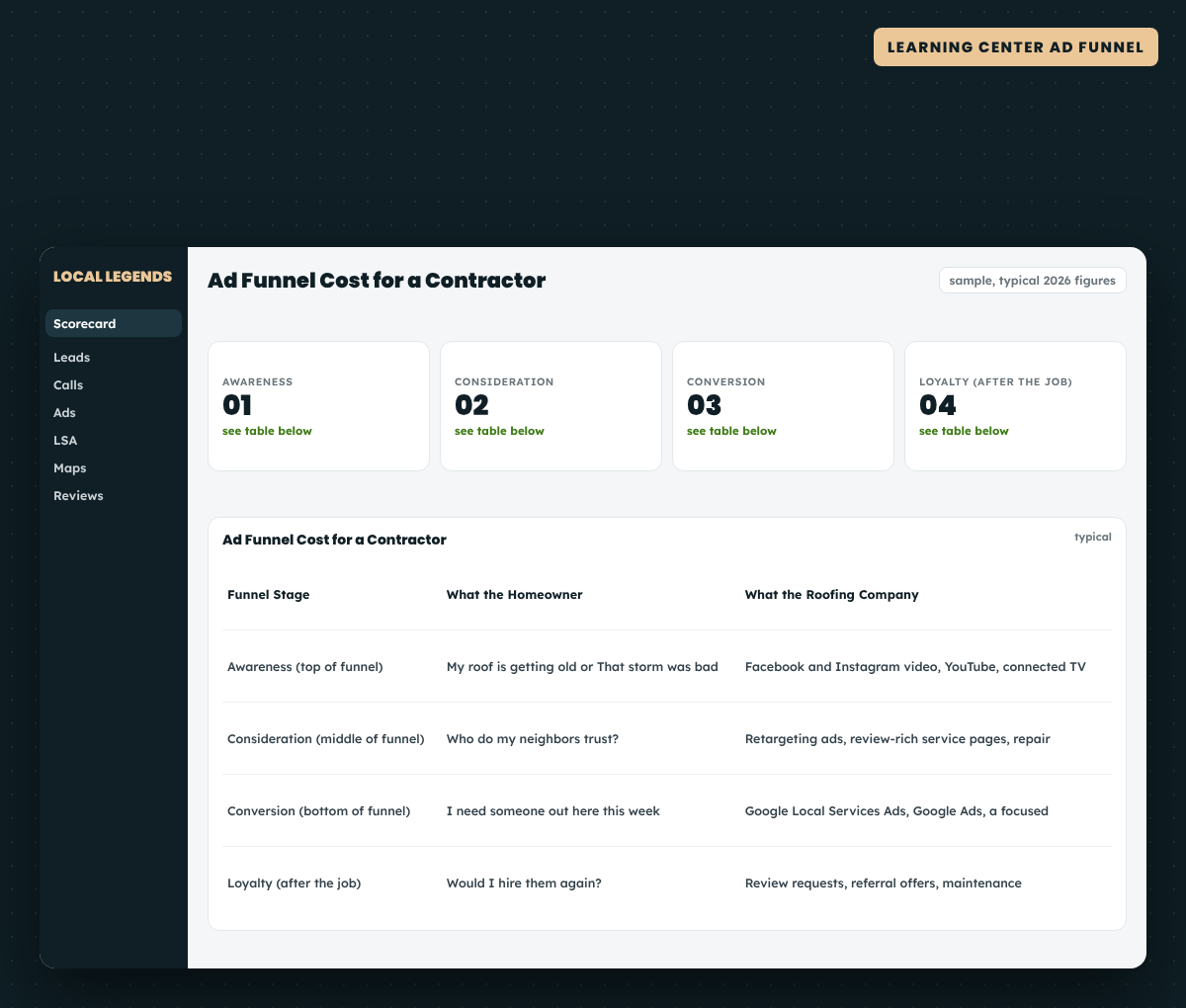
An ad funnel for a roofing company is a planned sequence of ads, landing pages and follow-up that moves a homeowner from noticing a roof problem to scheduling an inspection and signing a contract. Each stage asks the homeowner for one small next step.
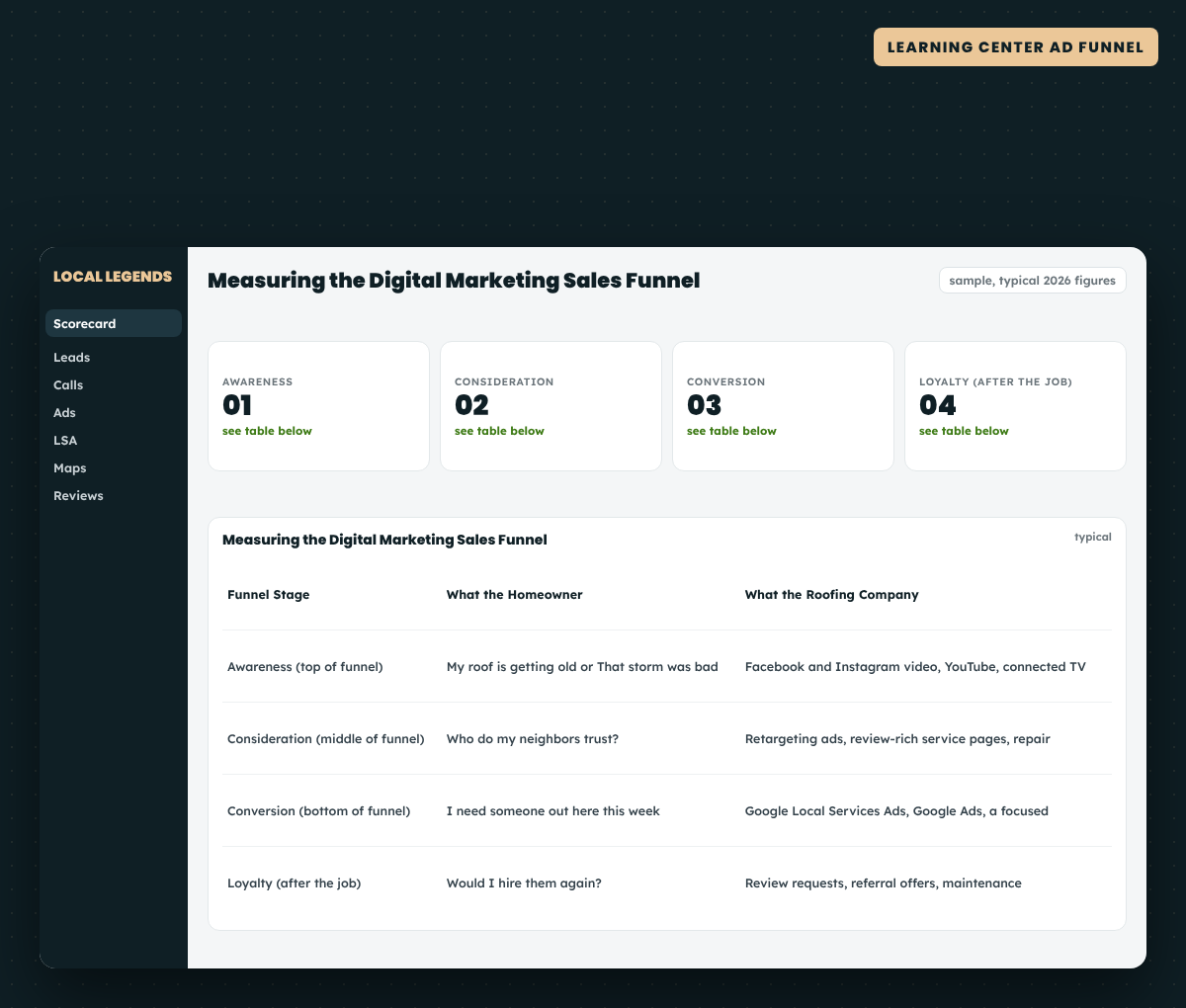
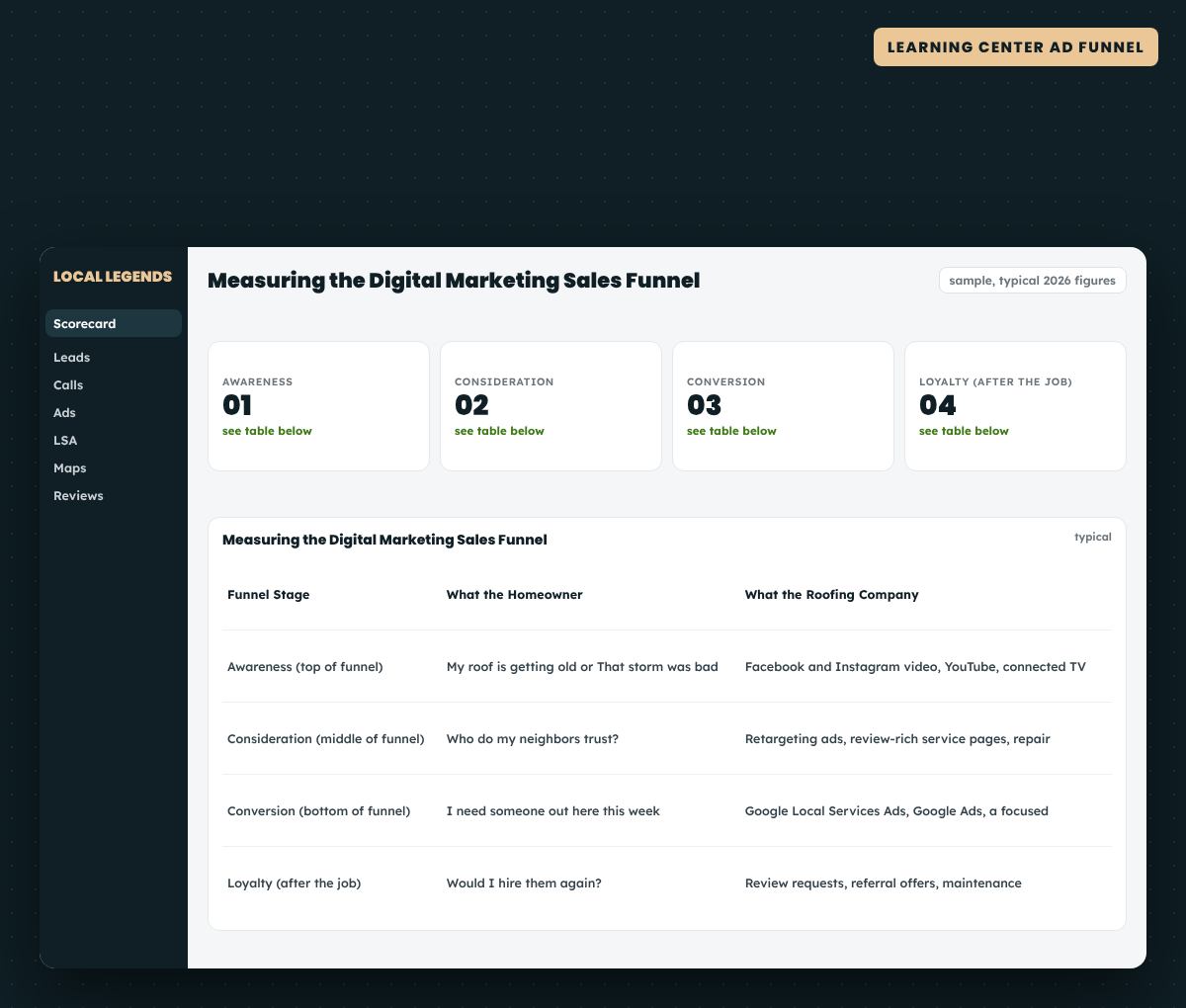
| Funnel Stage | What the Homeowner Is Thinking | What the Roofing Company Runs | What to Measure |
|---|---|---|---|
| Awareness (top of funnel) | "My roof is getting old" or "That storm was bad" | Facebook and Instagram video, YouTube, connected TV, Google Business Profile posts | Reach in your ZIP codes, video views, branded searches |
| Consideration (middle of funnel) | "Who do my neighbors trust?" | Retargeting ads, review-rich service pages, repair versus replace guides | Return visits, page engagement, review views |
| Conversion (bottom of funnel) | "I need someone out here this week" | Google Local Services Ads, Google Ads, a focused landing page with tap-to-call | Calls, booked inspections, cost per booked job |
| Loyalty (after the job) | "Would I hire them again?" | Review requests, referral offers, maintenance reminders | New reviews, referrals, repeat jobs |
Ad Funnel, Marketing Funnel and Sales Funnel: What Each Term Covers
The marketing funnel describes the whole journey, including word of mouth and search results you never paid for. An ad funnel is the paid portion of that journey. The sales funnel picks up once a lead talks to your office, from the first call to the signed contract.
Storm Work and Planned Replacements Need Separate Funnels
A homeowner with water dripping into a bedroom moves through all four stages in one afternoon. A homeowner with a 20-year-old roof may take months. Roofers usually do best with a short emergency funnel on search ads and a longer replacement funnel on video, retargeting and financing.
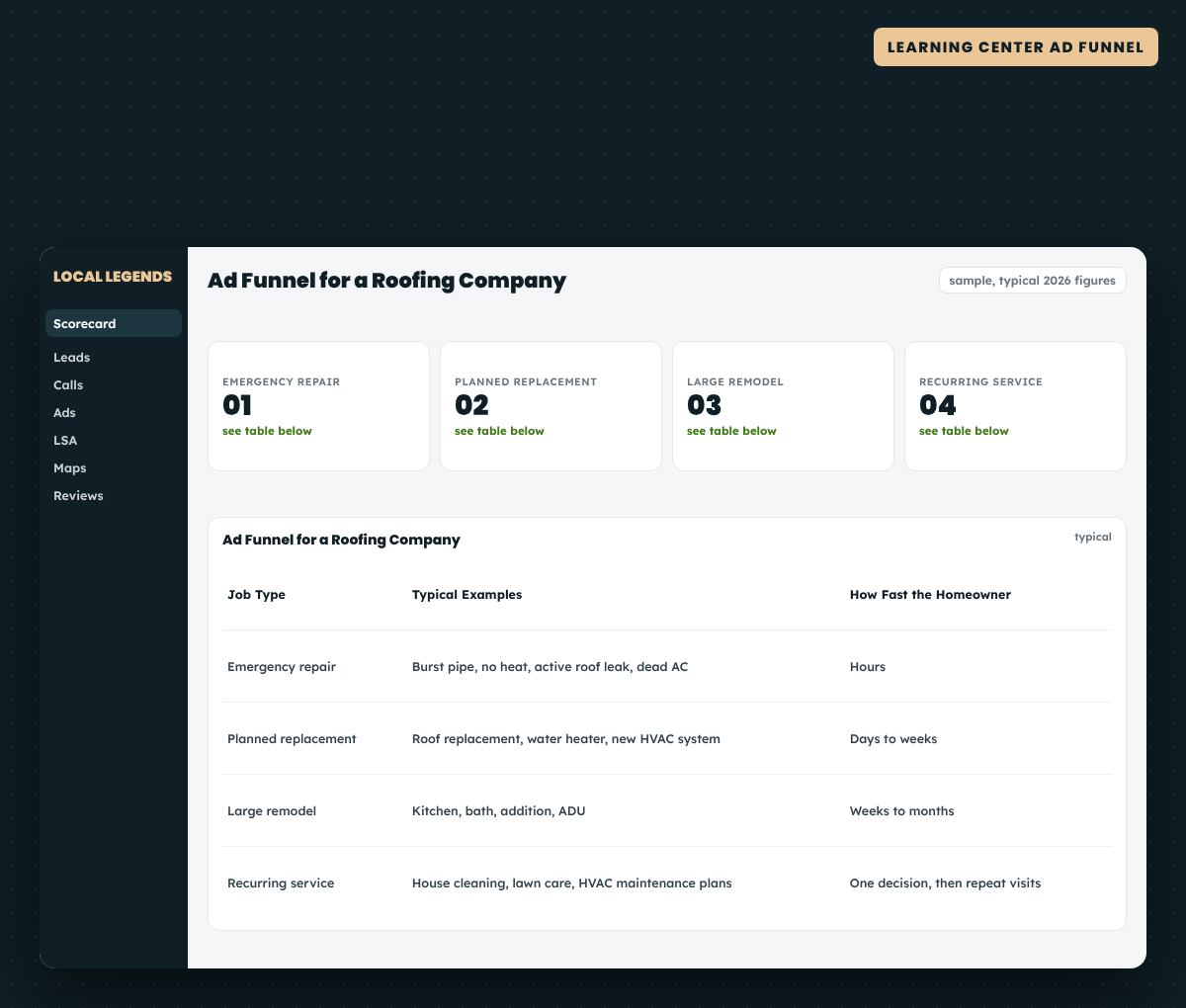
Digital Marketing Funnel Stages for Home Service Contractors Emergency Calls and Planned Projects Move Differently
Digital marketing funnel stages look different for a contractor than for an online store, because local homeowners either need help right now or are researching a large project for weeks. The digital funnel has to serve both buyers.
| Job Type | Typical Examples | How Fast the Homeowner Moves | Where the Funnel Should Focus |
|---|---|---|---|
| Emergency repair | Burst pipe, no heat, active roof leak, dead AC in summer | Hours | Bottom of funnel: Local Services Ads, search ads, fast phone answering |
| Planned replacement | Roof replacement, water heater, new HVAC system | Days to weeks | Middle of funnel: retargeting, reviews, financing pages, follow-up |
| Large remodel | Kitchen, bath, addition, ADU | Weeks to months | Top and middle: video, project galleries, email and text nurture |
| Recurring service | House cleaning, lawn care, HVAC maintenance plans | One decision, then repeat visits | Bottom and loyalty: quick booking, reminders, reviews |
What Are the Stages of a Digital Marketing Funnel for an HVAC Company?
An HVAC company's digital marketing funnel has four stages: awareness, consideration, conversion and retention, and HVAC adds a seasonal twist because demand jumps with the first heat wave or cold snap.
- Awareness: seasonal Facebook and YouTube ads, Google Business Profile posts and local search visibility for "AC repair near me."
- Consideration: repair versus replace guides, heat pump and rebate pages, reviews and retargeting ads.
- Conversion: Local Services Ads, Google Ads, click-to-call buttons, online booking and quick text replies.
- Retention: tune-up reminders, maintenance agreements, review requests and referral offers.
- Seasonal timing: build reviews and pages in the off-season so the funnel is ready before peak demand.
What Does a Digital Sales Funnel Look Like for a House Cleaning Business?
A house cleaning business runs a short digital sales funnel that turns local searches and social ads into a first clean, then a recurring plan. Trust and quick follow-up matter more than long content.
- Show up in local search, the Map Pack and Local Services Ads for "house cleaning near me."
- Run Facebook and Instagram ads by ZIP code with before and after photos.
- Send clicks to a mobile page with recent reviews, service areas and a short quote form.
- Ask for bedrooms, bathrooms and standard versus deep clean on the form.
- Confirm every request by text and let the homeowner pick a time online.
- Offer a recurring plan after the first clean and ask for a review.
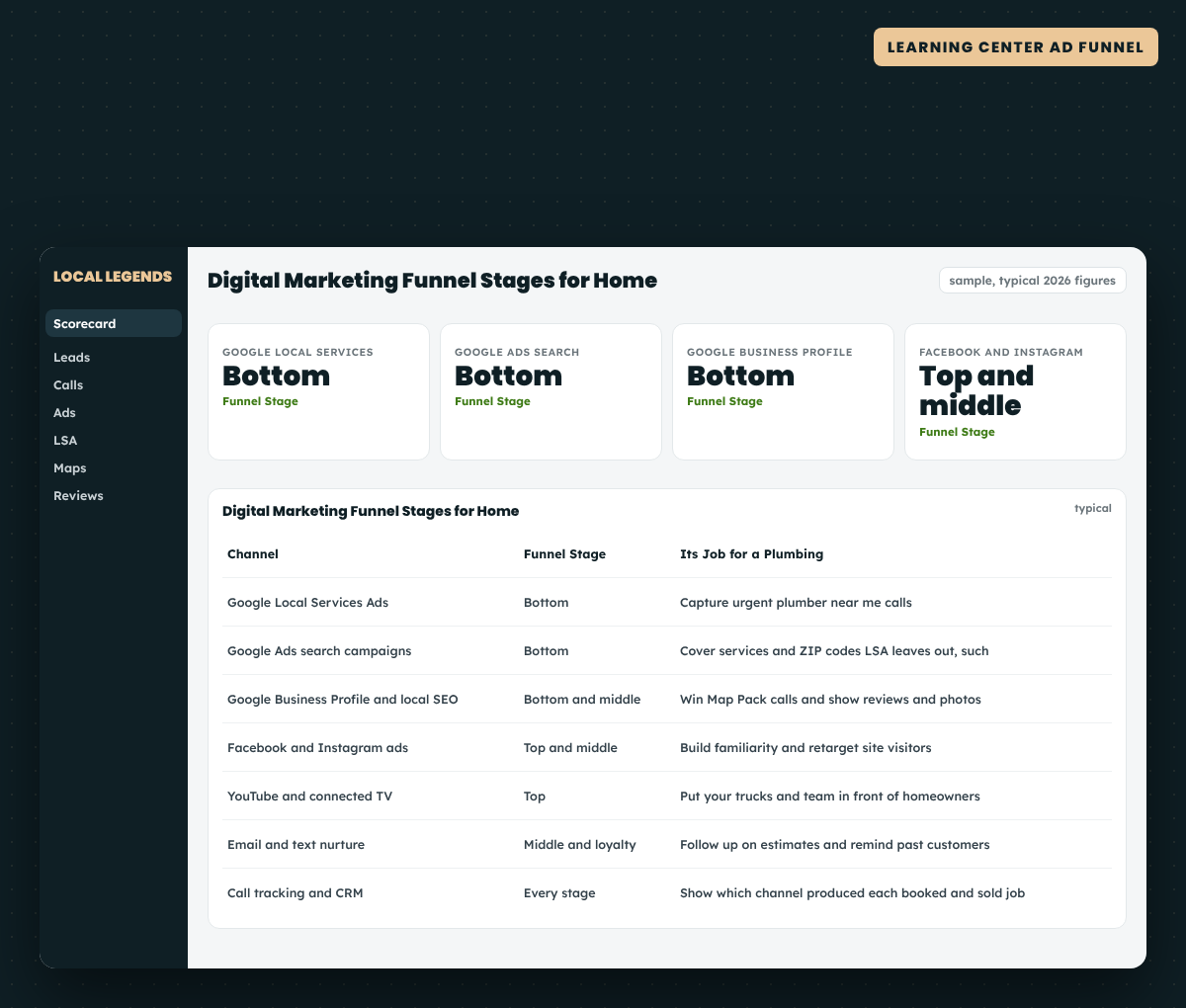
How Do I Build a Full Funnel Marketing Strategy for My Plumbing Business? Match Every Channel to One Funnel Stage
A full funnel marketing strategy for a plumbing business gives every channel a single job, from getting your name known before a pipe bursts to booking the call when it does. Plumbing needs one path for emergencies and another for planned work like water heaters and repipes.
| Channel | Funnel Stage | Its Job for a Plumbing Company |
|---|---|---|
| Google Local Services Ads | Bottom | Capture urgent "plumber near me" calls with the verified badge |
| Google Ads search campaigns | Bottom | Cover services and ZIP codes LSA leaves out, such as repipes or water heaters |
| Google Business Profile and local SEO | Bottom and middle | Win Map Pack calls and show reviews and photos |
| Facebook and Instagram ads | Top and middle | Build familiarity and retarget site visitors |
| YouTube and connected TV | Top | Put your trucks and team in front of homeowners before an emergency |
| Email and text nurture | Middle and loyalty | Follow up on estimates and remind past customers |
| Call tracking and CRM | Every stage | Show which channel produced each booked and sold job |
Step 1: Separate Emergency and Planned Funnels
Emergency calls go to search and LSA campaigns with tap-to-call pages. Planned jobs get their own pages, financing details and follow-up.
Step 2: Fix the Bottom of the Funnel First
Answer every call, keep forms short and track every lead. More awareness spend does not help if booked calls leak out at the bottom.
Step 3: Add the Middle and Top Once the Bottom Converts
Retargeting, video and connected TV work best after the conversion stage is tracked and steady, so their effect can be measured.
Step 4: Close the Loop With Reviews and Referrals
Every finished job should produce a review request and, where it fits, a referral offer that feeds the top of the funnel again.
Is Google Ads Top of Funnel or Bottom of Funnel for a Home Service Contractor?
Google Ads is mostly a bottom-of-funnel channel for a home service contractor, because people who search "emergency plumber" or "AC not cooling" already know they need help. Some campaign types reach earlier stages.
- Bottom of funnel: search campaigns on service and "near me" terms, plus Local Services Ads.
- Earlier stages: educational searches such as how to prevent frozen pipes, display ads and YouTube video.
- Longer projects: remodeler searches show strong intent but slower decisions, so pair them with retargeting.
- Settings that protect budget: tight location targeting, phrase and exact match keywords and a solid negative keyword list.
- Management: Google Ads management[LINK: /services/ppc/] at Local Legends includes the campaign landing pages.
Where Do Connected TV and YouTube Ads Fit in a Roofing or HVAC Company Marketing Funnel?
Connected TV sits at the top of a roofing or HVAC funnel, and YouTube runs from the top into the middle, so both prime homeowners to choose your name later in search and on the map. Neither usually closes the job by itself.
- Connected TV plays full-screen ads on streaming apps to homeowners in the ZIP codes you choose.
- Viewers rarely click a TV, so watch for growth in branded searches and direct calls.
- YouTube can run short brand spots and longer explainer videos, such as repair versus replace.
- YouTube viewers can be retargeted later with search and social ads.
- Local Legends manages connected TV for $1,500 a month, with media paid directly to the network.
Funnel Strategy in Marketing: Retargeting the Middle of the Funnel Stay Visible While Homeowners Compare
The middle of the funnel is where most contractor ad budgets leak, because homeowners visit two or three company websites, then leave without calling. A sound funnel strategy in marketing keeps your name in front of them while they decide.
How Do I Retarget Homeowners Who Visited My Roofing Website but Did Not Call?
A roofing company retargets website visitors by installing the Meta Pixel and Google tag, grouping visitors by the pages they viewed and showing them proof-focused ads, while excluding people who already called or filled out a form.
- Install the Meta Pixel and Google Ads tag, ideally through Google Tag Manager, and confirm call and form events fire.
- Build an audience of replacement, storm and pricing page visitors, separate from blog readers.
- Exclude anyone who already called, tapped the phone number or sent a form.
- Keep the geography tight to your service area and cap how often each person sees an ad.
- Show local reviews, warranties, financing and a free inspection offer in the creative.
- Test the tap-to-call button on a phone before spending, since a broken button looks like a retargeting problem.
Facebook and Instagram ads[LINK: /services/facebook-ads/] are where most contractor retargeting runs, alongside Google display and YouTube placements.
Bottom of the Funnel: Turning Ad Clicks Into Booked Estimates Landing Pages, Phone Answering and Lead Quality
The bottom of the funnel decides whether ad spend turns into booked estimates, and it depends on the page the ad opens, how quickly the office responds and whether the lead form screens out casual submissions.
Should a Contractor Send Ad Traffic to a Funnel Landing Page or to the Company Website?
A contractor should usually send paid ad traffic to a dedicated landing page that matches the ad, with one service, one offer and one clear next step. The full website still matters for branded searches and for homeowners who want to browse.
- Use a landing page for a specific service or offer, such as roof repair or a furnace tune-up.
- Remove menus that pull visitors away from calling or booking.
- Repeat the ad's promise in the page headline so the visitor knows they landed in the right place.
- Keep the full website for branded searches, project galleries and SEO.
- Compare pages by booked jobs and lead quality, not form fills alone.
- Check load speed and tap-to-call on a phone before launch.
Why Do My Facebook Ad Leads for My Remodeling Company Never Answer the Phone?
Facebook leads for a remodeling company often go unanswered because instant forms make it easy to submit without much intent, the number may be outdated and the call comes from a number the homeowner does not recognize. Slow follow-up makes it worse.
- Text the lead right away, name the company and the project, and ask when to call.
- Add qualifying questions, such as project type, timeline, ZIP code and whether they own the home.
- Ask the homeowner to confirm or type their phone number instead of relying on autofill.
- Say in the ad and the form that a project specialist will call or text.
- Register your number so caller ID shows your company name.
- Follow up by call, text and email over several days and at different times.
- Optimize campaigns toward booked appointments, not the cheapest form fill.
Funnel Online Marketing After the First Call: Nurture and Follow-Up Estimates Are Won in the Follow-Up
Funnel online marketing does not stop when a homeowner calls, because many estimates sit unsigned for weeks. Email and text nurture keeps the conversation going without pressure.
How Long Should a Remodeling Company Follow Up With a Lead by Email and Text Before Giving Up?
A remodeling company should follow up actively for about one to two weeks, then move quiet leads into a long-term check-in, since remodel decisions often take months. Stop right away if the homeowner says no or hires someone else.
- Day 0: send the estimate or reply, then a short text confirming it arrived.
- Days 1 to 2: check that they received it and ask if they have questions.
- Days 3 to 7: send one or two useful follow-ups about scope, schedule openings or materials.
- Days 7 to 14: send a polite wrap-up note that leaves the door open.
- Two to three months later: send one check-in asking whether the project is still planned.
What Should a Contractor Do With Homeowners Who Got an Estimate but Never Signed?
A contractor should keep unsigned estimates in a low-pressure follow-up list and learn from them, while never starting work without signed terms. Old quotes should be re-priced if the homeowner returns months later.
- Add something new to each follow-up instead of repeating "just checking in."
- Move non-responders into a seasonal reminder list, such as spring and fall.
- Reissue the estimate at current material and labor costs if it has expired.
- Review unsigned bids for patterns in price, timing or unclear scope.
- Spell out materials, inclusions, payment milestones and change orders in every proposal.
The Loyalty Stage: Reviews and Referrals Refill the Top of the Funnel Every Finished Job Feeds the Next Lead
The loyalty stage turns finished jobs into reviews and referrals, which make every other stage of the funnel work better. Fresh reviews help a contractor show up in local search and help homeowners choose.
How Do Reviews and Referrals Fit Into a Home Service Contractor Marketing Funnel?
Reviews and referrals act as proof at every stage of a contractor's funnel, from appearing in the Map Pack to reassuring a homeowner just before they call. Referrals often enter the funnel near the bottom, with trust already in place.
- Top of funnel: steady new reviews support Google Business Profile visibility.
- Middle of funnel: detailed reviews answer questions about communication, cleanup and quality.
- Bottom of funnel: reviews near the call button lower the risk of picking the wrong company.
- After the job: ask for a review once the work is done and reply to every one.
- Referrals: past customers, technicians and partners such as real estate agents can all send work.
- Automation: every Local Legends growth plan includes the LSA Ranker review texter.
How Much Does an Ad Funnel Cost for a Contractor? Management Fees, Ad Spend and Pages
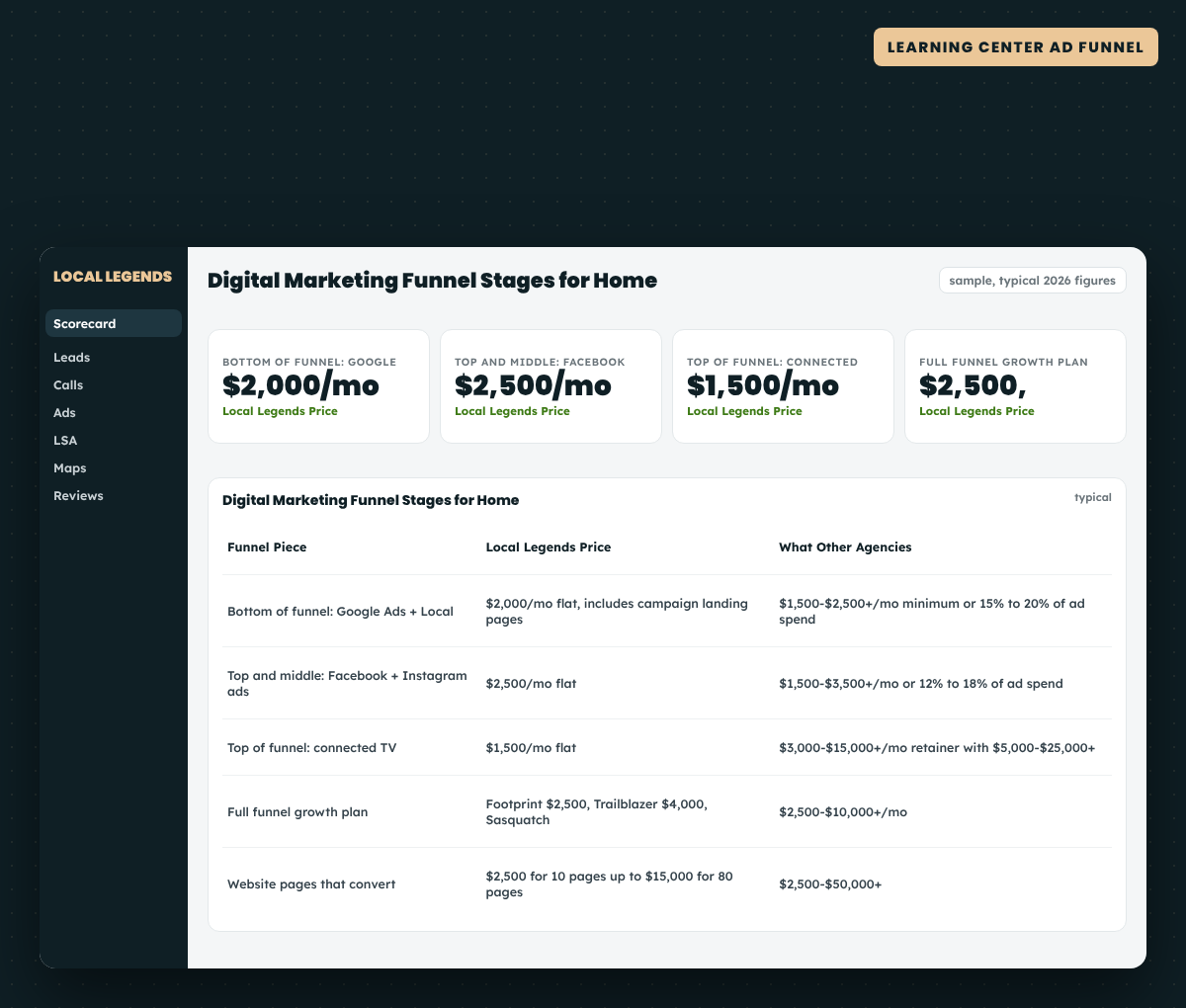
An ad funnel for a contractor costs a management fee plus ad spend paid to the platforms, and the total depends on how many stages and channels you run. Local Legends publishes flat fees and never takes a percentage of ad spend.
| Funnel Piece | Local Legends Price | What Other Agencies Typically Charge |
|---|---|---|
| Bottom of funnel: Google Ads + Local Services Ads management | $2,000/mo flat, includes campaign landing pages and monthly GBP optimization | $1,500-$2,500+/mo minimum or 15% to 20% of ad spend |
| Top and middle: Facebook + Instagram ads and retargeting | $2,500/mo flat | $1,500-$3,500+/mo or 12% to 18% of ad spend |
| Top of funnel: connected TV | $1,500/mo flat | $3,000-$15,000+/mo retainer with $5,000-$25,000+ media minimums |
| Full funnel growth plan | Footprint $2,500, Trailblazer $4,000, Sasquatch $8,000, Legend $10,000+ per month | $2,500-$10,000+/mo |
| Website pages that convert | $2,500 for 10 pages up to $15,000 for 80 pages | $2,500-$50,000+ |
Trailblazer adds Bing, Facebook and Instagram ads, review automation and email and text automations for the middle and loyalty stages. See the Local Legends pricing[LINK: /pricing/] page. [SOURCE: Levi Ostlund pricing, Nov 8 and Nov 10 2026]
How Should a Home Service Contractor Split Ad Budget Between Awareness and Lead Generation Ads?
Most home service contractors put the larger share of ad budget into bottom-of-funnel lead generation and a smaller share into awareness, then adjust by trade, season and how established the company is.
- Emergency trades: plumbing, HVAC repair, electrical and storm roofing lean heavily toward search and LSA.
- Planned, high-ticket work: remodeling and full replacements need more awareness and retargeting.
- New markets: a company entering a new area needs more awareness before search converts well.
- Peak season: shift money into lead generation when demand is high and the pipeline is thin.
- Slow season: move some budget into awareness, reviews and pages that pay off later.
- Small budgets: fund one bottom-of-funnel channel well before adding more.
Measuring the Digital Marketing Sales Funnel From Click to Sold Job Track the Lead Through Every Pipeline Stage
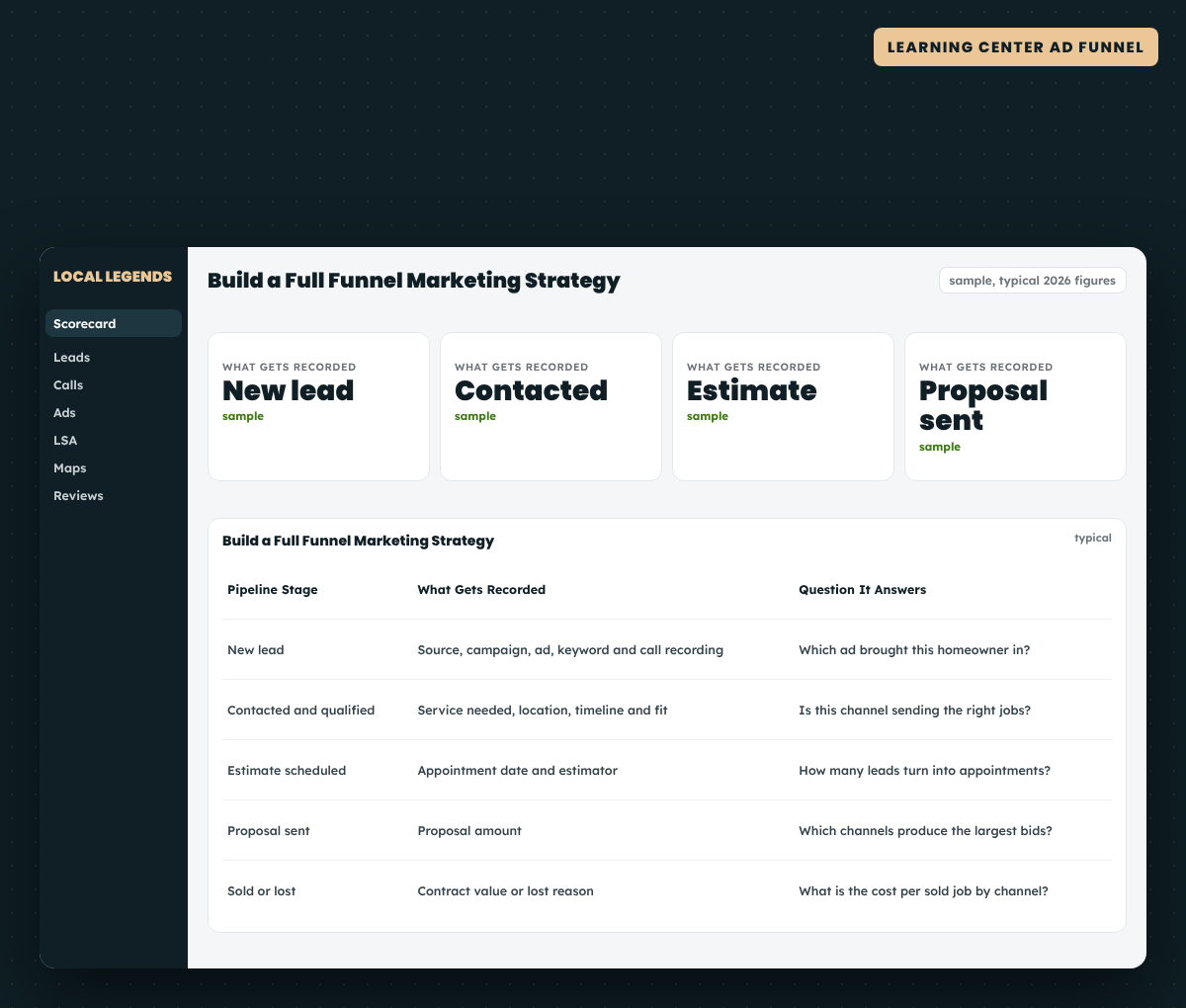
A digital marketing sales funnel is only measurable when each lead carries its source from the first click to the signed contract, so the owner can see which ads produce sold jobs, not just leads.
| Pipeline Stage | What Gets Recorded | Question It Answers |
|---|---|---|
| New lead | Source, campaign, ad, keyword and call recording | Which ad brought this homeowner in? |
| Contacted and qualified | Service needed, location, timeline and fit | Is this channel sending the right jobs? |
| Estimate scheduled | Appointment date and estimator | How many leads turn into appointments? |
| Proposal sent | Proposal amount | Which channels produce the largest bids? |
| Sold or lost | Contract value or lost reason | What is the cost per sold job by channel? |
How Do I Track a Lead From Ad Click to Sold Job in My Contractor CRM?
A contractor tracks a lead from ad click to sold job by capturing the ad source the moment the homeowner reaches out, locking it onto the CRM record and moving that record through defined stages with the contract value attached.
- Pass UTM tags, the Google click ID and Meta campaign names into hidden form fields.
- Use call tracking so phone leads carry their campaign too.
- Connect Google and Facebook lead forms straight to the CRM.
- Never overwrite the original source as the lead moves forward.
- Merge duplicate records by phone number so each homeowner has one history.
- Record the sold amount so revenue reports group by original campaign.
Call tracking and CRM integration[LINK: /services/call-tracking-crm/] at Local Legends connects with ServiceTitan, Housecall Pro, JobNimbus, AccuLynx, Jobber, Buildertrend and GoHighLevel.
How Local Legends reports the funnel: every client gets a CEO scorecard covering leads, booked jobs, sold jobs and cost per booked job, monthly on Footprint and weekly on Trailblazer and above. [SOURCE: BRIEF.md proof and plan details, Nov 2026]
Is the Marketing Funnel Dead Now That Homeowners Use AI Search to Find Contractors? The Funnel Is Changing Shape, Not Disappearing
The marketing funnel is not dead for contractors, but AI search now handles much of the early research, so many homeowners arrive at a website or phone call with a short list already in mind. The stages remain, and some happen inside the AI answer.
- Discovery moves into AI tools: homeowners ask for recommendations and comparisons before they click.
- Fewer clicks, stronger intent: the people who do reach out are often closer to hiring.
- Proof comes from many places: AI answers draw on reviews, directories, your website and your Google Business Profile.
- Consistency matters: your name, address, phone, services and service areas should match everywhere.
- Detailed reviews help: reviews that name the job, such as an AC install or a roof replacement, give AI tools specifics to repeat.
- Bottom-of-funnel search stays strong: urgent searches still happen on Google, the Map Pack and Local Services Ads.
How Local Legends Marketing Builds Ad Funnels for Contractors Audit, Fix the Bottom, Then Widen the Top
Local Legends Marketing builds contractor ad funnels from the bottom up, starting with an audit and call tracking, then launching search and LSA, then adding retargeting, video and nurture once booked jobs are being counted.
The Audit Comes Before Any Ad Spend
Every engagement starts with an audit of tracking, local SEO, Local Services Ads and the sales funnel, including Google Maps rank grids, so the first dollars go where the funnel leaks most. [SOURCE: Levi Ostlund confirmation, audits include Google Maps rank grids, Nov 10 2026]
Built by a Contractor Who Saw Both Ends of the Funnel
Founder Levi Ostlund sold driveway jobs door to door at 10, poured concrete with his father and ran a landscaping company in high school, then spent more than $30,000 on marketers who did not deliver. [SOURCE: client-confirmed founder story, BRIEF.md, Nov 2026]
That history is why every Local Legends client owns the website, domain, Google Business Profile, ad accounts and call data, and why each engagement includes the Local Legends marketing course.
Local Legends Marketing Reviews From Contractor CEOs Owners Who Worked With Levi
Contractor CEOs have described working with Levi Ostlund and the Local Legends team in video and written testimonials on the Local Legends home page.
Levi has been absolutely outstanding to work with over the years... His creativity, responsiveness, and deep understanding of our marketing strategy have made a huge impact." Brad Beldon, CEO, Roofing Company. See it on locallegends.marketing
A multi-year roofing relationship: Brad Beldon's written testimonial reflects several years of work with Levi on his roofing company's marketing. [SOURCE: written testimonial, locallegends.marketing home page, Nov 2026]
- Kyle Scott, CEO, Roofing Company (video testimonial)
- Jim Dodson, CEO, Roofing Company (video testimonial)
- Race Allen, CEO, Precision Restoration of Texas (video testimonial)
Frequently Asked Questions About Ad Funnels for Contractors Short Answers on the Marketing Funnel
What Are the 5 Stages of the Marketing Funnel?
A five-stage marketing funnel usually runs awareness, interest, consideration, conversion and loyalty. Many contractor funnels combine interest and consideration into one middle stage.
What Is the Difference Between a Marketing Funnel and a Sales Funnel?
The marketing funnel covers how homeowners find and judge your company, and the sales funnel covers what happens after they contact you, from the first call to the signed contract.
What Is Full Funnel Marketing?
Full funnel marketing runs coordinated campaigns at every stage, from awareness ads to retargeting to search and LSA, and measures how they work together instead of judging each channel alone.
What Is a Funnel in Digital Marketing?
A funnel in digital marketing is the online path a buyer follows from first contact to purchase, narrowing at each step as fewer people move forward.
Is $10 a Day Enough for Facebook Ads for a Contractor?
A small daily budget can test an offer or retarget past visitors in a tight service area, but results depend on your trade, market and follow-up. Start with retargeting and measure booked jobs before raising spend.
Is an Ad Funnel the Same as a Landing Page?
No, a landing page is one step inside an ad funnel. The funnel also includes the ad, the follow-up, the sales call and the review request after the job.
How Many Stages Should a Contractor Funnel Have?
Four stages cover most contractor funnels: awareness, consideration, conversion and loyalty. More detail only helps when each stage has its own tracking.
What Is a Campaign Funnel?
A campaign funnel is the set of ads and pages built for one offer, such as a spring AC tune-up or a storm inspection, that moves people from the ad to a booked appointment.
Reviewed by Levi Ostlund, Founder, Local Legends Marketing

Build an Ad Funnel That Ends in Sold Jobs Start With a Free Growth Audit
Book a free growth audit and Local Legends Marketing[LINK: /] will show you where your funnel leaks, from unanswered calls to unsigned estimates, and which stage to fix first. Your accounts stay in your name, and there is no long-term contract.
Call (936) 900-1248 or book online to start with the stage that will produce booked jobs fastest.