


Local Legends Marketing for Local, Long

Marketing for Moving Companies That Puts Your Own Trucks at the Top of Google, Fills Peak Season With Booked Moves and Ends the Race to the Bottom on Shared Leads
Local Legends Marketing for Local, Long Distance and Moving and Storage Companies
Updated November 2026 · Reviewed by Levi Ostlund, Founder
Local Legends Marketing provides marketing for moving companies that want booked moves from customers who chose them, not shared leads sold to five movers at once. The team runs Google Local Services Ads, Google Ads, Facebook ads, local SEO and review systems for movers, and tracks every quote to a booked move.
Ad management runs on flat fees: Google Ads plus Local Services Ads is $2,000 a month with the campaign landing pages included, and Facebook and Instagram ads are $2,500 a month. Growth plans start at $2,500 a month. Ad spend is paid by you straight to Google or Meta.
- Booked moves counted: a CEO scorecard with quotes, booked moves, completed moves and cost per booked move.
- Your accounts stay yours: website, domain, Google Business Profile, ad accounts and call recordings.
- Peak season planned in advance: budgets and pages built before May, not in June.
- No setup fees and no long-term contracts on any plan.
- Agency-reported proof: 25,000+ appointments generated and $30M+ in revenue influenced for home service companies.
Free Growth Audit
Your Reviews, Radius and Response Rate vs the competitors beating you.
About Local Legends Marketing
A home service marketing agency headquartered in Conroe, Texas, with 8+ years of marketing experience, running Google Ads, Local Services Ads, local SEO, AI SEO, connected TV and review systems for contractors nationwide.
Moving Company Marketing Reviews Owners Can Verify Before They Sign CEOs Who Put Their Names on It
The owners who vouch for Local Legends Marketing run roofing and restoration companies, not moving companies, and the page says so plainly. They hired the same team and the same tracking a moving company would get. [SOURCE: Local Legends testimonials, BRIEF.md]
Moving owners can ask for a reference call during the growth audit. No moving company results are claimed on this page.
Levi has been absolutely outstanding to work with over the years... His creativity, responsiveness, and deep understanding of our marketing strategy have made a huge impact.
 Brad Beldon
CEO, Roofing Company
How Moving Company Marketing Is Different From Other Home Service Trades One Job per Customer, Every Few Years
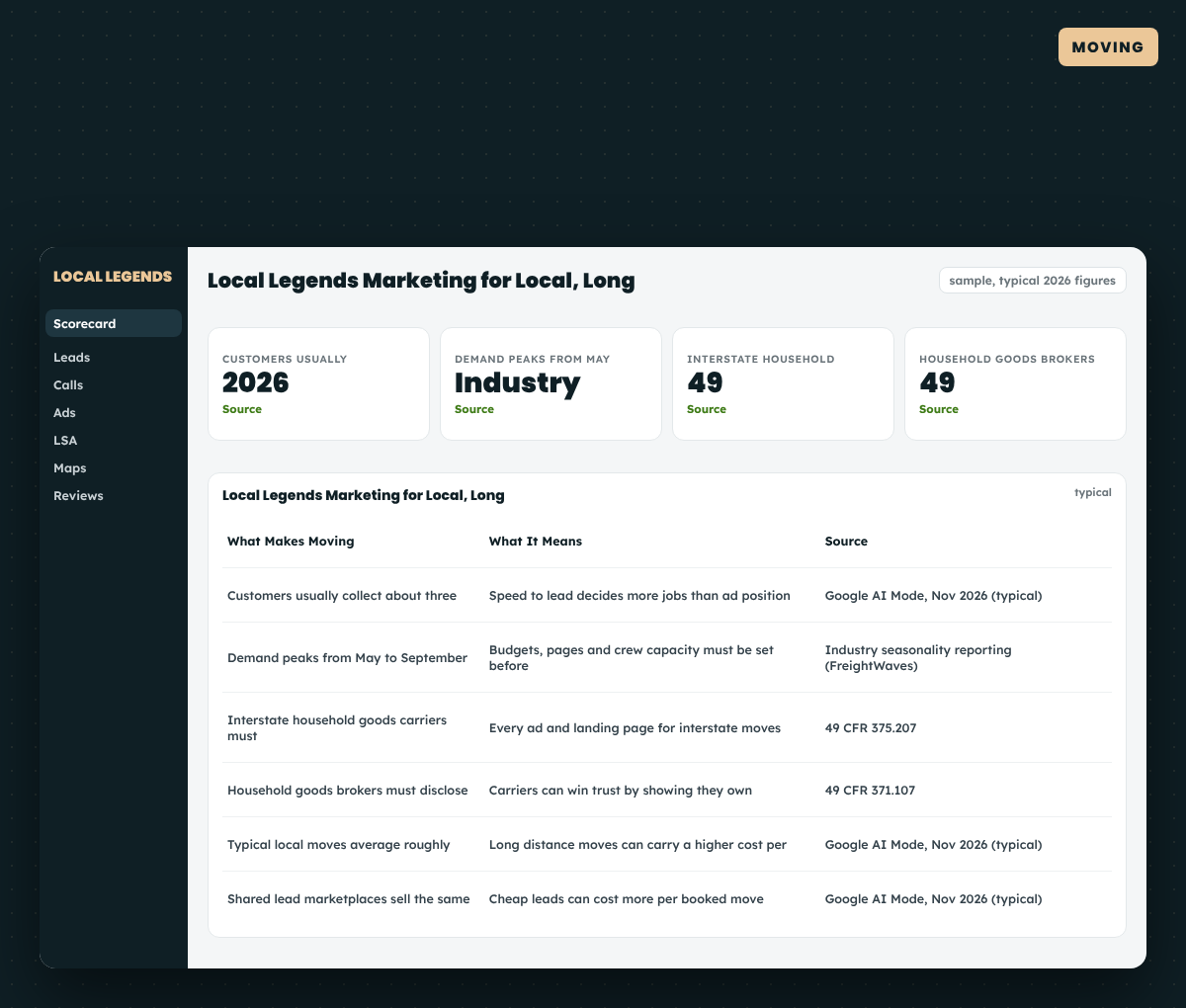
Moving company marketing is different because most customers hire a mover once every few years, compare several quotes in a few days and book whoever earns trust first. There is no maintenance plan to sell and no repeat visit next spring, so every booked move has to be won fresh.
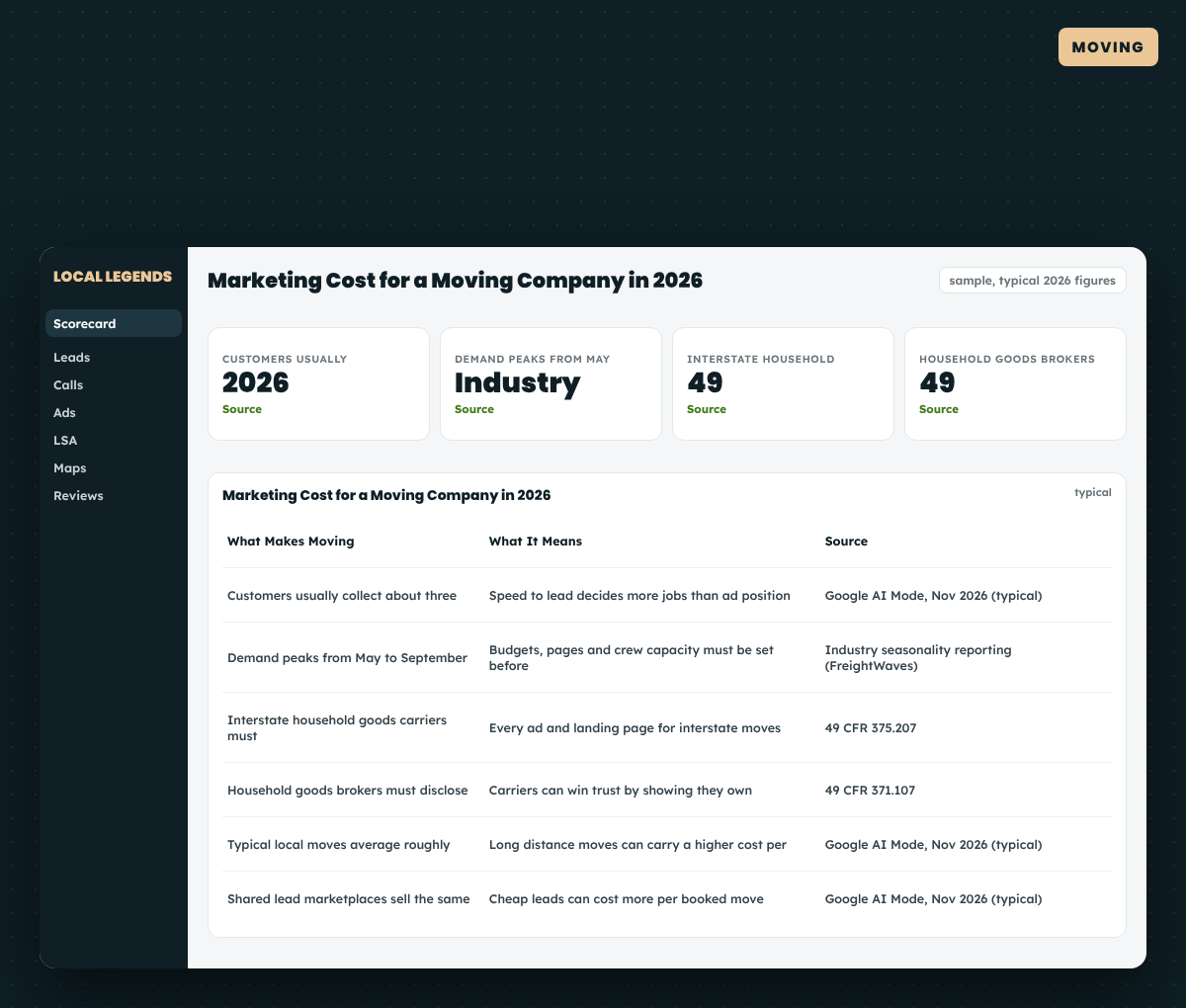
| What Makes Moving Different | What It Means for Marketing | Source |
|---|---|---|
| Customers usually collect about three quotes and often book the first professional company that responds | Speed to lead decides more jobs than ad position | Google AI Mode, Nov 2026 (typical) |
| Demand peaks from May to September, busiest June to August, with month-end and Saturdays the heaviest days | Budgets, pages and crew capacity must be set before May | Industry seasonality reporting (FreightWaves) |
| Interstate household goods carriers must show their name and "U.S. DOT No." in advertising | Every ad and landing page for interstate moves carries the USDOT number | 49 CFR 375.207 |
| Household goods brokers must disclose that they arrange moves and do not move goods themselves | Carriers can win trust by showing they own the trucks and crews | 49 CFR 371.107 |
| Typical local moves average roughly $1,200-$1,700+ per job and long distance moves $4,000+ | Long distance moves can carry a higher cost per booked move | Google AI Mode, Nov 2026 (typical) |
| Shared lead marketplaces sell the same request to several movers, with typical close rates around 8% to 12% | Cheap leads can cost more per booked move than exclusive ones | Google AI Mode, Nov 2026 (typical) |
Every Move Type Needs Its Own Campaign
A studio apartment move, a four-bedroom house, a piano, an office and a cross-country relocation attract different buyers with different budgets. Lumping them into one ad group hides which ones make money.
- Local residential moves: the volume driver, won on reviews, speed and clear hourly or flat pricing.
- Long distance and interstate moves: higher tickets, longer sales cycles and the USDOT rule in every ad.
- Moving and storage: storage offers fill the calendar in slow months and keep customers for longer.
- Apartment and student moves: short notice, price sensitive and tied to lease end dates.
- Senior moves: families researching for a parent value care, patience and packing help.
- Office and commercial moves: planned weeks ahead, often on weekends, with a different decision maker.
- Specialty moves: pianos, safes, antiques and art need their own pages and proof.
Why Trust Signals Matter More for Movers
A family is handing over everything it owns to strangers with a truck. Real crew photos, branded trucks, a visible USDOT number, recent reviews that describe the move and clear pricing rules do more for conversion than any headline.
What Do Moving Company Ads Have to Include, Like the USDOT Number, to Stay Compliant?
Moving company ads for interstate household goods moves must include the company's name and its USDOT number written as "U.S. DOT No.", under the federal rule at 49 CFR 375.207. State rules can add more for intrastate moves, so check your state's requirements too.
- Put the USDOT number in the footer of every page and on every landing page for long distance moves.
- Match the FMCSA record exactly: the legal name and number in ads should match the carrier's registration.
- Show the MC number if the company holds interstate operating authority.
- Use the same name on the Google Business Profile that appears on the registration.
- Brokers must say they are brokers, so a carrier should say clearly that it owns its trucks and employs its crews.
- This is general information, not legal advice: confirm the current rules for your state and authority type.
The Local Legends Channel Mix for Moving Companies Which Channels Go Live First and Why
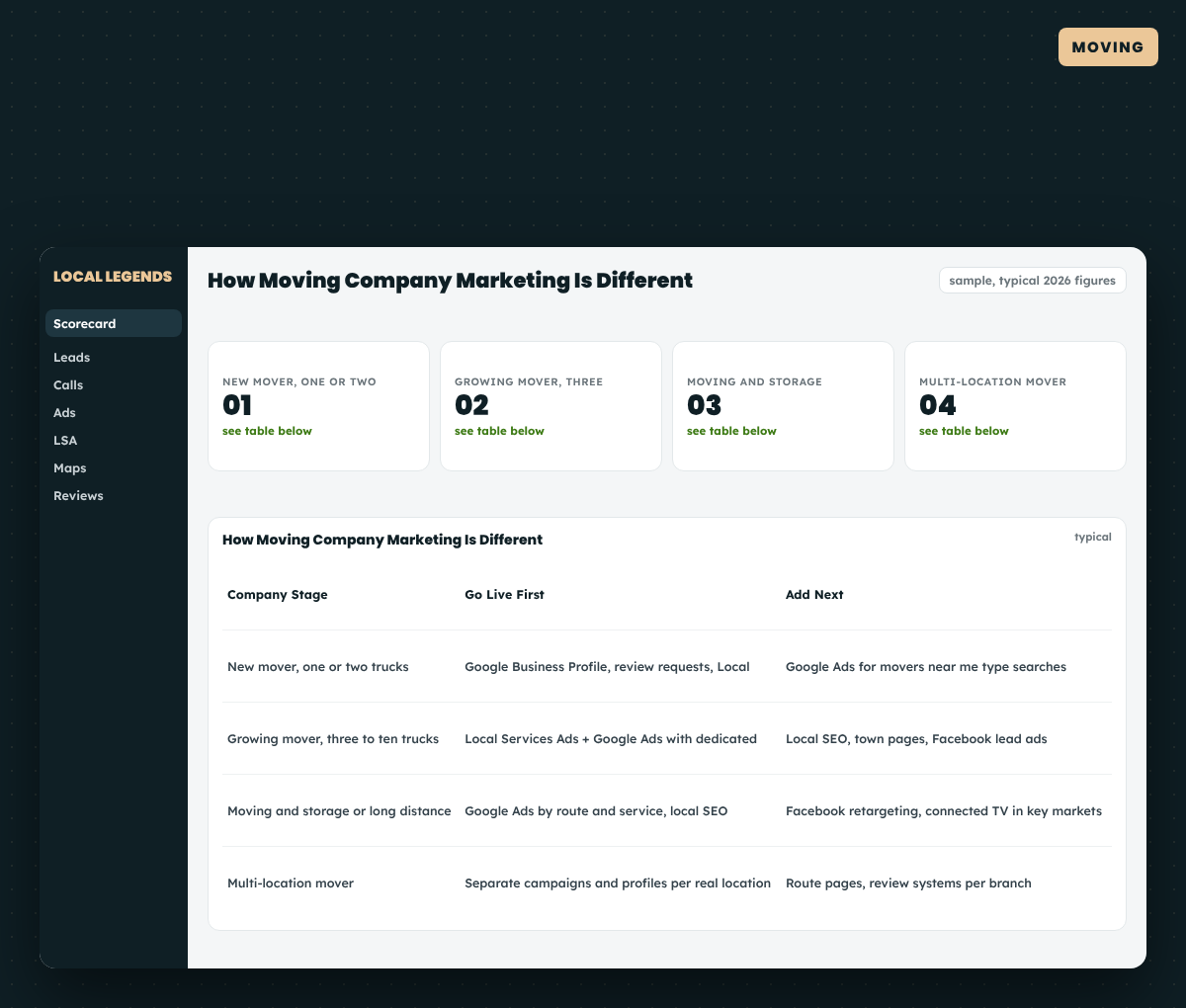
The Local Legends channel mix for moving companies starts with the channels that capture people already shopping for a mover, then adds channels that reach them earlier. The order depends on fleet size and budget.
| Company Stage | Go Live First | Add Next | Why This Order |
|---|---|---|---|
| New mover, one or two trucks | Google Business Profile, review requests, Local Services Ads | Google Ads for "movers near me" type searches | Pay-per-lead calls while reviews build |
| Growing mover, three to ten trucks | Local Services Ads + Google Ads with dedicated landing pages | Local SEO, town pages, Facebook lead ads | Owned demand replaces shared leads |
| Moving and storage or long distance | Google Ads by route and service, local SEO | Facebook retargeting, connected TV in key markets | Higher tickets justify more channels |
| Multi-location mover | Separate campaigns and profiles per real location | Route pages, review systems per branch | Each branch competes in its own Map Pack |
Google Local Services Ads and Google Ads
Google Local Services Ads charge per lead and include weekly lead disputes. Google Ads management covers local, long distance, packing, storage and specialty moves with landing pages built for each campaign.
Facebook and Instagram Ads
Facebook and Instagram ads reach families before they search, which suits pre-season offers, apartment move promotions and retargeting people who visited the quote page.
Local SEO, Reviews and Call Tracking
Local SEO and review management build the Map Pack presence that brings calls without a click charge, and call tracking and CRM integration ties each quote and call to the move it booked. For a deeper look at search, see SEO for moving companies.
Do Google Local Services Ads or Regular Google Ads Work Better for a Local Moving Company?
For most local moving companies, Local Services Ads come first because "moving services" is an eligible LSA category and you pay per lead instead of per click. Regular Google Ads come next for long distance, packing, storage and specialty moves that LSA does not separate well.
- Local Services Ads: top-of-page placement for mover searches, pay per lead, weekly disputes for wrong-area or spam leads.
- Google Ads: control over keywords, routes and landing pages, with typical optimized leads of $40-$100+ and higher costs while a new account learns.
- Verification first: Google screens the business, owner, license where required and insurance before LSA runs.
- Reviews drive LSA ranking, so the review system matters as much as the bid.
- The LSA move into Google Ads: Google is folding Local Services Ads management into the Google Ads interface, so one team should run both.
What Should Moving Company Ads Say to Get More Calls on Google and Facebook?
Moving ads that get calls lead with what the customer fears most: surprise charges, damaged furniture and a crew that does not show. Clear pricing rules, real crew photos, reviews and a fast quote promise answer those fears.
- Lead with price certainty: typical industry reporting says flat-rate quotes close better than hourly quotes, so advertise how you quote.
- Show the crew and trucks: real photos and short videos of uniformed movers beat stock images.
- Name the move type: apartment moves, senior moves, piano moves, long distance and storage each get their own ad.
- Use review quotes that mention care, timing and the final bill.
- State the scope rules: minimum hours, travel time and stairs belong on the landing page, not in a surprise invoice.
- Make quoting easy: a short form or click-to-call, followed by a fast call back from someone who can quote.
Should My Moving Company Keep Buying Shared Moving Leads or Run Our Own Google Ads? Rented Leads Compared With Owned Demand
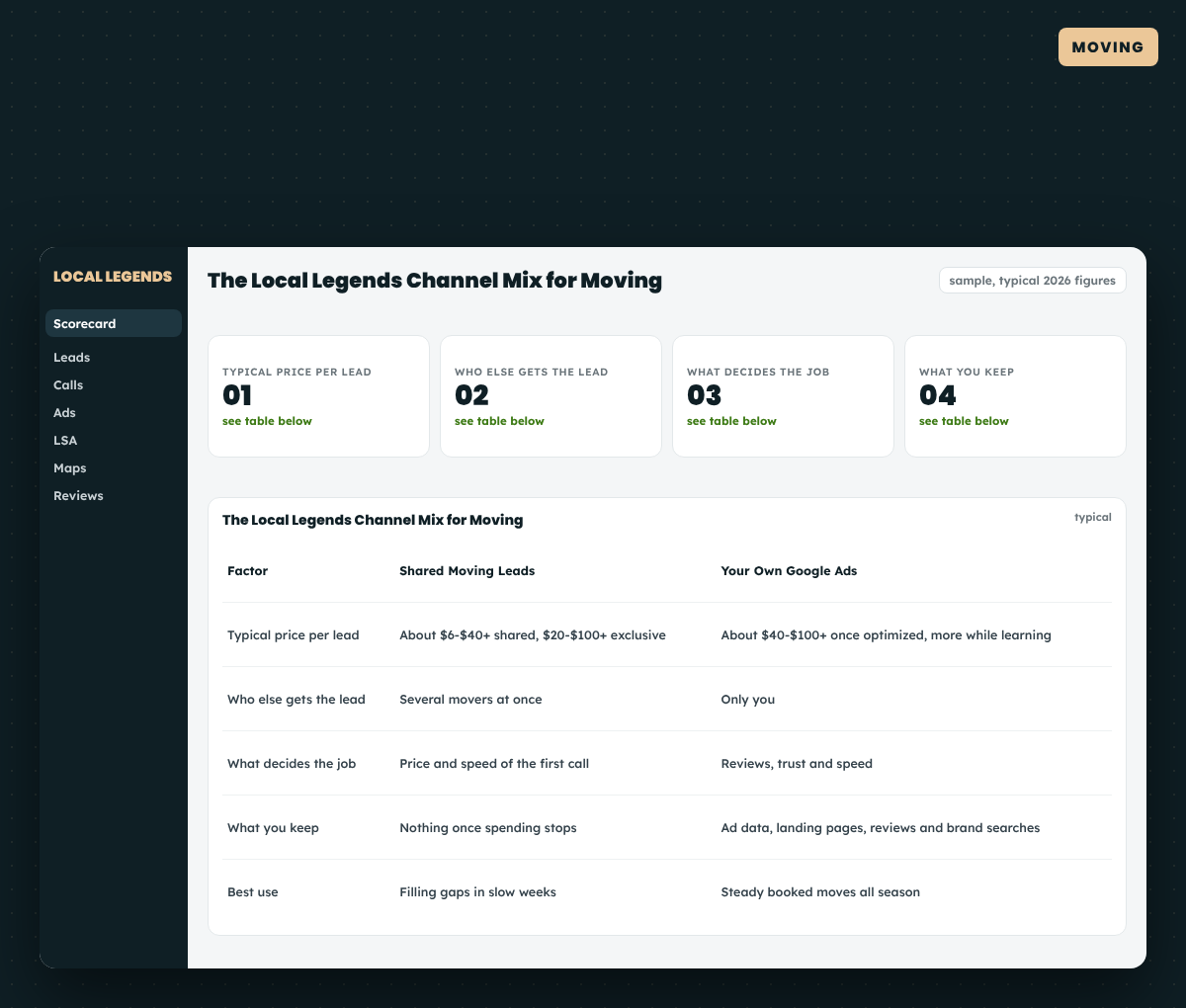
Most moving companies should move from shared leads toward their own Google Ads and Local Services Ads over a few months, not overnight, because shared leads keep trucks busy today while owned channels build the exclusive calls that close at better rates.
| Factor | Shared Moving Leads | Your Own Google Ads and LSA |
|---|---|---|
| Typical price per lead | About $6-$40+ shared, $20-$100+ exclusive | About $40-$100+ once optimized, more while learning |
| Who else gets the lead | Several movers at once | Only you |
| What decides the job | Price and speed of the first call | Reviews, trust and speed |
| What you keep | Nothing once spending stops | Ad data, landing pages, reviews and brand searches |
| Best use | Filling gaps in slow weeks | Steady booked moves all season |
All figures are typical ranges reported by Google AI Mode and published mover guides in November 2026. Your own numbers come from call tracking.
How to Switch Without an Empty Schedule
- Turn on Local Services Ads and fix the Google Business Profile first.
- Build landing pages for local, long distance and storage moves.
- Launch Google Ads for the services with the best margins.
- Track cost per booked move for every channel for 90 days.
- Reduce shared lead spend as the owned channels prove themselves.
Why Do My Moving Company Facebook Ads Get Lots of Leads That Never Book?
Moving company Facebook ads usually produce leads that never book because the form is too easy, the offer attracts browsers and the follow-up is too slow. People on Facebook are not searching for a mover at that moment, so qualification and speed matter more than on Google.
- Add qualifying questions: move date, origin and destination ZIP codes and home size.
- Call or text fast: many movers set a goal of five minutes or less for the first reply to each new lead.
- Match the ad to the offer: a clear quote promise beats a vague discount.
- Send booked moves back to Meta through call tracking and CRM data so the algorithm learns who books.
- Run Facebook alongside Google: retargeting people who visited the quote page tends to produce warmer leads.
Moving Company Marketing Seasonality: Peak Season, Month-End and the Slow Winter A 12-Month Moving Marketing Calendar
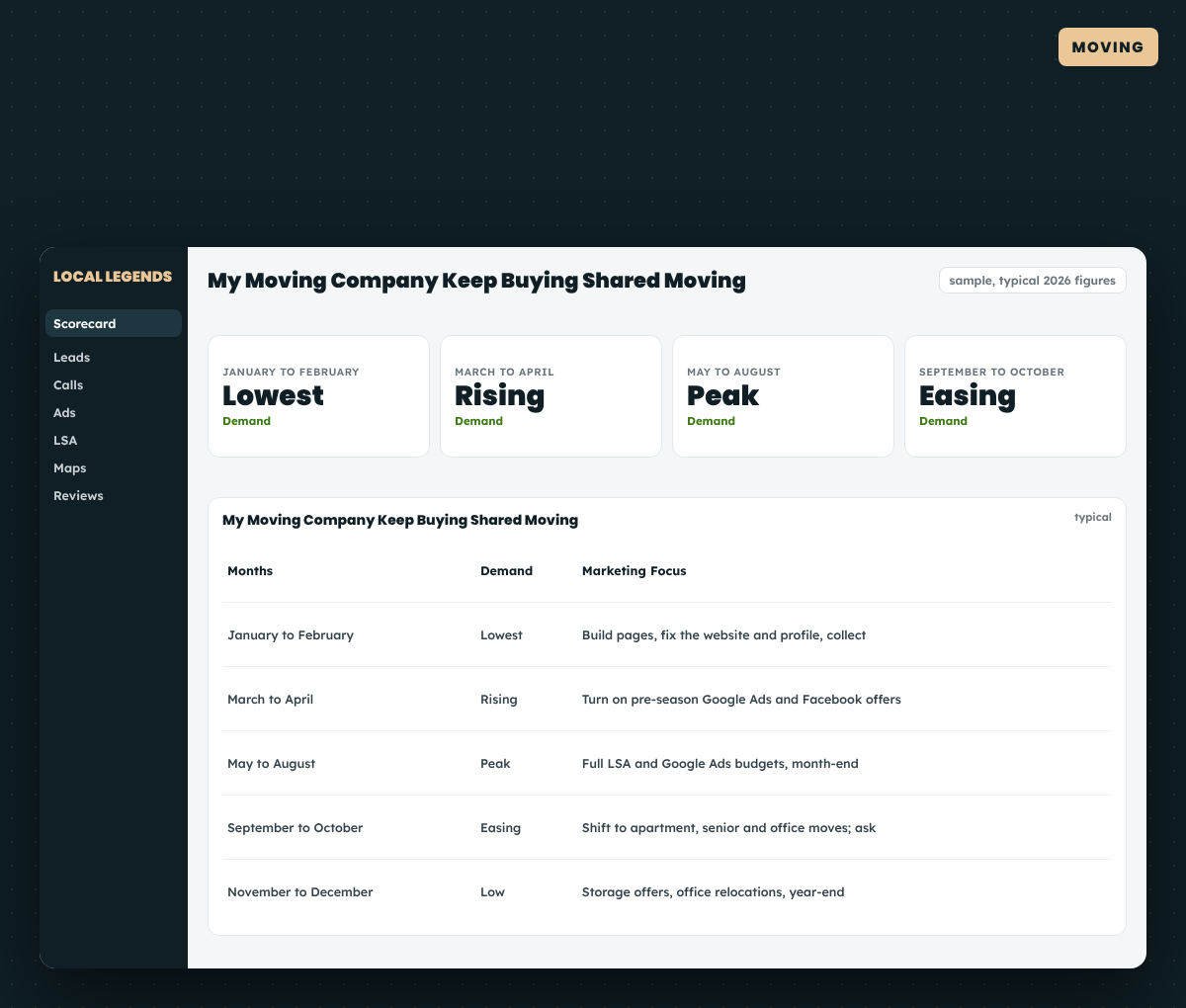
Moving company marketing follows a strong seasonal curve, with most demand from May to September and the heaviest weeks in June, July and August. The calendar below sets what to build and what to spend each quarter.
| Months | Demand | Marketing Focus |
|---|---|---|
| January to February | Lowest | Build pages, fix the website and profile, collect reviews from winter moves, plan budgets |
| March to April | Rising | Turn on pre-season Google Ads and Facebook offers, recruit crews, push review requests |
| May to August | Peak | Full LSA and Google Ads budgets, month-end and Saturday capacity, fast follow-up on every quote |
| September to October | Easing | Shift to apartment, senior and office moves; ask every summer customer for a review |
| November to December | Low | Storage offers, office relocations, year-end analysis of cost per booked move by channel |
Month-End and Weekend Spikes
Leases end and closings land at the end of the month, and Saturdays book first. Raise budgets and staff the phones for the last week of each month in peak season.
Peak Moving Season Starts in May. When Should My Moving Company Start Advertising and How Much Should We Spend?
A moving company should start building in winter and turn on paid campaigns by March or April, so profiles, pages and ad accounts are trained before May. Typical industry guidance puts total marketing at about 5% to 12% of revenue, with newer companies at the high end.
- January: fix tracking, landing pages and the Google Business Profile.
- February: publish service and town pages and ask winter customers for reviews.
- March: start Local Services Ads and Google Ads at a learning budget.
- April: raise budgets toward peak and test Facebook offers.
- May to August: spend where cost per booked move is lowest, and protect month-end capacity.
Long Distance Moving Marketing Without Looking Like a Broker Prove You Own the Trucks
Long distance moving marketing works best when the carrier shows proof that it owns the trucks and employs the crews, because many homeowners have heard stories about brokers and resold jobs.
How Do I Advertise Long Distance Moving Without Looking Like a Moving Broker?
A carrier should advertise long distance moves with its USDOT and MC numbers, photos of its own fleet and route pages that describe real lanes it runs. Federal rules require brokers to say they arrange moves through carriers, so a carrier gains by being explicit about what it is.
- Say "we are the carrier" on long distance pages and in ad copy.
- Build route pages only for lanes you run often, with transit times and how quotes work.
- Explain estimates plainly, including how binding and non-binding estimates differ for interstate moves.
- Show crew and truck photos from real long distance jobs.
- Collect reviews that mention the route and the delivery experience.
- Track long distance calls separately so the higher ticket shows its true cost per booked move.
Moving Company Leads Tracked From First Call to Booked Move Count Moves, Not Form Fills
Moving company leads should be tracked from the first call or form to the booked and completed move, because a channel with cheap leads and low close rates can cost more per move than one with expensive leads.
What Is a Good Cost per Booked Move for a Local Moving Company From Google Ads?
A good cost per booked move from Google Ads is typically about $150-$300+ for a local mover, according to figures reported by Google AI Mode in November 2026, with long distance moves often worth $300-$600+ per booked move because of the larger ticket.
- Formula: total marketing spend divided by moves booked from marketing.
- Typical target: acquisition cost around 8% to 15% of the average job.
- Channel ranges reported as typical: Google and LSA leads about $30-$100+, Facebook leads about $15-$45+.
- Organic and referral moves usually cost the least once SEO and partnerships mature.
- Measure by move type: local, long distance, storage and commercial each have their own target.
What a Moving Company Scorecard Should Show Each Week
- Quotes requested by channel and move type.
- Quotes answered and how long the first reply took.
- Booked moves and the booking rate for each channel.
- Completed moves and revenue, pulled from the moving CRM.
- Cost per booked move by channel, compared with the target for that move type.
- Reviews earned that week and the current average rating.
How Much Does Marketing Cost for a Moving Company in 2026? Agency Fees, Ad Spend and What You Get
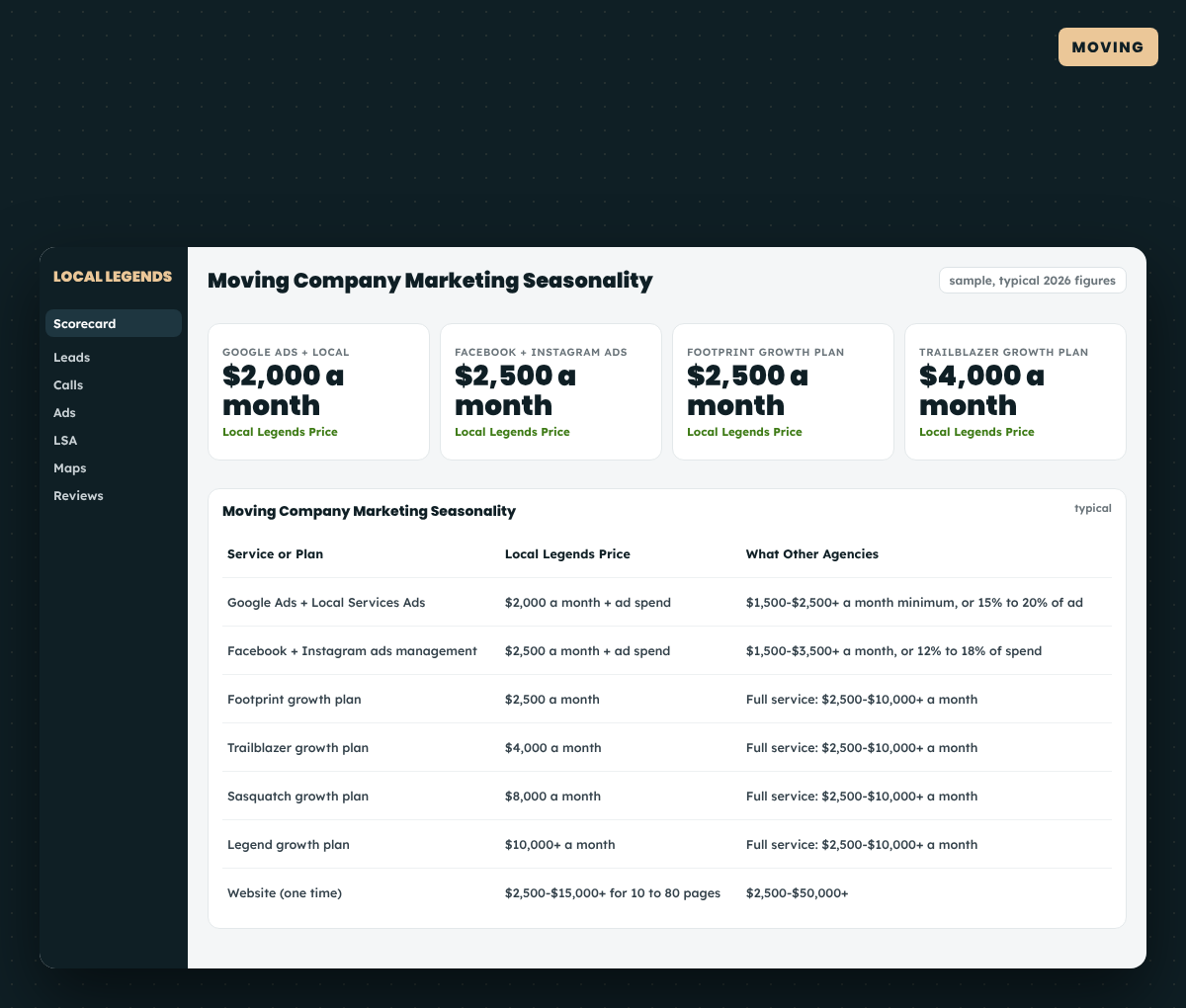
Marketing for a moving company typically costs $1,500-$5,000+ a month in total, with agency management of about $1,000-$3,000+ a month on top of ad spend, going by figures reported by AI platforms and published mover guides in November 2026. Local Legends charges flat fees, never a percentage of spend.
| Service or Plan | Local Legends Price | What Other Agencies Typically Charge |
|---|---|---|
| Google Ads + Local Services Ads management (landing pages and monthly GBP optimization included) | $2,000 a month + ad spend | $1,500-$2,500+ a month minimum, or 15% to 20% of ad spend |
| Facebook + Instagram ads management | $2,500 a month + ad spend | $1,500-$3,500+ a month, or 12% to 18% of spend |
| Footprint growth plan (Google Ads + LSA, LSA Ranker review texter, 10 pages or blogs a month, local SEO, call tracking) | $2,500 a month | Full service: $2,500-$10,000+ a month |
| Trailblazer growth plan (adds Bing and Facebook ads, 20 pages a month, backlinks, review and text automations) | $4,000 a month | Full service: $2,500-$10,000+ a month |
| Sasquatch growth plan (adds AI SEO, connected TV, geofencing, retargeting, 50 pages a month) | $8,000 a month | Full service: $2,500-$10,000+ a month |
| Legend growth plan (100 pages a month, multi-location pages, weekly CMO + CEO meeting) | $10,000+ a month | Full service: $2,500-$10,000+ a month |
| Website (one time) | $2,500-$15,000+ for 10 to 80 pages | $2,500-$50,000+ |
No plan has a setup fee or a long-term contract. See every plan and add-on on the Local Legends pricing page.
What Changes a Moving Company's Marketing Budget
- Move mix: long distance and storage work justify higher spend per booked move.
- Market size: big metros have more movers bidding for the same searches.
- Season: peak months need more budget and more crew capacity.
- Website and reviews: a slow site or thin review count makes every ad dollar work harder.
Want to see what your booked moves really cost by channel? Book a free growth audit online for a rank grid, a tracking check and a peak-season plan.
What Is the Best Marketing Company for a Moving Company? What AI Platforms Say to Look For
The best marketing company for a moving company understands moving seasonality and compliance, builds assets the mover owns and tracks quotes to booked moves. Those are the criteria Google AI Mode listed in November 2026. Use them on every agency, Local Legends Marketing included.
- Owned demand, not resold leads: your website, rankings and ad accounts instead of a marketplace subscription.
- Google Business Profile skill: profile management, town pages and a steady review system.
- Local Services Ads and Google Ads experience, including Google's verification process for movers.
- Booked-move tracking: calls, forms and quotes followed to booked jobs.
- Seasonal planning: budgets and pages adjusted ahead of peak season.
- Clear terms: month-to-month or short commitments, and honest answers about competing clients.
How Local Legends Answers These Questions
Local Legends works only with home service companies, publishes its fees, runs Local Services Ads with weekly disputes, reports leads, booked jobs, sold jobs and cost per booked job, keeps every account in your name and has no setup fees or long-term contracts.
How Do I Know a Marketing Agency for Movers Will Not Lock Me Into a Contract or Keep My Google Business Profile?
A marketing agency for movers is safe to sign with when it puts every account in your name, bills ad spend to your card and lets you leave on short notice. Ask these questions before the first invoice.
- Who is the primary owner of the Google Business Profile? It should be you, with the agency added as an owner or manager.
- Whose card pays Google and Meta? It should be yours, with no markup.
- Who owns the domain and website? They should be registered to your company.
- What happens if I cancel? You should keep the site, pages, ad accounts and call data.
- Do you work with other movers in my area? Get a straight answer.
- What does the monthly report show? Booked moves and cost per booked move, not only clicks.
Getting Started: Marketing for a New Moving Company and a Profile Problem in Peak Season Two Situations Owners Ask About Most
New moving companies and established movers with a suspended profile face the same problem: they need calls this week while the long-term channels catch up. Both answers start with Google.
I Just Started a Moving Company With Two Trucks. How Do I Get My First Customers?
A new two-truck moving company gets its first customers fastest by setting up a complete Google Business Profile, asking every customer for a review and turning on Local Services Ads once verified. Referral partners fill the gaps while reviews build.
- Google Business Profile: moving category, service area, real truck and crew photos, accurate hours.
- Review on moving day: a direct link or QR code after the final walk-through.
- Local Services Ads after license and insurance verification.
- Referral partners: real estate agents, property managers, apartment leasing offices and senior living communities.
- Nextdoor and local groups: answer moving questions in your service area.
- Branded trucks and yard signs where customers allow them.
My Moving Company's Google Business Profile Got Suspended in the Middle of Peak Season. How Do I Get Calls Back This Week?
A moving company with a suspended Google Business Profile should keep calls coming through Google Ads and other channels while it fixes the cause and files one careful appeal. Reinstatement often takes several business days, and a new duplicate profile can make things worse.
- Run Google Search ads now: a suspended profile does not stop search campaigns to your website.
- Fix the likely cause first: keyword-stuffed names, a virtual office address or a service area that is too large.
- Gather matching documents: business registration, USDOT record and a utility bill with the same name and address.
- File one appeal with the evidence, then wait for the review.
- Call referral partners and past customers to fill the week.
- Do not create a second profile: it can lead to a permanent suspension.
Our Moving Company Marketing Process, Step by Step Audit, Track, Launch, Grow
Every moving company engagement starts with a growth audit of tracking, local SEO, Local Services Ads and the quote funnel, including Google Maps rank grids, so the plan starts from real numbers, not guesses.
Step 1: Growth Audit
Rank grids across your service area, a profile and review check, an ad account review and a look at how fast quotes get answered.
Step 2: Tracking and Ownership
Call tracking and CRM integration go in first, and every account is confirmed in your name.
Step 3: Launch Before Peak
Local Services Ads, Google Ads and landing pages go live in time to learn before May.
Step 4: Grow What Books Moves
The weekly project review and your CMO + CEO meetings move budget toward the channels with the lowest cost per booked move.
Moving Company Marketing From a Founder Who Worked With His Hands Levi Ostlund Started in the Field
Local Legends Marketing was founded by Levi Ostlund, who sold driveway jobs door to door at 10, poured concrete with his father and lost more than $30,000 to marketers before running marketing as CMO of Amstill Roofing.[SOURCE: Local Legends founder bio, Levi Ostlund]
- Marketing home service companies for 8+ years
- The Local Legends marketing course is part of every engagement
- A weekly project review meeting on every account
Local Legends serves companies nationwide; see industries we serve and Local Legends service areas.
Frequently Asked Questions About Marketing for Moving Companies Short Answers for Moving Company Owners
What Are Some Effective Marketing Ideas for a Moving Company?
The most effective ideas are a complete Google Business Profile, steady reviews, Local Services Ads, Google Ads by move type and real estate and property manager referrals, all tracked to booked moves.
How Do Moving Companies Get Leads Without Buying Them?
Moving companies get their own leads from Local Services Ads, Google Ads, local SEO, Facebook ads and referral partners, which send customers who contacted only them.
Should My Moving Company Advertise Flat Rate or Hourly Prices?
Most movers do better advertising how they quote and leading with price certainty, with hourly rates explained clearly for small local moves and flat quotes for larger or long distance moves.
Do Moving Companies Need a Live Person Answering Calls for Local Services Ads?
Answering quickly matters a great deal, because missed calls are still paid leads and customers often book the first mover who responds. Many movers use a call team or fast call backs during peak season.
How Many Google Reviews Does a Moving Company Need?
There is no fixed number, but steady recent reviews that describe the move matter more than a large old total. Ask every customer on moving day.
Can I Run Ads Only for Long Distance Moves?
Yes. Google Ads campaigns can target long distance and route searches with their own landing pages, budgets and tracking.
Do I Keep My Website, Profile and Ad Accounts If I Leave?
Yes. The website, domain, Google Business Profile, ad accounts and call data are in your company's name.
Is There a Long-Term Contract or Setup Fee?
No. No plan has a setup fee or a long-term contract.
Reviewed by Levi Ostlund, Founder, Local Legends Marketing

Get Moving Company Marketing That Counts Booked Moves Start With a Free Growth Audit
Local Legends Marketing builds moving company marketing that stays yours: Local Services Ads, Google Ads, Facebook ads, local SEO, reviews and call tracking, with every quote followed to a booked move.
- Call:(936) 900-1248
- Home office: 481 Stephen F Austin Dr, Conroe, TX 77302
- Next step: book your growth audit; ad management starts at $2,000 a month