


PPC Advertising for Contractors
PPC, What Is It? Pay Per Click Advertising, CPC and Search Engine Marketing Explained for Roofers, HVAC Companies, Plumbers and Other Home Service Contractors
A Contractor's Guide to Paying for Clicks
Updated November 2026 · Reviewed by Levi Ostlund, Founder
Breadcrumb: Home > Learning Center [LINK: /learning-center/] > PPC: What Is It?
PPC, or pay per click, is online advertising where a contractor pays the ad platform only when someone clicks the ad, usually to call the company or open a service page. On Google, a roofer or plumber bids on searches like "roof leak repair near me" and the ad shows above the regular results.
- PPC: the pricing model, pay when someone clicks.
- SEM: the strategy of getting found on search engines, paid and often organic.
- CPC: what one click costs, total ad spend divided by clicks.
- The number that matters most: cost per booked job, not cost per click.
Free Growth Audit
Your Reviews, Radius and Response Rate vs the competitors beating you.
About Local Legends Marketing
A home service marketing agency headquartered in Conroe, Texas, with 8+ years of marketing experience, running Google Ads, Local Services Ads, local SEO, AI SEO, connected TV and review systems for contractors nationwide.
What Is PPC Advertising for Contractors? Pay Per Click Meaning, Simply
PPC advertising for contractors is a way to rent the top of the search page for the exact jobs a company wants, paying only when a homeowner clicks through. An HVAC company can run ads for "AC replacement" in its service area and pay nothing when the ad is only seen.
The Google AI Overview described PPC in November 2026 as paying for measurable engagement instead of paying just to display an ad. For a contractor, that engagement is a call, a form or a booked estimate.
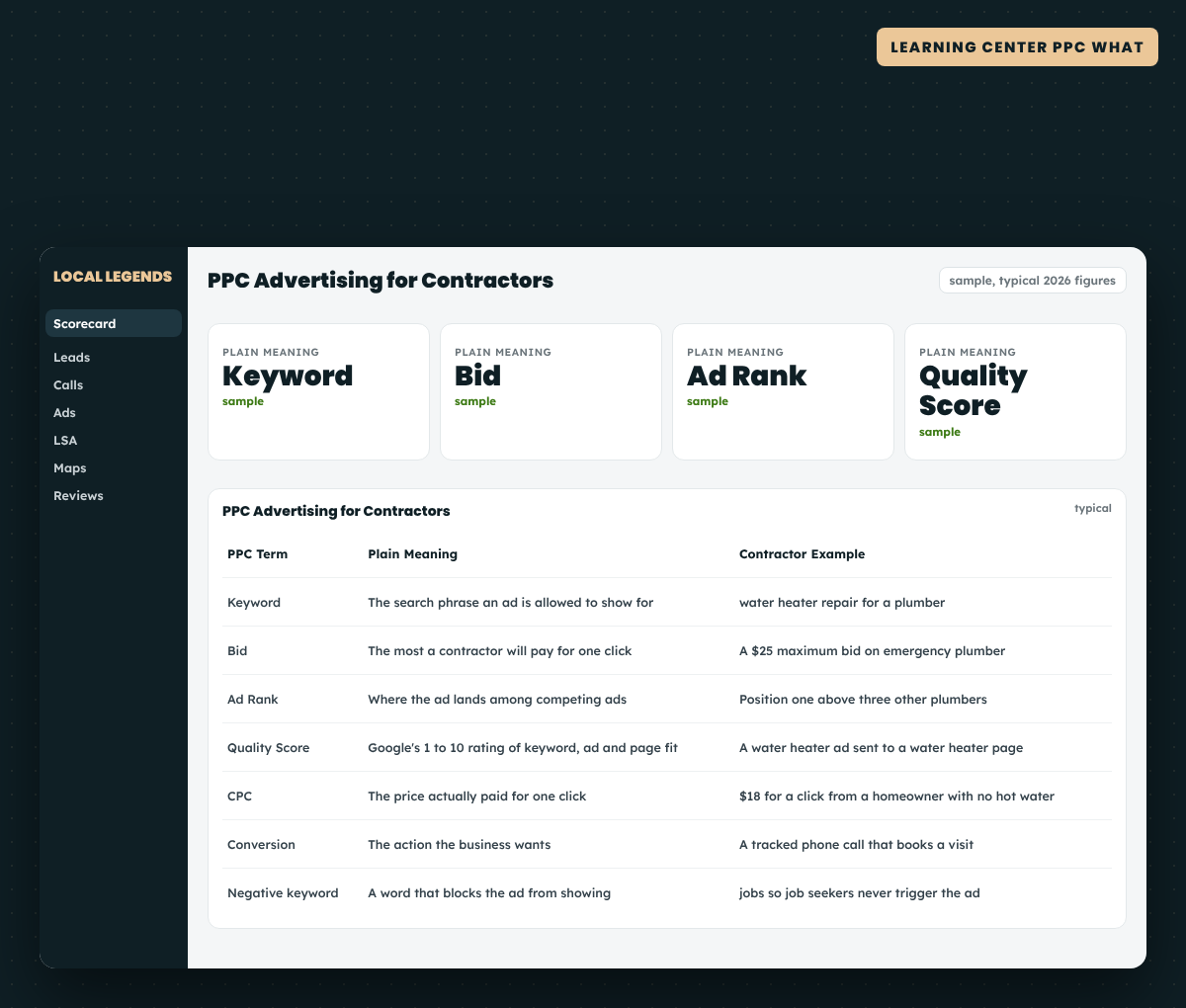
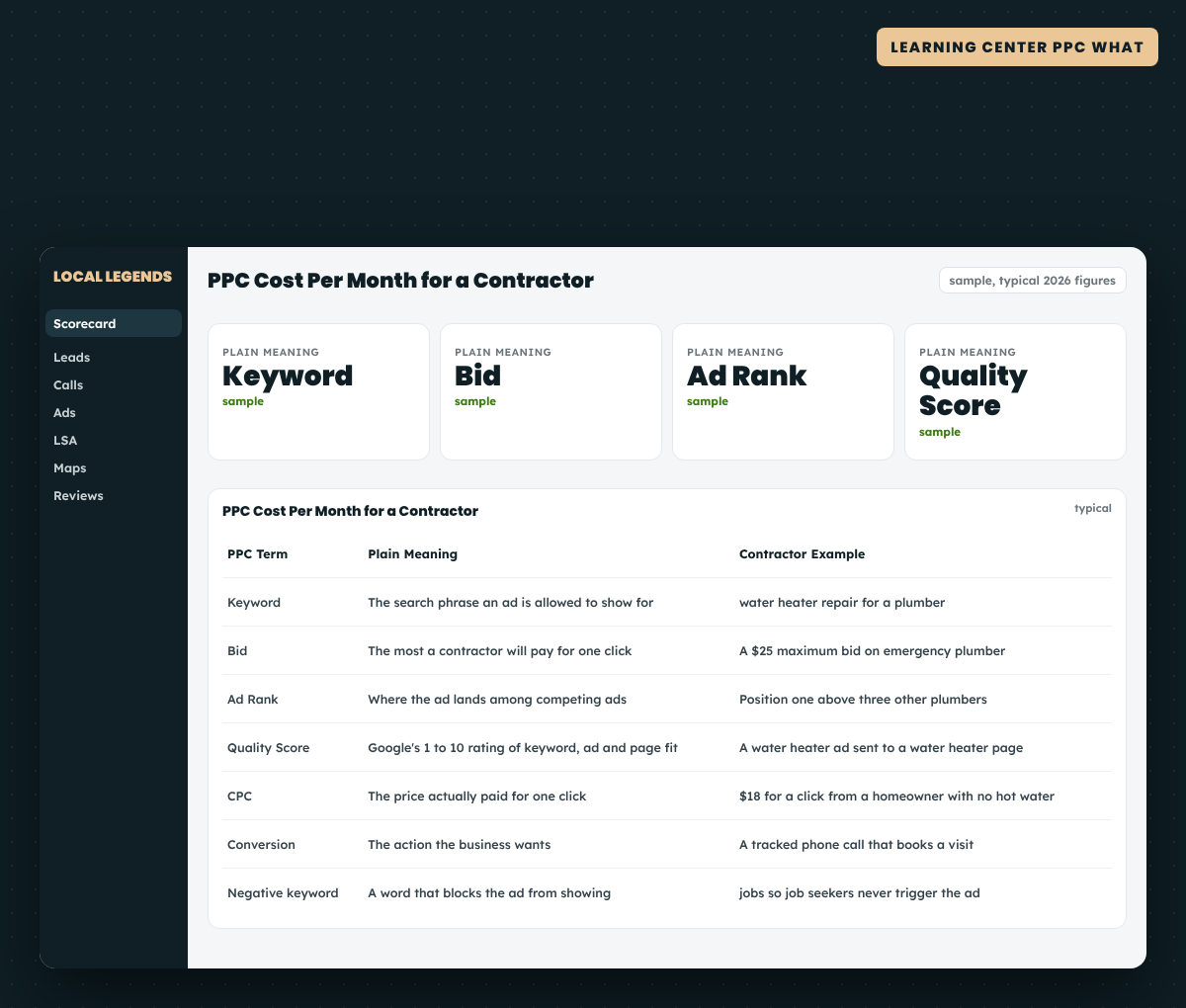
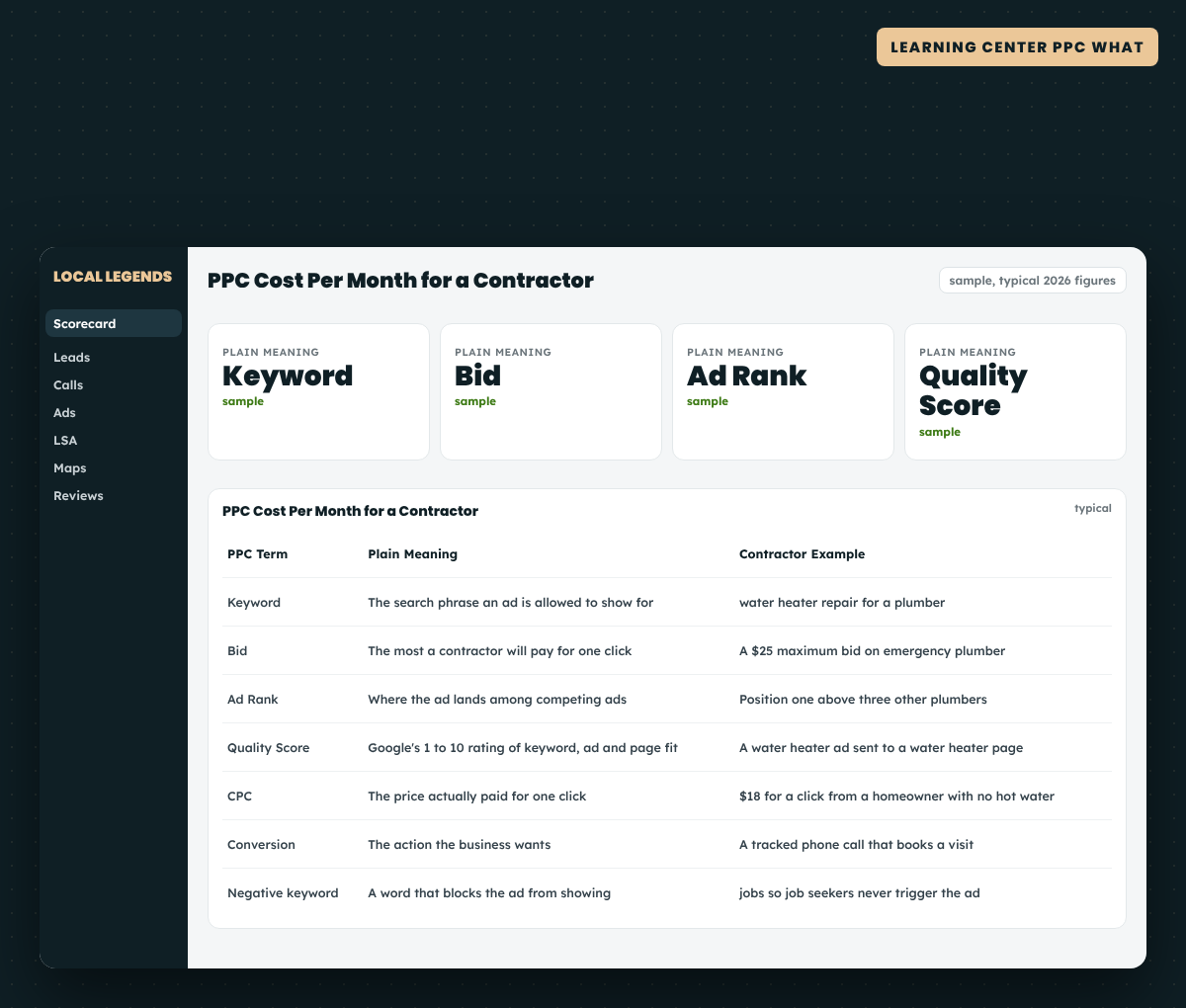
| PPC Term | Plain Meaning | Contractor Example |
|---|---|---|
| Keyword | The search phrase an ad is allowed to show for | "water heater repair" for a plumber |
| Bid | The most a contractor will pay for one click | A $25 maximum bid on "emergency plumber" |
| Ad Rank | Where the ad lands among competing ads | Position one above three other plumbers |
| Quality Score | Google's 1 to 10 rating of keyword, ad and page fit | A water heater ad sent to a water heater page |
| CPC | The price actually paid for one click | $18 for a click from a homeowner with no hot water |
| Conversion | The action the business wants | A tracked phone call that books a visit |
| Negative keyword | A word that blocks the ad from showing | "jobs" so job seekers never trigger the ad |
Is Search Engine Marketing the Same as PPC?
Search engine marketing and PPC overlap but are not the same thing: SEM is the strategy of winning visibility on search engines, while PPC is a pricing model used on search, social and video platforms. A Facebook ad billed per click is PPC, but it is not search engine marketing.
The Google AI Overview drew that line in November 2026, noting that many marketers treat SEM as an umbrella over paid search and SEO.
- Search engine marketing, what is it: every effort to show up on Google or Bing results pages.
- PPC: paying per click, wherever the ad runs.
- Paid search: PPC ads that run on search engines, where SEM and PPC meet.
- SEO: earning unpaid rankings, often grouped under SEM.
Where PPC Ads Show Up for a Home Service Company
PPC is not only Google. A contractor can pay per click on several platforms, and each one reaches homeowners at a different moment.
- Google search ads: text ads above and below the organic results.
- Microsoft Advertising: the same idea on Bing, often with cheaper clicks.
- Facebook and Instagram: feed ads billed per click or per 1,000 views.
- YouTube and display: video and banner ads, often used for retargeting.
Why Contractors Usually Start With Search
Search ads reach a homeowner who already has the problem. A social ad reaches someone who might need a new roof next year, which suits planned projects more than emergencies.
How Local Legends starts every account: before a dollar goes into ads, the team audits tracking, local SEO, Local Services Ads and the booking funnel, and runs Google Maps rank grids to see where the contractor already shows up. [SOURCE: Local Legends audit process, confirmed by Levi Ostlund, Founder, Nov 10 2026]
How Does Pay Per Click Work on Google for a Plumbing Company? The Ad Auction Behind Every Search
Pay per click on Google works as a live auction that runs every time a homeowner searches, weighing each plumbing company's bid against the quality and relevance of its ad and landing page. The winner of the top spot is not always the highest bidder.
The Google AI Overview walked through that process for a plumbing company in November 2026: pick keywords and bids, let the auction score each ad, then pay only when someone taps the ad or the click-to-call button.
- Choose keywords:"drain cleaning", "burst pipe repair" and "water heater replacement" in the service area.
- Set a bid and budget: a maximum per click and a daily limit.
- The search happens: a homeowner types "plumber near me" at 7 a.m.
- The auction runs: bid, ad quality and expected impact decide placement.
- The click is billed: often less than the maximum bid.
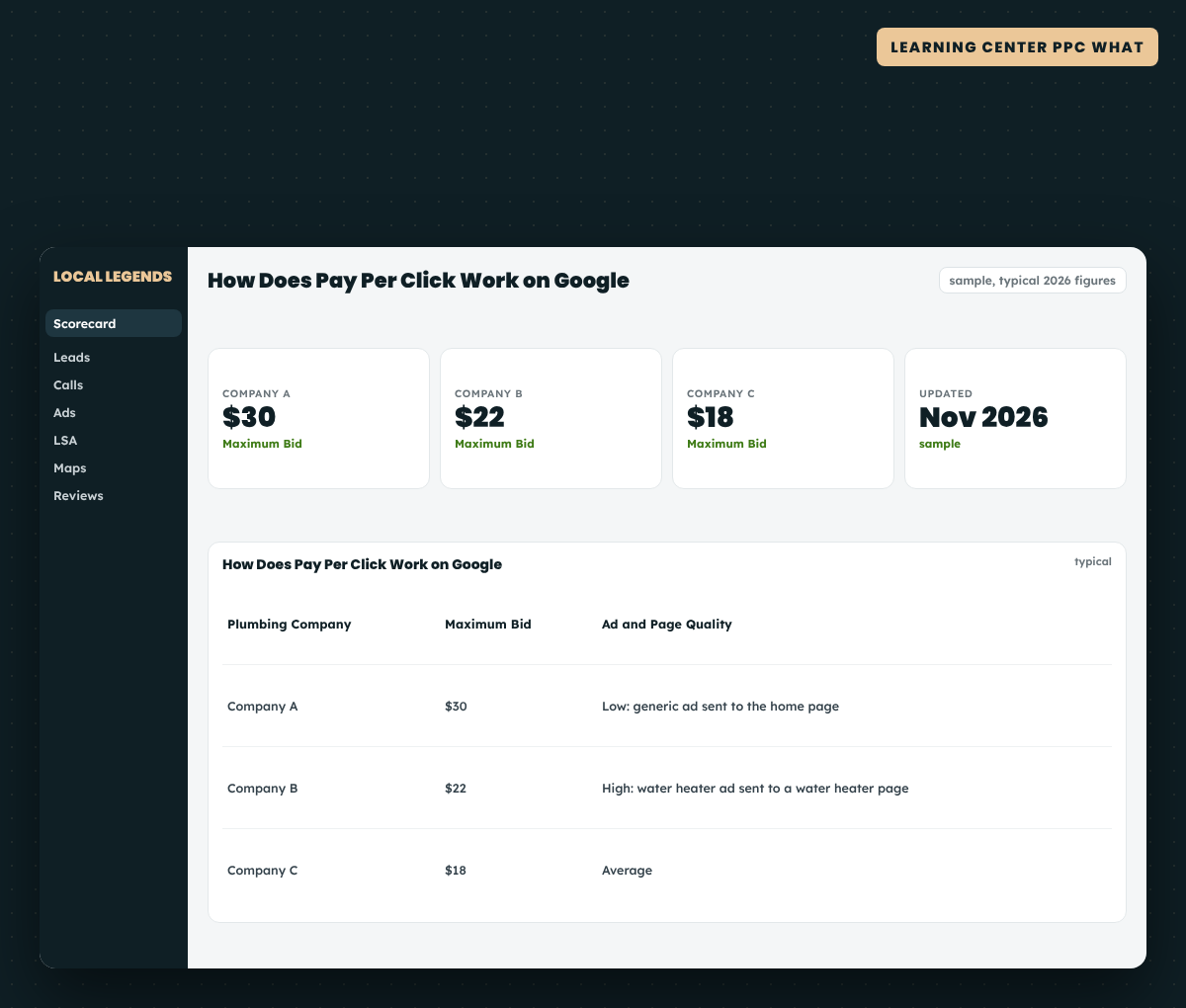
| Plumbing Company (Simplified Example) | Maximum Bid | Ad and Page Quality | Likely Result |
|---|---|---|---|
| Company A | $30 | Low: generic ad sent to the home page | Shows lower or not at all |
| Company B | $22 | High: water heater ad sent to a water heater page | Can win the top spot and pay less per click |
| Company C | $18 | Average | Shows below Company B |
This is a simplified illustration of how Google weighs bids and quality, not a real auction result or a price quote.
What Is Quality Score in Google Ads and Why Does It Matter for a Contractor?
Quality Score is Google's 1 to 10 rating of how well a keyword, its ad and its landing page fit together, and a stronger score can help a contractor pay less per click. Google calls the number a diagnostic, while the live auction uses ad quality, bids and context.
- Expected click-through rate: how likely searchers are to click, improved by naming the exact service and town in the headline.
- Ad relevance: how closely the ad matches the search, improved by separate ad groups for repair, replacement and emergency.
- Landing page experience: how fast and useful the page is, improved by a service page with a tappable phone number and real photos.
What Keywords Should a Roofing Company Bid On in Google Ads?
A roofing company should bid on keywords that show a homeowner is ready to hire or ask for an estimate, grouped by service and urgency so each ad matches the search. The Google AI Overview listed those groups in November 2026.
- Emergency and storm: emergency roof repair, roof tarping, storm and hail damage repair.
- Replacement: roof replacement plus the town, roof replacement estimate, metal roof installation.
- Repair: roof leak repair, shingle repair, flashing repair, roof inspection.
- Local modifiers: roofer near me and roofing contractor plus each town served.
- Usually skip:"how to fix a roof" and other do-it-yourself research terms.
What Are Negative Keywords and Why Do Plumbers Need Them?
Negative keywords are words added to a Google Ads campaign that stop the ad from showing on searches containing them, and plumbers need them because plumbing searches overlap with jobs, trade schools, parts and DIY videos. Each blocked click is budget saved.
- Careers: jobs, salary, apprentice, hiring, school.
- Do it yourself: how to, DIY, video, tutorial.
- Parts shoppers: parts, supply, wholesale, store names.
- Bargain hunting: free, cheap, when the company does not compete on price.
What Is CPC in Marketing, and What Is a Good CPC for a Roofing Company? Cost Per Click, Explained With Contractor Math
CPC in marketing is cost per click, the average price an advertiser pays each time someone clicks its ad, found by dividing total ad spend by total clicks. A roofer who spends $1,000 and gets 100 clicks has a $10 CPC.
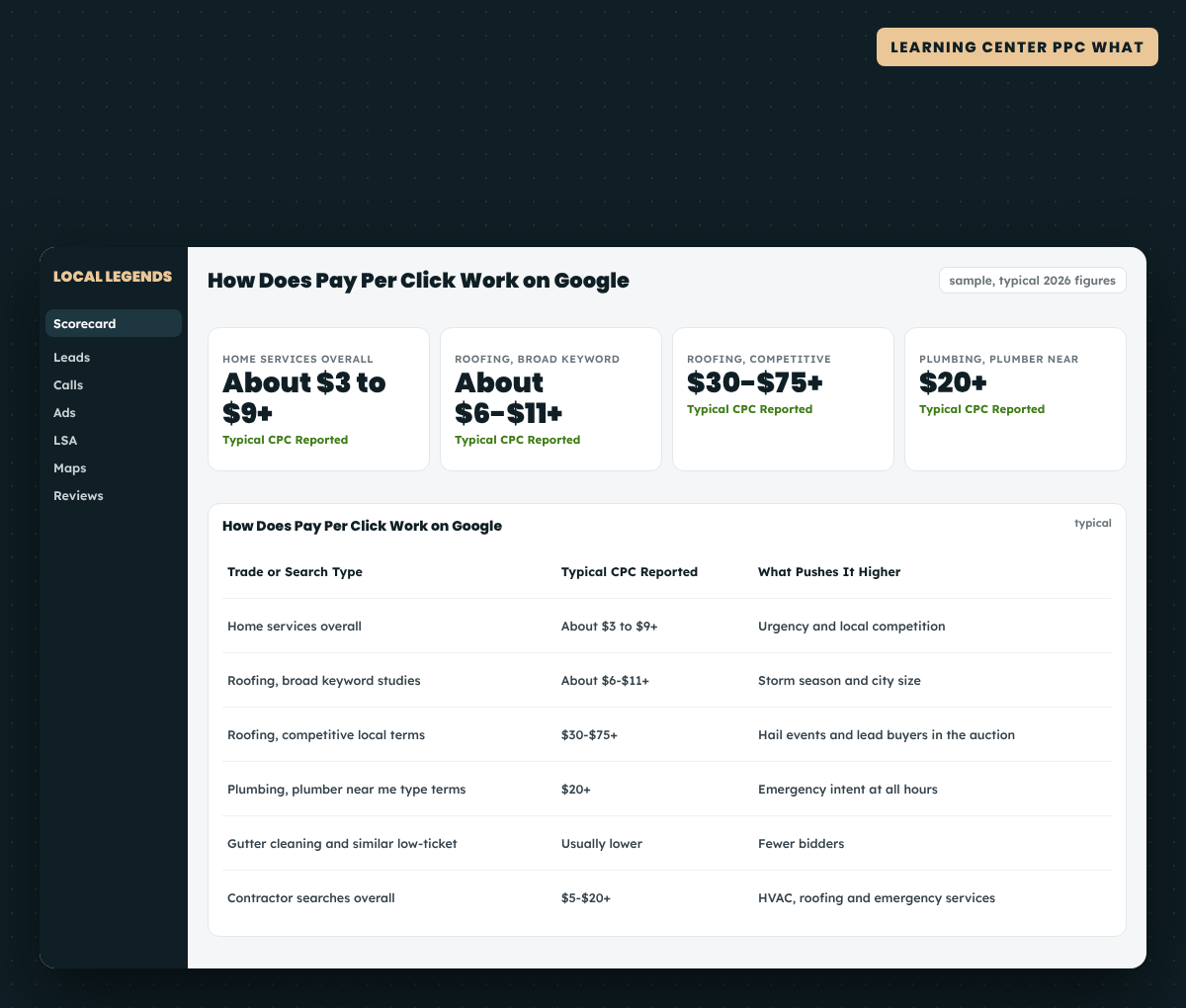
A good CPC for a roofing company is one that still produces booked inspections at a profit. The Google AI Overview reported in November 2026 that broad roofing keyword studies average roughly $6-$11+ a click, while competitive local roofing auctions often run $30-$75+.
| Trade or Search Type | Typical CPC Reported in 2026 | What Pushes It Higher |
|---|---|---|
| Home services overall | About $3 to $9+ | Urgency and local competition |
| Roofing, broad keyword studies | About $6-$11+ | Storm season and city size |
| Roofing, competitive local terms | $30-$75+ | Hail events and lead buyers in the auction |
| Plumbing, "plumber near me" type terms | $20+ | Emergency intent at all hours |
| Gutter cleaning and similar low-ticket work | Usually lower | Fewer bidders |
| Contractor searches overall | $5-$20+ | HVAC, roofing and emergency services |
These are typical figures quoted by the Google AI Overview in November 2026, not Local Legends data or a price quote. Your city, season and keyword match types change them.
Why Local Legends tracks past the click: founder Levi Ostlund lost $30,000+ to marketers before starting the agency, including one who ghosted and one who built a good-looking site that never ranked. Every report now follows a click to the booked and sold job. [SOURCE: Levi Ostlund founder story, BRIEF.md Nov 2026]
CPC vs CPM vs Cost Per Lead: Which Number Matters Most for Contractors?
For contractors, cost per lead and cost per booked job matter more than CPC or CPM, because a cheap click that never calls is still wasted money. The Google AI Overview called CPC and CPM leading signals for fixing campaigns, not goals on their own.
- CPC: ad spend divided by clicks, a check on keyword and ad pricing.
- CPM: ad spend divided by impressions, times 1,000, the cost of being seen.
- Conversion rate: leads divided by clicks, a test of the landing page.
- Cost per lead: ad spend divided by calls and forms.
- Booking rate: booked appointments divided by leads, a test of the office.
- Cost per booked job: ad spend and fees divided by booked jobs, the true cost of a full calendar.
Here is how those numbers connect for a contractor running search ads.
- Worked example:$2,000 in spend at a $10 CPC buys 200 clicks.
- At a typical 10% conversion rate: those 200 clicks become 20 calls and forms.
- At a 50% booking rate: 20 leads become 10 booked jobs, or $200 per booked job.
- Typical conversion rates: Google AI Overview figures put home service search ads near 8% to 15%, with emergency work higher and remodeling lower.
How the weekly scorecard reads: Local Legends sends a CEO scorecard with leads, booked jobs, sold jobs and cost per booked job, and connects CallRail call tracking to CRMs like ServiceTitan, Housecall Pro, JobNimbus, AccuLynx and Jobber. [SOURCE: Local Legends reporting and CRM integrations, BRIEF.md Nov 2026]
PPC vs Local Services Ads vs SEO for Home Service Companies Pay Per Click, Pay Per Lead and Earned Rankings
Home service companies have three main ways to show up on Google: PPC ads billed per click, Local Services Ads billed per lead and SEO rankings that are earned over time. Most growing contractors end up using all three in a set order.
- Google Ads PPC: billed per click, shows in search results with a link to your page, live in days and best for choosing exact services and towns.
- Google Local Services Ads: billed per qualified lead with disputes for invalid leads, shows at the top with your rating and suits core repair and service calls.
- Local SEO and the Map Pack: paid through content, citations and management, builds over months and lowers cost per lead over time.
- Microsoft Advertising: billed per click on Bing, live in days and often cheaper per click.
What Is the Difference Between Google Local Services Ads and Google Ads PPC?
Google Local Services Ads charge a contractor per lead and appear at the very top with the company's rating, while Google Ads PPC charges per click and sends the homeowner to a page the contractor chooses. The Google AI Overview drew that contrast in November 2026.
- Billing: LSA bills per qualified call or message; PPC bills every click, even when nobody calls.
- Setup: LSA requires license, insurance and background checks; PPC can launch in a day or two.
- Control: PPC gives keyword, schedule and landing page control; LSA works from service categories.
- Disputes: invalid LSA leads can be disputed for credit, which Local Legends does weekly.
Learn how pay-per-lead ads work on our Google Local Services Ads page.
PPC vs SEO for a Home Service Business: Which Should You Do First?
A home service business that needs calls this month should start with PPC or Local Services Ads, while one with a tight budget and a 6 to 12 month runway can lean on SEO first. The Google AI Overview recommended running both for most contractors.
- Start with PPC when: crews need work now, the site does not rank yet or a new service needs testing.
- Start with SEO when: ad budget is tight and referrals already cover the basics.
- Run both when: PPC fills the schedule while SEO lowers the long-term cost per lead.
- Use PPC data for SEO: the keywords that book jobs in ads become the service pages to build.
How Much Does PPC Cost Per Month for a Contractor? Ad Spend Plus the Management Fee
PPC for a contractor typically costs $1,500-$15,000+ a month in total, combining ad spend paid to Google and a separate management fee. The Google AI Overview reported in November 2026 that small local campaigns often start at $500-$3,000+ in ad spend while competitive remodelers spend $3,000-$15,000+.
Management fees usually follow one of two models: a flat monthly retainer or a percentage of ad spend, commonly 10% to 20%. Flat fees keep the price tied to the work, not the size of the budget.
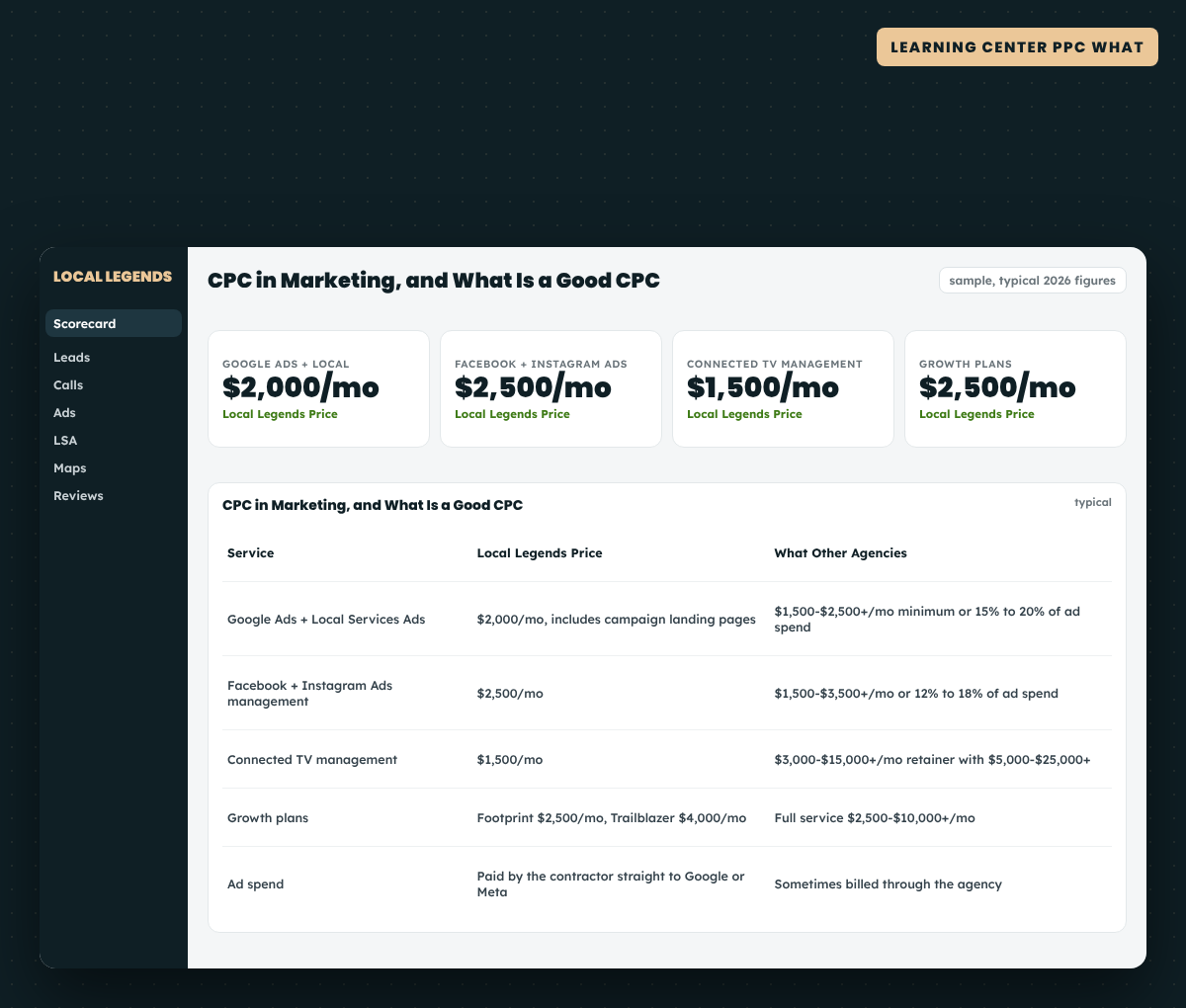
| Service | Local Legends Price | What Other Agencies Typically Charge |
|---|---|---|
| Google Ads + Local Services Ads management | $2,000/mo, includes campaign landing pages and monthly Google Business Profile optimization | $1,500-$2,500+/mo minimum or 15% to 20% of ad spend |
| Facebook + Instagram Ads management | $2,500/mo | $1,500-$3,500+/mo or 12% to 18% of ad spend |
| Connected TV management | $1,500/mo | $3,000-$15,000+/mo retainer with $5,000-$25,000+ media minimums |
| Growth plans | Footprint $2,500/mo, Trailblazer $4,000/mo, Sasquatch $8,000/mo, Legend $10,000+/mo | Full service $2,500-$10,000+/mo |
| Ad spend | Paid by the contractor straight to Google or Meta | Sometimes billed through the agency |
- Flat monthly fees: never a percentage of ad spend.
- No setup fees and no long-term contracts: on every Local Legends plan.
- Bing included on Trailblazer and up: along with Facebook and Instagram ads.
- Typical cost per lead: Google AI Overview figures range from about $50 to $500+ by trade and project size.
See every plan and add-on on the Local Legends pricing page.
Is PPC Worth It for a Small HVAC Company?
PPC is usually worth it for a small HVAC company that focuses on high-ticket replacements and urgent repairs, answers the phone fast and tracks every call to a booked job. The Google AI Overview said in November 2026 that it often fails when budgets are too thin to gather data.
- Works well for: no-cool and no-heat calls, system replacements and heat pump installs.
- Struggles when: calls go to voicemail or ads land on a generic home page.
- Start narrow: core service area, emergency and replacement keywords, strong negatives.
- Scale by season: more budget ahead of the first heat wave and the first cold snap.
Want to know if PPC fits your budget? Book a free growth audit and the Local Legends team will review your tracking, Google Business Profile and funnel before recommending a number.
Common PPC Problems Contractors Run Into and How to Fix Them From Wasted Clicks to Booked Jobs
Most contractor PPC problems come from where the click goes, which searches trigger the ad and whether anyone can see which calls came from which ad. Each one is fixable once tracking is in place.
My Google Ads Get Clicks but No Calls. Why?
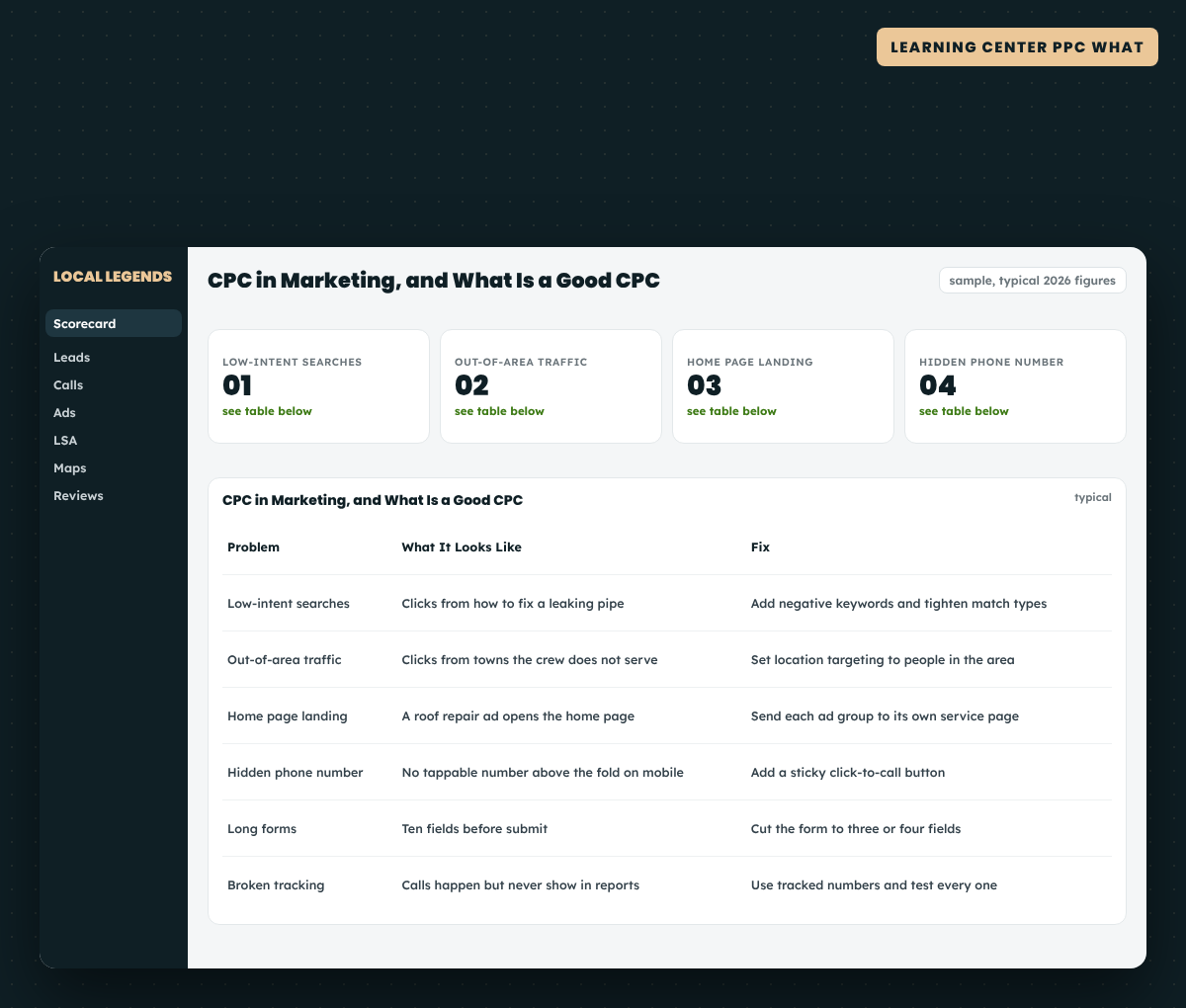
When contractor ads get clicks but no calls, the cause is usually low-intent searches, a landing page that is hard to use on a phone or call tracking that is not recording calls. The Google AI Overview listed these causes in November 2026.
| Problem | What It Looks Like | Fix |
|---|---|---|
| Low-intent searches | Clicks from "how to fix a leaking pipe" | Add negative keywords and tighten match types |
| Out-of-area traffic | Clicks from towns the crew does not serve | Set location targeting to people in the area |
| Home page landing | A roof repair ad opens the home page | Send each ad group to its own service page |
| Hidden phone number | No tappable number above the fold on mobile | Add a sticky click-to-call button |
| Long forms | Ten fields before submit | Cut the form to three or four fields |
| Broken tracking | Calls happen but never show in reports | Use tracked numbers and test every one |
How Long Does It Take for PPC to Work for a Plumbing Company?
PPC can bring a plumbing company its first calls within days of launch, while a steady cost per booked job typically takes 30 to 90 days of data and adjustments. The Google AI Overview laid out that timeline in November 2026.
- Days 1 to 14: campaigns, call tracking and the first emergency calls.
- Weeks 2 to 4: search term reviews and new negative keywords cut waste.
- Months 1 to 3: bids, schedules and service areas tuned to calls that book.
- Months 2 to 4 and on: stable cost per lead, then scaling the services that pay best.
Should You Run Your Own Google Ads or Hire a PPC Agency, and Who Owns the Account?
A contractor spending under roughly $2,500-$3,000+ a month with a simple service area can often run Google Ads alone, while larger or multi-service budgets usually justify an agency. Either way, the business should own the ad account.
The Google AI Overview explained in November 2026 that an account created by an agency inside its own manager account can make the agency the default owner. Create the account under a business login and grant access instead.
- Run it yourself if: you have a few hours each week and will check search terms and locations.
- Hire help if: spend is growing, several services compete for budget or tracking is unclear.
- Ownership: keep admin access to Google Ads, call tracking and analytics in your name.
- Questions to ask: how fees are set, who owns the account and what the reports measure.
How Local Legends handles ownership: clients own every account, from the website and domain to the Google Business Profile, ad accounts and call data, and every engagement includes the Local Legends marketing course and a weekly project review meeting. [SOURCE: Local Legends ownership and engagement facts, BRIEF.md Nov 2026]
Compare management options on our PPC management page.
Local Legends Marketing Reviews From Contractor CEOs Owners Who Hired Levi Ostlund
Roofing and restoration owners have gone on record about working with Local Legends Marketing and founder Levi Ostlund on strategy, paid ads and tracking. Video testimonials are on the Local Legends reviews page [LINK: /about-us/reviews/].
Levi has been absolutely outstanding to work with over the years... His creativity, responsiveness, and deep understanding of our marketing strategy have made a huge impact." Brad Beldon, CEO, Roofing Company. Read on Local Legends
- Kyle Scott, CEO, Roofing Company (video testimonial)
- Jim Dodson, CEO, Roofing Company (video testimonial)
- Race Allen, CEO, Precision Restoration of Texas (video testimonial)
- Brad Beldon, CEO, Roofing Company (written testimonial)
Frequently Asked Questions About PPC PPC in Short Answers
What Does PPC Stand For?
In marketing, PPC stands for pay per click. The same letters mean other things in other fields, such as the production possibility curve in economics, so the context of the search matters.
What Is the Difference Between PPC and CPC?
PPC is the advertising model and CPC is the price of one click inside it. People often use the two terms as synonyms.
Is PPC the Same as Google Ads?
Google Ads is the largest PPC platform, but PPC also runs on Microsoft Advertising, Facebook, Instagram, YouTube and other networks. Google Ads also sells ads billed per impression.
What Is PPC in Social Media?
PPC in social media means paying when someone clicks a Facebook, Instagram or similar ad. Contractors often use it for planned projects like roofing, remodeling and painting.
What Are Examples of PPC Marketing for a Contractor?
An HVAC search ad for "AC replacement" in one county, a roofer's Bing ad after a hailstorm and a remodeler's Facebook ad showing a finished kitchen are all PPC. Each one bills when someone clicks.
What Is Search Engine Marketing in Simple Words?
Search engine marketing is everything a business does to show up when people search on Google or Bing. For a contractor, that means search ads, the Google Map Pack and service pages that rank.
What Is CPM in Advertising?
CPM is cost per mille, the price of 1,000 ad impressions, whether or not anyone clicks. Contractors use it mostly for awareness and retargeting.
Can a Contractor Stop PPC Ads at Any Time?
Yes, a contractor can pause Google Ads campaigns at any time, and ad spend stops when the ads stop. Pausing during a backlog and restarting before peak season is common.
Reviewed by Levi Ostlund, Founder, Local Legends Marketing

Turn PPC Clicks Into Booked Jobs for Your Home Service Company Start With a Free Growth Audit
The fastest way to see what PPC can do for your company is to review your tracking, landing pages, Google Business Profile and current ad accounts in one pass. Local Legends Marketing audits all of them, runs Google Maps rank grids and recommends a budget that fits your trade.
- Flat monthly fees, with no setup fees and no long-term contracts.
- You own every account, from Google Ads to the call data.
- A CEO scorecard that follows each click to the booked and sold job.
See how campaigns are built on our Google Ads management page, then call (936) 900-1248 or book a free growth audit online. Local Legends works with contractors in every state; see the Local Legends service areas page.