


Local Legends Marketing for Production,

Home Builder Marketing That Fills Model Home Tours, Moves Quick Move-In Homes and Tracks Every Lead to a Signed Purchase Agreement
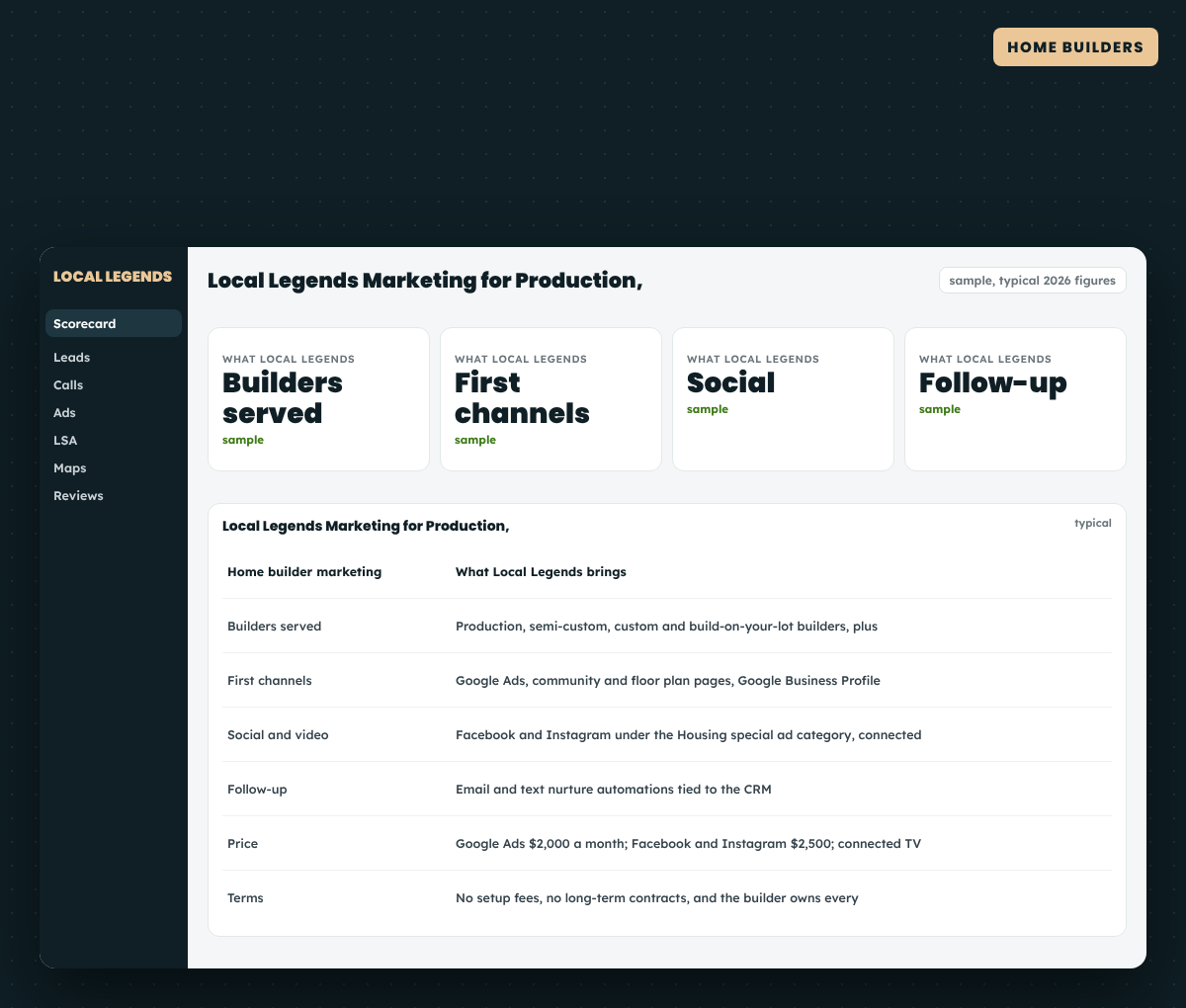
Local Legends Marketing for Production, Semi-Custom and Custom Home Builders
Updated November 2026 · Reviewed by Levi Ostlund, Founder
Home builder marketing is the work of getting qualified buyers to tour a community, choose a lot or a quick move-in home and sign a purchase agreement, and Local Legends Marketing runs it with search ads, SEO, housing-category social ads, connected TV and fast follow-up, all reported in signed contracts.
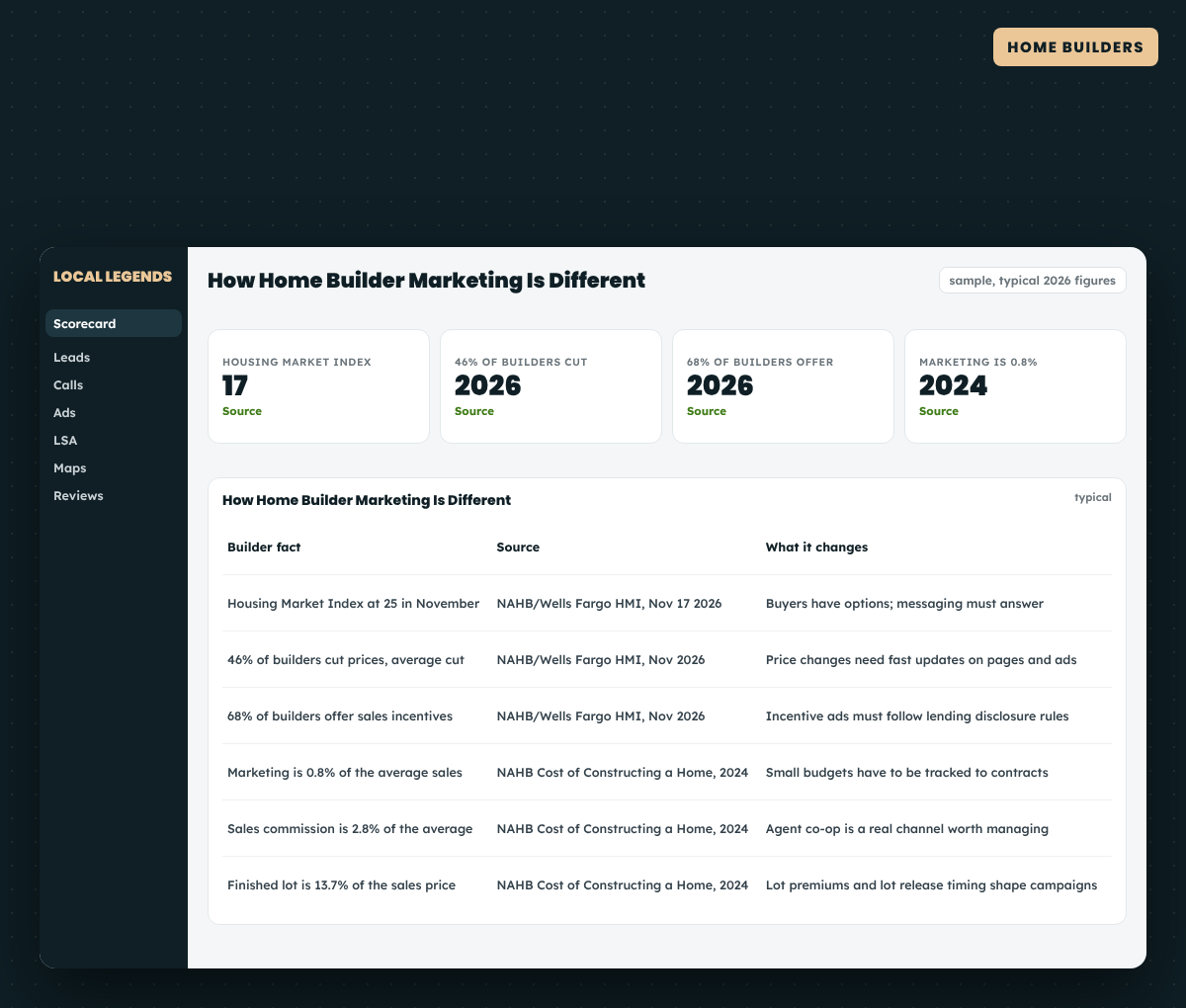
The market makes that work harder in 2026. The NAHB/Wells Fargo Housing Market Index fell to 25 in November 2026, its lowest since April 2012, with 46% of builders cutting prices and 68% offering sales incentives. Marketing has to sell value, not just announce inventory.
- Search first: Google Ads for "new homes in" searches, managed for a flat $2,000 a month.
- Social built for the rules: Facebook and Instagram ads run under Meta's Housing special ad category, $2,500 a month.
- Pages that sell homes: community, floor plan and quick move-in pages written to rank and to book tours.
- Contracts on the report: tours, purchase agreements and cost per sale, not clicks alone.
Free Growth Audit
Your Reviews, Radius and Response Rate vs the competitors beating you.
About Local Legends Marketing
A home service marketing agency headquartered in Conroe, Texas, with 8+ years of marketing experience, running Google Ads, Local Services Ads, local SEO, AI SEO, connected TV and review systems for contractors nationwide.
How Home Builder Marketing Is Different From Marketing a Service Trade Inventory, Lots and Long Decisions
Home builder marketing differs from service trade marketing because a builder sells a finished product with a price, a lot and a closing date, not an emergency repair. Buyers compare floor plans, schools, payments and incentives for weeks or months, and every unsold home costs money while it waits.
The cost structure shows how lean marketing usually is. NAHB's 2024 Cost of Constructing a Home survey put marketing at just 0.8% of the average sales price and sales commission at 2.8%, with the finished lot at 13.7%.
| Builder fact | Source | What it changes for marketing |
|---|---|---|
| Housing Market Index at 25 in November 2026, lowest since April 2012 | NAHB/Wells Fargo HMI, Nov 17 2026 | Buyers have options; messaging must answer affordability |
| 46% of builders cut prices, average cut 6% | NAHB/Wells Fargo HMI, Nov 2026 | Price changes need fast updates on pages and ads |
| 68% of builders offer sales incentives | NAHB/Wells Fargo HMI, Nov 2026 | Incentive ads must follow lending disclosure rules |
| Marketing is 0.8% of the average sales price | NAHB Cost of Constructing a Home, 2024 | Small budgets have to be tracked to contracts |
| Sales commission is 2.8% of the average sales price | NAHB Cost of Constructing a Home, 2024 | Agent co-op is a real channel worth managing |
| Finished lot is 13.7% of the sales price | NAHB Cost of Constructing a Home, 2024 | Lot premiums and lot release timing shape campaigns |
Three Builder Models, Three Funnels
- Production builders: many homes in a few communities, where model home tours and quick move-in homes drive sales.
- Semi-custom builders: a plan library with options, where floor plan pages and design center visits matter.
- Custom and build-on-your-lot builders: fewer, larger contracts, where lot owners and long nurture decide the sale.
How Should a Home Builder Market Quick Move-In Spec Homes Sitting in Inventory?
A home builder moves quick move-in spec homes by marketing each home on its own, with its photos, completion date, incentive and the buyer it fits best, instead of posting one long inventory list. Every unsold week adds construction interest, taxes, insurance, HOA dues and utilities.
- One home per campaign: a dedicated page, ad and email for each priority home.
- Show what is finished: real rooms, real light and real dimensions, with no construction delay.
- Lead with move-in timing:"ready in 30 days" speaks to relocating and lease-ending buyers.
- State the incentive correctly: closing cost help or a rate buydown, with the lending disclosures it needs.
- Tell agents first: send the quick move-in list to local agents every week.
When to Change the Offer Instead of the Ad
If a home gets tours but no contracts, the problem is usually price, lot or incentive, not ad reach. A tour-to-contract number on the scorecard shows which lever to pull.
Who Is the Best Home Builder Marketing Agency? Lots, Tours and Contracts
The best home builder marketing agency understands construction sales cycles, qualifies buyers before they reach the sales team and reports cost per tour and cost per signed contract, not impressions or form fills. That is the standard Google's AI Overview described for this search in November 2026.
- Industry fluency: knows custom, build-on-your-lot, spec and production building, plus construction loans and long timelines.
- Lead quality over volume: filters out-of-budget buyers with price, timing and lot questions.
- Outcome reporting: cost per lead, cost per tour and cost per signed contract.
- Channels that connect: search, SEO, Google Business Profile, housing-category social and AI search work together.
- Rule awareness: Fair Housing ad rules, Meta's housing category limits and lending ad disclosures.
- Ownership in writing: the website, ad accounts, CRM data and content stay with the builder.
How Local Legends Answers These Questions
Local Legends Marketing grew out of home service and remodeling marketing, and brings the same tracked approach to builders. Clients own every account, and there are no long-term contracts or setup fees.
Every engagement starts with an audit of tracking, local SEO, Local Services Ads and the funnel, including Google Maps rank grids.
Why the founder measures contracts, not clicks: Levi Ostlund poured concrete with his dad, sold driveway jobs door to door at 10 and later served as CMO of Amstill Roofing. He lost $30,000+ to marketers who reported activity instead of results, which is why every client gets a weekly CEO scorecard. [SOURCE: Local Legends founder story and CEO scorecard, confirmed company facts, Nov 2026]
The Local Legends Channel Mix for Home Builders Search First, Then Stay Visible
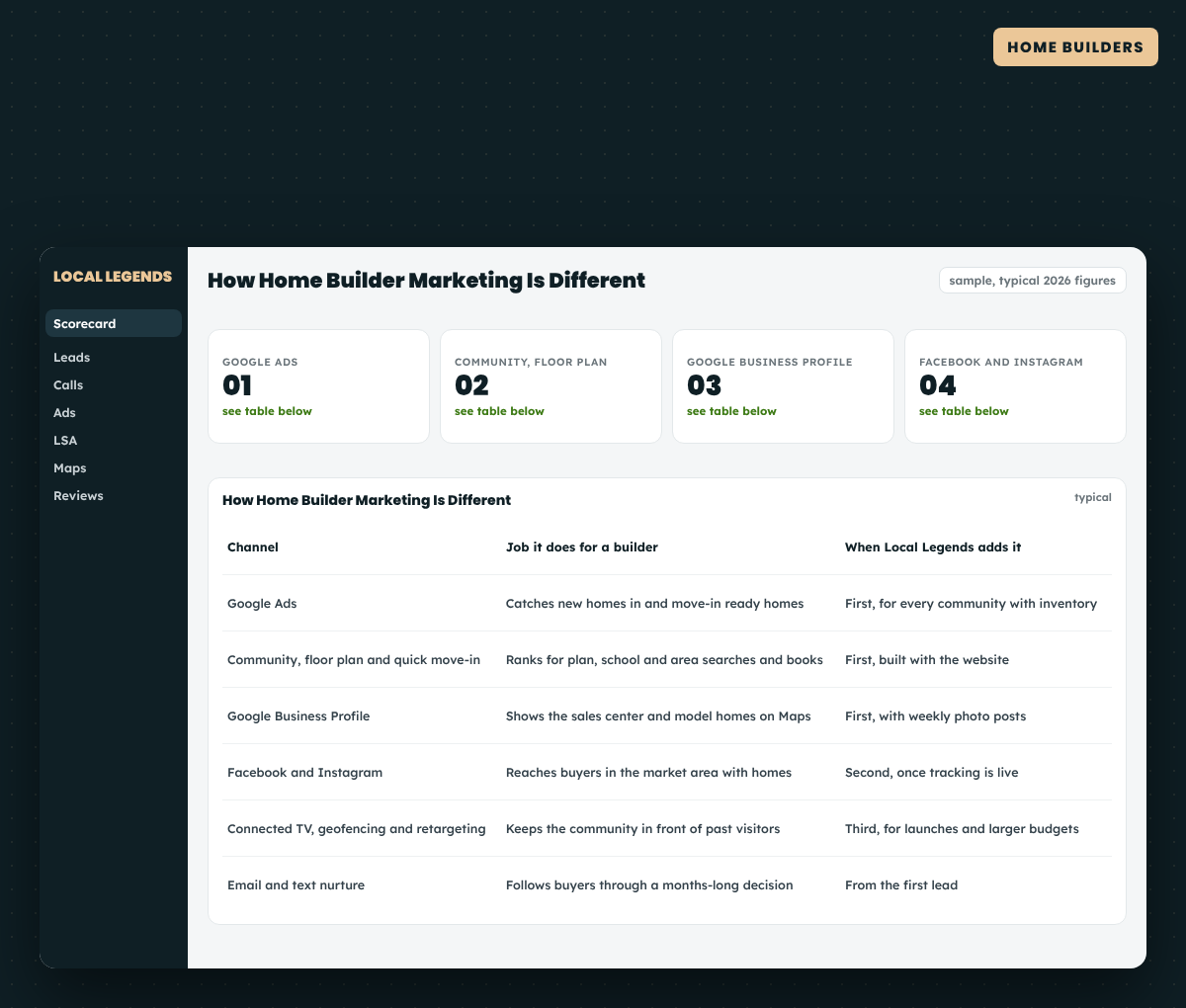
The Local Legends channel mix for home builders starts with Google Ads and community pages that catch buyers searching for new homes, then adds housing-category social ads, connected TV and retargeting to stay visible through a decision that can take months.
| Channel | Job it does for a builder | When Local Legends adds it |
|---|---|---|
| Google Ads | Catches "new homes in" and "move-in ready homes" searches | First, for every community with inventory |
| Community, floor plan and quick move-in pages | Ranks for plan, school and area searches and books tours | First, built with the website |
| Google Business Profile | Shows the sales center and model homes on Maps with reviews | First, with weekly photo posts |
| Facebook and Instagram (Housing special ad category) | Reaches buyers in the market area with homes and incentives | Second, once tracking is live |
| Connected TV, geofencing and retargeting | Keeps the community in front of past visitors and nearby households | Third, for launches and larger budgets |
| Email and text nurture | Follows buyers through a months-long decision | From the first lead |
Search campaigns are managed on the Google Ads management page, and social campaigns on the Facebook and Instagram ads page.
Why Search Ads Usually Come First for Community Builders
Search ads reach people already typing "new homes in" a town, and a home's margin gives room for the cost of a lead when campaigns are judged by signed contracts. The weak spots are broad keywords and slow follow-up, which waste spend quickly.
Are Facebook Ads for Home Builders Restricted Under Meta's Housing Special Ad Category?
Yes. Facebook and Instagram ads for home builders fall under Meta's Housing special ad category in the United States, which removes ZIP code targeting and exclusions, locks age and gender to everyone and requires a location radius of at least 15 miles.
- Declare it at the campaign level: set the Housing special ad category before the ads are built.
- Plan wider geography: use cities, counties, metros or a 15-mile minimum radius instead of ZIP codes.
- Let the creative qualify: price ranges, home styles and community details attract the right buyers.
- Lean on your own lists: past visitors and interest list sign-ups help where detailed targeting is limited.
- Keep the wording fair: describe the home and community, never the kind of person who should live there.
Home Builder Websites and SEO Built Around Communities and Floor Plans Every Community, Plan and Home Gets Its Own Page
Home builder SEO works when each community, floor plan and quick move-in home has its own page with unique local details, current pricing and availability, linked together so buyers and search engines can move from area to community to plan to home.
What Pages Does a Home Builder Website Need for SEO, Like Community Pages, Floor Plan Pages and Quick Move-In Pages?
A home builder website needs a page for every community, every floor plan and every quick move-in home, each written with details only that page has, because thin, identical templates across subdivisions rarely rank or convert.
- Area pages: the towns or counties where you build, with schools, commutes and amenities.
- Community pages: lot sizes, HOA details, amenities, site plan, price range and available homes.
- Floor plan pages: square footage, beds, baths, stories, garage and elevations, with the communities that offer it.
- Quick move-in pages: one per home, with address, completion date, photos and incentive.
- Buying process pages: financing basics, design center steps and warranty.
- Tour booking: a calendar link on every page so buyers can pick a time.
Local Legends websites run $2,500 for 10 pages, $5,500 for 20, $7,500 for 40 and $15,000 for 80, which fits a builder with several communities and a plan library. See website design.
How Do I Get My Home Building Company Recommended by ChatGPT and Google AI Mode?
A home building company gets recommended by ChatGPT and Google AI Mode by publishing clear facts, keeping listings consistent, earning steady reviews and letting AI crawlers read the site, because both tools pull from search indexes, business profiles and third-party sources.
- Google Business Profile: complete categories, sales center hours and community details for AI Mode.
- Bing Places and Bing Webmaster Tools: ChatGPT's web search draws on Bing's index.
- Consistent facts everywhere: name, address, phone, communities and price ranges match on every listing.
- Answer-first pages: price ranges, included features and timelines stated plainly.
AI SEO is included in the Sasquatch and Legend plans and covered on the SEO page.
Do Google Local Services Ads Work for New Home Builders? No Category for New Homes
Google Local Services Ads has no category for new home construction or custom home building, so most builders get more from Google Search ads, community pages and the Google Business Profile. Google's US category list covers general contractors and remodeling trades, not new home sales.
- General contractor category: open to builders who also sell additions or large renovations, but new-home buyers rarely trigger it.
- Kitchen and bathroom remodeling: fits only if the builder also sells remodels.
- Pay-per-lead pricing: a poor match for a buyer who researches for months before calling.
- Better fit for new homes: Search ads for "new homes in" a town, with a page for each community.
Google is moving Local Services Ads into Google Ads in phases, starting in the United States in August 2026. Builders who run the General contractor category should save their LSA reports before the move. The Google Ads plus LSA fee at Local Legends is $2,000 a month either way.
Speed to Lead: Turning Home Builder Inquiries Into Model Home Tours The First Helpful Reply Wins the Tour
Home builder inquiries turn into model home tours when the reply comes fast and booking is easy, because buyers often message several builders at once and favor the first helpful answer.
How Fast Should a Home Builder Respond to a New Home Inquiry?
A home builder's online sales counselor should give a personal reply within 5 minutes during sales hours, with an instant acknowledgment at any hour and a personal call or text by 10 AM for overnight inquiries, per the benchmark Google's AI Overview reported in November 2026.
- During sales hours: a real phone call, text or email within 5 minutes.
- After hours: an automatic reply with a booking link, then a personal follow-up next morning.
- First two weeks: several touches by phone, text, email and video, not one reply.
- Every reply logged: the CRM records who answered and when, so slow spots show up.
How Local Legends supports follow-up: Trailblazer and above add email and text automations, and CallRail call tracking connects to the CRM so every call and form is tied to its source. See call tracking and CRM integration. [SOURCE: Local Legends plan inclusions and CallRail CRM integration, confirmed company facts, Nov 2026]
How Do Home Builders Get More Model Home Tour Appointments From Online Leads?
Home builders get more model home tours from online leads by answering fast, offering self-scheduled tour times and giving buyers the tour style they prefer, including self-guided options for shoppers who want to look without pressure.
- Calendar links: let buyers pick a slot without phone tag.
- Tour choices: guided, self-guided and video tours.
- Pre-tour texts: directions, parking and which homes are open.
- Same-day reminders: cut no-shows with a short text before the visit.
Realtor Co-Op and New Community Launch Marketing for Builders Sell Before Opening Day
Builders sell more homes when local agents and early interest lists are treated as real sales channels, with written co-op terms, ready-to-share materials and a launch plan that starts months before the grand opening.
How Do Home Builders Get More Realtor Co-Op Sales and Agent Referrals?
Home builders get more co-op sales by treating local agents as a structured channel, targeting the agents who already sell in their price band and making it easy to show and sell their homes.
- Target by price band: the agents who close homes at your prices in your areas.
- Put co-op terms in writing: commission, registration rules and timing, so agents know they are protected.
- Give agents tools: a one-page sheet of plans, pricing, lots and the weekly quick move-in list.
- Host agent previews: let agents see new phases before the public.
How Should a Home Builder Launch a New Community With a Grand Opening and VIP Interest List?
A home builder should start marketing a new community 3 to 8 months before opening, building a VIP interest list with early access so the first phase has buyers waiting on opening day.
- Brand the community early: name, renderings, aerial footage, plans and lifestyle message.
- Launch a VIP page: a "join the VIP list" form that captures timing and price range.
- Put up coming-soon signs: with a short web address or QR code to the VIP page.
- Run search and social ads: pointed at the VIP page, not a generic home page.
- Nurture the list: monthly updates on lots, pricing and the opening date.
- Open to VIPs first: a preview event before the public grand opening.
Connected TV, geofencing and retargeting are part of the Sasquatch plan and fit launch campaigns well. Connected TV alone is $1,500 a month plus media.
Advertising Incentives, Rate Buydowns and Fair Housing Rules for Builders Sell the Incentive Without Breaking the Rules
Builders can advertise incentives and rate buydowns when the ads carry the disclosures federal rules require, and every housing ad has to follow the Fair Housing Act, which bars ads that state a preference based on a protected class.
Can a Home Builder Advertise Mortgage Rate Buydowns, and What Are the Disclosure Rules?
Yes, a home builder can advertise a mortgage rate buydown if the ad meets truth-in-lending advertising rules, because Regulation Z (12 CFR 1026.24) requires an ad that states a rate to also state the APR, and payment terms trigger more disclosures.
- State the term and the later rate: how long the reduced rate lasts and what it becomes.
- Show the APR: with equal prominence next to any advertised rate.
- Watch payment claims:"own it for" a monthly amount triggers added disclosures.
- Have the lender review it: the preferred lender or compliance team signs off before launch.
- Keep Fair Housing language: describe homes and features, never the buyer.
Home Builder Marketing Seasonality and Budget Calendar Ramp in Winter, Spend in Spring
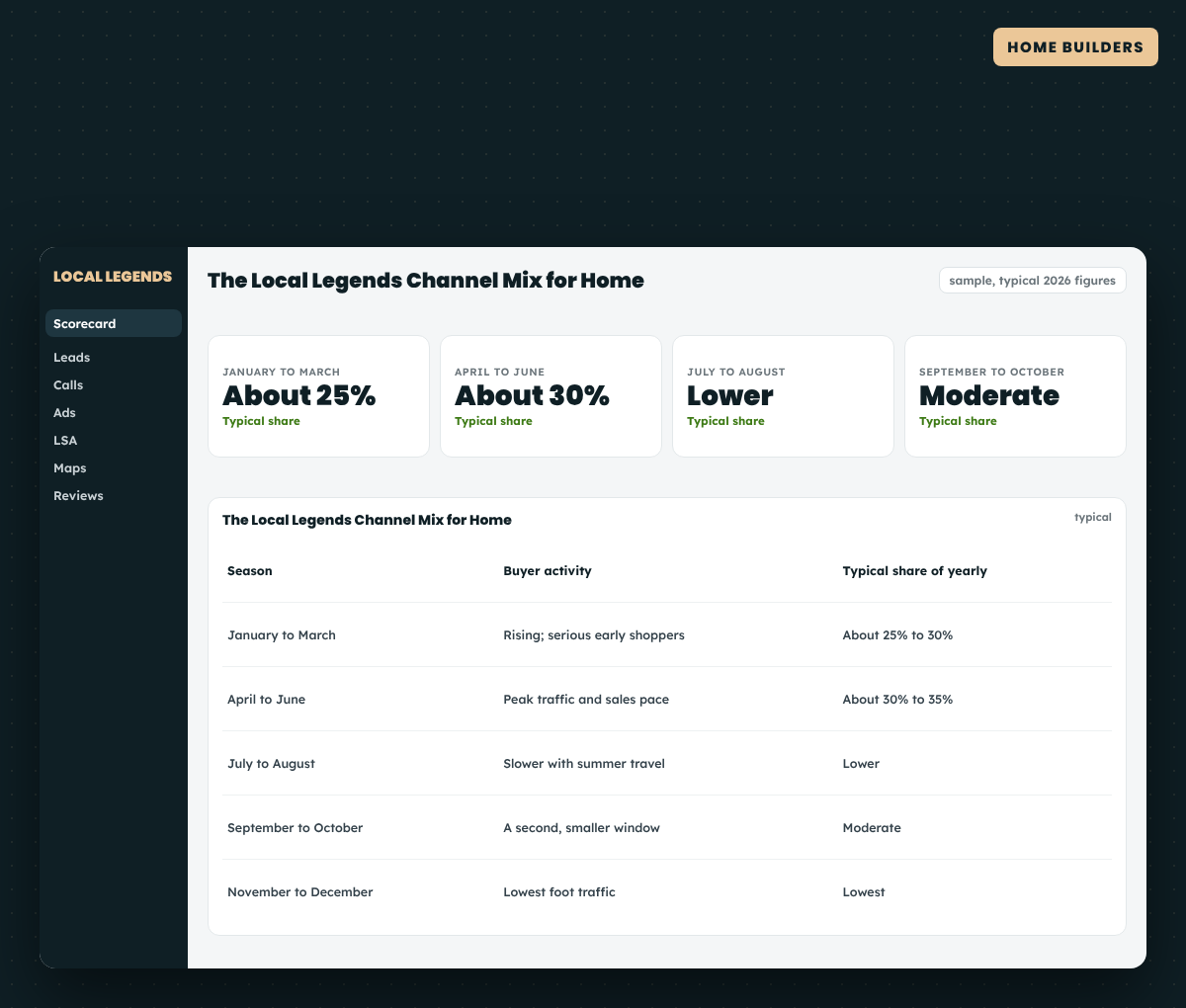
Home builder marketing follows a spring selling season, with buyer traffic and sales pace highest from March through June, so budgets ramp in the first quarter and peak in the second.
When Is the Best Season to Sell New Homes, and When Should Builders Spend the Most on Marketing?
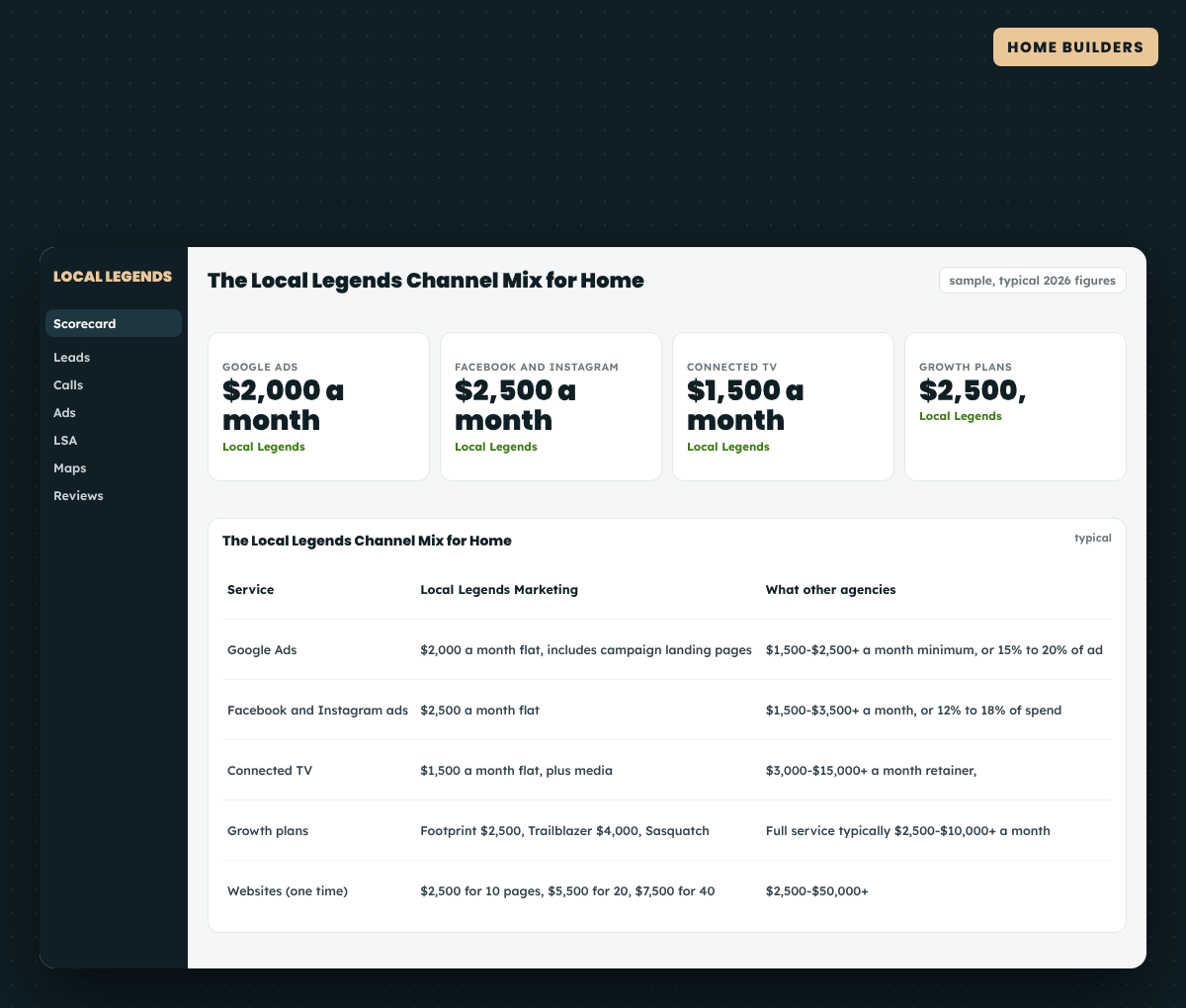
The best season to sell new homes is spring through early summer, roughly March through June, and builders typically put their heaviest spend in the second quarter, about 30% to 35% of the year's budget, after ramping up with about 25% to 30% in the first quarter.
| Season | Buyer activity | Typical share of yearly budget | Campaign focus |
|---|---|---|---|
| January to March | Rising; serious early shoppers | About 25% to 30% | Interest lists, new phase previews, plan and community pages |
| April to June | Peak traffic and sales pace | About 30% to 35% | Search ads, tours, open houses, agent events |
| July to August | Slower with summer travel | Lower | Quick move-in homes for school-year moves |
| September to October | A second, smaller window | Moderate | Fall incentives and remaining inventory |
| November to December | Lowest foot traffic | Lowest | Year-end closeouts, motivated buyers, next-year launch prep |
Typical seasonal patterns and budget shares reported by Google's AI Overview in November 2026. Climate and local school calendars shift each market.
How Much Does Home Builder Marketing Cost in 2026? A Share of Each Sale
Home builder marketing typically costs 1% to 5% of a home's sale price per home sold, according to Google's AI Overview in November 2026, with production builders near 1% to 2.5%, custom builders near 2% to 5% and new community launches running higher. NAHB's survey puts the average at 0.8% of the sales price.
On a $450,000 production home, 1% to 2.5% is about $4,500-$11,250+ in marketing per sale. Published builder guides also put digital spend for larger builders near $5,000-$15,000+ a month.
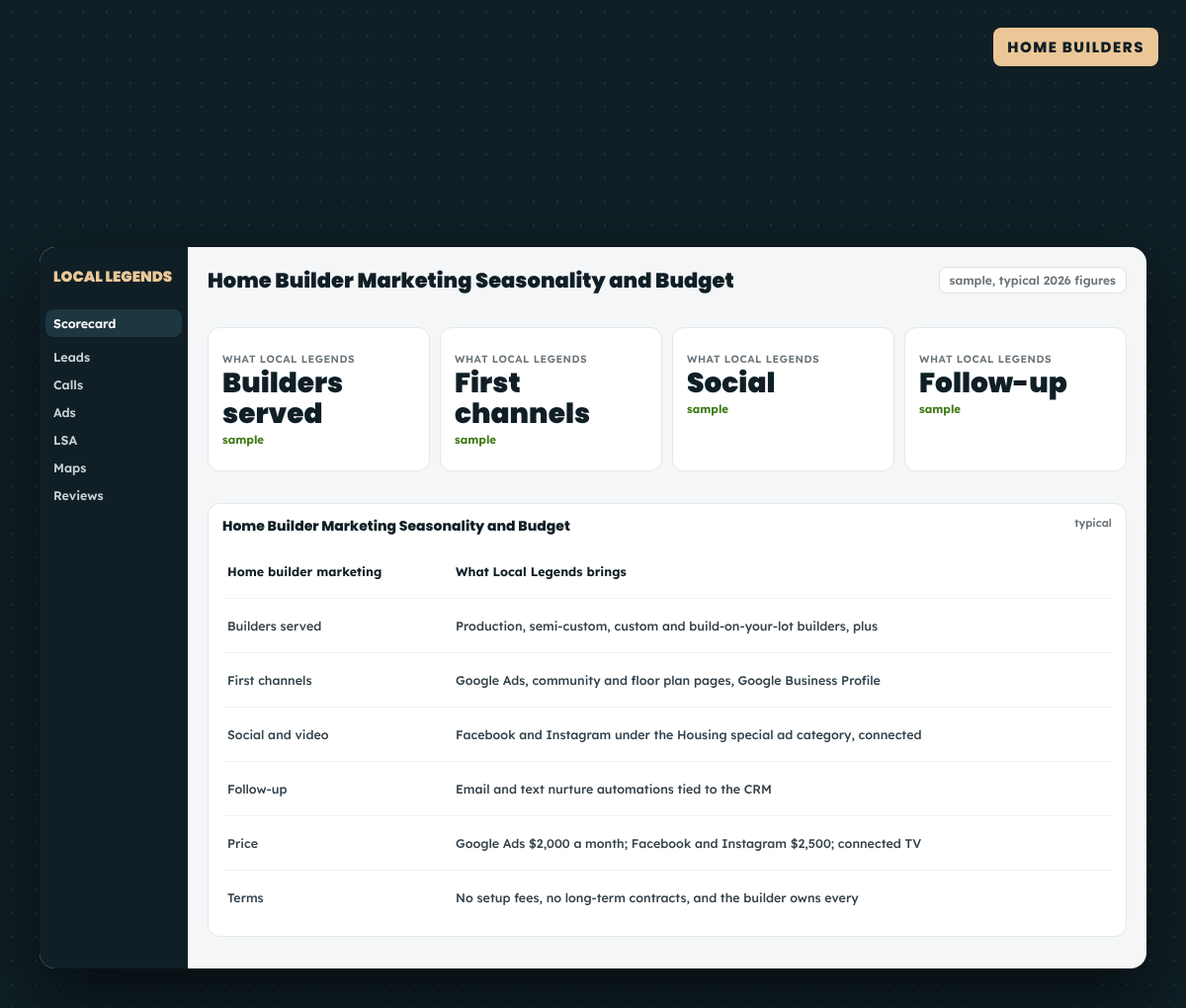
| Service | Local Legends Marketing | What other agencies typically charge |
|---|---|---|
| Google Ads (plus Local Services Ads where it fits) | $2,000 a month flat, includes campaign landing pages and monthly Google Business Profile optimization | $1,500-$2,500+ a month minimum, or 15% to 20% of ad spend |
| Facebook and Instagram ads | $2,500 a month flat | $1,500-$3,500+ a month, or 12% to 18% of spend |
| Connected TV | $1,500 a month flat, plus media | $3,000-$15,000+ a month retainer, with $5,000-$25,000+ media minimums |
| Growth plans | Footprint $2,500, Trailblazer $4,000, Sasquatch $8,000, Legend $10,000+ a month | Full service typically $2,500-$10,000+ a month |
| Websites (one time) | $2,500 for 10 pages, $5,500 for 20, $7,500 for 40, $15,000 for 80 | $2,500-$50,000+ |
Typical agency ranges reflect 2026 published agency pricing. Ad spend is paid by the builder straight to Google, Meta or the TV network. Every plan and add-on is on the Local Legends pricing page.
What Is a Good Cost per Lead and Marketing Cost per Home Sale for a New Home Builder?
A good cost per lead for a new home builder typically runs $15-$150+ depending on the channel, and marketing cost per home sale often lands under 1% to 2% of contract value, worked out as cost per lead divided by the lead-to-sale rate.
- Social ads: typically about $14-$30+ per lead, with lower intent and lower close rates.
- Search ads: commonly $50-$160+ per lead, averaging near $100, with higher intent.
- Listing sites and niche platforms: typically $50-$220+ per lead, by metro.
- SEO and referrals: lower direct cost once built, but slower to start.
- The real number: cost per signed contract, which needs every lead tracked to the sale.
Home Builder Marketing Tracked From Lead to Signed Purchase Agreement The Contract Is the Report
Home builder marketing is tracked by tagging every lead with its source at first contact and following it through tours to a signed purchase agreement, so the builder knows which channel and community actually sell homes. Leads and tours are chapter one; contracts and cost per sale finish the story.
How Does a Home Builder Track Which Marketing Leads to Signed Purchase Agreements?
A home builder tracks marketing to purchase agreements by tagging each lead's source in the CRM, linking the buyer to a community or home and moving the record through pipeline stages until the contract is signed.
- Tag every source: forms and ads pass campaign tags; calls use tracking numbers.
- Log walk-ins and calls: sales counselors record model home visits with their source.
- Credit referrals: agents and past buyers logged as sources so they get credit at closing.
- Link to a home: each buyer record ties to a community, lot or quick move-in home.
- Report by stage: lead, tour, contract and closing, by channel and by community.
What a Local Legends builder scorecard shows: Footprint includes a monthly scorecard and Trailblazer and above a weekly one, with leads, booked tours, sold homes and cost per sale, plus a fractional CMO and CEO meeting on every plan. [SOURCE: Local Legends plan inclusions and scorecard, confirmed company facts, Nov 2026]
Contractor Reviews of Local Legends Marketing CEOs on the Record
Contractor CEOs describe Local Legends' day-to-day work in their own words, quoted exactly as given. No home builder clients or builder results are claimed on this page.
Levi has been absolutely outstanding to work with over the years... His creativity, responsiveness, and deep understanding of our marketing strategy have made a huge impact." Brad Beldon, CEO, Roofing Company. Read on Local Legends Marketing
Video testimonials from Kyle Scott, CEO, Roofing Company; Jim Dodson, CEO, Roofing Company; and Race Allen, CEO, Precision Restoration of Texas, are on the Local Legends Marketing home page. [SOURCE: Local Legends written and video testimonials, confirmed company facts, Nov 2026]
Our Home Builder Marketing Process Audit, Track, Launch, Review
The Local Legends process for home builders starts with an audit of tracking and the funnel and ends each week with contracts on a scorecard, so budgets follow what sells homes.
Step 1: Growth Audit
Tracking, local SEO, Google Business Profile, ads and the funnel from inquiry to tour are reviewed, with Google Maps rank grids around each sales center.
Step 2: Tracking and Ownership
Call tracking, form tags and CRM stages go live first, all in accounts the builder owns.
Step 3: Launch Search and Pages
Google Ads for each community with inventory, plus community, plan and quick move-in pages.
Step 4: Add Social, Video and Nurture
Housing-category social ads, connected TV and retargeting for launches, plus email and text nurture.
Step 5: Weekly Review
A weekly project review meeting moves budget toward the channels and communities that sign contracts. Every engagement includes the Local Legends marketing course.
Frequently Asked Questions About Home Builder Marketing Quick Answers for Builders
Does Local Legends Work With Home Builders?
Local Legends' core is home service contractors and remodelers, and it offers the same channels to builders: Google Ads, SEO, websites, housing-category social, connected TV and nurture. Fit is confirmed in a free growth audit. See the industries we serve.
Do I Need a Separate Page for Every Floor Plan?
Yes. Each plan has its own size, layout and communities, and buyers search for those details. A separate page also gives each plan a place to show photos, elevations and tour links.
Can I Target Facebook Ads by ZIP Code to Reach One Neighborhood?
Not under Meta's Housing special ad category. Use a city, county, metro or a radius of at least 15 miles, and let the creative and community details attract the right buyers.
How Long Before SEO Brings Tour Requests to a New Community?
Community pages often take a few months to rank, so search ads usually carry the first months. Pages built before opening day have a head start when the first phase releases.
Should a Builder Use Video and 3D Tours?
Yes, for remote and relocating buyers. Short walkthroughs and 3D tours let buyers narrow choices before they visit, which makes the in-person tour more serious.
Do I Own the Website, Ad Accounts and CRM Data?
Yes. The website, domain, Google Business Profile, ad accounts and call data stay in the builder's name from the first day.
Is There a Setup Fee or Long Contract?
No. Local Legends has no setup fees on any plan and no long-term contracts.
Where Does Local Legends Work?
Nationwide, from the home office in Conroe, Texas. See Local Legends service areas for the markets with local pages.
Reviewed by Levi Ostlund, Founder, Local Legends Marketing

Get a Home Builder Marketing Plan Built Around Signed Contracts Book Your Free Growth Audit
Local Legends Marketing builds home builder marketing around your communities, your inventory and your purchase agreements, with flat monthly fees, no setup fees and every account in your name. Email and text nurture details are on the email marketing page.
- See your funnel: leads, tours and contracts by channel and community.
- Get a page plan: communities, floor plans and quick move-in homes.
- Compare costs: Local Legends prices next to typical agency pricing.
Call (936) 900-1248 or book your free growth audit with Local Legends Marketing today.