


Marketing Strategies for Home Service

Marketing Strategies for Home Service Contractors: How Roofers, HVAC Companies, Plumbers and Remodelers Build a Digital Marketing Strategy That Books Jobs
A 2026 Contractor Playbook From Local Legends Marketing
Updated November 2026 · Reviewed by Levi Ostlund, Founder
Breadcrumb: Home > Learning Center [LINK: /learning-center/] > Marketing Strategies
Marketing strategies for home service contractors work best when they capture homeowners already searching on Google first, then build trust, then create new demand. A roofer, plumber or HVAC owner who masters one lead channel before adding the next usually books more jobs per dollar than one who spreads a small budget thin.
- Start where demand already exists: Google Business Profile, Local Services Ads, Google Ads and service pages.
- Prove the work: reviews, real project photos and short videos answer the trust question.
- Create demand second: Facebook, Instagram, retargeting and connected TV reach homeowners before they search.
- Keep every customer: email and text nurture, maintenance reminders and referral asks turn one job into three.
- Measure booked jobs: cost per booked job, not clicks, decides which strategy stays.
Free Growth Audit
Your Reviews, Radius and Response Rate vs the competitors beating you.
About Local Legends Marketing
A home service marketing agency headquartered in Conroe, Texas, with 8+ years of marketing experience, running Google Ads, Local Services Ads, local SEO, AI SEO, connected TV and review systems for contractors nationwide.
What Are Marketing Strategies for Home Service Contractors? Strategy Sets Direction for Every Channel
A contractor marketing strategy is the long-range decision about which homeowners to win, what makes your company the better choice and which channels will reach them profitably. Tactics like a yard sign or a Google ad only work when that decision is already made.
Google's AI Overview described a marketing strategy in November 2026 as a long-term plan built on a value proposition, a defined target customer, competitive analysis, the marketing mix and measurable goals. For a home service company, each of those pieces has a very practical meaning.
Inside a Local Legends audit: before any plan is written, the team checks call tracking, local SEO, Local Services Ads and the booking funnel, and runs Google Maps rank grids across the service area. The strategy is built on what that audit shows, not on a package. [SOURCE: Local Legends audit process, confirmed by Levi Ostlund, Founder, Nov 10 2026]
What Is the Difference Between a Marketing Strategy and a Marketing Plan for a Contractor?
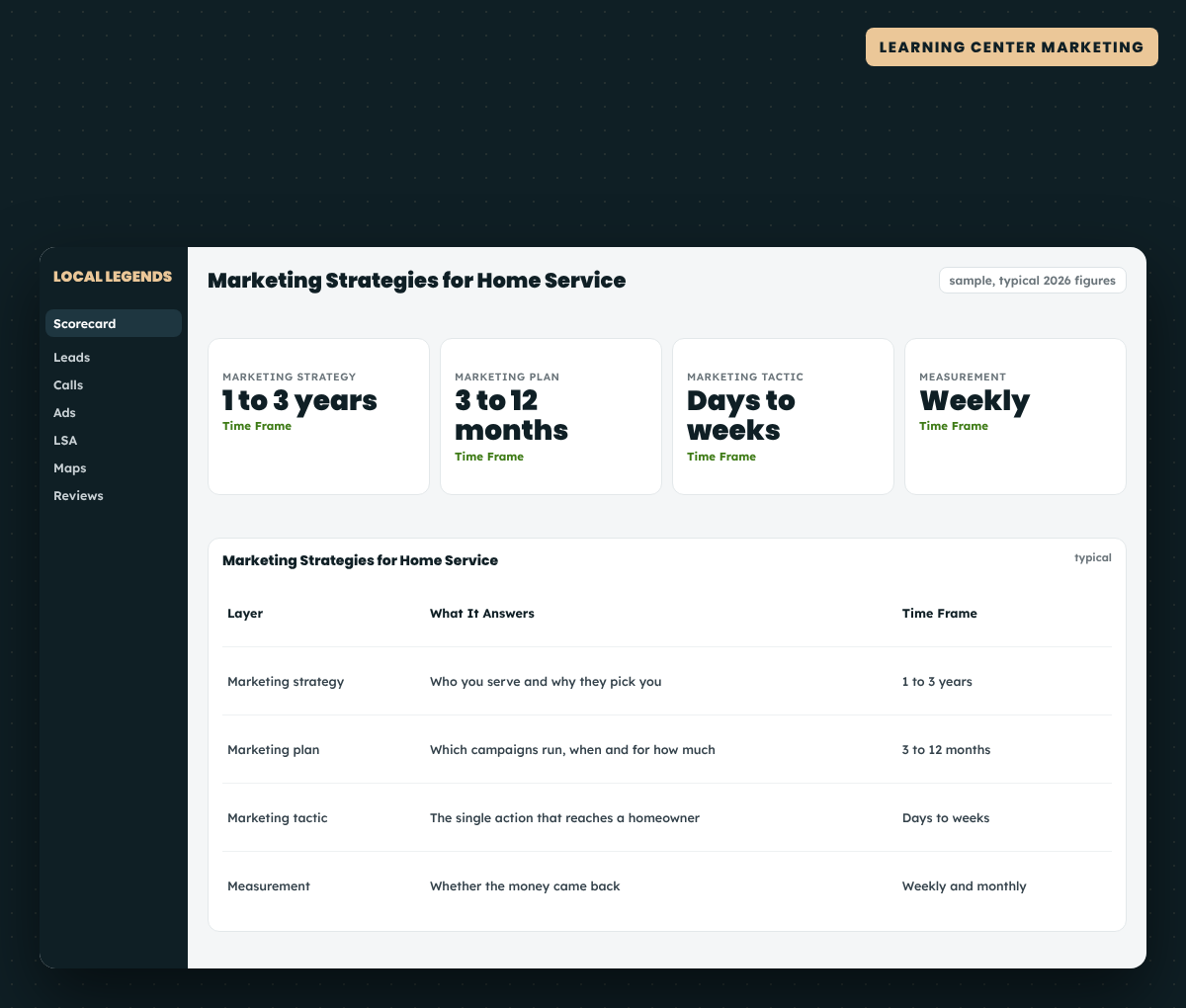
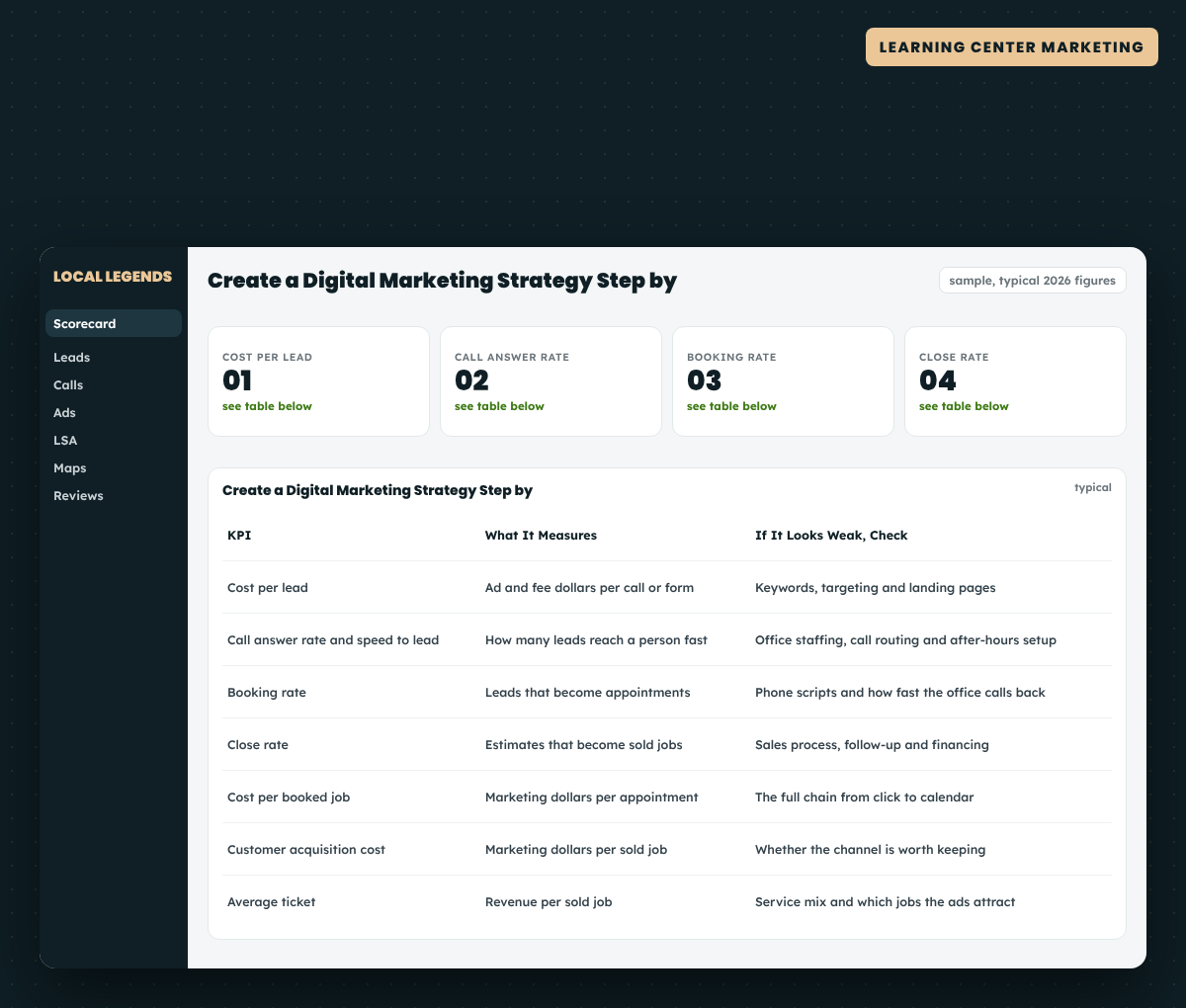
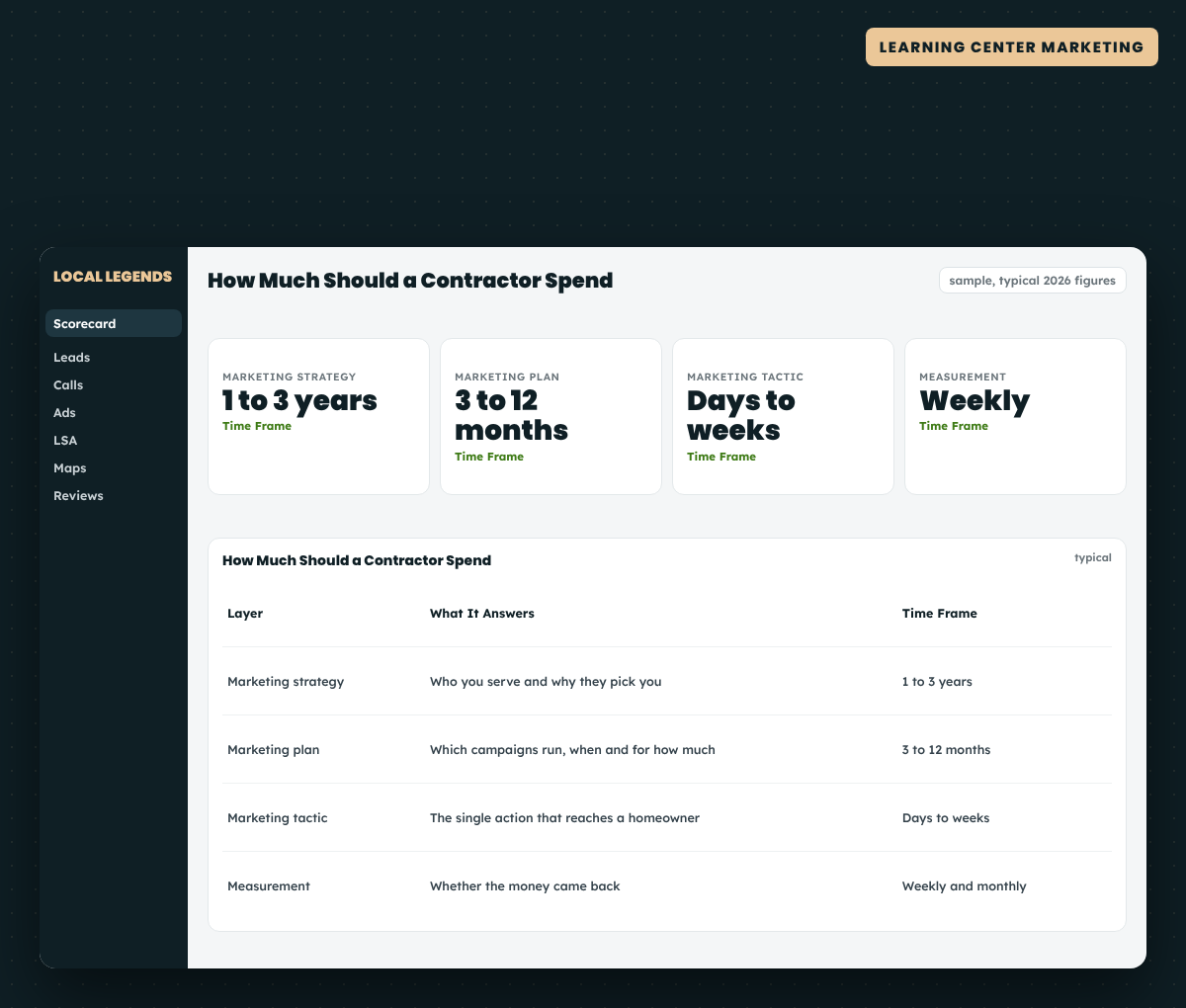
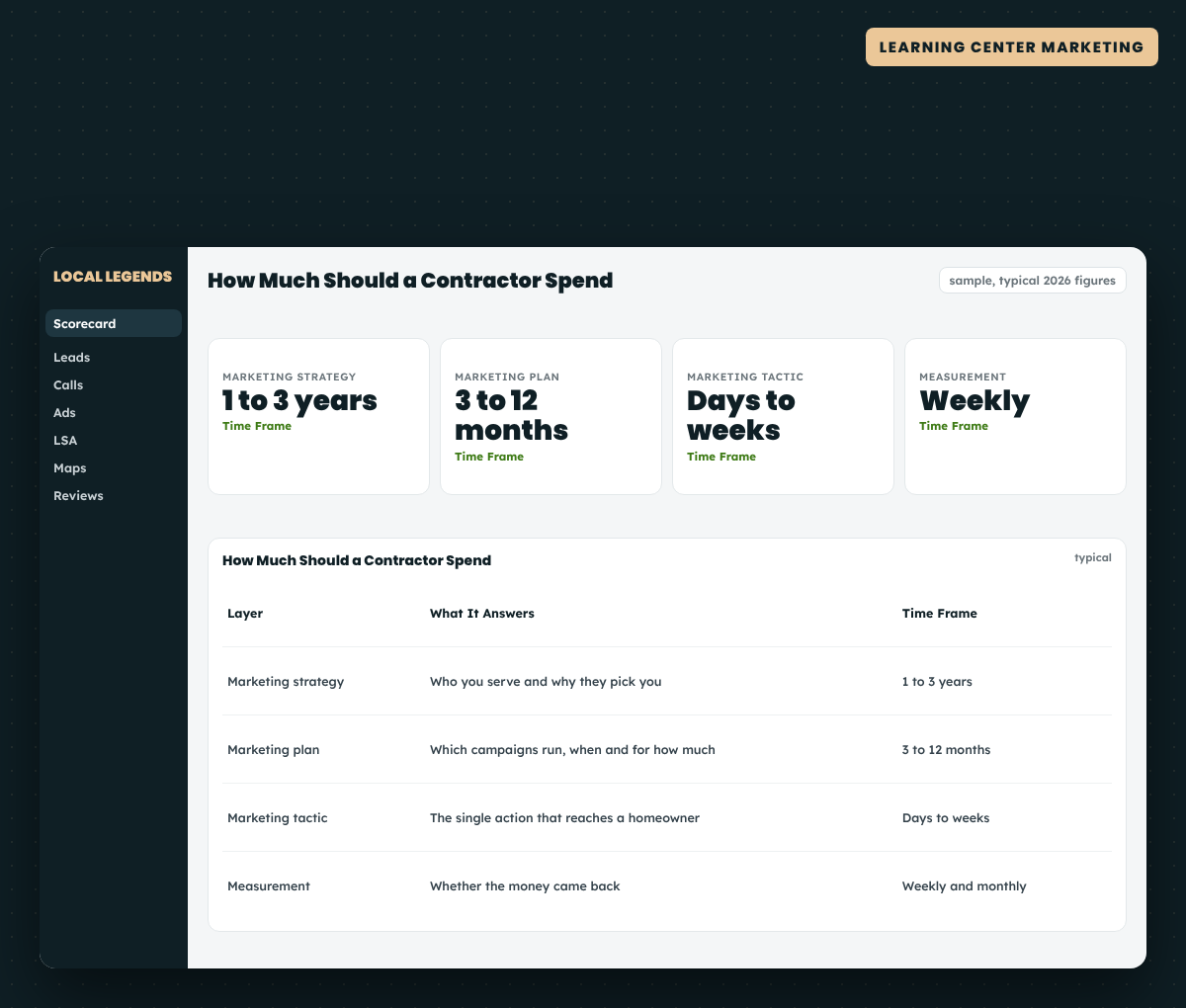
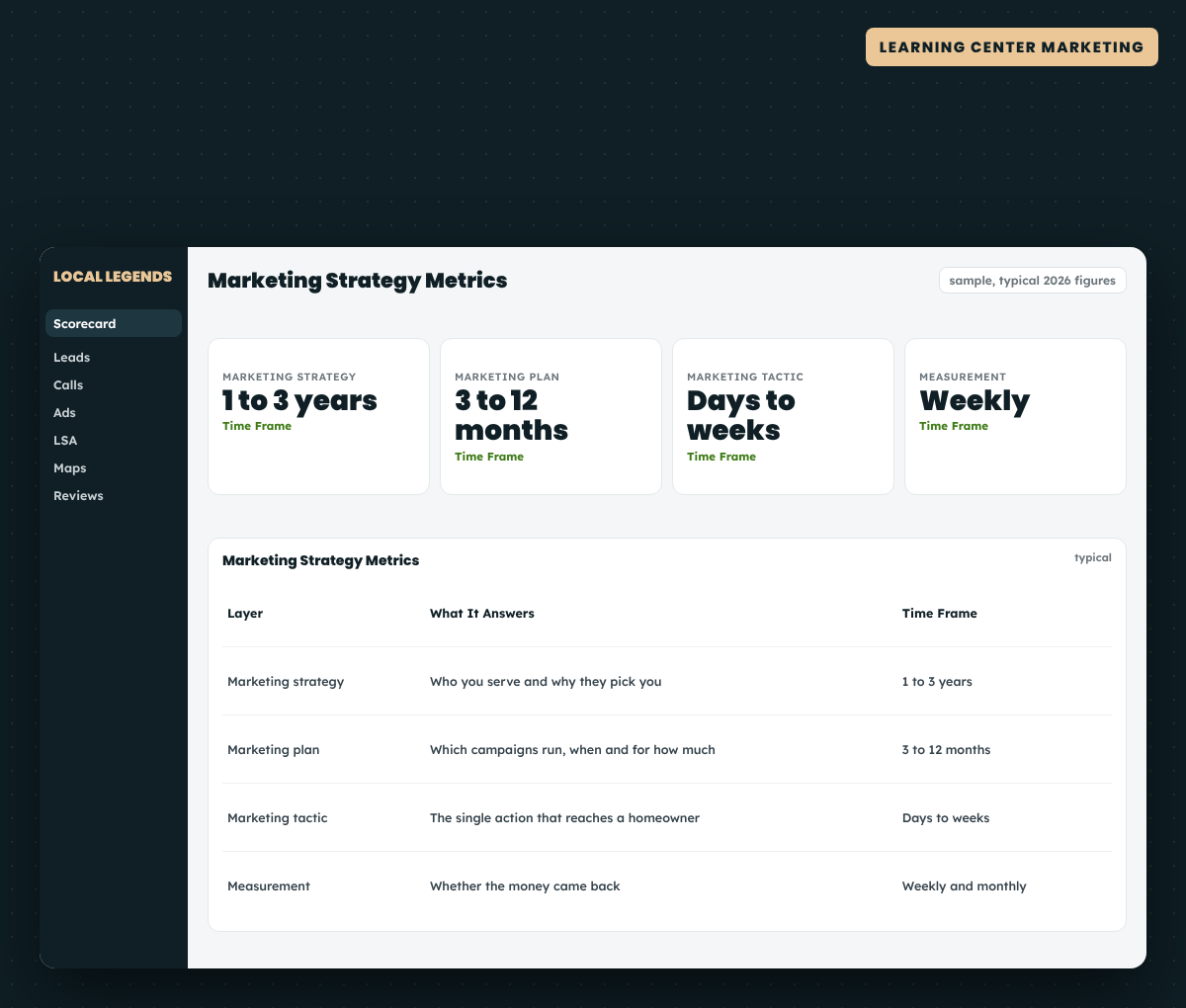
A contractor's marketing strategy explains why and to whom you sell, while the marketing plan sets how and when each campaign runs. Google AI Mode compared them to a blueprint and a construction schedule: the schedule is useless without the blueprint, and the blueprint never gets built without a schedule.
| Layer | What It Answers | Time Frame | Contractor Example |
|---|---|---|---|
| Marketing strategy | Who you serve and why they pick you | 1 to 3 years | Win high-ticket roof replacements in three growing suburbs |
| Marketing plan | Which campaigns run, when and for how much | 3 to 12 months | LSA all year, storm season ads in spring, mailers in fall |
| Marketing tactic | The single action that reaches a homeowner | Days to weeks | Yard sign and door hangers around every finished job |
| Measurement | Whether the money came back | Weekly and monthly | Cost per booked job by channel on a CEO scorecard |
The Four Decisions Every Contractor Strategy Makes
- Target homeowner: emergency callers, planned project buyers or recurring service clients, by town and home type.
- Positioning: the reason to choose you, such as financing, warranties, speed or a specialty trade.
- Channel mix: where those homeowners look, from the Google Map Pack to Facebook to the mailbox.
- Scorecard: the numbers that prove it works, led by booked jobs and cost per booked job.
Emergency Trades and Project Trades Choose Differently
Plumbing, HVAC repair and garage door companies sell to homeowners with a problem today, so search channels come first. Remodelers, painters and roofers selling replacements sell planned projects, so visual proof and repeated exposure matter more.
What Are the Best Marketing Strategies for a Roofing Company or Other Contractor in 2026? Ten Strategies Ranked by Speed to Booked Jobs
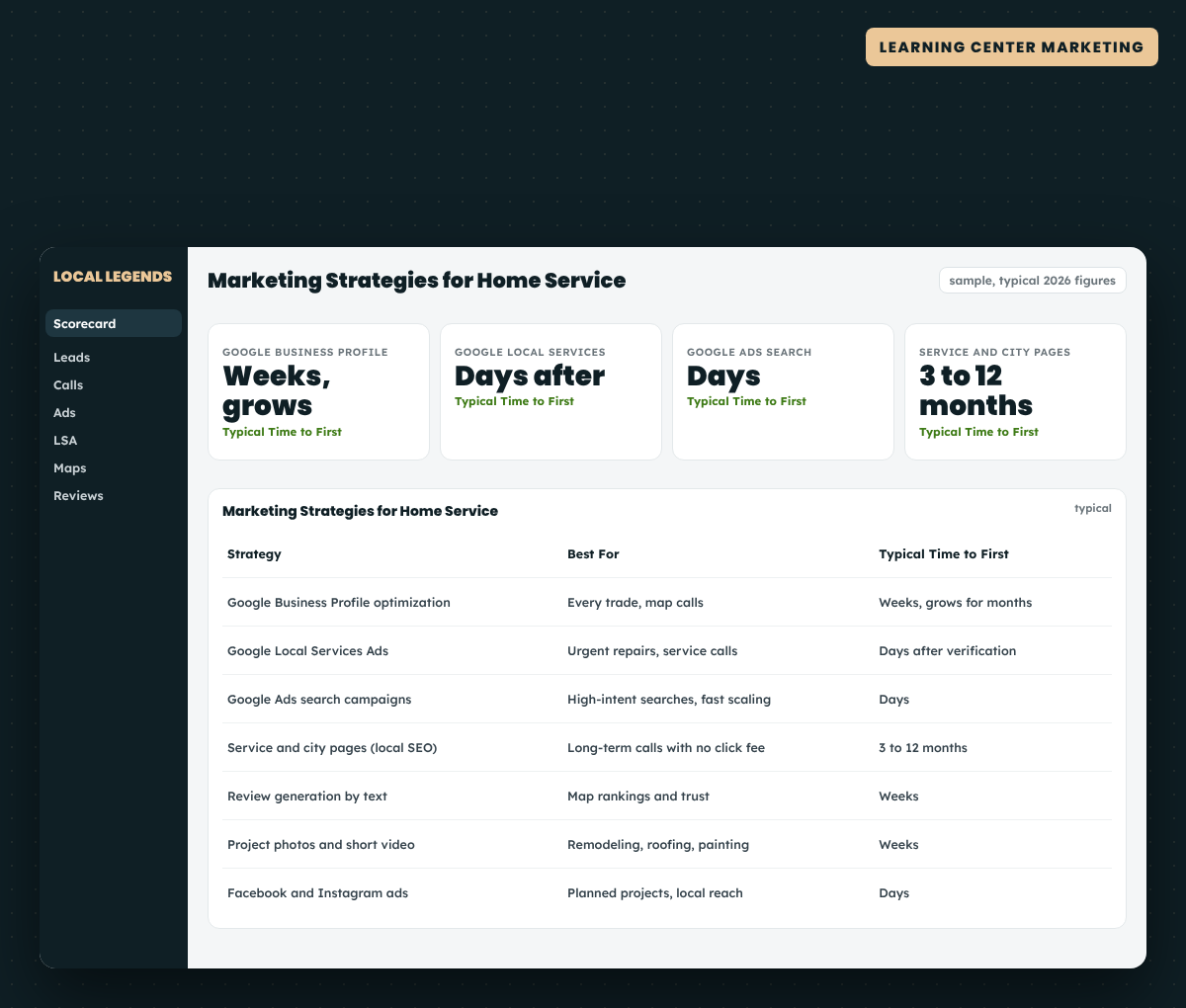
The best marketing strategies for contractors in 2026 start with local search visibility, then add reviews, paid search and retention. Google AI Mode gave that order for roofing companies in November 2026: win the Google Business Profile, reviews and Local Services Ads before paying for broad awareness.
| Strategy | Best For | Typical Time to First Calls | How You Pay |
|---|---|---|---|
| Google Business Profile optimization | Every trade, map calls | Weeks, grows for months | Time or management fee |
| Google Local Services Ads | Urgent repairs, service calls | Days after verification | Per lead |
| Google Ads search campaigns | High-intent searches, fast scaling | Days | Per click plus management |
| Service and city pages (local SEO) | Long-term calls with no click fee | 3 to 12 months | Content and SEO fee |
| Review generation by text | Map rankings and trust | Weeks | Software or plan feature |
| Project photos and short video | Remodeling, roofing, painting | Weeks | Crew time and editing |
| Facebook and Instagram ads | Planned projects, local reach | Days | Ad spend plus management |
| Retargeting and geofencing | Homeowners who visited but did not call | Weeks | Ad spend plus management |
| Email and text nurture | Repeat work, maintenance plans | Weeks | Software or plan feature |
| Referrals, yard signs and truck wraps | Neighbors around every job | Weeks | Low one-time cost |
Typical timelines above summarize what Google AI Mode and the top-ranking contractor guides reported in November 2026. They are typical ranges, not Local Legends results.
Capture Homeowners Who Are Already Searching
Search channels catch the homeowner at the moment of need. A complete Google Business Profile with weekly photos, accurate hours and steady reviews is the free starting point, and Local Services Ads put a verified badge above the regular ads.
- Google Business Profile: categories, services, service area, photos and posts kept current.
- Local Services Ads: pay per lead, ranked by reviews, responsiveness and distance.
- Google Ads: search campaigns on "near me" and service keywords with tight negative keywords.
- Service and city pages: one page per core service and per town with real local facts.
Build Trust Before the Estimate
Homeowners compare contractors on proof. Recent reviews that name the job, before-and-after photos and a short video walkthrough answer more objections than a slogan. Google AI Mode listed review velocity among the top factors in how fast any strategy produces calls.
Create Demand Before Homeowners Search
Facebook and Instagram ads, retargeting, geofencing and connected TV reach homeowners who have not searched yet. These channels suit roof replacements, remodels and other planned projects where the buyer decides over weeks.
Turn One Job Into the Next Three
Retention is the cheapest lead source most contractors ignore. Seasonal maintenance reminders, follow-ups on unclosed estimates, cross-selling a second service and a simple referral ask all work from customers you already paid to win.
What Are Marketing Strategy Examples That Work for Remodeling Companies?
Remodeling companies win with marketing strategies that prove craftsmanship visually and reach homeowners during a long decision. Google AI Mode named these examples for remodelers in November 2026, all built on high trust because the jobs are high ticket.
- Before-and-after case studies: one page per finished kitchen or bath with the scope, timeline and photos.
- Short video walkthroughs: a project manager explaining a finished space in under a minute.
- Cost and process guides: pages that explain budgets, permits and timelines before the first call.
- Neighborhood retargeting: ads shown to homeowners who visited the gallery but did not book.
- Neighbor letters and yard signs: a note to the homes around each active project.
- Referral partners: designers, realtors and showrooms who hear about projects first.
- Past-client nurture: check-ins that bring the next room, the deck or the basement.
What Online Marketing Strategy Gets a House Cleaning Business More Recurring Clients?
A house cleaning business gets more recurring clients by pairing a strong Google Business Profile with search ads on recurring-service keywords and an automated follow-up after the first clean. Google AI Mode described that combination in November 2026 as the core online marketing strategy for cleaners.
- Map Pack first: reviews, photos and service areas on the Google Business Profile.
- Recurring keywords in ads:"weekly house cleaning" and "biweekly maid service" over one-time deep cleans.
- Show recurring plans up front: homeowners commit faster when the plan is on the page.
- First clean as the trial: follow up by text the same week with the recurring offer.
- Win-back texts: a check-in to clients who paused, plus a referral offer.
Google Ads vs SEO vs Facebook Ads: Which Digital Advertising Strategy Is Best for Contractors? Search Pays First, Social Builds Later
For most contractors, the best digital advertising strategy launches Google Ads and Local Services Ads for immediate calls while SEO builds in the background. Google AI Mode said in November 2026 that the right mix depends on whether the trade solves urgent problems or sells visual, planned upgrades.
- Google Ads and LSA capture active demand: the fastest calls and the highest intent, with a cost on every click or lead.
- SEO builds an asset you keep: slower, months instead of days, but calls keep coming without a per-click fee.
- Facebook and Instagram create demand: fast to launch, lower intent, strongest for big projects and retargeting.
- Order that works for most trades: Google Business Profile first, then Google Ads to fill the schedule, then Facebook for projects and retargeting.
Read the full breakdown of search ad management on our Google Ads management page, and how rankings compound on our local SEO page.
When Facebook Ads Should Come First
Facebook and Instagram ads can lead for remodelers, painters and roofers selling replacements in towns with little search volume. A strong project gallery and a clear offer usually decide whether the channel pays.
What Does a Digital Strategy Agency Actually Do for a Home Service Company?
A digital strategy agency for a home service company connects local homeowner demand to the dispatch schedule, so online searches turn into booked, profitable jobs. Google AI Mode said in November 2026 that a home service strategy should match campaign pace to truck capacity and margins.
- Picks the high-margin jobs: which services and towns deserve the budget first.
- Maps the service area: where crews can profitably drive, and where they cannot.
- Paces campaigns to capacity: more spend when crews have room, less during backlog.
- Builds the search stack: Google Business Profile, local SEO, Local Services Ads and Google Ads.
- Builds landing pages and booking paths: one clear action per page.
- Runs reviews and reputation: a steady system, not a burst.
- Tracks calls and forms: then separates raw leads from booked jobs.
How Do You Create a Digital Marketing Strategy Step by Step? Seven Steps From Revenue Goal to Scorecard
A contractor builds a digital marketing strategy by working backward from a revenue goal to the number of jobs, leads and dollars it requires, then choosing channels that fit that math. Google AI Mode gave an eight-step version for HVAC companies in November 2026; the seven steps below fit every trade.
Step 1: Set the Revenue Goal and the Job Math
Divide the revenue goal by the average ticket to get jobs needed, then divide by close rate and booking rate to get leads needed. That lead count, times a typical cost per lead, is the real budget.
Step 2: Choose the Homeowners and Services That Pay Best
Name the two or three services with the best margin and the towns your crews reach without long drives. Those choices decide every ad group, page and post.
Step 3: Fix the Website and Tracking Before Spending
A mobile-fast site with service and city pages, trust signals and one call to action per page should exist before ads run. Every channel gets its own tracked phone number.
Step 4: Win the Google Map Pack and Reviews
Optimize the Google Business Profile, make citations consistent and text every finished customer a review link while satisfaction is highest. Respond to every review.
Step 5: Add Paid Search With Tight Controls
Turn on Local Services Ads and search campaigns for the highest-margin services, with negative keywords, call scheduling and budgets matched to crew capacity.
Step 6: Layer Retargeting, Social and Nurture
Retarget visitors who did not call, run Facebook ads for planned projects, and set up seasonal email and text reminders for past customers.
Step 7: Review the Scorecard and Reallocate
Every week, compare leads, booked jobs, sold jobs and cost per booked job by channel. Move budget toward what books, and cut what only produces clicks.
How Local Legends runs this step: every account gets a weekly project review meeting, and owners see a CEO scorecard with leads, booked, sold and cost per booked job, monthly on Footprint and weekly from Trailblazer up. [SOURCE: Local Legends service facts and plan inclusions, BRIEF.md, Nov 2026]
How Long Does It Take for a Contractor Marketing Strategy to Start Working?
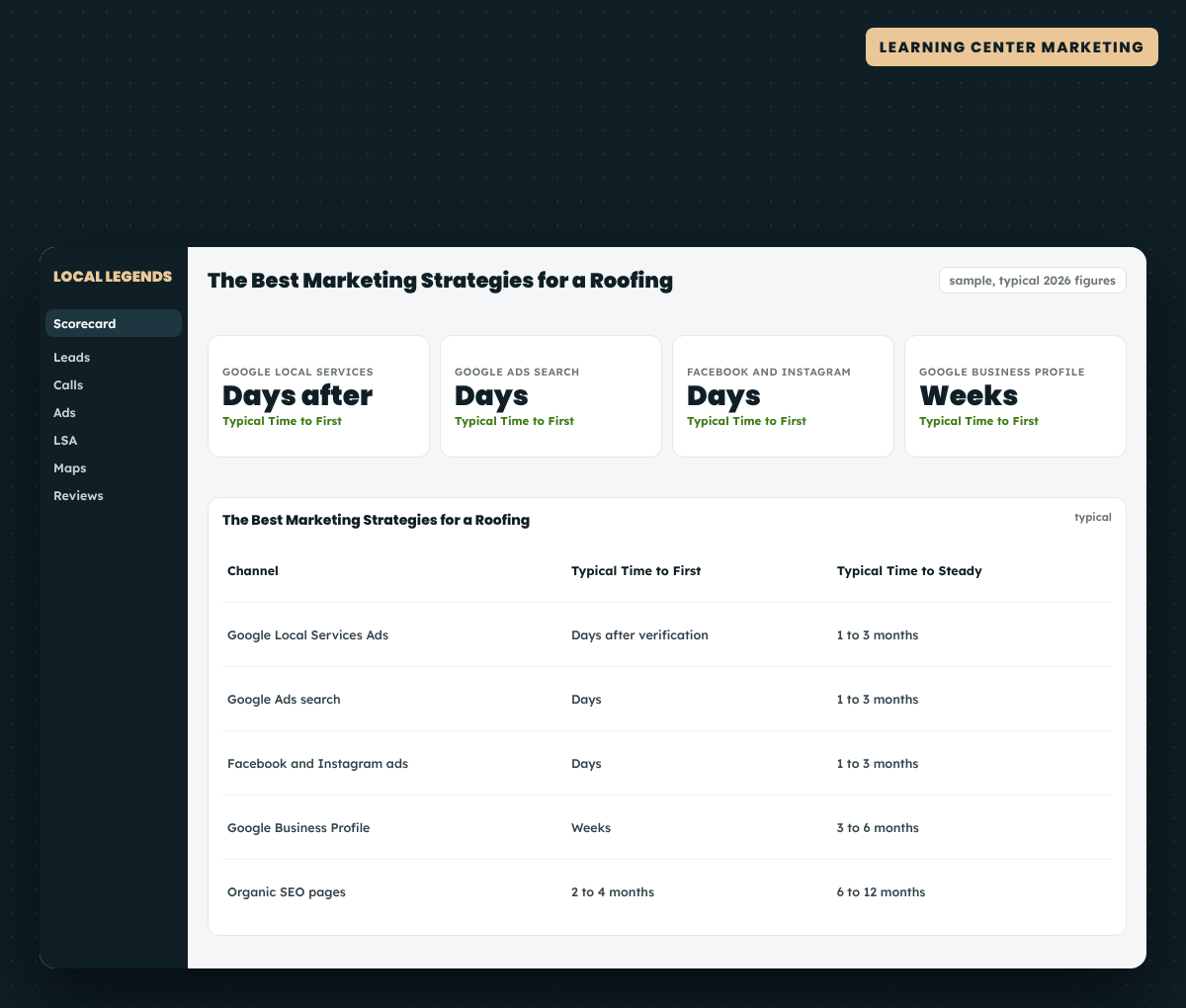
A contractor marketing strategy typically produces paid leads in 1 to 4 weeks and steady organic growth in 6 to 12 months. Google AI Mode gave that range in November 2026 and said speed to lead, review velocity, competition, website readiness and seasonality move it the most.
| Channel | Typical Time to First Leads | Typical Time to Steady Results | What Speeds It Up |
|---|---|---|---|
| Google Local Services Ads | Days after verification | 1 to 3 months | Reviews and fast answers |
| Google Ads search | Days | 1 to 3 months | Negative keywords and landing pages |
| Facebook and Instagram ads | Days | 1 to 3 months | Real project photos and a clear offer |
| Google Business Profile | Weeks | 3 to 6 months | Review velocity and weekly posts |
| Organic SEO pages | 2 to 4 months | 6 to 12 months | Service and city pages with real facts |
These are typical ranges, not promises. Seasonality matters too: HVAC calls follow heat and cold, roofing follows storms, and cleaning follows holidays and move-outs.
How Much Should a Contractor Spend on Marketing Strategies Each Month? Typical Budgets Run 5% to 10% of Revenue
Most home service contractors spend a typical 5% to 10% of gross revenue on marketing, and 10% to 15% of target revenue while scaling. Google AI Mode translated that in November 2026 to roughly $1,500-$15,000+ a month, or about $1,000-$3,000+ per truck.
- 1 to 2 trucks: typically $1,500-$3,000+ a month.
- 3 to 10 trucks: typically $3,000-$6,000+ a month.
- 15 or more trucks: typically $6,000-$15,000+ a month.
- A common split: about 50% to 60% on immediate calls, 25% to 35% on long-term assets like SEO, and 10% to 15% on repeat business and brand.
These are typical market figures reported by Google AI Mode, not Local Legends data. Your own job math from the step-by-step section is the better guide.
What Marketing Strategies Work Best for a Small Home Service Business on a Small Budget?
A small home service business on a tight budget should capture existing demand before paying to interrupt anyone. Google AI Mode put the free Google Business Profile first in November 2026, then low-cost local tactics, then pay-per-lead channels.
- Google Business Profile: free, and where homeowners look first.
- Automated review requests: a text with the review link after every job.
- Local Facebook groups and Nextdoor: helpful answers, not ads.
- Door hangers around each job: the five homes on each side and across the street.
- Vehicle branding and yard signs: a one-time cost that works every day.
- Local Services Ads: pay only for leads once reviews are in place.
- Small Facebook test: a typical $10-$20+ a day on one offer.
What Local Legends Charges and What Other Agencies Typically Charge
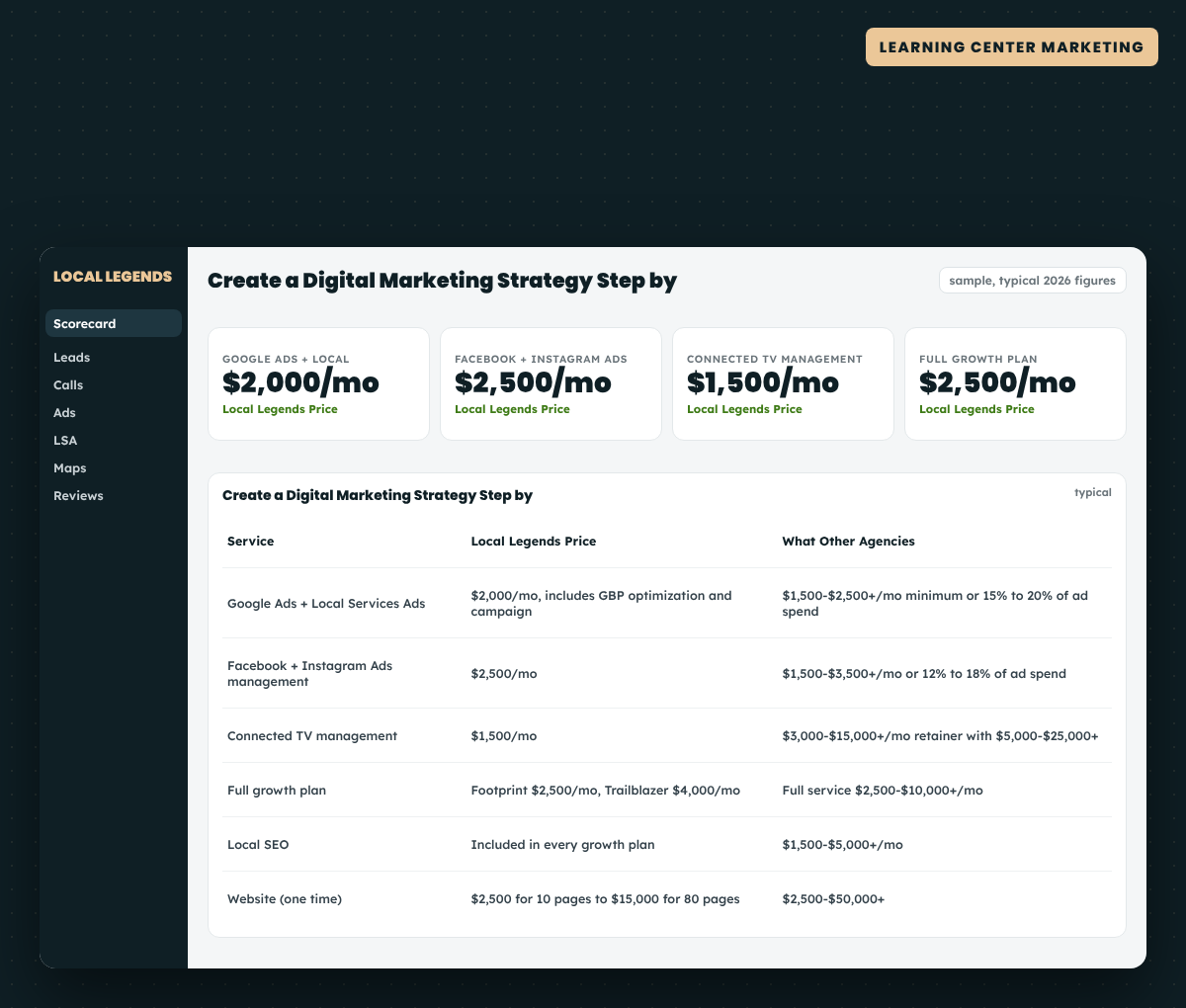
Local Legends Marketing charges flat monthly fees that never rise with your ad spend, and ad spend is paid by the contractor straight to Google, Meta or the TV network. The table compares those fees to typical 2026 published agency pricing.
| Service | Local Legends Price | What Other Agencies Typically Charge |
|---|---|---|
| Google Ads + Local Services Ads management | $2,000/mo, includes GBP optimization and campaign landing pages | $1,500-$2,500+/mo minimum or 15% to 20% of ad spend |
| Facebook + Instagram Ads management | $2,500/mo | $1,500-$3,500+/mo or 12% to 18% of ad spend |
| Connected TV management | $1,500/mo | $3,000-$15,000+/mo retainer with $5,000-$25,000+ media minimums |
| Full growth plan | Footprint $2,500/mo, Trailblazer $4,000/mo, Sasquatch $8,000/mo, Legend $10,000+/mo | Full service $2,500-$10,000+/mo |
| Local SEO | Included in every growth plan | $1,500-$5,000+/mo |
| Website (one time) | $2,500 for 10 pages to $15,000 for 80 pages | $2,500-$50,000+ |
Every plan has no setup fees and no long-term contracts, and the contractor owns the website, domain, Google Business Profile, ad accounts and call data. See every plan and add-on on the Local Legends pricing page.
Ad Spend vs Management Fee
Ad spend is what Google or Meta charges for clicks, leads and impressions. The management fee pays for the people who build and run the campaigns. A percentage-of-spend fee grows every time the budget grows; a flat fee does not.
Ready to see which strategy fits your trade and budget? Book a free growth audit and the Local Legends team will check your tracking, Google Business Profile, Local Services Ads and funnel before recommending a single channel.
Marketing Strategy Metrics: How Contractors Know a Strategy Is Working Booked Jobs Matter More Than Clicks
A contractor's marketing strategy is working when customer acquisition cost stays well below average job profit and the return on marketing spend is positive month after month. Google AI Mode said in November 2026 that traffic and lead totals mislead owners when those leads never book.
Why Local Legends reports past the click: founder Levi Ostlund lost $30,000+ to marketers before starting the agency, including a site that looked good and never ranked. That is why impressions and traffic are treated as chapter one, and every report follows calls through to booked jobs, sold jobs and cost per booked job. [SOURCE: Levi Ostlund founder story, Local Legends about page, BRIEF.md Nov 2026]
How Do I Know If My Marketing Is Working, and What KPIs Should a Contractor Track?
Home service contractors should track cost per lead, booking rate, close rate, customer acquisition cost and return on marketing investment, each by channel. The diagnosis column shows what a weak number usually points to.
| KPI | What It Measures | If It Looks Weak, Check |
|---|---|---|
| Cost per lead | Ad and fee dollars per call or form | Keywords, targeting and landing pages |
| Call answer rate and speed to lead | How many leads reach a person fast | Office staffing, call routing and after-hours setup |
| Booking rate | Leads that become appointments | Phone scripts and how fast the office calls back |
| Close rate | Estimates that become sold jobs | Sales process, follow-up and financing |
| Cost per booked job | Marketing dollars per appointment | The full chain from click to calendar |
| Customer acquisition cost | Marketing dollars per sold job | Whether the channel is worth keeping |
| Average ticket | Revenue per sold job | Service mix and which jobs the ads attract |
| Marketing spend as % of revenue | Total investment against sales | Typically 8% to 12%, per Google AI Mode |
- High cost per lead, few leads: the targeting or the offer needs work.
- Many leads, low booking rate: the phones or the follow-up need work.
- Many bookings, low close rate: the sales visit needs work.
- High close rate, low profit: the pricing or the job mix needs work.
My Phone Stopped Ringing. What Part of My Contractor Marketing Should I Fix First?
When a contractor's phone suddenly goes quiet, the Google Business Profile and the review pipeline are the first things to check. Google AI Mode advised that order in November 2026, because new ads or a new website cannot fix a profile that is suspended, wrong or stale.
- Check the listing status: look for a suspension, a duplicate or a changed category.
- Test the phone number and hours: call your own listing and every tracked number.
- Check the latest review date: a long gap often lines up with a ranking drop.
- Text your five most recent happy customers: fresh reviews restart momentum.
- Test the website on a phone: make sure the call button and forms still work.
- Reach your past customers: a maintenance or referral offer to your own list.
- Sudden drop or slow slide: a sudden drop points to a technical break, a slow slide to competition.
Choosing a Marketing Strategy Consultant or Marketing Strategy Agency DIY, Consultant or Agency for a Contractor
The right marketing help for a contractor depends on revenue, available time and whether someone must run the campaigns, not just plan them. Google AI Mode described DIY, agency and consultant as three stages a growing company moves through.
Should a Contractor Hire a Marketing Strategy Consultant, an Agency or Do Marketing Themselves?
Most contractors should handle the basics themselves, then hire a trades-focused agency when lead flow becomes the bottleneck. Google AI Mode said in November 2026 that a pure strategy consultant is rarely needed until a company runs multiple crews or enters new territories, because consultants usually advise without executing.
- Do it yourself: Google Business Profile, review requests, yard signs and referrals, while the company is small.
- Hire an agency: when ads, SEO and tracking need daily hands and the owner's time is better spent selling.
- Add a consultant or fractional CMO: when the plan, budget and team need a senior marketing lead without a full-time salary.
Local Legends includes fractional CMO and CEO meetings in every growth plan. Learn how that role works on our fractional CMO page.
What Questions Should I Ask a Digital Marketing Strategy Agency Before Hiring Them?
Contractors should ask a digital marketing agency how it measures booked jobs, who owns the accounts and what happens if the contract ends. Google AI Mode built its November 2026 list around those three topics.
- Do you work with home service companies, and do you limit how many competitors you take in one market?
- How do you handle speed to lead, and do you report booked jobs or only leads?
- Is your management fee separate from my ad spend, and is it flat or a percentage?
- Who owns the website, domain, Google Business Profile, ad accounts and call data?
- What happens if I cancel, and how long is the contract?
- How often do we meet, and what does each report show?
Google AI Mode also told owners to look for agencies that avoid guaranteed rankings, long lock-in contracts and proprietary website platforms the client cannot take with them.
How Local Legends Answers These Questions
Local Legends works only with home service contractors and reports leads, booked, sold and cost per booked job. Fees are flat, never a percentage of ad spend, every account stays in the client's name, and there are no long-term contracts.
Local Legends is added as an owner on the Google Business Profile while the client stays the primary owner.
Online Marketing Strategy for AI Search: Getting Recommended by ChatGPT and Google AI AI Answers Reward Proof and Clear Pages
Contractors get recommended in AI answers by building strong local trust signals, writing pages that answer homeowner questions directly and letting AI crawlers read the site. Google AI Mode said in November 2026 that there is no way to pay for an organic AI recommendation.
How Do I Get My Contracting Business Recommended by ChatGPT and Google AI?
A contracting business earns AI recommendations the same way it earns referrals: by being visible, consistent and well reviewed across many sources. Google AI Mode listed these steps for contractors.
- Complete Google and Bing listings: identical name, address, phone and categories.
- Steady, detailed reviews: reviews that name the job and the town.
- Licenses and insurance shown clearly: on the site and the profile.
- Service and location pages: one clear page per service and per real service town.
- Direct answers to homeowner questions: cost, timing and process in plain words.
- Short video answers: a crew lead explaining a common problem.
- Local lists and links:"best of" lists, local news and community sites.
- Open to AI crawlers: the site does not block them.
Local Legends builds this work into its AI SEO service and the Sasquatch and Legend plans.
A real Local Legends weekly habit: on Local Services Ads accounts, the team disputes invalid leads every week and runs the LSA Ranker review texter, because reviews and answered calls decide how often a contractor shows up, in ads and in AI answers alike. [SOURCE: Local Legends LSA management service facts, BRIEF.md Nov 2026]
Local Legends Marketing Reviews From Contractor CEOs Owners Who Hired Levi Ostlund
Roofing and restoration owners have gone on record about working with Local Legends Marketing and founder Levi Ostlund on strategy, ads, search and tracking. Video testimonials are on the Local Legends reviews page [LINK: /about-us/reviews/].
Levi has been absolutely outstanding to work with over the years... His creativity, responsiveness, and deep understanding of our marketing strategy have made a huge impact." Brad Beldon, CEO, Roofing Company. Read on Local Legends
- Kyle Scott, CEO, Roofing Company (video testimonial)
- Jim Dodson, CEO, Roofing Company (video testimonial)
- Race Allen, CEO, Precision Restoration of Texas (video testimonial)
- Brad Beldon, CEO, Roofing Company (written testimonial)
Frequently Asked Questions About Marketing Strategies for Contractors Contractor Marketing Strategy Questions Answered
What Are the 4 Ps of Marketing for a Contractor?
The 4 Ps are product, price, place and promotion. For a contractor, product is the service mix, price is how jobs are quoted and financed, place is the service area, and promotion is every channel that reaches homeowners.
What Are the Main Types of Marketing Strategies?
The main types contractors use are search marketing, content marketing, social media advertising, email and text marketing, referral marketing and local community marketing. Most growing companies combine three or four, led by search.
What Marketing Strategy Fits a Contractor Under $2 Million in Revenue?
A contractor under $2 million in revenue usually does best with a Google Business Profile, review texting, Local Services Ads and one search campaign on the highest-margin service. Add SEO pages and social once those channels book profitably.
How Should a Contractor Split a Marketing Budget?
A common split is about half or more on channels that bring calls now, roughly a third on long-term assets like SEO and the website, and the rest on retention and brand. Adjust the split by season and crew capacity.
Do Seasonal Trades Need a Different Marketing Strategy?
Seasonal trades need a strategy that raises spend before peak season and keeps retention running in the slow months. HVAC companies push maintenance plans in spring and fall, and roofers prepare storm campaigns before the season starts.
Does a Contractor Need a Written Marketing Plan?
A one-page plan is enough for most contractors: the revenue goal, the target services and towns, the monthly budget by channel, and the scorecard numbers reviewed each week.
What Is a Marketing Strategy Consultant?
A marketing strategy consultant advises a company on positioning, budget and channel choices, usually without running the campaigns. A fractional CMO plays a similar senior role on an ongoing basis and works with the team that executes.
Is Digital Marketing Strategy Different From Online Marketing Strategy?
The terms mean nearly the same thing for contractors. Both cover search, ads, social, email and the website; digital marketing strategy sometimes also includes connected TV and other screens outside the browser.
Reviewed by Levi Ostlund, Founder, Local Legends Marketing

Build a Marketing Strategy That Books Jobs for Your Home Service Company Start With a Free Growth Audit
The fastest way to choose the right marketing strategies is to see what your tracking, Google Business Profile, Local Services Ads and funnel are doing today. Local Legends Marketing audits all four, runs Google Maps rank grids across your service area and recommends the order that fits your trade.
- Flat monthly fees, no setup fees and no long-term contracts.
- You own every account, from the website to the call data.
- A CEO scorecard that follows every lead to the booked and sold job.
Call (936) 900-1248 or book a free growth audit online. Local Legends works with contractors in every state; see the Local Legends service areas page.