


More Calls From the Traffic You Already Pay

Conversion Rate Optimization Agency Guide for Home Service Contractors: What CRO Agencies Do, What They Typically Charge and How Roofers, Plumbers and HVAC Companies Turn Visitors Into Booked Jobs
More Calls From the Traffic You Already Pay For
Updated November 2026 · Reviewed by Levi Ostlund, Founder
Breadcrumb: Home > Learning Center [LINK: /learning-center/] > Conversion Rate Optimization Agency
A conversion rate optimization agency studies how visitors use a website and changes the pages so more of them take action, which for a contractor means calling, texting, booking or filling out an estimate form. For a roofer, plumber or HVAC company, the action that counts is the booked job behind the call.
- What CRO is: finding where visitors drop off and fixing those pages.
- What it costs: typically $800-$15,000+ a month at an agency, more for enterprise programs.
- What contractors measure: calls, texts, forms and booked jobs, not clicks.
- Where to start: test your own phone and form path before paying anyone.
Free Growth Audit
Your Reviews, Radius and Response Rate vs the competitors beating you.
About Local Legends Marketing
A home service marketing agency headquartered in Conroe, Texas, with 8+ years of marketing experience, running Google Ads, Local Services Ads, local SEO, AI SEO, connected TV and review systems for contractors nationwide.
What Does a Conversion Rate Optimization Agency Do? Research, Fix, Measure and Repeat
A conversion rate optimization agency follows a loop: it measures where visitors leave, finds out why, changes the page and measures again. The work is less about design taste and more about evidence from analytics, recordings and real calls.
Most CRO agency pages describe the same core services. Contractors should know each one so they can tell which ones fit a home service website and which belong to an online store.
- Analytics review: which pages get traffic, where people exit and which devices they use.
- Behavior research: heatmaps, session recordings and form analytics that show where visitors stall.
- Customer research: surveys and call reviews that reveal what buyers wanted to know.
- Page changes: new headlines, calls to action, layouts, forms and trust elements.
- Testing: A/B tests or before and after comparisons on the changed pages.
- Reporting: the change in conversion rate and, at better agencies, the change in revenue.
Which CRO Services Fit a Contractor Website
Call reviews, form analytics and mobile layout fixes fit almost every contractor site. Large multivariate tests, personalization engines and checkout work fit online stores far better than a plumbing company with a few thousand monthly visits.
What CRO Does Not Fix
CRO cannot fix an offer people do not want, a phone nobody answers or a service area with no demand. If calls come in and the office misses them, the leak is in dispatch, not on the website.
Do I Need a CRO Agency or a Website Design Agency for My Roofing Company?
A roofing company usually needs a website design agency first when the current site is slow, thin or missing service pages, and a CRO agency only after a solid site is already getting steady traffic.
- Website design agency: builds the pages, layout, copy and speed; the right call when the site is old, slow or missing service and town pages.
- CRO agency: studies behavior and tests page changes; fits when a solid site gets traffic but calls and forms lag.
- PPC agency: runs Google Ads and campaign landing pages; fits when paid clicks arrive but the landing page leaks.
- SEO agency: earns organic rankings; fits when the site converts but too few people find it.
- Contractor marketing agency: combines the site, ads, SEO and tracking under one team judged by booked jobs.
How Much Does a Conversion Rate Optimization Agency Cost? Typical CRO Pricing Models and What Contractors Pay
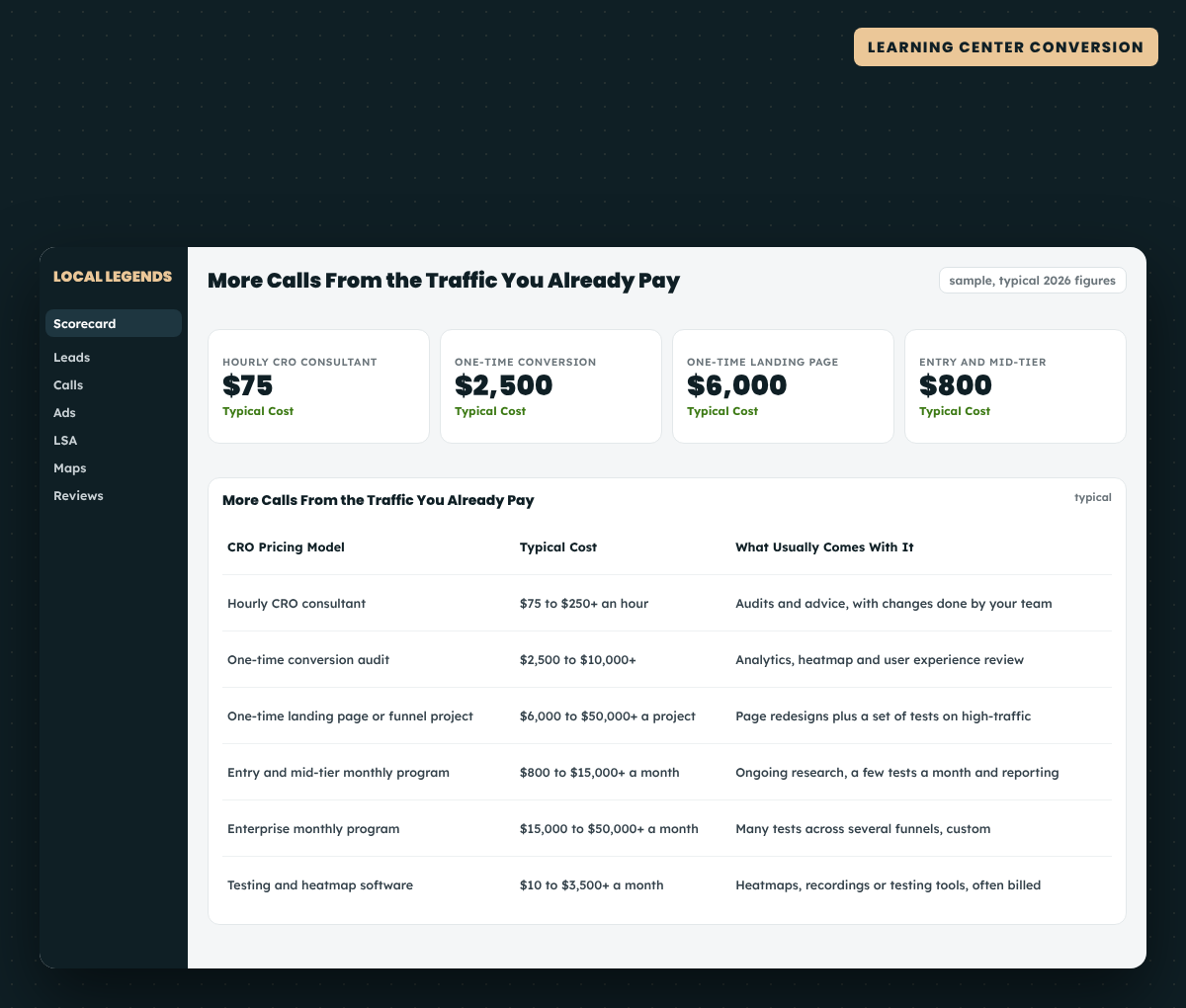
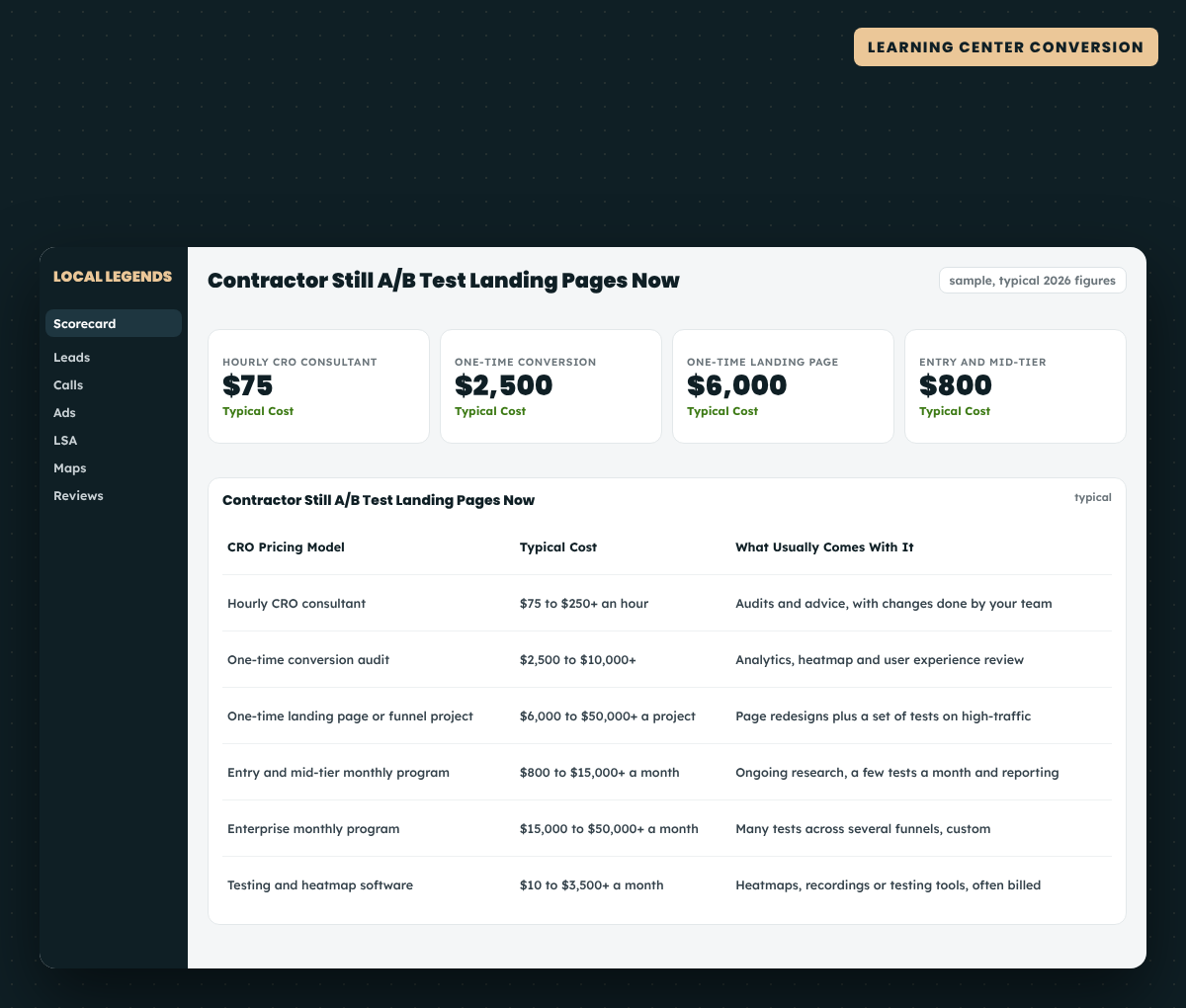
A conversion rate optimization agency typically costs $800 to $15,000+ a month for a small or mid-sized program and $15,000 to $50,000+ a month for an enterprise program, based on published 2026 CRO pricing guides and Google AI Mode answers reviewed in November 2026.
| CRO Pricing Model (Typical 2026 Ranges) | Typical Cost | What Usually Comes With It |
|---|---|---|
| Hourly CRO consultant | $75 to $250+ an hour | Audits and advice, with changes done by your team |
| One-time conversion audit | $2,500 to $10,000+ | Analytics, heatmap and user experience review with a fix list |
| One-time landing page or funnel project | $6,000 to $50,000+ a project | Page redesigns plus a set of tests on high-traffic pages |
| Entry and mid-tier monthly program | $800 to $15,000+ a month | Ongoing research, a few tests a month and reporting |
| Enterprise monthly program | $15,000 to $50,000+ a month | Many tests across several funnels, custom development and analytics |
| Testing and heatmap software | $10 to $3,500+ a month | Heatmaps, recordings or testing tools, often billed outside the retainer |
[SOURCE: published 2026 CRO pricing guides saved in research/sources/cro/, plus Google AI Mode cost answer citing agency pricing guides, captured Nov 27 2026]
What Moves a CRO Quote Up or Down
- Traffic: more visitors means more tests can finish, so programs grow with traffic.
- Number of pages or funnels: one landing page costs less than a 60-page site.
- Research depth: user testing and surveys add cost over heatmaps alone.
- Who builds the changes: some agencies only recommend, others design and code.
- Tools: testing and recording software may be billed on top.
- Minimum terms: some retainers require several months up front, so ask before signing.
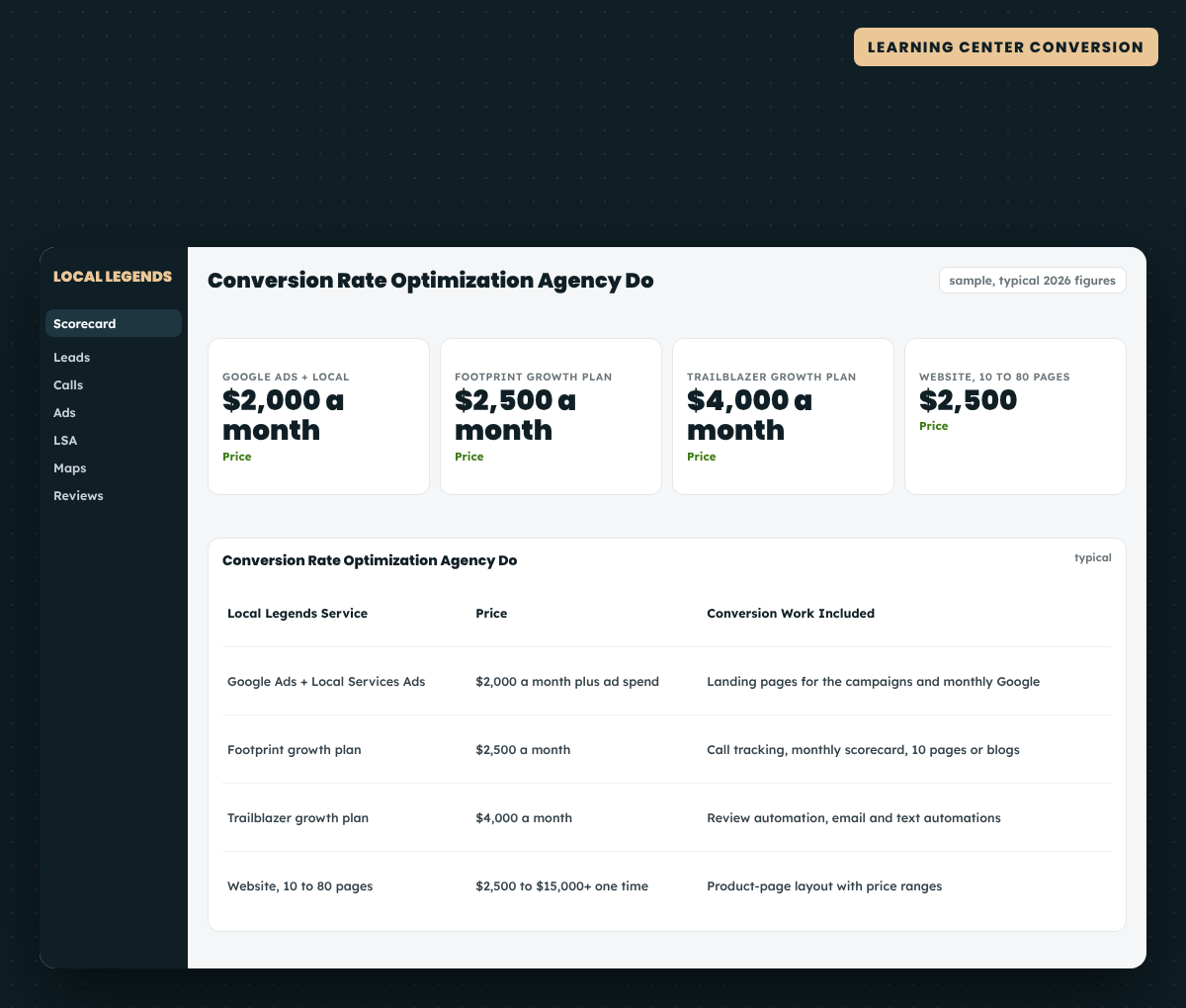
What Local Legends Includes Instead of a CRO Retainer
| Local Legends Service | Price | Conversion Work Included |
|---|---|---|
| Google Ads + Local Services Ads management | $2,000 a month plus ad spend | Landing pages for the campaigns and monthly Google Business Profile optimization |
| Footprint growth plan | $2,500 a month | Call tracking, monthly scorecard, 10 pages or blogs a month |
| Trailblazer growth plan | $4,000 a month | Review automation, email and text automations, weekly scorecard |
| Website, 10 to 80 pages | $2,500 to $15,000+ one time | Product-page layout with price ranges and tap-to-call buttons |
No plan has a setup fee or a long-term contract. Full details are on the Local Legends pricing page.
Is CRO Worth It for a Contractor Website With Only 1,000 Visitors a Month?
A contractor website with about 1,000 visitors a month can still gain from conversion work, but it usually lacks the traffic to run reliable A/B tests, so the money is better spent on clear fixes than on a testing program.
- Fix the obvious first: phone number in the header, a call button on every mobile page, short forms.
- Add proof near the top: reviews, real job photos and license details.
- Show price ranges so visitors know they are in the right place.
- Watch session recordings: free tools such as Microsoft Clarity show where visitors stall.
- Check that the traffic is local: out-of-area blog readers will not call at any conversion rate.
- Compare before and after: track calls and forms for 30 days before and after each change.
- Save formal testing for paid landing pages that get steady clicks.
What Is a Good Conversion Rate for a Home Service Website? Measure Your Own Baseline Before Chasing Benchmarks
A good conversion rate for a home service website is one that beats its own baseline month after month, because published benchmarks for contractors disagree widely on what they count as a conversion and which traffic they include.
Some benchmarks count only forms, others count calls, chat and texts. Some include paid traffic, others only organic visits. A plumbing company that counts every tracked call and form gets a very different number than one that counts forms alone.
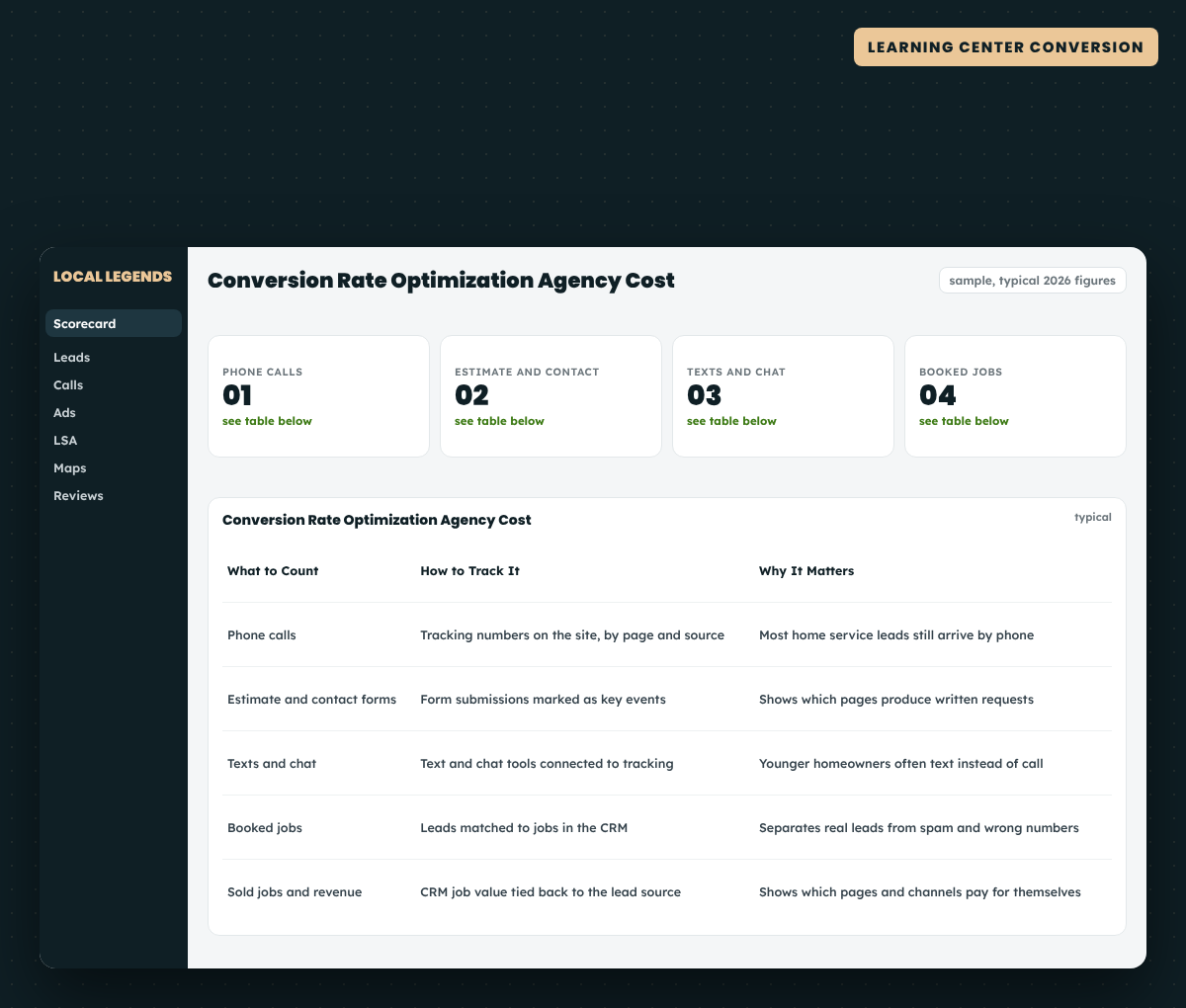
Google AI Mode answers checked in November 2026 quoted contractor benchmarks from agency blogs rather than primary studies, and they listed paid landing pages apart from whole-site rates. Compare each page type only with itself.
| What to Count | How to Track It | Why It Matters for Contractors |
|---|---|---|
| Phone calls | Tracking numbers on the site, by page and source | Most home service leads still arrive by phone |
| Estimate and contact forms | Form submissions marked as key events | Shows which pages produce written requests |
| Texts and chat | Text and chat tools connected to tracking | Younger homeowners often text instead of call |
| Booked jobs | Leads matched to jobs in the CRM | Separates real leads from spam and wrong numbers |
| Sold jobs and revenue | CRM job value tied back to the lead source | Shows which pages and channels pay for themselves |
[SOURCE: support.google.com/analytics/answer/13965727, GA4 events and key events, checked Nov 27 2026]
Why Booked Jobs Beat Conversion Rate
A page can double its form fills by attracting tire kickers. Cost per booked job shows whether the extra leads turned into work, which is the number a contractor actually pays bills with.
How Do I Track Phone Calls as Conversions From My Contractor Website?
A contractor tracks phone calls as conversions by placing tracking numbers on the website, recording which page and source produced each call and sending those calls into analytics and the ad platform.
- Install dynamic call tracking so each visitor source shows its own number.
- Give the Google Business Profile its own tracking number so Maps calls stay separate from website calls.
- Set a minimum call length so wrong numbers and robocalls do not count as conversions.
- Mark qualified calls as key events in Google Analytics 4.
- Import those conversions into Google Ads so bidding learns from real calls.
- Connect the CRM: ServiceTitan, Housecall Pro, JobNimbus, AccuLynx, Jobber, Buildertrend or GoHighLevel.
- Place a live test call after setup and confirm it shows up in every report.
In GA4, a key event is an event that matters most to the business, and a Google Ads conversion can be created from that key event, so both tools count the same call. [SOURCE: Google Analytics Help, Events and key events]
Why Do Visitors Leave a Roofing or HVAC Website Without Calling? The Leaks CRO Work Finds Most Often on Contractor Sites
Visitors usually leave a roofing or HVAC website without calling because they cannot find the phone number fast, cannot tell whether the company serves their town or cannot see any price or proof on the first phone screen.
The Phone Number Is Hard to Find
The number should sit in the header and in a tap-to-call button that stays on screen as the visitor scrolls. A number shown only as an image or buried in the footer loses mobile callers.
The Page Does Not Answer the First Questions
Homeowners want to know three things before calling: do you do this job, do you work in my town and roughly what will it cost. A service page that skips any of the three sends people back to the search results.
The Page Shows No Local Proof
Letting a contractor into the house or onto the roof takes trust. Pages without Google reviews, real crew and truck photos, license and insurance details, manufacturer certifications or warranty terms near the top lose callers to the next result.
The Page Loads Slowly on a Phone
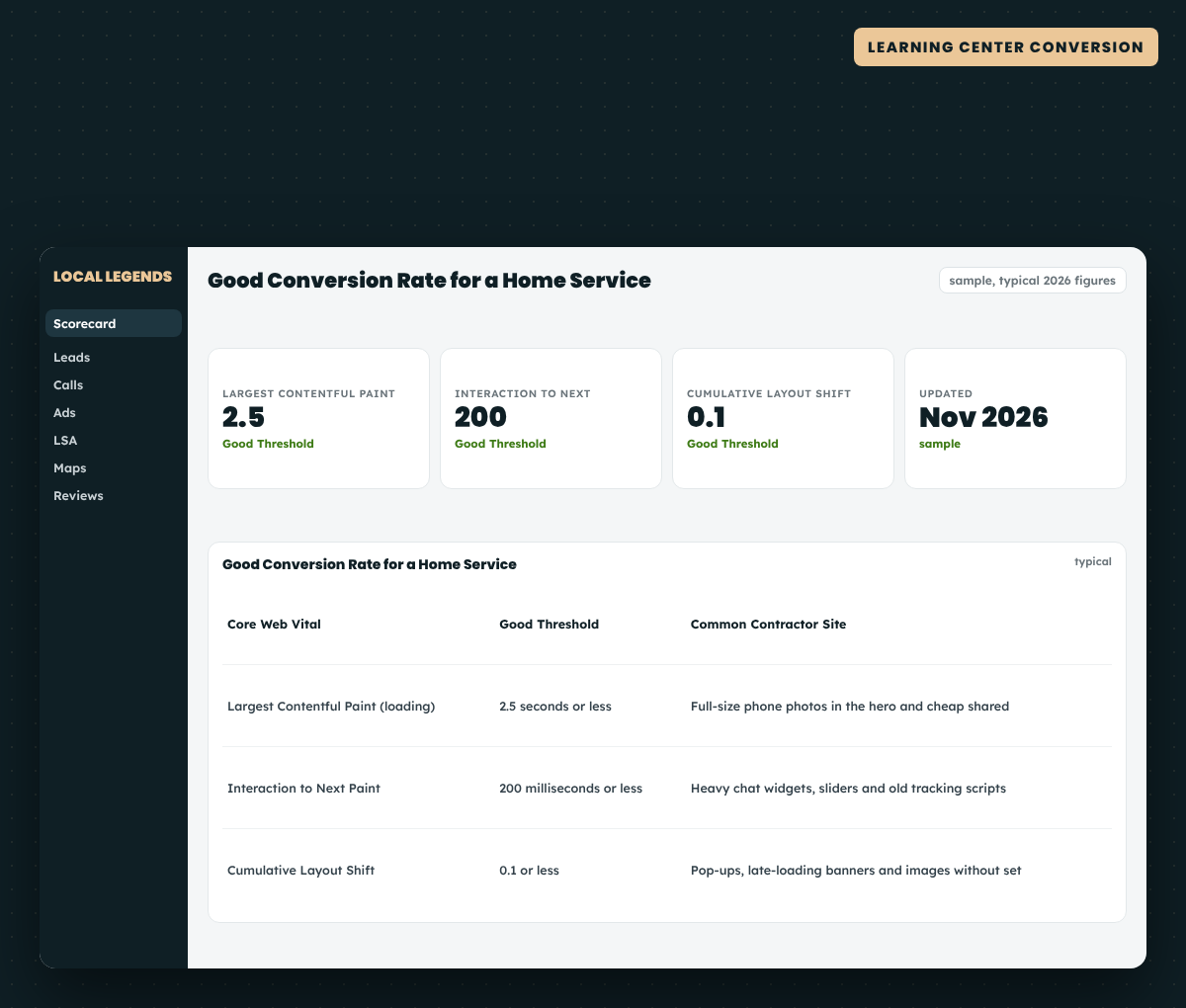
Google's Core Web Vitals set clear targets for a good experience. The table shows each metric and what usually breaks it on contractor sites.
| Core Web Vital | Good Threshold | Common Contractor Site Cause |
|---|---|---|
| Largest Contentful Paint (loading) | 2.5 seconds or less | Full-size phone photos in the hero and cheap shared hosting |
| Interaction to Next Paint (responsiveness) | 200 milliseconds or less | Heavy chat widgets, sliders and old tracking scripts |
| Cumulative Layout Shift (visual stability) | 0.1 or less | Pop-ups, late-loading banners and images without set sizes |
Google measures these at the 75th percentile of page loads, split by mobile and desktop, and Interaction to Next Paint replaced First Input Delay as a Core Web Vital in 2024. [SOURCE: web.dev, Web Vitals, checked Nov 27 2026]
Should I Use Live Chat, Pop-Ups or a Quote Calculator on My HVAC Website?
An HVAC website should add live chat, pop-ups or a quote calculator only when each one is answered quickly and does not slow the page or cover the call button.
- Live chat: useful when someone answers in minutes; an automated chat that books into the calendar can cover after hours, with the phone number kept beside it.
- Pop-ups: keep them off mobile service pages; if used at all, show them only when a visitor is about to leave.
- Quote calculators: helpful on system replacement pages when the ranges are honest and current.
- Text-to-call options: many homeowners prefer texting, so offer it beside the phone number.
- Test each one: compare calls and forms for 30 days with and without it.
Our HVAC Website Traffic Is Up but Calls Dropped This Month. What Broke? Check the Call Path Before Blaming the Market
When HVAC website traffic rises while calls fall, the cause is usually a broken call path, a tracking error or a shift in where the traffic comes from, and each one can be checked in an afternoon.
- Call every number on the site from a phone, including the tracking numbers.
- Submit every form and confirm the lead reaches the office.
- Check the traffic source: a blog post ranking nationally can lift visits without local calls.
- Check visitor locations in GA4: out-of-area or bot traffic inflates visits without producing calls.
- Read the Google Ads search terms report: broad match or Performance Max changes can pull in unrelated clicks.
- Look at mobile speed after any new plugin, chat tool or theme update.
- Check the Google Business Profile phone, website link and Maps calls report.
- Check missed and abandoned calls in case the call routing or answering service changed.
We Just Launched a New Website and Leads Went Down. What Should We Check?
A contractor whose leads drop after a new website launch should check redirects, tracking and the call path first, because launch mistakes cause most post-launch drops.
- Redirects: every old page that earned traffic should have a 301 to its new page.
- Tracking code: analytics, call tracking and ad conversion tags should all be installed again.
- Forms: confirm the new forms deliver to the right inbox and CRM.
- Phone numbers: make sure the old tracking numbers still forward.
- Content: pages that ranked should keep the copy that made them rank.
- Search Console: watch for crawl errors, pages dropped from the index and a noindex tag left on from staging.
- Ad final URLs: confirm Google Ads and Local Services traffic points to live pages, not old ones.
Can a Contractor Still A/B Test Landing Pages Now That Google Optimize Is Gone? Testing Tools Changed, the Method Did Not
Yes, a contractor can still A/B test landing pages after Google Optimize ended on September 30, 2023, using a third-party testing tool, the experiment features in some page builders or Google Ads campaign experiments for paid traffic.
[SOURCE: Google Analytics Help, Sunset September 2023 Google Optimize, checked Nov 27 2026]
Google Analytics 4 has no built-in way to split traffic, so the test tool does the splitting and sends results to GA4.
The bigger limit for most contractors is traffic, not tools. A test needs enough visits and leads on each version to show a real difference, and a page with a few calls a week can take months to reach that point.
Testing Options for Lower-Traffic Contractor Sites
- Test big changes, not button colors: a new headline and price range moves results more than a shade of orange.
- Use paid traffic: Google Ads landing pages collect visits faster than organic pages.
- Run before and after comparisons: same season, same budget, one change at a time.
- Watch recordings: a few dozen session recordings often show the problem without a test.
- Listen to calls: callers say exactly what the page failed to answer.
Do Financing Offers and Coupons on a Contractor Website Increase Calls?
Financing offers and coupons can increase calls on a contractor website when they match the job and appear on the right page, but the only way to know for your company is to track calls before and after adding them.
- Financing belongs on big-ticket pages: roof replacement, HVAC systems and remodels.
- Coupons fit smaller jobs: drain cleaning, tune-ups and inspections.
- Use the lender's wording for any monthly payment claim.
- Put an end date on every offer and remove it when it expires.
- Keep the offer next to the call button and limit the page to two or three offers.
- Track each offer with its own form or number when possible.
What Is the Best Conversion Rate Optimization Agency for Home Service Companies? Choose by Trade Experience and Booked-Job Reporting
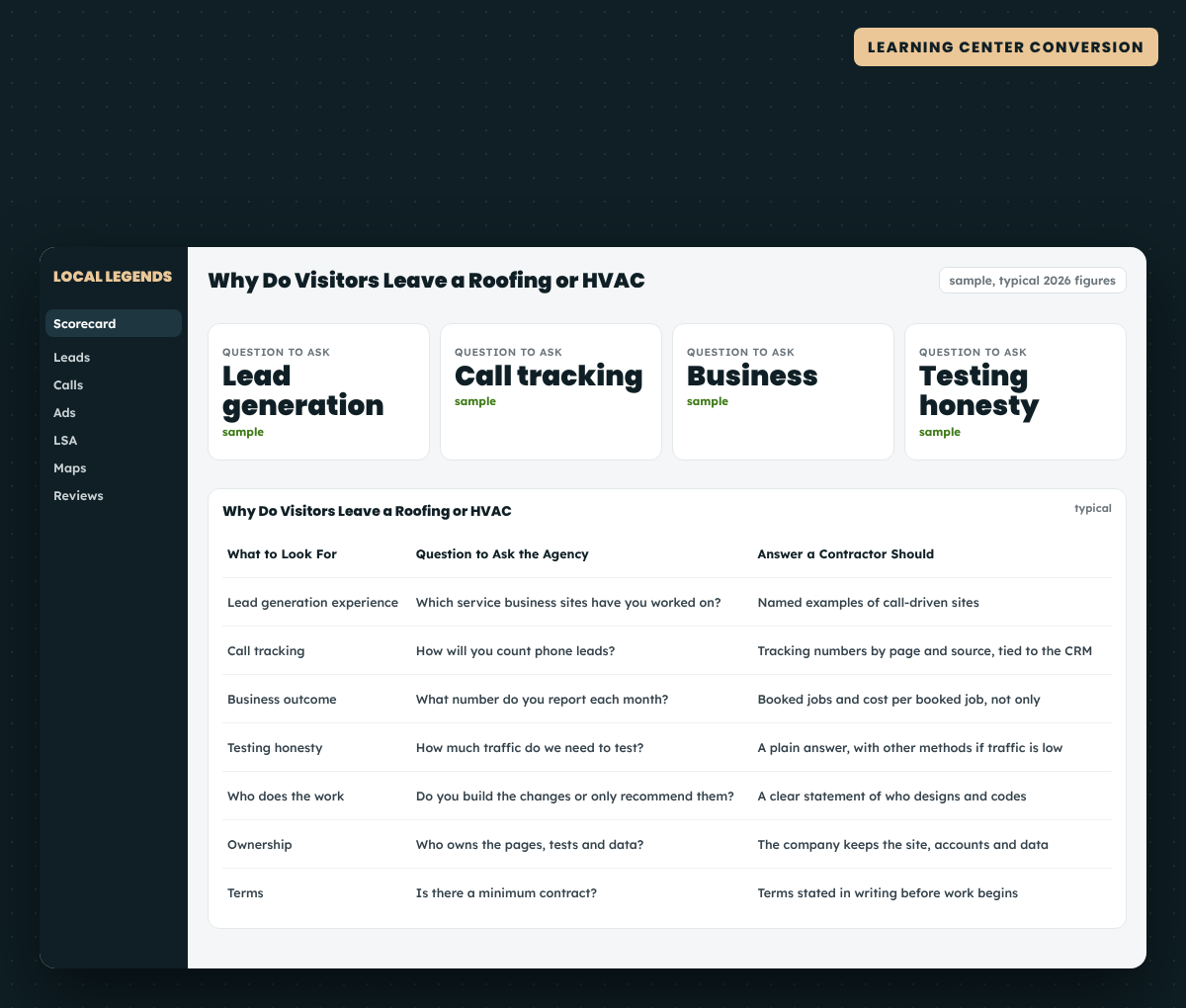
The best conversion rate optimization agency for a home service company is one that understands phone-driven leads, reports booked jobs and fixes pages it can prove are leaking, rather than one known mainly for online store checkouts.
Published lists of top CRO agencies lean heavily toward online retail and software clients with large traffic. A contractor should judge an agency by whether it can show work on lead generation sites where most leads arrive by phone.
| What to Look For | Question to Ask the Agency | Answer a Contractor Should Hear |
|---|---|---|
| Lead generation experience | Which service business sites have you worked on? | Named examples of call-driven sites |
| Call tracking | How will you count phone leads? | Tracking numbers by page and source, tied to the CRM |
| Business outcome | What number do you report each month? | Booked jobs and cost per booked job, not only conversion rate |
| Testing honesty | How much traffic do we need to test? | A plain answer, with other methods if traffic is low |
| Who does the work | Do you build the changes or only recommend them? | A clear statement of who designs and codes |
| Ownership | Who owns the pages, tests and data? | The company keeps the site, accounts and data |
| Terms | Is there a minimum contract? | Terms stated in writing before work begins |
Emergency Trades and High-Ticket Trades Convert Differently
Plumbing and HVAC repair visitors want a tap-to-call button and fast scheduling on the first screen. Roofing, remodeling and system replacement buyers research longer, so a short multi-step estimate form that asks about the project often fits those pages better.
What Should I Ask a Conversion Rate Optimization Agency Before Hiring?
A contractor should ask a conversion rate optimization agency how it measures phone leads, what it will change first and how it reports results in booked jobs before signing anything.
- What will you look at first, and why?
- How do you count calls, texts and forms?
- Can you connect results to our CRM?
- What do you do when our traffic is too low to test?
- Who writes and builds the changes?
- Can you walk us through a test that lost and what it taught you?
- Who will work on our account week to week?
- What happens to the pages, test results and data if we leave?
What Results Can a CRO Agency Honestly Promise a Roofing Company?
An honest CRO agency promises a process and clear reporting, not a fixed lift in leads, because results depend on traffic, season, the offer and how fast the office answers the phone.
- Fair promises: a research plan, a list of changes, a testing schedule and monthly reports.
- Promises to question: a guaranteed percentage increase before any research is done.
- Ask for a baseline: current calls, forms and booked jobs before work begins.
- Agree on the measure: booked jobs, not page views or button clicks.
How Local Legends Answers These Questions
Local Legends Marketing starts every engagement with an audit of tracking, local SEO, Local Services Ads and the website funnel, including Google Maps rank grids. [SOURCE: BRIEF.md engagement facts, Nov 2026]
Clients own every account, results are reported on a CEO scorecard of leads, booked, sold and cost per booked job, and there are no long-term contracts.
CRO or SEO: Which Should a Plumbing Company Invest in First? Fix the Page Before Buying More Traffic
A plumbing company should usually fix conversion problems before investing heavily in SEO or ads, because more traffic sent to a page that leaks only buys more lost callers.
- Start with conversion basics when the site gets traffic but few calls.
- Start with SEO or ads when the site converts well but too few people see it.
- Do both together when the site is new and has neither traffic nor proof.
- Check the office: missed calls and slow callbacks undo any website fix.
The Local Legends approach to pages that convert is explained on the contractor website design page, and paid traffic with its own landing pages is covered on the Google Ads management page.
Contractor CEO Reviews of Local Legends Marketing What Roofing and Restoration Owners Say
Contractor CEOs have gone on record about the strategy, paid ads and tracking Levi Ostlund and Local Legends ran for their companies.
A long roofing partnership: Brad Beldon, CEO of a roofing company, wrote about working with Levi over several years and the impact of his marketing strategy on the business. [SOURCE: Local Legends written testimonial, Brad Beldon, CEO, Roofing Company]
Levi has been absolutely outstanding to work with over the years... His creativity, responsiveness, and deep understanding of our marketing strategy have made a huge impact." Brad Beldon, CEO, Roofing Company. Read on Local Legends
- Kyle Scott, CEO, Roofing Company (video testimonial)
- Jim Dodson, CEO, Roofing Company (video testimonial)
- Race Allen, CEO, Precision Restoration of Texas (video testimonial)
- Brad Beldon, CEO, Roofing Company (written testimonial)
Why the Founder Measures Booked Jobs
Levi Ostlund sold driveway jobs door to door at 10, poured concrete with his father and ran a landscaping company in high school. He lost $30,000+ to marketers, one of whom built a good-looking site that never ranked, and later served as CMO of Amstill Roofing. [SOURCE: BRIEF.md founder facts]
That experience is why every page Local Legends builds is judged by calls and booked jobs, and why the leads are traced through call tracking and CRM integration.
Frequently Asked Questions About Conversion Rate Optimization Agencies Short Answers for Contractors
What Does CRO Stand For?
CRO stands for conversion rate optimization, the practice of increasing the share of website visitors who take a chosen action, such as calling or requesting an estimate.
How Is Conversion Rate Calculated?
Conversion rate is the number of conversions divided by the number of visitors, times 100. A page with 40 calls and forms from 1,000 visits converts at 4%.
How Long Does CRO Take to Show Results?
Simple fixes like a visible call button can show a change within weeks, while formal tests on lower-traffic contractor pages can take months to reach a reliable answer.
Is Landing Page Optimization the Same as CRO?
Landing page optimization is one part of CRO. CRO covers the whole site and funnel, while landing page work focuses on the pages that ads and campaigns send visitors to.
Does CRO Help SEO?
CRO and SEO support each other. Clear pages that answer questions well tend to keep visitors engaged, and better rankings bring more visitors for the improved pages to convert.
Can I Do CRO Myself?
Yes, for the basics. Call your own numbers, submit your own forms, move the phone number up, add price ranges and reviews, then track calls before and after each change.
Does Local Legends Offer a Separate CRO Retainer?
No. Conversion work is built into Local Legends websites, Google Ads landing pages and call tracking, and results are reported in booked jobs on the CEO scorecard.
What Tools Do CRO Agencies Use?
Most use analytics, heatmaps, session recordings, form analytics and an A/B testing tool, plus call tracking for businesses that get leads by phone.
Reviewed by Levi Ostlund, Founder, Local Legends Marketing

Turn More Website Visitors Into Booked Jobs With Conversion Rate Optimization Built In Start With a Free Growth Audit
The quickest way to find where your website leaks leads is to check tracking, pages, speed and the call path in one review. Local Legends Marketing audits all of it, runs Google Maps rank grids and shows which fixes come first.
- Call:(936) 900-1248
- Home office: 481 Stephen F Austin Dr, Conroe, TX 77302
- Next step: book a free growth audit and see your funnel from visit to booked job