


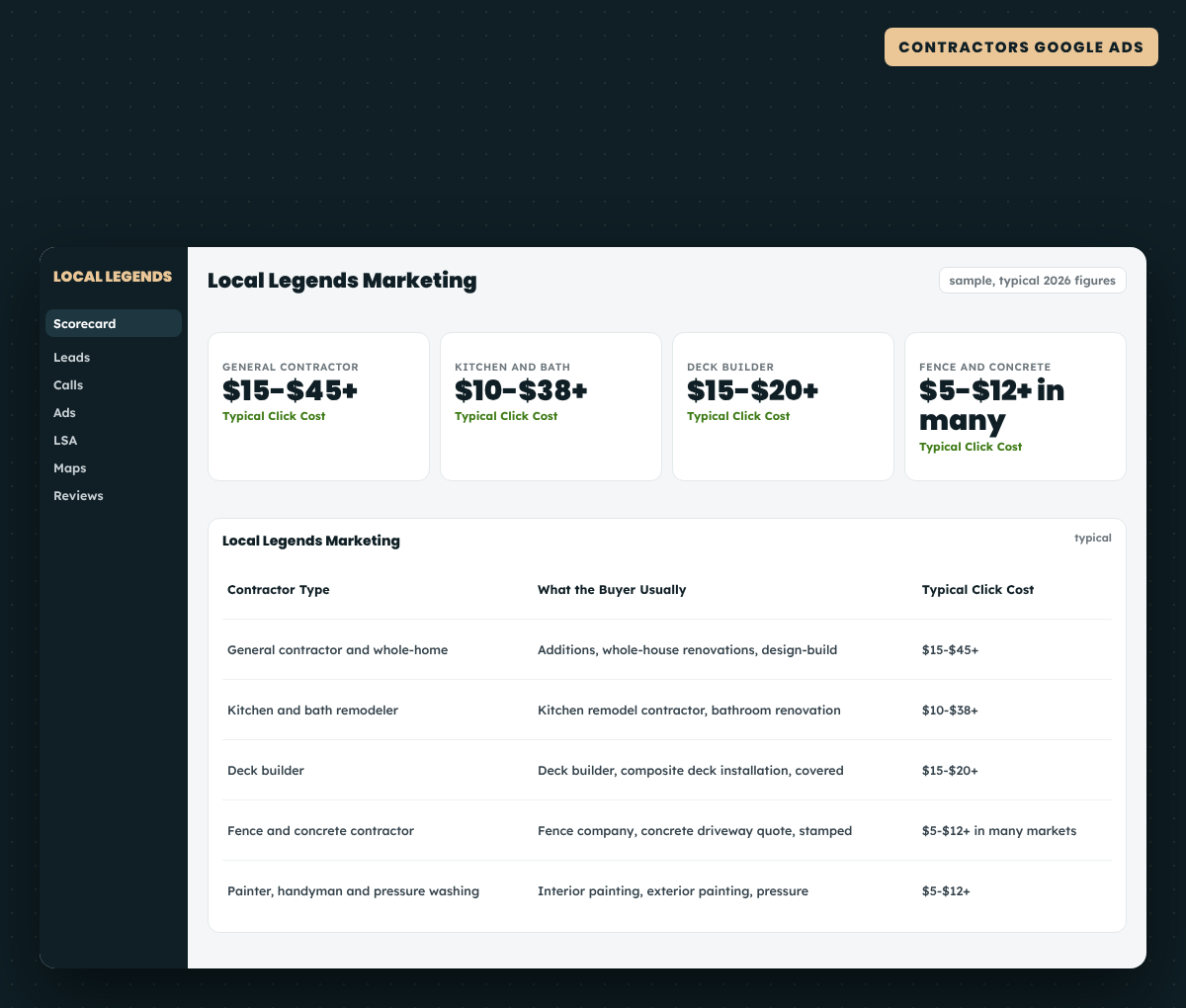
Local Legends Marketing

Google Ads for Contractors That Buy Project Searches, Block Job Seekers and Small Repairs, and Report Signed Contracts Back to Google
Local Legends Marketing: PPC for Contractors at $2,000 a Month, Flat
Updated November 2026 · Reviewed by Levi Ostlund, Founder
Breadcrumb: Home > Industries > Contractors [LINK: /industries/contractors/] > Google Ads
Google Ads for contractors works when the account pays for searches tied to real projects, such as a kitchen remodel or a new deck, and refuses the searches that bring job seekers, do-it-yourselfers and small repair calls. That is how Local Legends Marketing builds every contractor account.
- Campaigns by project: kitchens, baths, additions, decks or fences each get their own campaign, budget and landing page.
- Junk blocked on day one: career, do-it-yourself and wrong-scope terms go into negative lists before launch.
- Local reach only: location settings limited to people in or regularly in the service area.
- Signed work reported back: consultations and contracts from the CRM feed Google's bidding.
- Landing pages included: campaign pages come with the $2,000 fee.
Free Growth Audit
Your Reviews, Radius and Response Rate vs the competitors beating you.
About Local Legends Marketing
A home service marketing agency headquartered in Conroe, Texas, with 8+ years of marketing experience, running Google Ads, Local Services Ads, local SEO, AI SEO, connected TV and review systems for contractors nationwide.
How Google Ads for Contractors Differs From Google Ads for Other Local Businesses Wide Job Sizes, Long Sales Cycles, Crowded Words
Google Ads for contractors is harder than ads for a restaurant or salon because one account can attract both a $150 patch job and a six-figure addition, sales can take months to close, and the same words are searched by homeowners, job seekers and subcontractors. The account has to sort them.
The Job Size Spread
Google AI Mode put it plainly in November 2026: if every form and call counts as an equal conversion, the system treats a drywall patch and a home addition as the same win, then hunts for more of the cheaper one. Contractors fix that by reporting which leads became real projects.
The Sales Cycle
A remodeling contract can sign weeks or months after the first click. Google accepts offline conversions tied to a click ID for up to 90 days, so long projects are usually reported at the held consultation or estimate stage, with the signed contract added when it lands inside that window.
The Shared Vocabulary
People searching "contractor" or "construction company" include job hunters, students looking for licensing classes, subcontractors and commercial buyers. A residential contractor pays for all of them unless the keywords and negatives say otherwise.
Why Are My Remodeling Company's Google Ads Bringing In Job Seekers and Tiny Repair Jobs Instead of Big Projects?
A remodeling company's Google Ads usually draw job seekers and small repairs because broad keywords, extra networks and equal-value conversions teach Google to chase cheap, plentiful clicks, according to Google AI Mode in November 2026. Tighter keywords and better conversion data reverse it.
- Match types: move from broad match to phrase and exact match on project terms such as "home addition contractor."
- Networks: run Search campaigns on Google Search only, without search partners or display expansion.
- Career negatives: jobs, hiring, careers, salary, apprentice and apply.
- Scope negatives: handyman, patch, small repair, cheap and DIY, if the company does not want that work.
- Price anchoring: a minimum project size in the ads and on the landing page lets small budgets opt out before they click.
- Better signals: report qualified consultations and signed contracts, not raw form fills.
What Keywords Should Contractors Bid On in Google Ads? Project Searches Beat the Words "General Contractor"
Contractors should bid on project-specific searches paired with buying words like contractor, company, remodeler or estimate, and avoid the bare term "general contractor," because homeowners searching for a remodel usually name the project, not the license type. Google AI Mode gave the same advice.
| Keyword Approach | Example Searches | How Local Legends Treats It |
|---|---|---|
| Project plus buying word | "kitchen remodel contractor," "home addition builder," "basement finishing company" | Core campaigns, phrase and exact match |
| Project plus place | "bathroom renovation in [town]," "deck builder near me" | Core campaigns with town names in the ad copy |
| Design and build terms | "design build remodeling," "whole house renovation contractor" | Separate campaign with its own landing page |
| Residential general contractor | [residential general contractor near me] | Test only, exact match, heavy negatives |
| Bare trade words | "general contractor," "contractors near me" | Usually skipped, too many job seekers and commercial buyers |
| Early research | "kitchen ideas," "average cost of an addition" | Negative or left to SEO and content |
Negative Keyword Groups Every Contractor Account Needs
Career and Licensing Terms
Jobs, hiring, careers, salary, apprentice, license, classes, school and exam. These searches come from people who want to work in the trade, not hire it.
Do-It-Yourself and Early Research Terms
Ideas, pictures, photos, how to, DIY, supplies, lumber and plans. These buyers may hire later, but paid clicks rarely pay off at this stage.
Wrong-Scope Terms
Commercial, industrial, government and subcontractor for a residential company, and handyman or small repair for a company that only takes larger projects.
Our Contracting Company Is Adding Deck Building as a New Service. How Should We Set Up Google Ads for It?
A contractor adding deck building should launch a separate Search campaign with its own budget, a dedicated deck landing page and ad groups split by material and feature, rather than adding deck keywords to an existing remodeling campaign. Google AI Mode recommended the same in November 2026.
- Own campaign: a separate budget keeps deck clicks from starving the kitchen and bath campaigns.
- Ad groups by build type: custom decks, composite and PVC, wood and cedar, and covered decks or pergolas.
- Repairs apart: deck repair and resurfacing in their own campaign as shoulder-season work.
- Dedicated page: real deck photos, the design and build process and one clear consultation button.
- Deck negatives: lumber, plans, screws, kits, stain, plus unrelated phrases like boat deck or card deck.
- Bidding: start with capped clicks, then move to conversion bidding once the campaign has recorded roughly 15 to 30 conversions.
PPC for Contractors: Campaign Settings That Stop Wasted Spend Google's Defaults Favor Reach, Not Local Jobs
PPC for contractors starts with settings, because Google's defaults show ads to people who only showed interest in an area, place ads on partner sites and spread budget across every service at once. Changing a few settings often matters more than any new keyword.
My Google Ads Are Getting Clicks From People Outside My Service Area. I Am a General Contractor. How Do I Fix It Today?
A general contractor can stop most out-of-area clicks today by changing each campaign's location option from "Presence or interest" to "Presence," which limits ads to people in or regularly in the targeted area, the fix Google's own help pages describe and AI Mode put first.
- Open each campaign's settings, expand Locations and set the target option to Presence.
- Add location exclusions for bordering counties, cities or states the crews do not serve.
- Add town names you skip as negative keywords so local searches for those towns do not trigger ads.
- Name the service area in headlines, such as the county or main city, so travelers screen themselves out.
- Turn off search partners if out-of-area clicks continue.
- Check the locations report a week later to confirm where clicks now come from.
I Just Started a Contracting Business. How Do I Set Up My First Google Ads Campaign Without Wasting Money?
A new contracting business should start with one manual Search campaign for its one or two most profitable services, tight local targeting, phrase and exact match keywords, a negative list and conversion tracking installed before the first dollar is spent, which matches Google AI Mode's November 2026 answer.
- Skip the automated setup prompts and build a Search campaign directly.
- Pick one or two services with the best margin instead of advertising everything.
- Set Presence targeting around the ZIP codes or radius the trucks really drive.
- Run ads only when someone answers the phone, since a voicemail often sends the caller to the next ad.
- Track calls and forms first, then launch.
- Start with capped click bidding while the account has no conversion history.
- Read the search terms report daily for the first few weeks and add negatives.
- Add a call asset and callouts such as licensed and insured or free estimates, only if true.
Ad Assets That Fit Contractor Search Ads
Assets give a contractor ad more room on the results page without raising the bid. A call asset lets phone searchers dial straight from the ad, and it should run only during hours when the office or an answering service picks up.
- Sitelinks: one per core project, such as kitchens, additions or decks, each pointing to its own page.
- Callouts: short facts the company can prove, like years in business, licensed and insured or a written warranty.
- Structured snippets: a list of services or project types under a "Services" header.
- Image assets: real project photos from the company's own jobs, never stock images of someone else's work.
- Location asset: a linked Business Profile so the address and rating can appear with the ad.
Every asset should match the landing page it supports. A sitelink for basement finishing that opens a generic services page wastes the click the asset earned.
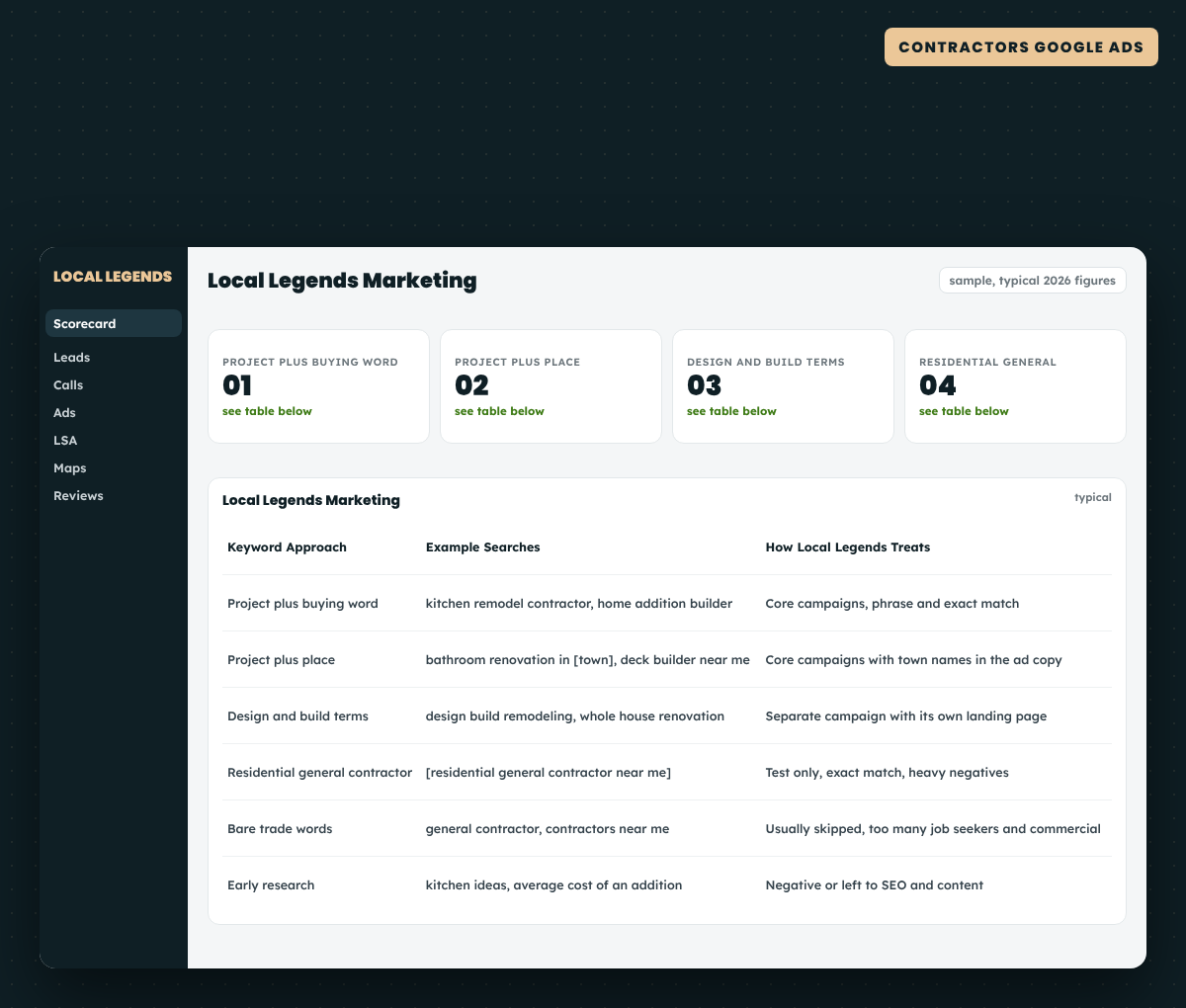
Should a Contractor Run Google Ads, Local Services Ads or Facebook Ads First? Each Channel Catches a Different Buyer
Most contractors should start with Google Search Ads for their highest-value projects, add Local Services Ads where the trade qualifies and reviews are strong, and add Facebook ads once search is profitable, because search buyers are already shopping while social buyers are still dreaming.
| Channel | How It Charges | Best Fit for Contractors | What It Needs to Work |
|---|---|---|---|
| Google Search Ads | Per click | High-ticket projects with specific searches, such as kitchens, additions and decks | Project keywords, negatives, landing pages and tracking |
| Local Services Ads | Per lead | Urgent and everyday jobs in eligible categories | License and insurance checks, a verified Business Profile, strong reviews and fast answers |
| Facebook and Instagram ads | Per impression or click | Visual planned upgrades, such as patios, custom fences and outdoor living | Real project photos, fast follow-up and qualifying questions |
| Retargeting | Per impression or click | Visitors who came from Google but did not request a quote | Enough site traffic and a tracking pixel |
Google Ads or Local Services Ads: Which Is Better for a Remodeling Contractor?
For a remodeling contractor, Google Search Ads are usually better for full kitchens, baths, additions and whole-home work, while Local Services Ads tend to bring smaller jobs and quick estimates, according to Google AI Mode in November 2026. Many remodelers run both, with most of the budget on Search.
- Search strengths: control over keywords, ad copy and the landing page that shows the portfolio.
- Local Services Ads strengths: pay per lead, top placement and a verified badge.
- Local Services Ads limits: less control over which jobs come in, and missed calls can hurt placement.
- Reviews matter: Local Services Ads lean heavily on rating and review volume, so newer companies often start with Search.
- Profile accuracy: Google pulls Local Services Ads details from the Business Profile, so hours and services must be current.
The Verified Badge Changed
Published Local Services Ads guides report that Google retired the Google Guaranteed badge in October 2025 and replaced it with a Google Verified checkmark. Background, license and insurance checks still apply, and Local Services Ads now run inside Google Ads.
Is Google Ads or Facebook Ads Better for a Fencing or Concrete Contractor?
A fencing or concrete contractor usually gets faster, ready-to-book jobs from Google Ads, because those buyers are searching for a quote, while Facebook ads work better for visual upgrades like stamped patios and custom privacy fences, which is how AI Mode framed it in November 2026.
- Google first: replacements, storm-damaged fences and cracked driveways are searched when the need is real.
- Facebook second: before and after photos and short videos spark interest in patios and decorative fences.
- Social follow-up: social leads need a quick call back and a few questions about budget and timing.
- Retargeting bridge: show finished projects to people who visited from Google but did not ask for a quote.
- Local Legends options: Facebook and Instagram ads run $2,500 a month on their own, and Trailblazer plans include them.
How Much Should a Contractor Spend on Google Ads, and What Does Management Cost? Ad Spend and the Management Fee Are Separate Bills
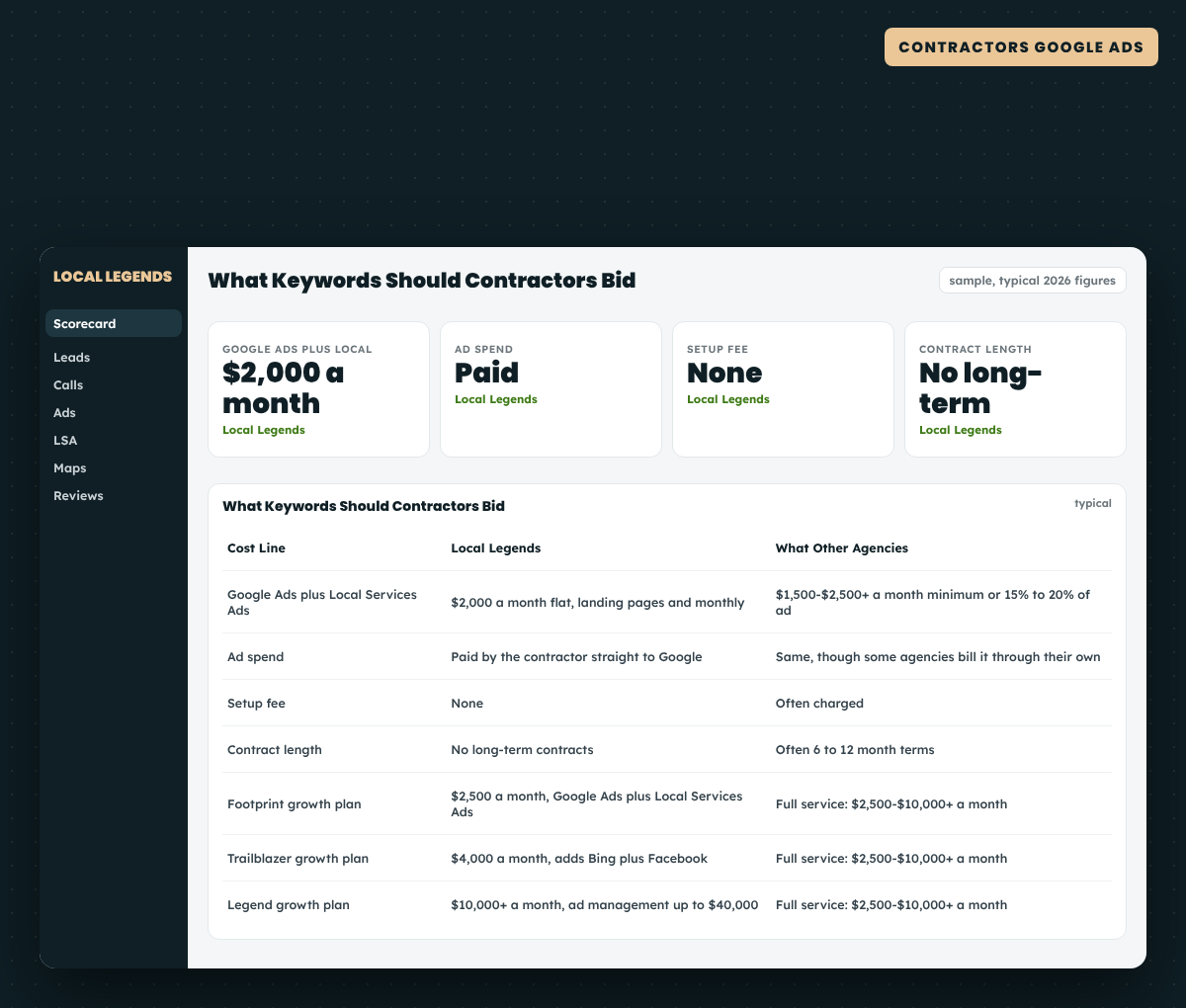
A general contractor typically starts at $1,500 to $3,000+ a month in Google ad spend, with $3,000 to $5,000+ common in competitive metros, according to Google AI Mode in November 2026, and management is a separate fee. Local Legends charges a flat $2,000 a month for that management.
| Cost Line | Local Legends | What Other Agencies Typically Charge |
|---|---|---|
| Google Ads plus Local Services Ads management | $2,000 a month flat, landing pages and monthly Business Profile optimization included | $1,500-$2,500+ a month minimum or 15% to 20% of ad spend |
| Ad spend | Paid by the contractor straight to Google | Same, though some agencies bill it through their own account |
| Setup fee | None | Often charged |
| Contract length | No long-term contracts | Often 6 to 12 month terms |
| Footprint growth plan | $2,500 a month, Google Ads plus Local Services Ads, 10 pages or blogs, local SEO and call tracking | Full service: $2,500-$10,000+ a month |
| Trailblazer growth plan | $4,000 a month, adds Bing plus Facebook and Instagram ads | Full service: $2,500-$10,000+ a month |
| Legend growth plan | $10,000+ a month, ad management up to $40,000 a month in spend, then 10% above | Full service: $2,500-$10,000+ a month |
Every plan, add-on and fee is listed on the Local Legends pricing page.
What Typical Contractor Numbers Looked Like in 2026
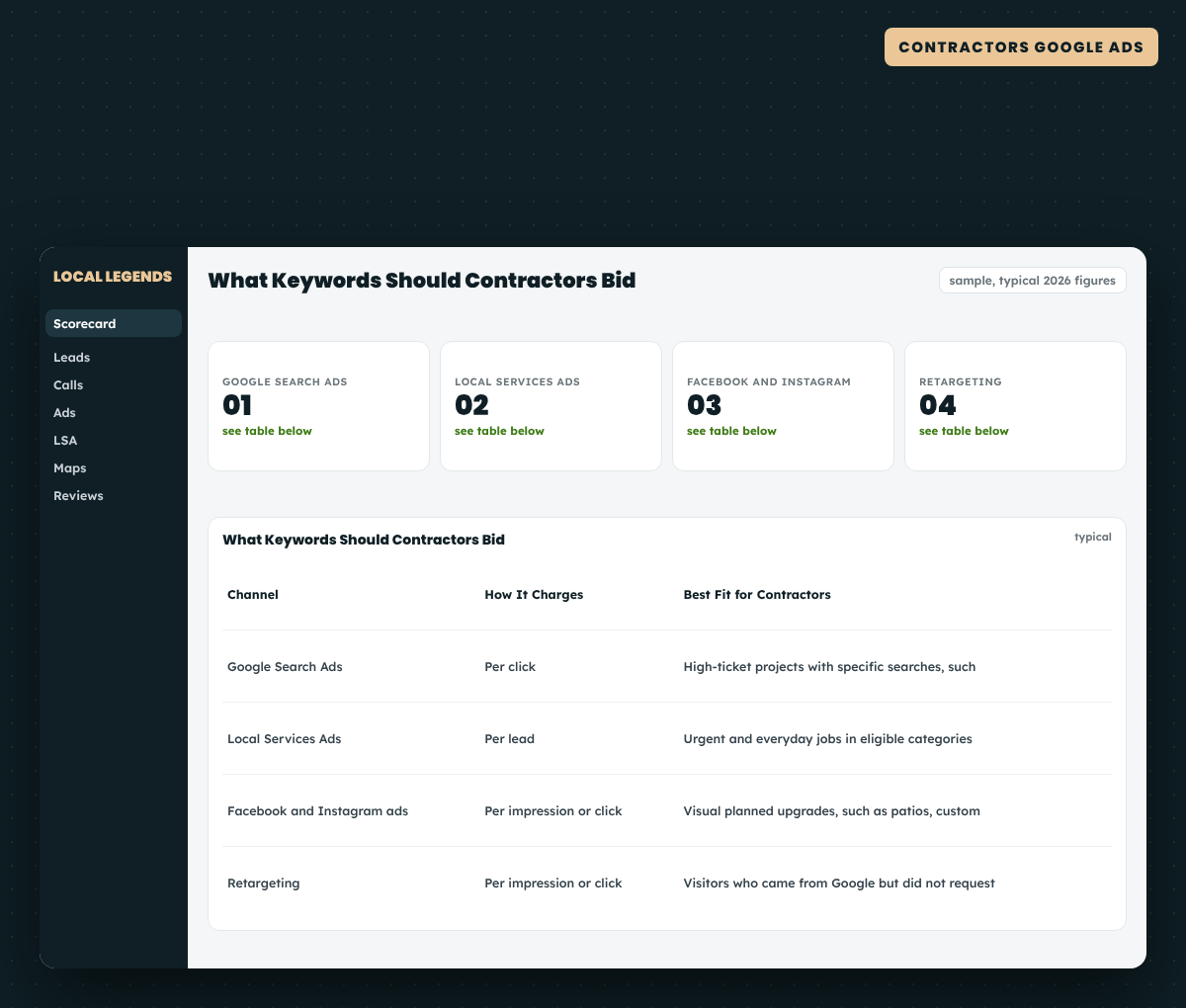
Google AI Mode cited typical general contractor figures of $15 to $25+ a click, up to $30 to $45+ for custom builds and remodels, about an 8% conversion rate and a blended cost per lead near $166. Treat these as starting points; local markets vary widely.
Is $500 a Month Enough for Google Ads for a Small Contractor?
$500 a month is usually enough for a narrow test of one service in a few nearby towns, not a steady lead engine, according to Google AI Mode in November 2026. It stretches further in lower-cost trades than in remodeling.
- Lower-cost trades: painters, handymen, pressure washers and many fence companies often see typical clicks around $5 to $12+.
- Competitive trades: roofing, HVAC, plumbing and electrical clicks often run $15 to $45+, so $500 buys few clicks.
- Major remodeling: typical clicks of $30 to $50+ make $500 too thin to learn much.
- Make it count: one service, two or three towns, phrase and exact match, and every call answered live.
- Consider pay per lead: Local Services Ads can stretch a small budget in eligible trades.
How Do I Figure Out the Most I Can Afford to Pay Per Click and Per Lead as a Remodeling Contractor?
A remodeling contractor finds its ceiling by working backward from average job value, profit margin, close rate and landing page conversion rate, then bidding well below break-even. Google AI Mode walked through the same math in November 2026.
- Break-even cost per lead: average job value times net margin times close rate. A $40,000 job at 20% margin and a 20% close rate gives $1,600.
- Target cost per lead: aim for 30% to 50% of break-even, or $480 to $800+ in that example.
- Subtract management: take the monthly fee out of the allowable budget first.
- Maximum cost per click: target cost per lead times conversion rate. $600 at a 5% conversion rate allows about $30 a click.
- Adjust for lead quality: if half the leads are unqualified, cut the close rate in half before doing the math.
- Check against the market: typical remodeling clicks run about $10 to $38+, so a much lower ceiling points to a page or sales problem.
Google Ads Copy for Contractors: Licenses, Financing and Lead-Safe Claims Each Ad Claim Has a Rule
Contractor ad copy can mention licenses, financing and lead-safe work, but each claim must be true, match the company's credentials and follow federal and state advertising rules. The safest ads state facts the company can prove.
What Can a Contractor Say in Google Ads About Licenses, Financing and Lead-Safe Renovation?
A contractor can advertise "Licensed and Insured," "Financing Available" and lead-safe renovation, as long as the license is real and in scope, specific loan terms come with full disclosures, and the firm holds EPA lead-safe certification before advertising work on homes built before 1978.
- License claims: state only the classification the company holds, and include the license number where the state requires it in advertising.
- Scope: never advertise trades the license does not cover, such as plumbing under a builder's license.
- General financing words:"financing available" or "ask about payment plans" avoid the trigger terms.
- Specific loan terms: a down payment, number of payments, payment amount or finance charge in an ad triggers required disclosures under federal Regulation Z.
- Lead-safe work: federal rule 40 CFR 745.81 bars a firm from performing, offering or claiming to perform covered renovations without EPA certification.
- Legal review: these are general guidelines, not legal advice, so confirm state rules with the licensing board.
What Regulation Z Requires When an Ad Names Loan Terms
When a contractor ad names a triggering term, such as a specific monthly payment, Regulation Z requires the down payment, the full repayment terms and the annual percentage rate, with a note if the rate can rise. Short ad headlines rarely have room, so most contractors keep loan math off the ad.
The Pre-1978 Home Rule
Homes built before 1978 fall under the EPA's Renovation, Repair and Painting rule. A remodeler, painter or window installer whose firm is not certified should not advertise that work, and certified firms can say so in the ad and on the page.
Tracking Signed Contracts From Google Ads for Contractors Click IDs Must Reach the CRM
Tracking Google Ads for contractors means capturing the Google click ID on every call and form, carrying it into the CRM and sending qualified consultations and signed contracts back to Google, so the system learns which searches lead to real projects.
The 90-Day Window
Google accepts offline conversions tied to a click ID for up to 90 days after the click. Contractors with long sales cycles report an earlier milestone, such as a held design consultation, so the signal arrives in time.
Which CRMs Connect
Local Legends connects CallRail call tracking with CRMs including ServiceTitan, Housecall Pro, JobNimbus, AccuLynx, Jobber, Buildertrend and GoHighLevel, so each tracked call or form can be matched to a booked or sold job.
Leads traced to sold jobs: Local Legends pairs CallRail tracking with the contractor's CRM and reports leads, booked jobs, sold jobs and cost per booked job on a CEO scorecard, monthly on Footprint and weekly on Trailblazer and above. [SOURCE: Local Legends call tracking and scorecard, Local Legends brief, confirmed Nov 10 2026]
The tracking build is explained on the call tracking and CRM page.
My Contractor Google Ads Get Clicks but No Calls or Quote Requests. What Should I Check?
When contractor ads get clicks but no leads, the cause is usually who is clicking, what they see after the click or whether tracking records the leads at all, according to Google AI Mode in November 2026. Checking in that order finds most problems quickly.
- Who clicks: the search terms report, location option and network settings.
- When ads run: pause or change messaging during hours nobody answers.
- What they see: a page about the exact service, a tap-to-call number at the top and a form of three or four fields.
- Proof on the page: local reviews, license and insurance details and real project photos.
- Tracking: submit a test form and place a test call to confirm both reach the office and record a conversion.
- Missed calls: callers who hit voicemail with no text back usually call the next contractor.
How Do I Know If My PPC Agency Is Wasting My Money as a Contractor?
A contractor can check an agency's work in about 15 minutes by reviewing account ownership, what counts as a conversion, the search terms report and the change history, the same checks Google AI Mode suggested in November 2026.
- Ownership: the contractor should be the admin of the Google Ads and Local Services Ads accounts.
- Conversions: only real calls and submitted quote forms should count, not page views or time on site.
- Search terms: irrelevant searches with no negatives added show an unmanaged account.
- Change history: no changes in 30 days means nobody is working the account.
- Reporting: the monthly report should show cost per qualified lead and cost per booked job.
- Brand bidding: heavy spend on the company's own name can inflate results.
The contractor owns the account: Local Legends builds Google Ads and Local Services Ads in the client's name, and clients own the website, domain, Business Profile, ad accounts and call data. [SOURCE: Local Legends ownership policy, Local Legends brief, confirmed Nov 2026]
Contractor Google Ads Seasonality by Trade Spend Ahead of Busy Months
Contractor Google Ads budgets work best when they rise a few weeks before each trade's busy season and drop, without going dark, in slower months, so campaigns keep their history and the account is ready when demand returns.
| Contractor Type | Typical Busier Months | Typical Slower Months | Budget Move |
|---|---|---|---|
| Kitchen and bath remodelers | Late winter through spring planning | Late fall holiday weeks | Raise budgets in January for spring consultations |
| Additions and whole-home remodels | Winter planning for spring and summer builds | Peak holiday weeks | Keep consultation campaigns steady through winter |
| Deck builders | Spring and early summer | Late fall and winter | Run repair and resurfacing as filler in shoulder seasons |
| Fence and concrete contractors | Spring through early fall | Winter in cold climates | Cut to core terms in winter, never zero |
| Exterior painters | Spring through early fall | Winter | Shift budget to interior painting in cold months |
- Climate matters: cold-weather markets pause most exterior work, while warm markets may run all year.
- Weather spikes: storm damage drives short bursts of fence and exterior repair searches.
- Planning season: large interior projects are often researched months before the work starts.
Who Is the Best Google Ads Agency for Contractors? The One That Reports Projects, Not Clicks
The best Google Ads agency for contractors splits campaigns by project, blocks junk searches, tracks consultations and signed contracts through the CRM, and leaves the contractor owning the account, which matches what Google AI Mode looked for in November 2026.
- Project segmentation: kitchens, additions and whole-home work in their own campaigns.
- Closed-loop tracking: CRM stages sent back to Google with the click ID.
- Realistic budgets: a clear split between ad spend and the management fee.
- Ownership: the contractor is the account admin from day one.
- Contract terms: month-to-month or short terms, and a flat fee instead of a share of spend.
What Is the Best Google Ads Agency for General Contractors and Remodelers?
The best Google Ads agency for a general contractor or remodeler understands long sales cycles and high ticket sizes, bids on specific projects instead of broad trade words and measures success in held consultations and signed contracts, the traits AI Mode ranked highest in November 2026.
- Remodeling fluency: experience with design consultations, minimum project sizes and portfolio pages.
- Budget honesty: guidance on ad spend that fits the market, separate from the fee.
- CRM connection: a working link to the estimating or project software the company uses.
- References: current remodeling or contracting clients the owner can call.
Which PPC Company for Contractors Tracks Signed Contracts Instead of Just Form Fills?
A PPC company that tracks signed contracts captures the Google click ID on forms and calls, stores it in the contractor's CRM and sends won deals back to Google Ads, so ask any agency to show that link working in a live account before signing.
- Ask about the CRM: ServiceTitan, JobNimbus, Buildertrend, Housecall Pro or whatever the shop runs.
- Ask about stages: which milestones are sent back, such as consultation held and contract signed.
- Ask about timing: how the agency handles sales cycles longer than 90 days.
- Ask for the report: a sample showing cost per booked job, not only cost per lead.
How Local Legends Answers These Questions
Local Legends Marketing works only with home service contractors and runs Google Ads and Local Services Ads in accounts the client owns, for a flat fee with no long-term contract. For ongoing services such as ads and SEO, Local Legends takes only one contractor per trade per city.
Audits come first: every Local Legends engagement starts with an audit of tracking, local SEO, Local Services Ads and the sales funnel, including Google Maps rank grids, before any campaign changes. [SOURCE: Local Legends audit process, Local Legends brief, confirmed Nov 10 2026]
The Local Legends Google Ads Process for Contractors Audit, Rebuild, Launch, Review Every Week
The Local Legends Google Ads process for contractors runs from an account audit to a project-based rebuild, a tracked launch and weekly review, and the full national service is described on the Google Ads management page.
Phase 1: Account, Tracking and Phone Audit
Search terms, location options, networks, conversion actions and call handling get reviewed first, along with rank grids and the Business Profile.
Phase 2: Rebuild Around Projects
Campaigns are rebuilt by project with phrase and exact match keywords, shared negative lists and a landing page for each campaign.
Phase 3: Connect the CRM
Calls and forms carry the click ID into the CRM, and qualified consultations and signed contracts are reported back to Google.
Phase 4: Launch and Watch the Search Terms
New campaigns launch with capped bids, and the search terms report is read often in the first weeks so negatives keep up.
Phase 5: Review Weekly and Report to the Owner
Budgets move toward the campaigns producing booked jobs, and the owner sees leads, booked jobs, sold jobs and cost per booked job on the scorecard.
Local Services Ads management is covered on the Google Local Services Ads page, campaign pages on the contractor website design page, and the wider channel plan on the contractor marketing page. Coverage areas are listed under Local Legends service areas.
Google Ads for Contractors, Run by a Founder Who Came Up in the Trades Levi Ostlund Has Paid for Bad Marketing Too
Local Legends founder Levi Ostlund sold driveway jobs door to door at age 10, poured concrete with his father and ran a landscaping company in high school before he ever bought an ad. He later lost more than $30,000 to marketers, then served as CMO of Amstill Roofing.
From the job site to the ad account: Levi Ostlund's years of selling, pouring concrete and running a landscaping crew, followed by a CMO role at a roofing company, are why every Local Legends account is measured in booked and sold jobs. [SOURCE: Levi Ostlund founder story, Local Legends brief, confirmed Nov 2026]
Local Legends Marketing Reviews From Contractor CEOs What Roofing and Restoration Owners Say
Contractor CEOs have shared what working with Local Legends Marketing is like.
Levi has been absolutely outstanding to work with over the years... His creativity, responsiveness, and deep understanding of our marketing strategy have made a huge impact." Brad Beldon, CEO, Roofing Company. Read more reviews
- Kyle Scott, CEO, Roofing Company (video testimonial)
- Jim Dodson, CEO, Roofing Company (video testimonial)
- Race Allen, CEO, Precision Restoration of Texas (video testimonial)
Agency-reported totals: 25,000+ appointments generated and $30M+ in revenue influenced.
Frequently Asked Questions About Google Ads for Contractors Quick Answers for Contractor Owners
Do Google Ads Work for Contractors?
Yes, Google Ads work for contractors when campaigns target specific projects, send clicks to matching pages and track leads through to signed jobs. Accounts that bid on broad words and count every click as success usually struggle.
Is $20 a Day Good for Google Ads for a Contractor?
About $20 a day, or roughly $600 a month, can test one service in a small area, but in remodeling and other high-cost trades it buys only a handful of clicks, so results take longer to read.
How Long Does It Take for Contractor Google Ads to Start Working?
Most contractor campaigns typically need 30 to 90 days to settle, because the first weeks go to adding negatives, fixing pages and collecting enough conversions for Google's bidding to learn.
Should a Contractor Use Performance Max or Broad Match?
Usually not at the start. Search campaigns with phrase and exact match give cleaner data; broad match and Performance Max make more sense once the account records a steady flow of real conversions.
Should a Contractor Bid on Its Own Company Name?
Often a small brand campaign helps protect the name from competitors, but it should be reported separately, because brand searches convert well and can make overall results look better than the project campaigns really are.
Who Owns the Google Ads Account With Local Legends?
The contractor does. Accounts are built in the client's name, ad spend is paid straight to Google, and the client keeps the account, data and history if they leave.
Does Local Legends Work With Other Contractors in My Trade and Area?
For ongoing services like Google Ads and SEO, Local Legends takes only one contractor per trade per city, so a client never shares its account strategy with a direct local competitor.
What Should a Contractor Have Ready Before Launching Google Ads?
Have a landing page for each core service, call and form tracking, a clear service area, a minimum project size if there is one, and someone ready to answer the phone. Real project photos and reviews make every page stronger.
Reviewed by Levi Ostlund, Founder, Local Legends Marketing

Get Google Ads Built Around the Projects Your Contracting Company Wants Book a Free Growth Audit
Send your Google Ads account, and the free growth audit will show the searches, settings and tracking gaps costing you projects, plus the campaign plan to fix them.
- Call:(936) 900-1248
- Office: 481 Stephen F Austin Dr, Conroe, TX 77302
- Next step: book the free growth audit and get a project-by-project Google Ads plan