


Contractor Web Design From Local Legends

Websites for Trades: Contractor Website Design Built Around How Each Trade Gets Hired, From the Emergency Call to the Signed Project
Contractor Web Design From Local Legends Marketing, From $2,500 One Time
Updated November 2026 · Reviewed by Levi Ostlund, Founder
Websites for trades work when the layout matches how the customer hires that trade: a plumber's site has to win a panicked phone call in seconds, while a remodeler's site has to hold a careful buyer through weeks of comparing. Local Legends Marketing designs contractor websites around that difference.
Typical contractor website design costs $1,500-$15,000+ in 2026, depending on who builds it and how many pages it needs. Local Legends charges a one-time fee by page count, from $2,500 for 10 pages to $15,000 for 80 pages, and the site, domain and call data stay in your name.
- Trade-matched layouts: emergency trades get tap-to-call and short forms first; project trades get galleries, process and estimate requests first.
- Pages people search for: one page for each service you want more of and town pages only where the team can write 5+ real local facts.
- Booking that fits the job: a scheduling widget for tune-ups, a request-a-window form for installs and remodels.
- Tracked to the sold job: CallRail call tracking and CRM routing so each call and form keeps its source.
- Agency-reported results: 25,000+ appointments generated and $30M+ in revenue influenced across contractor clients.
Free Growth Audit
Your Reviews, Radius and Response Rate vs the competitors beating you.
About Local Legends Marketing
A home service marketing agency headquartered in Conroe, Texas, with 8+ years of marketing experience, running Google Ads, Local Services Ads, local SEO, AI SEO, connected TV and review systems for contractors nationwide.
How Websites for Trades Differ by the Way Each Trade Gets Hired The Urgency of the Job Sets the Layout
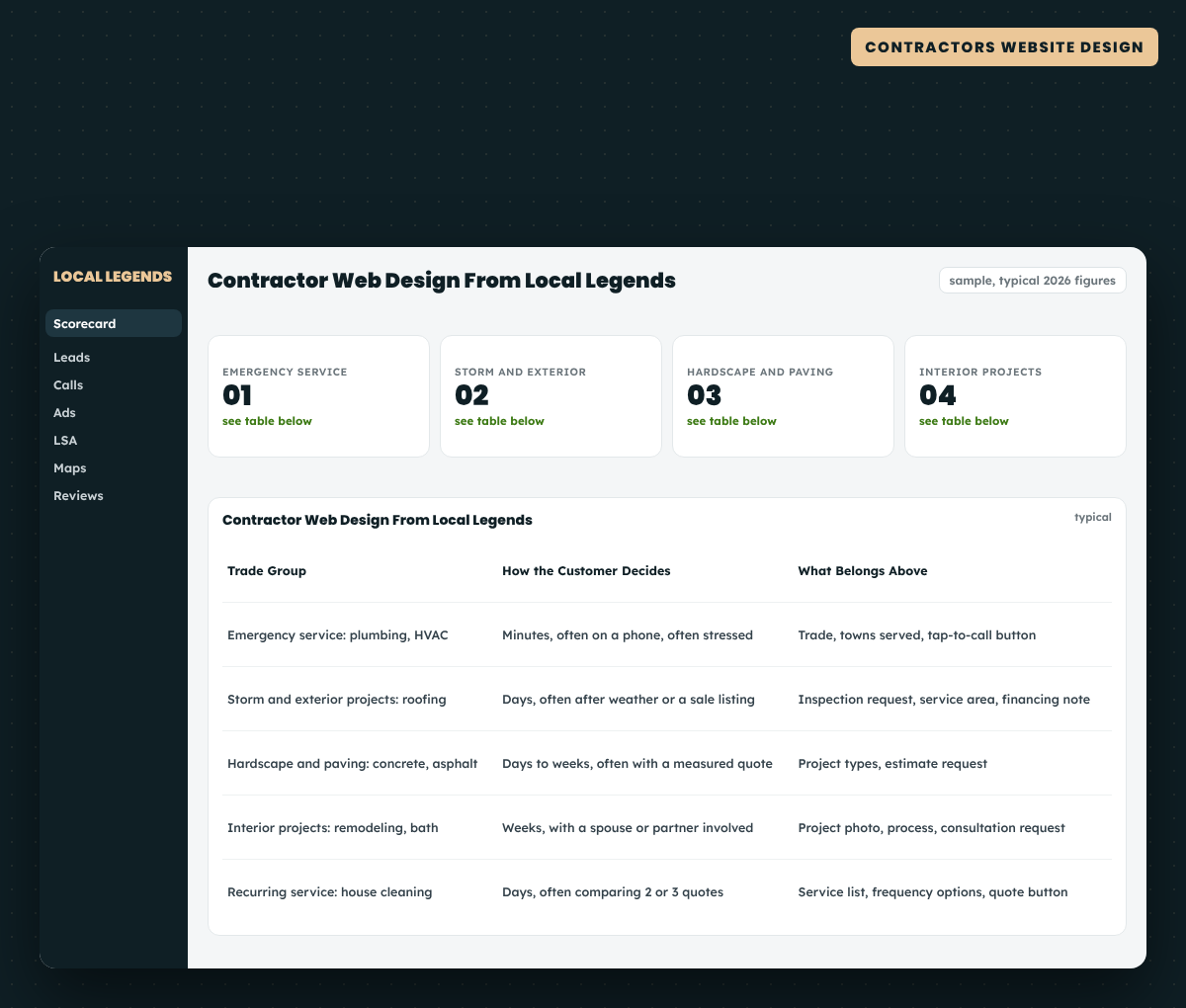
Contractor web design starts with one question: how fast does the customer decide? A homeowner with no heat in January decides in minutes. A homeowner pricing a new roof, a patio or a bathroom decides over days or weeks, and visits the site several times before reaching out.
Google AI Mode described the same split in November 2026: emergency trades need a site built for distress and speed, while remodelers and roofers need a site built for visual trust and longer consideration. Most trades fall into one of four buying patterns.
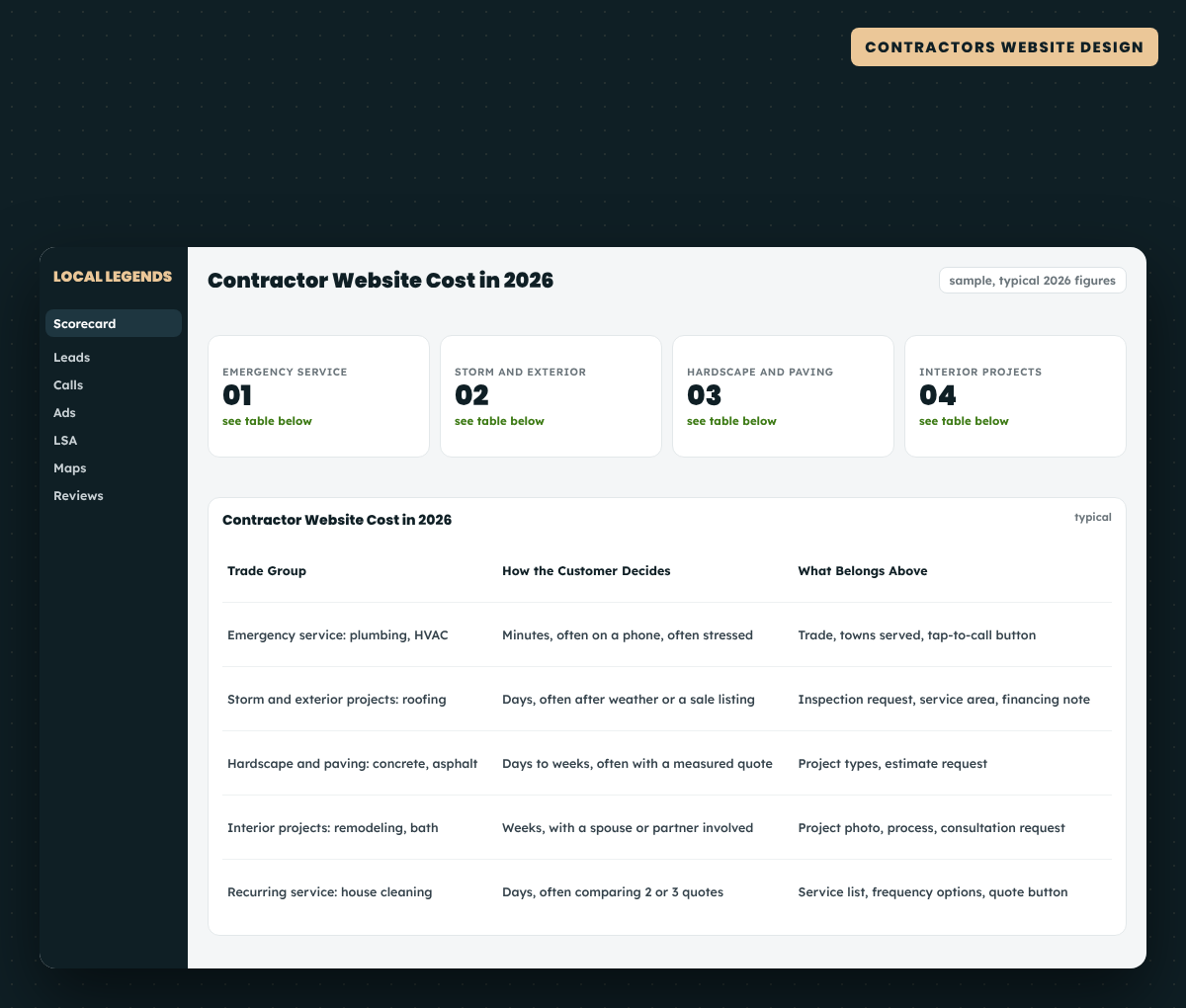
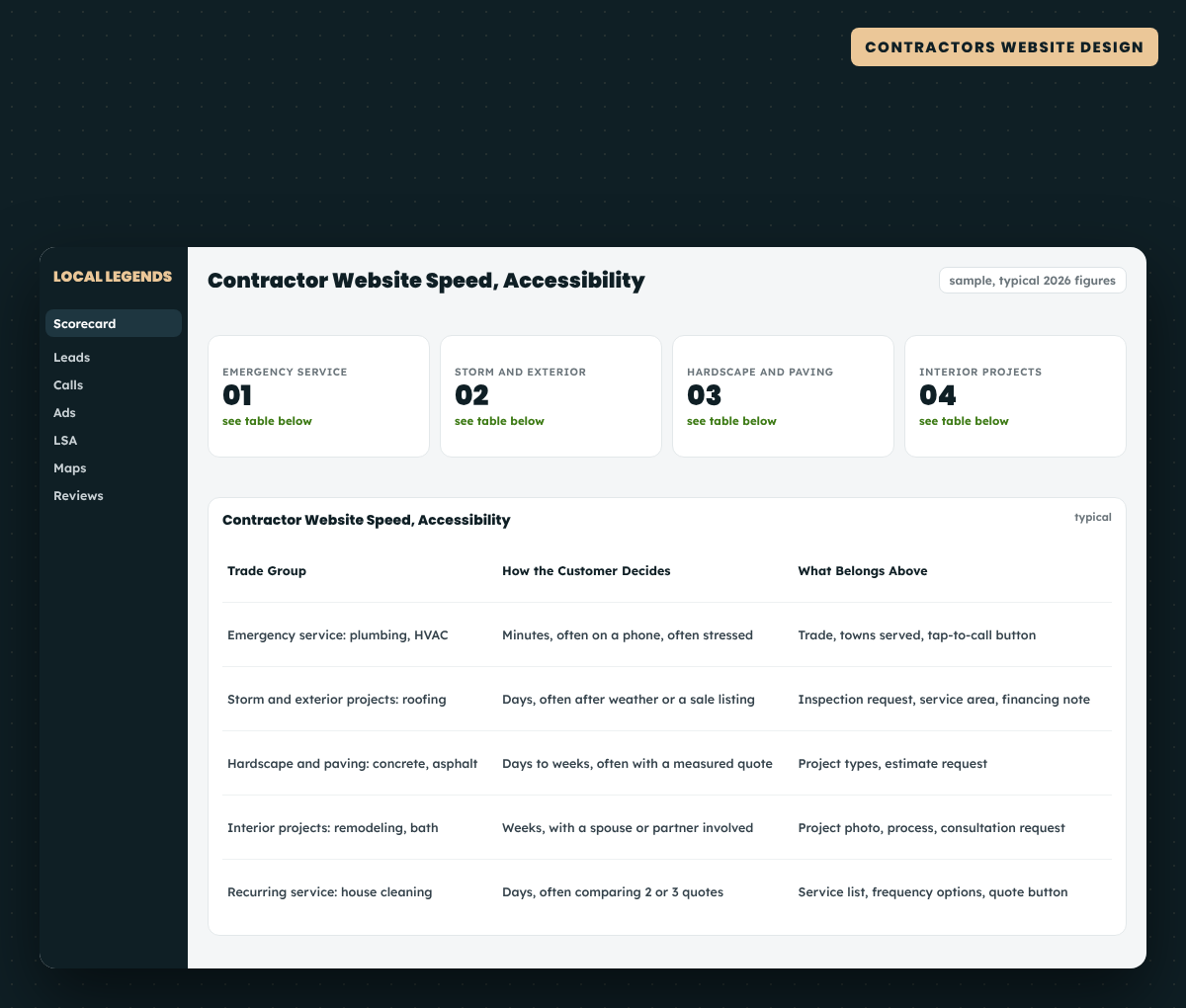
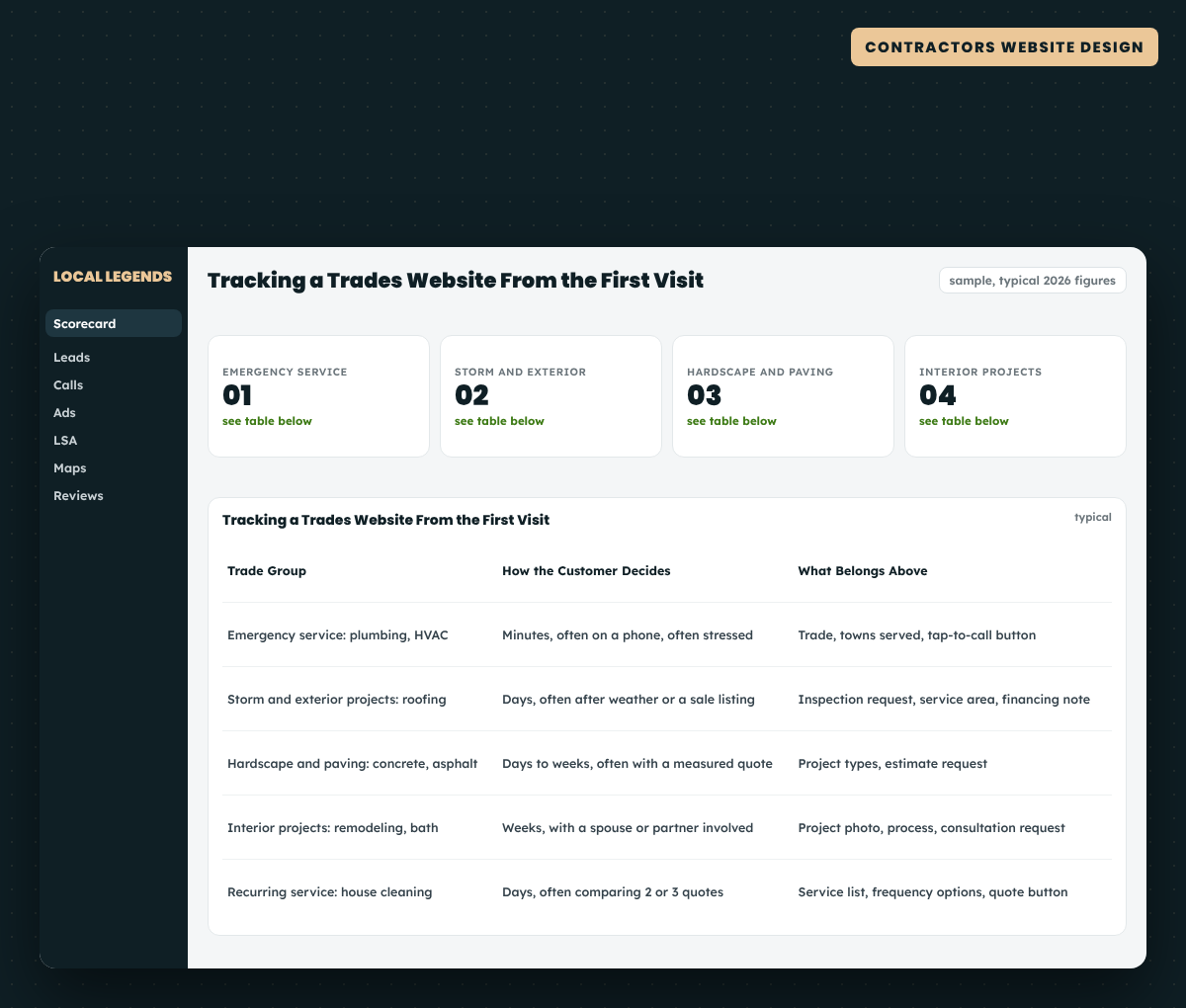
| Trade Group | How the Customer Decides | What Belongs Above the Fold | Proof That Sells the Job | Best Lead Path |
|---|---|---|---|---|
| Emergency service: plumbing, HVAC, electrical, garage doors | Minutes, often on a phone, often stressed | Trade, towns served, tap-to-call button | Uniformed techs, branded trucks, license number, recent reviews | Phone call first, short form second |
| Storm and exterior projects: roofing, siding, gutters, fencing | Days, often after weather or a sale listing | Inspection request, service area, financing note | Job photos by material and color, warranty terms | Inspection request form plus call |
| Hardscape and paving: concrete, asphalt paving, driveways | Days to weeks, often with a measured quote | Project types, estimate request | Before and after photos, finish options, square footage context | Estimate form with project size and photos |
| Interior projects: remodeling, bath and shower, painting | Weeks, with a spouse or partner involved | Project photo, process, consultation request | Galleries with captions, named team, timelines | Consultation request with project details |
| Recurring service: house cleaning, landscaping, lawn care | Days, often comparing 2 or 3 quotes | Service list, frequency options, quote button | Reviews that mention reliability, crew photos | Quote form with home size and frequency |
Why One Template Rarely Fits Every Trade
A theme built for a remodeler hides the phone number below a large photo, which costs a plumber the emergency call. A theme built for a plumber shows a phone number and little proof.
That second layout leaves a remodel buyer with no reason to trust a five-figure job to you. The right site picks a lead path on purpose.
How Should a Website for an Emergency Trade Like Plumbing or HVAC Differ From a Website for a Remodeler or Roofer?
An emergency trade website should get a stressed visitor to a phone call in one tap, while a remodeler or roofer website should give a careful buyer enough proof to request an estimate. The difference shows up in every part of the page.
- Calls to action: a plumber or HVAC company pairs a large call button with a second "Schedule Service" option for tune-ups; a remodeler leads with "Request a Consultation."
- Proof: emergency trades show the people and trucks that will arrive at the door; project trades show finished work sorted by type, style or material.
- Pricing context: service trades can list a diagnostic or trip fee if the company publishes one; project trades show ranges and financing options instead of one number.
- Content: emergency trades build symptom pages such as "AC blowing warm air"; project trades build process, material and warranty pages.
- Speed priority: emergency pages strip heavy video and pop-ups so the phone number loads first on a weak signal; project pages balance image quality with load time.
What Should a Website for a Trades Business Include to Get More Calls and Booked Jobs? Answer the Visitor's First Three Questions Fast
A trades business website gets more calls when the first screen answers three questions at once: do you do this job, do you work in my town and can I trust you. Google AI Mode put fast mobile contact, real job photos, license details and town-specific reviews at the top of its November 2026 list.
The First Screen
- A plain headline: the trade and the main area served in the first line, such as "Water Heater Repair and Drain Cleaning Across the North Side."
- A tap-to-call button: in the header on every page, so a phone visitor never scrolls to find it.
- A second, lighter option:"Request an Estimate" or "Schedule Service" for visitors who cannot talk right now.
- One trust line: star rating, license number or years in business, whichever is strongest and true.
The Pages Below It
- Service pages: one page per job you want more of, each with photos, what the visit includes and common questions.
- Service area pages: a page for a town only when the team can write 5+ real local facts about it; other towns get listed in plain text.
- About and team: the owner and crew leads by name and title, with photos used with their permission.
- Reviews: recent reviews placed on the service pages they mention, not hidden on a separate tab.
The Estimate and Service Request Form
Short forms convert better for urgent trades. A name, phone number, ZIP code, the job needed and an optional photo upload cover most service calls. Project trades can add timing and budget range so the estimator knows what to prepare before driving out.
What Do the Best Contractor Websites Have in Common?
The best contractor websites share fast contact, real proof and a clear local structure, according to what Google AI Mode and the top organic pages for contractor web design highlighted in November 2026.
- Click-to-call in the header: visible on every page, sticky on phones.
- Two calls to action: an immediate option and a lower-commitment option side by side.
- Real photos with context: the problem, the material used, the timeline and a before and after where it applies.
- Reviews on the money pages: Google reviews and star ratings next to the service they describe.
- Named people: the owner and key team members, which makes a stranger at the door less of a stranger.
- A short process outline: three or four steps from first call to finished job.
- Fast pages: compressed images and no heavy pop-ups on mobile.
Should I Put My Contractor License Number, Insurance and Warranty on My Website?
Yes, list all three in specific, checkable terms instead of the phrase "licensed and insured." A visitor who can verify a license number with the issuing agency in a few seconds has one less reason to call the next company.
- Contractor license: the license type, number and issuing agency, in the footer of every page and on the About page.
- Insurance: the coverage types you carry, such as general liability and workers' compensation, named on the About and estimate pages.
- Certificate of insurance: a line saying it is provided on request or with every estimate, instead of a public PDF with policy numbers.
- Workmanship warranty: your labor warranty, written exactly as your company states it.
- Manufacturer warranty: the maker's coverage, labeled separately so the two promises never blend.
Some states and cities have rules about where a license number must appear in advertising. Check your licensing board's rules for your trade before launch.
Contractor Website Structure for Multi-Trade Home Service Companies One Domain With a Hub per Trade
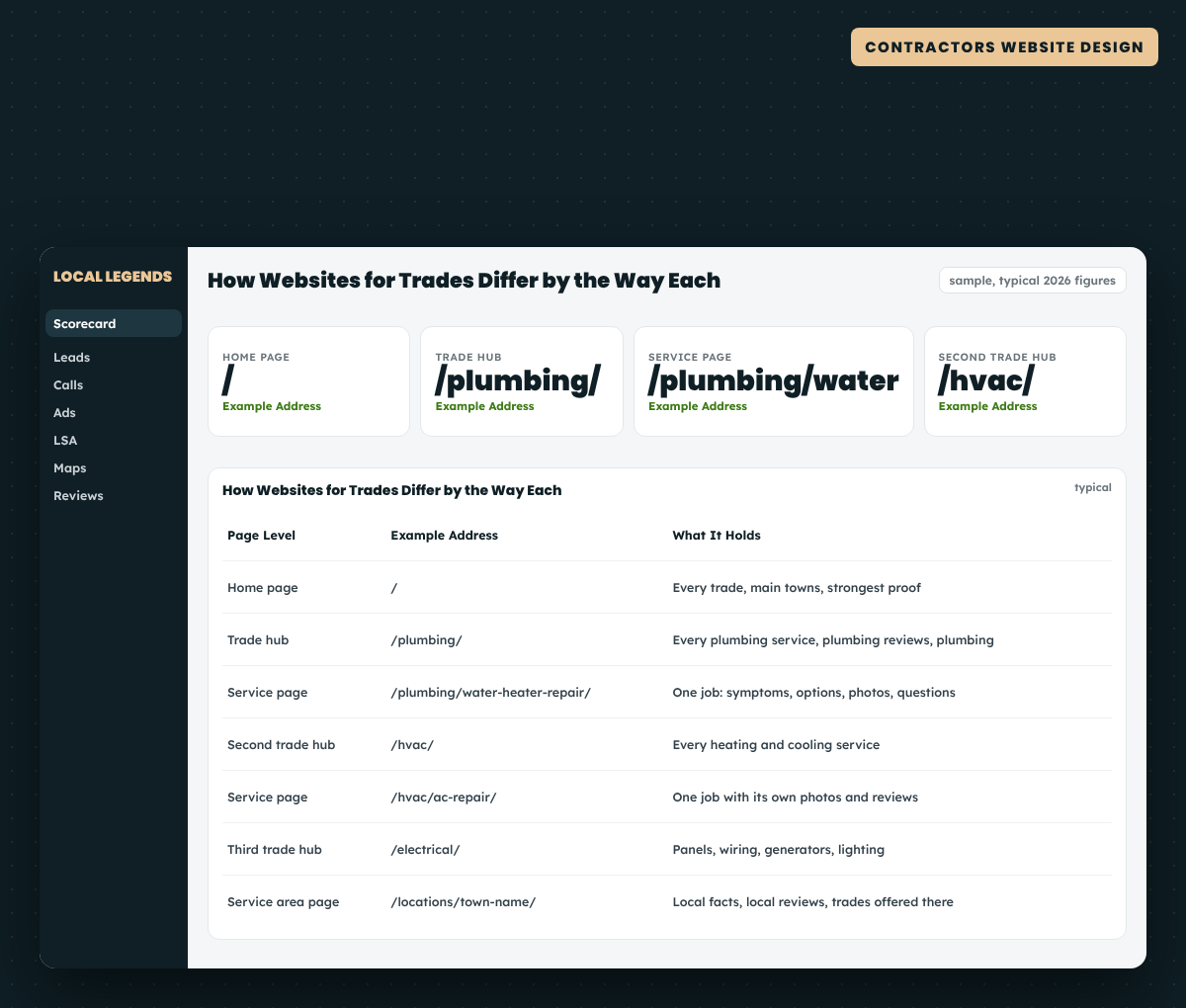
A contractor website for a company that sells more than one trade works best as one domain with a hub section for each trade, so every review, link and new page strengthens the whole brand instead of being split across several sites.
The structure below is the one Local Legends uses when a home service company runs plumbing, HVAC and electrical under one name. The same pattern fits a roofer that also sells siding and gutters, or a concrete contractor that also pours patios and lays pavers.
| Page Level | Example Address | What It Holds | What It Links To |
|---|---|---|---|
| Home page | / | Every trade, main towns, strongest proof | Each trade hub |
| Trade hub | /plumbing/ | Every plumbing service, plumbing reviews, plumbing team | Each plumbing service page |
| Service page | /plumbing/water-heater-repair/ | One job: symptoms, options, photos, questions | Its trade hub and related services |
| Second trade hub | /hvac/ | Every heating and cooling service | Each HVAC service page |
| Service page | /hvac/ac-repair/ | One job with its own photos and reviews | Its trade hub |
| Third trade hub | /electrical/ | Panels, wiring, generators, lighting | Each electrical service page |
| Service area page | /locations/town-name/ | Local facts, local reviews, trades offered there | The trade hubs |
Why the Hub Structure Helps a Multi-Trade Company
- Shared authority: one domain collects every backlink, review mention and new page.
- Cross-selling: a water heater customer who sees your HVAC section has a reason to call you for the next AC tune-up.
- One brand: the name on the truck, the phone number and the website match.
- One build and one upkeep bill: one hosting plan and one set of pages to keep current.
My Company Does Plumbing, HVAC and Electrical. Should We Have One Website or a Separate Website for Each Trade?
Most multi-trade companies should run one website with a deep section for each trade, and Google AI Mode gave the same answer in November 2026. Separate sites split your reviews, links and budget without a matching gain in rankings.
- Choose one site when: all trades run under one company name, one phone line and one truck wrap.
- Consider separate sites when: you bought a company that already has its own brand, reviews and phone number that customers know.
- Keep the hub depth equal: a thin electrical section beside a deep plumbing section makes the company look like a plumber that dabbles.
- Match the Google Business Profile plan: the profile categories and the trade hubs should tell the same story.
When a Separate Brand Site Makes Sense
An acquired company with years of reviews under its own name can keep its site while the brands share tracking and reporting. The decision belongs in the audit, because a merge done badly can lose rankings the old brand earned.
Is a One-Page Website Enough for a Small Trades Business?
A one-page website is enough only for a company that sells one service in one area and gets most work from referrals, because a single page cannot rank for several jobs in several towns. Google AI Mode recommended a small multi-page site of about 5 pages for most trades businesses.
- A one-pager can work: for a brand-new solo operator, a single specialty service or a business fed by referrals and a strong Google Business Profile.
- A multi-page site wins: once you want to show up for separate jobs such as drain cleaning and water heater repair.
- Build for growth: choose a platform where service and town pages can be added later without starting over.
- Local Legends starts at 10 pages: the smallest Local Legends build covers the home page, core service pages and the trust pages a trades buyer checks.
Contractor Website Builder, Field Service Software Site or Web Design Company Choose by the Job the Website Has to Do
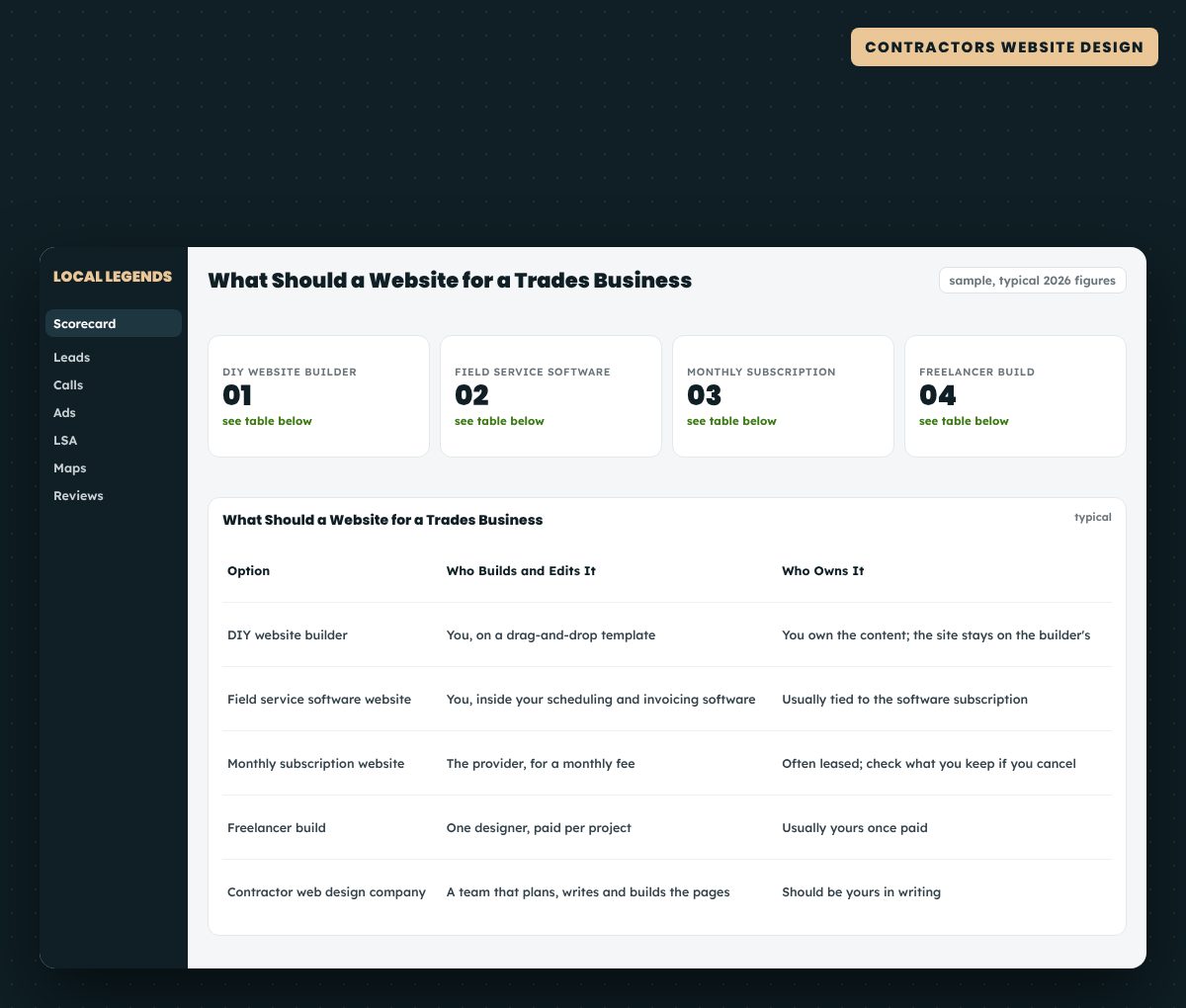
A contractor website builder, a field service software site and a web design company each fit a different stage of a trades business, and the right pick depends on whether the site only confirms you are real or has to win new customers from search.
| Option | Who Builds and Edits It | Who Owns It | Best Fit |
|---|---|---|---|
| DIY website builder | You, on a drag-and-drop template | You own the content; the site stays on the builder's platform | A new solo operator living on referrals |
| Field service software website | You, inside your scheduling and invoicing software | Usually tied to the software subscription | A small crew that mainly needs booking and payments online |
| Monthly subscription website | The provider, for a monthly fee | Often leased; check what you keep if you cancel | A company that wants low upfront cost and hands-off upkeep |
| Freelancer build | One designer, paid per project | Usually yours once paid | A small crew that needs a credible custom site |
| Contractor web design company | A team that plans, writes and builds the pages | Should be yours in writing | A company that relies on Google for new jobs or runs ads |
Should My Trades Company Use a Contractor Website Builder or Hire a Web Design Company?
A contractor website builder fits a company that only needs a basic presence, and a web design company fits a company that needs the site to rank and bring in new jobs. Google AI Mode estimated 30 to 50+ hours of the owner's own time to build a site yourself.
- Build it yourself when: you are just starting, work comes from referrals and few local competitors invest in search.
- Hire a web design company when: Google is a main lead source, you need a page for every service and town, or you run Google Ads and Local Services Ads.
- Hire when the time costs more: 40 hours in a template is 40 hours off a job site.
- Hire when you bid commercial work: general contractors and property managers check your site before they add you to a bid list.
- Either way, own the domain: register it in your own account so no vendor can hold it.
Should My Contractor Website Have Online Booking, and Can It Connect to ServiceTitan, Housecall Pro or Jobber?
Online booking helps service trades capture customers who are ready to schedule at night or on weekends, and the leading field service platforms offer booking tools that sit on a contractor website. Project trades usually do better with a request form than a live calendar.
- Tune-ups and repairs: a booking widget from your field service software lets customers pick a service and a time window that lands on the dispatch board.
- Installs and remodels: a "request a preferred window" form lets the office confirm before a truck rolls, because job lengths vary.
- Data in one place: booked jobs and form leads should flow into ServiceTitan, Housecall Pro, Jobber, JobNimbus, AccuLynx, Buildertrend or GoHighLevel instead of an inbox.
- Source kept: each booking should carry the page and channel it came from, so the scorecard can count it.
Local Legends connects website forms and tracked calls to the CRM a contractor already runs. See the call tracking and CRM integration[LINK: /services/call-tracking-crm/] page for how the routing works.
How Much Does a Contractor Website Cost in 2026? Typical Builds Run $1,500-$15,000+ One Time
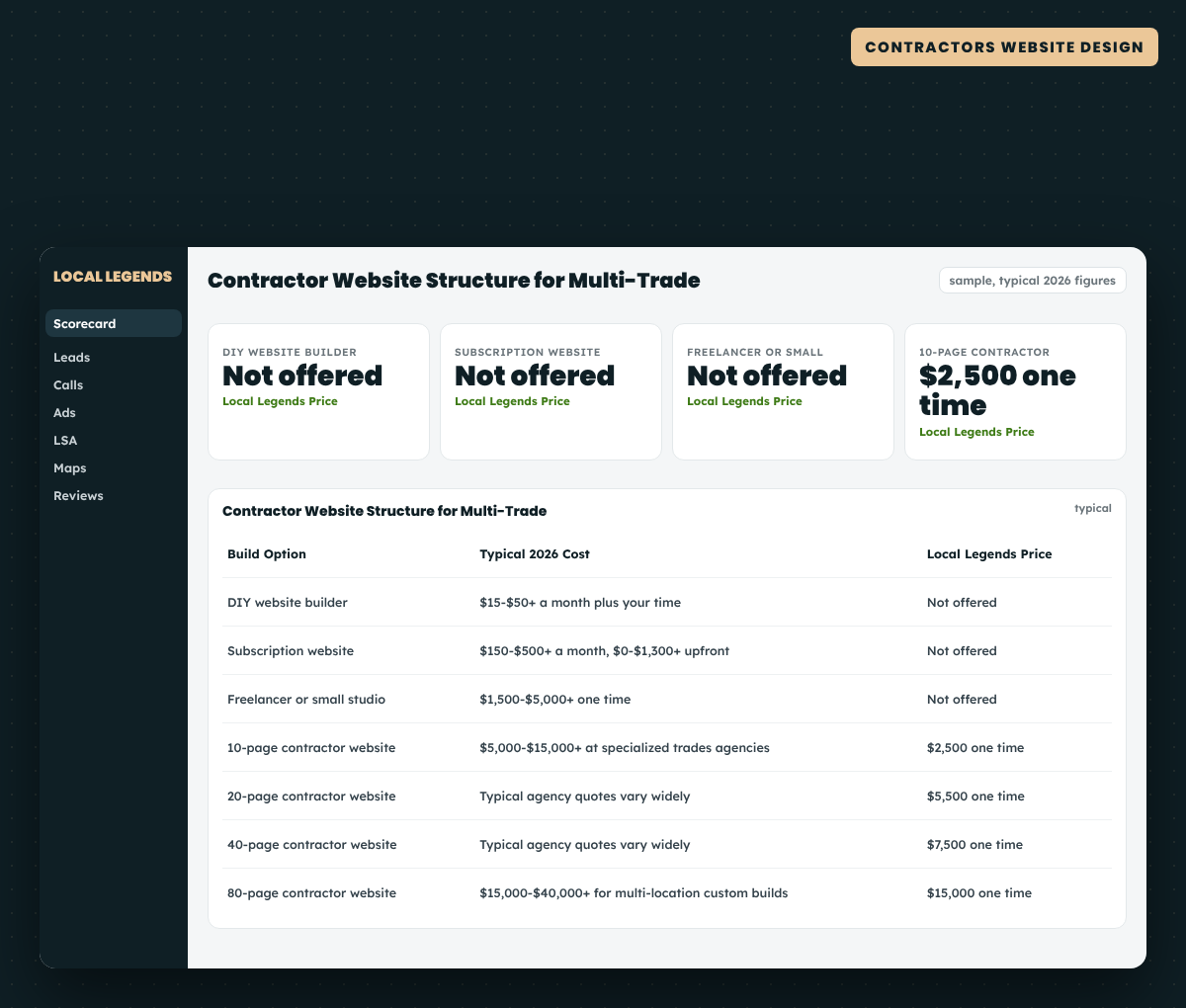
A contractor website typically costs $1,500-$15,000+ for a one-time professional build in 2026, or $15-$1,500+ a month on a builder or managed plan, based on what Google AI Mode and published 2026 pricing pages reported. Page count, copywriting and integrations drive most of the spread.
| Build Option | Typical 2026 Cost | Local Legends Price | What the Price Usually Covers |
|---|---|---|---|
| DIY website builder | $15-$50+ a month plus your time | Not offered | Templates, hosting, drag-and-drop editing |
| Subscription website | $150-$500+ a month, $0-$1,300+ upfront | Not offered | Template design, hosting, small edits; often leased |
| Freelancer or small studio | $1,500-$5,000+ one time | Not offered | Custom layout, forms, basic on-page SEO |
| 10-page contractor website | $5,000-$15,000+ at specialized trades agencies | $2,500 one time | Home, core service pages, trust pages, forms, tracking setup |
| 20-page contractor website | Typical agency quotes vary widely | $5,500 one time | Adds more service pages and town pages with real local facts |
| 40-page contractor website | Typical agency quotes vary widely | $7,500 one time | Full trade hubs for a multi-trade company |
| 80-page contractor website | $15,000-$40,000+ for multi-location custom builds | $15,000 one time | Several trade hubs, many service and area pages |
Typical other-agency website pricing across all types of builds runs $2,500-$50,000+, so ask every company what is in the page count before comparing quotes. Local Legends charges no setup fees and requires no long-term contract. See Local Legends pricing[LINK: /pricing/] for every plan.
What Moves a Contractor Website Quote Up or Down
- Number of service and town pages: a 5-page brochure costs far less than a 30-page site with a page for each job and each town.
- Copywriting: Google AI Mode reported that a writer typically adds $500-$2,500+ to a build compared with writing the pages yourself.
- Booking and quote tools: connecting scheduling, financing or estimate calculators adds build and testing time.
- Photos: a library of real job photos saves time; a site with none needs a photo plan first.
- Ongoing costs: domain renewal, hosting and updates continue after launch on any option.
Is a Monthly Subscription Contractor Website Worth It, or Should I Pay Once and Own My Website?
A monthly subscription website is worth it for a company that wants low upfront cost and hands-off updates, as long as the domain stays in your name, while paying once makes sense for a company that wants to own the site outright. Google AI Mode leaned toward subscriptions for owners who never update their site and toward ownership for everyone else.
- Subscription strengths: little cash upfront, edits and hosting bundled, predictable monthly bill.
- Subscription risks: many plans lease the design, set a 12 to 24 month minimum and keep the site if you cancel.
- Ownership strengths: the site is yours at launch, and a future agency can work on it without a rebuild.
- Ownership risks: the site goes stale if nobody adds pages, photos and reviews after launch.
- Three things to check on any plan: domain in your own registrar account, the exit terms and whether your photos and text leave with you.
How Local Legends Handles Ownership and Upkeep
Local Legends builds the website for a one-time fee and you own the site, the domain and the call data. Ongoing pages come from the monthly growth plans.
Footprint at $2,500 a month adds 10 pages or blogs a month, Trailblazer at $4,000 adds 20, Sasquatch at $8,000 adds 50 and Legend at $10,000+ adds 100.
When Ad Landing Pages Are Already Included
Google Ads and Local Services Ads management at $2,000 a month includes the landing pages for those campaigns, so a contractor who starts with ads does not pay twice for campaign pages. Ad spend is paid by the client straight to Google.
Contractor Website Speed, Accessibility and Search Basics Published Google and ADA Targets
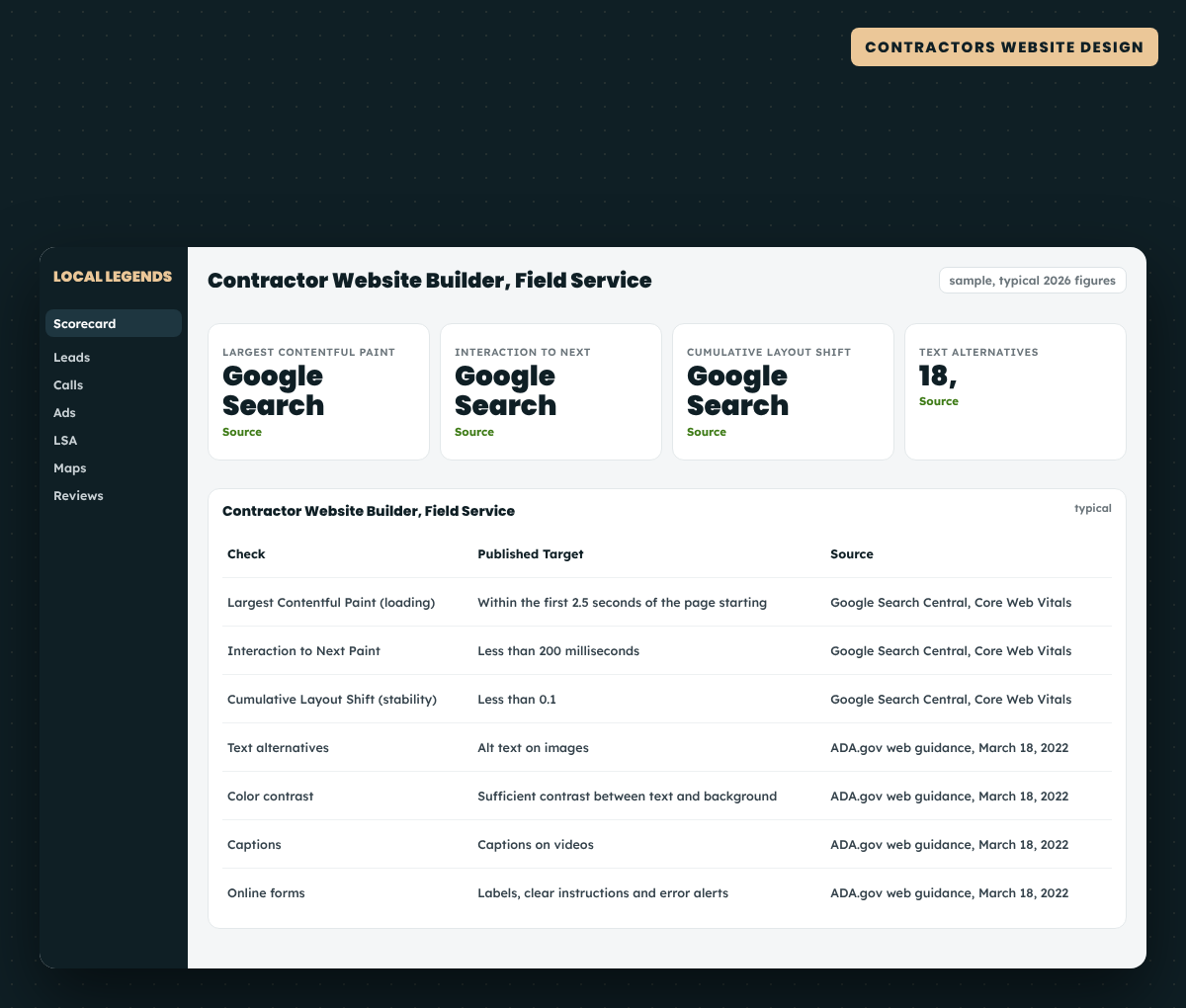
Contractor website speed and accessibility have published targets, and both affect whether a visitor on a phone can reach your phone number or form. Google's Search Central documentation lists Core Web Vitals targets, and the Department of Justice published web accessibility guidance in March 2022.
| Check | Published Target or Guidance | Source | What It Means on a Trades Website |
|---|---|---|---|
| Largest Contentful Paint (loading) | Within the first 2.5 seconds of the page starting to load | Google Search Central, Core Web Vitals | The hero headline and call button appear fast on a phone |
| Interaction to Next Paint (responsiveness) | Less than 200 milliseconds | Google Search Central, Core Web Vitals | A tap on "Call" or "Book" reacts right away |
| Cumulative Layout Shift (stability) | Less than 0.1 | Google Search Central, Core Web Vitals | The call button does not jump as images load |
| Text alternatives | Alt text on images | ADA.gov web guidance, March 18, 2022 | Job photos are described for screen reader users |
| Color contrast | Sufficient contrast between text and background | ADA.gov web guidance, March 18, 2022 | Phone numbers and buttons are readable outdoors |
| Captions | Captions on videos | ADA.gov web guidance, March 18, 2022 | Crew and review videos can be followed without sound |
| Online forms | Labels, clear instructions and error alerts | ADA.gov web guidance, March 18, 2022 | Estimate forms work with a screen reader |
| Keyboard navigation | Content reachable without a mouse | ADA.gov web guidance, March 18, 2022 | Menus, galleries and forms work by keyboard |
What Usually Slows a Trades Website
- Oversized job photos: full-resolution phone pictures uploaded straight to a gallery.
- Autoplay video headers: a background video ahead of the phone number.
- Stacked plugins and chat widgets: several scripts loading before the page is usable.
- Pop-ups on mobile: a coupon box covering the call button.
Does My Contractor Website Need to Be ADA Accessible?
A contractor website that serves the public should be built to be accessible, because the Department of Justice's March 18, 2022 guidance says Title III of the ADA prohibits discrimination by businesses open to the public and that inaccessible websites can limit access to their services. The guidance does not set one required technical standard.
- What the guidance says: businesses have flexibility in how they comply, and the department points to WCAG and Section 508 as helpful resources.
- Barriers it names: poor color contrast, missing alt text, videos without captions, inaccessible forms and mouse-only navigation.
- What Local Legends builds in: alt text on every image, labeled form fields, readable contrast on buttons and keyboard-reachable menus.
- What to skip: plug-in overlay widgets as a stand-in for an accessible build.
- What to ask your attorney: whether any extra rules apply to your business, especially if you bid public or government work.
Local Legends builds accessibility basics into every contractor website but does not give legal advice or certify legal compliance.
Why Does My Contractor Website Get Visitors but No Phone Calls or Quote Requests? Most Quiet Websites Have a Conversion Problem
A contractor website that gets visitors but no calls usually has a conversion problem, not a traffic problem: people find the site, then something on the page stops them. Google AI Mode traced most cases to unclear headlines, hidden phone numbers, long forms and missing proof.
Work through the list below in order. Each step takes minutes to check on your own phone.
- Read the first line. A headline like "Welcome to Our Company" tells a visitor nothing; it should name the trade and the area.
- Find the phone number. It should sit in the header, open the dialer on one tap and stay visible while scrolling.
- Submit your own form. Send a test lead and confirm it reaches the right inbox or CRM.
- Count the form fields. Ten required fields lose service calls; name, phone, ZIP and the job cover most of them.
- Rename the button."Submit" becomes "Get My Estimate" or "Schedule Service."
- Look for real photos. Stock images of models in hard hats read as a company with nothing to show.
- Move reviews up. A star rating and two or three job-specific reviews belong on the home page and service pages.
- Check where the traffic lands. Visitors reading a how-to article on fixing a running toilet are often doing the job themselves.
- Time the page on cellular data. A page that takes several seconds to show the phone number loses the urgent caller.
When the Problem Really Is Traffic
If the phone stays quiet after those fixes, the issue may be visibility: the site is not showing up for the jobs and towns that matter. That is where local SEO[LINK: /services/local-seo/], a fully built Google Business Profile and paid search come in.
Tracking a Trades Website From the First Visit to the Sold Job Calls, Forms, Booked Jobs, Sold Jobs
Contractor website tracking connects every call and form on the site to a booked job and a sold job in your CRM, so the website is judged on revenue, not on visits alone. Visits and rankings are chapter one of the story; booked and sold jobs are how it ends.
How Local Legends tracks it: CallRail call tracking swaps the phone number on the site with a tracking number that still rings your main line, and each call and form flows into the contractor's CRM, including ServiceTitan, Housecall Pro, JobNimbus, AccuLynx, Jobber, Buildertrend and GoHighLevel. [SOURCE: Local Legends services list, confirmed company facts, Nov 2026]
What the owner sees: a scorecard with leads, booked jobs, sold jobs and cost per booked job, reviewed at the project review meeting each week. [SOURCE: Local Legends weekly CEO scorecard and project review meeting, confirmed company facts, Nov 2026]
How Do I Know If My Contractor Website Is Actually Bringing In Booked Jobs?
You know a contractor website is bringing in booked jobs when you can follow one unbroken chain from the page visit or call to a won job in your CRM. Google AI Mode listed four methods that make the chain work.
- Call tracking with number swapping: the website shows its own tracking number, separate from the truck wrap, yard signs and Google Business Profile.
- Tagged forms: hidden fields record the page and channel, so a form lead arrives with its source attached.
- Lead source in the CRM: every new customer record is marked with its source, and won jobs are filtered by source each month.
- One intake question:"How did you first hear about us?" catches the customer who saw the site on a laptop and dialed from a cell phone.
- Call review: recordings separate real customers from vendors, spam and job seekers before anyone counts them as leads.
Who Is the Best Web Design Company for Contractors and Home Service Trades? The One Whose Sites Bring Calls You Can Trace
The best web design company for contractors is the one that builds sites you own, matches the layout to your trade and can show calls and booked jobs traced back to its pages. Google AI Mode weighed fast mobile pages, local service-area SEO and CRM integration above design style in November 2026.
- Ownership in writing: the domain, the site files and the logins stay with you if you leave.
- Trade fit: a portfolio of live sites in your type of trade, tested on a phone, not desktop screenshots.
- Build and ranking are separate services: a clear answer on whether the quote includes ongoing pages and local SEO or only the launch.
- Tracking included: call tracking and form routing set up at launch, not offered later.
- Clear scope: the page count, revision rounds and exclusions written into the quote.
What Questions Should I Ask a Contractor Web Design Agency Before I Hire Them?
Ask a contractor web design agency about ownership, who builds the site, what is excluded and what happens after launch, because most surprise costs and stalled projects trace back to one of those four areas.
- Who owns the domain, hosting account, site files and logins when the final invoice is paid?
- Who builds the site: your own team or subcontractors, and can I reach the lead builder directly?
- What do you need from me, and by when? Photos and job details cause most delays.
- How many revision rounds are included, and what does an extra round cost?
- Is this a custom build or a modified template?
- What speed, mobile, redirect and analytics work happens before launch?
- What is not in this quote? Extra pages, plugin licenses and integrations are common add-ons.
- How are payments tied to milestones?
- What happens the day after launch: bug fixes, training, updates and new pages?
How Local Legends Answers These Questions
You own the website, domain, Google Business Profile, ad accounts and call data. Pricing is a published one-time fee by page count, with no setup fees and no long-term contracts.
Every engagement starts with an audit and includes the Local Legends marketing course, and a weekly project review meeting keeps the build on schedule.
Local Legends is not a Google Partner and does not claim the badge. For the broader channel plan beyond the website, see contractor marketing[LINK: /industries/contractors/] for home service companies.
Contractor Website Design Process and Build Timeline Audit, Plan, Write, Build, Track
The Local Legends contractor website design process runs in five stages, from an audit of what you have to a tracked launch, and the stage that usually sets the pace is gathering job photos and service details from the owner.
Stage 1: Audit
The audit reviews the current site, call tracking, Google Business Profile and local search position, including Google Maps rank grids that show where the company appears across its service area.
Stage 2: Page Plan
Each service you want more of gets its own page, grouped under trade hubs for multi-trade companies. Town pages go only to towns with 5+ real local facts.
Stage 3: Writing and Photos
Pages are written from research on what your customers ask, with your own job photos, captions and alt text. Stock photos are not used for job proof.
Stage 4: Build in the Product-Page Layout
Local Legends builds service pages in a product-page layout: job photos on one side and the options, price context, call button and form on the other. On a phone the call button stays in reach.
Stage 5: Launch, Redirects and Tracking
Old addresses are redirected to their new pages, tracking numbers and form routing are tested, and the scorecard starts counting calls, booked jobs and sold jobs.
How Long Does It Take to Build a Contractor Website?
A contractor website typically takes 1 to 12 weeks to build, depending on the build route, the page count and how fast photos and details arrive, according to Google AI Mode in November 2026. Integrations with booking software and financing tools add testing time.
- DIY builder: a weekend to 4 weeks, with 40 to 80 hours of the owner's time.
- Template or productized service: about 1 to 3 weeks for a 5 to 7 page site.
- Freelance designer: about 2 to 6 weeks.
- Full-service contractor agency: about 8 to 12 weeks for larger custom builds with integrations.
- What speeds any build: job photos, a list of services and towns and quick feedback on drafts ready at kickoff.
The Local Legends schedule for your site is set in the audit once the page count and integrations are known.
Contractor Web Design From a Founder Who Worked in the Trades Levi Ostlund Started Out on Job Sites
Local Legends Marketing[LINK: /] founder Levi Ostlund sold driveway jobs door to door at age 10, poured concrete with his dad and ran a landscaping company in high school, so the agency's websites start from the contractor's side of the phone call. [SOURCE: Levi Ostlund founder story, Local Legends brief, Nov 2026]
Levi lost $30,000+ to marketers before he started the agency: one stopped answering, and another built an attractive website that never ranked. He later served as CMO of Amstill Roofing and has spent 8+ years marketing contractors. [SOURCE: Levi Ostlund founder story, Local Legends brief, Nov 2026]
That history explains the house rules: the contractor owns every account, the website is planned around real searches and every call is traced to a booked job.
Local Legends also teaches clients through its marketing course, so owners understand what their website and their Google Business Profile management[LINK: /services/google-business-profile-management/] are doing.
Local Legends Marketing Reviews From Contractor CEOs Owners on Working With Levi
Contractor CEOs have shared on-the-record testimonials about working with Local Legends, including one written testimonial and three video testimonials on the Local Legends home page. [SOURCE: Local Legends home page testimonials, Nov 2026]
Levi has been absolutely outstanding to work with over the years... His creativity, responsiveness, and deep understanding of our marketing strategy have made a huge impact." Brad Beldon, CEO, Roofing Company. Read on the Local Legends home page
- Kyle Scott, CEO, Roofing Company (video testimonial)
- Jim Dodson, CEO, Roofing Company (video testimonial)
- Race Allen, CEO, Precision Restoration of Texas (video testimonial)
- Brad Beldon, CEO, Roofing Company (written testimonial)
Frequently Asked Questions About Websites for Trades and Contractor Web Design Short Answers for Trades Business Owners
How Many Pages Does a Trades Website Need?
Most trades websites need a home page, one page per core service, an about page, a reviews or gallery page and a contact page, then town pages for areas with real local facts. The smallest Local Legends build is 10 pages, and multi-trade companies often need 40 or more.
Should a Trades Business Show Prices on Its Website?
A trades website should show price context where the company has real numbers to share, such as a published diagnostic fee or a typical project range, along with what moves the price. It should not promise a final price before the job is seen.
Do You Build Websites for My Trade?
Local Legends builds websites for roofing and storm restoration, HVAC, plumbing, electrical, concrete, paving, fencing, remodeling, bath and shower, painting, house cleaning, garage door and landscaping companies. Each trade gets the lead path that fits how its customers hire.
Can You Rebuild My Site Without Losing My Google Rankings?
Yes, a rebuild keeps rankings safest when every old page that earns traffic is kept or redirected to its new address, and the redirects are tested at launch. The audit lists those pages before anything is taken down. More detail is on the contractor website design[LINK: /services/website-design/] page.
Do I Still Need a Website If I Have a Google Business Profile?
Yes, a website gives your Google Business Profile somewhere to send people for the full story, including service details, photos, reviews and forms, and it gives Google more about each service and town to match against searches.
Do I Need a New Website to Run Google Ads or Local Services Ads?
Not always, but Google Ads work better when each campaign lands on a page for that exact service. Google Local Services Ads began moving into Google Ads in August 2026 as Performance Max campaigns that still charge per lead, so the ads, the landing pages and the tracking now live closer together. The $2,000 a month Google Ads + Local Services Ads plan includes its campaign landing pages.
Who Writes the Content on My Contractor Website?
The Local Legends team writes the pages from research on what your customers search and ask, then checks the facts with you. You supply job photos and details such as licenses, warranties and the services you want more of.
Where Does Local Legends Build Contractor Websites?
Local Legends builds contractor websites for home service companies nationwide. See Local Legends service areas[LINK: /locations/] for the markets the team covers.
Reviewed by Levi Ostlund, Founder, Local Legends Marketing

Get a Website for Your Trade That Rings the Phone and Proves the Jobs Start With a Free Growth Audit
Local Legends Marketing[LINK: /] builds websites for trades with layouts matched to how each trade gets hired, service pages people search for and tracking from the first call to the sold job. Websites start at $2,500 one time, with no setup fees and no long-term contracts.
- Call:(936) 900-1248
- Office: 481 Stephen F Austin Dr, Conroe, TX 77302
- Next step: book a free growth audit and get a page plan and lead path for your trade