


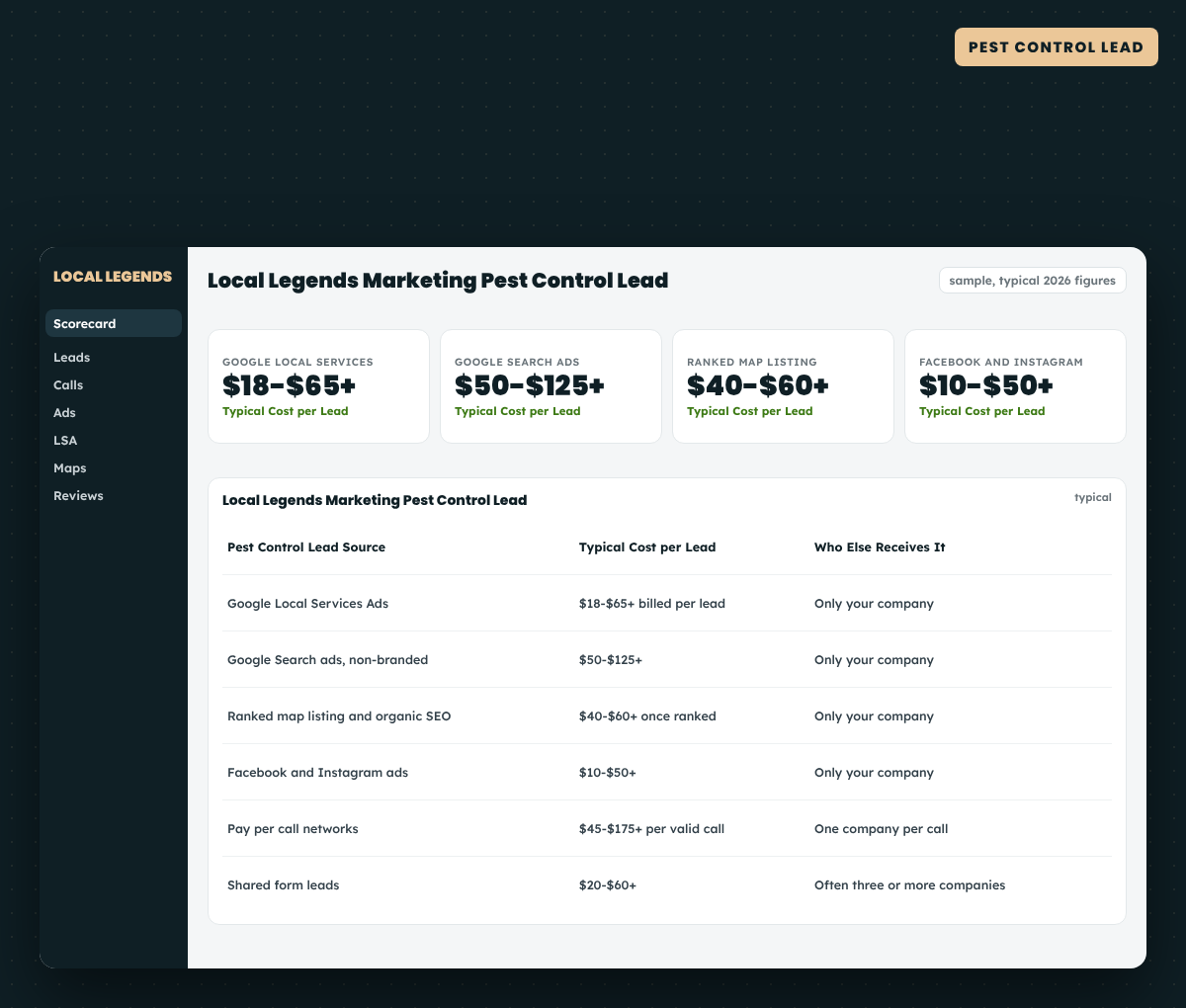
Local Legends Marketing Pest Control Lead

Pest Control Leads Your Company Owns: Pest Control Lead Generation for General Pest, Termite, Rodent, Mosquito and Commercial Accounts Measured by Plans Sold
Local Legends Marketing Pest Control Lead Generation Built Around Recurring Plans
Updated November 2026 · Reviewed by Levi Ostlund, Founder
Breadcrumb: Home > Industries > Pest Control > Lead Generation
Pest control leads are calls, forms and online bookings from homeowners and businesses with a pest problem, and the most valuable ones arrive through ads and profiles the exterminator owns. Local Legends Marketing builds those owned lead channels and scores each one by the service plans it sells.
- Leads that ring one office: Local Services Ads, search campaigns, your Google Business Profile, your site and referrals.
- Budgets split by pest: general pest, termite, rodent, mosquito, bed bug, wildlife and commercial each get their own money.
- Junk charges challenged weekly: wrong-pest, out-of-area and spam calls on Local Services Ads are disputed every week.
- Scored by plans, not calls: each source is measured by booked services and recurring plans still active.
- Owned by your company: the ad accounts, profile, website, numbers and recordings stay in your name.
Free Growth Audit
Your Reviews, Radius and Response Rate vs the competitors beating you.
About Local Legends Marketing
A home service marketing agency headquartered in Conroe, Texas, with 8+ years of marketing experience, running Google Ads, Local Services Ads, local SEO, AI SEO, connected TV and review systems for contractors nationwide.
How Much Do Pest Control Leads Cost in 2026? The Pest and the Channel Set the Price
Pest control leads typically cost from under $20 to well over $150 each, and the spread comes from two things: which pest the caller has and which channel delivered them. The ranges below come from 2026 benchmark reports and published lead provider pricing, labeled typical.
| Pest Control Lead Source | Typical Cost per Lead | Who Else Receives It | What You Keep If You Stop |
|---|---|---|---|
| Google Local Services Ads | $18-$65+ billed per lead | Only your company | Reviews, badge history and call recordings |
| Google Search ads, non-branded | $50-$125+ | Only your company | Account history, keywords and conversion data |
| Ranked map listing and organic SEO | $40-$60+ once ranked | Only your company | Rankings that keep producing calls |
| Facebook and Instagram ads | $10-$50+ | Only your company | Pixel data and audiences in your account |
| Pay per call networks | $45-$175+ per valid call | One company per call | Usually nothing after the last call |
| Shared form leads | $20-$60+ | Often three or more companies | Nothing after the last lead |
Each figure above is a typical 2026 market range, not a Local Legends quote. The high end of each range belongs to crowded metros and termite season. [SOURCE: published 2026 pest control CPL benchmarks and pay per call rate cards, research/sources/pest-leads, Nov 28 2026]
Typical Lead Prices by Pest Type
A termite caller and an ant caller can arrive on the same day from the same ad and carry very different price tags. Exclusive lead price ranges published for 2026 run roughly in this order, from cheapest to most expensive:
- Mosquito and tick: about $20-$45+ per exclusive lead, with short seasonal plans.
- General pest: about $25-$50+, the classic quarterly plan starter.
- Rodent: about $35-$75+, often tied to exclusion work.
- Wildlife: about $40-$100+, mostly one-time removals.
- Bed bugs: about $50-$125+, driven by urgency and large tickets.
- Termite: about $75-$175+, backed by treatment and renewal value.
- Commercial accounts: about $100-$300+, priced against multi-year contracts.
The Booked Service Math
Divide a channel's spend by its leads for cost per lead, then divide that by the share of leads that booked. A $40 lead booked 25% of the time costs $160 per booked service, while a $70 lead booked 60% of the time costs about $117.
How Much Is a Pest Control Customer Worth, and How Much Can I Afford to Pay per Lead?
A recurring pest control customer is typically worth $1,500-$3,000+ over its lifetime, which is why exterminators can pay more per lead than most trades and still profit. The ceiling on lead price is set by how long plans last, not by the first invoice.
- A common starter plan: an initial service near $150, then about $120 a quarter, which is close to $500 a year.
- Typical retention: published figures put annual plan retention near 75% to 85%, so most accounts pay for several years.
- Recurring share: industry reporting places most residential pest revenue in recurring service, often cited at 74% to 85%.
- One-time work: wildlife removals and single treatments do not renew, so their lead price has to clear on the first ticket.
- A practical ceiling: set the most you will pay to win one plan customer, then work backward through your booking rate to a lead price.
[SOURCE: published 2026 pest control lifetime value and retention benchmarks, research/sources/pest-leads, Nov 28 2026]
Exclusive Pest Control Leads, Shared Leads and Leads From Your Own Ads Six Ways a Pest Lead Reaches Your Phone
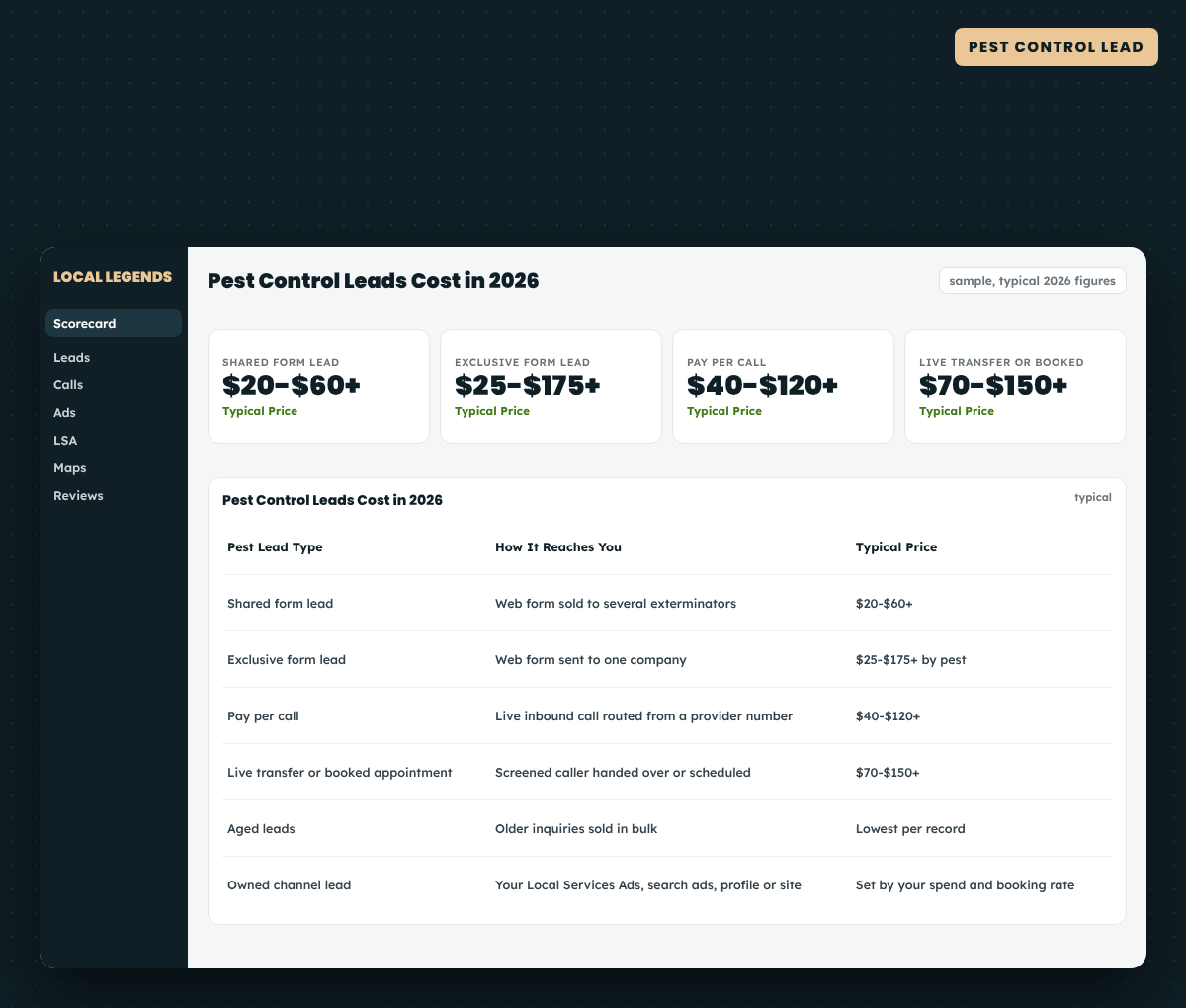
Pest control lead generation comes in two families: leads you rent from a provider, and leads you produce through channels registered to your company. Rented leads start fast, and owned channels keep paying after the budget pauses.
| Pest Lead Type | How It Reaches You | Typical Price | Ownership After You Stop |
|---|---|---|---|
| Shared form lead | Web form sold to several exterminators | $20-$60+ | None |
| Exclusive form lead | Web form sent to one company | $25-$175+ by pest | None |
| Pay per call | Live inbound call routed from a provider number | $40-$120+ | The provider keeps the number |
| Live transfer or booked appointment | Screened caller handed over or scheduled | $70-$150+ | None |
| Aged leads | Older inquiries sold in bulk | Lowest per record | None, and consent rules apply |
| Owned channel lead | Your Local Services Ads, search ads, profile or site | Set by your spend and booking rate | Every account, number and review |
[SOURCE: published 2026 pest control lead type pricing, research/sources/pest-leads, Nov 28 2026]
Are Exclusive Pest Control Leads Worth It Compared to Shared Leads?
Exclusive pest control leads are usually worth the higher price because a homeowner who is not fielding calls from four exterminators books more often and is more open to a recurring plan. Published close rate examples put shared leads near 5% and exclusive calls closer to 30%.
- The close rate gap: 100 shared leads at $20 that close at 5% produce 5 customers, while 60 exclusive calls at $30 that close at 30% produce 18.
- The plan effect: at $1,500 of lifetime value each, those 13 extra customers outweigh the higher lead price many times over.
- When shared leads fit: a slow week, open routes and an office that calls back within seconds.
- Fine print to read: some providers sell "semi-exclusive" leads that still go to two or three companies.
- What exclusive does not mean: the homeowner can still phone other companies on their own.
Should My Pest Control Company Buy Leads or Run Its Own Google Local Services Ads?
Most established pest control companies get a lower cost per plan from their own Local Services Ads than from bought leads, provided they pass Google's screening, keep reviews coming and answer calls live. Bought leads still help a new company fill routes while its own channels mature.
- Local Services Ads: top placement with the Google Verified badge, billed per lead rather than per click.
- General pest and termite: published 2026 analyses show Local Services Ads winning on cost per booked job for these services.
- Wildlife and commercial: exact-match search ads often filter intent better than category matching.
- Bought leads: quick to start, but the pipeline ends the day the payments stop.
- A sensible transition: shift budget to owned channels in stages instead of cancelling every provider at once.
The cross-trade view of these channels lives on our contractor lead generation page.
What Is the Best Pest Control Lead Generation Company? Checks That Separate a Partner From a Vendor
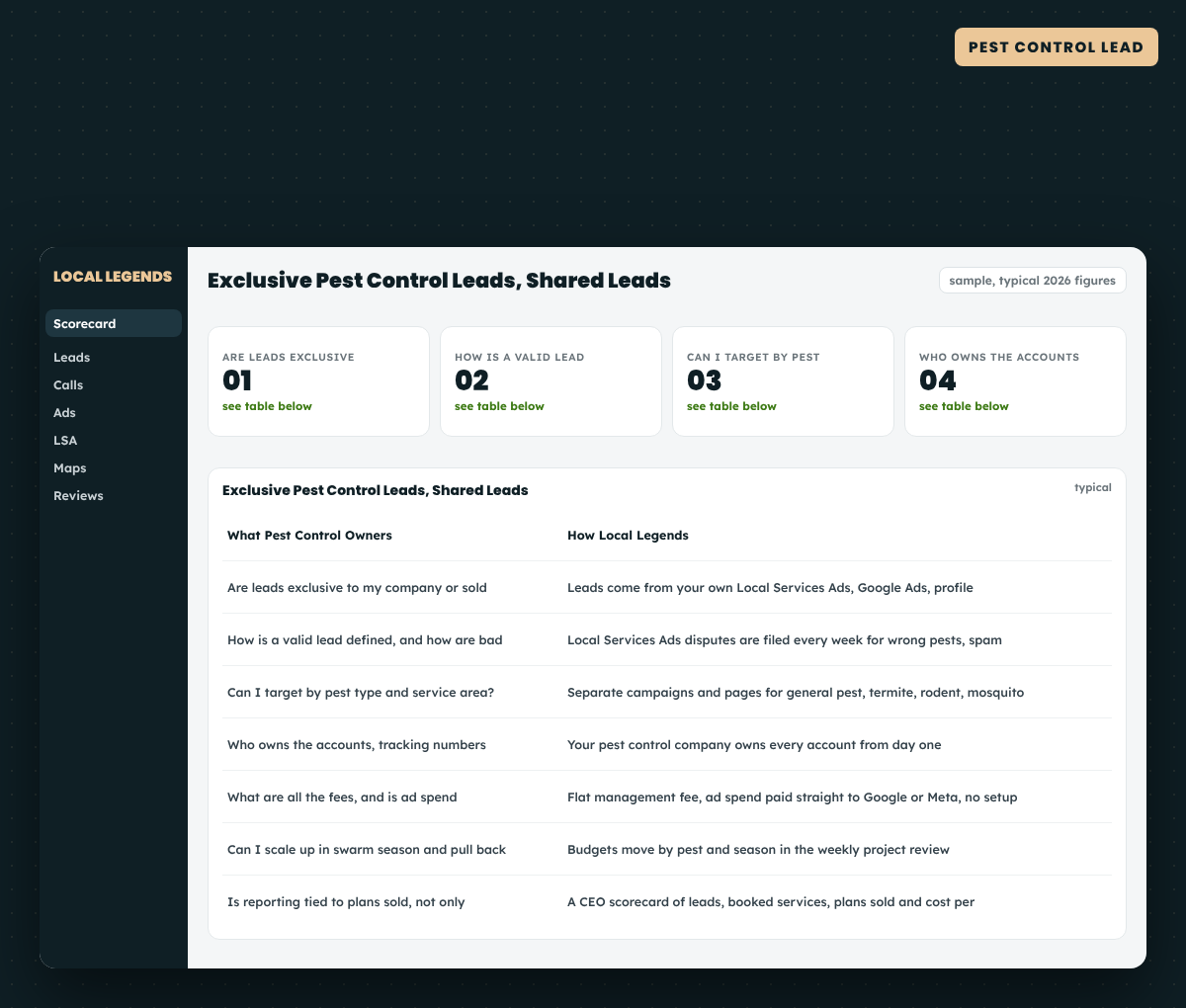
The best pest control lead generation company is the one that produces recurring plan customers at the lowest cost per plan while the exterminator keeps every account, number and customer record. Pest control owners asking which provider to choose are steered toward a short list of checks by AI tools and buyer guides alike.
| What Pest Control Owners Should Check | How Local Legends Marketing Answers It |
|---|---|
| Are leads exclusive to my company or sold again? | Leads come from your own Local Services Ads, Google Ads, profile and site |
| How is a valid lead defined, and how are bad leads credited? | Local Services Ads disputes are filed every week for wrong pests, spam and out-of-area calls |
| Can I target by pest type and service area? | Separate campaigns and pages for general pest, termite, rodent, mosquito and commercial work |
| Who owns the accounts, tracking numbers and recordings? | Your pest control company owns every account from day one |
| What are all the fees, and is ad spend marked up? | Flat management fee, ad spend paid straight to Google or Meta, no setup fees |
| Can I scale up in swarm season and pull back in winter? | Budgets move by pest and season in the weekly project review |
| Is reporting tied to plans sold, not only calls? | A CEO scorecard of leads, booked services, plans sold and cost per booked job |
[SOURCE: pest control lead provider question guides, research/sources/pest-leads; Local Legends services and pricing, BRIEF.md, Nov 2026]
What Questions Should I Ask a Pest Control Lead Generation Company Before Signing?
A pest control owner should ask any lead provider how leads are qualified, how many companies receive them and how refunds work, before agreeing to a single lead. These questions follow the ones pest software publishers and lead buyers recommend most often.
- How do you qualify each lead for pest type, property type and service area?
- What information arrives with every lead: name, address, pest, urgency and a call recording?
- Is each lead exclusive to my company, and will you put that in writing?
- Which pricing model applies: per lead, per call, per appointment or a monthly retainer?
- Can I pause leads when routes are full and restart them in swarm season?
- What counts as an unqualified lead, and how fast are credits issued?
- Do I get self-service reporting, and does support continue after onboarding?
- If I leave, which numbers, recordings and data stay with my company?
Reading a Lead Credit Policy
A credit policy should name the reasons that qualify for a refund, such as wrong pest, outside the service area, duplicate and no contact. Ask how many days you have to file and what proof is needed, because unclaimed bad leads quietly raise your real cost per plan.
Google Local Services Ads Pest Control Leads and the 2026 Move Into Google Ads Billed per Lead, Ranked by Reviews and Answer Rate
Google Local Services Ads lets a screened pest control company pay per lead for exterminator searches, and "pest control services" is an eligible category in the United States. Google began folding Local Services Ads into Google Ads in August 2026, and pest control was named in the first group of advertisers.
- Screening first: background, license and insurance checks before ads can run.
- Paid per lead: charges come from calls and messages, not clicks.
- Placement factors: review count and rating, responsiveness and distance shape where the ad shows.
- Inside Google Ads: budgets, bidding and reporting now sit in the Google Ads account for migrated advertisers.
- What carries over: leads, call recordings and the Google Verified badge move with the account.
[SOURCE: Google Ads Help migration notice and pest control Local Services Ads research, research/industries-pest-control.md, Nov 2026]
Why Are So Many of My Pest Control Local Services Ads Leads About Pests I Do Not Treat or Outside My Area?
Pest control Local Services Ads leads skew toward wrong pests and out-of-area calls because Google matches searches to a broad category, so a bat exclusion specialist can be billed for mice, birds and general questions. Published 2026 analyses put this non-target share at 25% to 40% of billed calls before disputes.
- Four common culprits: out-of-area callers, wrong-pest callers, general questions and existing customers.
- Tag during the call: have the office mark each non-target call so disputes have evidence.
- File weekly: disputes filed on a fixed day recover more spend than a monthly cleanup.
- Tighten the service area: remove zip codes your routes do not reach.
- Use search where matching is loose: wildlife and commercial work often do better on exact-match search ads.
- Watch the booked number: booked-job cost often runs two to four times the headline lead price, so track both.
What Local Legends runs for pest control: for $2,000 a month plus ad spend, pest clients get Local Services Ads and Google Ads management, the campaign landing pages, weekly dispute filing, a monthly Google Business Profile tune-up and the LSA Ranker texter that asks customers for reviews. Details sit on our Google Local Services Ads management page. [SOURCE: BRIEF.md pricing and LSA Ranker, Levi Ostlund confirmation Nov 10 2026]
Speed to Lead and Booking Rate for Pest Control Leads The Office Decides What a Lead Really Costs
Pest control lead generation pays off only when the office answers fast and books the caller into a first service with a plan attached. Response time and booking rate move cost per plan more than any bid change.
How Fast Should a Pest Control Company Call Back a New Lead?
A pest control company should answer inbound calls live and respond to forms within five minutes, because a homeowner who just saw a roach or a mouse usually books the first company that responds. Home service research cited in 2026 pest guides links a five-minute response, against thirty minutes, to conversion gains of up to 40%.
- Live calls: answer during every advertised hour, since missed calls on Local Services Ads can still bill.
- Forms and chat: an instant text acknowledgment, then a person within five minutes.
- Shared leads: the first callback often wins, so seconds matter more than minutes.
- After hours: an automated reply that asks the pest and the address, then a call first thing.
- Online booking: published benchmarks credit it with 25%+ more evening and weekend bookings.
What Booking and Close Rate Should Pest Control Leads Hit, and How Many Should Become Recurring Plans?
A healthy pest control office typically books 38% to 45% of Local Services Ads leads, and the stronger measure is how many of those first services convert to a recurring plan within 90 days. The figures below are typical ranges from 2026 pest control benchmarks.
- Urgent infestation callers: usually convert at 25% to 40% once reached.
- Planned or preventive inquiries: usually convert at 15% to 25%.
- Shared leads: often close in the single digits.
- Exclusive calls: published examples run near 30%.
- Plan attach rate: the share of new customers still on a recurring plan at 90 days, tracked by lead source.
- What lifts it: a plan offered on the first call, a simple three-tier menu and technicians who explain the next visit.
Pest Control Lead Generation Calendar for Termite Swarms, Mosquito Season, Fall Rodents and Winter Budget Follows the Bugs
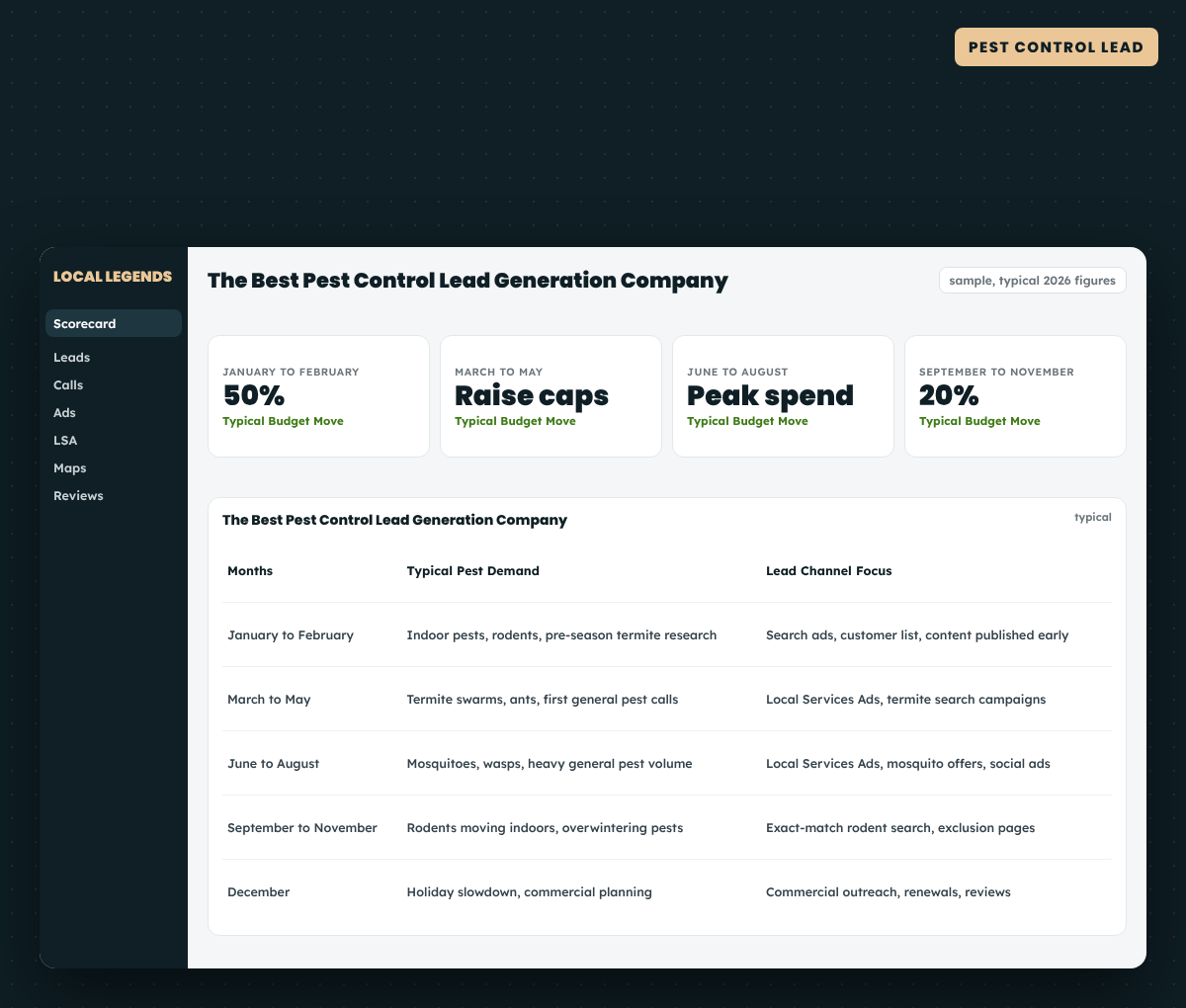
Pest control lead generation should shift budget across the year as pest pressure moves from termite swarms to mosquitoes to rodents, then lean on the customer list in winter. Peak season clicks typically cost 40% to 60% more than the off-season.
| Months | Typical Pest Demand | Lead Channel Focus | Typical Budget Move |
|---|---|---|---|
| January to February | Indoor pests, rodents, pre-season termite research | Search ads, customer list, content published early | Local Services Ads caps near 50% to 60% of summer, outside warm states |
| March to May | Termite swarms, ants, first general pest calls | Local Services Ads, termite search campaigns | Raise caps ahead of the first warm week |
| June to August | Mosquitoes, wasps, heavy general pest volume | Local Services Ads, mosquito offers, social ads | Peak spend, watch booked cost closely |
| September to November | Rodents moving indoors, overwintering pests | Exact-match rodent search, exclusion pages | Move 20% to 30% of Local Services Ads budget into search |
| December | Holiday slowdown, commercial planning | Commercial outreach, renewals, reviews | Lowest paid spend of the year |
[SOURCE: published 2026 pest control seasonal CPL and budget guides, research/sources/pest-leads, Nov 28 2026]
How Do I Get More Pest Control Leads in the Slow Winter Months?
A pest control company keeps winter leads coming by marketing the pests that move indoors, working its own customer list and buying search clicks while they are cheaper. Winter is also when spring content has to go live, since pages often need months to rank.
- Indoor pests: rodent, cockroach and stored product pest campaigns with matching pages.
- Exclusion offers: sealing gaps, vents and rooflines before the coldest weeks.
- Lapsed customers: call and text past one-time customers with a winter plan offer.
- Termite prep: publish swarm season pages by January so they can rank by spring.
- Commercial pipeline: restaurants, property managers and warehouses plan vendors early in the year.
- Cheaper clicks: off-season clicks often run 20% to 40% below peak, so test new keywords then.
Fall Rodent and Wildlife Exclusion Leads
Rodent searches rise from September through November, and so do vague questions that a broad category will bill. Exact-match search ads for rat exterminator and mice in walls removal, paired with an exclusion landing page, usually book better than relying on Local Services Ads alone.
Termite Inspection Leads and Commercial Pest Control Leads Two Lead Types Built on Relationships
Termite inspection leads and commercial pest control leads both come more from referral partners and paperwork than from a single ad click. Each one also carries renewal value that justifies a longer sales path.
How Do I Get More Termite Inspection Leads From Realtors and Homeowners?
A pest control company earns steady termite inspection leads by becoming the easy choice for real estate agents and home inspectors, then selling annual protection plans to the homeowners it inspects. Wood destroying insect reports are a common step in many home sales.
- Agent-friendly scheduling: an online request form for inspections with clear turnaround times.
- Clean reports: a consistent WDI report format agents can forward without edits.
- Inspector partners: home inspectors who refer termite work when they spot damage.
- Swarm season search: termite inspection and termite treatment campaigns from March through May.
- Renewal follow-up: annual inspection reminders that keep protection plans active.
How Does a Pest Control Company Get Commercial Pest Control Leads and Contracts?
Commercial pest control leads come from property managers, restaurant groups, warehouses and medical offices that need documented service, and they buy from vendors who make compliance easy. A multi-year commercial account can justify a far higher cost to acquire than a residential plan.
- Target the right buildings: food service, multifamily, healthcare, schools and storage.
- Paperwork ready: certificate of insurance, license numbers, service logs and audit-ready reports.
- Site visits and bids: walk the property, define the scope, then submit a written proposal.
- Search for urgency: exact-match commercial search ads for restaurant and warehouse pest control.
- Existing customers: homeowners who also own or manage businesses.
Pest Control Leads for New Companies and Free Pest Control Lead Sources Start Lean, Add Paid Channels as Routes Fill
A new pest control company can win its first leads with a complete Google Business Profile, its personal network and one paid channel it can answer fast. Free lead sources keep working long after the first year.
I Just Started a Pest Control Business. How Do I Get My First Pest Control Leads?
A new exterminator should launch a free Google Business Profile, ask its own network for first customers and reviews, and test Local Services Ads once screening is complete and calls can be answered live. Buying shared leads early can help fill open days, but only alongside channels the company owns.
- Profile first: categories, service area, hours and real photos of trucks and technicians.
- A simple site: one page per main pest, click-to-call buttons and a quote form.
- First ten reviews: ask every early customer, since reviews shape Local Services Ads placement.
- Neighbor marketing: door hangers or short visits around each new account.
- Partners: real estate agents, property managers and landscapers who refer work.
What Are the Best Free Ways to Get Pest Control Leads?
The best free pest control leads come from a well-kept Google Business Profile, referrals from current plan customers and reminders to past one-time customers before each pest season. None of these charge per lead, and every one stays exclusive.
- Profile upkeep: fresh photos, posts and steady new reviews that mention the pest and the town.
- Referral rewards: a free service or credit when a customer sends a neighbor.
- Seasonal reminders: termite, mosquito and rodent notes to customers before each peak.
- Truck and uniform branding: every route doubles as a moving billboard.
- Local groups: helpful answers in community groups and neighborhood apps.
- Compliance note: calling or texting purchased lists requires consent under telemarketing rules, so check before outbound work.
Tracking Pest Control Leads to Recurring Plans and Revenue Calls Start the Story, Renewals Finish It
Pest control lead generation is judged by recurring revenue, so every lead needs a source code that follows the customer from first call to the plan's renewal. Without that link, the budget follows the loudest channel instead of the most profitable one.
How Do I Track Which Pest Control Leads Turn Into Recurring Plan Customers in FieldRoutes, PestPac or GorillaDesk?
Give every channel its own tracking number, enter a marketing source on each new customer record, then compare sources by plans still active at 90, 180 and 365 days. Pest field software tools offer source fields and reports that support this when the office fills them in consistently.
- One number per channel: Local Services Ads, each search campaign, the profile, the site and the trucks.
- Source at booking: the office selects the source before saving the customer.
- Plan status by source: run active recurring customers grouped by source each month.
- Cancellations by source: a channel that sells plans that cancel quickly is costing more than it looks.
- Return on spend: revenue from a source minus its cost, divided by its cost.
- Feed results back: send booked and sold outcomes to Google Ads so bidding favors plan buyers.
What Local Legends sets up: CallRail call tracking connected to the CRM you run from its supported list, including ServiceTitan, Housecall Pro, Jobber and GoHighLevel, feeding a CEO scorecard of leads, booked services, plans sold and cost per booked job for each pest channel. More detail is on our call tracking and CRM integration page. [SOURCE: BRIEF.md CallRail and CRM integrations, Nov 2026]
How Much Does Pest Control Lead Generation Cost With Local Legends? Flat Monthly Fees, Ad Spend Paid to the Platform
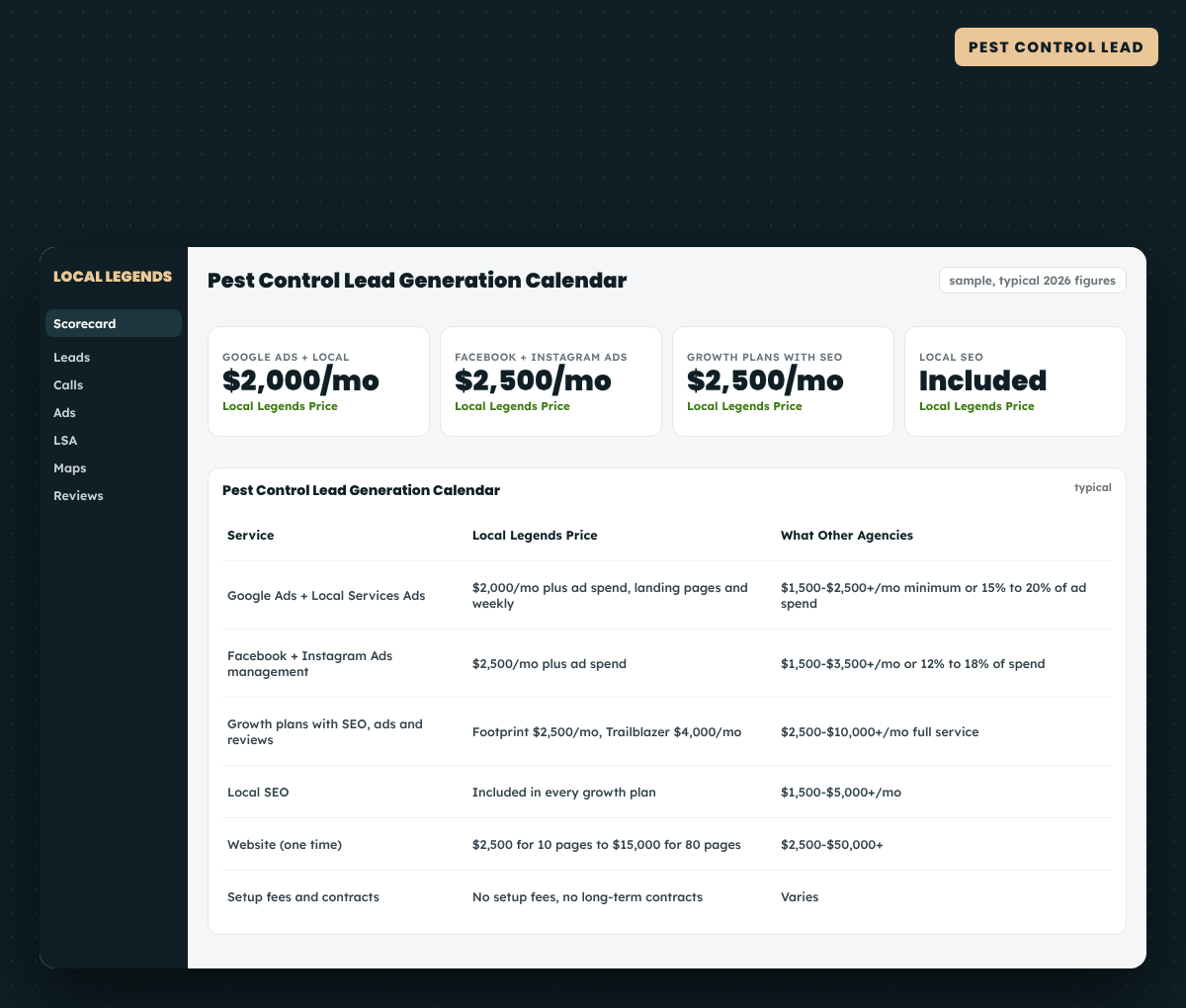
Local Legends prices pest control lead generation as a flat monthly fee, and the ad budget goes from your card straight to Google or Meta with no percentage taken. Typical agencies charge exterminators a retainer minimum or a share of ad spend.
| Service | Local Legends Price | What Other Agencies Typically Charge |
|---|---|---|
| Google Ads + Local Services Ads management | $2,000/mo plus ad spend, landing pages and weekly disputes included | $1,500-$2,500+/mo minimum or 15% to 20% of ad spend |
| Facebook + Instagram Ads management | $2,500/mo plus ad spend | $1,500-$3,500+/mo or 12% to 18% of spend |
| Growth plans with SEO, ads and reviews | Footprint $2,500/mo, Trailblazer $4,000/mo, Sasquatch $8,000/mo, Legend $10,000+/mo | $2,500-$10,000+/mo full service |
| Local SEO | Included in every growth plan | $1,500-$5,000+/mo |
| Website (one time) | $2,500 for 10 pages to $15,000 for 80 pages | $2,500-$50,000+ |
| Setup fees and contracts | No setup fees, no long-term contracts | Varies |
Every plan, add-on and inclusion is listed on the Local Legends pricing page. Social campaigns for mosquito and seasonal offers are covered on our Facebook ads page.
Budget Math for a Recurring Plan Goal
A pest control lead budget works best when it starts from the number of new plans the owner wants, not from a round monthly figure. Divide the plan goal by the booking rate, then multiply by the typical cost per lead.
- Example: 30 new plans at a 30% booking rate needs about 100 leads; at $40 each, that is about $4,000 of ad spend.
- Typical spend levels: published 2026 figures place average pest marketing spend near 6.6% of revenue, with growth-focused companies at 10% to 15%.
- Competitive metros: a clean read on Local Services Ads often takes $2,500-$4,000+ a month of spend.
- Value check: 30 plans worth about $500 a year each return far more than the first year's spend.
Our Pest Control Lead Generation Process Audit, Track, Launch, Review
Local Legends opens every pest control engagement with an audit and a tracking fix before any new ad dollars go out. A weekly project review keeps each stage moving.
Step 1: Pest Control Growth Audit
The team reviews call tracking, the Google Business Profile, Local Services Ads settings, current lead providers and how the office books, then runs Google Maps rank grids across the territory to show where the profile wins and where it disappears.
Step 2: Tracking and Ownership
Tracking numbers go on each channel, the CRM gets connected, and every ad account, profile and domain is confirmed as the pest control company's own.
Step 3: Launch by Pest and Service Area
Local Services Ads service areas get tightened, then general pest, termite, rodent, mosquito and commercial campaigns go live with their own pages and budgets.
Step 4: Weekly Review, Disputes and Seasonal Shifts
Each week the scorecard compares channels on booked services and plans sold, non-target charges are disputed, and budget follows the pest calendar.
Everything beyond leads, including SEO, plan conversion and WDI work, is covered on our pest control marketing page. Paid search depth is on the Google Ads management page.
Local Legends Marketing Reviews From Home Service CEOs Owners Who Recorded Their Experience
Several home service CEOs have gone on record about working with founder Levi Ostlund and Local Legends Marketing. Their comments cover strategy, responsiveness and long-term work.
Levi has been absolutely outstanding to work with over the years... His creativity, responsiveness, and deep understanding of our marketing strategy have made a huge impact." Brad Beldon, CEO, Roofing Company. Read on Local Legends
- Video: Kyle Scott, CEO, Roofing Company
- Video: Jim Dodson, CEO, Roofing Company
- Video: Race Allen, CEO, Precision Restoration of Texas
Frequently Asked Questions About Pest Control Leads Answers for Pest Control Owners
How Do Pest Control Companies Get Leads?
Pest control companies get leads by building owned channels, such as Local Services Ads, search ads, SEO and the Google Business Profile, or by buying leads and calls from providers. Owned channels keep every lead exclusive.
Is $50 a Month a Lot for Pest Control, and Why Does That Matter for Lead Value?
For most homeowners, $40-$75+ a month is a typical published price range for a recurring pest plan, and that monthly figure is exactly why a single plan customer can justify a much larger lead cost. Plans that renew for years turn a modest monthly price into four-figure lifetime value.
What Is the Best Way to Buy Pest Control Leads?
Buy pest control leads only on an exclusive, pay-for-valid-leads basis with a written credit policy and no long-term contract, and test more than one source at a time. Then compare every source by cost per plan sold.
Does Local Legends Sell Pest Control Leads?
No. Local Legends never sells, shares or resells pest control leads. The calls come from campaigns and profiles registered to your pest control company, so they belong to you alone.
Are Local Services Ads Pest Control Leads Exclusive?
Yes. A call or message to your listing in Local Services Ads is yours, though the same homeowner is free to phone other exterminators too.
Can Bad Pest Control Leads From Local Services Ads Be Disputed?
Yes. Every week Local Legends files credit requests on non-target pest control charges, such as spam, misdials and callers outside your service area or pest types.
Is It Legal to Call or Text Purchased Pest Control Lead Lists?
Calling or texting purchased lists depends on the consent behind them, because telemarketing and texting rules require permission for many outbound contacts. Ask any list seller how consent was collected, and check with a legal advisor before outbound campaigns.
Does Local Legends Work With Pest Control Companies Everywhere?
Yes. Pest control clients are served nationwide from the home office in Texas. Covered markets are listed on the Local Legends service areas page.
Is Local Legends a Google Partner?
No. Local Legends Marketing does not hold Google Partner status. Its team manages the pest control company's own Google Ads and Local Services Ads accounts on its behalf.
Reviewed by Levi Ostlund, Founder, Local Legends Marketing

Start Generating Pest Control Leads That Ring Only Your Office Request a Pest Control Growth Audit
A free growth audit reviews your pest control ad accounts, lead providers, map listing and call tracking and shows the real cost behind each recurring plan you sold this year. Local Legends Marketing then builds lead channels you own, on flat fees with no setup fee and no long-term contract.
- Helpful to bring: last year's leads, booked services, plans sold and spend by channel.
- Pricing is public: review the plans before the audit.
- Ownership stays put: every login remains in your company's name.
Call (936) 900-1248 or book a free growth audit online.