


What Pages Does a Moving Company Website Need

Moving Company Web Design That Puts Your Trucks, Your USDOT Number and a Two-Step Quote Form in Front of Families Planning Local, Long Distance and Storage Moves
Moving Company Websites From Local Legends Marketing, From $2,500 One Time
Updated November 2026 · Reviewed by Levi Ostlund, Founder
Breadcrumb: Home > Industries [LINK: /industries/] > Moving [LINK: /industries/moving/] > Website Design
Moving company web design earns quote requests when a family can confirm three things in seconds: you move households in their area, you are the licensed carrier with your own trucks, and getting a price takes less than a minute. Local Legends Marketing builds moving company websites around those three checks.
- A separate page for each kind of move: local, long distance, packing, storage, apartment and office moves.
- A quote path built for phones: move date and ZIP codes first, contact details second.
- Credentials where shoppers look: USDOT number, MC number, state mover license and insurance in every footer.
- Real trucks and real crews: your branded fleet and uniformed movers in place of stock photos.
- Every lead followed to the booked move: calls and forms carry their source into your moving CRM.
Free Growth Audit
Your Reviews, Radius and Response Rate vs the competitors beating you.
About Local Legends Marketing
A home service marketing agency headquartered in Conroe, Texas, with 8+ years of marketing experience, running Google Ads, Local Services Ads, local SEO, AI SEO, connected TV and review systems for contractors nationwide.
Local Legends Marketing Reviews From Home Service CEOs Four CEOs on the Record
The testimonials on this page come from four home service CEOs who recorded or wrote reviews of Local Legends Marketing and founder Levi Ostlund. None of them run moving companies, and this page shows no moving client names, moving launch results or invented case studies.
The three videos play on the Local Legends reviews page [LINK: /about-us/reviews/].
Levi has been absolutely outstanding to work with over the years... His creativity, responsiveness, and deep understanding of our marketing strategy have made a huge impact.
 Brad Beldon
CEO, Roofing Company
Why a Moving Company Website Has a Harder Job Than Most Home Service Sites One Purchase, High Stakes, Several Quotes
A moving company website has a harder job because a family hires a mover once every few years, hands strangers everything it owns and usually requests quotes from several movers in the same evening. The site has to earn that trust before the first phone call.
Google AI Mode described moving as a high-stress purchase in November 2026, where visitors only share their details once they see the company is licensed, insured and active in their exact area. A water heater buyer wants speed; a moving buyer wants proof.
Four Questions a Moving Shopper Asks That a Repair Customer Rarely Does
- Is this the company that shows up? The shopper wants to see your own trucks and the crew that will arrive.
- Can I verify the license? Many families type the USDOT number into the federal lookup before they book.
- What will the final bill look like? Hourly rates, minimums, travel fees and what is included.
- What happens if something breaks? Valuation coverage options and the claims process, in plain words.
Federal Guidance Shapes What Families Expect to See
The Federal Motor Carrier Safety Administration tells consumers to check its Registered Mover Database, and it warns families about mover websites that list no local address and no registration or insurance details. [SOURCE: FMCSA Protect Your Move pages, fetched Nov 28 2026]
That guidance turns credentials into a design requirement. A moving website that shows a real street address, a USDOT number and insurance details answers the question the federal agency tells families to ask.
What Should a Moving Company Website Include to Get More Quote Requests?
A moving company website gets more quote requests by putting a short quote form in the first screen, showing verifiable credentials beside it and giving each type of move its own page. Google AI Mode named that same trio in November 2026: a friction-free quote path, trust signals and local service pages.
- A two-step quote form in the hero: move date, origin ZIP, destination ZIP and home size, then name and phone.
- A sticky mobile bar:"Get a Quote" and a tap-to-call button that stay on screen while the visitor scrolls.
- A virtual survey option: a way to book a video walk-through or upload photos of the rooms being moved.
- Credentials near the button: USDOT number, state license and cargo insurance details under the form.
- Real fleet and crew photos: uniformed movers wrapping furniture and loading your branded trucks.
- Reviews that name crew members: Google reviews placed beside each quote button, not on one buried page.
- A clear next step: one sentence under the form that says who reaches out and how.
How Local Legends starts every moving website: before a page is planned, the team audits call and form tracking, the local SEO setup, Local Services Ads and the quote funnel, then maps the mover's visibility town by town with Google Maps rank grids. [SOURCE: Local Legends audit process, confirmed by Levi Ostlund, Founder, Nov 10 2026]
Why Is My Moving Company Website Getting Traffic but No Quote Requests? Friction, Missing Proof or the Wrong Visitors
A moving company website with traffic and no quote requests usually has one of three problems: the quote form asks too much, the page does not prove the company is a licensed carrier, or the visitors were never looking to hire a mover. Google AI Mode gave that same diagnosis in November 2026.
Each problem calls for a different fix, so the first step is finding which one applies. Too much friction is a form problem, missing proof is a content problem, and the wrong visitors is a targeting problem.
When the Quote Form Asks for Too Much
- A full inventory on the first screen: asking for every room and box before contact details scares off early shoppers.
- Weak button text:"Submit" tells a family nothing; "Get My Free Moving Estimate" tells them what they receive.
- A form that breaks on phones: tiny fields, the wrong keyboard for ZIP codes or a button hidden below a chat widget.
- Silent failures: a plugin update that stops form emails, so requests arrive and nobody sees them.
When the Page Does Not Prove You Are the Carrier
- No USDOT number or state license: the shopper cannot verify the company and moves on to the next result.
- Stock photos of smiling models: families notice when the trucks have no logo.
- No street address: a phone number alone looks like a reseller.
- Pricing left unexplained: shoppers who fear hidden fees hesitate to hand over a phone number.
When the Traffic Was Never Looking for a Mover
- Blog posts ranking for packing tips:"how to pack dishes" brings readers, not buyers.
- Visitors from outside the service area: city names missing from the headline invite clicks the crew cannot serve.
- Ads sent to the home page: paid clicks for long distance moves landing on a local moving page.
A Five-Minute Check Any Moving Company Owner Can Run
- Open the site on your own phone and request a quote with a real move date.
- Time how long the confirmation takes to reach your inbox and your CRM.
- Look for your USDOT number without scrolling past the first screen of the quote page.
- Search your main service and city and see whether your profile or site appears.
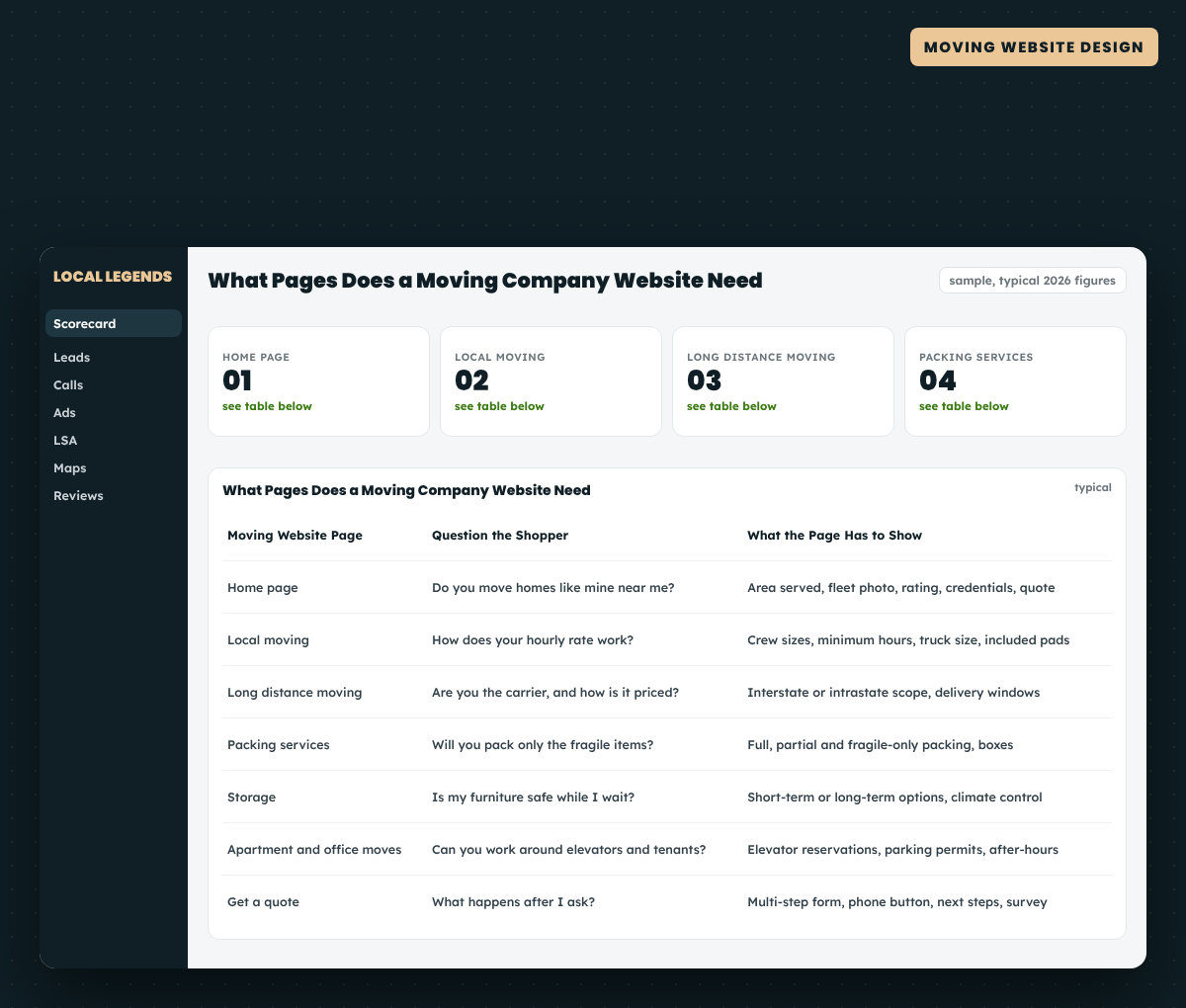
What Pages Does a Moving Company Website Need for Local Moves, Long Distance Moves, Packing and Storage? One Page per Move Type, Plus Trust and Quote Pages
A moving company website needs a home page, a dedicated page for local moving, long distance moving, packing and storage, plus a quote page, a credentials page, a reviews page, a service area hub and an FAQ page. Google AI Mode recommended four service pages paired with six core trust and conversion pages in November 2026.
| Moving Website Page | Question the Shopper Brings | What the Page Has to Show | Quote Form Fields |
|---|---|---|---|
| Home page | Do you move homes like mine near me? | Area served, fleet photo, rating, credentials, quote widget | Move date, origin and destination ZIP, home size |
| Local moving | How does your hourly rate work? | Crew sizes, minimum hours, truck size, included pads and wrap | Move date, ZIPs, bedrooms, stairs or elevator |
| Long distance moving | Are you the carrier, and how is it priced? | Interstate or intrastate scope, delivery windows, binding estimates, USDOT and MC numbers | Origin and destination, date, inventory or virtual survey |
| Packing services | Will you pack only the fragile items? | Full, partial and fragile-only packing, boxes, crating, unpacking | Rooms to pack, specialty items |
| Storage | Is my furniture safe while I wait? | Short-term or long-term options, climate control, security, redelivery steps | Storage length, item count |
| Apartment and office moves | Can you work around elevators and tenants? | Elevator reservations, parking permits, after-hours scheduling | Building type, floor, access rules |
| Get a quote | What happens after I ask? | Multi-step form, phone button, next steps, survey options | Full intake with optional photos |
| About and credentials | Who is moving my belongings? | Crew and leadership photos, USDOT, MC, state license, insurance and valuation | None |
| Reviews and recent moves | Have you moved someone like me? | Google reviews naming crews, short move stories | Link to quote form |
| Service area hub and town pages | Do you really work in my town? | Local routes, building rules, local reviews and photos | ZIP and move date |
Local and Long Distance Moves Need Separate Pages
Local moves are usually billed by the hour by crew size, while long distance moves are usually priced by weight, volume or a binding estimate. Google's AI Overview for "moving company web design" made that same split in November 2026.
One combined services page forces both buyers through the wrong pricing story, and Google cannot tell which search the page should answer.
Specialty Pages Earn Their Place When the Work Sells
Piano moving, senior moves, gun safe moving, military moves and labor-only loading each deserve a page only when the company books that work often. A page for a service the crew rarely performs adds upkeep without adding booked moves.
How Do I Build City Pages on My Moving Company Website Without Them Looking Copied?
A moving company builds city pages that read as original by keeping one layout and filling each page with that town's real moving details: building rules, neighborhoods, common routes, local reviews and photos from moves there. Google AI Mode gave a simple test in November 2026: delete the city name, and if the paragraph still fits any town, rewrite it.
- Building and access rules: high-rise freight elevator reservations, HOA truck parking hours or narrow stairs in older homes.
- Named neighborhoods and corridors: the subdivisions and highways the crew actually drives.
- A recent move from that town: two or three sentences describing a real job, shared with the customer's permission.
- Original photos: a branded truck at a recognizable local spot, never a stock skyline.
- Two or three local reviews: Google reviews that mention that town or neighborhood.
- A town-specific FAQ: truck parking permits, drive times to nearby hubs or seasonal weather.
- A steady rollout: a few strong pages a month for priority towns, not 30 thin pages at once.
Google's Rules on City Pages and Addresses
Google's spam policies describe doorway abuse as pages aimed at specific cities that funnel visitors to one page, and they treat large amounts of unoriginal content as scaled content abuse. [SOURCE: Google Search Central spam policies, fetched Nov 28 2026]
Google's business guidelines also say virtual offices and remote PO boxes are not eligible addresses, so a mover serving towns from one warehouse should say its crews dispatch from that warehouse instead of listing a fake office.
How Local Legends decides on moving town pages: a town gets its own page only after research finds at least 5 real local facts about it, such as building rules, named neighborhoods or common routes, which keeps every moving town page different. [SOURCE: Local Legends city page rule, confirmed by Levi Ostlund, Founder, Nov 10 2026]
How Do I Redesign My Moving Company Website Without Losing My Google Rankings?
A moving company protects its rankings in a redesign by keeping the URLs of pages that already rank, mapping every changed URL to its closest new page with a permanent 301 redirect and carrying over the text, titles and city pages that bring in traffic. Google's site move guidance says 301 and other permanent redirects do not cause a loss in PageRank.
- Benchmark first: export 12 to 16 months of Search Console clicks and impressions by page.
- Keep winning addresses: a page like /local-moving/ that ranks keeps its exact URL.
- Redirect one to one: never point every old service page at the new home page.
- Carry the proof across: NAP details, the embedded Google Map, city pages and structured data.
- Hide the staging site: password protection or a noindex tag until launch day.
- Remove the blocks at launch: check robots.txt and noindex tags, then submit the new sitemap.
- Test every quote path: forms, estimators, tap-to-call buttons and analytics tags on a real phone.
- Leave redirects in place: Google recommends keeping them for at least a year.
Google notes that a medium-sized site can take a few weeks or more before new URLs fully replace the old ones, so judge the move on 30-day trends, not launch week.
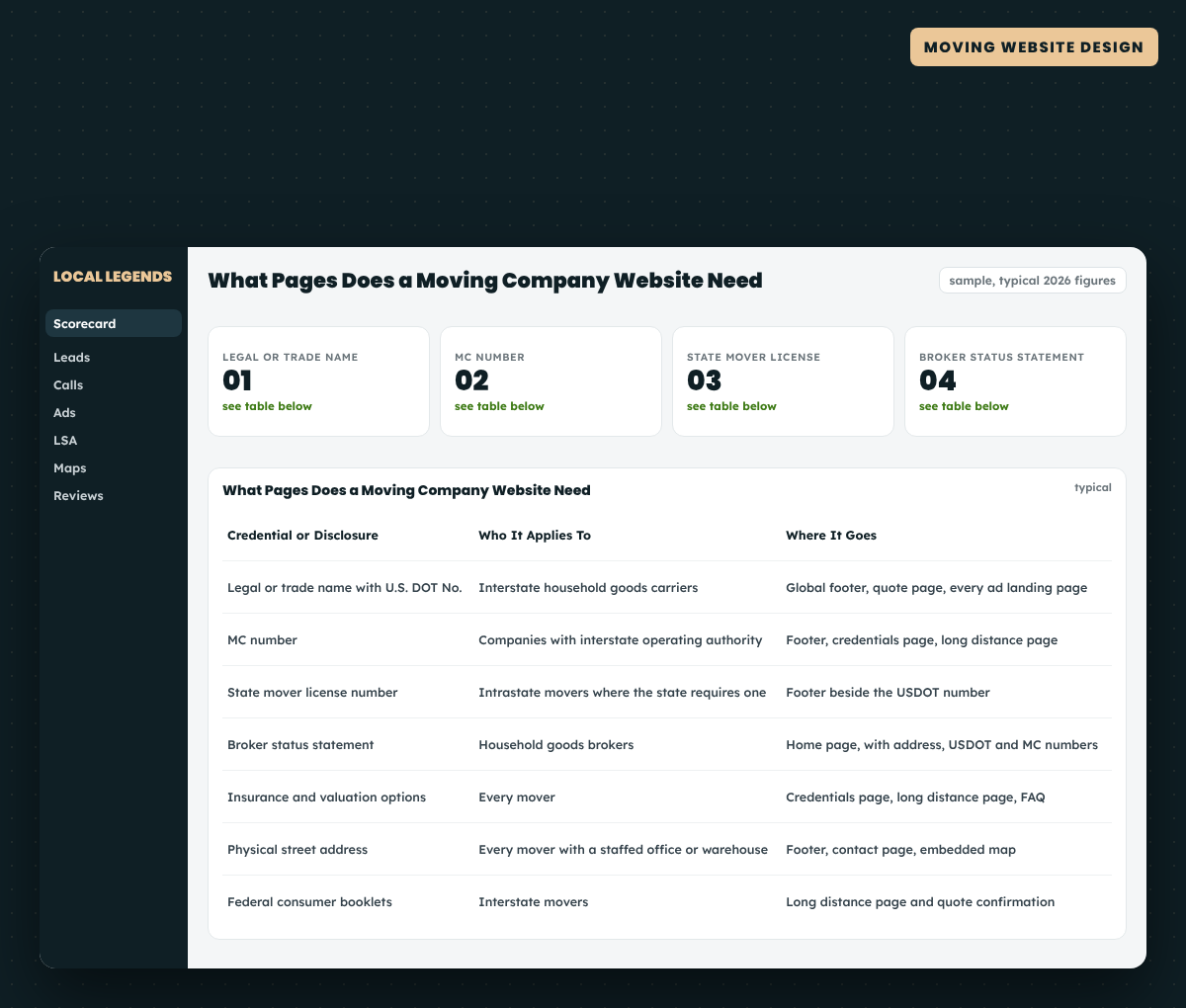
Moving Company Website Credentials: USDOT Number, MC Number, State License and Valuation Proof Families Can Verify
A moving company website builds trust fastest when every page carries the company's legal name, USDOT number, MC number for interstate work, state mover license and insurance or valuation details in a consistent footer. These are the details families can verify for themselves.
| Credential or Disclosure | Who It Applies To | Where It Goes on the Website | Rule or Source |
|---|---|---|---|
| Legal or trade name with "U.S. DOT No." | Interstate household goods carriers | Global footer, quote page, every ad landing page | 49 CFR 375.207 advertising rule |
| MC number | Companies with interstate operating authority | Footer, credentials page, long distance page | Standard practice, shown with the USDOT number |
| State mover license number | Intrastate movers where the state requires one | Footer beside the USDOT number | State transportation or utilities agency |
| Broker status statement | Household goods brokers | Home page, with address, USDOT and MC numbers | 49 CFR 371.107 broker disclosure rule |
| Insurance and valuation options | Every mover | Credentials page, long distance page, FAQ | Plain-language explanation of coverage choices |
| Physical street address | Every mover with a staffed office or warehouse | Footer, contact page, embedded map | Matches the Google Business Profile |
| Federal consumer booklets | Interstate movers | Long distance page and quote confirmation | Rights and Responsibilities booklet and Ready to Move brochure |
Where Should My Moving Company Show Its USDOT and MC Number on the Website?
A moving company should show its USDOT and MC numbers in the global footer of every page, on the about and credentials page, on the long distance page and directly under the quote form button. Google AI Mode recommended that placement in November 2026 so the numbers also appear on every paid landing page.
- The format matters: the federal rule for household goods carrier ads calls for the name as it appears on the USDOT record and the number shown as "U.S. DOT No." followed by the assigned number. [SOURCE: 49 CFR 375.207 via Cornell LII, fetched Nov 28 2026]
- Under the quote button: shoppers check credentials right before they share a phone number.
- On every ad landing page: a footer that loads sitewide covers pages built for Google Ads.
- Next to the state license: intrastate movers in states that license movers show both numbers together.
- Matching the federal record: the legal name and DBA on the website should match the USDOT registration.
Brokers Carry a Separate Disclosure
The federal broker rule requires household goods brokers to show their address, USDOT and MC numbers and broker status online, stating that authorized carriers perform the move. [SOURCE: 49 CFR 371.107 via Cornell LII, fetched Nov 28 2026]
A carrier that owns its trucks does not carry that disclosure, which is one reason a clear credentials section helps families see who they are hiring. This page shares general information, not legal advice.
How Do I Make My Moving Company Website Show Customers We Are the Real Carrier?
A moving company shows it is the carrier by anchoring the website in proof only an operating mover has: its own branded trucks, its uniformed crews, a staffed street address and credentials that match the federal record. Google AI Mode recommended that approach in November 2026.
- Fleet photos at your own facility: branded trucks parked at the warehouse or on a recognizable local street.
- Crew and leadership bios: names, roles and years with the company, so families recognize who arrives.
- Behind-the-scenes photos: furniture pads, shrink wrap, loading and the storage warehouse.
- A real address and an embedded map: matching the verified Google Business Profile.
- A plain statement near the quote form: that your company performs the move with its own crews, if that is true.
- A local phone number in the header: formatted as a tap-to-call button.
- Association and chamber badges: only memberships the company actually holds.
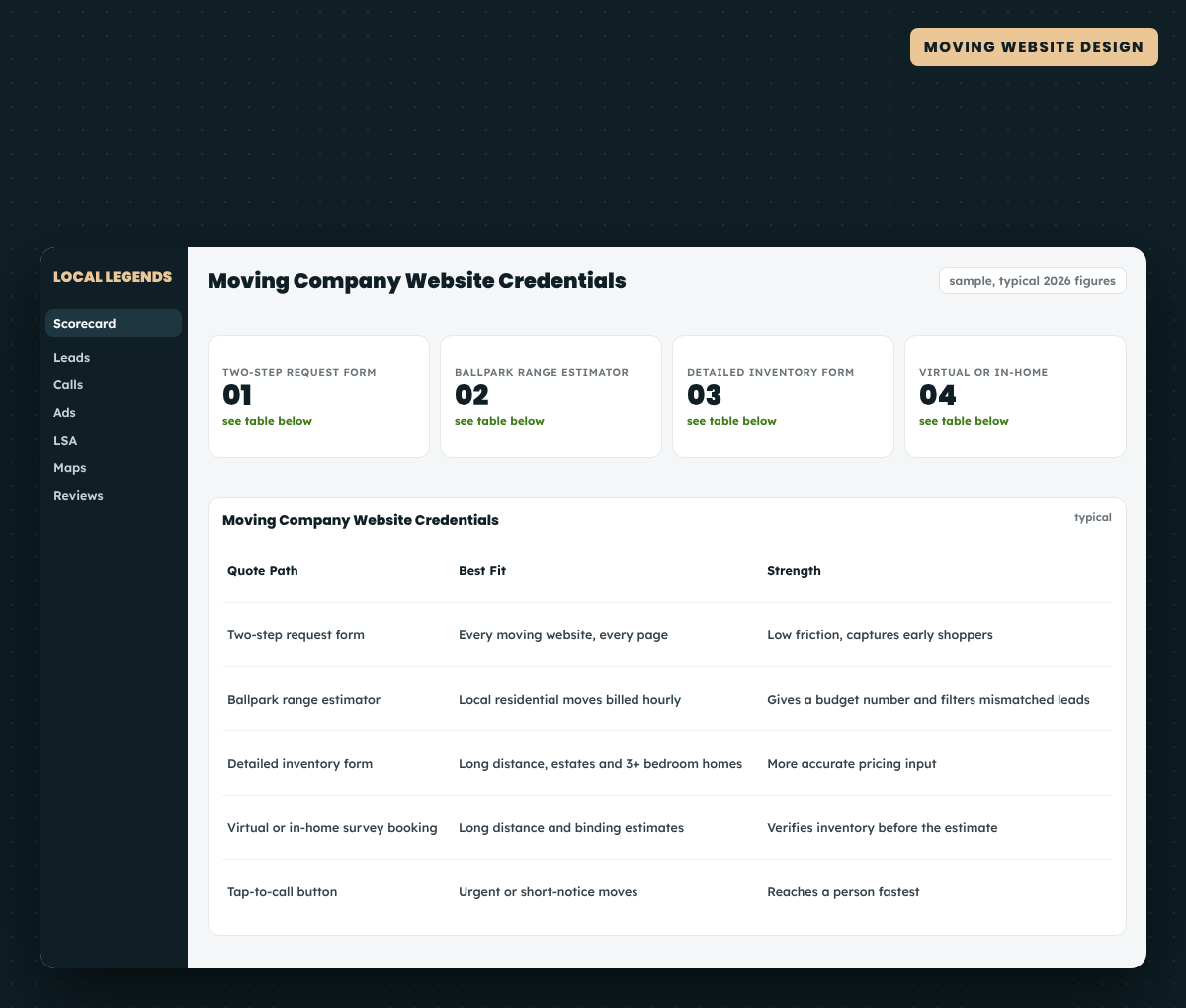
Moving Quote Forms, Ballpark Estimators and Virtual Surveys One Quote Path per Move Type
The right quote path on a moving website depends on the move: a ballpark estimator fits simple local moves, a short request form fits long distance and large homes, and a virtual survey turns either one into an accurate estimate. Most moving companies need a mix of the three.
| Quote Path | Best Fit | Strength | What It Needs |
|---|---|---|---|
| Two-step request form | Every moving website, every page | Low friction, captures early shoppers | Date and ZIPs first, contact details second |
| Ballpark range estimator | Local residential moves billed hourly | Gives a budget number and filters mismatched leads | Your real hourly rates, a range and a non-binding label |
| Detailed inventory form | Long distance, estates and 3+ bedroom homes | More accurate pricing input | Optional steps, saved progress, photo upload |
| Virtual or in-home survey booking | Long distance and binding estimates | Verifies inventory before the estimate | Calendar link and clear next steps |
| Tap-to-call button | Urgent or short-notice moves | Reaches a person fastest | Tracked number and staffed hours shown honestly |
Should My Moving Company Website Have an Instant Quote Calculator or a Quote Request Form?
Most moving companies do best with a hybrid: a ballpark estimator that shows a price range for simple local moves, followed by a prompt to book a virtual or in-home survey for a binding estimate. Google AI Mode recommended that approach in November 2026, warning that a single instant number invites moving-day disputes over stairs, long carries and heavy items.
- Show a range, never one number:"$950-$1,250+" reads as a budget, not a contract.
- Ask for the big cost drivers only: ZIP codes, bedrooms, stairs or elevator and packing needs.
- Name it honestly:"Ballpark Estimator" instead of "Instant Quote," so nobody mistakes it for a binding estimate.
- Skip the calculator for interstate work: weight and volume make automated long distance pricing unreliable.
- Hand off when the tool cannot price it: route pianos, estates and commercial moves to a survey or a call.
Federal Guidance on Estimates Without an Inspection
FMCSA consumer guidance cautions families about movers who give estimates by phone or online without inspecting the household goods. A website that pairs any online range with a survey step answers that concern directly. [SOURCE: FMCSA Protect Your Move consumer guidance, fetched Nov 28 2026]
Should I Put Hourly Rates or Moving Prices on My Moving Company Website?
Most moving companies should publish their starting hourly rates by crew size for local moves alongside "starting at" ranges by home size, and offer binding flat-rate estimates after a survey. Google AI Mode recommended that hybrid in November 2026 because it gives shoppers a budget without locking in a price the crew has not seen.
- Crew-based hourly tiers: two movers and a truck, three movers and a truck, rather than a per-mover rate.
- Minimums stated plainly: minimum hours and any truck or travel fee next to the rate.
- Ranges by home size: studio and one bedroom, two bedrooms, three bedrooms and up.
- What is included: furniture pads, shrink wrap, basic disassembly or wardrobe boxes, listed beside the rate.
- Binding estimates for big moves: offered for larger homes and long distance moves after a walk-through.
Moving Website Launch Timing, Speed and Uptime Before Peak Season Build in Winter, Book in Spring
A moving company website should be live, fast and tested before families start booking summer moves, because peak moving season runs from late spring through summer and many shoppers compare movers weeks ahead. The build calendar works backward from that date.
Peak Moving Season Starts in May. When Should My Moving Company Launch a New Website?
A moving company aiming to rank by May should launch a new website in November or December, roughly five to six months before peak season. Google AI Mode gave that timeline in November 2026, noting that new sites typically need several months to rank for competitive local searches and that early-May movers start booking in March and April.
- November to December: launch core service pages, connect the Google Business Profile and verify tracking.
- January to February: gather reviews, build citations and add town pages that earn their place.
- March to April: early shoppers request quotes while rankings settle.
- May to August: convert peak demand and add paid ads where organic coverage is thin.
- A late launch: sites finished in February or March lean on Google Local Services Ads and search ads while SEO catches up.
Speed Targets for Phone Shoppers
Google's Core Web Vitals call a page good when the largest content appears within 2.5 seconds, interactions respond in under 200 milliseconds and layout shift stays below 0.1.
Moving websites usually miss those numbers because of oversized truck photos, auto-playing video and heavy chat widgets, so every image gets compressed before launch.
Our Moving Company Website Went Down Right Before Peak Season. What Should We Do First?
A moving company whose website goes down should first pause paid ads that point to the broken site, then confirm customers can still reach the company through the Google Business Profile and the phone. Google AI Mode gave that order in November 2026.
- Pause paid clicks: stop Google Ads, Local Services Ads and social ads that send traffic to the dead URL.
- Check the profile: confirm the phone number, hours and quote link on the Google Business Profile.
- Read the error: a "site can't be reached" message often means an expired domain or changed DNS; a 500 error points to hosting or a plugin; a privacy warning means an expired SSL certificate.
- Restore before repairing: ask the host to roll back to the last good backup instead of debugging during peak.
- Tell Google it is temporary: a holding page should return a 503 status, not a 404.
- Prevent the next one: domain auto-renewal in the company's own name, off-site backups and uptime alerts.
Ownership Is the Best Insurance
Outages drag on when nobody at the moving company can log into the domain registrar or the host. With Local Legends, the mover owns the website, domain, Google Business Profile, ad accounts and call data, with no long-term contract. [SOURCE: Local Legends ownership policy, BRIEF.md Nov 2026]
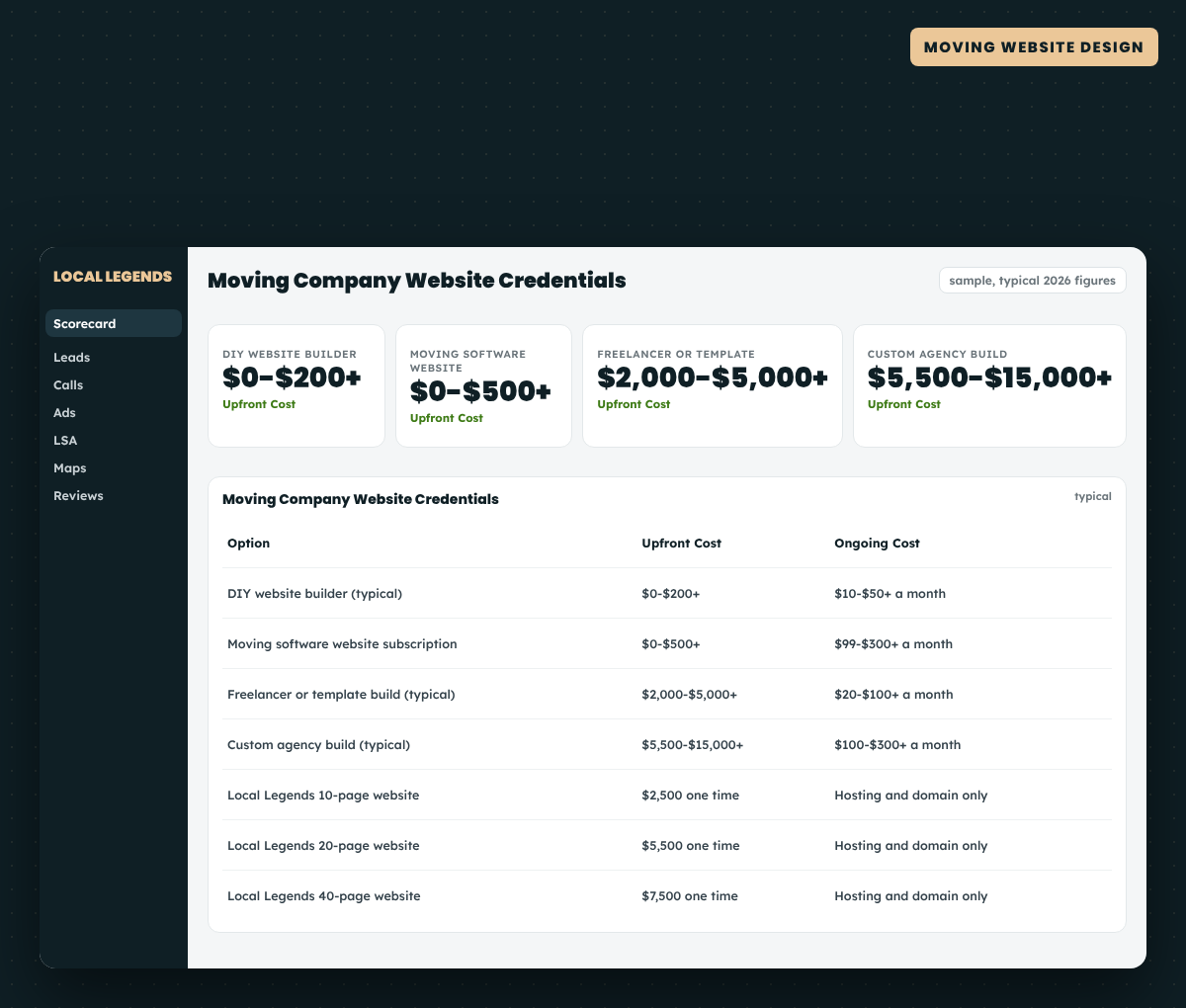
How Much Does a Moving Company Website Cost in 2026? Typical Professional Builds Run $2,500-$10,000+ Upfront
A moving company website typically costs $15-$49+ a month on a DIY builder, $2,500-$10,000+ upfront for a professional build and $5,500-$15,000+ for a custom agency build with calculators and CRM connections. Those ranges come from Google AI Mode in November 2026 and are typical market figures, not Local Legends prices.
| Option | Upfront Cost | Ongoing Cost | Usually Fits |
|---|---|---|---|
| DIY website builder (typical) | $0-$200+ | $10-$50+ a month | Brand-new one-truck mover on referrals |
| Moving software website subscription (typical) | $0-$500+ | $99-$300+ a month | Mover wanting a managed template tied to moving software |
| Freelancer or template build (typical) | $2,000-$5,000+ | $20-$100+ a month | Growing local mover needing service and town pages |
| Custom agency build (typical) | $5,500-$15,000+ | $100-$300+ a month | Multi-truck or long distance mover needing calculators and CRM sync |
| Local Legends 10-page website | $2,500 one time | Hosting and domain only | Home, local, long distance, packing, storage, quote, credentials, reviews |
| Local Legends 20-page website | $5,500 one time | Hosting and domain only | Adds apartment, office, specialty and earned town pages |
| Local Legends 40-page website | $7,500 one time | Hosting and domain only | Deeper route, service and town coverage |
| Local Legends 80-page website | $15,000 one time | Hosting and domain only | Multi-location moving and storage companies |
Plans, add-ons and monthly growth options are listed on the Local Legends pricing page, and the product-page layout behind every build is explained on the contractor website design page. Local Legends websites are a one-time purchase with no setup fee.
What Moves the Price of a Moving Website
- Quote calculators: Google AI Mode reported that a custom moving cost calculator typically adds $1,500-$3,800+ to a build.
- CRM and dispatch connections: sending form data straight into moving software takes integration work.
- Town and route pages: every page needs its own local facts, which takes research time.
- Fleet and crew photos: a short shoot of the trucks and crews replaces stock images.
Running Costs After Launch (Typical)
- Domain: typically $12-$20+ a year, registered in the moving company's own name.
- Hosting, SSL and maintenance: typically $15-$50+ a month for basic hosting on a one-time build.
- New pages: Local Legends growth plans add pages and blogs every month, starting with 10 a month on the Footprint plan at $2,500 a month.
Should My Moving Company Use Wix, WordPress or Hire a Moving Website Design Agency?
A brand-new moving company on referrals can launch on Wix or a similar builder, while a mover competing for local search across several towns usually needs a platform and a team that can build dozens of service and town pages with CRM connections. Google AI Mode drew that line in November 2026.
- Where a builder works: a clean five-page site live in a weekend with hosting handled.
- Where a builder strains: dozens of town and route pages, moving CRM connections and custom estimators.
- Where WordPress fits: full ownership and room to grow, with plugin and security upkeep to manage.
- Where an agency fits: steady lead volume that justifies a professionally planned build.
- The ownership check: some builders cannot export a site, and some monthly plans lease the site to the mover.
One-Time Ownership Versus a Rented Site
Local Legends builds every moving website as a one-time purchase that the mover owns outright, including the domain and the written pages. Monthly website subscriptions from other providers are a typical market option, and Local Legends does not sell one.
Not sure how many pages your moving company needs? The free growth audit counts your move types, routes and earned towns first, so the quote follows the plan.
Moving Website Leads Tracked From Quote Request to Booked Move Count Booked Moves, Not Form Fills
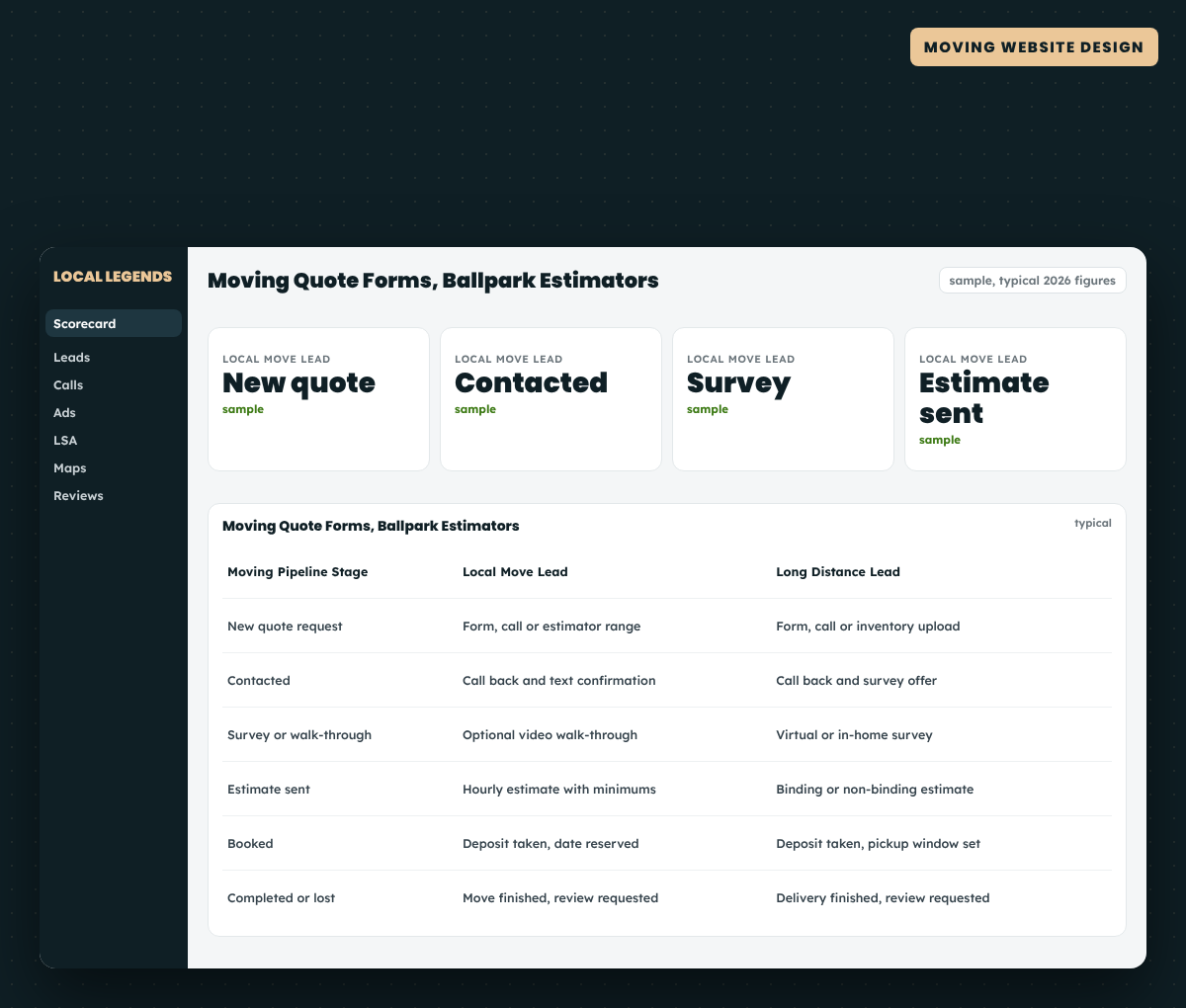
A moving website lead only matters once it becomes a booked move with a deposit, so each call and quote request needs its source stored in the CRM and a stage for the survey, the estimate and the outcome. Impressions and traffic are chapter one; booked and completed moves finish the story.
| Moving Pipeline Stage | Local Move Lead | Long Distance Lead | What to Record |
|---|---|---|---|
| New quote request | Form, call or estimator range | Form, call or inventory upload | Source, landing page and move type |
| Contacted | Call back and text confirmation | Call back and survey offer | Response time and who called |
| Survey or walk-through | Optional video walk-through | Virtual or in-home survey | Date and estimator |
| Estimate sent | Hourly estimate with minimums | Binding or non-binding estimate | Amount and estimate type |
| Booked | Deposit taken, date reserved | Deposit taken, pickup window set | Job value and move date |
| Completed or lost | Move finished, review requested | Delivery finished, review requested | Final invoice or loss reason |
How Do I Track Which Moving Company Website Leads Turn Into Booked Moves?
A moving company tracks which website leads become booked moves by passing each lead's source into the moving CRM, giving calls dynamic tracking numbers and keeping one record per job from the first request through the deposit. Google AI Mode described that setup in November 2026.
- Hidden source fields on every form: source, medium, campaign and landing page saved with the request.
- Dynamic tracking numbers: the number on the site changes by traffic source, so calls carry their source too.
- A separate number for the Google Business Profile: Map Pack calls stay distinct from website calls.
- One record per job: the same record holds the inventory, the estimate, the contract and the deposit.
- Booked moves sent back to the ad platforms: so bidding learns from booked jobs, not form fills.
- Cost per booked move by channel: channel spend divided by booked moves from that channel.
Moving companies on GoHighLevel, Jobber, Housecall Pro or ServiceTitan can have CallRail numbers feed those systems; the call tracking and CRM page explains the connection.
Moving Website Pages and Google Local Services Ads Work Together
"Moving services" is one of the categories Google Local Services Ads covers, and many families open the website before they call. [SOURCE: Google Local Services Ads category list, support.google.com, fetched Nov 28 2026]
Local Legends manages Google Ads and Local Services Ads for $2,000 a month, including the campaign landing pages; see the Google Local Services Ads page. Ranking work for the site is covered on the moving company SEO page.
Why Local Legends follows moving leads past the form: founder Levi Ostlund once paid for a website that looked good and never ranked, part of the $30,000+ he lost to marketers before he ran marketing for contractors. Every scorecard now reports leads, booked jobs, sold jobs and cost per booked job. [SOURCE: Levi Ostlund founder story, BRIEF.md Nov 2026]
Who Is the Best Website Design Company for Moving Companies? Booked Moves and Ownership First
The best website design company for a moving company is the one that understands local and long distance pricing, connects quote forms to the moving CRM, shows credentials and real crews, writes original town pages and puts the domain and site in the mover's name. Google AI Mode listed those criteria in November 2026 and said the right fit depends on budget and fleet size.
- Moving knowledge: knows why a long distance shopper needs a survey and a local shopper needs an hourly rate.
- Quote path design: multi-step forms and estimators that feed the CRM or dispatch inbox.
- Mobile speed: sticky quote and call buttons that load fast on a phone.
- Separate move-type and town pages: no single catch-all services page.
- Credentials and real photos: USDOT, MC and license details plus fleet and crew images.
- Ownership in writing: domain, design and content stay with the moving company.
What Should I Ask a Web Designer Before Hiring Them for My Moving Company?
A moving company owner should ask a web designer who owns the domain and site, how quote requests reach the moving CRM, who writes the pages and supplies photos, how town pages stay original and what upkeep costs after launch. Published agency hiring guides add a live test inquiry to that list.
- Who owns the domain, the design and the written content if we part ways?
- Can you send a test quote request into our moving CRM before launch?
- Will local, long distance, packing and storage each get a separate page?
- Where will our USDOT number, MC number and state license appear?
- How will each town page be different from the others?
- How are calls and forms tracked to booked moves?
- What does hosting and upkeep cost after launch, and who makes changes?
How Local Legends Answers Those Questions
Local Legends Marketing answers each one in writing: the mover owns every account, website prices are published, setup fees are zero and contracts are month to month. Owners also get the Local Legends marketing course and a weekly project review meeting.
Our Moving Company Website Design Process Audit, Build, Measure
Every Local Legends moving website moves through five steps, and each step is judged by booked moves and cost per booked move.
Step 1: Audit the Site, Profile, Tracking and Rank Grid
The team reviews the current website, Google Business Profile, call tracking and Local Services Ads, then runs a Maps rank grid across the towns the movers serve.
Step 2: Plan Pages by Move Type and Buyer
Local, long distance, packing, storage, apartment and office moves each get a page, and each page gets the quote fields that buyer needs.
Step 3: Write the Pages and Gather the Proof
Pages are researched and written for your move types and towns, with credentials, fleet photos and crew details placed where shoppers check them.
Step 4: Build, Connect and Launch
Quote forms feed the CRM, tracked numbers go live, old URLs get redirects and someone runs a test quote on a real phone before the site goes public.
Step 5: Measure and Add What Books Moves
The scorecard reports leads, booked moves and cost per booked move by source, and new pages follow the routes and towns that book. The wider moving company marketing plan covers the ads, profile and review work that sends families to these pages.
Frequently Asked Questions About Moving Company Web Design Quick Answers for Moving Company Owners
How Many Pages Does a Moving Company Website Need?
Most moving company websites start with 10 pages: home, local, long distance, packing, storage, quote, credentials, reviews, FAQ and a service area hub. Town and specialty pages are added as the company earns them.
Does My Moving Website Need to Connect to My Moving CRM?
Yes, quote requests should flow straight into the moving CRM or dispatch inbox so nobody retypes them and every lead keeps its source. A test request before launch confirms the connection works.
Should a Moving Company Website Offer Virtual Surveys?
A virtual survey option helps long distance and larger local moves because it lets the estimator see the inventory before pricing. A booking link beside the quote form keeps it simple.
Do Interstate and Intrastate Moves Need Different Website Pages?
Usually yes, because interstate moves carry federal credentials and estimate rules while intrastate moves follow the state's licensing. Each page can explain its own pricing and paperwork.
Should My Moving Website Explain Valuation Coverage?
Yes, a short plain-language explanation of the coverage options answers one of the most common pre-booking questions. It belongs on the credentials page, the long distance page and the FAQ.
Do I Need Professional Photos of My Trucks and Crews?
Not always; clear phone photos of your branded trucks and uniformed crews often build more trust than staged stock images. A short shot list keeps the quality consistent.
Should I Add Live Chat to My Moving Company Website?
Live chat helps when someone can answer it during business hours, with an automated reply after hours that points to the quote form. It should never cover the quote button on a phone.
Do I Keep My Moving Website If I Stop Working With Local Legends?
Yes, the moving company keeps its site, domain, written pages and every account. The website is paid for once and nothing is rented.
Does Local Legends Build Websites for Other Trades Too?
Yes, the same team builds sites for roofing, HVAC, plumbing, electrical, remodeling and cleaning companies. Each trade is listed on the industries we serve page.
Reviewed by Levi Ostlund, Founder, Local Legends Marketing

Get a Moving Company Website That Books Moves Start With a Free Growth Audit
A moving company website should turn comparison shoppers into booked moves, not only look good beside the next mover in the search results. Local Legends Marketing starts with a free review of your site, profile, rank grids and tracking, then designs the move-type pages, credential footers and quote paths your customers need.
- One-time website prices from $2,500, with no setup fees.
- A page for every move type and every town you earn.
- Reporting on booked moves and cost per booked move.
Call (936) 900-1248 or request your free growth audit online. Moving companies in every state are welcome, and the Local Legends service areas page shows the markets served.