


Online Website Marketing Strategy for a Home

Online Website Marketing Strategy for Home Service Contractors: How Roofers, HVAC Companies, Plumbers and Remodelers Turn a Website Into a Booked-Job Engine
The 2026 Website Marketing Playbook From Local Legends Marketing
Updated November 2026 · Reviewed by Levi Ostlund, Founder
Breadcrumb: Home > Learning Center [LINK: /learning-center/] > Online Website Marketing Strategy
An online website marketing strategy for a contractor is the plan that brings nearby homeowners to the right page on your site and turns that visit into a call, a form or a booked estimate. The website is the hub, and search, ads, reviews and follow-up are the roads that lead to it.
- Get found: a Google Business Profile, service pages and city pages that match how homeowners search.
- Earn trust fast: real crew photos, license and insurance details, reviews and a clear process.
- Make contact easy: a tap-to-call button, a short form and a booking option on every page.
- Follow up instantly: text and email replies the moment a form comes in.
- Measure booked jobs: tracked calls and forms tied to the job each one produced.
Free Growth Audit
Your Reviews, Radius and Response Rate vs the competitors beating you.
About Local Legends Marketing
A home service marketing agency headquartered in Conroe, Texas, with 8+ years of marketing experience, running Google Ads, Local Services Ads, local SEO, AI SEO, connected TV and review systems for contractors nationwide.
What Is an Online Website Marketing Strategy for a Home Service Contractor? One Hub, Five Jobs, Every Channel Pointing Home
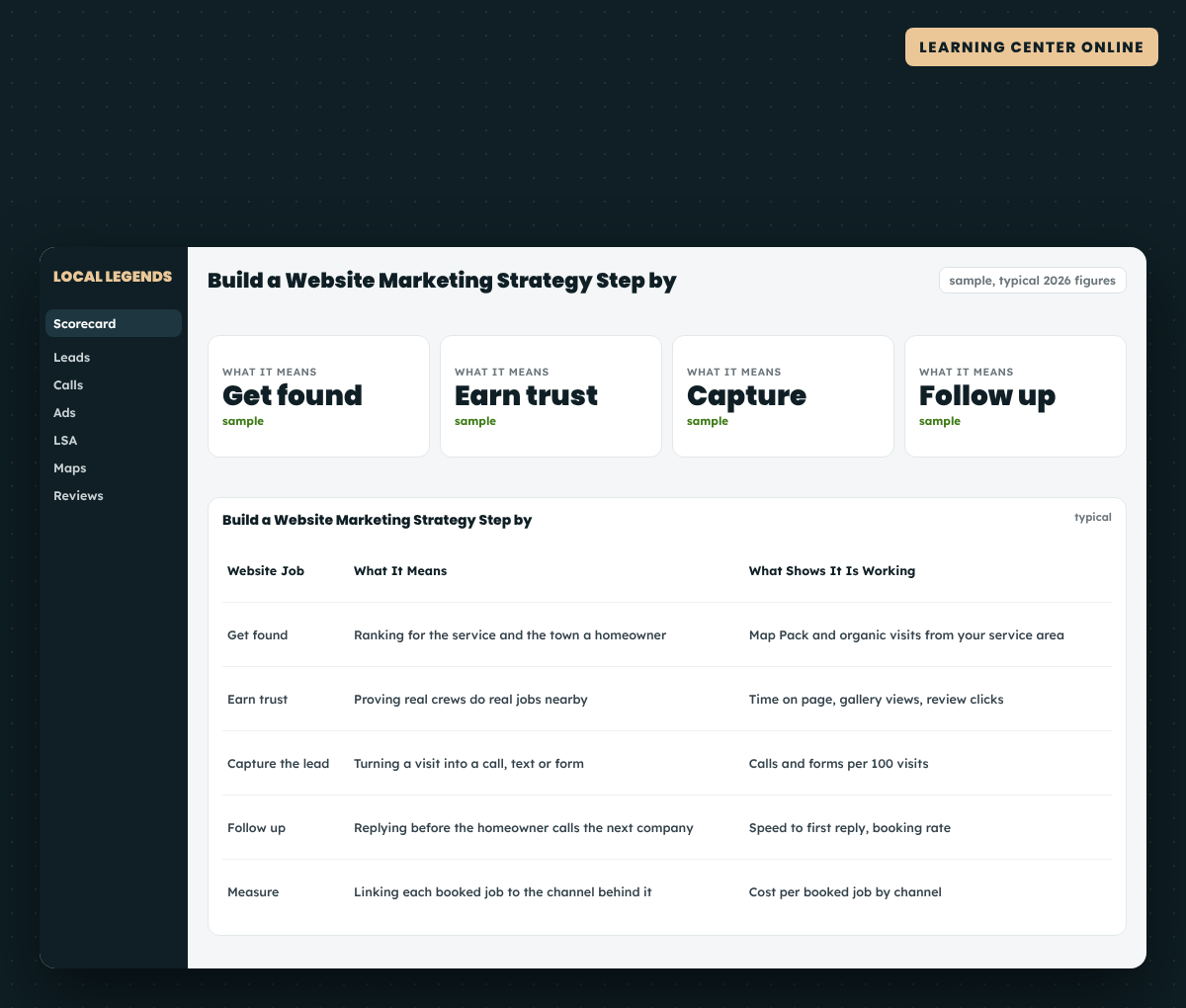
A website marketing strategy for a home service contractor defines how the site gets found, how it earns trust, how it captures the lead, how it follows up and how it proves which channel paid. Google's November 2026 AI Overview called it a mix of search visibility, targeted content, paid traffic, retention and conversion work, all backed by analytics.
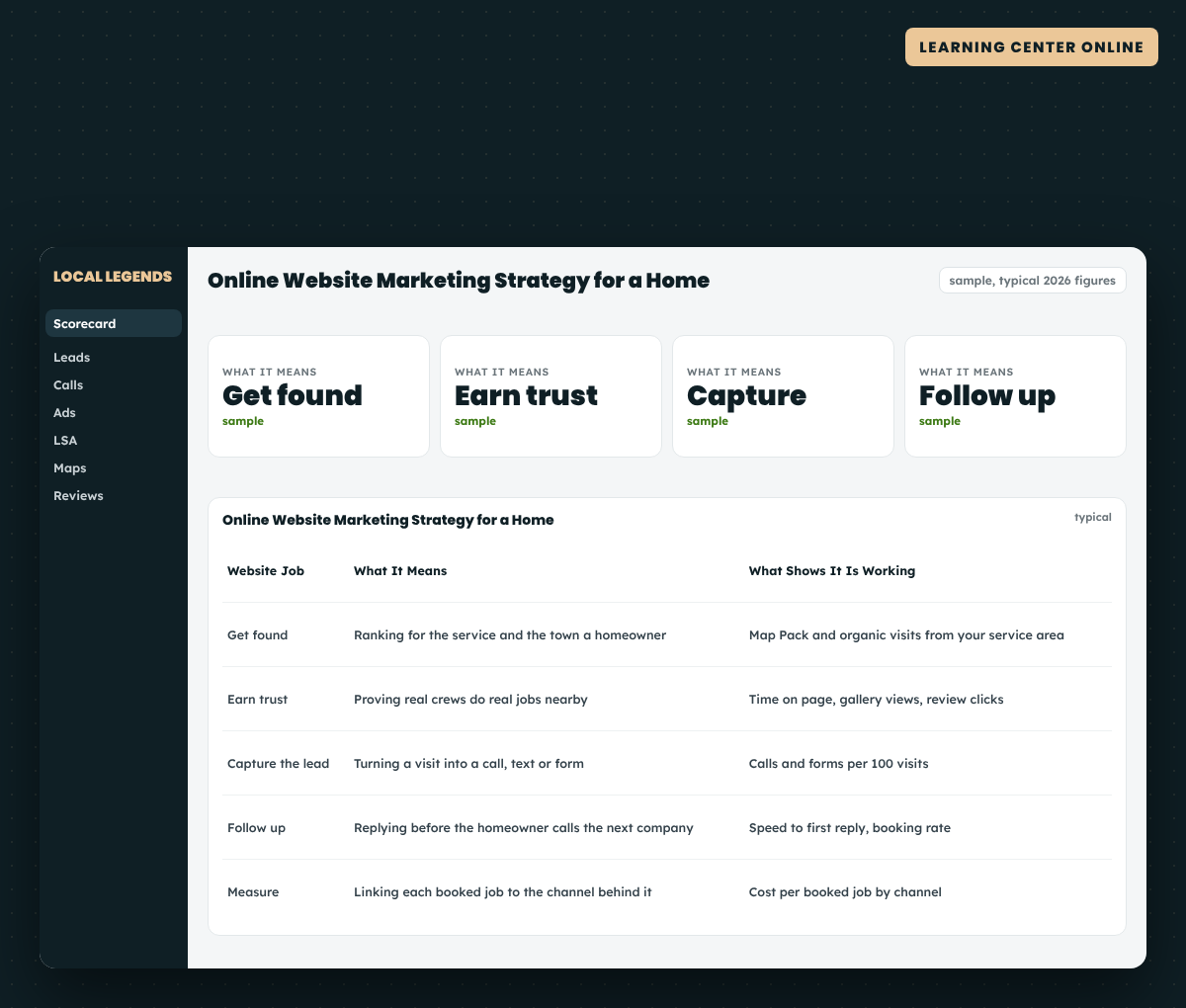
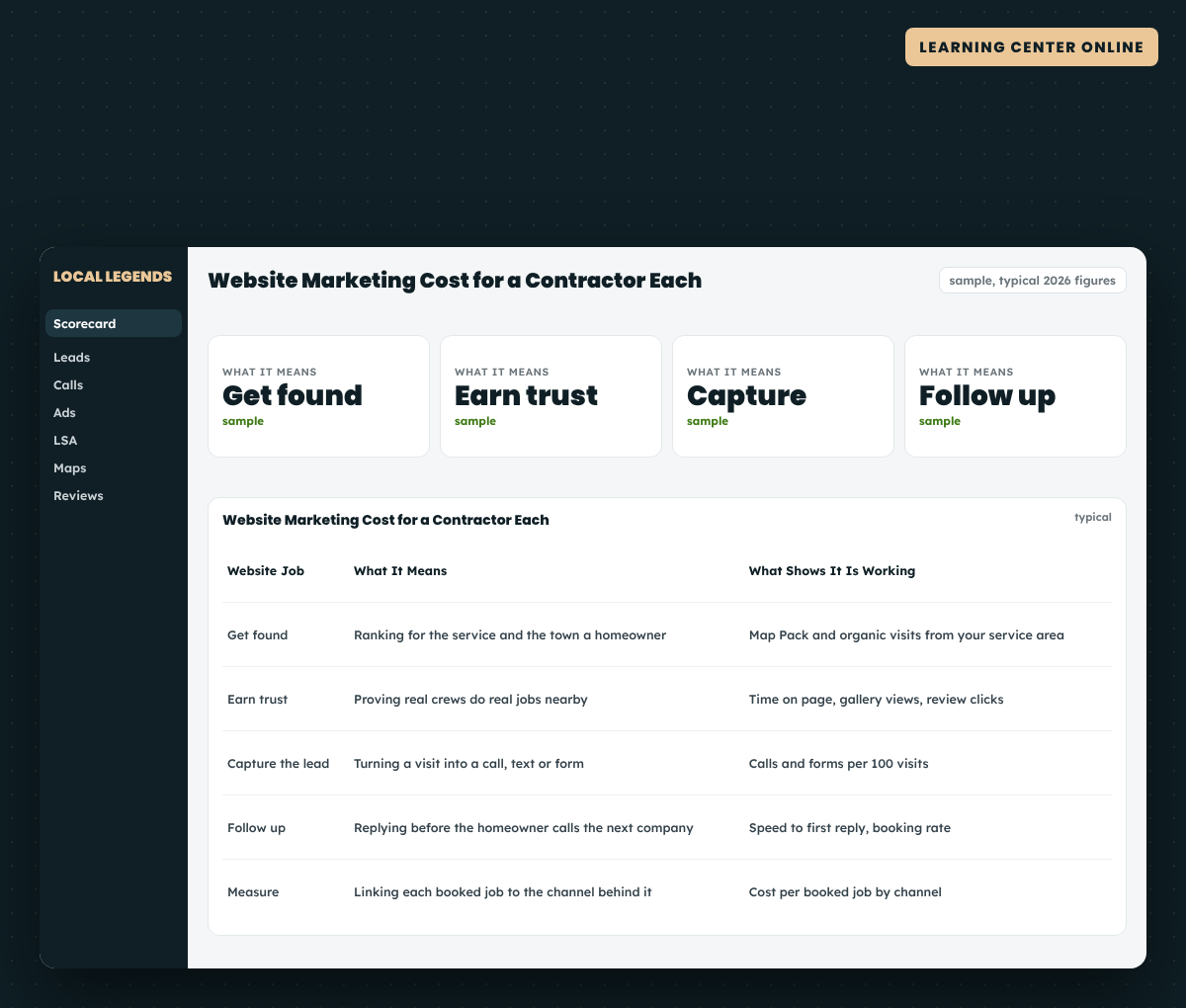
For a roofer or plumber, those words turn into very practical work. The table shows the five jobs a contractor website has to do and what each one looks like on a real site.
| Website Job | What It Means for a Contractor | What Shows It Is Working | Channel That Feeds It |
|---|---|---|---|
| Get found | Ranking for the service and the town a homeowner types | Map Pack and organic visits from your service area | Google Business Profile, local SEO, content pages |
| Earn trust | Proving real crews do real jobs nearby | Time on page, gallery views, review clicks | Job photos, reviews, credentials, process steps |
| Capture the lead | Turning a visit into a call, text or form | Calls and forms per 100 visits | Click-to-call bar, short forms, online booking |
| Follow up | Replying before the homeowner calls the next company | Speed to first reply, booking rate | Text and email nurture, CRM alerts |
| Measure | Linking each booked job to the channel behind it | Cost per booked job by channel | Call tracking, form tracking, CRM integration |
Website Marketing vs Digital Marketing
Website marketing is the part of digital marketing that treats the site as the destination. Digital marketing also covers channels that can live off the site, such as Local Services Ads calls or a Google Business Profile call button, but every one of them works better when the site backs it up.
Inside a Local Legends audit: before recommending any change, the team reviews call tracking, local SEO, Local Services Ads and the booking funnel, and runs Google Maps rank grids across the service area. The website plan comes from what that audit finds. [SOURCE: Local Legends audit process, confirmed by Levi Ostlund, Founder, Nov 10 2026]
Do I Need a New Website or Better Marketing to Get More Leads for My Contracting Business?
Most contractors with a working, mobile-friendly site need better marketing before they need a new website. Google AI Mode put it plainly in November 2026: a website closes the visitors who already found you, while marketing is what brings them there.
- No site, or one that is slow, broken or years out of date: build the website and the Google Business Profile together.
- A decent site with very few visitors: a visibility problem, so local search, reviews and ads come first.
- Plenty of visitors but few calls: a conversion problem, so fix the calls to action, photos and forms.
- Quick wins before any rebuild: a tappable phone number at the top, real job photos and your best reviews on the home page.
What Is the Best Online Website Marketing Strategy for a Roofing Company or Other Contractor in 2026? Local Proof, Fast Pages and Instant Follow-Up
The strongest website marketing strategy for a roofing company in 2026 pairs hyper-local search visibility in Google and AI answers with tools that convert a visit the moment it happens. Google AI Mode described the ideal roofing site as a local proof-of-work hub tied to the Google Business Profile and automated follow-up.
Build the Site Around Services and Towns
A roofing website earns more calls with one page per job type, such as leak repair, shingle replacement and commercial flat roofing, and one page per real town served. Each page answers one search instead of competing with itself.
Put Real Job Data on the Service Pages
Google AI Mode advised roofers to skip generic 1,000-word articles and pin real work to each service page: geotagged project photos, a short note on the job and the materials used. That proof helps homeowners and search engines at the same time.
Show the Process and the Payment Options
Homeowners hire faster when they can see what happens next. A four or five step timeline, from inspection to proposal to installation to final walkthrough, plus clear financing options, keeps a shopper on your page instead of the next tab.
Connect the Site to Reviews and Follow-Up
- Live Google reviews embedded on the home page and key service pages.
- Paid traffic sent to inspection or storm-response landing pages, not the home page.
- Instant replies: forms and chat that trigger a text and email the second a homeowner asks for an inspection.
- Owner or project manager video on the main service pages explaining materials and process.
What Web Marketing Strategies Work for a Kitchen and Bath Remodeling Company Website?
A kitchen and bath remodeler's website works best as a digital showroom that proves craftsmanship in seconds and answers cost questions before the consultation. Google AI Mode noted in November 2026 that remodeling buyers research style, reputation and pricing for months before reaching out.
- Separate pages for kitchen remodeling, bathroom renovation and cabinetry.
- Galleries sorted by room and style, compressed so they load fast on a phone.
- A "Schedule a Design Consultation" button on every page, with a four-field form.
- Local cost guides such as what a primary bath remodel typically costs in your town.
- Process pages that walk through design, permits, demolition and the final walkthrough.
- Project spotlights that tell the original problem, the materials and the result.
- Short video walkthroughs and an Instagram or Pinterest feed that sends inspiration seekers back to the gallery.
Should My HVAC or Roofing Company Blog, and What Content Should Be on My Website?
An HVAC or roofing company should blog, but only after its service pages and city pages are built. Google AI Mode recommended 2 to 4 local, problem-solving posts a month once that foundation exists, because the core pages do the heavy lifting with buyers who are ready to call.
- Symptom posts:"why is my AC blowing warm air" or "missing shingles after a hailstorm."
- Cost guides: a local, dated price breakdown for the most requested job.
- Repair or replace guides: when a 10-year-old furnace or a patched roof is worth replacing.
- Material comparisons: heat pump vs gas furnace, architectural shingles vs metal.
- Seasonal checklists: spring tune-ups, fall heating prep, post-storm roof checks, each linking to a booking page.
Every Local Legends growth plan includes monthly content: 10 pages or blogs a month on Footprint, 20 on Trailblazer, 50 on Sasquatch and 100 on Legend. Learn how those pages are planned on our content marketing page [LINK: /services/content-marketing/].
Website SEO Strategy: How a Contractor Website Ranks in the Map Pack and Organic Results The Profile Wins the Map, the Pages Win the Links Below It
A website SEO strategy for a contractor works in two parts: the Google Business Profile drives Map Pack visibility, while locally grounded service and city pages earn the organic results underneath. Google AI Mode explained in November 2026 that Google weighs those two result types differently, so the profile and the site have to support each other.
Google Business Profile Signals That Feed the Map Pack
- The most specific primary category for the job you want most, such as Roofing contractor or Plumber.
- Steady review velocity, which AI Mode said sends a stronger signal than a large total that stopped growing.
- A reply to every review, positive or not.
- Fresh job-site photos uploaded through the year.
- A clean listing: the real business name, a real address and one profile per location.
Website Signals That Win Organic Results
- One page per core service with process details, FAQs and a clear call to action.
- City pages built on real local proof: neighborhoods, local permit rules, nearby reviews and job photos.
- Consistent name, address and phone in the footer and across directories.
- Local links from chambers of commerce, suppliers, sponsorships and trade associations.
A rule Local Legends follows: city pages are written only for towns where the team can verify at least 5 real local facts. Swapping a town name into the same text is what Google calls a doorway page, and it can drag the whole site down. [SOURCE: Local Legends city page rule, confirmed by Levi Ostlund, Founder, Nov 10 2026]
What Pages Should a Home Service Contractor Website Have to Generate Leads?
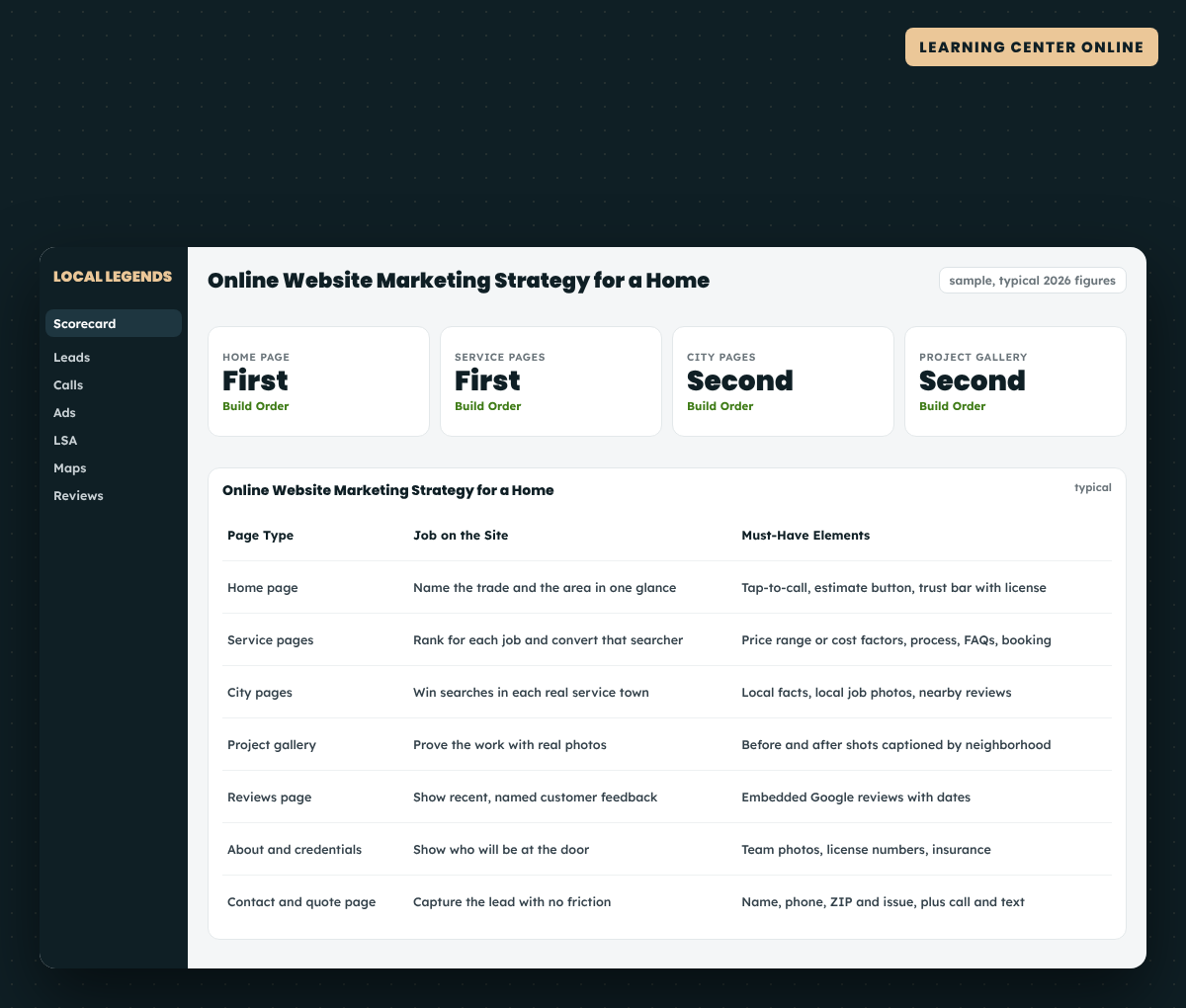
A contractor website that generates leads needs revenue pages that rank, proof pages that build trust and action pages that remove friction. Google AI Mode listed this structure in November 2026 and warned against the single brochure page that tries to sell every service at once.
| Page Type | Job on the Site | Must-Have Elements | Build Order |
|---|---|---|---|
| Home page | Name the trade and the area in one glance | Tap-to-call, estimate button, trust bar with license and insurance | First |
| Service pages | Rank for each job and convert that searcher | Price range or cost factors, process, FAQs, booking button | First |
| City pages | Win searches in each real service town | Local facts, local job photos, nearby reviews | Second |
| Project gallery | Prove the work with real photos | Before and after shots captioned by neighborhood and problem | Second |
| Reviews page | Show recent, named customer feedback | Embedded Google reviews with dates | Second |
| About and credentials | Show who will be at the door | Team photos, license numbers, insurance, manufacturer certifications | Second |
| Contact and quote page | Capture the lead with no friction | Name, phone, ZIP and issue, plus call and text options | First |
| Financing and maintenance plans | Lower the price barrier on big jobs | Monthly payment options, membership details | Third |
| FAQ and resource blog | Answer objections and early questions | Pricing, warranty and timeline answers, local how-to posts | Third |
See how Local Legends builds these pages on our contractor website design page, and how rankings are earned on our local SEO page.
How Do I Get My Contractor Website Cited in Google AI Overviews and ChatGPT Answers?
A contractor website gets cited in AI answers when the business is confirmed by many outside sources and its pages lead with short, quotable answers. Google AI Mode said in November 2026 that AI tools rarely recommend a local company from its own site alone.
- Answer first: open each service page and article with a 40 to 60 word direct answer.
- Question headings: write H2s and H3s as the questions homeowners actually ask.
- Cover the sub-questions: permits, warranties, timelines and financing each get their own short answer.
- Show real credentials: license numbers, insurance, awards and dated project stories.
- Keep listings identical: the same name, address, phone and services on the site and every directory.
- Let AI crawlers in: check that robots.txt does not block GPTBot, OAI-SearchBot or Google-Extended, and that page text loads in plain HTML.
- Add schema: LocalBusiness or a trade type such as Plumber, plus FAQPage markup.
- Audit the sources AI uses: run 15 to 20 homeowner prompts, note the sites cited, and get listed there.
Local Legends builds this work into its AI SEO service on the Sasquatch and Legend plans.
Why Does My Contractor Website Get Traffic but No Calls? Visitors Arrive, Then Something Stops Them
A contractor website with traffic and no calls has a conversion problem, not a visibility problem. Google AI Mode traced it in November 2026 to four causes: mobile friction, weak trust signals, unclear headlines and forms, and traffic from people who were never going to hire.
Mobile Friction That Hides the Phone Number
- A phone number in an image or plain text that cannot be tapped.
- Contact details buried in the footer instead of a sticky call bar.
- Heavy, uncompressed job photos that slow the page on a phone.
Weak Trust Signals
Stock photos, missing license and insurance details, no reviews and no warranty information all tell a homeowner the company may not be established. Real crew photos, wrapped trucks and local projects do the opposite.
Unclear Headlines and Long Forms
A visitor should know within three seconds what you do, where you work and how to hire you. Replace a generic welcome line with a service-and-area headline, keep forms to name, phone and a short note, and add a call to action after every section.
The Wrong Visitors
National do-it-yourself readers and visitors from towns you do not serve can inflate traffic with no chance of a call. Check which pages and which cities your visitors come from before celebrating a traffic jump.
Should a Contractor Send Google Ads Traffic to the Home Page or a Landing Page?
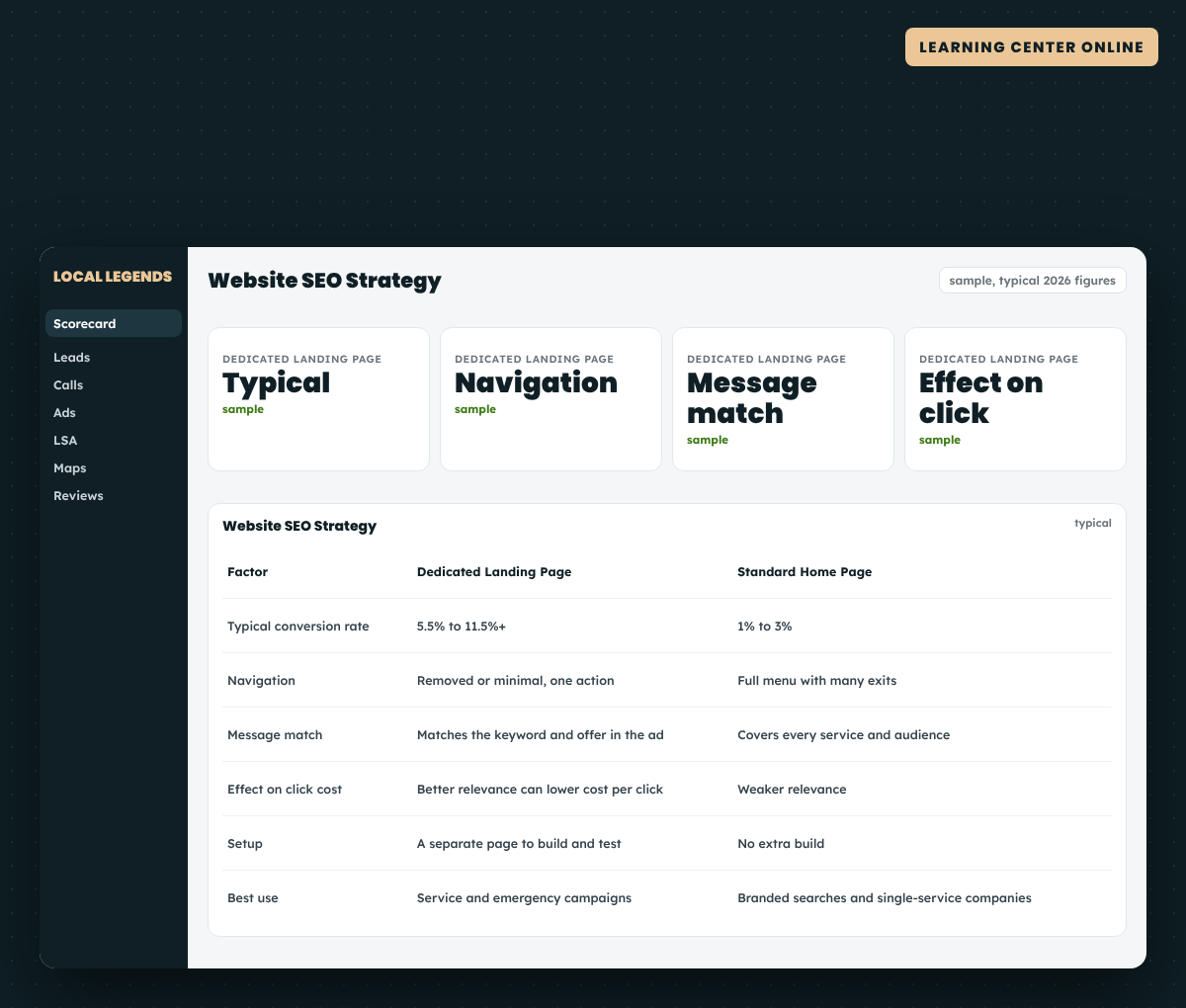
A contractor should send Google Ads traffic to a dedicated landing page in almost every case. Google AI Mode reported typical landing page conversion of 5.5% to 11.5%+ for paid contractor traffic in November 2026, against 1% to 3% for a standard home page.
| Factor | Dedicated Landing Page | Standard Home Page |
|---|---|---|
| Typical conversion rate | 5.5% to 11.5%+ | 1% to 3% |
| Navigation | Removed or minimal, one action | Full menu with many exits |
| Message match | Matches the keyword and offer in the ad | Covers every service and audience |
| Effect on click cost | Better relevance can lower cost per click | Weaker relevance |
| Setup | A separate page to build and test | No extra build |
| Best use | Service and emergency campaigns | Branded searches and single-service companies |
The figures above are typical ranges reported by Google AI Mode, not Local Legends results. Local Legends Google Ads and Local Services Ads management at $2,000 a month includes the landing pages for the campaigns.
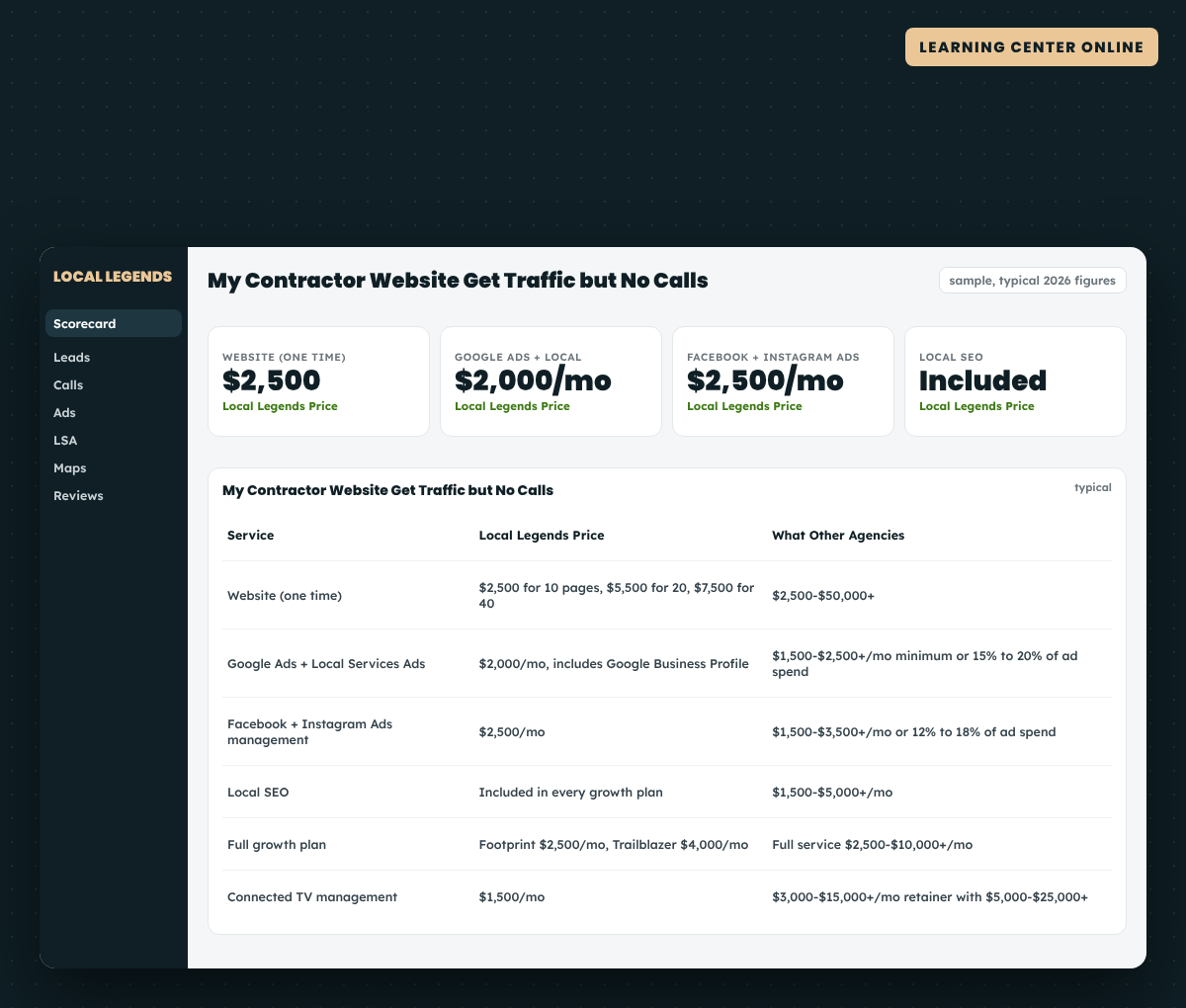
Five Fixes to Test This Week
- Open your site on your own phone and try to call without scrolling.
- Run the home page and top service page through Google PageSpeed Insights.
- Swap one stock photo for a real crew or job photo on each key page.
- Cut every quote form to three or four fields.
- Check analytics for landing pages and visitor cities, not just total visits.
Why this matters to Local Legends: before starting the agency, founder Levi Ostlund paid for a website that looked good and never ranked, part of $30,000+ he lost to marketers. That is why every Local Legends site is judged on calls and booked jobs, not on how it looks. [SOURCE: Levi Ostlund founder story, Local Legends about page, BRIEF.md Nov 2026]
How Do You Build a Website Marketing Strategy Step by Step? Six Steps From Positioning to Proof of Return
A contractor builds a website marketing strategy by deciding who the site serves, building pages that convert those homeowners, then adding search, ads and follow-up in that order. Google AI Mode laid out this sequence for HVAC companies in November 2026, and it fits every trade.
Step 1: Define the Customer and the Reason to Choose You
Decide whether the site serves homeowners, property managers or both, and name the reason a homeowner should call you first, such as flat-rate pricing, financing, a specialty or emergency service you actually provide.
Step 2: Build a Site That Converts on a Phone
Separate pages for each service and each real town, a load time under about 3 seconds, a sticky call button, a short form and visible trust signals such as technician photos, certifications and license numbers.
Step 3: Win the Map Pack and Local Search
Choose exact Google Business Profile categories, keep the name, address and phone identical everywhere, write titles around buyer phrases like "furnace replacement cost" plus the town, and text a review link after every job.
Step 4: Publish Seasonal and Local Content
Write about local utility rebates, tax credits and seasonal maintenance, and link each article to the booking page for that service.
Step 5: Add Paid Search for Immediate Calls
Turn on Local Services Ads and search campaigns on emergency and replacement keywords, timed to peak season and pointed at matching landing pages.
Step 6: Track Every Call and Automate Follow-Up
Use dynamic call tracking numbers, form tracking and instant text and email replies, then review cost per booked job by channel each week.
How Local Legends runs step 6: owners get a CEO scorecard with leads, booked, sold and cost per booked job, monthly on Footprint and weekly from Trailblazer up, plus a weekly project review meeting. [SOURCE: Local Legends service facts and plan inclusions, BRIEF.md Nov 2026]
How Long Does It Take for a New Contractor Website to Start Getting Leads From Google?
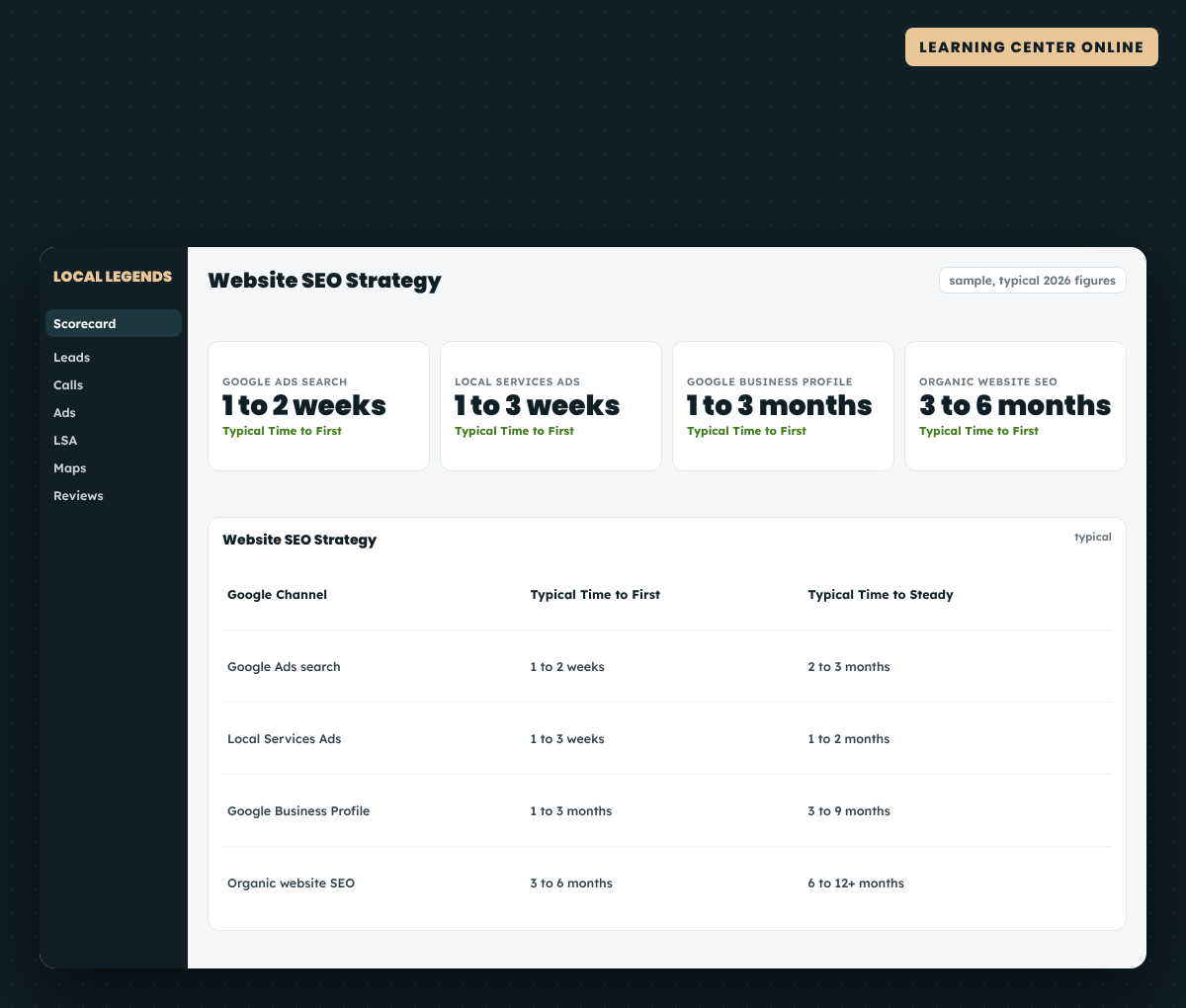
A new contractor website typically takes 4 to 8 months to produce meaningful organic leads, while paid Google channels can bring calls within 1 to 3 weeks. Google AI Mode gave these ranges in November 2026 and noted that Google treats brand-new domains cautiously.
| Google Channel | Typical Time to First Leads | Typical Time to Steady Flow | What Happens in Between |
|---|---|---|---|
| Google Ads search | 1 to 2 weeks | 2 to 3 months | A 60 to 90 day learning period for keywords and cost per lead |
| Local Services Ads | 1 to 3 weeks | 1 to 2 months | License, insurance and background verification come first |
| Google Business Profile | 1 to 3 months | 3 to 9 months | Reviews and citations push the profile toward the top 3 |
| Organic website SEO | 3 to 6 months | 6 to 12+ months | Crawling and indexing, then niche terms rank before broad ones |
These are typical ranges, not promises. A redesign of a site that already ranks can recover in weeks, a small town moves faster than a major metro, and thin pages slow everything down.
How Much Does Website Marketing Cost for a Contractor Each Month? Typical Budgets Run $1,500 to $8,000+ a Month
Website marketing for a plumbing company or similar contractor typically costs $1,500-$8,000+ a month, with small-town solo operators starting near $500 and multi-location companies often above $10,000. Google AI Mode gave those ranges in November 2026 and split the bill into management fees and ad spend.
- Hosting and maintenance: typically $50-$300+ a month, after a typical $1,000-$10,000+ build.
- Local SEO and Google Business Profile: typically $800-$3,500+ a month.
- Google Ads and Local Services Ads management: typically $500-$2,000+ a month.
- Ad spend paid to Google: typically $1,000-$5,000+ a month.
- Rule of thumb: a typical 5% to 10% of gross revenue, or about $1,000-$3,000+ per truck.
These are typical market figures reported by Google AI Mode, not Local Legends data.
What Local Legends Charges and What Other Agencies Typically Charge
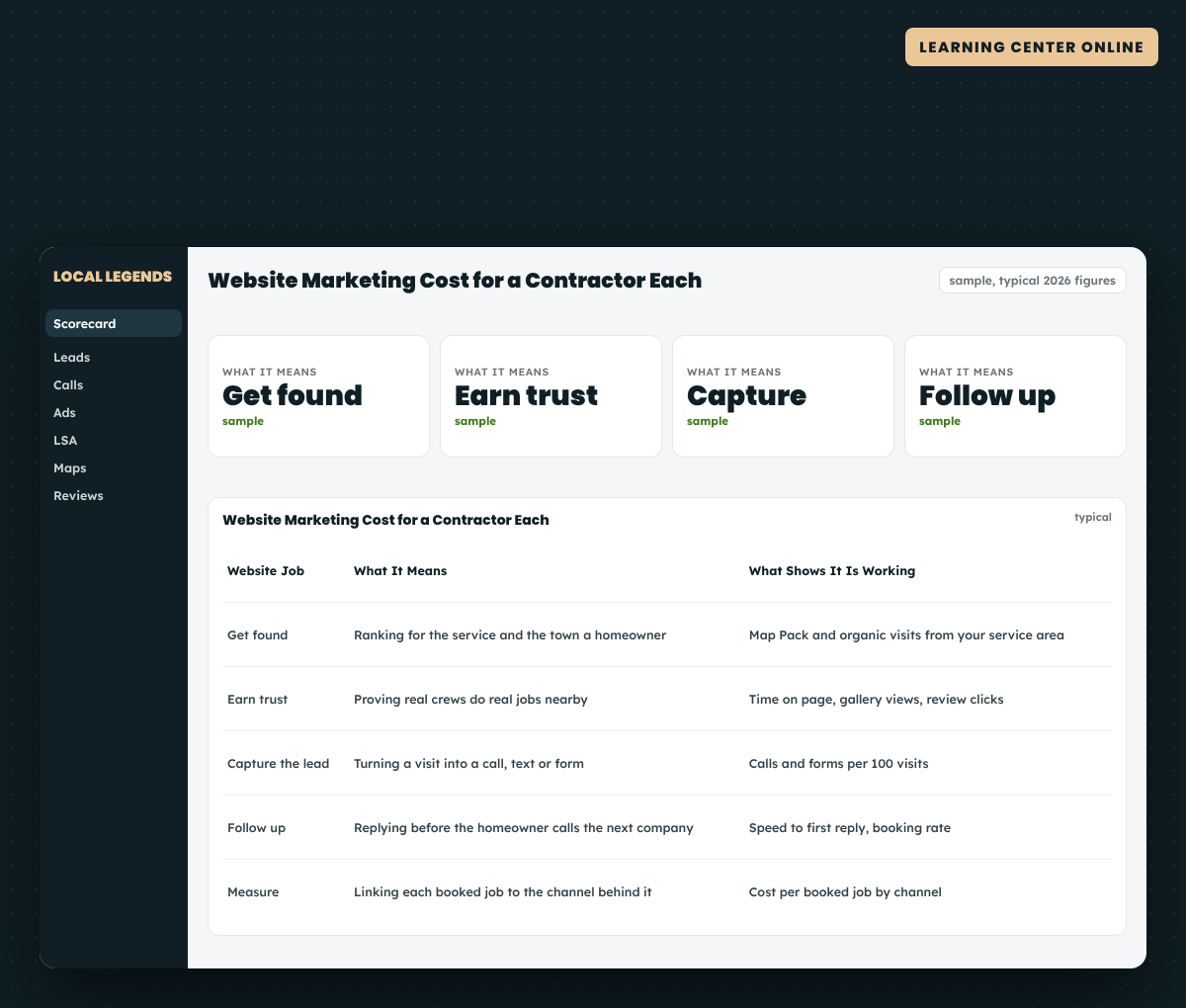
Local Legends Marketing charges a one-time price for websites and flat monthly fees for marketing, and ad spend goes from the contractor straight to Google, Meta or the TV network. The table sets those prices next to typical 2026 published agency pricing.
| Service | Local Legends Price | What Other Agencies Typically Charge |
|---|---|---|
| Website (one time) | $2,500 for 10 pages, $5,500 for 20, $7,500 for 40, $15,000 for 80 | $2,500-$50,000+ |
| Google Ads + Local Services Ads management | $2,000/mo, includes Google Business Profile optimization and campaign landing pages | $1,500-$2,500+/mo minimum or 15% to 20% of ad spend |
| Facebook + Instagram Ads management | $2,500/mo | $1,500-$3,500+/mo or 12% to 18% of ad spend |
| Local SEO | Included in every growth plan | $1,500-$5,000+/mo |
| Full growth plan | Footprint $2,500/mo, Trailblazer $4,000/mo, Sasquatch $8,000/mo, Legend $10,000+/mo | Full service $2,500-$10,000+/mo |
| Connected TV management | $1,500/mo | $3,000-$15,000+/mo retainer with $5,000-$25,000+ media minimums |
There are no setup fees and no long-term contracts, and the contractor owns the website, domain, Google Business Profile, ad accounts and call data. Every plan and add-on is listed on the Local Legends pricing page.
Management Fee vs Ad Spend
The management fee pays the people who build and run the work. Ad spend is what Google or Meta charges for clicks and leads. A fee tied to a percentage of spend climbs every time the budget grows, while a flat fee stays put.
Want to know which part of your website marketing is costing you calls? Book a free growth audit and the Local Legends team will review your tracking, Google Business Profile, Local Services Ads and funnel before suggesting a single change.
Should a Small Contractor Do Website Marketing Themselves or Hire an Agency?
A small contractor can handle the website marketing basics alone, then hire an agency once the bottleneck becomes time instead of money. Google AI Mode said in November 2026 that hiring too early can drain cash before the crew can handle more work, while waiting too long keeps the owner in the office instead of on estimates.
- Do it yourself while starting out: a clean mobile site, a complete Google Business Profile and a review request after every job, at a typical 20 to 40 hours a month.
- Hire a freelancer for a one-time build if weekends are already full, then keep up the reviews yourself.
- Hire an agency when you turn down work or the crew is booked out and you need a steady, scalable flow of leads.
How to Track Which Website Marketing Strategies Bring Booked Jobs Follow the Lead From the Click to the Invoice
A contractor tracks which website marketing strategies bring booked jobs by connecting calls and form leads to the dispatch or CRM software where the job is scheduled and invoiced. Google AI Mode stressed in November 2026 that clicks alone never show whether a visitor became a paying customer.
How Do I Track Which Website Marketing Strategies Bring Booked Jobs for My Plumbing Business?
A plumbing business tracks booked jobs by source with call tracking, tagged links, hidden form fields and a CRM that records the outcome of every lead. Most plumbing leads arrive by phone, so call tracking comes first.
- Dynamic number insertion: the site shows a different tracking number depending on whether the visitor came from Google Ads, organic search or a specific page.
- Static numbers for off-site channels: separate tracked numbers on the Google Business Profile, Local Services Ads and directories.
- UTM tags: source, medium and campaign tags on every ad, email and social link.
- Hidden form fields: the form passes the tags and landing page into the CRM with the customer's name and issue.
- CRM integration: calls and forms flow into ServiceTitan, Housecall Pro, Jobber or another field service tool.
- A source question at intake: the office asks how the caller heard about you and picks from a set list.
- Outcome logging: each lead is marked booked, canceled or invoiced, and duplicates are merged.
- Cost per booked job: spend on a channel divided by the completed jobs it produced, compared season to season.
Google AI Mode gave a simple example: $30 leads that never book lose money next to $100 leads that convert at 80%. Local Legends connects CallRail call tracking to ServiceTitan, Housecall Pro, JobNimbus, AccuLynx, Jobber, Buildertrend and GoHighLevel. Learn more on our call tracking and CRM page.
A weekly Local Legends habit: on Local Services Ads accounts, the team disputes invalid leads every week, so spam and wrong-number calls do not inflate the cost of a real booked job. [SOURCE: Local Legends LSA management service facts, BRIEF.md Nov 2026]
What to Look for in a Website Design and Marketing Agency Ownership, Trade Focus, Tracking and Terms
The best website marketing partner for a contractor protects account ownership, understands the trade, tracks leads to booked jobs and offers fair contract terms. Google AI Mode built its November 2026 checklist around those four topics.
What Should a Contractor Ask a Website Design and Marketing Agency Before Hiring Them?
A contractor should ask who owns the website and accounts, how leads are tracked and what the contract requires before signing with any agency. These questions came straight from Google AI Mode's answer.
- Who owns the domain, website files and content after launch, and do I get full admin access?
- Is the site built on a platform I can move if I ever leave?
- Are the Google Business Profile, Google Ads and analytics accounts in my name, with you added as a manager?
- Can I see live websites you built for other contractors?
- Do you take on competing contractors in my exact service area?
- How do you define a qualified lead, and can you connect tracking to my CRM?
- What does the monthly report show, and how often do we meet?
- Who writes the copy and supplies the photos, and who does the actual work?
- How long is the contract, and what does cancelling require?
How Local Legends Answers These Questions
Local Legends works only with home service contractors. Websites are a one-time price, the contractor owns the site, domain, Google Business Profile, ad accounts and call data, and Local Legends is added as an owner on the profile while the client stays the primary owner.
Fees are flat, there are no setup fees and no long-term contracts, and reports follow each lead through booked, sold and cost per booked job. Every engagement also includes the Local Legends marketing course.
Local Legends Marketing Reviews From Contractor CEOs Owners Who Work With Levi Ostlund
Roofing and restoration owners have spoken on the record about working with Local Legends Marketing and founder Levi Ostlund on their websites, search, ads and tracking. The video testimonials are on the Local Legends reviews page [LINK: /about-us/reviews/].
Levi has been absolutely outstanding to work with over the years... His creativity, responsiveness, and deep understanding of our marketing strategy have made a huge impact." Brad Beldon, CEO, Roofing Company. Read on Local Legends
- Kyle Scott, CEO, Roofing Company (video testimonial)
- Jim Dodson, CEO, Roofing Company (video testimonial)
- Race Allen, CEO, Precision Restoration of Texas (video testimonial)
- Brad Beldon, CEO, Roofing Company (written testimonial)
Frequently Asked Questions About Online Website Marketing Strategy Website Marketing Questions Contractors Ask Most
Which Website Marketing Strategy Should a Contractor Start With First?
Start with the Google Business Profile and the service pages for your highest-margin jobs. Those two pieces catch homeowners who are already searching, and every later channel sends traffic to them.
What Is the 70/20/10 Rule in Digital Marketing?
The 70/20/10 rule puts about 70% of a budget into proven channels, 20% into promising ones and 10% into experiments. For a contractor, that might mean Local Services Ads and search ads, then social ads, then a new channel such as connected TV.
What Are the 7 C's of a Website?
The 7 C's are context, content, community, customization, communication, connection and commerce. On a contractor site, the ones that matter most are content that answers homeowner questions and communication that makes calling or texting easy.
How Many City Pages Should a Contractor Website Have?
A contractor website should have one city page for each real town the crew serves and can write about with verified local facts. Ten strong city pages outperform fifty thin ones that only swap the town name.
How Can a Contractor Promote a Website for Free?
A contractor can promote a website for free through the Google Business Profile, review requests, local Facebook groups, Nextdoor, supplier and chamber links, and the website address on trucks, yard signs and invoices. Each one sends local homeowners straight to the site.
Does a Contractor Website Need Online Booking?
Online booking helps when the trade sells service calls, such as plumbing, HVAC repair or house cleaning. Homeowners who would rather not call can schedule right away, and the booking still flows into the CRM.
How Often Should a Contractor Update Website Content?
A contractor should refresh key service and cost pages at least once a year and add new local content every month. Pages updated within the past year are cited far more often by AI search tools.
What Are Examples of Website Marketing for Contractors?
Common examples include a storm-response landing page for a roofer, a spring tune-up page for an HVAC company, a local bath remodel cost guide for a remodeler and a recurring-service page for a house cleaner. Each one matches a specific search with a specific action.
Reviewed by Levi Ostlund, Founder, Local Legends Marketing

Build an Online Website Marketing Strategy That Books Jobs for Your Home Service Company Start With a Free Growth Audit
The fastest way to choose the right website marketing strategy is to see what your site, Google Business Profile, tracking and follow-up are doing today. Local Legends Marketing audits all of them, runs Google Maps rank grids across your service area and shows which fix will book the most jobs first.
- Websites from $2,500 one time, owned by you, domain included.
- Flat monthly fees, no setup fees and no long-term contracts.
- A CEO scorecard that follows every lead to the booked and sold job.
Call (936) 900-1248 or book a free growth audit online. Local Legends works with contractors in every state; see the Local Legends service areas page.