


A Plan Built From Job Math, Weather

Marketing Strategy for HVAC Companies: How Heating and Cooling Contractors Plan Channels, Budgets and Seasons Around Booked Jobs
A Plan Built From Job Math, Weather and Your Customer List
Updated November 2026 · Reviewed by Levi Ostlund, Founder
Breadcrumb: Home > Learning Center [LINK: /learning-center/] > Marketing Strategy for HVAC
A marketing strategy for an HVAC company is a written plan that decides how many jobs the business needs, which channels will produce them in each season and how every dollar will be judged by booked and sold work. It turns scattered ads into one system.
- Job math first: the plan starts with the number of booked jobs the trucks can run.
- Three engines: capture urgent demand, keep past customers and create planned demand for replacements.
- Weather calendar: spend rises before peak seasons and shifts to the customer list in mild months.
- Proof everywhere: reviews, real photos, licenses and clear options build trust before the call.
- One scoreboard: cost per booked job and revenue by channel, reviewed every month.
Free Growth Audit
Your Reviews, Radius and Response Rate vs the competitors beating you.
About Local Legends Marketing
A home service marketing agency headquartered in Conroe, Texas, with 8+ years of marketing experience, running Google Ads, Local Services Ads, local SEO, AI SEO, connected TV and review systems for contractors nationwide.
What Is the Best Marketing Strategy for an HVAC Company in 2026? Capture Demand, Keep Customers, Track Revenue
The best marketing strategy for an HVAC company in 2026 captures high-intent local searches, keeps past customers coming back and ties every channel to booked jobs and revenue, then adjusts spend to the weather and the dispatch board. Google AI Mode framed it the same way in November 2026.
No single channel wins every season. A homeowner whose AC quit in July searches Google and calls fast. A homeowner with a 14-year-old system in April is not searching at all yet. A strong HVAC marketing strategy plans for both people.
Engine 1: Capture Urgent Demand
When equipment fails, homeowners search, compare a few listings and call. This engine is the Google Business Profile, Local Services Ads, Google search ads and the service pages on the website. It needs fast answers on the phone more than clever ads.
Engine 2: Keep the Customers Already Served
Past customers already trust the company. Tune-up reminders, maintenance plan renewals, repair follow-ups and referral requests turn one call into years of work, and this engine costs far less than finding a stranger.
Engine 3: Create Planned Demand
Replacement buyers often decide before the system dies. Social ads, mailers to aging neighborhoods, financing offers and helpful content reach them early. This engine fills install crews in mild weather and raises the average ticket.
Why the Three Engines Need One Scoreboard
Each engine produces a different kind of job at a different cost. A $59 tune-up and a full system replacement should never be judged by the same cost per lead, so the strategy tracks booked jobs and revenue by job type.
Why the plan starts with booked jobs: Levi Ostlund, Founder of Local Legends Marketing, lost more than $30,000 to marketers before starting the agency, including one who stopped responding. That experience is why every HVAC plan here is judged by booked and sold jobs, not by clicks. [SOURCE: Levi Ostlund founder story, Local Legends brief, confirmed Nov 2026]
How Can a Local HVAC Company Stand Out From Bigger Competitors?
A local HVAC company stands out by owning its nearby map results, showing how its technicians diagnose and price work and putting real people, trucks and reviews in front of homeowners, rather than trying to match a larger company's ad budget dollar for dollar.
- Own the near radius: a complete Business Profile with weekly photos competes well close to the shop.
- Show the diagnosis: photos of worn parts and plain explanations before any quote build trust.
- Offer clear options: good, better and best choices on major repairs and replacements let the homeowner decide.
- Use real faces: short videos of the actual technicians outperform stock photos.
- Prove the license: state license details and EPA Section 608 certification belong on the website, since federal rules require that certification for technicians who service refrigerant equipment.
- Answer fast: a smaller shop that picks up on the first ring often wins the call outright.
How Do I Create an HVAC Marketing Plan Step by Step? Seven Steps From Job Math to Monthly Review
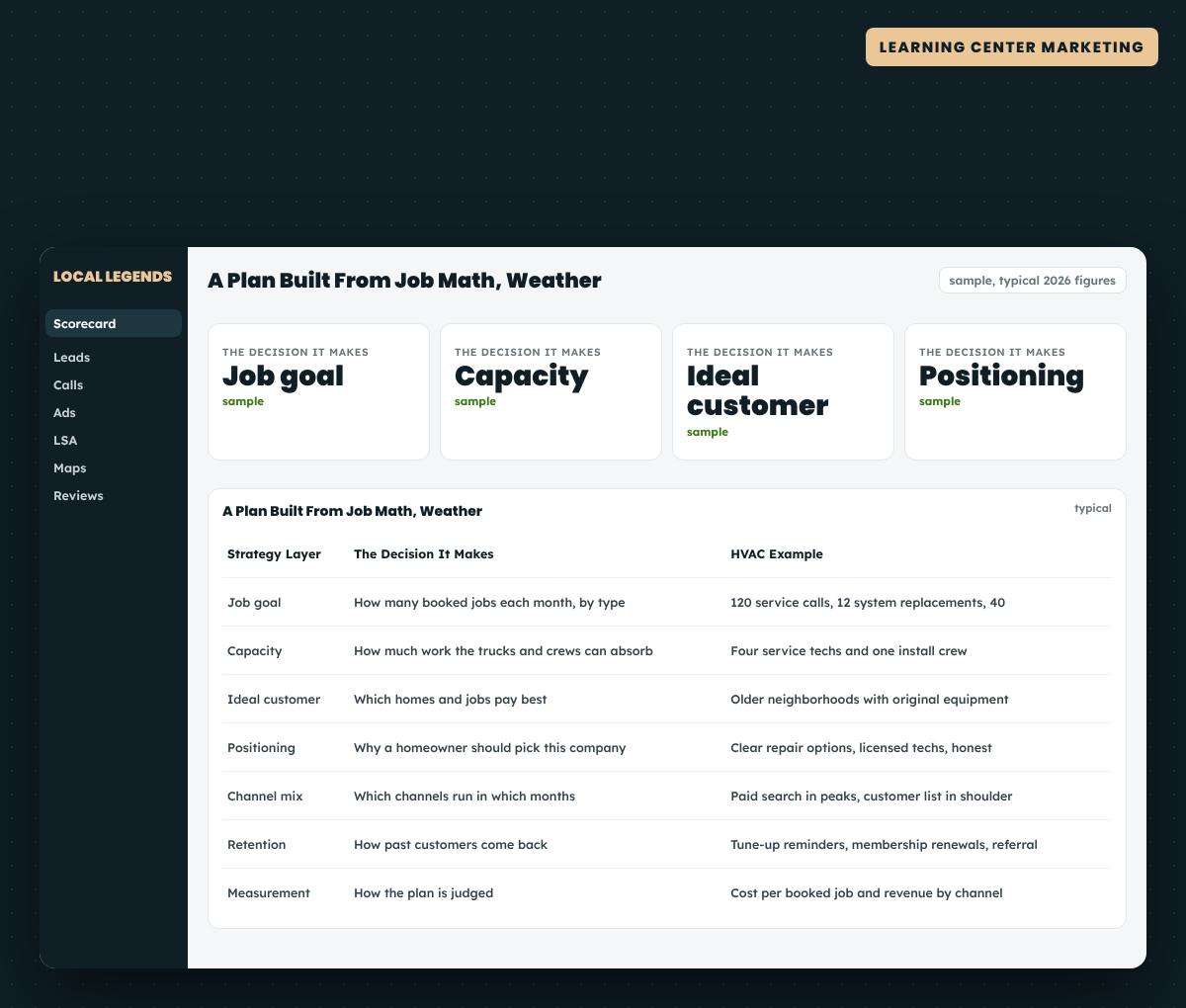
An HVAC company creates a marketing plan by setting a job goal, checking capacity, choosing the customers and jobs it wants, fixing its digital foundation, building a seasonal channel mix, training the phones and reviewing results monthly. The order matters more than the tools.
Step 1: Turn the Revenue Goal Into Booked Jobs
Divide the added revenue the owner wants by the average ticket for each job type: maintenance, repair and replacement. The answer is the number of extra booked jobs the plan must produce each month, which is a target the whole team understands.
A Worked Example of HVAC Job Math
The numbers below are an example only, to show the method. Each company should use its own average tickets and booking rates from its CRM.
- The owner wants 6 more system replacements a month in the shoulder seasons.
- The comfort advisor closes about half of replacement appointments, so the plan needs 12 replacement appointments.
- The office books about two out of three replacement inquiries, so the plan needs about 18 qualified inquiries.
- The budget then equals 18 inquiries times the company's own cost per inquiry for that job type.
Step 2: Check Technician and Install Capacity
A plan that produces more calls than the trucks can run wastes money and hurts reviews. Write down how many service calls and installs each week the team can handle in peak and mild months, then plan spend to fill the gaps, not to overflow the board.
Step 3: Choose the Homes and Jobs That Pay Best
Decide which work the company wants more of: emergency repair, replacements, heat pumps, ductwork, indoor air quality or maintenance plans. Then decide which neighborhoods hold that work, such as subdivisions where most systems are original.
Step 4: Fix the Digital Foundation
Before spending on ads, make sure the Business Profile is complete, the website has a page for each core service, the phone number is easy to tap on a phone and reviews are coming in every week. Ads only amplify what the foundation already does.
Step 5: Build the Seasonal Channel Mix
Assign channels to months: paid search and Local Services Ads before and during peaks, the customer list and replacement offers in shoulder months, and brand signals such as trucks, yard signs and video all year. The calendar section below lays this out.
Step 6: Train the Office and the Technicians
Marketing makes the phone ring, and people close the work. Customer service staff should answer quickly and book the visit. Technicians should explain repair and replacement options clearly and offer the maintenance plan on every call.
Step 7: Review the Numbers Every Month
Compare booked jobs, sold jobs, revenue and cost per booked job by channel each month. Move money from channels that produce calls but few jobs toward channels that produce sold work, and adjust the next month to the weather forecast.
Audits come first: every Local Legends engagement begins with an audit of tracking, local SEO, Local Services Ads and the sales funnel, including Google Maps rank grids, so the plan starts from real numbers instead of guesses. [SOURCE: Local Legends audit process, Local Legends brief, confirmed Nov 10 2026]
Google Ads, Local Services Ads or SEO: Which Marketing Channel Is Best for an HVAC Company? Each Channel Has a Job in the Plan
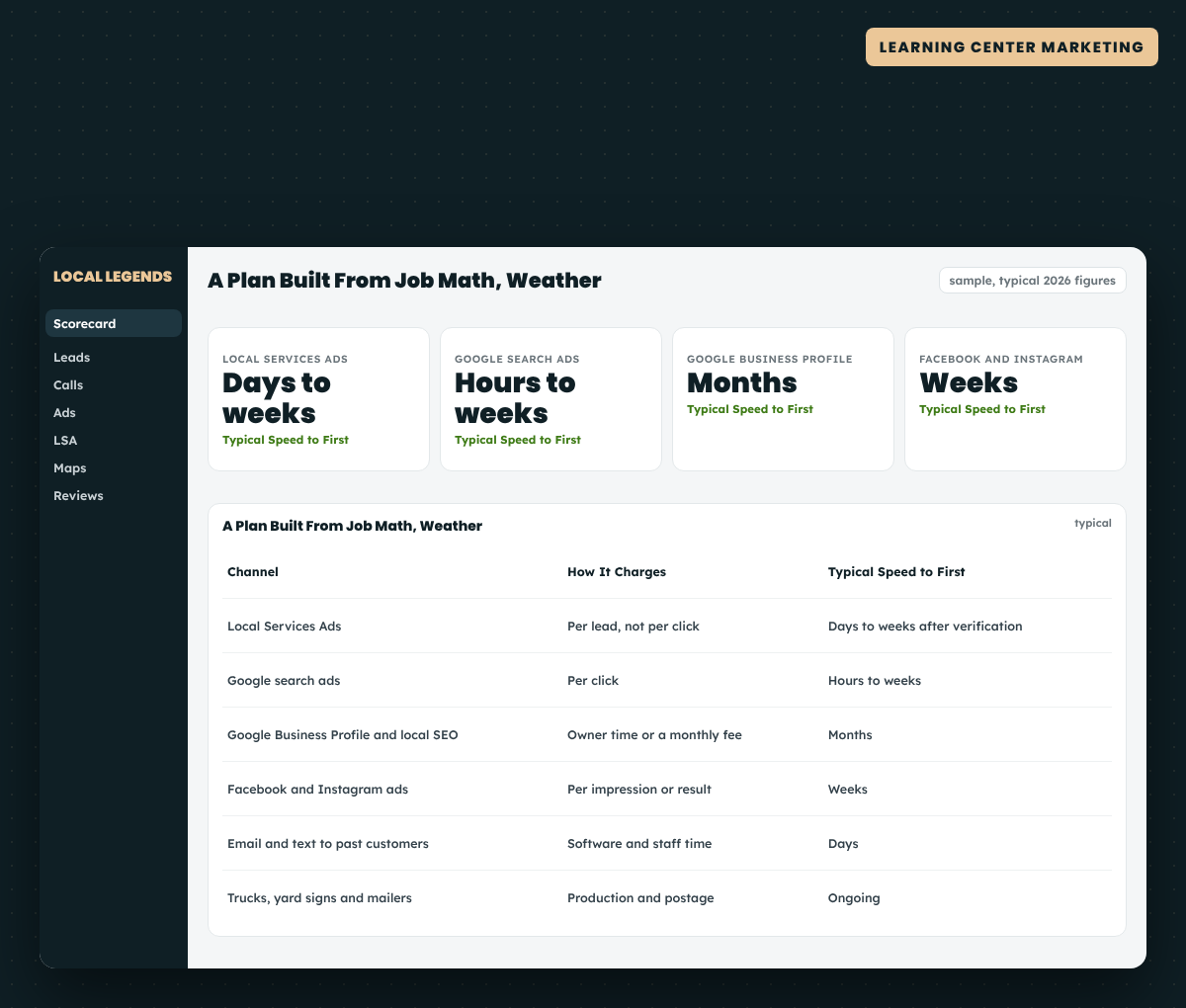
Most HVAC companies get the fastest booked jobs from Local Services Ads and Google search ads, while local SEO and the Business Profile build lower-cost calls over time, so the strongest HVAC marketing strategies run paid and organic together instead of picking one.
| Channel | How It Charges | Typical Speed to First Calls | Best HVAC Use | What to Watch |
|---|---|---|---|---|
| Local Services Ads | Per lead, not per click | Days to weeks after verification | Urgent repair and service calls | Review count, answer rate and lead quality |
| Google search ads | Per click | Hours to weeks | Replacements, heat pumps, seasonal offers | Landing pages and negative keywords |
| Google Business Profile and local SEO | Owner time or a monthly fee | Months | Steady Map Pack calls near the shop | Consistent photos, reviews and service pages |
| Facebook and Instagram ads | Per impression or result | Weeks | Tune-up offers, replacement financing, retargeting | Fast follow-up on form leads |
| Email and text to past customers | Software and staff time | Days | Tune-ups, renewals, aging-system outreach | Clean lists and clear consent |
| Trucks, yard signs and mailers | Production and postage | Ongoing | Neighborhood familiarity around installs | Tracking with unique numbers or codes |
Local Services Ads Now Live Inside Google Ads
Google began moving Local Services Ads into Google Ads in August 2026 as a Performance Max campaign type with pay-per-lead goals. Advertisers still pay for valid leads such as calls and messages rather than clicks, and Google says manual lead disputes are no longer supported after the move.
What That Means for the HVAC Plan
Local Services Ads and search ads now sit in the same account, so budgets, lead quality and reporting should be reviewed together. A fast answer rate and a strong review profile matter more than ever. Local Legends manages both under one Google Ads management fee.
Do Facebook and Instagram Ads Work for HVAC Companies?
Facebook and Instagram ads work for HVAC companies when they promote planned work such as tune-ups, maintenance plans and system replacements with financing, not emergency repairs, because a homeowner with no heat searches Google instead of scrolling a feed.
- Strong uses: shoulder-season tune-up offers, replacement financing, maintenance memberships and retargeting website visitors.
- Weak uses: emergency repair ads and generic "we fix AC" posts with no offer.
- Targeting: keep the area to the real drive-time radius and let the offer filter the audience.
- Creative: real technicians, wrapped trucks and recognizable local streets instead of stock photos.
- Follow-up: connect lead forms to the CRM and call back the same day, since social leads cool quickly.
How Can an HVAC Company Get Recommended by ChatGPT or Google AI?
An HVAC company earns AI recommendations by making its business easy to verify: consistent name, address and phone everywhere, a complete Business Profile, steady detailed reviews and service pages that answer price, timeline and warranty questions plainly.
- Consistent listings: the same details on the Business Profile, Bing Places, Apple Maps and manufacturer dealer locators.
- Detailed reviews: customers who mention the service and the neighborhood give AI tools specific proof.
- Direct answers: short, clear answers on repair ranges, replacement timelines and financing.
- Credentials on the page: license details, EPA certification, installer training and warranty terms.
- Test it: ask AI tools the questions homeowners ask and note which sources they cite.
Seasonal HVAC Marketing Strategies: A 12-Month Calendar Spend Before the Weather Turns
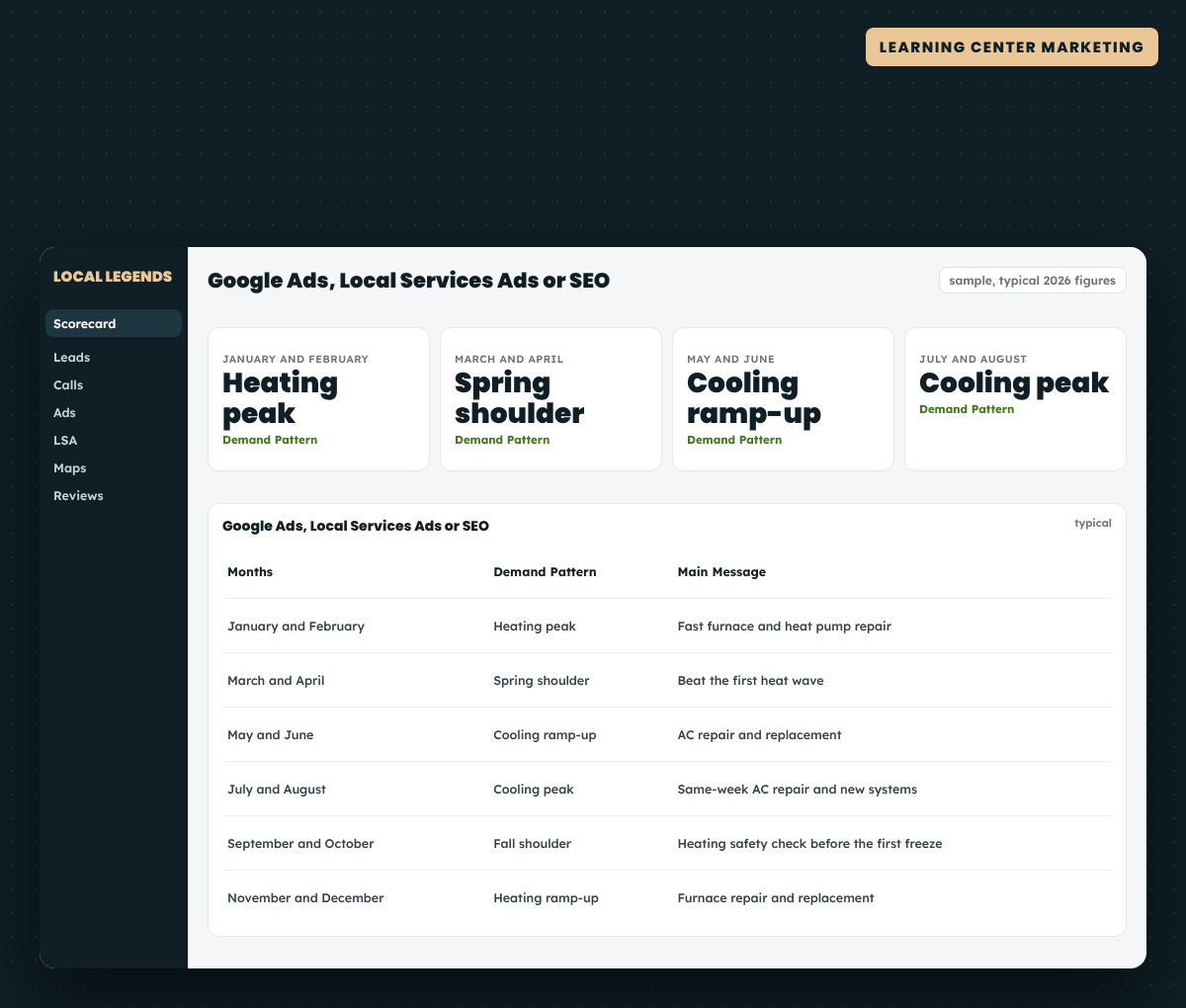
A seasonal HVAC marketing calendar shifts money toward paid search before and during heat waves and cold snaps, then shifts effort to the customer list, tune-ups and replacement offers in spring and fall, so the dispatch board stays fuller all year.
| Months | Demand Pattern | Main Message | Lead Channels | Customer List Action |
|---|---|---|---|---|
| January and February | Heating peak | Fast furnace and heat pump repair | Local Services Ads, search ads, Business Profile | Heating tune-up reminders to members |
| March and April | Spring shoulder | Beat the first heat wave | Search ads for AC tune-ups, social ads, mailers | AC tune-up campaign, aging-system outreach |
| May and June | Cooling ramp-up | AC repair and replacement | Local Services Ads, search ads | Membership pre-booking, open estimate follow-up |
| July and August | Cooling peak | Same-week AC repair and new systems | Local Services Ads, search ads, retargeting | Review requests after every job |
| September and October | Fall shoulder | Heating safety check before the first freeze | Search ads for furnace tune-ups, social ads, mailers | Furnace tune-up campaign, replacement offers |
| November and December | Heating ramp-up | Furnace repair and replacement | Local Services Ads, search ads | Membership renewals, referral asks |
Climate changes the calendar. A cooling-heavy market leans harder on the summer and may run AC campaigns most of the year, while a heating-heavy market builds its plan around fall and winter. The method stays the same: spend ahead of demand, then work the list.
What HVAC Marketing Strategies Keep Technicians Busy in the Spring and Fall Shoulder Seasons?
The strategies that keep HVAC technicians busy in the shoulder seasons are customer list campaigns, pre-season tune-up offers, outreach to owners of aging systems and replacement offers timed to manufacturer rebates and financing. Mild weather makes attic and crawlspace work easier too.
- Aging-system outreach: ENERGY STAR suggests considering replacement when a heat pump or air conditioner is more than 10 years old or a furnace or boiler is more than 15 years old, so those customers get replacement messages first.
- Open estimates: follow up on declined repairs and replacement quotes from the last peak season.
- Member pre-booking: schedule included tune-ups weeks ahead of the slow stretch.
- Pre-season deadlines:"before the first heat wave" and "before the first freeze" give homeowners a reason to book now.
- Indoor air quality: spring allergies and closed fall windows make filtration and humidity work timely.
- Neighbor mailers: after an install, mail nearby homes built in the same years.
Why Teaser Prices Can Backfire
Very low tune-up prices fill the schedule with homeowners shopping only on price. A fair, flat tune-up price paired with a thorough checklist usually produces better repair and replacement opportunities and better reviews.
HVAC Marketing Strategy for Retention: Turning One Call Into Years of Work The Customer List Is the Cheapest Lead Source
An HVAC retention strategy uses email, text, reviews and referrals to bring past customers back for tune-ups, repairs, memberships and replacements, because people who already trust the company book faster and cost far less to reach than strangers searching online.
How Can an HVAC Company Use Email and Text Marketing to Sell Maintenance Agreements?
An HVAC company sells more maintenance agreements with email and text by segmenting customers by plan status, last service date and equipment age, then sending short, timed messages: a plan offer shortly after a repair, tune-up reminders before each season and renewal reminders before a plan expires.
- Segment first: members, non-members, customers overdue for service and owners of older equipment each get different messages.
- Pitch after the repair: a day or two after a breakdown is fixed, the value of regular maintenance is easiest to see.
- Remind before each season: members book their included visits early, which fills mild weeks.
- Renew before expiry: a short summary of visits and savings from the past year makes renewal simple.
- Get consent: collect permission for marketing texts and include an easy opt-out in every message.
Nurture is built in: Local Legends Trailblazer plans and above include email and text automations, so tune-up reminders, renewal notices and estimate follow-ups run without the office sending each one. [SOURCE: Local Legends Trailblazer plan inclusions, Local Legends brief, confirmed Nov 8 2026]
How Do HVAC Companies Get More Google Reviews and Use Them in Marketing?
HVAC companies get more Google reviews by texting a direct review link to every customer as soon as the job is closed, with the technician mentioning it before leaving, then reusing those reviews on service pages, social posts, mailers and replacement proposals.
- Ask every customer: Google's content policy prohibits offering incentives for reviews and prohibits asking only happy customers.
- Make it one tap: a direct link by text, plus a QR card for customers who prefer to scan.
- Reply to every review: mention the service and the area naturally in the reply.
- Match reviews to pages: a furnace install review belongs on the furnace installation page.
- Reuse in print: short quotes with a first name and neighborhood on tune-up postcards and door hangers.
Referral Partners Who See Aging Systems First
Home inspectors, real estate agents, property managers, plumbers, electricians and roofers often see an old furnace or a struggling condenser before the homeowner calls anyone. A simple referral arrangement with a few of them adds planned replacement work without ad spend.
HVAC Marketing Budget: How to Set the Monthly Number Start From the Jobs You Need
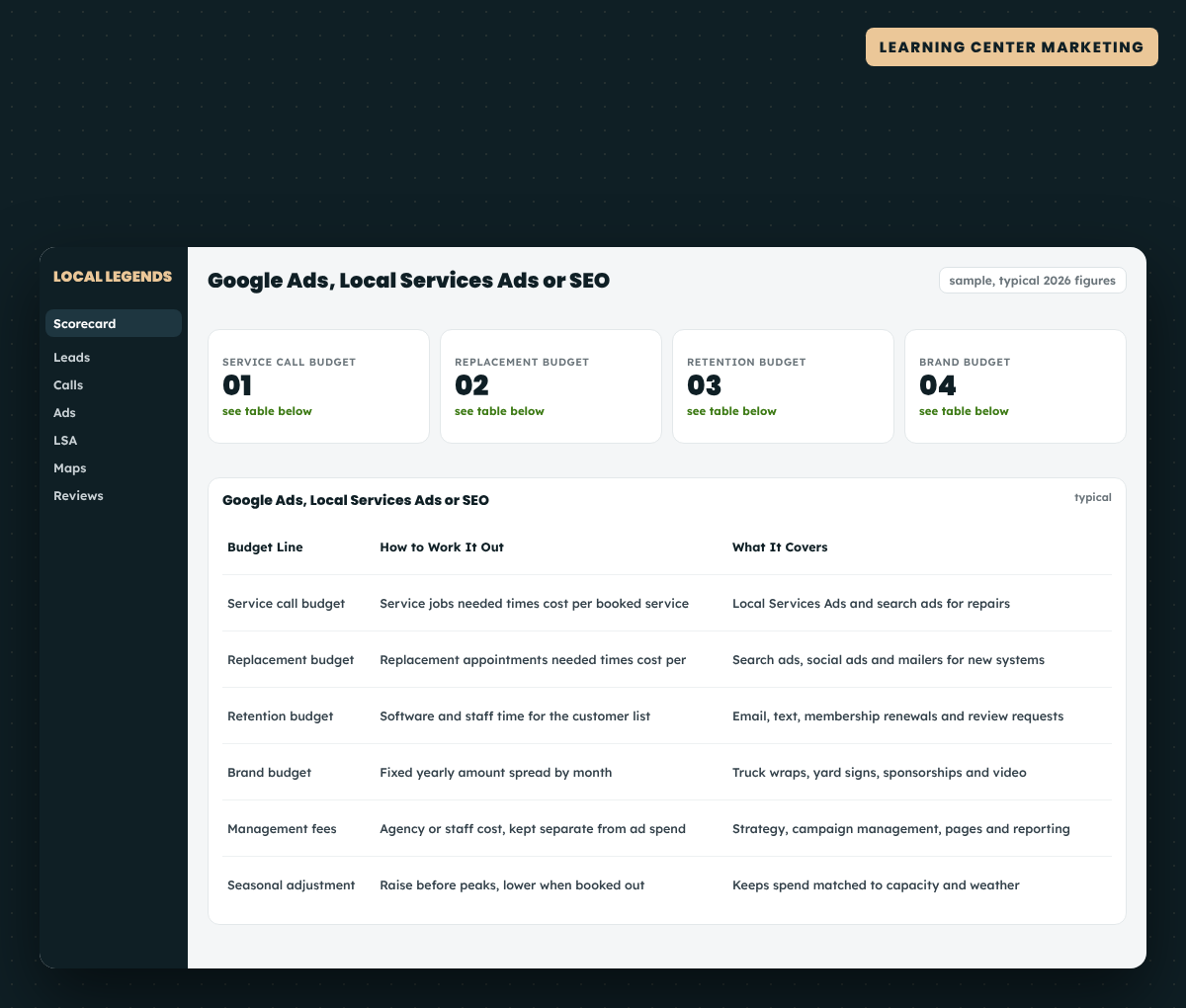
An HVAC marketing budget is set by working backward from the booked jobs the plan needs, multiplying by the company's real cost per booked job for each job type, then checking that total against margins and capacity. Ad spend and management fees are counted separately.
How Should an HVAC Company Decide How Much to Spend on Marketing Each Month?
An HVAC company should decide its monthly marketing spend from its own job math: jobs needed, booking and closing rates and cost per booked job, adjusted up before peak seasons and down when the board is already full. Percentage-of-revenue rules are only a rough cross-check.
| Budget Line | How to Work It Out | What It Covers |
|---|---|---|
| Service call budget | Service jobs needed times cost per booked service job | Local Services Ads and search ads for repairs |
| Replacement budget | Replacement appointments needed times cost per booked appointment | Search ads, social ads and mailers for new systems |
| Retention budget | Software and staff time for the customer list | Email, text, membership renewals and review requests |
| Brand budget | Fixed yearly amount spread by month | Truck wraps, yard signs, sponsorships and video |
| Management fees | Agency or staff cost, kept separate from ad spend | Strategy, campaign management, pages and reporting |
| Seasonal adjustment | Raise before peaks, lower when booked out | Keeps spend matched to capacity and weather |
Why Flat Fees Make the Budget Easier to Read
When management is a percentage of ad spend, the fee grows every time the budget grows, even if results do not. A flat monthly fee keeps the two numbers apart, so an owner can raise spend before a heat wave without raising the agency's cut.
What HVAC Marketing Strategies Work Best on a Tight Budget?
A small HVAC business on a tight budget gets the most from its Google Business Profile, a steady review process and its own customer list first, then adds Local Services Ads with a firm weekly cap once cash flow allows. Spreading small amounts across many channels rarely works.
- Business Profile: the right primary category, every service listed, accurate service area and weekly job photos.
- Reviews: a text request after every job and a reply to every review.
- Customer list: a simple text or email before each season offering a tune-up.
- Local Services Ads: a capped weekly budget timed to hot and cold spells.
- Partners: a few plumbers, electricians, roofers and real estate agents who refer work.
- Trucks and signs: clean lettering and a yard sign at every install, with the homeowner's permission.
How Do I Track HVAC Marketing ROI and Cost per Booked Job by Channel? From the First Ring to the Paid Invoice
An HVAC company tracks marketing ROI by giving every channel its own tracked phone number or link, carrying that source into the CRM from the first call to the paid invoice and reporting booked jobs, revenue and cost per booked job by channel and job type each month.
- Tracked numbers: separate numbers for Local Services Ads, search ads, the website, mailers and trucks.
- Tagged links: tracking tags on ad and Business Profile links so web leads carry their source.
- Lead-source field: a required field in the booking software for referrals and signs.
- CRM connection: call tracking linked to ServiceTitan, Housecall Pro, Jobber or another CRM.
- Job type split: service, maintenance and replacement reported separately.
- Full cost: ad spend plus management fees and software, so ROI is not overstated.
The Four Formulas Every HVAC Owner Should Know
- Cost per booked job: channel spend divided by booked jobs from that channel.
- Customer acquisition cost: channel spend divided by new paying customers.
- Return on ad spend: channel revenue divided by channel spend.
- Marketing ROI: channel revenue minus channel spend, divided by channel spend.
Scorecards on every plan: Local Legends clients get a CEO scorecard of leads, booked jobs, sold jobs and cost per booked job, monthly on Footprint and weekly on Trailblazer and above, with CallRail call tracking connected to CRMs such as ServiceTitan and Housecall Pro. [SOURCE: Local Legends scorecard and call tracking, Local Legends brief, confirmed Nov 10 2026]
How Long Does an HVAC Marketing Strategy Take to Start Producing Booked Jobs?
Paid channels such as Local Services Ads and search ads typically produce first booked HVAC jobs within weeks, customer list campaigns within days, and local SEO usually needs several months before it produces steady calls, so a full strategy often takes about a quarter to settle.
- Customer list campaigns: days, because the homeowners already know the company.
- Local Services Ads and search ads: typically days to a few weeks once accounts are live and verified.
- Business Profile improvements: often several weeks to a few months to show in the Map Pack.
- Website SEO: usually several months, longer in crowded metros.
- The full system: roughly 90 days for tracking, channels and the monthly review to work together.
How Much Does an HVAC Marketing Agency Cost Compared With Doing It In-House? Typical Fees Next to Local Legends Prices
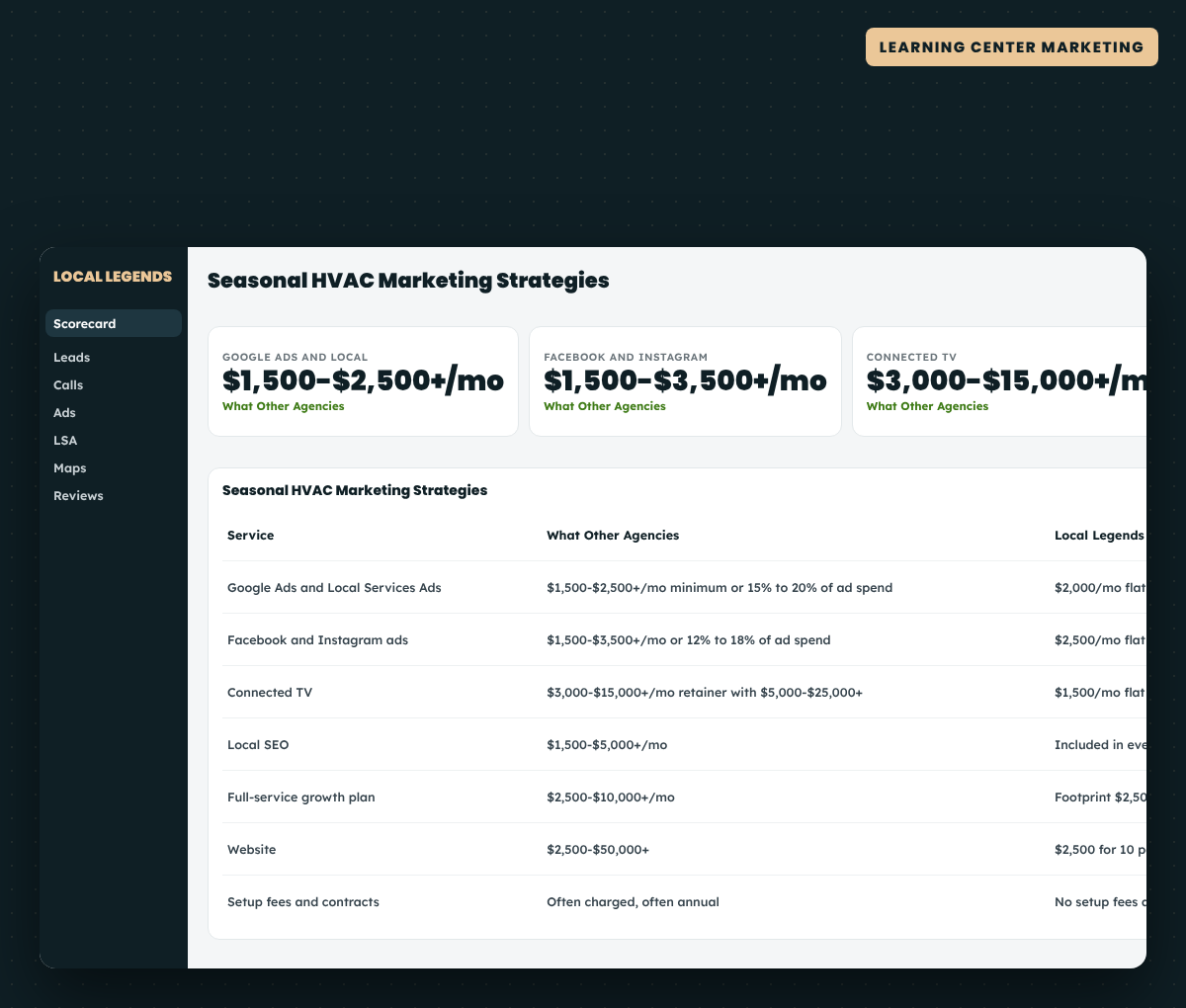
Typical HVAC marketing agency fees run $1,500-$2,500+ a month for Google Ads and Local Services Ads management or 15% to 20% of ad spend, and full-service marketing typically runs $2,500-$10,000+ a month. Local Legends charges flat fees with ad spend paid straight to the platforms.
| Service | What Other Agencies Typically Charge | Local Legends Price |
|---|---|---|
| Google Ads and Local Services Ads management | $1,500-$2,500+/mo minimum or 15% to 20% of ad spend | $2,000/mo flat, includes monthly Business Profile optimization and campaign landing pages |
| Facebook and Instagram ads | $1,500-$3,500+/mo or 12% to 18% of ad spend | $2,500/mo flat |
| Connected TV | $3,000-$15,000+/mo retainer with $5,000-$25,000+ media minimums | $1,500/mo flat |
| Local SEO | $1,500-$5,000+/mo | Included in every growth plan |
| Full-service growth plan | $2,500-$10,000+/mo | Footprint $2,500, Trailblazer $4,000, Sasquatch $8,000, Legend $10,000+ per month |
| Website | $2,500-$50,000+ | $2,500 for 10 pages up to $15,000 for 80 pages |
| Setup fees and contracts | Often charged, often annual | No setup fees and no long-term contracts |
Ad spend is paid by the HVAC company directly to Google, Meta or the TV network. Every plan includes the LSA Ranker review texter and fractional CMO and CEO meetings. Compare every option on the Local Legends pricing page.
Should an HVAC Company Hire a Marketing Agency or Handle Marketing In-House?
Many growing HVAC companies start with a trade-focused agency because one in-house hire rarely covers paid search, Local Services Ads, local SEO, the website and reporting at once, then add an in-house coordinator for photos, reviews and community events as they grow.
- Agency strengths: a full team, faster launch and predictable monthly cost plus ad spend.
- In-house strengths: daily access to technicians, job sites and community events for real content.
- True in-house cost: salary, payroll taxes, benefits, software and training time.
- Hybrid model: an in-house coordinator captures field content while an agency runs technical and paid work.
- Either way: the owner reviews booked jobs and cost per booked job every month.
What Questions Should I Ask Before Hiring an HVAC Marketing Agency?
Before hiring an HVAC marketing agency, ask about its home service experience, its plan for peak and shoulder seasons, how it ties calls to booked jobs and revenue, who owns the accounts and what the contract terms are.
- Have you worked with heating and cooling companies, and how does your plan change by season?
- Do you work with any direct competitors in my service area?
- Can you show me how a call is tracked from the first ring to a booked job in my CRM?
- What does a sample monthly report look like, and does it show cost per booked job?
- Who owns the website, domain, Business Profile, ad accounts and tracking numbers?
- Is the fee flat or a percentage of ad spend, and what are the cancellation terms?
How Local Legends Answers These Questions
Local Legends Marketing works with roofing, HVAC, plumbing, electrical and other home service companies, starts with an audit, charges flat fees with no setup fees and uses no long-term contracts. Every engagement includes the Local Legends marketing course and a weekly project review meeting.
Clients own every account: HVAC companies that work with Local Legends keep ownership of the website, domain, Google Business Profile, ad accounts and call data, so the marketing assets stay with the business. [SOURCE: Local Legends account ownership policy, Local Legends brief, confirmed Nov 2026]
See how the managed side of this strategy works on the HVAC marketing, Google Local Services Ads and email marketing pages.
Local Legends Marketing Reviews From Home Service CEOs What Owners Say About Levi
Home service CEOs have shared what it is like to work with Local Legends Marketing on ads, search and the tracking that connects marketing to booked jobs.
Levi has been absolutely outstanding to work with over the years... His creativity, responsiveness, and deep understanding of our marketing strategy have made a huge impact." Brad Beldon, CEO, Roofing Company. Read more reviews
- Kyle Scott, CEO, Roofing Company (video testimonial)
- Jim Dodson, CEO, Roofing Company (video testimonial)
- Race Allen, CEO, Precision Restoration of Texas (video testimonial)
Agency-reported totals: 25,000+ appointments generated and $30M+ in revenue influenced.
Frequently Asked Questions About HVAC Marketing Strategy Quick Answers for HVAC Owners
What Is HVAC Marketing?
HVAC marketing is everything a heating and cooling company does to reach homeowners and businesses that need repair, maintenance or new equipment, from Google search and Local Services Ads to reviews, email, trucks and referrals.
What Are the 5 P's of Marketing for an HVAC Company?
The 5 P's are commonly listed as product, price, place, promotion and people. For HVAC, that means the services offered, clear pricing options, the real service area, the channels used to reach homeowners and the technicians who represent the brand.
Is There a Standard Percentage of Revenue HVAC Companies Spend on Marketing?
There is no single required percentage, and published benchmarks vary, so the most reliable number comes from the company's own job goal, booking rate and cost per booked job, checked against margins.
What Is the Best Marketing for a Small HVAC Business?
For most small HVAC businesses, the best starting point is a complete Google Business Profile, a steady review process and regular messages to past customers, with Local Services Ads added once there is budget for paid leads.
Do Truck Wraps and Yard Signs Still Work for HVAC Companies?
Truck wraps and yard signs still help HVAC companies build familiarity in the neighborhoods they already serve, and they work best alongside reviews and a strong Business Profile, with unique numbers or codes to track them.
Does Direct Mail Work for HVAC Marketing?
Direct mail can work for HVAC companies when it is targeted, such as postcards to homes near a recent install, new homeowners or neighborhoods with older systems, and when each piece carries a tracked number or code.
When Should an HVAC Company Start Shoulder-Season Campaigns?
Many HVAC companies start spring cooling campaigns in late winter and fall heating campaigns in late summer, a few weeks before the first hot or cold spell, so tune-ups are booked before demand rises.
Should HVAC Websites Show EPA Certification?
Yes, showing EPA Section 608 certification and state license details on the website gives homeowners and AI tools clear proof of qualification, since federal rules require that certification for technicians who service refrigerant equipment.
Reviewed by Levi Ostlund, Founder, Local Legends Marketing

Build Your HVAC Marketing Strategy With a Free Growth Audit Start With Your Own Job Math
Local Legends will review your Business Profile, Local Services Ads, search campaigns, Google Maps rank grids and call tracking, then map an HVAC marketing strategy around the jobs your trucks can run in every season.
- Call:(936) 900-1248
- Office: 481 Stephen F Austin Dr, Conroe, TX 77302
- Next step: book your free growth audit and get a written plan for your service area and your slow months