


A Beginner's Playbook in Eight Chapters and 90

SEO Guide for Contractors: A Do It Yourself Google SEO Guide That Helps Roofers, HVAC Companies, Plumbers and Remodelers Turn Searches Into Booked Jobs
A Beginner's Playbook in Eight Chapters and 90 Days
Updated November 2026 · Reviewed by Levi Ostlund, Founder
Breadcrumb: Home > Learning Center [LINK: /learning-center/] > SEO Guide
This SEO guide for contractors is a step-by-step playbook that shows a roofing, HVAC, plumbing, electrical or remodeling company how to show up in the Google Map Pack, the organic results and AI answers, and how to prove those rankings turn into booked jobs. It is written for owners, not marketers.
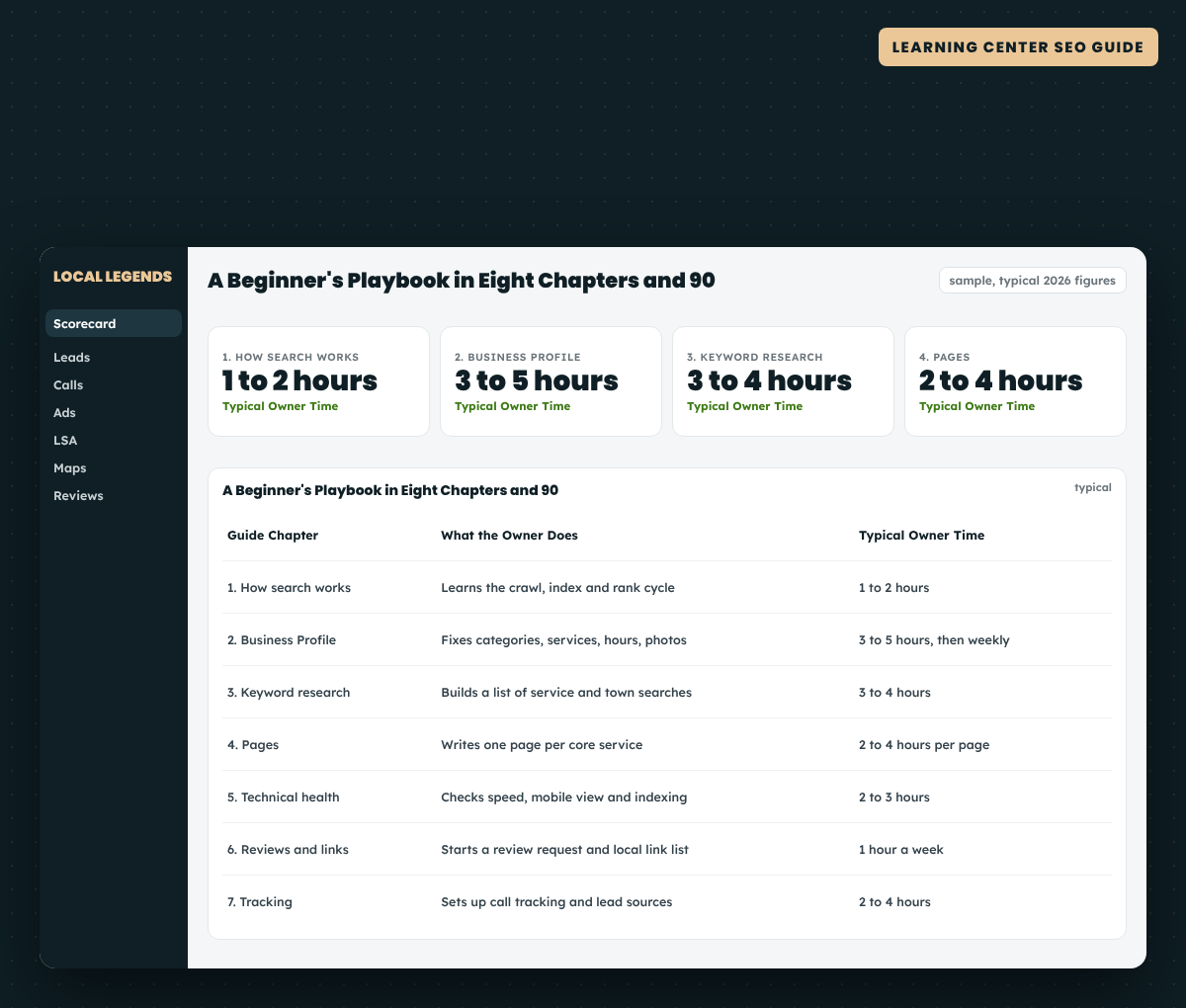
- Chapter 1, how search works: crawling, indexing and ranking in plain language.
- Chapter 2, the Business Profile: the listing that controls the Map Pack.
- Chapter 3, keyword research: the words homeowners type when something breaks.
- Chapter 4, pages: one page per money service and real town pages.
- Chapter 5, technical health: speed, mobile layout, indexing and structured data.
- Chapter 6, reviews and links: the proof that earns prominence.
- Chapter 7, tracking: calls and booked jobs, not just visits.
- Chapter 8, upkeep: a one-hour weekly routine that keeps the work compounding.
Free Growth Audit
Your Reviews, Radius and Response Rate vs the competitors beating you.
About Local Legends Marketing
A home service marketing agency headquartered in Conroe, Texas, with 8+ years of marketing experience, running Google Ads, Local Services Ads, local SEO, AI SEO, connected TV and review systems for contractors nationwide.
What Is an SEO Guide for Contractors and Where Should a Roofer Start? Start With the Map Pack, Then Build the Website
An SEO guide for contractors explains how a local trade business earns free placement in Google Maps and the organic results for the services and towns it actually serves. For a roofer, the first stop is the Google Business Profile, because a homeowner with a leak usually calls one of the three listings in the Map Pack.
Google AI Mode gave the same advice in November 2026 when asked where a roofing company should begin: the Business Profile first, a review process second, separate service pages third and honest town pages fourth. That order runs through this whole guide.
How Google Search Works in Three Steps
Google Search runs in three stages, and every SEO task helps one of them. A beginner who understands these three steps can tell which advice matters for a contracting business and which advice is noise.
- Crawling: Google's software follows links to discover pages. Google says most new pages it finds are reached through links from pages it already knows.
- Indexing: Google reads each page and files it. A page that is blocked, broken or a near copy of another page may never be filed.
- Ranking: when a homeowner searches, Google picks the indexed pages and listings that best answer that search from that location.
Why a Contractor Ranks in Two Places at Once
A local search usually shows the Map Pack near the top and the organic website results below it. The Map Pack is driven by the Business Profile, while the organic results are driven by the website. A strong contractor plan works on both, because each one feeds the other.
Where AI Answers Come From
Google says a page only needs to be indexed and eligible for a normal search snippet to appear as a source in AI Overviews or AI Mode. That means the same crawl, index and rank work also decides whether a contractor gets cited in AI answers.
What Does Google's Own SEO Guide Tell a Small Home Service Business to Do?
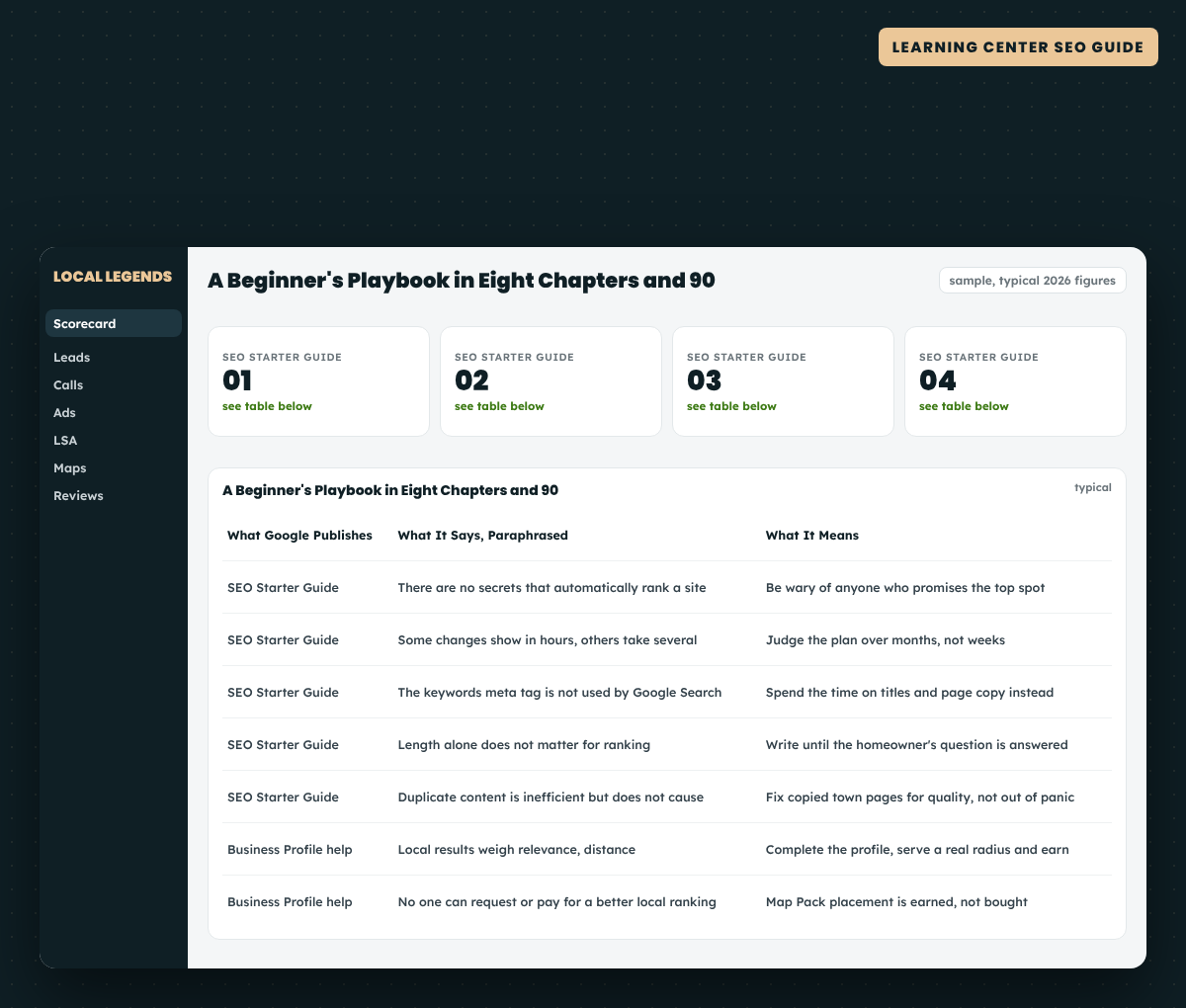
Google does not publish an SEO manual written for contractors, so a home service business combines two official sources: the Search Central SEO Starter Guide for the website and the Business Profile help pages for local ranking. Both are free and both are updated by Google.
| What Google Publishes | What It Says, Paraphrased | What It Means for a Contractor |
|---|---|---|
| SEO Starter Guide | There are no secrets that automatically rank a site first | Be wary of anyone who promises the top spot |
| SEO Starter Guide | Some changes show in hours, others take several months | Judge the plan over months, not weeks |
| SEO Starter Guide | The keywords meta tag is not used by Google Search | Spend the time on titles and page copy instead |
| SEO Starter Guide | Length alone does not matter for ranking | Write until the homeowner's question is answered, then stop |
| SEO Starter Guide | Duplicate content is inefficient but does not cause a manual action | Fix copied town pages for quality, not out of panic |
| Business Profile help | Local results weigh relevance, distance and prominence | Complete the profile, serve a real radius and earn reviews |
| Business Profile help | No one can request or pay for a better local ranking | Map Pack placement is earned, not bought |
| AI features guidance | No extra requirements exist for AI Overviews or AI Mode | Normal SEO fundamentals are the AI plan |
Beginners SEO Guide: The Basics an HVAC Company Needs Before Anything Else Five Foundations That Make Every Later Step Work
A beginners SEO guide for an HVAC company starts with five foundations: an accurate Business Profile, a list of buyer searches, one page per core service, a fast mobile site and a way to count calls. Everything else in SEO sits on top of these five.
Heating and cooling is a good test case because the searches spike with the weather. A company that has the foundations in place before the first heat wave catches the calls. A company that starts in July is usually building while competitors book the jobs.
Foundation 1: A Business Profile That Matches the Real Business
The profile should use the company's real-world name, the most specific primary category that fits the core trade and a services list that names the actual work, such as furnace repair, heat pump installation and duct cleaning.
Foundation 2: Searches Written in Homeowner Words
Homeowners rarely type "HVAC." They type "AC not blowing cold," "furnace repair near me" or "heat pump installation" plus a town. The page copy should use both the trade term and the everyday words.
Foundation 3: One Page per Money Service
AC repair, AC replacement, furnace repair, heat pumps and maintenance plans each deserve a page. A single page that lists all of them rarely ranks well for any one of them.
Foundation 4: A Site That Works on a Phone
Most urgent searches happen on phones. The tap-to-call button belongs at the top of every screen, photos should be compressed and forms should work with a thumb.
Foundation 5: A Way to Count Calls
Before any SEO work starts, set up a tracked number for the website and a lead-source field in the booking software. Without that, the owner can only guess whether the work paid off.
What Free SEO Tools Should a Small Contractor Use?
A small contractor can run a beginner SEO program with four free tools from Google and Bing: Google Business Profile, Google Search Console, Google Analytics 4 and Bing Webmaster Tools, plus PageSpeed Insights for mobile speed checks.
- Google Business Profile: manages the Map Pack listing, photos, services and review replies.
- Google Search Console: shows which searches bring visitors, which pages are indexed and which have errors.
- Google Analytics 4: shows what visitors do, such as tapping the phone number or sending a quote form.
- Bing Webmaster Tools: the Bing version of Search Console, which can import a site from Search Console.
- PageSpeed Insights: tests how fast a page loads on a phone and lists what to fix.
- Google Keyword Planner: shows search demand for service terms through a free Google Ads account.
How Do I Do SEO Myself? A Step-by-Step SEO Do It Yourself Guide for a Plumbing Business The 90-Day Plan, Two Weeks at a Time
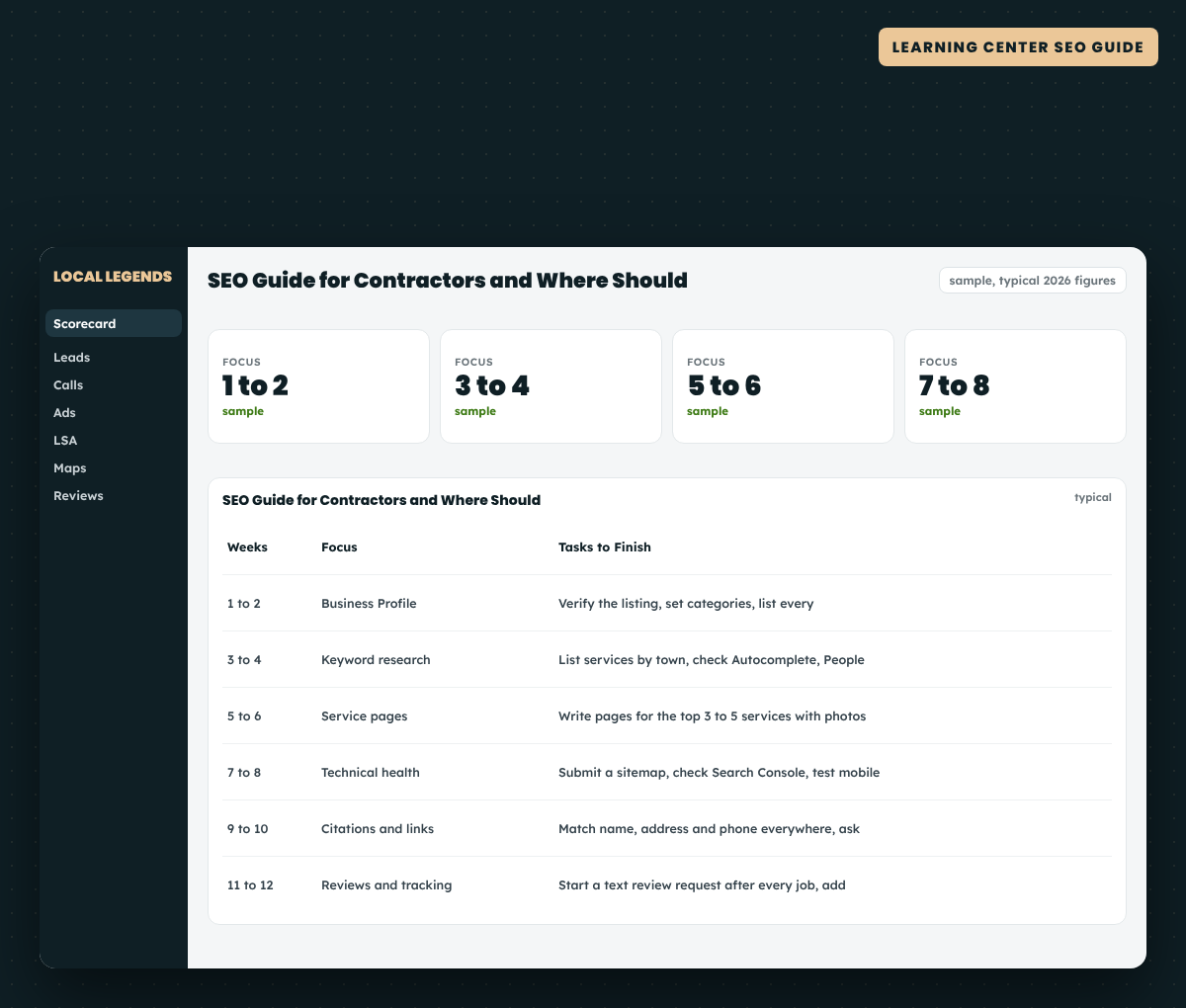
A plumbing business can do its own SEO by working through the Business Profile, keyword research, service pages, technical checks, citations, reviews and tracking in that order over about 90 days. The plan below spreads the work so it fits around a full schedule of calls.
| Weeks | Focus | Tasks to Finish | Done When |
|---|---|---|---|
| 1 to 2 | Business Profile | Verify the listing, set categories, list every service, add real job photos | The profile matches the truck and the invoice |
| 3 to 4 | Keyword research | List services by town, check Autocomplete, People Also Ask and Keyword Planner | Every money service has a target search |
| 5 to 6 | Service pages | Write pages for the top 3 to 5 services with photos, prices or price ranges and FAQs | Each page answers one job completely |
| 7 to 8 | Technical health | Submit a sitemap, check Search Console, test mobile speed | No key page shows an indexing error |
| 9 to 10 | Citations and links | Match name, address and phone everywhere, ask suppliers and partners for links | Listings agree with the Business Profile |
| 11 to 12 | Reviews and tracking | Start a text review request after every job, add tracked numbers and lead sources | Calls and reviews are counted every week |
Chapter 2: Set Up the Business Profile Correctly
The profile is the single biggest local asset a plumber has. Google's guidelines ask for the real-world business name, the fewest categories that describe the core business and a hidden street address for service-area businesses that travel to customers.
- Name: the name on the truck and the license, with no extra words added.
- Primary category: the most specific match, such as Plumber.
- Services: every job the company wants, from water heater replacement to sewer line repair.
- Service area: the towns the trucks reach on a normal day.
- Photos: real crews, trucks and finished jobs, added on a steady schedule.
How Do I Do Keyword Research for My Roofing Company for Free?
A roofing company can do free keyword research by pairing each service with each town it serves, then checking those phrases against Google Autocomplete, People Also Ask, Related Searches and Google Keyword Planner. The goal is a short list of searches a homeowner types right before calling.
- Start with a seed list: roof repair, roof replacement, storm damage, metal roofing and inspections, each paired with a town.
- Mine Autocomplete: type a phrase and add a letter at the end to see more predictions.
- Read People Also Ask: each expanded question is a ready-made FAQ or blog topic.
- Check Keyword Planner: filter to the service area to compare relative demand between phrases.
- Look at the top local sites: see which service pages the strongest roofers have built.
- Map phrases to pages: service searches go to service pages, town searches to town pages and questions to articles.
Chapter 3: Sort Searches by How Close They Are to a Call
Group every phrase into four buckets: emergency searches, service searches, town searches and research questions. Emergency and service searches sit closest to the phone, so they get pages first. Research questions become articles once the money pages exist.
What Pages Should a Contractor Website Have for SEO?
A contractor website needs a home page, one page for each core service, a page for each main town it serves with real local proof, an about page, a reviews page, a project gallery and a contact or quote page. Google ranks pages, so each service needs its own address.
- Home and contact: states the trade, the area and the fastest way to call.
- Top 3 to 5 service pages: answers the searches closest to a booked job.
- About, reviews and project gallery: shows license, insurance, crews and finished work.
- Town pages with real local facts: reaches towns the Business Profile cannot win alone.
- FAQs, financing and articles: answers longer questions and supports the money pages.
Every page should carry the phone number, the service area, real photos and at least one review. A gallery entry is stronger when it names the problem, the fix and the town where the job happened.
Town pages need real facts: the Local Legends team writes a city page only when a town has 5 or more real local facts to share, so every town page says something true about that place instead of repeating another page with a new name. [SOURCE: Local Legends city page rule, Local Legends brief, confirmed Nov 10 2026]
Chapter 4: Write Each Service Page Around One Job
A water heater page should answer what the homeowner wants to know about water heaters: signs of failure, repair or replace, tank or tankless, typical price ranges, timeline, warranty and how to book. The title, the main heading and the first sentence should all name the service and the area.
What Belongs on Every Service Page
- A clear headline that names the service and the area.
- A short answer in the first paragraph.
- Real job photos with descriptive alt text.
- Price ranges or the factors that set the price.
- Reviews that mention that service.
- A tap-to-call button and a short quote form.
Chapter 5: Check the Technical Basics
Technical SEO sounds harder than it is for a small site. Submit an XML sitemap in Search Console, confirm the key pages are indexed, test the main pages on a phone and fix broken links. Structured data, such as LocalBusiness markup, helps Google read the hours and service area.
Google Business Profile and Reviews: The Local Half of the SEO Guide Relevance, Distance and Prominence in Practice
Google says local results are based on relevance, distance and prominence, and the Business Profile and its reviews are where a contractor works on all three. Relevance comes from accurate categories and services, distance from an honest service area and prominence from reviews, links and mentions.
Distance is the factor an owner cannot change, which is why a profile rarely wins searches far from its address. Relevance and prominence are where the work goes. A complete profile with steady reviews competes well inside its real radius.
How Local Legends handles profile access: Local Legends is added as an owner on a client's Google Business Profile while the client stays the primary owner and keeps ownership of the listing, so the business never loses control of its most important local asset. [SOURCE: Local Legends GBP access policy, Local Legends brief, confirmed Nov 8 2026]
How Do Google Reviews Help SEO for a House Cleaning Business?
Google reviews help a house cleaning business in local search by adding prominence, by putting service and neighborhood words into public text and by giving searchers a reason to call, and the steadiest way to earn them is a text request sent right after each clean.
- Prominence: Google's help pages list reviews and ratings among the signals of how well known a business is.
- Relevance: reviews that mention a deep clean, a move-out clean or a neighborhood describe the work in customers' words.
- Recency: a few reviews every month show an active business better than a burst followed by silence.
- Replies: Google says replying to reviews shows customers the business values their feedback.
- Policy: Google's content rules prohibit offering payment, discounts or free services in exchange for reviews, and prohibit asking only happy customers.
Chapter 6: Build a Review Request Into Every Job
The simplest process is a text with the direct review link, sent the day the job closes. Ask every customer, not only the ones who seemed happy, and reply to every review with a short note that mentions the service. Many field service tools can send the text automatically when the invoice is paid.
Earning Local Links Without Buying Them
Local links come from real relationships: suppliers and manufacturers that list dealers, a youth league the company sponsors, a chamber of commerce membership, a trade association and non-competing trades that refer work. A handful of relevant local links usually beats a pile of unrelated ones.
What Are the Most Common SEO Mistakes Contractors Make? Small Oversights That Cost Calls
The most common SEO mistakes contractors make are putting every service on one page, copying town pages, using vague page titles and running a slow mobile site with no call tracking. Each one is fixable by the owner, and each one quietly costs phone calls until it is fixed.
- One page for every service: a bulleted list of six trades on one page rarely ranks for any of them. Give each money service its own page.
- Copied town pages: swapping the town name into the same text adds pages without adding value. Write town pages only where there is something true to say.
- Titles that say "Home": a page title should name the service, the area and the company.
- Keyword stuffing: repeating "best cheap plumber" in every sentence reads as spam to people and to Google.
- Huge photos: images straight from a phone camera slow pages down. Compress them before upload.
- A profile that links to social media: the Business Profile website link should point to the company's own site.
- No tracking: without Search Console, analytics and tracked numbers, nobody knows which pages produce jobs.
- Promotional profile descriptions: Google's guidelines say the profile description should not include links, prices or sales offers.
Myths a Beginner Can Skip
Google's Starter Guide names several things beginners need not worry about. The keywords meta tag is not used, heading order does not affect ranking, there is no magic word count and duplicate content is a quality issue, not a penalty.
When a Mistake Needs a Specialist
Some problems need a professional: a site that dropped out of the index after a redesign, a suspended Business Profile, a hacked site or a domain change without redirects. In those cases, the cost of guessing is usually higher than the cost of help.
SEO Guide by Trade: First Moves for Roofers, HVAC, Plumbers, Electricians, Remodelers and Cleaners The Same Playbook, Different Starting Points
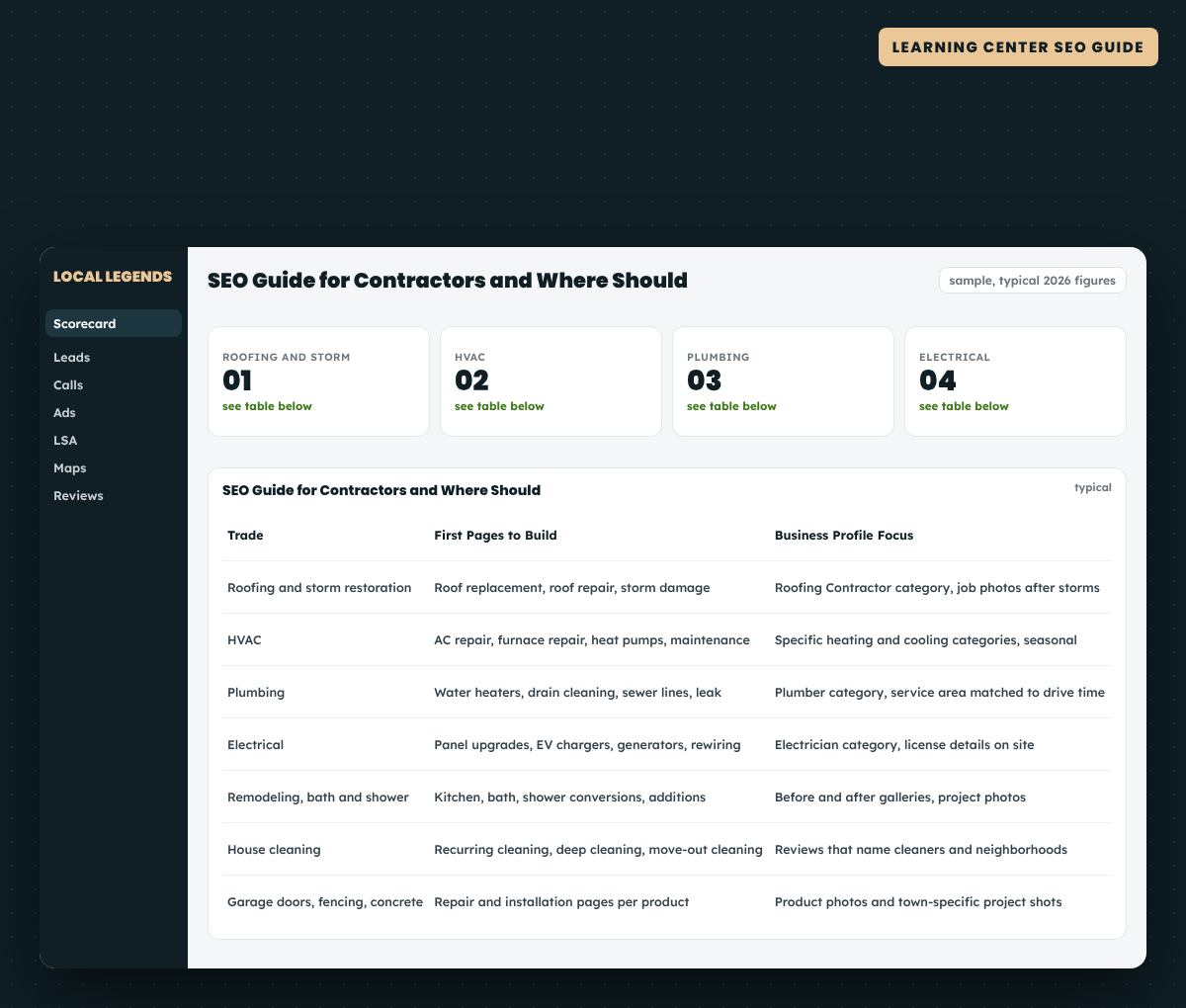
Every trade follows the same eight chapters, but the first pages and the first signals differ because homeowners shop for a roof, a furnace, a drain or a kitchen in different ways. The table shows where each trade usually gets the fastest return from its first month of SEO work.
| Trade | First Pages to Build | Business Profile Focus | Early Sign It Is Working |
|---|---|---|---|
| Roofing and storm restoration | Roof replacement, roof repair, storm damage | Roofing Contractor category, job photos after storms | More inspection requests from tracked calls |
| HVAC | AC repair, furnace repair, heat pumps, maintenance plans | Specific heating and cooling categories, seasonal photos | Calls during the first heat wave or cold snap |
| Plumbing | Water heaters, drain cleaning, sewer lines, leak repair | Plumber category, service area matched to drive time | Emergency calls from Map Pack listings |
| Electrical | Panel upgrades, EV chargers, generators, rewiring | Electrician category, license details on site | Quote requests for planned projects |
| Remodeling, bath and shower | Kitchen, bath, shower conversions, additions | Before and after galleries, project photos | Longer calls that ask about timelines and design |
| House cleaning | Recurring cleaning, deep cleaning, move-out cleaning | Reviews that name cleaners and neighborhoods | Recurring bookings added each month |
| Garage doors, fencing, concrete, landscaping | Repair and installation pages per product | Product photos and town-specific project shots | Estimate requests tied to specific pages |
Why Storm Trades and Emergency Trades Start Differently
Roofers and restoration companies see demand jump after hail and wind, so their pages and photos need to be ready before the storm season. Plumbers and HVAC companies see emergency searches all year, so their Business Profile and mobile call button carry more weight.
Why Project Trades Lean on Galleries
Remodelers, bath and shower companies and electricians doing panel upgrades sell planned projects. Homeowners compare carefully, so project galleries, clear process pages and reviews that describe the whole job do more of the selling than an emergency call button.
How Do I Track Whether SEO Brings Calls and Booked Jobs to My Plumbing Company? Chapter 7: From Search Console Clicks to Sold Work
A plumbing company tracks SEO results by giving organic visitors and the Business Profile their own tracked phone numbers, connecting those numbers to the booking or CRM software and comparing calls to booked and sold jobs every month. Free Google tools stop at clicks and button taps.
Search Console shows the searches and pages that bring visits. Analytics shows taps on the phone number and form sends. Call tracking and the CRM close the gap by showing which of those calls became a scheduled job, an invoice and revenue.
- Tracked numbers: a dynamic number on the website shows organic callers separately from ads and referrals.
- Business Profile tracking: add a tracking tag to the website link in the profile so Map Pack visits are counted on their own.
- Keep the main number primary: use the real business number as the profile's main phone number, with any tracking number as a secondary number.
- CRM matching: connect call tracking to ServiceTitan, Housecall Pro, Jobber or another CRM so calls match booked jobs.
- Missed calls: track unanswered calls by hour, because a ranking that rings to voicemail books nothing.
The Six Numbers to Read Every Month
- Search impressions and clicks from Search Console, to see whether pages are seen for the right searches.
- Profile calls and website taps from the Business Profile, to see whether the Map Pack listing produces contact.
- Tracked organic calls from call tracking, to count real conversations SEO started.
- Booked appointments from the CRM, to see how many calls became scheduled jobs.
- Sold jobs and revenue from CRM invoices, to see whether SEO paid for itself.
- Cost per booked job, marketing spend divided by booked jobs, to compare SEO with every other channel.
What Local Legends reports: every engagement starts with an audit of tracking, local SEO, Local Services Ads and the sales funnel, including Google Maps rank grids, and clients receive a CEO scorecard with leads, booked jobs, sold jobs and cost per booked job. [SOURCE: Local Legends audit and scorecard process, Local Legends brief, confirmed Nov 10 2026]
How Long Does SEO Take to Work for a Local Contractor Like an Electrician?
For a local electrician, early SEO movement typically appears in about 3 to 6 months and steadier lead flow often takes 9 to 12 months or more, depending on the market and the starting point. Google itself says some changes show in hours and others take several months.
- Months 1 to 3: profile fixes, citations and technical cleanup. Branded and nearby searches tend to move first.
- Months 4 to 6: new service pages get indexed and reviews build. Map Pack visibility often starts to improve.
- Months 6 to 12: visibility spreads across the service area and tracked calls become more consistent.
- What speeds it up: a smaller town, an older domain, existing reviews and specific services such as generator installs.
- What slows it down: a crowded metro, a brand-new site and broad terms such as "electrician near me."
Filling the Calendar While SEO Matures
Many contractors run Google Ads or Local Services Ads while organic rankings build, then lean on SEO as it grows. Since August 2026, Google has been moving Local Services Ads into Google Ads as Performance Max campaigns that still charge per lead.
SEO, AI Overviews and AI Mode: What Changes for Contractors in 2026 The Fundamentals Still Decide Who Gets Named
AI Overviews and AI Mode draw on the same index as regular Google Search, so the SEO fundamentals in this guide also decide which contractors AI answers name. Google states that no special optimization is required to appear in those features beyond being indexed and eligible for a snippet.
What has changed is the type of page that earns a visit. A generic "how does a water heater work" article is now often answered on the results page. A page with the company's own prices, project photos, crew names and reviews gives AI answers something only that contractor can supply.
Does SEO Still Work for Contractors in 2026 With AI Overviews and ChatGPT?
Yes, SEO still works for contractors in 2026, because homeowners still search Google Maps when something breaks and AI tools still lean on indexed websites, Business Profiles and reviews to decide which local businesses to mention.
- Local searches stay local:"plumber near me" still leads with a Map Pack, not a long AI essay.
- Firsthand detail wins: Google's helpful content guidance asks whether a page offers original information and first-hand expertise.
- Consistency matters: matching name, address and phone across the web helps every system recognize the same business.
- Mentions count: trade associations, suppliers, local news and community sites that name the company add outside proof.
- Ask how they found you: add "AI assistant" as a lead source on intake forms and call scripts.
What AI Search Means for the Weekly Routine
The weekly upkeep in Chapter 8 does not change much. Post real job photos, answer every review, add one helpful page when a customer question keeps coming up and keep the facts on the website current. Accurate, specific pages are what both readers and AI tools can trust.
Chapter 8: The One-Hour Weekly Upkeep Routine
- Add three to five real job photos to the Business Profile.
- Reply to every new review with a note about the job.
- Send review requests for every completed job that week.
- Check Search Console for new errors or new searches.
- Write down one customer question for a future FAQ or article.
- Compare tracked calls and booked jobs with the prior week.
How Much Does SEO Cost for a Home Service Business? Owner Time, Typical Retainers and Plans
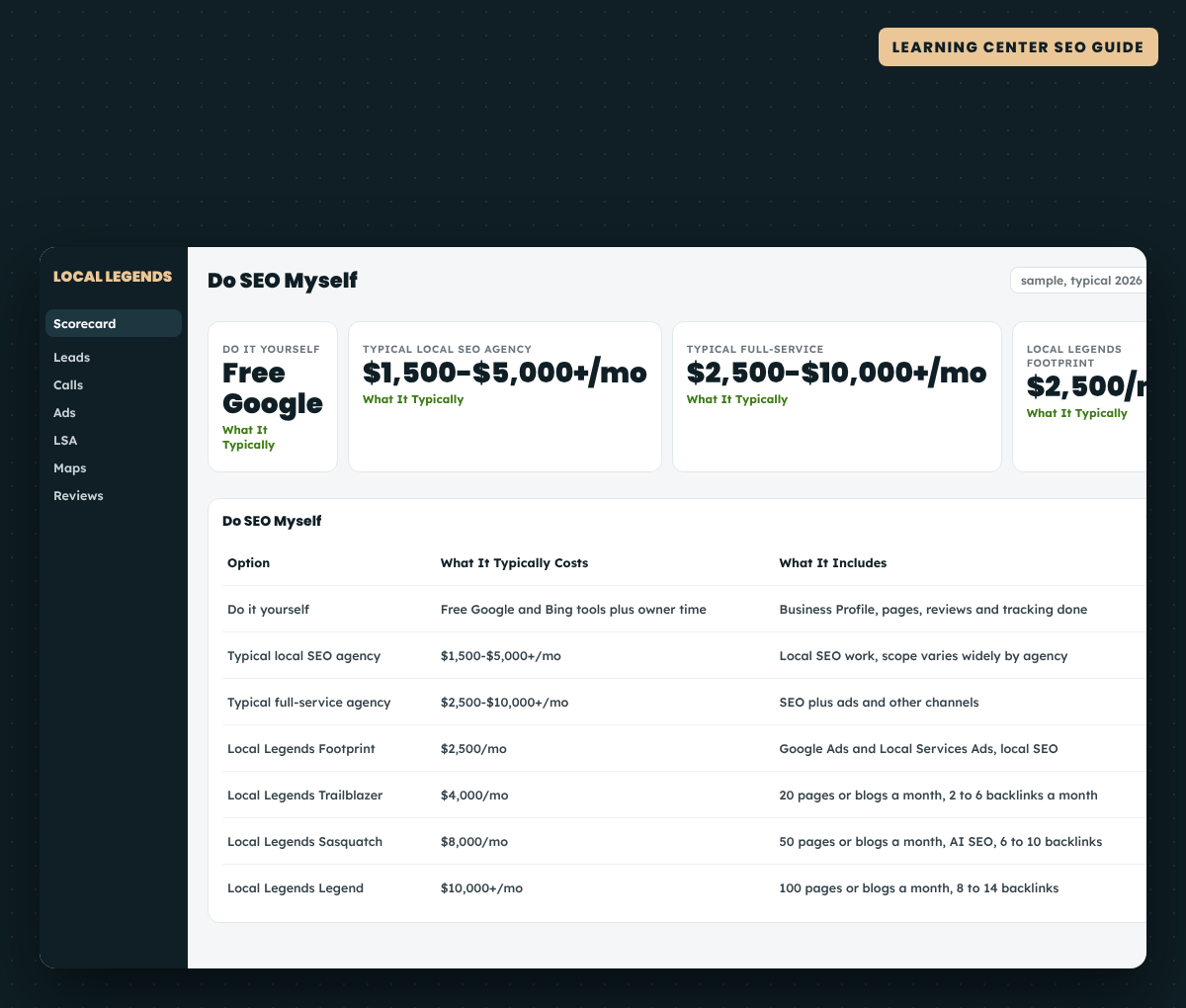
Doing SEO yourself costs mostly time, while a typical local SEO retainer for a contractor runs $1,500-$5,000+ a month and full-service marketing typically runs $2,500-$10,000+ a month. Local Legends growth plans start at $2,500 a month with no setup fees and no long-term contracts.
| Option | What It Typically Costs | What It Includes |
|---|---|---|
| Do it yourself | Free Google and Bing tools plus owner time | Business Profile, pages, reviews and tracking done in house |
| Typical local SEO agency | $1,500-$5,000+/mo | Local SEO work, scope varies widely by agency |
| Typical full-service agency | $2,500-$10,000+/mo | SEO plus ads and other channels |
| Local Legends Footprint | $2,500/mo | Google Ads and Local Services Ads, local SEO with 70+ citations in month 1, 10 pages or blogs a month, GBP photo posts twice a week, call tracking, monthly scorecard |
| Local Legends Trailblazer | $4,000/mo | 20 pages or blogs a month, 2 to 6 backlinks a month, Bing and Facebook and Instagram ads, review automation, weekly scorecard |
| Local Legends Sasquatch | $8,000/mo | 50 pages or blogs a month, AI SEO, 6 to 10 backlinks and PR in month 1, connected TV, geofencing and retargeting |
| Local Legends Legend | $10,000+/mo | 100 pages or blogs a month, 8 to 14 backlinks, quarterly PR, multi-location city pages, Levi twice a month |
| Website build | $2,500-$15,000+ one time | 10 to 80 pages in the product-page layout |
Ad spend is paid by the client straight to Google, Meta or the TV network, and Google Ads plus Local Services Ads management on its own is $2,000 a month, including monthly Business Profile optimization and campaign landing pages. Compare every plan on the Local Legends pricing page.
What Moves the Price of SEO
- Competition: a dense metro takes more pages and links than a small town.
- Services and towns: each one adds pages, photos and tracking.
- Starting point: a slow or broken site needs repair before growth work.
- Channels: plans that also run ads, social posts or connected TV cost more.
Should I Do SEO Myself or Hire an Agency for My Remodeling Company?
Many remodeling companies start with a hybrid: the owner handles the Business Profile, project photos and review requests, then hires help for page writing, technical work and links once the schedule fills up. High project values mean a few extra kitchens or baths can cover professional help.
- Do it yourself when: the budget is tight, the market is small and someone has a few steady hours each week.
- Hire help when: the market is crowded, the site has technical problems or the owner's time is worth more on estimates.
- Keep doing either way: project photos, review requests and answering calls fast, because no agency can do those for the crew.
- Learn the basics first: an owner who has read this guide can judge any proposal on its merits.
What Should a Contractor Look For in an SEO Company Before Hiring One?
A contractor should look for an SEO company with home service experience, a written plan for services and towns, reports on calls and booked jobs, plain terms and contracts that keep the website, domain, Business Profile and call data in the contractor's name.
- Trade experience: can explain how searches differ for your trade and your area.
- Methods that follow Google's guidelines: no bought links, no fake reviews, no keyword-stuffed business names.
- Honest timelines: months, not days, with no guaranteed first-place rankings.
- Ownership: website, domain, Business Profile, analytics, content and tracked numbers stay yours.
- Reporting on jobs: calls, booked appointments, sold work and cost per booked job.
- Clear exit terms: what happens to your pages and accounts if you leave.
How Local Legends Answers These Questions
Local Legends Marketing starts every engagement with an audit, charges no setup fees and uses no long-term contracts. Every engagement also includes the Local Legends marketing course and a weekly project review meeting.
Ownership stays with the client: clients own every account Local Legends works in, including the website, domain, Google Business Profile, ad accounts and call data, so the SEO work stays with the business if the relationship ends. [SOURCE: Local Legends account ownership policy, Local Legends brief, confirmed Nov 2026]
See how the managed version of this guide works on the SEO services, local SEO and Google Business Profile management pages.
Local Legends Marketing Reviews From Contractor CEOs What Owners Say About Levi
Roofing and restoration CEOs have shared what it is like to work with Local Legends Marketing on search, ads and the systems that connect them to booked jobs.
Levi has been absolutely outstanding to work with over the years... His creativity, responsiveness, and deep understanding of our marketing strategy have made a huge impact." Brad Beldon, CEO, Roofing Company. Read more reviews
- Kyle Scott, CEO, Roofing Company (video testimonial)
- Jim Dodson, CEO, Roofing Company (video testimonial)
- Race Allen, CEO, Precision Restoration of Texas (video testimonial)
Agency-reported totals: 25,000+ appointments generated and $30M+ in revenue influenced.
Frequently Asked Questions About This SEO Guide Quick Answers for Owners
What Is an SEO Guide?
An SEO guide is a step-by-step resource that explains how search engines find, file and rank pages and what a business can do to show up for the searches its customers make. This one is written for home service contractors and local search.
Is SEO Still Relevant in 2026?
SEO is still relevant in 2026 for contractors, because Google Maps, the organic results and AI answers all rely on indexed pages, accurate Business Profiles and reviews, and homeowners still search when a pipe bursts or a roof leaks.
How Do You Do SEO as a Beginner?
A beginner does SEO by fixing the Business Profile first, then listing the searches customers make, building one page per core service, checking the site in Search Console and tracking calls, in roughly that order.
Can I Teach Myself SEO as a Contractor?
Yes, contractors can teach themselves the basics of SEO with Google's free Starter Guide, Business Profile help pages and a guide like this one, and the basics are enough to run the first 90 days and to judge any agency later.
Can I Pay Google to Rank Higher in Google Maps?
No, Google states there is no way to request or pay for a better local ranking. Paid ads can appear above or beside the Map Pack, but the free Map Pack listings are earned through relevance, distance and prominence.
Does Content Length Matter for Contractor SEO?
Google's Starter Guide says length alone does not matter for ranking, so a service page should be as long as it takes to answer the homeowner's questions about that job completely and no longer.
Should a Contractor Also Set Up Bing Webmaster Tools?
Setting up Bing Webmaster Tools is a quick free step, since it can import a site already verified in Google Search Console and shows how the site performs in Bing search.
How Often Should a Contractor Update Its Website for SEO?
A contractor should add fresh photos and reviews weekly, review Search Console monthly and refresh key service pages at least once or twice a year, or sooner when prices, services or the service area change.
Reviewed by Levi Ostlund, Founder, Local Legends Marketing

Put This SEO Guide to Work With a Free Growth Audit See Which Chapter Your Business Needs Most
Local Legends will review your Business Profile, website, Google Maps rank grids and call tracking, then show which chapter of this SEO guide will produce booked jobs fastest for your trade and towns.
- Call:(936) 900-1248
- Office: 481 Stephen F Austin Dr, Conroe, TX 77302
- Next step: book your free growth audit and get a written plan for your services and service area