


A 10-Part SEM Plan for Roofing, HVAC, Plumbing

Search Engine Marketing Strategy for Contractors: How to Build a Pay Per Click Strategy That Sets a Target Cost per Booked Job, Picks the Right Searches and Feeds Real Jobs Back to Google
A 10-Part SEM Plan for Roofing, HVAC, Plumbing and Remodeling Companies
Updated November 2026 · Reviewed by Levi Ostlund, Founder
A search engine marketing strategy for a contractor is a written plan for buying search ads: what a booked job is allowed to cost, which searches to pay for, where and when the ads run, and how real jobs flow back to Google. Without it, an ad account spends to whatever budget it is given.
This guide lays the plan out in 10 parts, from the cost math to the weekly review. Local Legends manages Google Ads and Local Services Ads for contractors at a flat $2,000 a month, with campaign landing pages included and ad spend paid by you straight to Google.
- Start with the math: a target cost per booked job from your ticket size and close rate.
- Pick the channels: Local Services Ads, Search, Performance Max and Microsoft Advertising each have a job.
- Aim the ads: service-level campaigns, tight towns, staffed hours and a landing page per service.
- Teach the bidding: feed booked and sold jobs back to Google so it learns which clicks pay.
- Review on a rhythm: search terms weekly, revenue monthly, season and bidding quarterly.
Free Growth Audit
Your Reviews, Radius and Response Rate vs the competitors beating you.
About Local Legends Marketing
A home service marketing agency headquartered in Conroe, Texas, with 8+ years of marketing experience, running Google Ads, Local Services Ads, local SEO, AI SEO, connected TV and review systems for contractors nationwide.
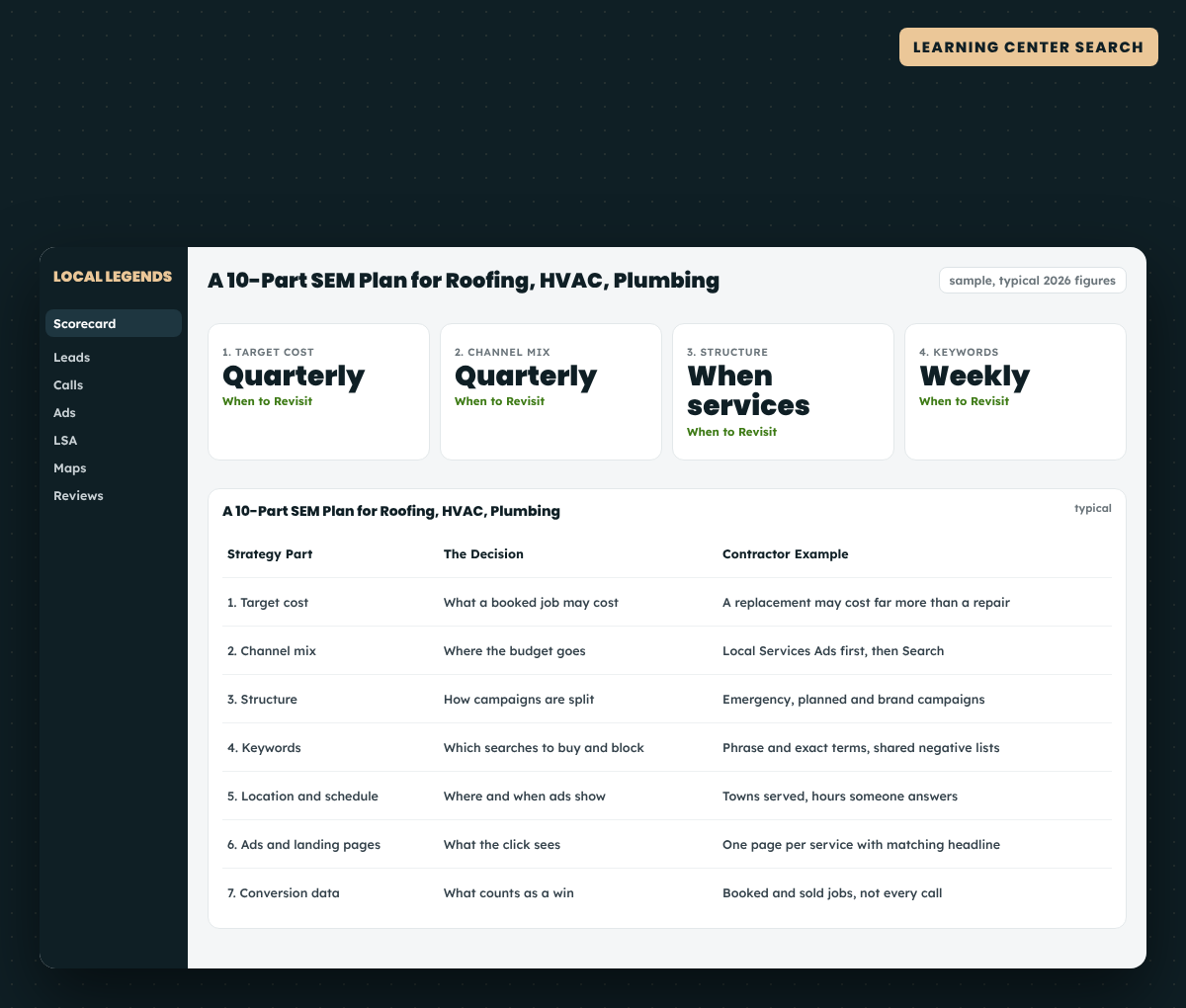
What Is a Good Search Engine Marketing Strategy for a Home Service Contractor? Ten Decisions Written Down Before the First Click
A good search engine marketing strategy for a home service contractor answers ten questions in writing before any money is spent, then revisits them on a fixed schedule. Most wasted ad spend traces back to one question nobody answered.
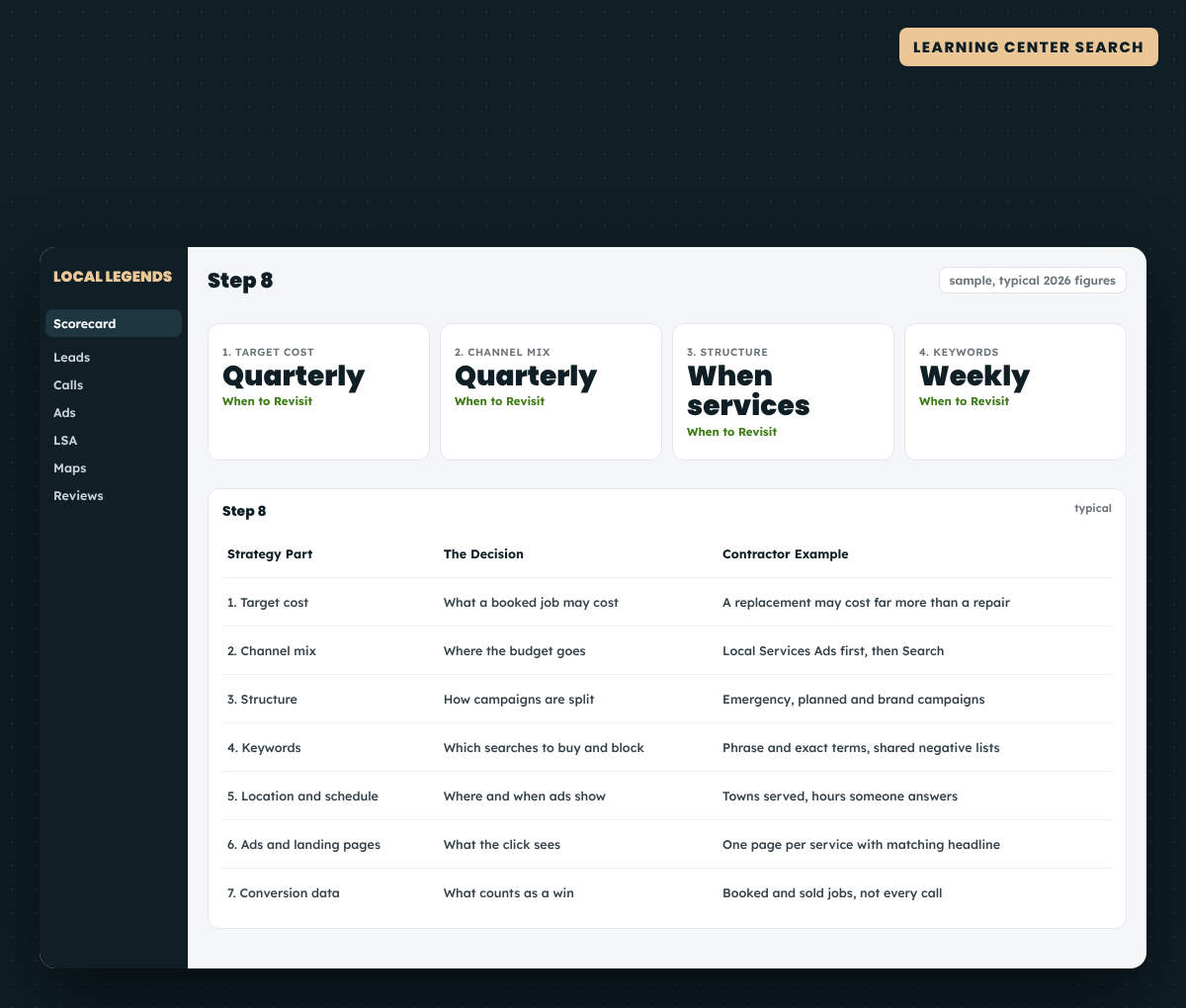
| Strategy Part | The Decision | Contractor Example | When to Revisit |
|---|---|---|---|
| 1. Target cost | What a booked job may cost | A replacement may cost far more than a repair | Quarterly |
| 2. Channel mix | Where the budget goes | Local Services Ads first, then Search | Quarterly |
| 3. Structure | How campaigns are split | Emergency, planned and brand campaigns | When services change |
| 4. Keywords | Which searches to buy and block | Phrase and exact terms, shared negative lists | Weekly |
| 5. Location and schedule | Where and when ads show | Towns served, hours someone answers | Monthly |
| 6. Ads and landing pages | What the click sees | One page per service with matching headline | Monthly |
| 7. Conversion data | What counts as a win | Booked and sold jobs, not every call | At setup, then quarterly |
| 8. Bidding | How Google sets bids | Maximize Conversions, then Target CPA or value | When volume allows |
| 9. Season | How spend moves through the year | Storm surge, summer heat, slow winter | Before each season |
| 10. Review rhythm | Who checks what, how often | Weekly terms, monthly revenue | Fixed calendar |
Paid search shares the results page with organic listings, the Map Pack and AI answers. This guide covers the paid side; the way paid and organic work together is covered in our Google Ads management service.
Step 1: Set a Target Cost per Booked Job Before Choosing a Keyword Work Backward From the Ticket
The first decision in a contractor's search engine marketing strategy is how much a booked job is allowed to cost, worked out from the company's own ticket size, close rate and marketing share. Industry averages describe someone else's business.
How Do I Work Out a Target Cost per Lead and Cost per Booked Job for Google Ads?
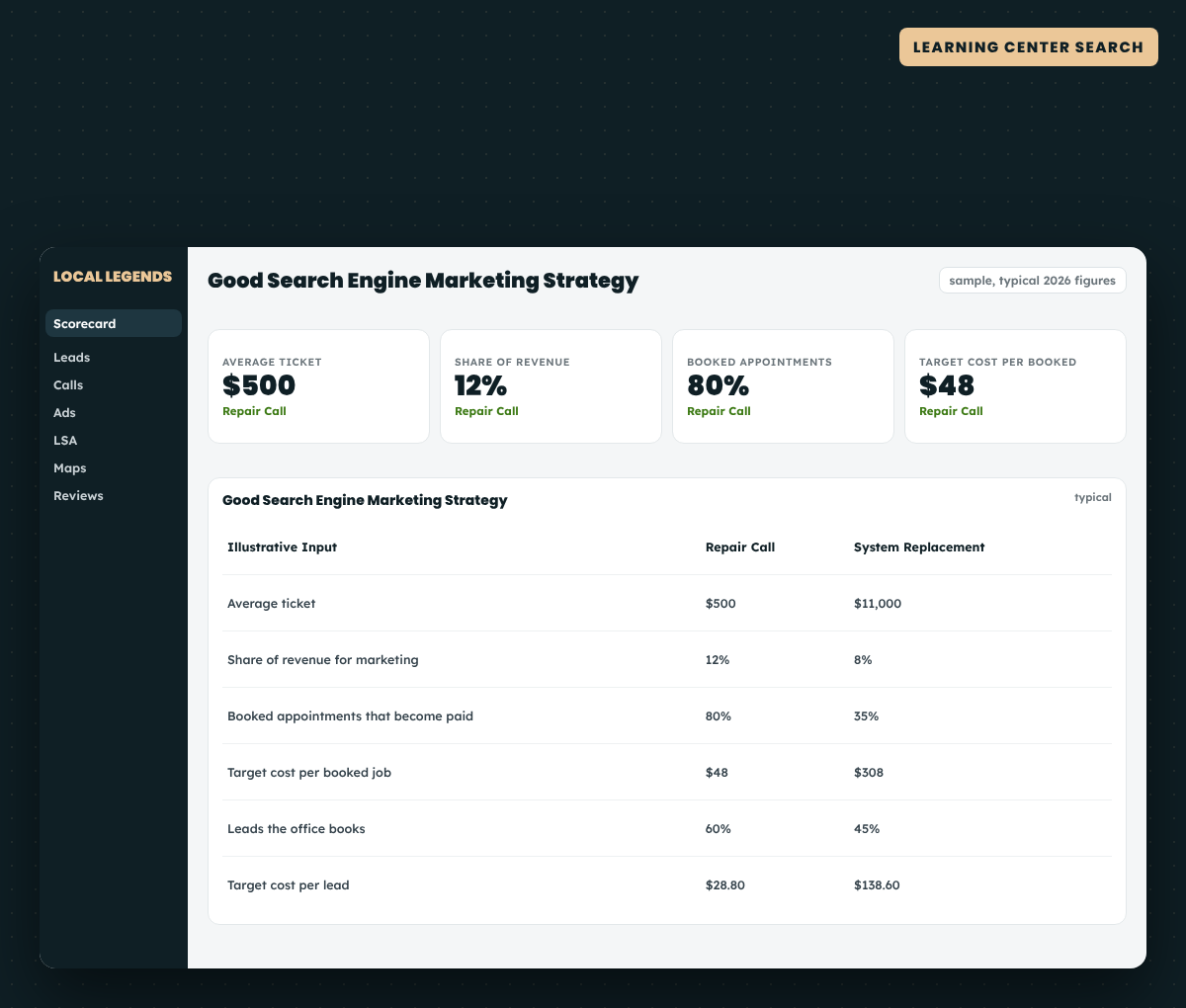
A contractor works out a target cost per booked job by multiplying the average ticket by the share of revenue set aside for marketing and by the close rate on booked appointments, then multiplies that by the office's booking rate to get a target cost per lead. Pull 60 to 90 days of numbers from your job software first.
| Illustrative Input | Repair Call | System Replacement |
|---|---|---|
| Average ticket | $500 | $11,000 |
| Share of revenue for marketing | 12% | 8% |
| Booked appointments that become paid work | 80% | 35% |
| Target cost per booked job | $48 | $308 |
| Leads the office books | 60% | 45% |
| Target cost per lead | $28.80 | $138.60 |
These numbers are an example, not a benchmark. The point is the gap: a replacement lead can cost several times a repair lead and still be profitable, which is why the two belong in separate campaigns with separate targets.
- Count the agency fee and tracking costs with ad spend when you check the result.
- Count only qualified leads: spam, job seekers and wrong numbers inflate the lead count and hide the real cost.
- Keep branded searches separate: calls from people who searched your name are cheap and make everything else look better than it is.
Step 2: Choose the Channel Mix for Contractor Search Ads Local Services Ads, Search, Performance Max and Microsoft
A contractor's channel mix decides which search ad products get the budget and in what order, and in 2026 most home service accounts start with Local Services Ads and Search. Each channel answers a different kind of search.
- Local Services Ads: pay per lead, at the top of many urgent local searches, with job types you switch on and off.
- Search campaigns: keyword control for high-ticket and emergency work that Local Services Ads cannot target by phrase.
- Performance Max: broader reach across Google's networks; it needs strong, clean conversion data to avoid low-intent placements.
- Microsoft Advertising: a smaller, often cheaper audience on Bing and partner sites, best added after Google is profitable.
The 2026 Move of Local Services Ads Into Google Ads
In August 2026 Google began moving Local Services Ads into Google Ads as Performance Max campaigns with pay-per-lead goals.
The first group included plumbing, HVAC, electrical, roofing and house cleaning, and leads are still charged per valid lead. [SOURCE: Google Ads Help, Local Services Ads transition to Performance Max with pay-per-lead goals, fetched Nov 2026]
How Should a Contractor Split the Search Budget Between Local Services Ads, Search and Performance Max?
A typical 2026 split for a home service contractor puts about half or more of paid search budget into Local Services Ads, most of the rest into Search, and little or nothing into click-based Performance Max until conversion data is strong. These are typical published ranges, not rules.
- Smaller budgets: most of the money in Local Services Ads, the rest in one Search campaign.
- Growing budgets: Search takes a larger share for high-ticket services and overflow demand.
- Larger, data-rich accounts: a measured Performance Max test with brand exclusions and job values fed back.
- Move unspent money: when Local Services Ads do not use their full budget, shift the remainder to the best Search campaign.
Is Microsoft Advertising Worth Adding to a Contractor's Search Marketing Strategy?
Microsoft Advertising is usually worth testing once a contractor's Google campaigns are profitable, because clicks are often cheaper and the audience leans toward homeowners researching planned projects. It rarely carries emergency work, which happens on phones and mostly on Google.
- Import the winners: Microsoft can copy proven Google campaigns, keywords and negatives.
- Watch partner traffic: review where ads show and exclude low-quality placements.
- Judge it the same way: cost per booked job against the same target as Google.
Local Legends adds Bing and Microsoft Advertising on the Trailblazer plan and above.
How Do I Build a Pay Per Click Strategy With a $2,000 Monthly Ad Budget? One Campaign, Tight Towns and Staffed Hours
A contractor with about $2,000 a month in ad spend builds a pay per click strategy by concentrating it: Local Services Ads plus one tightly aimed Search campaign, a short list of towns and ads only when someone answers. Spreading a small budget across many campaigns leaves each one without enough data to improve.
- Lead with Local Services Ads and switch on only the job types you want.
- Run one Search campaign with two or three ad groups, such as replacement and urgent repair.
- Use phrase and exact match on bottom-of-funnel terms and skip broad match for now.
- Load negatives before launch: jobs, salary, DIY, how to, parts, free and cheap.
- Target your most profitable towns or ZIP codes instead of a whole metro.
- Schedule ads for staffed hours so no paid call reaches voicemail.
- Send clicks to a service landing page, not the home page.
- Listen to calls weekly and add new negatives from the search terms report.
Step 3: Contractor Account Structure by Service, Urgency and Brand Split Campaigns Where the Targets Differ
A contractor's Google Ads account should be split wherever the target cost, the schedule or the message changes, which usually means separate emergency, planned and brand campaigns. One campaign holding everything forces one budget and one bid goal onto very different jobs.
Emergency Repair Campaigns for Urgent Calls
No-heat, burst pipe, active roof leak and similar urgent terms, scheduled only when calls are answered, with call assets prominent.
Planned Replacement and Install Campaigns
Replacements, installs and remodels, scheduled during office hours, sent to pages with financing, process and proof.
A Separate Campaign for Your Company Name
Your own company name in its own campaign on exact match, kept out of the other campaigns so it does not flatter their numbers.
Should My Company Run Google Ads on Our Own Name if We Already Rank First Organically?
A contractor should run a small brand campaign when competitors or lead sites show ads on its name, and can skip it when nobody does. Ads and Local Services Ads sit above organic results, so a rival's ad can catch a customer who was trying to call you.
- Check first: search your company name from a private window on a phone.
- Keep it small: a modest daily cap on exact match.
- Use it well: your real phone number, rating and current offer in the ad.
- Watch generic names: a name built from service words can match broad searches unless negatives are tight.
Should a Contractor Bid on Competitor Names in Google Ads?
Bidding on a competitor's name as a keyword is generally allowed under Google's trademark policy in the US, but most local contractors earn more from service searches. Using a competitor's trademark in the ad text can get ads restricted, and confusing wording can create legal risk.
- Intent is weaker: many searchers already chose that company.
- Clicks often cost more because the ad does not match the name searched.
- Turn off keyword insertion and automatically created assets in any competitor campaign.
- Otherwise add rival names as negatives so you are not paying for people trying to call them.
This is general marketing information, not legal advice.
Step 4: Keyword and Negative Keyword Strategy for Contractors Buy the Problem, Block the Hobbyist
Contractor keyword strategy means paying for searches from people ready to hire and blocking the searches from people who want to learn, work or buy parts. In 2026 match types are looser than they once were, so negatives do more of the work.
Should a Contractor Use Broad, Phrase or Exact Match Keywords in 2026?
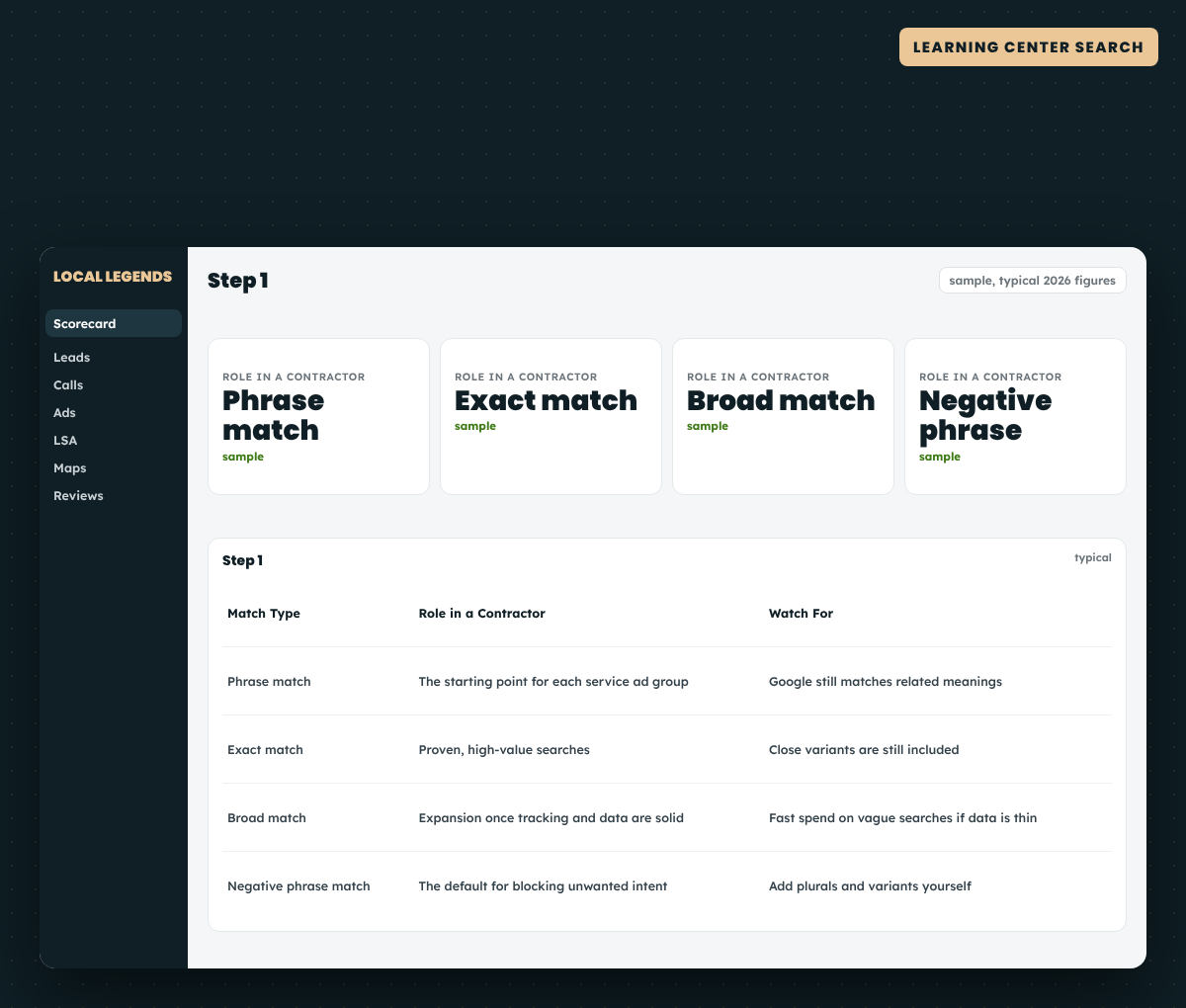
Most contractors should start with phrase match, move proven searches to exact match and save broad match for accounts with strong conversion data and Smart Bidding. The search terms report decides when to graduate a keyword.
| Match Type | Role in a Contractor Account | Watch For |
|---|---|---|
| Phrase match | The starting point for each service ad group | Google still matches related meanings |
| Exact match | Proven, high-value searches | Close variants are still included |
| Broad match | Expansion once tracking and data are solid | Fast spend on vague searches if data is thin |
| Negative phrase match | The default for blocking unwanted intent | Add plurals and variants yourself |
- Shared negative lists by theme: DIY and how-to, jobs and training, parts and supply, out-of-area towns and services you do not offer.
- Careful with single words: a negative on "free" can block "free roof inspection" if that is your offer.
- Weekly review: sort search terms by cost and block what spent without booking.
Step 5: Location and Ad Schedule Targeting for Contractors The Right Towns, When the Phone Is Answered
Location and schedule settings decide whether a contractor pays for clicks from people who can actually hire them, at hours when someone can answer. Default settings are often wider than a service area.
How Do I Make My Google Ads Show Only to People in the Towns My Company Serves?
A contractor keeps ads inside the service area by changing each campaign's location option from "Presence or interest" to "Presence: People in or regularly in your included locations," then targeting the actual towns or ZIP codes served. The default can show ads to people outside the area who search about it. [SOURCE: Google Ads Help, Target ads to geographic locations]
- Change the location option in every campaign's settings.
- List towns or ZIP codes instead of a radius that crosses a river or county line you do not cross.
- Exclude nearby areas you never serve.
- Add town names you do not serve as negatives where searchers name the place.
- Check the locations report after a week or two and exclude any leaks.
Should a Contractor Run Google Ads 24/7 or Only During Business Hours?
A contractor should run emergency campaigns around the clock only if a live person or answering service picks up, and keep planned-work campaigns to staffed hours. A paid emergency call that reaches voicemail usually becomes a competitor's job.
- Match the schedule to phone coverage, not to the hours you wish you had.
- Lean on call assets after hours, since a homeowner at 11 p.m. taps the phone number.
- Know your bidding: schedule bid adjustments are ignored by most Smart Bidding strategies, so the schedule itself does the work.
- Keep profile hours honest so the listing matches when ads run.
Step 6: Ads and Landing Pages That Match the Search One Service, One Page, One Clear Next Step
Contractor ads convert when the ad and the page both repeat the exact service and town the homeowner searched, and the next step is one tap away. A home page makes a paying visitor hunt.
What Landing Page Should a Contractor's Google Ads Campaign Send Clicks To?
A contractor's Google Ads campaign should send clicks to a dedicated page for that service, with the only exception being a brand campaign, which can use the home page. Separate intents get separate pages: storm repair and a new metal roof are different visitors.
- A headline that repeats the search, service and town.
- A call button and a short form above the fold on a phone.
- License, insurance and certifications you can document, with your real star rating and review count.
- Real photos of your trucks, crew and local jobs, plus recent reviews.
- What happens next, in three short steps, with no promise you cannot keep.
- Fast load on phones and a call button that stays on screen.
The Local Legends Google Ads and Local Services Ads plan includes the landing pages for the campaigns.
Step 7: Feed Booked Jobs Back to Google and Choose the Bidding Teach the Algorithm Which Clicks Pay
Google's automated bidding learns from whatever you mark as a conversion, so a contractor's strategy has to send back booked and sold jobs, not every phone call. When every call counts the same, Google finds more calls, including the useless ones.
How Do I Feed Booked and Sold Jobs From My CRM Back Into Google Ads?
A contractor feeds jobs back to Google Ads with offline conversion imports: the click ID or hashed customer details travel with the lead into the CRM, then return to Google when the job is booked or sold. Enhanced conversions for leads fill gaps when the click ID is lost.
- Turn on auto-tagging so every ad click carries a click ID.
- Capture it on calls and forms through call tracking and a hidden form field.
- Connect the CRM through a built-in integration or a connector.
- Promote booked or sold jobs to primary conversions, and set basic calls and forms to secondary.
- Pick the milestone by sales cycle: sold jobs for fast repair work, booked estimates for long replacement cycles.
- Mark spam and out-of-area calls so they never count.
Local Legends sets up call tracking and CRM integration for ServiceTitan, Housecall Pro, JobNimbus, AccuLynx, Jobber, Buildertrend and GoHighLevel.
When Should a Contractor Move From Maximize Conversions to Target CPA or Value-Based Bidding?
A contractor should change bidding strategies only after the campaign produces a steady monthly flow of qualified conversions and the cost per lead has settled. Switching on thin data often chokes the campaign's spend.
- Target CPA fits when jobs have similar values; Google's recommended starting target is the campaign's average cost per conversion over the last 30 days. [SOURCE: Google Ads Help, About Target CPA bidding]
- Lower the target gradually after the campaign is stable, rather than jumping to a dream number.
- Maximize Conversion Value fits when tickets range widely and real job values are imported.
- Add a return target later, once value data has run for a while.
Step 8: Plan Search Budgets Around the Season Shift Spend, Do Not Switch It Off
A contractor's search engine marketing strategy should move budget and keywords with the season instead of pausing ads, because a paused campaign loses the data its bidding depends on. Each trade has its own peaks.
How Should a Roofing Company Change Its Search Strategy in Storm Season and Slow Winter Months?
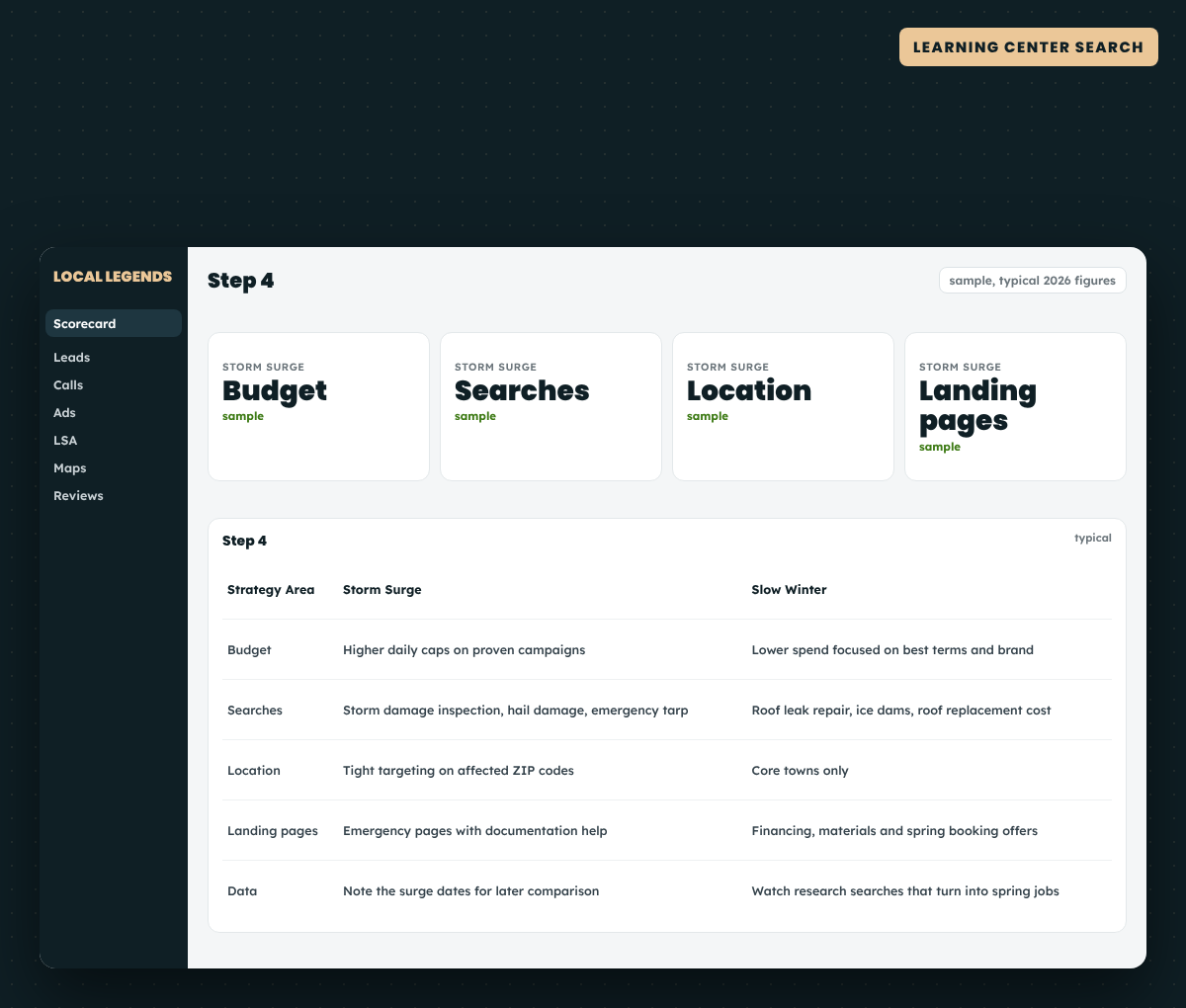
A roofing company raises budgets and narrows targeting to affected ZIP codes during storm surges, then shifts winter spend to repairs, research searches and brand protection. Campaigns built and paused before the season can go live the day weather hits.
| Strategy Area | Storm Surge | Slow Winter |
|---|---|---|
| Budget | Higher daily caps on proven campaigns | Lower spend focused on best terms and brand |
| Searches | Storm damage inspection, hail damage, emergency tarp | Roof leak repair, ice dams, roof replacement cost |
| Location | Tight targeting on affected ZIP codes | Core towns only |
| Landing pages | Emergency pages with documentation help | Financing, materials and spring booking offers |
| Data | Note the surge dates for later comparison | Watch research searches that turn into spring jobs |
Use Seasonality Adjustments for Short Spikes
Google Ads offers seasonality adjustments that tell Smart Bidding to expect a short jump in conversion rate, such as the first days after a hailstorm. They are meant for brief events, not whole seasons.
- HVAC: cooling searches rise ahead of summer heat, heating searches before the first cold snap.
- Plumbing: freeze warnings bring burst pipe searches within hours.
- Remodeling: planning searches often build in late winter for spring projects.
How Are AI Overviews, AI Mode and AI Max Changing Search Engine Marketing Strategy? Longer Questions, Broader Matching, Better Data
AI Overviews, AI Mode and AI Max for Search are pushing contractor search marketing toward broader matching, conversational questions and better conversion data, while short urgent searches still show familiar local results. The fundamentals above matter more, not less.
- Short urgent searches such as an emergency plumber near me still lean on local results and ads.
- Longer research questions now get AI-written comparisons, with ads that can appear inside or near them.
- Ad slots in AI experiences generally rely on broader matching, AI Max for Search or Performance Max, so exact-match-only accounts see less of them.
- AI Max can choose the landing page and rewrite text, which makes clean service pages and brand rules important.
- Reporting is thinner, so offline conversions from the CRM become the trusted measure.
Steps 9 and 10: Measure the Strategy and Review It on a Fixed Rhythm Weekly Waste, Monthly Revenue, Quarterly Direction
A contractor's search engine marketing strategy is working when cost per booked job stays at or under target while booked jobs grow, and that is checked on a fixed weekly, monthly and quarterly rhythm. Clicks and impressions are the first chapter of that story, not the ending.
What KPIs Show a Contractor's Search Marketing Strategy Is Working, and How Often Should the Account Be Reviewed?
The KPIs that matter most for a contractor are qualified leads, booking rate, cost per booked job and revenue from paid search, with search terms checked weekly and revenue checked monthly. Reviewing hourly invites overreaction; reviewing quarterly lets waste pile up.
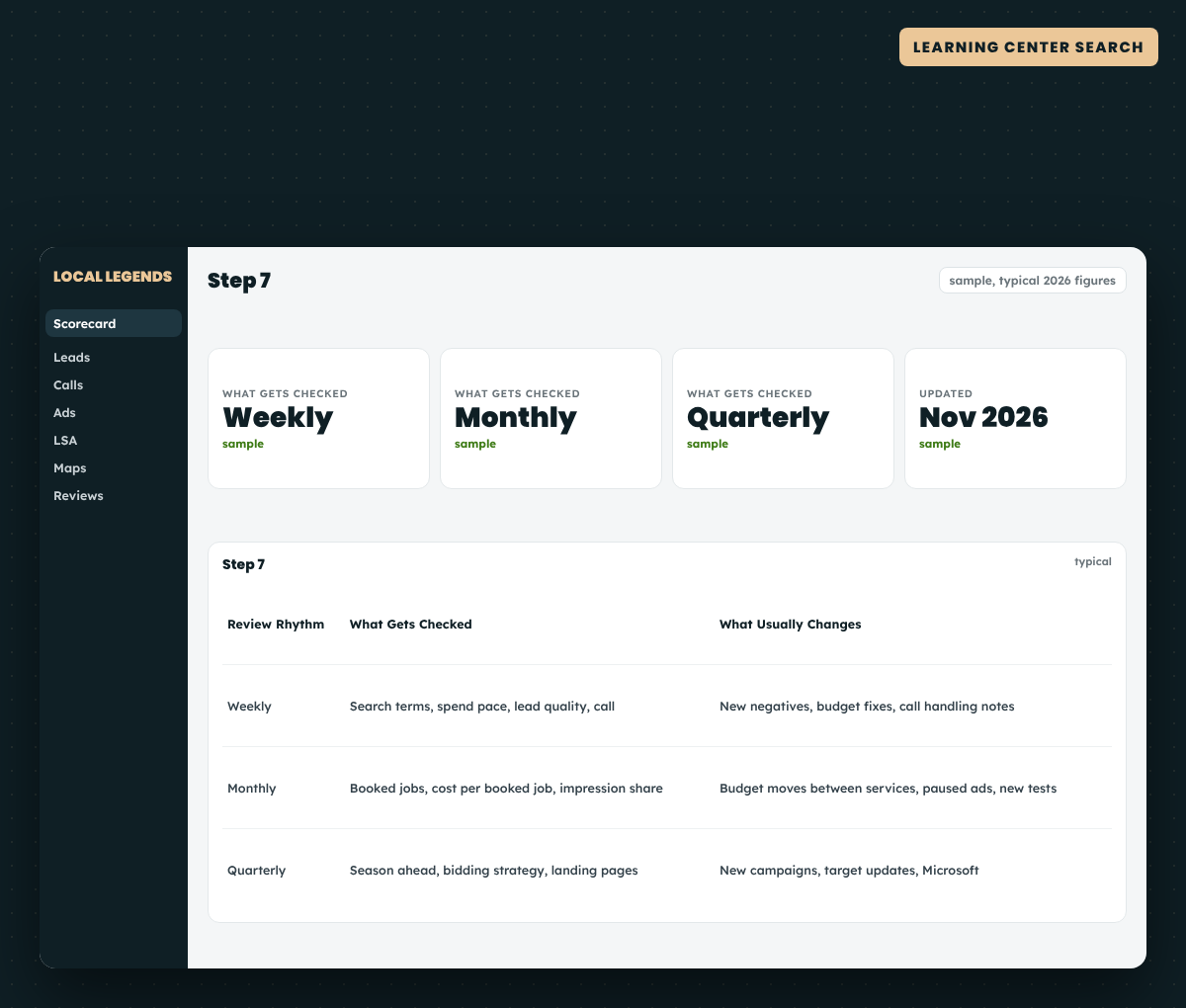
| Review Rhythm | What Gets Checked | What Usually Changes |
|---|---|---|
| Weekly | Search terms, spend pace, lead quality, call recordings | New negatives, budget fixes, call handling notes |
| Monthly | Booked jobs, cost per booked job, impression share lost to budget, ad and page tests | Budget moves between services, paused ads, new tests |
| Quarterly | Season ahead, bidding strategy, landing pages, channel mix | New campaigns, target updates, Microsoft or Performance Max tests |
- Impression share lost to budget on a campaign that books under target is a signal to spend more there.
- Rising leads with flat bookings point to targeting or call handling, not the budget.
- Owner-level scorecard: leads, booked, sold and cost per booked job, in one view.
How Much Does a Search Engine Marketing Strategy Cost a Contractor? Ad Spend Plus a Management Fee
A contractor's search marketing cost has two parts: ad spend paid to Google or Microsoft and the fee for building and running the strategy. Keeping the two separate makes it clear what the ads cost and what the work costs.
- Local Legends Google Ads and Local Services Ads management:$2,000 a month, flat, never a percentage of spend, including campaign landing pages and monthly Google Business Profile optimization.
- Local Legends growth plans: Footprint $2,500 a month, Trailblazer $4,000 (adds Bing and Facebook and Instagram ads), Sasquatch $8,000 and Legend $10,000+.
- What other agencies typically charge:$1,500-$2,500+ a month minimum or 15% to 20% of ad spend for Google Ads and Local Services Ads management.
- No setup fees and no long-term contracts on any Local Legends plan.
- Ad spend goes from your card straight to Google or Microsoft.
See every plan on the Local Legends pricing page.
How Local Legends Builds and Runs Contractor SEM Strategies Your Account, Your Data, Scored on Booked Jobs
Local Legends Marketing writes the ten-part plan with each contractor, builds the campaigns inside the contractor's own Google Ads account and reports on booked jobs and cost per booked job. A free growth audit comes first and includes a Google Maps rank grid of your towns.
Home service CEOs have recorded or written testimonials about working with founder Levi Ostlund and the team. [SOURCE: Local Legends testimonials, BRIEF.md]
Levi has been absolutely outstanding to work with over the years... His creativity, responsiveness, and deep understanding of our marketing strategy have made a huge impact." Brad Beldon, CEO, Roofing Company. Read on Local Legends
- Kyle Scott, CEO, Roofing Company (video testimonial)
- Jim Dodson, CEO, Roofing Company (video testimonial)
- Race Allen, CEO, Precision Restoration of Texas (video testimonial)
Levi Ostlund lost $30,000+ to marketers before he started the agency and later served as CMO of Amstill Roofing. The agency reports 25,000+ appointments generated and $30M+ in revenue influenced for contractors. [SOURCE: Local Legends founder story, BRIEF.md]
- One contractor per trade per city on ongoing programs.
- A weekly project review meeting and a CEO scorecard.
- Not a Google Partner: Local Legends does not claim the badge, and every account stays in your company's name.
For the full paid search service, see PPC management for contractors.
Frequently Asked Questions About Search Engine Marketing Strategy Short Answers for Contractors
What Is Search Engine Marketing in Marketing?
Search engine marketing is the practice of paying for ads on search engines such as Google and Bing so a business shows up when people search for what it sells. For contractors it mostly means search ads and Local Services Ads.
Is a Pay Per Click Strategy the Same as a Search Engine Marketing Strategy?
A pay per click strategy is the main part of a search engine marketing strategy, since most search ads charge per click. Local Services Ads charge per lead instead, so a contractor's SEM plan covers both.
Does the 80/20 Rule Apply to Google Ads for Contractors?
The 80/20 rule often shows up in contractor accounts, where a small share of keywords and towns produces most booked jobs. The search terms report and job data show which ones deserve the budget.
Are Google Ads Still Worth It for Contractors in 2026?
Google Ads are still worth it for most contractors in 2026 when spend is tied to a target cost per booked job and real jobs are fed back to Google. Accounts run on clicks alone tend to grow cost without growing the schedule.
Should a Contractor Use Performance Max?
A contractor can use Performance Max once Search is profitable and conversion data reflects real booked jobs. Without that data it tends to find cheaper, lower-intent traffic.
How Long Before a New Search Engine Marketing Strategy Shows Results?
Calls usually start within days of launch, while a strategy typically needs several weeks of data before bidding and targeting settle. Judge it on booked jobs over a full month, not the first week.
Who Should Own the Google Ads Account?
The contractor should own the Google Ads account and grant the agency access, so the history, data and billing stay with the business. Local Legends works inside client-owned accounts.
Does Local Legends Work With More Than One Contractor per Trade in My City?
No, on ongoing programs Local Legends takes one contractor per trade per city. The free growth audit confirms whether your city is open.
Reviewed by Levi Ostlund, Founder, Local Legends Marketing

Get a Search Engine Marketing Strategy Built Around Booked Jobs Start With a Free Growth Audit
Local Legends Marketing will review your ad account, tracking and landing pages, set a target cost per booked job and show which parts of your search strategy are leaking money, before you commit to anything.
- Call:(936) 900-1248
- Office: 481 Stephen F Austin Dr, Conroe, TX 77302
- Next step: book a free growth audit; Google Ads and Local Services Ads management is $2,000 a month with no setup fees