

Do Google Ads Actually Work for a Landscaping
Google Ads for Landscapers That Fill Hardscape Calendars, Lawn Care Routes and Fertilization Programs Without Paying for Mower Shoppers
Local Legends Marketing Landscaping PPC and Lawn Care PPC
Updated November 2026 · Reviewed by Levi Ostlund, Founder
Google Ads for landscapers is paid search that puts a landscaping or lawn care company at the top of Google when homeowners look for patio installation, sod, drainage work or weekly mowing near them. Local Legends Marketing runs those campaigns and follows each lead to a signed project or a renewed contract.
Landscaping search leads typically cost $85-$105+ each, per Google AI Mode in November 2026, and most companies typically spend $1,000-$3,000+ a month with Google. The Local Legends ad plan is one flat $2,000 monthly fee covering both Google Ads and Local Services Ads, landing pages built in.
- Installs and maintenance kept apart: hardscape, lawn maintenance and fertilization each get their own budget.
- Bids follow project value: signed contract amounts flow back to Google so it learns who buys patios.
- Budgets follow the crew calendar: heavy in late winter and spring, trimmed when routes are full.
- Every lead tracked: CallRail numbers and form sources tied to booked estimates and signed jobs.
- Your city stays yours: Local Legends signs one landscaper per city for ongoing ads.
Free Growth Audit
Your Reviews, Radius and Response Rate vs the competitors beating you.
About Local Legends Marketing
A home service marketing agency headquartered in Conroe, Texas, with 8+ years of marketing experience, running Google Ads, Local Services Ads, local SEO, AI SEO, connected TV and review systems for contractors nationwide.
Do Google Ads Actually Work for a Landscaping and Lawn Care Company? Yes for Installs, With Conditions for Mowing
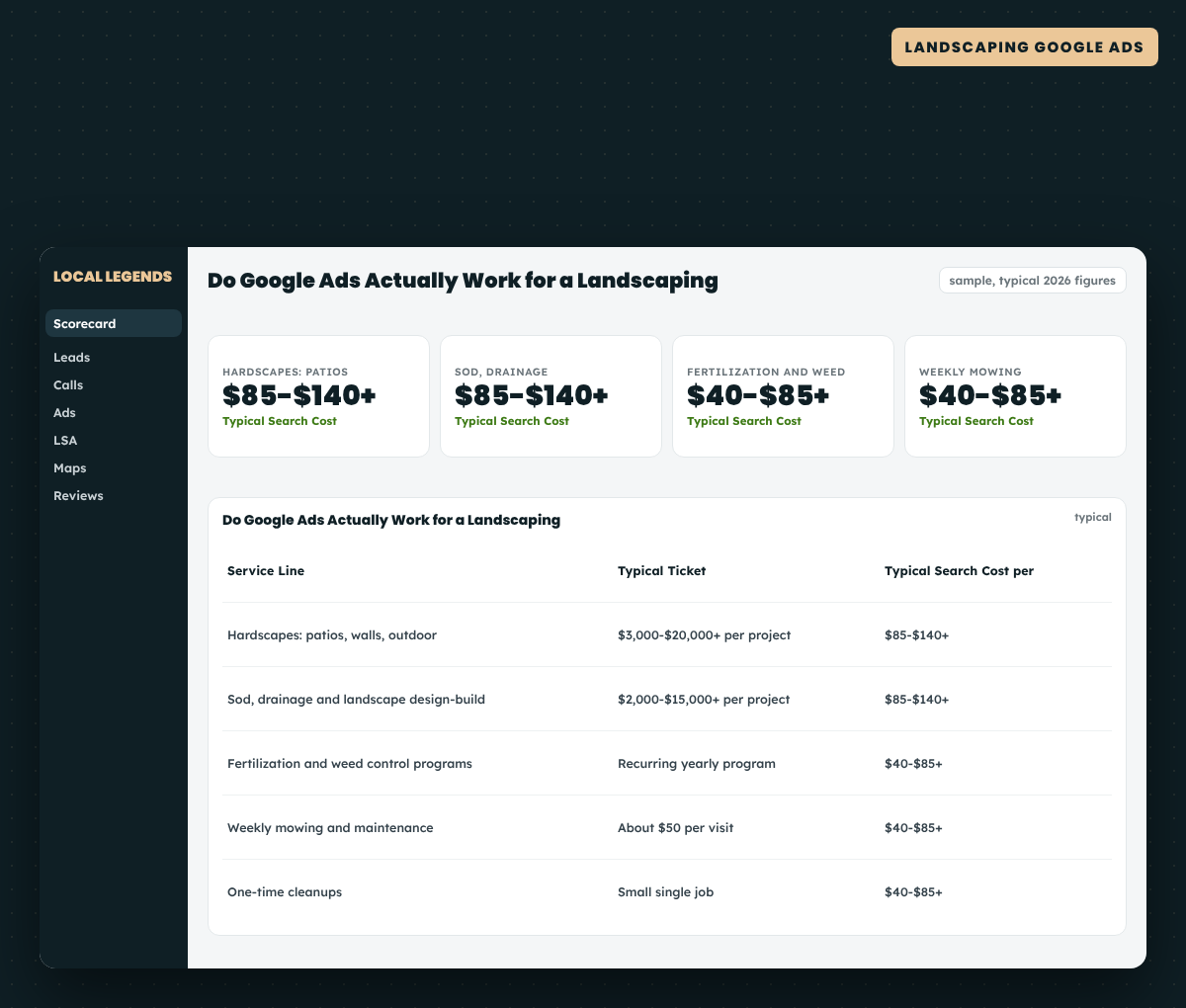
Google Ads works well for landscaping companies selling high-ticket installs, and it works for lawn care only when customers stay for a full season or longer. Google AI Mode gave that verdict in November 2026: the math breaks on one-time mows and holds on patios, walls and recurring programs.
The reason is simple arithmetic. A landscaping company that pays about $250 to win a customer is happy when the job is a $15,000 retaining wall and unhappy when it is a single $50 cut. Landscaping PPC lives or dies on which services the budget is allowed to chase.
| Service Line (Typical, Nov 2026) | Typical Ticket | Typical Search Cost per Lead | Does Google Ads Pay? |
|---|---|---|---|
| Hardscapes: patios, walls, outdoor kitchens | $3,000-$20,000+ per project | $85-$140+ | Yes, a strong fit |
| Sod, drainage and landscape design-build | $2,000-$15,000+ per project | $85-$140+ | Yes, a strong fit |
| Fertilization and weed control programs | Recurring yearly program | $40-$85+ | Yes, when customers renew |
| Weekly mowing and maintenance | About $50 per visit | $40-$85+ | Only with high retention and dense routes |
| One-time cleanups | Small single job | $40-$85+ | Rarely on its own |
These are typical ranges from Google AI Mode and the industry benchmarks it cited, not Local Legends results or quotes. AI Mode added that landscaping close rates typically run 30% to 50% on qualified leads, which puts a paying customer at about $200-$300+.
Should My Landscaping Company Use Google Local Services Ads or Google Search Ads?
Most full-service landscaping companies should use Google Local Services Ads for maintenance and quick-turn jobs and Google search ads for hardscape and design-build projects, running both when the budget allows. Google AI Mode recommended that split in November 2026.
- Local Services Ads: pay per lead, top placement and a verified badge; typical leads run $38-$130+.
- Search ads: pay per click, full control of keywords, copy and project landing pages.
- Reviews matter for Local Services Ads: AI Mode said companies with fewer than 10 to 15 reviews often do better starting with search.
- Answer fast: AI Mode reported that missed Local Services Ads calls can still be billed as leads.
Both run under the same flat ad plan, and landscaping category choices are walked through on the Google Local Services Ads page. Weekly lead quality checks cover every landscaping lead: junk and out-of-area calls get flagged and the targeting is tuned.
Is Lawn Care PPC Worth It for a New Lawn Care Business With One Crew and Few Reviews?
Lawn care PPC is usually not worth it yet for a new one-crew company with only a handful of reviews, because thin social proof lowers conversion and scattered leads break route density. Google AI Mode gave that advice in November 2026 and suggested waiting until the company has about 15 to 25 reviews.
- Build the profile first: real truck, crew and before and after photos.
- Ask every early customer for a review.
- Door hangers around each finished yard: neighbors see the work in person.
- Neighborhood groups: respond quickly and professionally to recommendation requests.
- Then add PPC: to fill open slots or push higher-margin cleanups, aeration and mulch.
AI Mode estimated a meaningful lawn care search budget typically starts around $1,500-$3,000+ a month, which is a lot to test before the reviews are in place.
How Do I Get Bigger Hardscape and Patio Leads From Google Ads Instead of Small Mowing Jobs? Separate the Money Before Google Mixes It
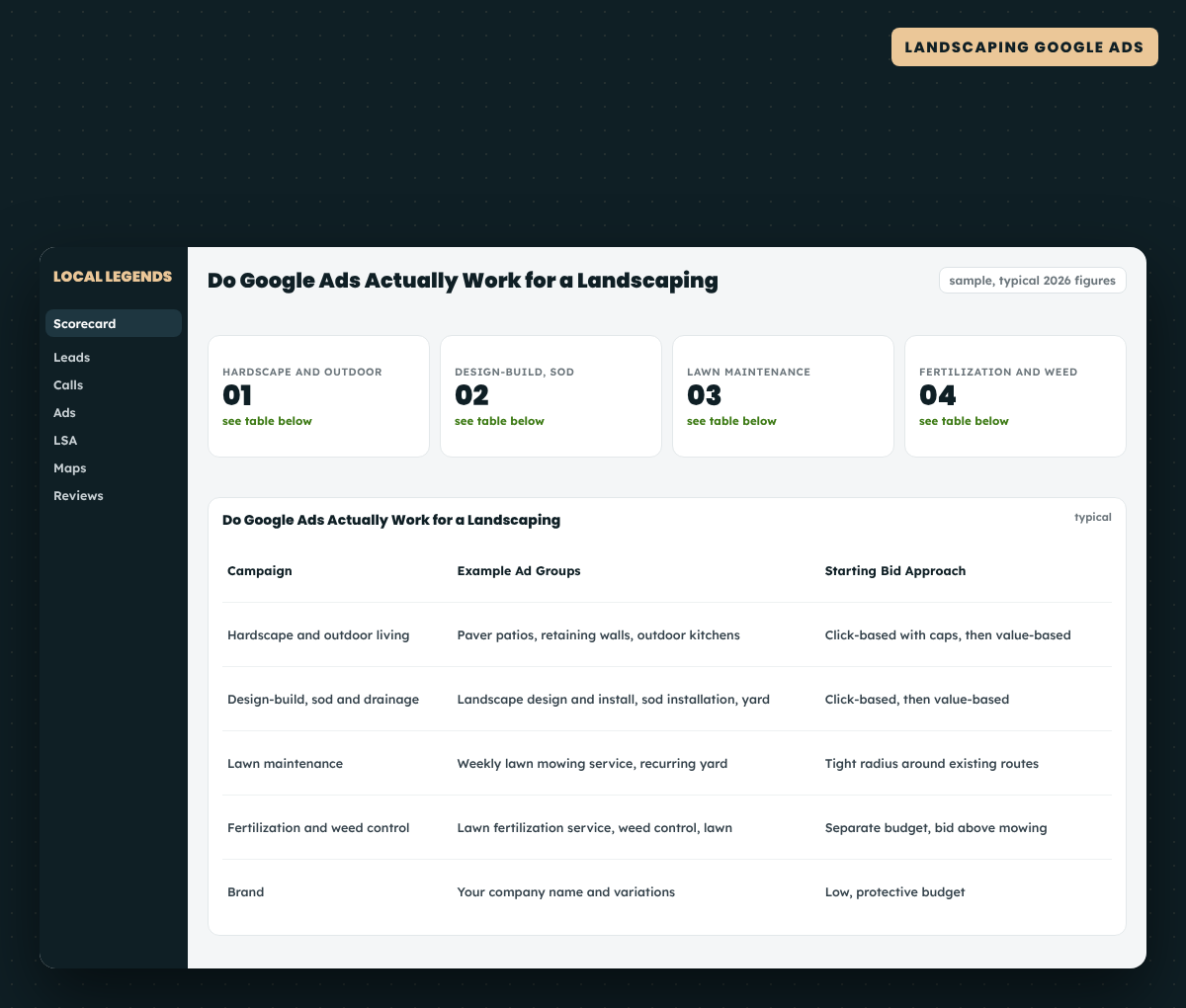
A landscaping company gets bigger hardscape leads by running hardscape in its own campaign, bidding only on project-specific keywords and blocking maintenance searches inside that campaign. Google AI Mode explained in November 2026 that one combined "landscaping" campaign lets Google drift toward the cheapest conversions, which are usually quick cuts.
| Campaign | Example Ad Groups | Starting Bid Approach | Conversion Goal |
|---|---|---|---|
| Hardscape and outdoor living | Paver patios, retaining walls, outdoor kitchens, pergolas | Click-based with caps, then value-based | Qualified estimate and signed contract value |
| Design-build, sod and drainage | Landscape design and install, sod installation, yard drainage | Click-based, then value-based | Qualified estimate and signed contract value |
| Lawn maintenance | Weekly lawn mowing service, recurring yard maintenance | Tight radius around existing routes | Booked first visit and season signups |
| Fertilization and weed control | Lawn fertilization service, weed control, lawn treatment program | Separate budget, bid above mowing | Program signups |
| Brand | Your company name and variations | Low, protective budget | Calls and forms |
Negatives That Belong Only in the Hardscape Campaign
Mowing, grass cutting, mulch, cleanup and weed terms are negatives in the hardscape campaign, not across the account, because the maintenance campaign still wants them. Account-wide negatives cover jobs, equipment, rentals, retail stores and do it yourself searches.
The Word "Landscape" Has Other Meanings
Searchers also type "landscape" when they mean a photo orientation, a painting style or wallpaper. Google AI Mode cited negative lists that block landscape mode, landscape painting, landscape photography, wallpaper and landscape architecture school.
Qualify the Buyer Before the Click
Ad copy that states a real starting price or project scope, such as full backyard design and build, turns away small-job shoppers before they cost a click. Only publish a minimum the company actually holds to.
Can a Landscaping Company Target Higher-Income Neighborhoods or Zip Codes With Google Ads?
Yes, a landscaping company can focus Google Ads on specific zip codes, tight radiuses around upscale subdivisions and, in the United States, household income tiers, which helps patio and outdoor living campaigns reach homeowners likely to invest. Google AI Mode confirmed those controls in November 2026.
- Zip code targeting: areas with higher home values inside the crew's real travel range.
- Radius pins: around master-planned communities and established subdivisions.
- Household income tiers: top 10%, 11% to 20% and 21% to 30% as bid adjustments or observation.
- Presence targeting: people in or regularly in those areas, not people who only show interest.
- A caution: Google's location and income signals are estimates, so judge results by signed projects.
AI Mode also noted that Google limits demographic targeting for housing ads, while landscaping and home improvement services are generally allowed.
What Keywords Should a Lawn Care Company Bid On in Google Ads for Mowing and Fertilization?
A lawn care company should bid on hiring phrases such as "weekly lawn mowing service" and "lawn fertilization service" in two separate campaigns, one for mowing and one for treatments. Google AI Mode recommended that split in November 2026 because treatment programs typically carry higher lifetime value and renew.
- Mowing phrases: weekly lawn mowing service, grass cutting service, residential lawn mowing, recurring lawn service.
- Treatment phrases: lawn fertilization service, weed control service, lawn treatment program, crabgrass control service.
- Town modifiers: the service plus each town on the routes.
- Skip single words:"lawn mowing" alone pulls in people shopping for mowers.
- Lawn care negatives: spreader, seed, blades, repair, rental, store names and jobs.
Mowing ads work best inside a tight radius around existing routes, where each new stop adds density instead of drive time.
Landscaping Google Ads Landing Pages and Ad Copy The Project Photos Do the Selling
Landscaping Google Ads convert when each ad lands on a page built for that one service, led by real local project photos and a quote form that matches the size of the job. A homeowner pricing a $25,000 patio wants different proof than a homeowner booking weekly mowing.
Responsive Search Ads for Landscapers
Responsive search ads allow up to 15 headlines of 30 characters and 4 descriptions of 90 characters. For landscaping, headlines that name the service and the town, the design process and real credentials outperform generic "beautiful yards" lines.
What Should a Landscaping or Hardscape Landing Page for Google Ads Include?
A landscaping or hardscape landing page for Google Ads should open with a headline that repeats the service and town searched, three to five real photos of finished local work and the star rating, then ask for the details that separate a project from a small job. Google AI Mode listed those elements in November 2026.
- No main menu: one goal, a quote request or a design consultation.
- Real photos first: before and after shots from local yards, never stock images.
- Reviews near the top: rating, review count and one or two local quotes.
- Form by job size: short for maintenance; project type, timeline and budget range for hardscape.
- Sticky call button on mobile.
- Service area list: the towns and neighborhoods the crews reach.
- Credentials: state licenses, insurance, years in business, installer training, warranties and financing where offered.
- A three-step process: walkthrough, design and quote, installation.
Campaign landing pages are part of the $2,000 Local Legends ad plan; permanent project galleries and service pages are built through website design. [SOURCE: Confirmed claim that the Google Ads plus LSA fee covers campaign landing pages, BRIEF.md Nov 10 2026]
Do I Need a Pesticide Applicator License to Advertise Lawn Fertilization and Weed Control on Google?
A lawn care company that applies herbicides or other pesticides for hire typically needs a state pesticide applicator license, and Google's Local Services Ads verification can ask for it when weed control is listed on the profile. Google AI Mode raised both points in November 2026.
- State rules vary: check your state department of agriculture before advertising weed control.
- Fertilizer-only work: in at least some states it does not require a pesticide license, but weed-and-feed products do.
- Match the names: the license, insurance certificate and Google profile should show the same legal business name.
- Until licensed: advertise only the services you are licensed to perform.
Local Legends asks for license details during onboarding so ads, pages and the Google Business Profile describe only services the company is licensed to sell.
How Do I Use Offline Conversions and Value-Based Bidding So Google Ads Finds Landscaping Customers Who Sign Big Projects? Teach Google What a Patio Is Worth
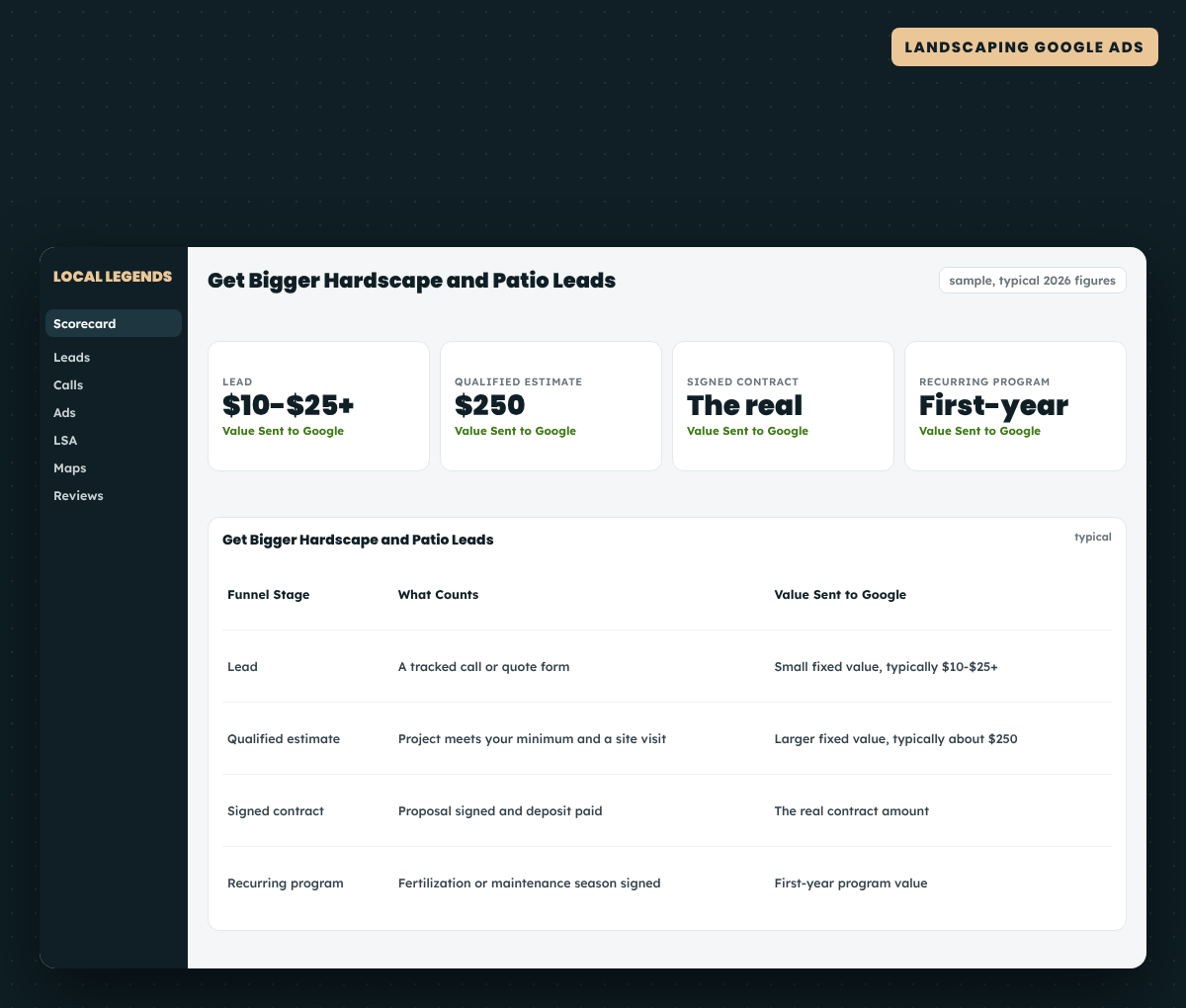
A landscaping company teaches Google Ads to find big-project buyers by sending signed contract values back as offline conversions and then switching to value-based bidding, so Google stops treating a leaf cleanup and a $45,000 hardscape install as the same lead. Google AI Mode described that setup in November 2026.
| Funnel Stage | What Counts | Value Sent to Google | Setting |
|---|---|---|---|
| Lead | A tracked call or quote form | Small fixed value, typically $10-$25+ | Secondary while volume builds |
| Qualified estimate | Project meets your minimum and a site visit is booked | Larger fixed value, typically about $250 | Primary once data is clean |
| Signed contract | Proposal signed and deposit paid | The real contract amount | Primary, drives value-based bidding |
| Recurring program | Fertilization or maintenance season signed | First-year program value | Primary for the lawn care campaigns |
The fixed values above are examples Google AI Mode gave in November 2026; each company sets its own from its average job size and close rate.
The Order of Operations
- Auto-tagging on so every ad click carries a Google click ID.
- Click IDs in hidden form fields and stored with each lead in the CRM.
- Call tracking or enhanced conversions for leads so phone leads match back to their click.
- Offline actions set to secondary for two to four weeks while the numbers are checked against the CRM.
- Switch to primary after roughly 15 to 30 qualified or closed conversions in 30 days.
- Maximize conversion value, then add a target return on ad spend once results settle.
- Upload within 90 days of the click, daily or weekly.
What the landscaping owner sees: a weekly or monthly CEO scorecard of leads, booked estimates, sold jobs and cost per booked job from CallRail data, while the ad account, domain, site and every call recording remain registered to the landscaping company. [SOURCE: BRIEF.md CEO scorecard, CallRail tracking and client ownership facts, Nov 2026]
Jobber, ServiceTitan and other CRM hookups are explained under call tracking and CRM.
Is Performance Max or YouTube Demand Gen a Good Idea for a Landscaping and Hardscape Company?
Performance Max and Demand Gen can both work for landscaping and hardscape companies, but only after search campaigns are running and conversion tracking reports signed jobs. Google AI Mode gave that order in November 2026 and noted that landscaping is one of the more visual trades.
- Performance Max: adds Maps, YouTube, Gmail and Discover reach for active demand; exclude your own brand name.
- Demand Gen: shows before and after video and drone footage to homeowners planning backyard upgrades.
- Budget share for Demand Gen: AI Mode suggested starting around 10% to 15% of ad spend.
- The risk: weak tracking lets either campaign optimize for junk forms and do it yourself traffic.
Since the 2026 move, Local Services Ads show up in Google Ads labeled as Performance Max with a pay per lead goal; that is not the same as a standard Performance Max build.
Landscaping PPC Budgets Through the Season Spend Early, Then Trim
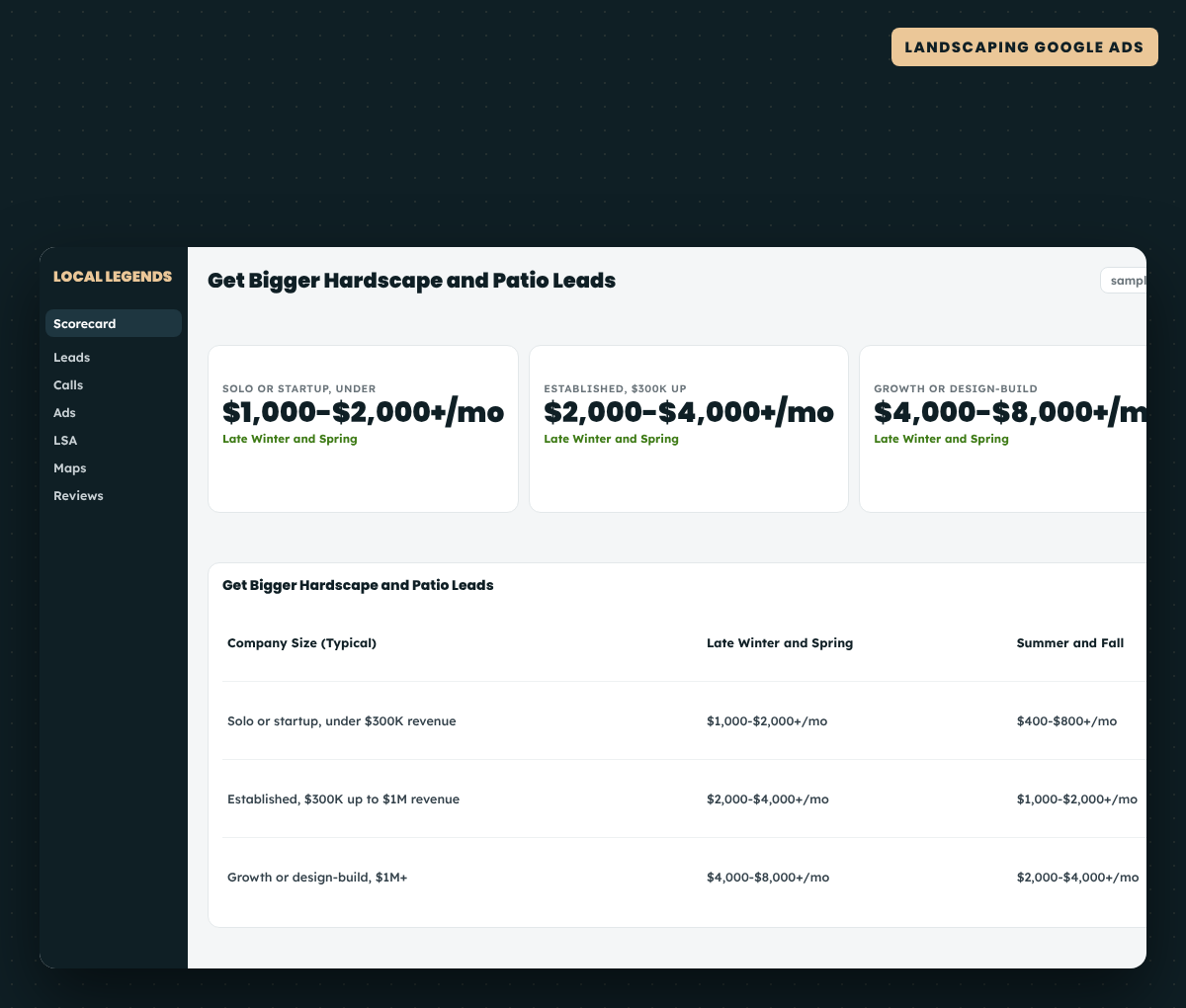
Landscaping PPC budgets should rise in late winter, peak through spring and taper when routes are full, because homeowners sign patios and lawn programs weeks before the first warm weekend. Google AI Mode reported in November 2026 that landscapers typically put 65% to 75% of yearly paid spend into the peak six to seven months.
| Company Size (Typical) | Late Winter and Spring (Feb to May) | Summer and Fall (Jun to Oct) | Winter (Nov to Jan) |
|---|---|---|---|
| Solo or startup, under $300K revenue | $1,000-$2,000+/mo | $400-$800+/mo | $0-$300+/mo, pause or minimal |
| Established, $300K up to $1M revenue | $2,000-$4,000+/mo | $1,000-$2,000+/mo | $300-$750+/mo, design and snow only |
| Growth or design-build, $1M+ | $4,000-$8,000+/mo | $2,000-$4,000+/mo | $750-$1,500+/mo |
These monthly ad spend ranges are typical figures from Google AI Mode in November 2026, paid directly to Google, and they shift with climate and region.
My Landscaping Crews Are Booked Out for Weeks in Spring. Should I Pause Google Ads?
Most landscaping companies booked out in spring should cut Google Ads to a reduced, targeted budget instead of pausing, so the pipeline does not dry up in three weeks and the account keeps its conversion history. Google AI Mode gave that advice in November 2026.
- Cut the daily budget by about 50% to 70%.
- Pause quick-turn ad groups: routine mowing and spring cleanups.
- Keep project ads running: patio and renovation buyers expect a wait.
- Tighten the radius to the most profitable zip codes.
- Update the copy with the next open start month.
AI Mode said a full pause makes sense only when leads are going unanswered, because paying for calls that reach voicemail wastes the click and the reputation.
How Should a Landscaping Company Run Google Ads in Late Fall and Winter to Book Spring Projects?
In late fall and winter, a landscaping company should move its smaller budget from maintenance to design consultations for patios, walls, outdoor kitchens and drainage, then raise spend four to six weeks before the local spring rush. Google AI Mode laid out that plan in November 2026.
- Pause mowing, mulch and cleanup ad groups.
- Sell the consultation: a winter design visit that secures a spring install date.
- Use real offers only: priority scheduling or design renderings, if the company provides them.
- Hold a baseline budget: AI Mode suggested typically $30-$50+ a day rather than turning ads off.
- Snow markets: a separate snow removal campaign where crews plow.
How Much Does Google Ads Management Cost for a Landscaping Company? Management Fee, Ad Spend and the Total
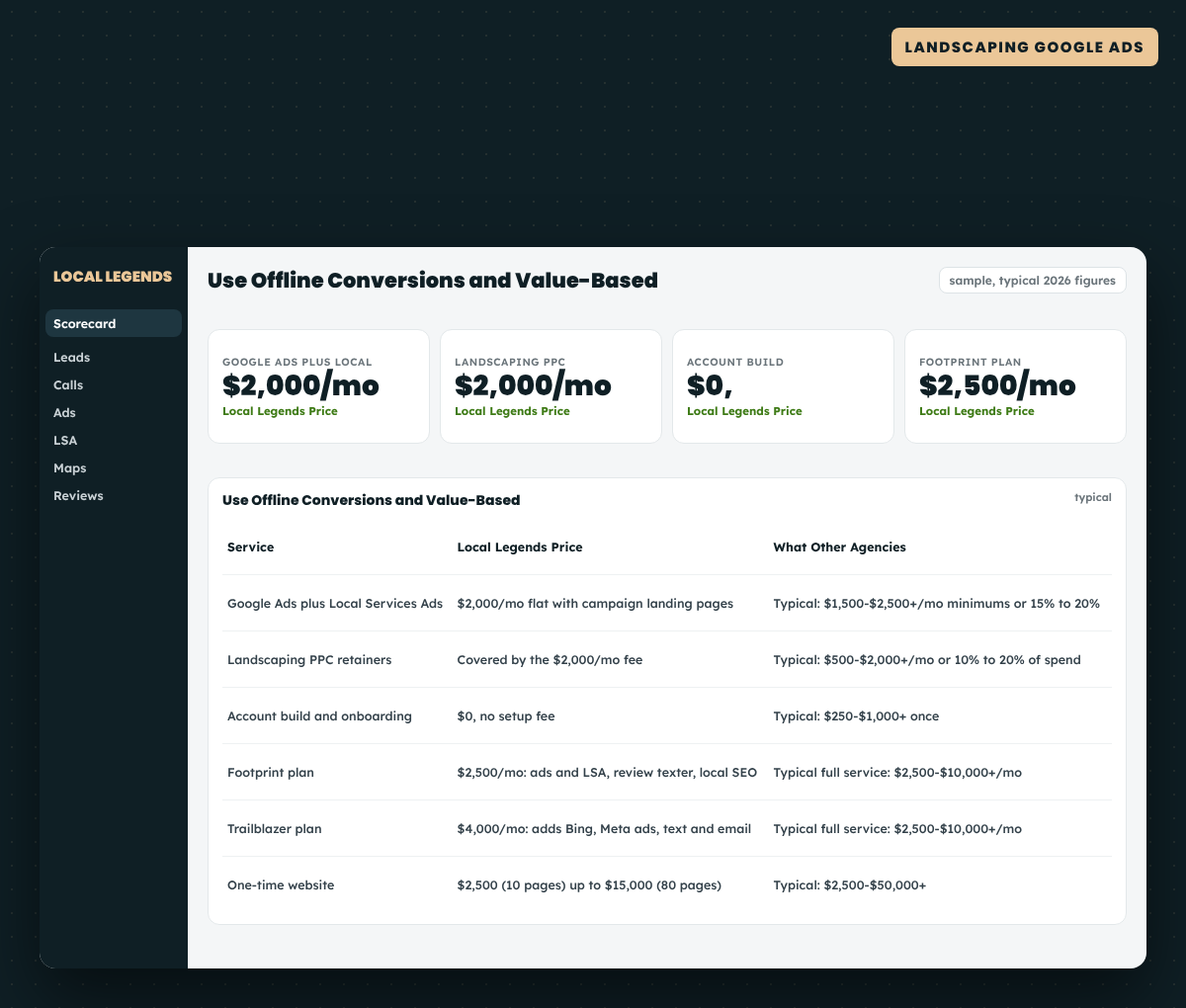
Google Ads management for a landscaping or lawn care company typically costs $500-$2,000+ a month in agency fees on top of $1,000-$3,000+ a month in ad spend, according to Google AI Mode in November 2026. That puts the typical all-in total at $1,500-$4,500+ a month.
| Service | Local Legends Price | What Other Agencies Typically Charge |
|---|---|---|
| Google Ads plus Local Services Ads | $2,000/mo flat with campaign landing pages and a monthly Google Business Profile tune-up | Typical: $1,500-$2,500+/mo minimums or 15% to 20% of spend |
| Landscaping PPC retainers (AI Mode, Nov 2026) | Covered by the $2,000/mo fee | Typical: $500-$2,000+/mo or 10% to 20% of spend |
| Account build and onboarding | $0, no setup fee | Typical: $250-$1,000+ once |
| Footprint plan | $2,500/mo: ads and LSA, review texter, local SEO with 70+ citations, call tracking | Typical full service: $2,500-$10,000+/mo |
| Trailblazer plan | $4,000/mo: adds Bing, Meta ads, text and email follow-up, a weekly scorecard | Typical full service: $2,500-$10,000+/mo |
| One-time website | $2,500 (10 pages) up to $15,000 (80 pages) | Typical: $2,500-$50,000+ |
- The fee stays flat as spend grows, with no percentage taken.
- Clicks are billed by Google to the landscaper's own card.
- Terms run month to month.
- Other-agency figures are typical market ranges, not any single firm's quote.
Full plan details sit on the Local Legends pricing page.
How Much Should a Landscaping Company Spend on Google Ads per Month?
Most landscaping companies typically spend $1,500-$5,000+ a month on Google Ads during the spring peak and $400-$1,500+ a month the rest of the year, according to Google AI Mode in November 2026. Budgets under about $400 a month rarely produce enough clicks to learn from.
- Work backward: new jobs wanted, divided by close rate, times target cost per lead.
- Typical cost per lead: search $48-$120+ and Local Services Ads $20-$72+, per AI Mode.
- Double the baseline in February or March, hold through May.
- Halve it once recurring routes are full.
Treat these as typical AI Mode ranges, not a Local Legends forecast; your own starting number comes out of the free growth audit.
Choosing Who Runs Your Landscaping Google Ads Do It Yourself, Freelancer or Agency
The choice between running landscaping Google Ads yourself and hiring help comes down to ad spend, the services you push and the hours you have in peak season. Google AI Mode drew the line at about $2,500-$3,000+ a month in November 2026.
Should I Run Google Ads Myself or Hire an Agency for My Landscaping Business?
A landscaping owner spending under about $2,500-$3,000+ a month can often run Local Services Ads alone, while companies pushing hardscape search campaigns above that level usually save money with a specialist. Google AI Mode added that trial-and-error mistakes can cost more than a year of management fees.
- Do it yourself: two to three hours every week on search terms, negatives and bids, even in April.
- Freelancer setup: a one-time build of the account and tracking, typically $500-$1,000+, then self-managed.
- Agency: when estimating, crews and sales are a better use of the owner's time.
Before hiring anyone, ask these questions:
- Will the campaigns live in my own Google Ads account with admin access?
- How will you separate maintenance from installs?
- How will budgets shift between spring, summer, fall and winter?
- Can I hear call recordings tied to each keyword?
- What is the contract length and cancellation policy?
- Will ads go to my home page or to service landing pages?
Where Local Legends stands on each one: campaigns are built in the landscaper's own account, maintenance and installs are split from day one, a weekly project review sets the seasonal moves, contracts run month to month with published prices, one landscaper is signed per city and the Local Legends marketing course comes with every engagement. [SOURCE: BRIEF.md ownership, weekly review, pricing and course facts; BRIEF_V2.md rule 9 territory, Nov 28 2026]
Local Legends holds no Google Partner badge and never implies one. For every channel beyond search, see landscaping marketing; the all-trade search offer is on Google Ads management.
The Local Legends Process for Landscaping Google Ads Audit, Track, Split, Pace
The Local Legends process for landscaping Google Ads runs in four steps: a free growth audit, tracking, a split account and weekly pacing against crew capacity. Each step is measured in booked estimates and signed work.
Step 1: Free Growth Audit
The audit opens your existing ad accounts, checks how calls are tracked and booked, and runs Google Maps rank grids over each town on the routes.
Step 2: Tracking Before Spend
CallRail numbers, click IDs on forms and offline conversion actions for estimates, contracts and programs go in before budgets rise.
Step 3: Split the Account
Hardscape, design-build, maintenance, fertilization and brand campaigns launch with their own budgets, negatives and landing pages.
Step 4: Weekly Pacing and Lead Quality Checks
Weekly, every landscaping lead gets a quality check, out-of-area and junk calls are flagged, and budgets follow the season and how far out crews are booked. Reviews from finished jobs feed back through the LSA Ranker review texter and review management.
Landscaping Google Ads Reviews From Home Service CEOs Named Owners, Real Words
Four home service CEOs have publicly vouched for Local Legends Marketing and Levi Ostlund. No landscaping case studies appear here because none would be made up; these testimonials are the record.
Levi has been absolutely outstanding to work with over the years... His creativity, responsiveness, and deep understanding of our marketing strategy have made a huge impact." Brad Beldon, CEO, Roofing Company. Read on Local Legends
- Kyle Scott, CEO, Roofing Company (video testimonial)
- Jim Dodson, CEO, Roofing Company (video testimonial)
- Race Allen, CEO, Precision Restoration of Texas (video testimonial)
- Brad Beldon, CEO, Roofing Company (written testimonial)
Frequently Asked Questions About Google Ads for Landscapers Answers for Landscapers
What Daily Budget Should a Landscaper Start With?
Many landscapers typically start around $50-$100+ a day in spring, according to AI Mode. Smaller budgets should focus on one high-margin service.
Which Bid Strategy Should a New Landscaping Account Use?
New accounts typically start with click-based bidding and a cost cap, then move to conversion-based bidding once tracking is verified. Value-based bidding comes after signed jobs flow back.
Should Landscaping Ads Run on Search Partners and Display?
No, keep landscaping search campaigns on the Google Search Network only at launch. Partner and display clicks are typically lower quality.
Do Snow Removal Ads Belong in the Same Campaign?
No, snow removal gets its own campaign and budget in markets where crews plow. It runs on a different calendar.
Can I Advertise a Price in Landscaping Ads?
Yes, when the price or minimum is real and current. A stated minimum filters out small-job shoppers.
Will Local Legends Work With Another Landscaper in My City?
No, only one landscaping company per city is signed for ongoing ads. The audit confirms whether your city is open.
Who Owns the Google Ads Account?
The landscaping company owns it, with billing and call data. Local Legends works inside it with manager access.
Do You Manage Lawn Care Companies That Only Do Treatments?
Yes, fertilization and weed control companies get their own program campaigns and license checks. Mowing campaigns are optional.
Reviewed by Levi Ostlund, Founder, Local Legends Marketing
Get Google Ads for Landscapers That Book Projects You Want Start With a Landscaping Audit
A free growth audit shows where landscaping ad money leaks, from mower-shopper searches to a missing campaign split to calls nobody tracked. Local Legends Marketing walks through it with you and picks the first service and towns to fund.
- $2,000 a month flat for Google Ads plus Local Services Ads, with landing pages.
- Zero setup fees, month to month.
- One landscaper per city on ongoing ads.
To book, call (936) 900-1248 or request the audit online. Landscaping and lawn care companies in all 50 states can check the Local Legends service areas page.