


Paying Only for Searches That Turn Into Calls

Google Ad Keywords for Contractors: How Roofers, HVAC Companies, Plumbers and Remodelers Find, Match and Manage the Searches That Book Jobs in 2026
Paying Only for Searches That Turn Into Calls
Updated November 2026 · Reviewed by Levi Ostlund, Founder
Google ad keywords are the words and phrases a contractor tells Google Ads to match, so its ads show when a homeowner searches for that service. The keyword, its match type and the negative keywords around it decide which searches you pay for, from "emergency plumber near me" to "plumber jobs".
The keywords that book jobs for home service companies pair a specific service with urgency or a place: "water heater repair," "roof leak repair near me," "AC replacement" plus the town. Broad, one-word terms and research searches cost money and rarely produce a call.
- Find: Keyword Planner, autocomplete and your own search terms report.
- Match: phrase and exact match first, broad match once tracking is proven.
- Block: negative keywords for jobs, DIY, parts and services you do not offer.
- Group: one job per ad group, each with its own ad and landing page.
- Review: search terms every week, judged by calls and booked jobs.
Free Growth Audit
Your Reviews, Radius and Response Rate vs the competitors beating you.
About Local Legends Marketing
A home service marketing agency headquartered in Conroe, Texas, with 8+ years of marketing experience, running Google Ads, Local Services Ads, local SEO, AI SEO, connected TV and review systems for contractors nationwide.
What Are Google Ads Keywords and AdWords Keywords? One Tool, Two Names
Google AdWords keywords and Google Ads keywords are the same thing, because AdWords was the platform's name until Google renamed it Google Ads in 2018. Guides that say "AdWords keywords" or "Google ad words keywords" describe the same keyword system contractors use today.
A keyword is what you add to the account. A search term is what the homeowner actually typed. Google compares the two using the keyword's match type, then decides whether your ad can enter the auction for that search. [SOURCE: Google Ads Help, "About keyword matching options"]
- Keyword: the phrase you choose, such as "drain cleaning service".
- Search term: the real search that triggered the ad, such as "drain cleaning near me open now".
- Match type: broad, phrase or exact, which sets how far Google can stretch the keyword.
- Negative keyword: a phrase that stops your ad from showing, such as "jobs".
- Ad group: the folder that ties a set of keywords to one ad and one landing page.
Why Keywords Still Matter With AI Max and Performance Max
Google's newer campaigns lean on automation, but keywords still steer Search campaigns. Google says an exact match keyword identical to the search is prioritized over broad or phrase keywords and over Performance Max for that search, which keeps your best keywords in your control.
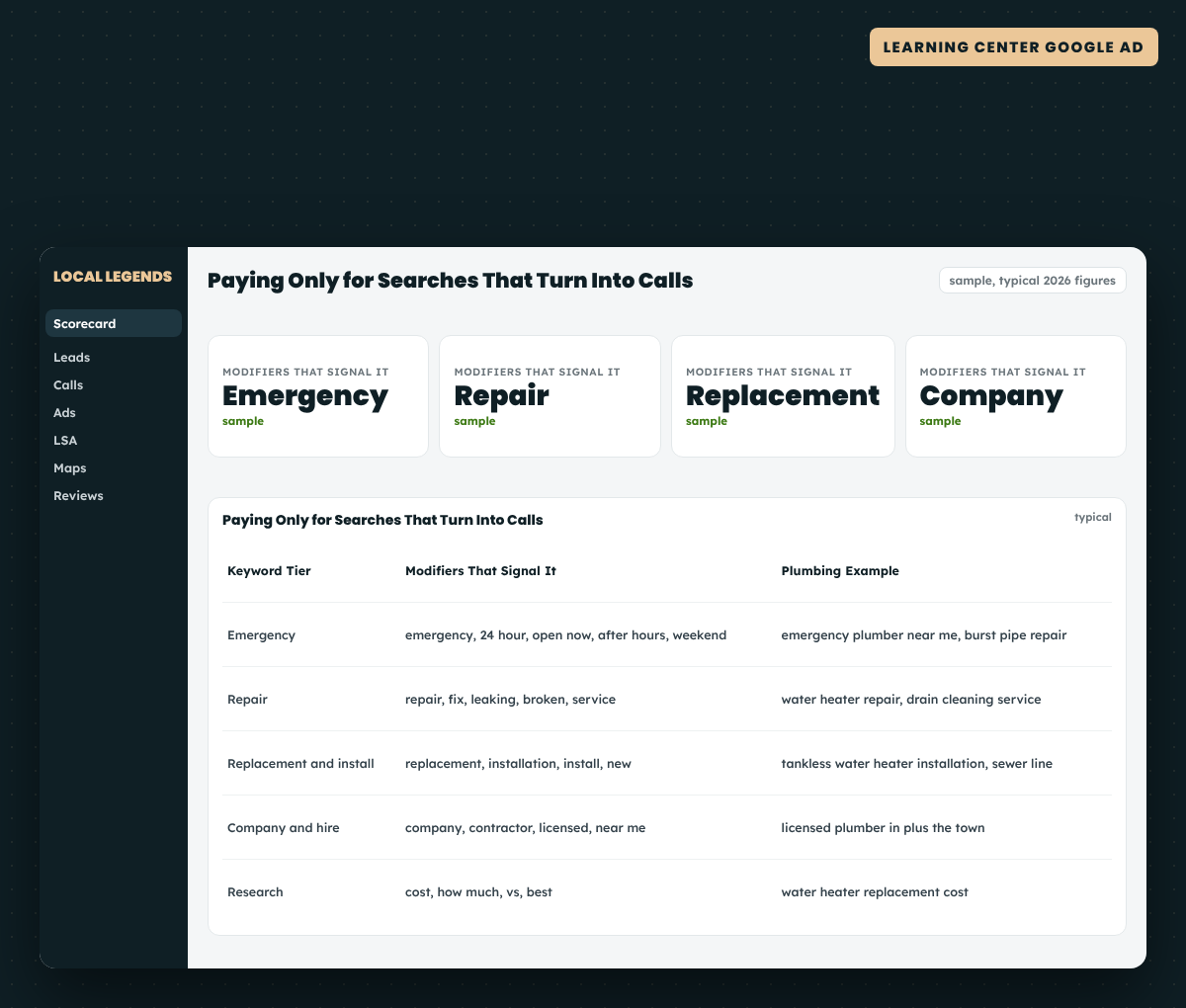
How Do I Find the Best Google Ads Keywords for My Plumbing Company? Service, Urgency and Place
A plumbing company finds its best Google Ads keywords by starting with its most profitable services, adding urgency and location words, and checking each idea in Keyword Planner for the real service area. The strongest terms name a job and a need at the same time.
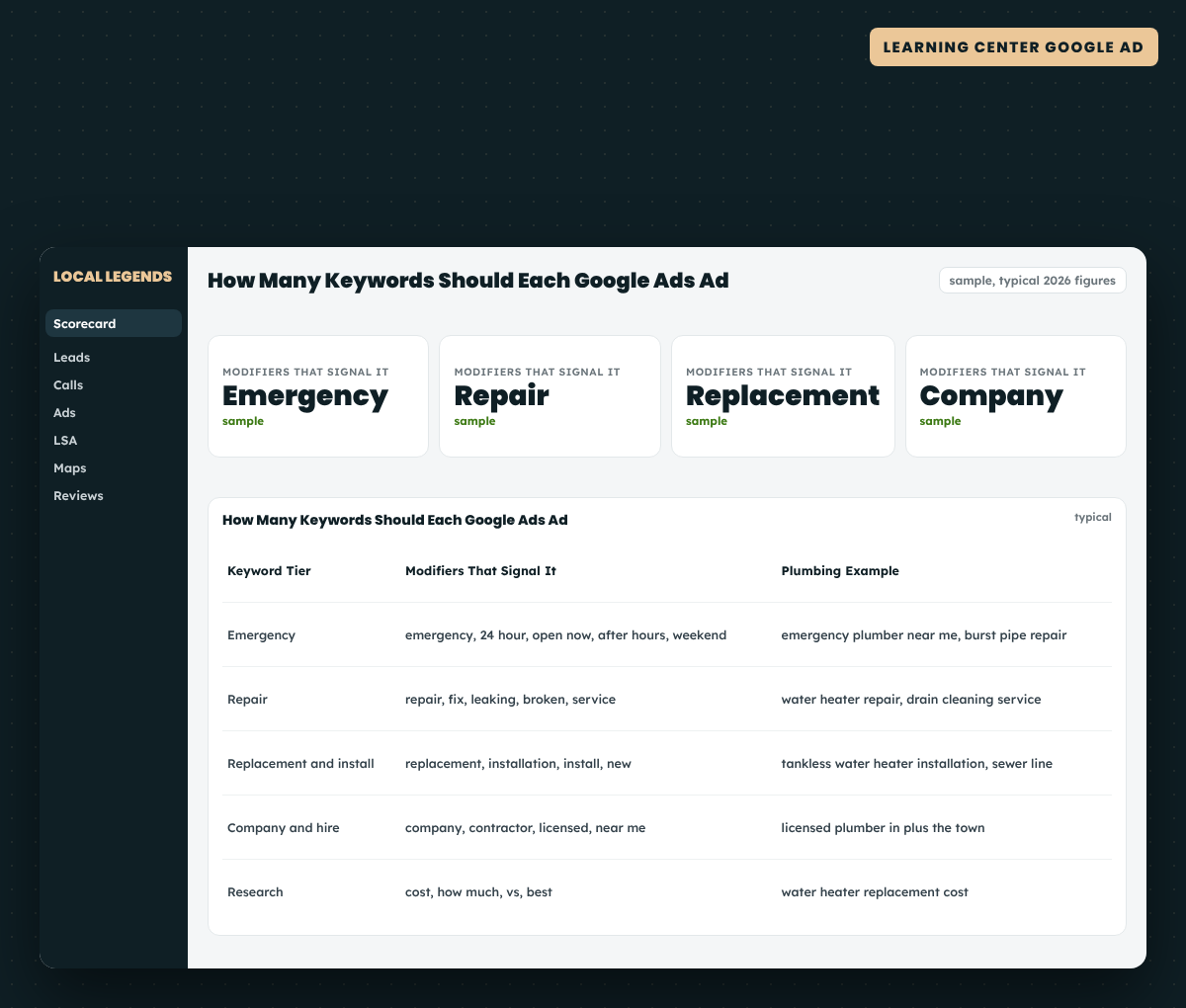
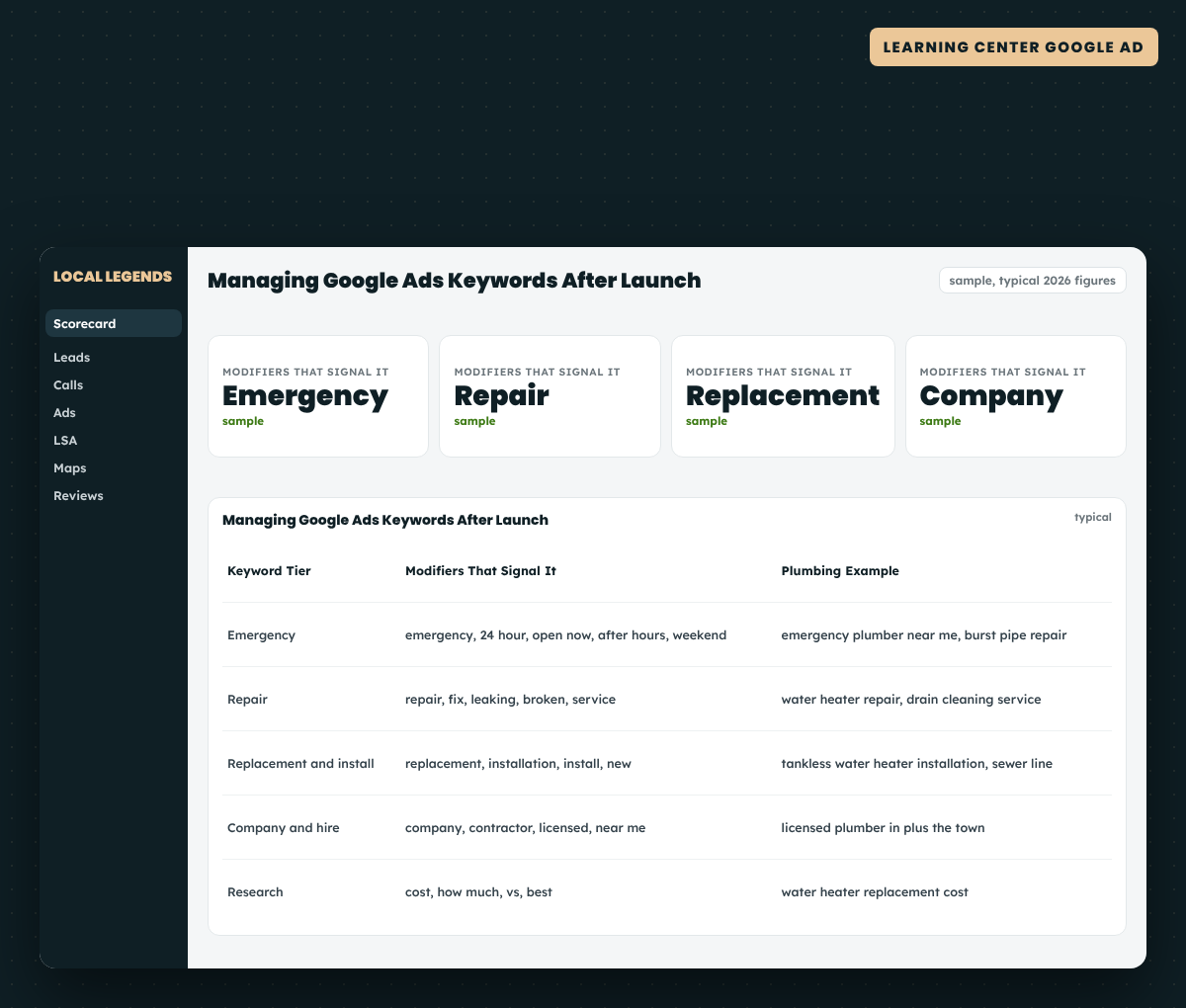
| Keyword Tier | Modifiers That Signal It | Plumbing Example | HVAC or Roofing Example | How It Usually Performs |
|---|---|---|---|---|
| Emergency | emergency, 24 hour, open now, after hours, weekend | "emergency plumber near me", "burst pipe repair" | "AC not cooling repair", "emergency roof leak repair" | Highest intent and usually the highest cost per click |
| Repair | repair, fix, leaking, broken, service | "water heater repair", "drain cleaning service" | "furnace repair", "roof repair" plus the town | Steady calls at a moderate cost |
| Replacement and install | replacement, installation, install, new | "tankless water heater installation", "sewer line replacement" | "HVAC replacement", "roof replacement" | Bigger tickets that need a page that explains options |
| Company and hire | company, contractor, licensed, near me | "licensed plumber in" plus the town | "roofing contractor near me" | Good intent, broader competition |
| Research | cost, how much, vs, best | "water heater replacement cost" | "furnace replacement cost" | Mixed: test in its own ad group with a smaller budget |
Searches built on "how to," "DIY" or a part name almost never become a service call. They belong on the negative keyword list, covered below.
How to Use Keyword Planner to Find Contractor Keywords
Google Keyword Planner is the free research tool inside a Google Ads account that suggests keyword ideas and shows search estimates and cost estimates for each one. Google describes two ways to start: enter words about your business or enter a website. [SOURCE: Google Ads Help, "Use Keyword Planner"]
- Open Keyword Planner from the Tools menu in your Google Ads account.
- Choose "Discover new keywords" and enter three to five core services, such as "water heater installation" or "clogged drain".
- Set the location to the towns your trucks actually serve, not the whole state.
- Try "Start with a website" with your own service pages to see which terms Google connects to them.
- Sort by relevance first, then look at the top-of-page bid estimates.
- Save the winners to a plan and group them by job before building ad groups.
Is Google Keyword Planner Accurate for Small-Town Contractor Keywords?
Google Keyword Planner is directional, not exact, for small-town contractor keywords, because low-volume local searches often show tiny or zero estimates, and Google says keywords with very low search volume may not be discoverable or forecastable at all.
- Compare services, not single numbers: use it to see whether "drain cleaning" beats "hydro jetting" in your area.
- Widen the area: check the county or the full service radius instead of one small town.
- Check autocomplete: type the service plus the town into Google and note the suggestions.
- Trust your own data: the search terms report and Search Console show what local people really typed.
- Remember "near me": many homeowners skip the town name, so a low town-name estimate does not mean low demand.
Where Real Homeowner Wording Shows Up
The best keyword ideas often come from the office, not a tool. Call recordings, booking notes, review text and the questions customers ask on the phone show the exact phrases people use when something breaks.
Google Ads Keyword Match Types for Contractors How Far Each Keyword Reaches
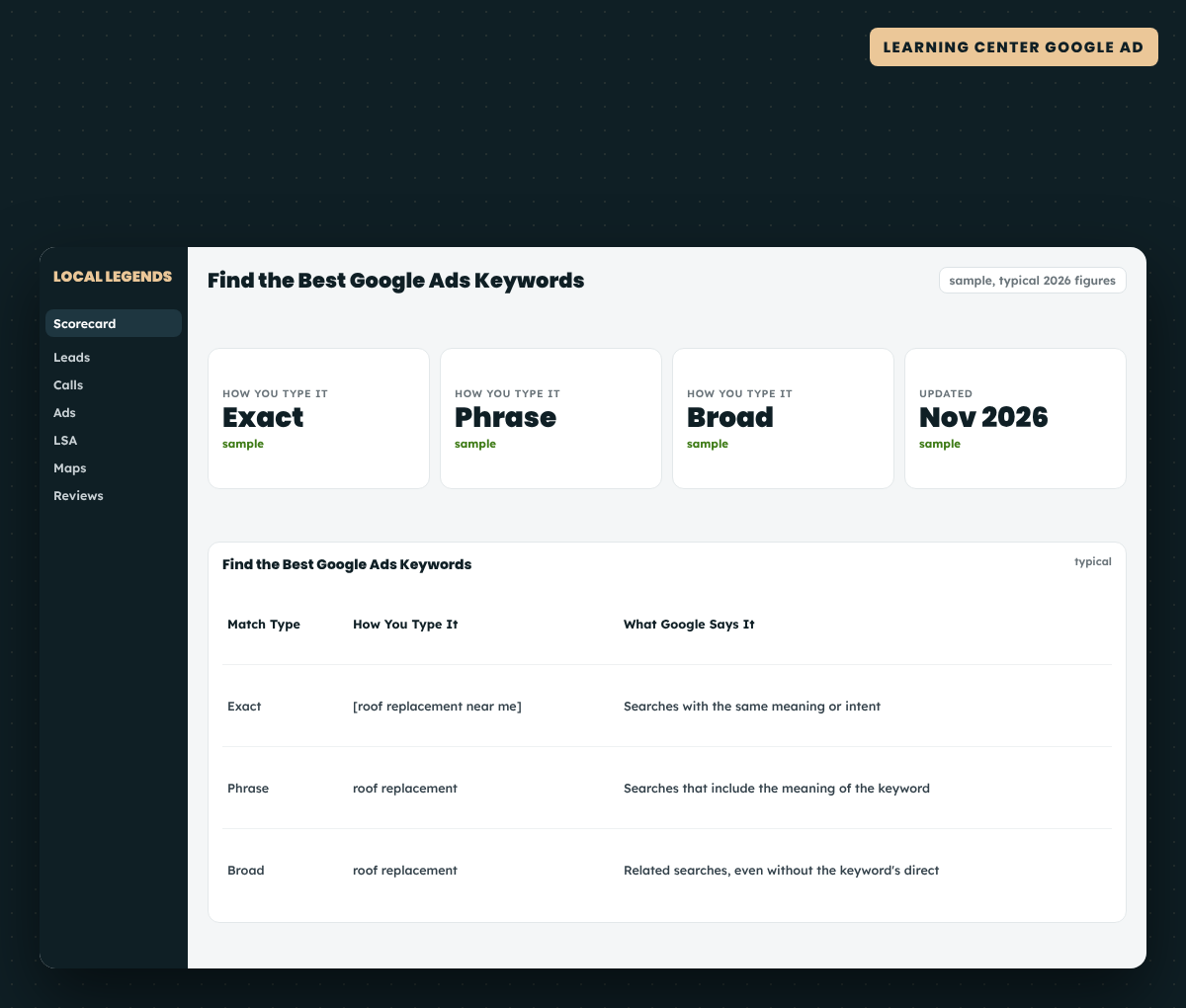
Keyword match types tell Google how closely a search must match your keyword before your ad can show, and Google offers three: broad, phrase and exact. Google notes that broader types reach everything the narrower types reach, plus more, and that broad match is the default for every new keyword. [SOURCE: Google Ads Help, "About keyword matching options"]
| Match Type | How You Type It | What Google Says It Reaches | Contractor Use | Stage |
|---|---|---|---|---|
| Exact | [roof replacement near me] | Searches with the same meaning or intent as the keyword | Proven money keywords and your company name | Launch and every stage after |
| Phrase | "roof replacement" | Searches that include the meaning of the keyword | The main workhorse for service plus modifier searches | Launch and every stage after |
| Broad | roof replacement | Related searches, even without the keyword's direct meaning | Scaling once Smart Bidding has real booked-job data | Mature accounts with strong tracking |
What Keyword Match Type Should a Roofing Company Use?
A roofing company should launch with phrase match and exact match keywords and hold broad match until the account tracks booked inspections reliably. Roofing searches mix homeowners, job seekers, material buyers and DIY patchers, and tighter match types keep the budget on homeowners.
- Exact match for the proven keywords, such as roof replacement or roof leak repair plus "near me".
- Phrase match for the services that need room to catch town names and modifiers.
- Negative keywords from day one, since even exact and phrase match include close variants.
- Broad match later, as a controlled test, once booked jobs flow back into Google Ads.
Should My HVAC Company Use Broad Match Keywords With Smart Bidding?
An HVAC company can use broad match keywords with Smart Bidding once its account sends Google consistent, qualified conversions such as booked calls and sold jobs. Google says Smart Bidding works best with broad match because the wider set of searches helps it learn, but that learning depends on the data you feed it.
- Ready: calls over a set length and booked appointments are tracked, and leads are steady every month.
- Not ready: a new account, a small budget or tracking that counts page views as leads.
- Before testing: load a full negative keyword list and set location targeting to people in your area.
- How to test: run it as a Google Ads experiment against the current campaign, not as a full switch.
How a Broad Match Test Should Be Judged
A broad match test wins only if cost per booked job holds or drops while volume grows. More clicks or more form fills alone do not count.
Signs a Test Should End Early
Search terms filling with jobs, parts, supply stores or towns outside the service area mean the test is buying the wrong traffic. Pause it, add negatives and restart with tighter signals.
What Negative Keywords Should an HVAC Company Add in Google Ads? Blocking Searches That Never Book
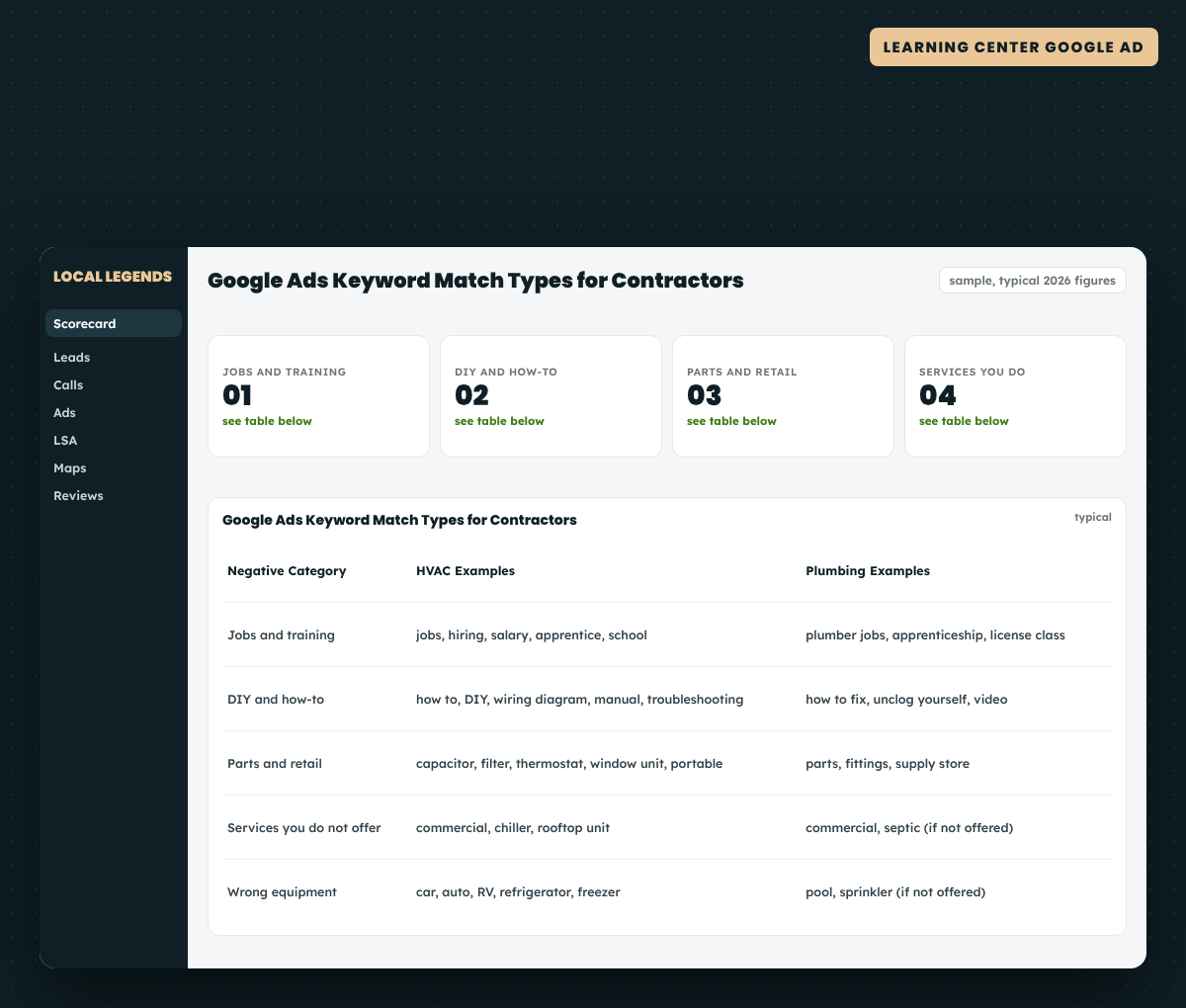
An HVAC company should add negative keywords for job seekers, DIY repairs, parts shoppers, services it does not offer and places it does not serve, so its ads stop showing for searches that will never become a service call.
| Negative Category | HVAC Examples | Plumbing Examples | Roofing Examples |
|---|---|---|---|
| Jobs and training | jobs, hiring, salary, apprentice, school, certification | plumber jobs, apprenticeship, license class | roofing jobs, roofer salary, adjuster training |
| DIY and how-to | how to, DIY, wiring diagram, manual, troubleshooting | how to fix, unclog yourself, video | how to patch, DIY shingle repair |
| Parts and retail | capacitor, filter, thermostat, window unit, portable ac, wholesale | parts, fittings, supply store | shingles for sale, roofing supplies |
| Services you do not offer | commercial, chiller, rooftop unit (residential-only shops) | commercial, septic (if not offered) | commercial, metal panels (if not offered) |
| Wrong equipment | car, auto, RV, refrigerator, freezer | pool, sprinkler (if not offered) | RV roof, car roof |
Google says negative keywords do not match close variants, so a contractor should add the singular and plural versions and common synonyms of each term. Google also says negatives account for casing and misspellings on their own. [SOURCE: Google Ads Help, "About negative keywords"]
How Negative Keyword Match Types Work
Negative keywords come in broad, phrase and exact versions, and each one blocks searches differently than the positive keyword of the same type. Most contractor lists use negative broad and negative phrase.
- Negative broad (the default): blocks the ad when the search contains every word, in any order.
- Negative phrase: blocks the ad when the words appear in the same order, even with extra words.
- Negative exact: blocks only that exact search with no extra words.
- Shared lists: keep one negative list for jobs, DIY and parts and apply it to every campaign.
Searches to Review Before Blocking
Some words look like waste but bring buyers. "Free" alone can block "free AC estimate," and "cost" can block "furnace replacement cost" from a homeowner close to hiring. Test these in their own ad group before deciding.
Should a Contractor Bid on Competitor Names as Keywords?
A contractor should cover its core service keywords fully before testing competitor names, because Google allows bidding on another company's name but those searchers have usually already chosen who to call. When it is tested, it needs its own budget and rules.
- Separate campaign with a capped daily budget, so it never takes money from service keywords.
- Never use the other company's trademarked name in headlines or descriptions, per Google's trademark policy.
- Add competitor names as negatives in the main service campaigns.
- Send clicks to a page that explains your own reviews, warranty and service area.
- Judge it by booked jobs, since misdirected calls are common.
Google Advertising Keywords by Trade: Emergency, Repair and Remodel Each Trade Searches Differently
Google advertising keywords change by trade because homeowners search differently for a burst pipe than for a new kitchen. Emergency trades need urgency keywords and a phone-first setup, while remodelers need project keywords and pages that show past work.
What Are the Best Emergency Keywords for a Plumber Running Google Ads?
The best emergency keywords for a plumber combine an urgency word with a specific crisis, such as "burst pipe repair," "sewer backup," "no hot water" or "emergency plumber near me," because those homeowners usually call the first credible company they see.
- Availability: emergency plumber, 24 hour plumber, plumber open now, after hours plumber, weekend plumber.
- Leaks: burst pipe repair, water leak repair, water coming through ceiling, frozen pipe repair.
- Drains and sewer: sewer backup, emergency drain cleaning, main line clog, toilet overflowing.
- Water heaters: no hot water, water heater leaking, emergency water heater repair.
- Setup: call assets on every ad and an ad schedule that matches the hours someone can answer the phone.
What Google Ads Keywords Should a Remodeling Contractor Bid On for Kitchens and Bathrooms?
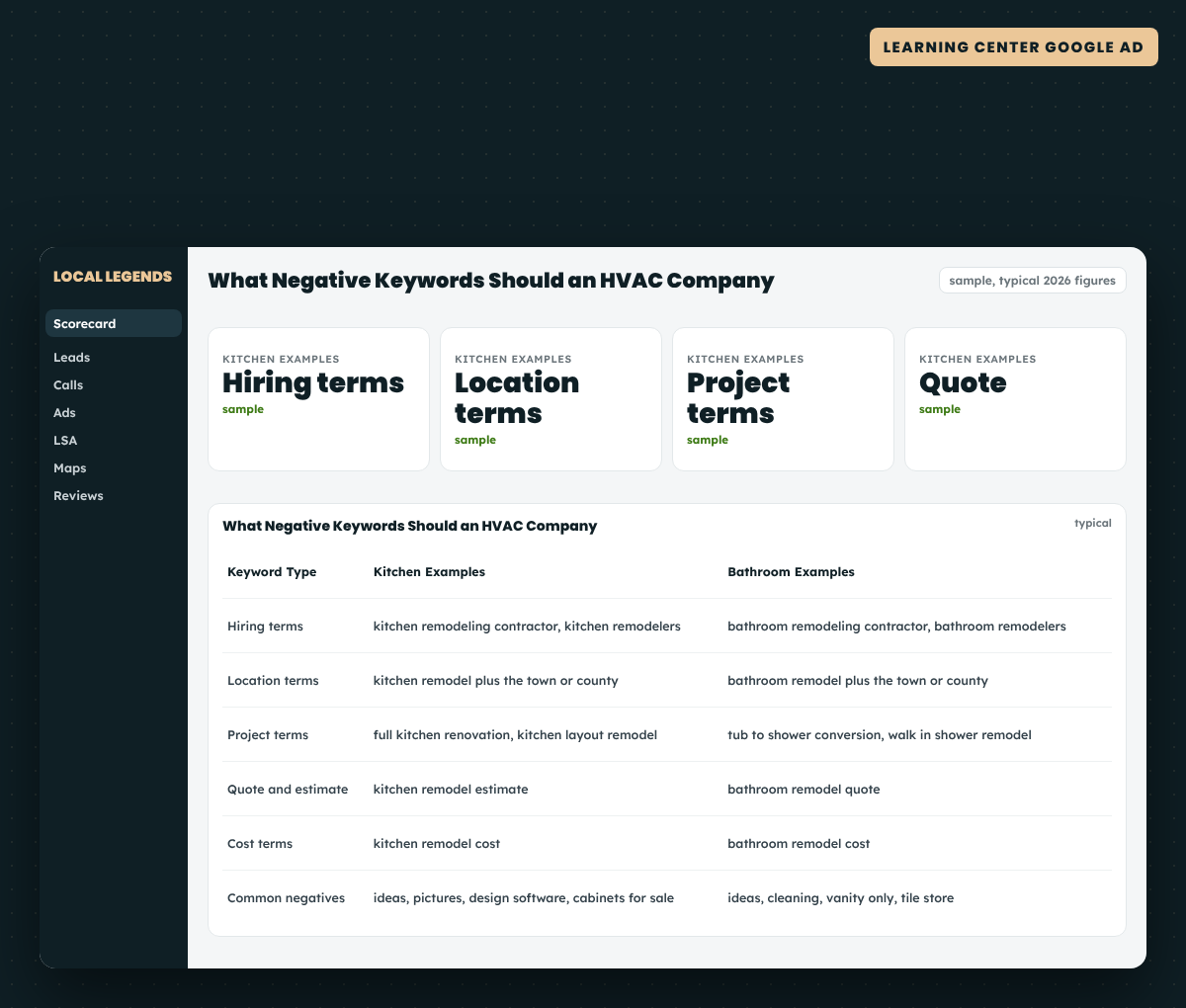
A remodeling contractor should bid on room-specific keywords paired with hiring words, such as "kitchen remodeling contractor" or "bathroom remodel quote," and keep kitchens and bathrooms in separate campaigns so each ad and landing page matches the room.
| Keyword Type | Kitchen Examples | Bathroom Examples | Notes |
|---|---|---|---|
| Hiring terms | kitchen remodeling contractor, kitchen remodelers near me, kitchen renovation company | bathroom remodeling contractor, bathroom remodelers near me, bathroom renovation company | Core of the campaign |
| Location terms | kitchen remodel plus the town or county | bathroom remodel plus the town or county | Pair with a tight service radius |
| Project terms | full kitchen renovation, kitchen layout remodel | tub to shower conversion, walk in shower remodel | Match each to its own landing page |
| Quote and estimate | kitchen remodel estimate | bathroom remodel quote | Strong intent to talk to a contractor |
| Cost terms | kitchen remodel cost | bathroom remodel cost | Test with a smaller budget |
| Common negatives | ideas, pictures, design software, cabinets for sale | ideas, cleaning, vanity only, tile store | Add "refacing" or "resurfacing" only if you do not offer them |
Roofing and HVAC Keyword Patterns
Roofers do best with repair, replacement and inspection keywords plus the town, kept apart from storm searches that need their own budget. HVAC companies split repair from replacement and raise budgets before summer and winter peaks.
How Many Keywords Should Each Google Ads Ad Group Have for a Contractor? Ad Groups Built Around One Job
Most contractor ad groups work best with about 5 to 15 closely related keywords that all describe the same job, because every keyword in the group shares one ad and one landing page. The count matters less than the theme.
- One job per ad group:"AC repair" and "AC installation" belong in different groups.
- Same ad, same page test: if a keyword needs a different headline or page, it needs its own group.
- Smaller budgets, fewer keywords: a few strong exact and phrase keywords beat a long list that splits a small budget.
- No duplicates: Google treats near-identical keywords like "red car" and "car red" as one bid, so they add nothing.
How to Add Keywords to a Google Ads Ad Group
Keywords are added inside the campaign's Search keywords page, one per line, with symbols for the match type. Google's help center lists the steps. [SOURCE: Google Ads Help, "Add keywords"]
- Open Campaigns, then the Audiences, keywords and content menu, then Search keywords.
- Click the blue plus button.
- Select the ad group where the keywords belong.
- Enter one keyword per line: plain for broad, quotes for phrase, brackets for exact.
- Save, then check the ad and landing page still match every keyword.
What Is a Good Quality Score for Contractor Keywords?
A Quality Score of 7 or higher out of 10 is generally treated as strong for contractor keywords, while 5 to 7 is common on competitive non-branded searches. Google calls Quality Score a 1 to 10 diagnostic, not an input in the ad auction. [SOURCE: Google Ads Help, "About Quality Score for Search campaigns"]
- Expected click-through rate: ads that name the service and the town earn more clicks.
- Ad relevance: tight ad groups let the headline repeat what the homeowner searched.
- Landing page experience: a dedicated service page beats sending every click to the home page.
How to Read the Three Components
Google rates each component Above average, Average or Below average against other advertisers on the same search over the last 90 days. Fix the Below average component first.
Managing Google Ads Keywords After Launch Reading the Search Terms
Managing Google Ads keywords after launch means reading the search terms report, adding negatives, promoting winning searches and pausing keywords that spend without booking jobs. Keywords are a starting guess, and search terms show what Google actually matched them to.
Why Is My Google Ads Search Terms Report Showing Irrelevant Searches for My Roofing Company?
A roofing company sees irrelevant searches in its search terms report when broad match keywords, missing negative keywords or loose location settings let Google match ads to loosely related queries. Each cause has a direct fix.
- Broad match stretching: switch the noisy keywords to phrase or exact.
- Missing negatives: add roofing jobs, apprenticeship, how to patch and supply searches.
- Location option: Google's default Presence or interest setting can include people outside the area; Presence limits ads to people in or regularly in it.
- Hidden keyword column: turn on the Keyword column to see which keyword matched each search.
- Sort by cost: fix the most expensive irrelevant searches first.
How Often Should a Contractor Review Google Ads Keywords and Search Terms?
A contractor should review Google Ads keywords and search terms weekly, and every few days during the first month of a new campaign or after a big change such as adding broad match.
- First two to four weeks: every two or three days, to catch waste before it adds up.
- Ongoing accounts: weekly, to keep up with seasons and new search patterns.
- Broad match campaigns: two or three times a week.
- Promote winners: add searches that book jobs as their own exact or phrase keywords.
- Pause wasters: keywords with steady spend and no calls over several weeks.
- Avoid knee-jerk blocks: one odd click is not a pattern.
Do Google Local Services Ads Use Keywords Like Regular Google Ads?
Google Local Services Ads do not use keywords, because the contractor chooses job types and a service area and Google matches the ad to relevant local searches, charging per lead instead of per click.
- No keyword list and no negative keywords to manage.
- Job types control which services the ad can show for.
- Reviews, responsiveness and proximity shape where the ad ranks.
- Weekly lead quality checks: reviewing every lead, flagging junk and out-of-area calls, and adjusting job types, targeting and budget.
- Invalid leads: Google now credits some invalid leads automatically, though credits are never guaranteed.
The Google Local Services Ads management page explains how Local Legends runs LSA beside Search campaigns.
How Much Do Google Ads Keywords Cost for Home Service Contractors? Clicks, Management and the Pages Behind Them
Google Ads keywords for home service contractors typically cost about $8-$15+ per click for routine repair searches and $25-$55+ for urgent or high-ticket searches, based on 2026 published industry ranges, with the trade, the market and the urgency of the job setting the price.
- Urgency: emergency and replacement searches cost more because one job is worth more.
- Market: dense metros and competitive trades push auctions higher than small towns.
- Relevance: tight ad groups and matching landing pages help ads compete.
- Ad type: Search charges per click, while Local Services Ads charge per lead.
The full breakdown of click costs, lead costs and starting budgets is in the guide to how much Google Ads cost.
Should I Hire an Agency to Manage My Google Ads Keywords or Do It Myself?
A contractor can manage keywords alone with a small budget and a few hours every week for search terms, and usually benefits from management once spend grows or the owner's time runs short. Either way, the account and data should stay in the contractor's name.
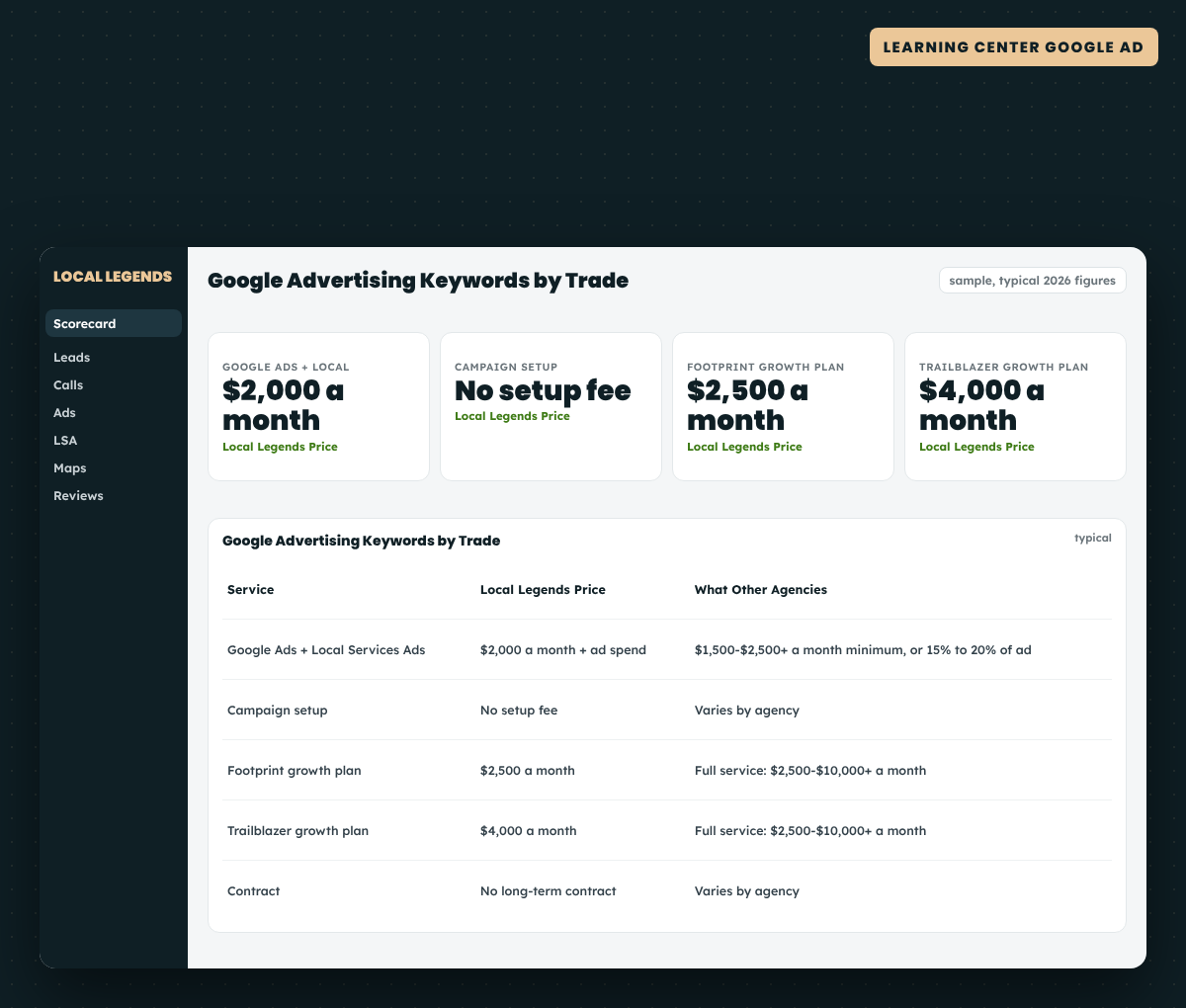
| Service | Local Legends Price | What Other Agencies Typically Charge |
|---|---|---|
| Google Ads + Local Services Ads management, keyword research, negative lists, campaign landing pages and monthly GBP optimization | $2,000 a month + ad spend | $1,500-$2,500+ a month minimum, or 15% to 20% of ad spend |
| Campaign setup | No setup fee | Varies by agency |
| Footprint growth plan (Google Ads + LSA, 10 pages a month, GBP posts, monthly scorecard) | $2,500 a month | Full service: $2,500-$10,000+ a month |
| Trailblazer growth plan (adds Bing and Facebook ads, backlinks, weekly scorecard) | $4,000 a month | Full service: $2,500-$10,000+ a month |
| Contract | No long-term contract | Varies by agency |
Ad spend is paid by the contractor straight to Google. For ongoing programs, Local Legends takes one contractor per trade per city. Every plan is on the Local Legends pricing page, and the service is described on the Google Ads management page.
Questions to Ask Before Anyone Manages Your Keywords
- Whose account is it? The account and billing should be in the contractor's name, with the manager linked in.
- How often are search terms reviewed? Weekly is the standard to expect.
- What counts as a conversion? Calls over a set length and booked jobs, not page views.
- What does the report show? Calls, booked jobs, sold jobs and cost per booked job.
Not sure which keywords are spending without booking jobs? Book a free growth audit online for a review of keywords, match types, negatives and search terms.
Local Legends Marketing Reviews From Contractor CEOs What Trade Owners Say
Roofing and restoration CEOs have shared on the record what it is like to work with Local Legends Marketing founder Levi Ostlund, who poured concrete with his father, ran a landscaping company in high school, lost more than $30,000 to marketers who did not deliver and later served as CMO of Amstill Roofing. [SOURCE: Local Legends founder bio, Levi Ostlund]
Years of roofing campaigns: Brad Beldon, CEO of a roofing company, wrote that Levi's creativity, quick responses and grasp of the marketing strategy made a major difference for his company. [SOURCE: Local Legends written testimonial, Brad Beldon, CEO, Roofing Company]
Levi has been absolutely outstanding to work with over the years... His creativity, responsiveness, and deep understanding of our marketing strategy have made a huge impact." Brad Beldon, CEO, Roofing Company. Read on Local Legends
Kyle Scott and Jim Dodson, both roofing company CEOs, and Race Allen, CEO of Precision Restoration of Texas, have also recorded video testimonials.
Frequently Asked Questions About Google Ad Keywords Quick Answers on Keywords
Are AdWords Keywords the Same as Google Ads Keywords?
Yes. Google AdWords was renamed Google Ads in 2018, so AdWords keywords, Google ad words keywords and Google Ads keywords all describe the same system.
What Are the Three Main Types of Keywords in Google Ads?
The three keyword match types are broad, phrase and exact match, written as plain text, in quotes and in square brackets.
Where Are My Keywords in Google Ads?
Keywords live under Campaigns, in the Audiences, keywords and content menu, on the Search keywords page, where each ad group's keywords and match types are listed.
Is Google Keyword Planner Free?
Yes, Keyword Planner is free inside a Google Ads account, though its estimates are broad ranges and work best for comparing services.
Are "Near Me" Keywords Worth Bidding On?
Usually, yes."Near me" searches show hiring intent, and Google already reads the searcher's location, so pair them with tight location settings.
Can the Same Keyword Run in Search and Performance Max?
It can, and Google says an exact match keyword identical to the search takes priority over Performance Max for that search, which keeps your top keywords under your control.
How Many Negative Keywords Should a Contractor Start With?
Start with a shared list covering jobs, DIY, parts and services you do not offer, then grow it every week from the search terms report.
Do Long-Tail Keywords Cost Less for Contractors?
Often, yes. Longer phrases like "tankless water heater installation" draw fewer competing ads and match the landing page more closely than one-word terms.
Reviewed by Levi Ostlund, Founder, Local Legends Marketing

Build a Google Ads Keyword List That Books Jobs for Your Home Service Company Start With a Free Growth Audit
Local Legends Marketing researches, builds and manages Google Ads keywords for contractors at a flat $2,000 a month for Google Ads and Local Services Ads, with negative keyword lists, campaign landing pages and weekly search terms reviews included, and every keyword judged by booked and sold jobs.
- Call:(936) 900-1248
- Home office: 481 Stephen F Austin Dr, Conroe, TX 77302
- Next step: book a free growth audit for a review of your keywords, match types and negatives