


What an Owner Can Handle in a Few Hours
How to Do Your Own SEO as a Contractor: A Step-by-Step DIY SEO Plan for Roofers, HVAC Companies, Plumbers and Remodelers in 2026
What an Owner Can Handle in a Few Hours a Week, and When to Get Help
Updated November 2026 · Reviewed by Levi Ostlund, Founder
To do your own SEO as a contractor, set up Google's free tracking tools, complete your Google Business Profile, research the words homeowners use, build one page per service, earn steady reviews and keep your business details consistent across the web. That order puts the fastest wins first.
Google AI Mode put the ongoing load at about 2 to 5 hours a week after a setup phase of 10 to 30 hours, with map results often moving within 30 to 90 days and website pages taking 4 to 6 months or longer.
- Step 1, tracking: Google Search Console and Google Analytics, so you can see what is working.
- Step 2, Google Business Profile: the right category, every service listed, real job photos.
- Step 3, keywords: the services and towns homeowners actually search.
- Step 4, service pages: one page per core service with clear titles and real proof.
- Step 5, reviews: a direct link sent after every finished job.
- Step 6, citations and local links: the same name, address and phone everywhere, plus links from local partners.
Free Growth Audit
Your Reviews, Radius and Response Rate vs the competitors beating you.
About Local Legends Marketing
A home service marketing agency headquartered in Conroe, Texas, with 8+ years of marketing experience, running Google Ads, Local Services Ads, local SEO, AI SEO, connected TV and review systems for contractors nationwide.
Can a Contractor Really Do Their Own SEO? Yes, With Limits in Crowded Markets
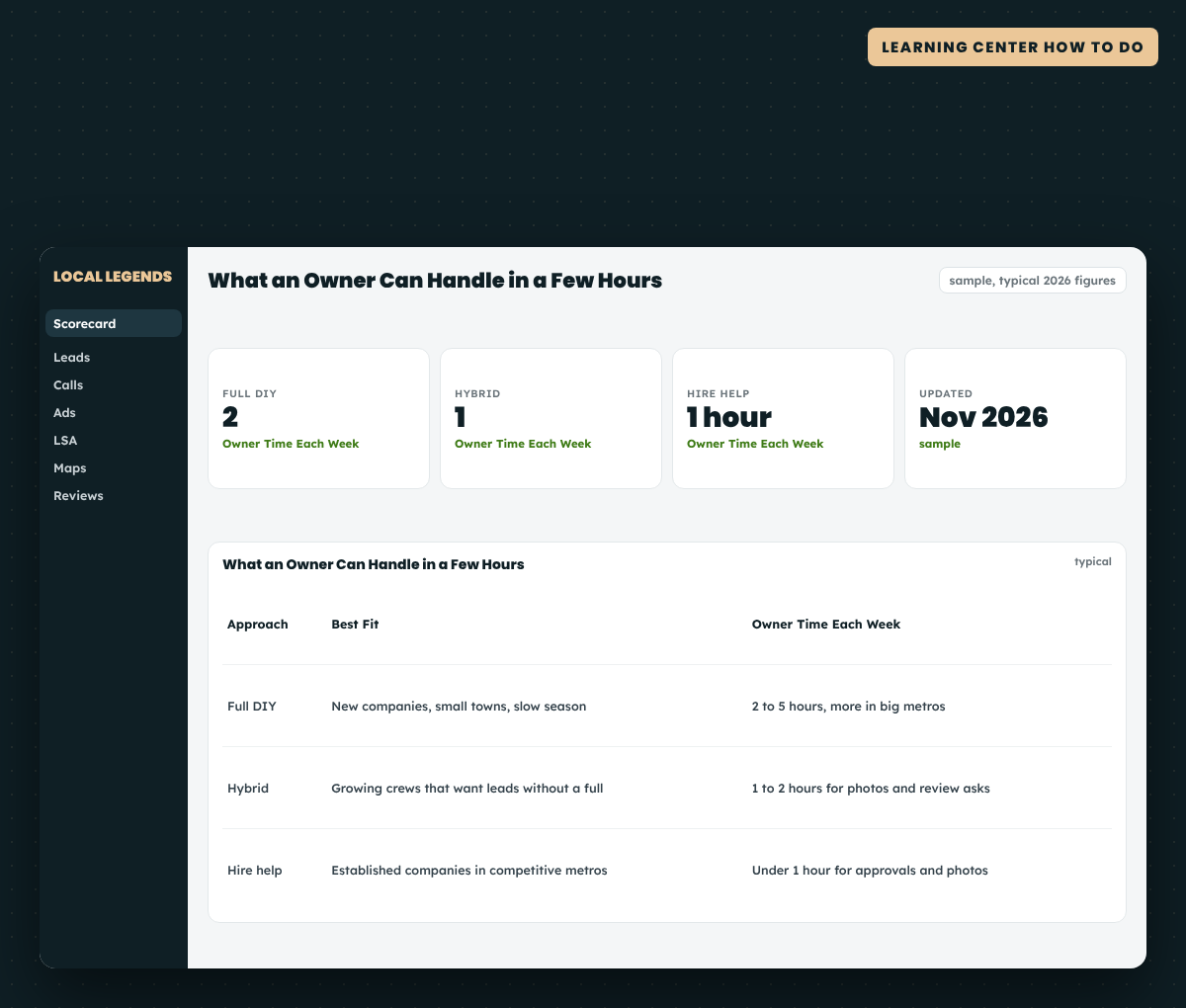
Yes, a contractor can do their own foundational SEO, especially a newer company or one in a smaller market, according to Google AI Mode. Profile work, reviews and job photos depend on real jobs, not code, so an owner can handle them between estimates.
Google AI Mode said DIY efforts usually stall in three places for high-ticket trades: writing unique pages for every service and town, technical fixes such as mobile speed and schema, and staying consistent once the busy season starts.
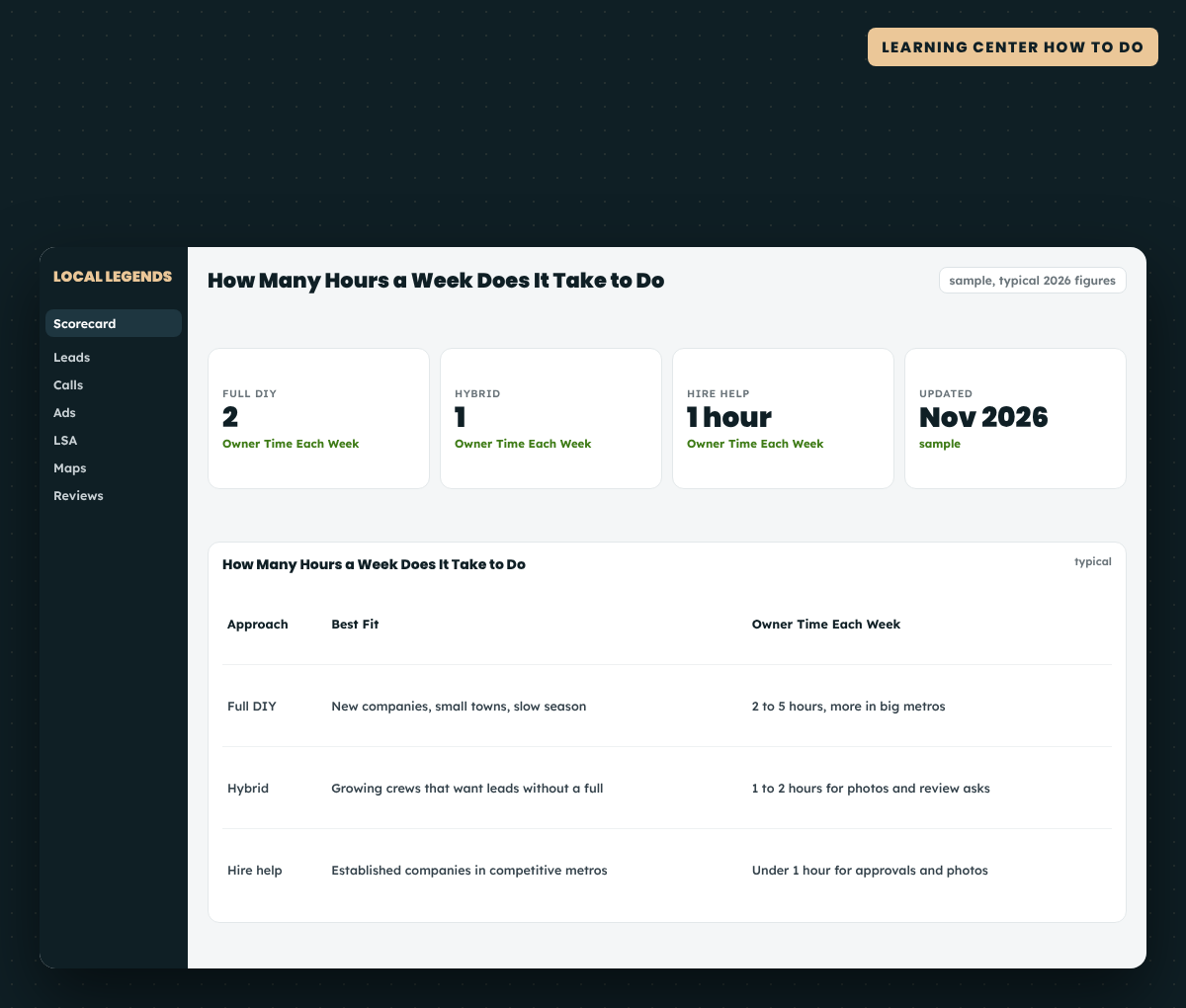
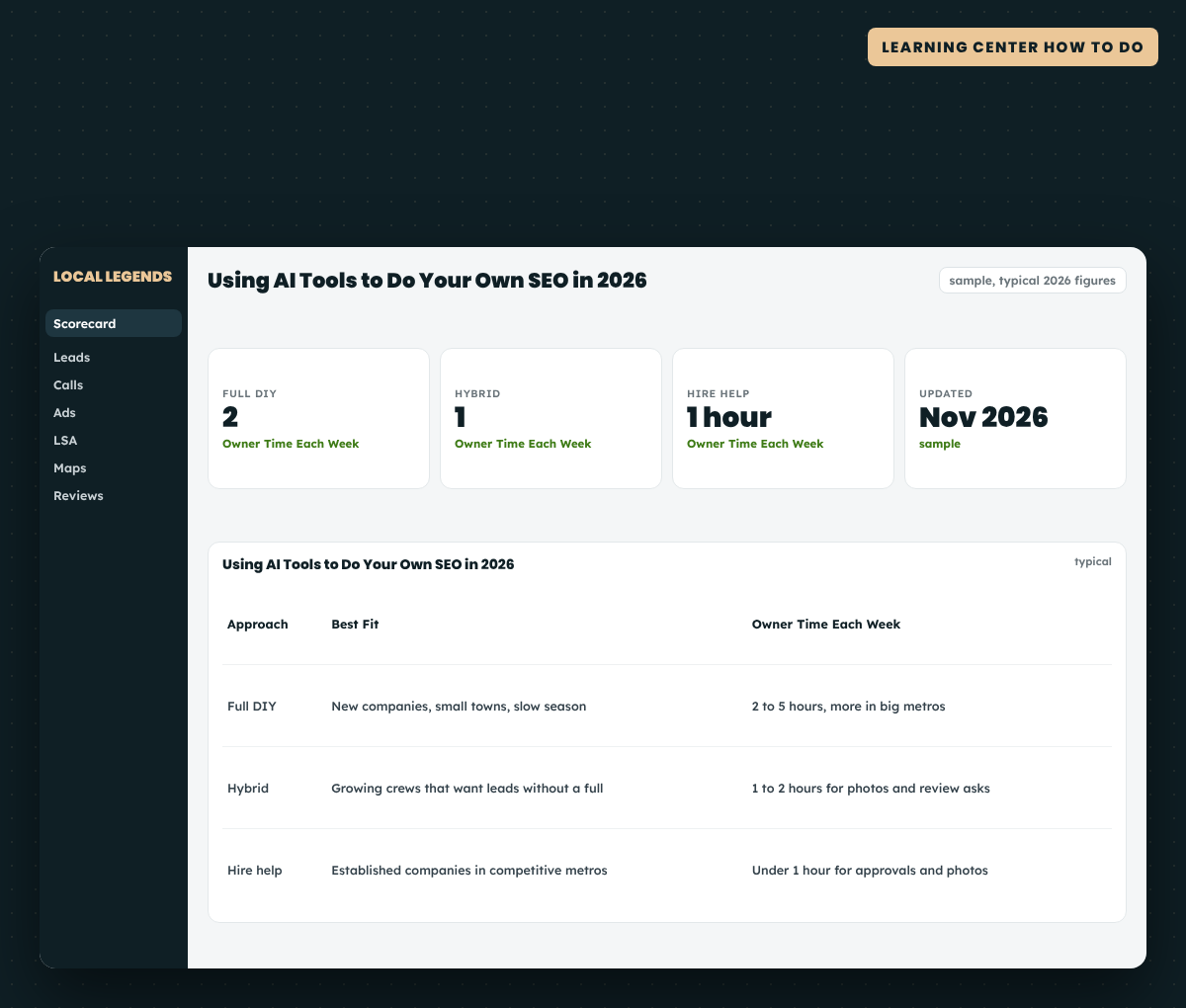
| Approach | Best Fit | Owner Time Each Week | Typical Cost | Main Tradeoff |
|---|---|---|---|---|
| Full DIY | New companies, small towns, slow season | 2 to 5 hours, more in big metros | Free tools, plus your time | Learning curve competes with running jobs |
| Hybrid | Growing crews that want leads without a full retainer | 1 to 2 hours for photos and review asks | One-time help for setup and pages | Still needs weekly discipline |
| Hire help | Established companies in competitive metros | Under 1 hour for approvals and photos | $1,500-$5,000+ a month (typical) | Higher monthly cost |
[SOURCE: Google AI Mode, "Can a roofing contractor do their own SEO without hiring an agency" and "How many hours a week does it take to do SEO yourself for a small home service business", captured Nov 28 2026]
When Should a Contractor Stop Doing Their Own SEO and Hire Help?
A contractor should hand off SEO when the work pulls time from billable jobs or when results stall against local competitors, according to Google AI Mode. Claiming the profile and gathering reviews stay easy; the harder parts grow with the business.
- Your hours are worth more in the field: AI Mode estimated effective SEO at roughly 5 to 10 hours a week in competitive markets.
- Updates have stopped: months without new photos, pages or listing checks let rankings slide.
- Competitors hold the map results: steady top-three map spots for your money searches often take local links and technical work.
- Traffic arrives but calls do not: the page, the offer or the call tracking needs work.
- You are expanding: a second location, a new service line or a site redesign brings redirect and duplicate content risks.
Set Up Free SEO Tools and Your Google Business Profile Yourself Steps One and Two Cost Nothing but Time
The first two steps of do-it-yourself SEO are free: connect Google's tracking tools to your website, then claim and complete your Google Business Profile. Google AI Mode called the profile the single most useful free tool for local contractors, because map results sit above regular website listings.
What Free Tools Do I Need to Do My Own SEO?
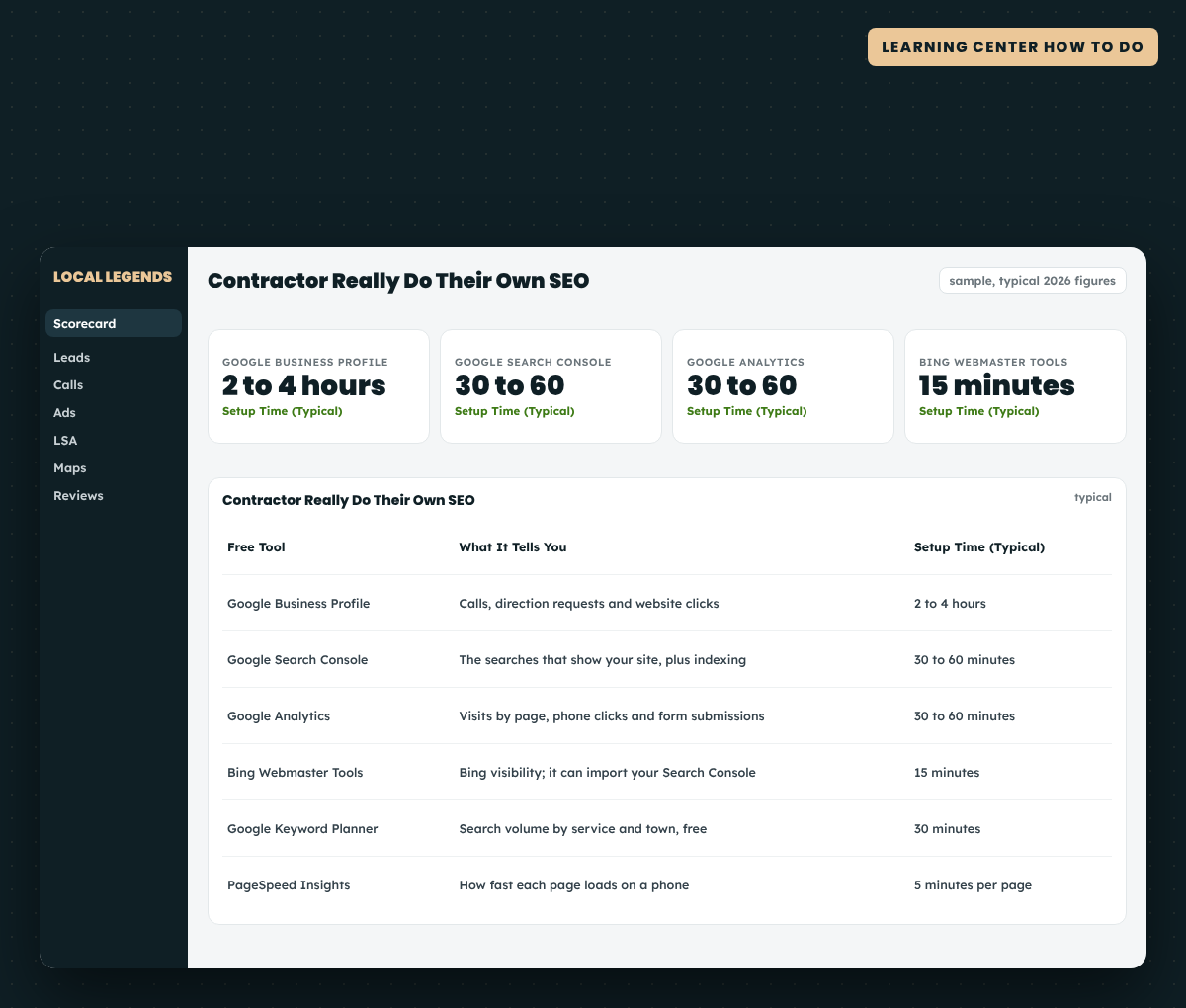
A contractor doing their own SEO needs Google Business Profile and Google Search Console first, then Google Analytics and a few free checks, according to Google AI Mode. Each tool answers a different question about how homeowners find you.
| Free Tool | What It Tells You | Setup Time (Typical) |
|---|---|---|
| Google Business Profile | Calls, direction requests and website clicks from Maps | 2 to 4 hours |
| Google Search Console | The searches that show your site, plus indexing errors | 30 to 60 minutes |
| Google Analytics | Visits by page, phone clicks and form submissions | 30 to 60 minutes |
| Bing Webmaster Tools | Bing visibility; it can import your Search Console setup | 15 minutes |
| Google Keyword Planner | Search volume by service and town, free with a Google Ads account | 30 minutes |
| PageSpeed Insights | How fast each page loads on a phone | 5 minutes per page |
[SOURCE: Google AI Overview for "how to do your own seo" and Google AI Mode, "What free tools do I need to do my own SEO for a plumbing company" and "How many hours a week does it take to do SEO yourself", captured Nov 28 2026]
Submit Your Sitemap and Check Indexing
Inside Search Console, submit your XML sitemap and use URL inspection on your main service pages. A page Google has not indexed cannot rank, no matter how good the writing is.
How Do I Optimize My Own Google Business Profile as a Contractor?
You optimize your own Google Business Profile by choosing the most specific primary category, listing every service you perform, adding real photos every week and asking every customer for a review, according to Google AI Mode.
- Remove duplicates: search your name and phone number on Google Maps and clean up old listings.
- Verify honestly: for video verification, show your branded truck, tools and office or shop signage.
- Use your real business name: adding keywords to the name can lead to a suspension.
- Pick a precise primary category:"HVAC contractor," "Roofing contractor" or "Plumber," not just "Contractor."
- Add secondary categories you truly offer, such as furnace repair or water heater installation.
- List every service with a short description, and turn on attributes that apply, such as online estimates or financing.
- Set a realistic service area: AI Mode suggested staying within about a 1.5 to 2 hour drive, with the address hidden if you have no storefront.
- Upload 20 to 30 real photos to start, then 2 to 3 new job photos a week.
How to Do Keyword Research and Build Service Pages Yourself Steps Three and Four Turn Searches Into Pages
Steps three and four of doing your own SEO are finding the exact words homeowners search and giving each core service its own page built around them. Google AI Mode named a single catch-all "Services" page as one of the most common DIY gaps on contractor websites.
How Do I Do Keyword Research for My Contracting Business for Free?
You can do keyword research for a contracting business for free with Google's own search bar and Google Keyword Planner, according to Google AI Mode. The goal is local, high-intent phrases homeowners type when they are ready to hire.
- Write a seed list: your services in plain homeowner words, your towns and modifiers such as "near me," "cost" and "estimate."
- Mine Google: watch autocomplete, the People Also Ask questions and the related searches at the bottom of the page.
- Check volume: Keyword Planner is free with a Google Ads account, even if you never run an ad.
- Read the competition: the planner's "start with a website" option shows terms tied to a competitor's site.
- Use your own data: once the site is live, Search Console shows searches that already find you.
Map One Topic to One Page
Give each group of related keywords its own page so your pages do not compete with each other. The home page takes the broadest term, each service page takes one service, and blog or FAQ pages take the research questions.
A Simple Keyword Map for a Plumbing Company
- Home page: plumber plus your main town.
- Service pages: drain cleaning, water heater replacement, leak repair, each with the town.
- Answer pages:"why is my water heater making a popping noise" or "how long does a repipe take."
What Should Be on a Contractor Service Page to Rank on Google?
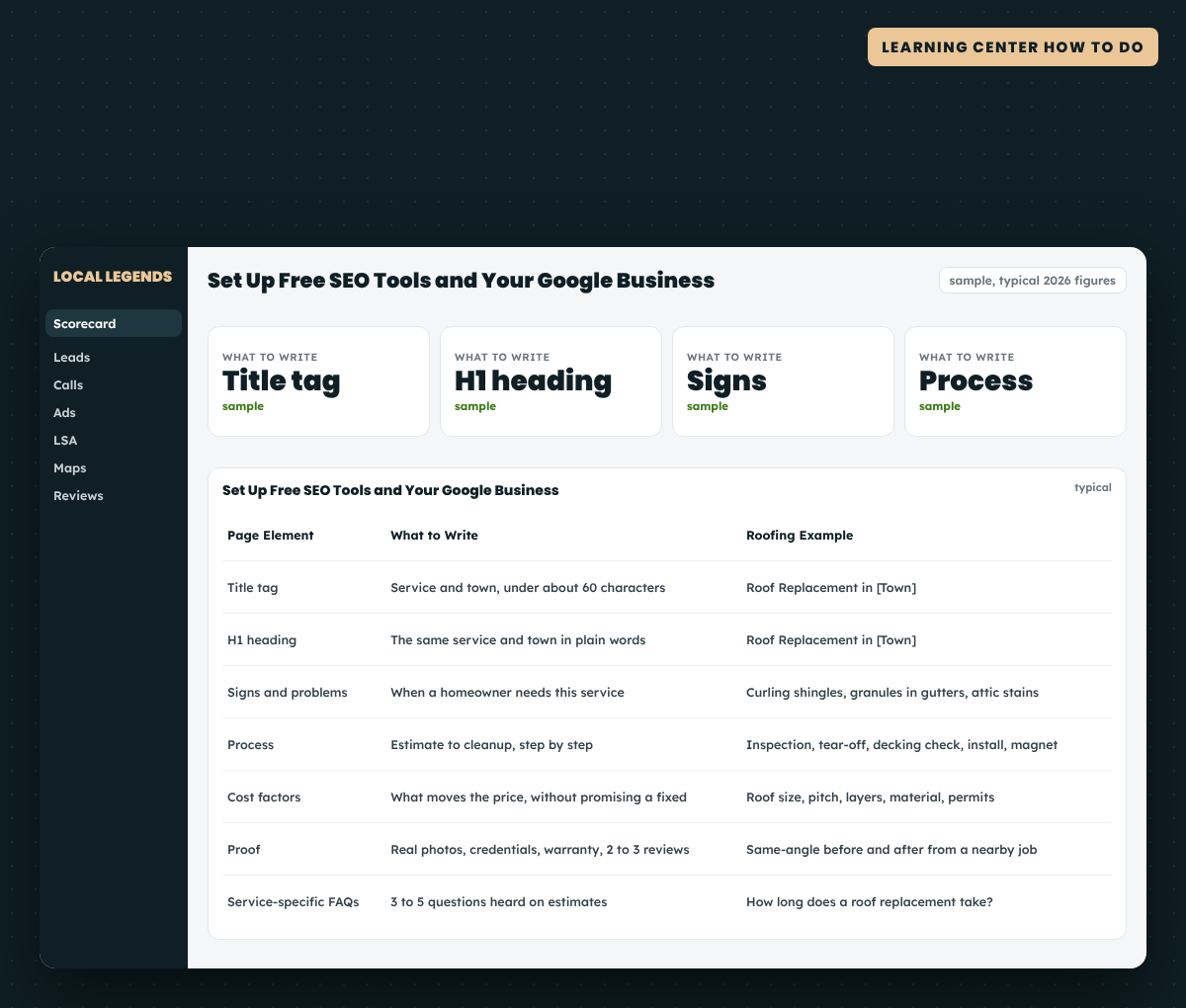
A contractor service page that ranks covers one service, names the town, explains the job honestly and proves the company has done it before, according to Google AI Mode.
| Page Element | What to Write | Roofing Example |
|---|---|---|
| Title tag | Service and town, under about 60 characters | Roof Replacement in [Town] |
| H1 heading | The same service and town in plain words | Roof Replacement in [Town] |
| Signs and problems | When a homeowner needs this service | Curling shingles, granules in gutters, attic stains |
| Process | Estimate to cleanup, step by step | Inspection, tear-off, decking check, install, magnet sweep |
| Cost factors | What moves the price, without promising a fixed quote | Roof size, pitch, layers, material, permits |
| Proof | Real photos, credentials, warranty, 2 to 3 reviews about this service | Same-angle before and after from a nearby job |
| Service-specific FAQs | 3 to 5 questions heard on estimates | "How long does a roof replacement take?" |
| Call to action | Tap-to-call and a quote form near the top | Request an inspection |
[SOURCE: Google AI Mode, "What should be on a contractor service page to rank on Google", captured Nov 28 2026]
City Pages Need Real Local Facts
City and service area pages help only when each one says something true and specific about that town, such as recent jobs, common home types or local permit rules. Swapping the town name on a template creates near-duplicates that Google may skip.
How to Earn Reviews, Citations and Local Links on Your Own Steps Five and Six Build Trust Outside Your Website
Steps five and six of doing your own SEO happen off your website: a steady flow of honest Google reviews, matching business details on every directory and a handful of real local links. Google AI Mode called review velocity the fastest lever a do-it-yourself owner can pull for map visibility.
How Do I Get More Google Reviews Without Breaking Google's Rules?
You get more Google reviews safely by sending every customer a direct review link right after the job and never offering anything in return, according to Google AI Mode. A steady stream of reviews reads more naturally than a sudden spike.
- Send it fast: a text or email with the link within a couple of hours of finishing the job.
- Use the direct link: copy the "ask for reviews" link from your profile so it opens in one tap.
- Ask in person: a card with a QR code lets a happy homeowner leave a review before the tech drives away.
- Add it everywhere: invoices, receipts and email signatures.
- Reply to every review, positive or negative, calmly and promptly.
Google Review Rules to Follow
- No incentives: no discounts, gift cards or drawings in exchange for a review.
- No gating: send the link to every customer, not only the ones who said they were happy.
- Keep the ask neutral: request honest feedback without telling customers what to write.
- No insider reviews: owners, employees and family members should not review the business.
[SOURCE: Google AI Mode, "How do I get more Google reviews for my home service business without breaking Google rules", captured Nov 28 2026]
How Do I Build Citations and Backlinks for a Local Contractor Myself?
You build citations by listing the exact same business name, address and phone number on the major directories, then earn backlinks from local suppliers, partners and community groups, according to Google AI Mode. A link from a local site carries more weight for a contractor than a random national blog.
- Write your details once: keep one document with your exact name, address, phone and website, down to "St." versus "Street."
- Claim the main platforms: Google Business Profile, Bing Places, Apple Business Connect and the major review and trade directories.
- Ask your suppliers: many supply houses and manufacturers keep "where to buy" or installer pages.
- Partner with related trades: a roofer and a gutter installer, or a plumber and a remodeler, can feature each other.
- Join local groups: chambers of commerce and builder associations often link to members.
- Pace it: AI Mode suggested 5 to 10 citations a week up to the top 30 to 40 sites, and 1 or 2 real local links a month. Never buy bulk link packages.
Technical SEO You Can Handle Yourself on a Contractor Website A Short List of Fixes Most Owners Can Make
Most technical SEO a contractor can do alone comes down to five checks: indexing, one secure domain, clean page addresses, compressed photos and a phone number that works on mobile. Google AI Mode put connecting Search Console and fixing indexing blockers at the top of the list.
How Do I Do Technical SEO Myself on a WordPress or Wix Contractor Website?
You do your own technical SEO on WordPress or Wix by confirming search engines can index the site, keeping one secure version of the domain and making every service page fast and easy to reach, according to Google AI Mode.
- Indexing: in WordPress, make sure "Discourage search engines from indexing this site" is unchecked under Settings, Reading.
- One secure domain: the site loads on https and redirects www or non-www to a single version.
- Clean addresses: short slugs like /roof-repair/ instead of /page-2/, with a 301 redirect whenever you rename a page.
- Fast photos: resize and compress job photos before upload and give each one descriptive alt text.
- No orphan pages: link every service and area page from the menu or footer.
- Mobile check: test the tap-to-call button and the quote form on your own phone.
- Local business schema: both platforms offer settings or plugins for business structured data.
What Google Says Not to Worry About
Google's SEO Starter Guide lists ideas it believes site owners should not focus on, including meta keywords. Spend the time on pages, reviews and photos instead.
How Many Hours a Week Does It Take to Do Your Own SEO? A Realistic Weekly Routine for a Busy Owner
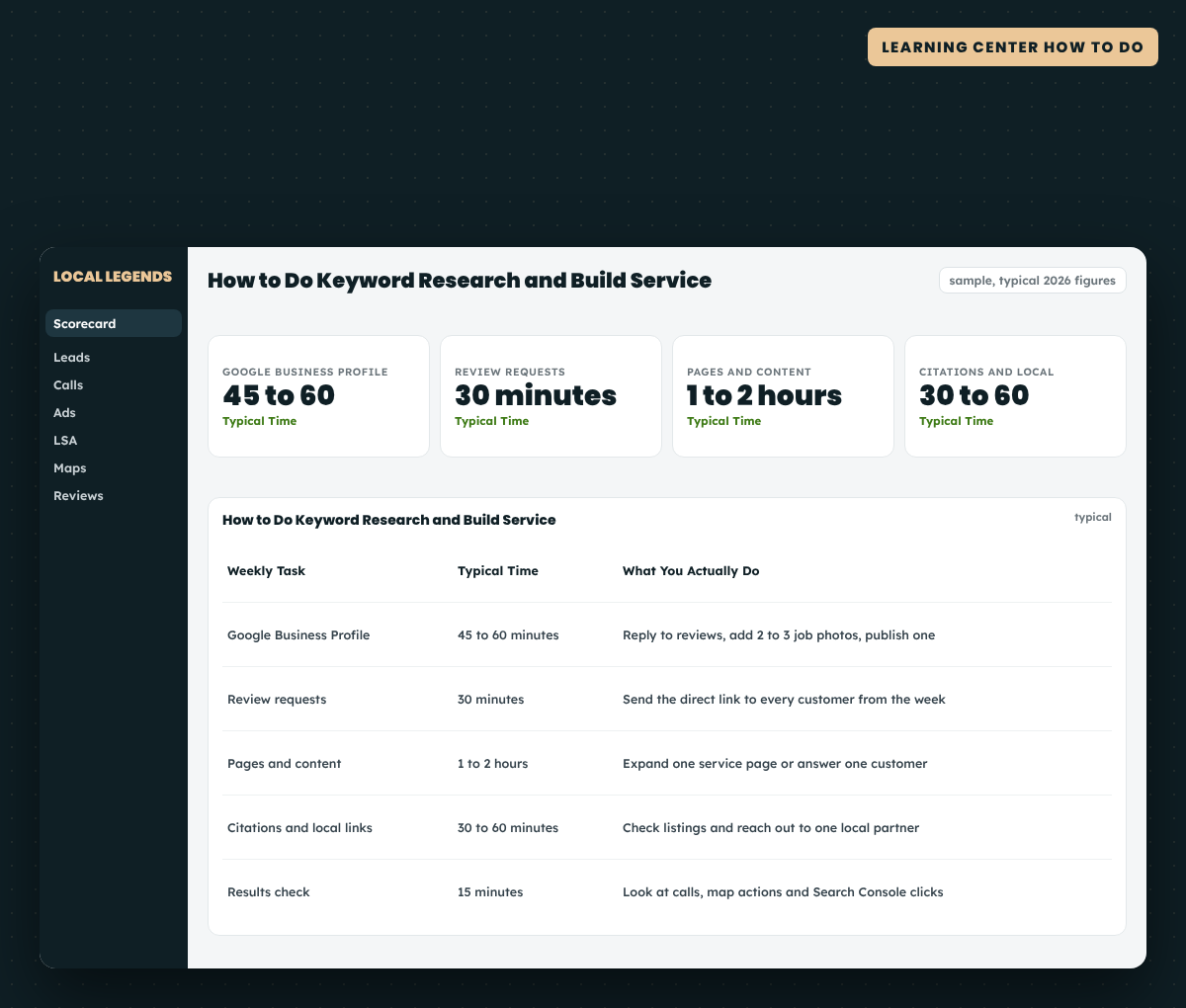
Doing your own SEO for a small home service business takes about 2 to 5 hours a week after a setup phase of 10 to 30 hours, according to Google AI Mode. A small town with few competitors may need 1 to 2 hours; a large metro can take 5 to 10 or more.
| Weekly Task | Typical Time | What You Actually Do |
|---|---|---|
| Google Business Profile | 45 to 60 minutes | Reply to reviews, add 2 to 3 job photos, publish one update |
| Review requests | 30 minutes | Send the direct link to every customer from the week |
| Pages and content | 1 to 2 hours | Expand one service page or answer one customer question |
| Citations and local links | 30 to 60 minutes | Check listings and reach out to one local partner |
| Results check | 15 minutes | Look at calls, map actions and Search Console clicks |
[SOURCE: Google AI Mode, "How many hours a week does it take to do SEO yourself for a small home service business", captured Nov 28 2026]
How Long Does It Take for DIY SEO to Work for a Local Service Business?
DIY SEO for a local service business usually shows clear ranking movement in 3 to 6 months and steadier leads in 6 to 12 months, according to Google AI Mode. Google's own Starter Guide notes that some changes register in hours and others take several months.
- Weeks 1 to 4: setup and fixes, with little ranking change yet.
- Months 2 to 3: map results often move first when the profile is complete and reviews keep coming.
- Months 4 to 6: service and town pages begin climbing.
- Months 6 to 12 and beyond: pages, citations and reviews compound.
- What speeds it up: a smaller market, a clean older website, steady reviews and a weekly habit.
Using AI Tools to Do Your Own SEO in 2026 A Helpful Assistant, Not a Shortcut
AI writing tools can speed up do-it-yourself SEO for a contractor when the owner supplies the facts and edits the result, according to Google AI Mode. Google rewards helpful, accurate pages and does not reward generic, mass-produced ones, whoever or whatever drafted them.
Can I Use ChatGPT to Write SEO Content for My Contracting Website?
Yes, you can use ChatGPT to draft content for a contracting website if you treat it as a writing partner and not a copy-and-paste source, according to Google AI Mode. The tool does not know your town, your crew or your warranty unless you tell it.
- Good uses: outlines, first drafts from your notes, title tags, meta descriptions and FAQ wording.
- Weak spots: local codes, weather and neighborhoods, which you must add yourself.
- Never trust its numbers: AI tools can invent search volumes; check them in Keyword Planner.
- Fact-check the trade details: materials, steps and safety claims need a pro's review.
- Workflow: write your facts as bullets, ask for a draft that uses only those facts, then edit it into your own voice.
How Can a Contractor Show Up in Google AI Overviews and ChatGPT Without an Agency?
A contractor shows up in AI answers by building a clear, consistent footprint: complete directory profiles, specific service and town pages, short answers to common questions and steady genuine reviews, according to Google AI Mode.
- Match your details everywhere: the same name, address, phone and categories on every platform.
- Answer questions plainly: cost ranges, timelines and permit basics in short sections.
- Let crawlers in: confirm pages are indexed in Search Console and that AI search crawlers are not blocked.
- Run a monthly prompt check: ask AI assistants 10 to 15 questions a homeowner would ask and note which sites they cite.
Common DIY SEO Gaps on Contractor Websites and How to Close Them Quick Fixes That Unlock Rankings
The most common gaps in contractor DIY SEO are a single catch-all services page, copied city pages, vague claims, hidden service areas and slow mobile pages, according to Google AI Mode. Each one has a direct fix an owner can make.
- One page for every service: split "Plumbing, Drains and Water Heaters" into separate pages.
- Unique town pages: add real projects and local details instead of swapping the town name.
- Facts instead of slogans: founding year, license numbers, warranty terms and review counts.
- Clear service areas: name your towns in titles, headings and body copy.
- Unique page titles: replace "Home" with the service and town.
- Lighter photos: compress large project images before uploading.
- A linked profile: point your Google Business Profile to the home page or matching service page.
How Do I Know if My DIY SEO Is Working? Track Calls From Your Service Area, Not Just Traffic
Your DIY SEO is working when it brings qualified calls and quote requests from the towns you serve, according to Google AI Mode. Early on, rising visibility signals that the calls will follow.
Which Numbers Should a Contractor Track to Measure Their Own SEO?
A contractor measuring their own SEO should track calls and forms from Google, profile actions, map positions in each town and review growth, then compare each month with the same month last year. Seasonal trades can look broken in a slow month when nothing is wrong.
- Calls and forms from organic search, with a "how did you hear about us" question as a backup.
- Google Business Profile actions: calls, website clicks and direction requests.
- Non-branded impressions in Search Console: searches for your services, not your company name.
- Visits to service and town pages, not total site traffic.
- Map positions across your towns.
- New reviews per month next to your top local competitors.
- Lead quality: area codes and addresses that fall inside your service area.
Local Legends Marketing reports these on a CEO scorecard of leads, booked jobs, sold jobs and cost per booked job, because rankings and traffic are only the first chapter of the story.
How Much Does It Cost to Do Your Own SEO Compared With Hiring Help? Free Tools, Your Time or a Monthly Plan
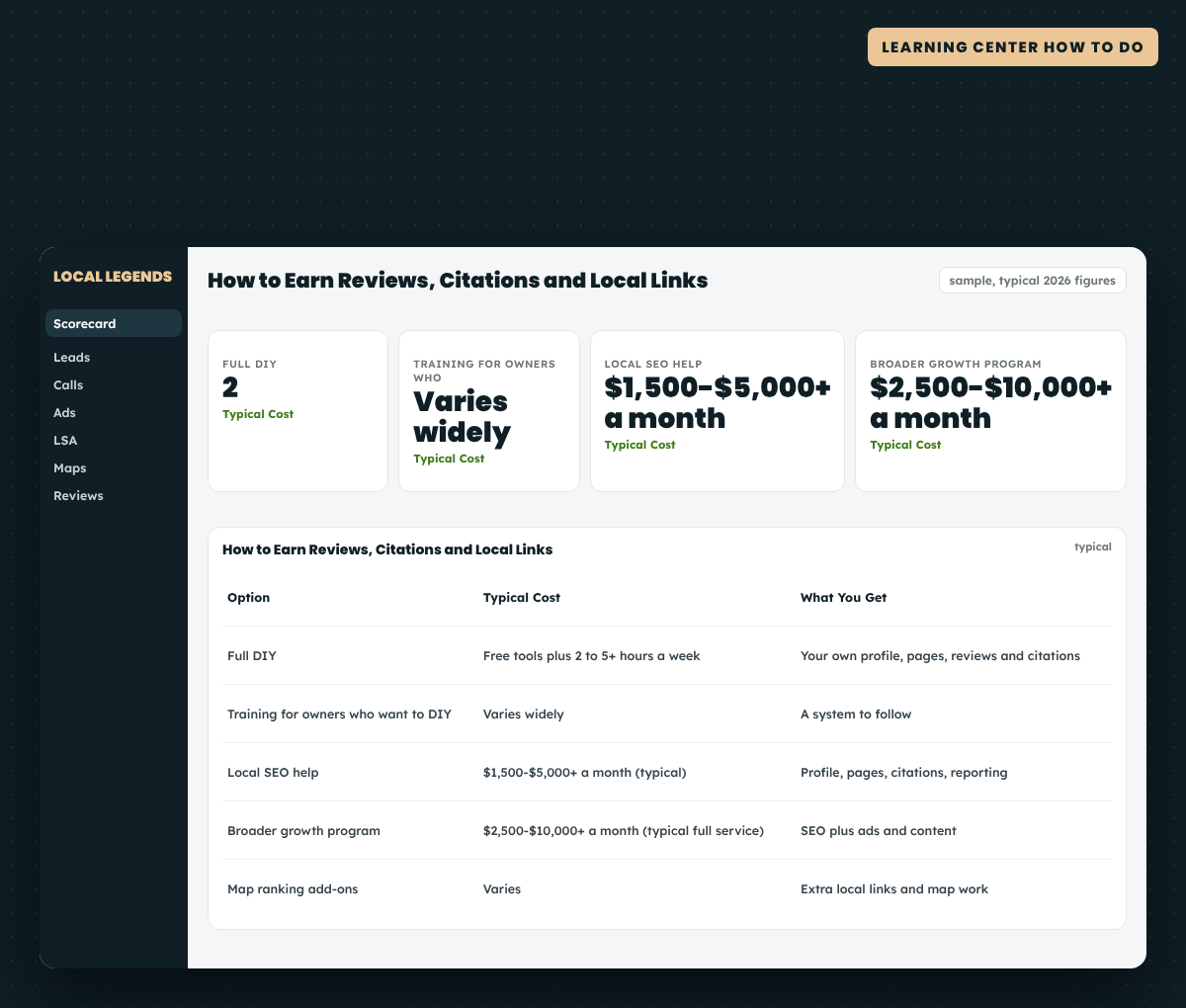
Doing your own SEO costs little in cash because the core tools are free, but it costs 2 to 5 or more hours a week, according to Google AI Mode. Hiring local SEO help typically runs $1,500-$5,000+ a month in published agency pricing.
| Option | Typical Cost | What You Get | Local Legends Pricing |
|---|---|---|---|
| Full DIY | Free tools plus 2 to 5+ hours a week | Your own profile, pages, reviews and citations | Learning Center guides like this one |
| Training for owners who want to DIY | Varies widely | A system to follow | Local Legends Academy, $999 one time |
| Local SEO help | $1,500-$5,000+ a month (typical) | Profile, pages, citations, reporting | Footprint $2,500/mo: local SEO, 70+ citations in month 1, 10 pages and blogs a month, Google Ads and Local Services Ads management |
| Broader growth program | $2,500-$10,000+ a month (typical full service) | SEO plus ads and content | Trailblazer $4,000/mo, Sasquatch $8,000/mo, Legend $10,000+/mo |
| Map ranking add-ons | Varies | Extra local links and map work | Local Map SEO backlinks $479-$1,299+/mo; Local Map Domination $675/mo |
Typical ranges come from published 2026 agency pricing and Google AI Mode and are labeled typical. Ad spend is separate and paid straight to Google. Every plan is listed on the Local Legends pricing page.
[SOURCE: Google AI Mode, "Can a roofing contractor do their own SEO without hiring an agency", captured Nov 28 2026; Local Legends prices and typical agency ranges from BRIEF.md, Nov 2026]
How Local Legends Marketing Answers Do-It-Yourself SEO Teach the Playbook, Then Run It
Local Legends Marketing treats SEO as something every contractor should understand, whether they run it themselves or hand it off. Every engagement includes the Local Legends marketing course, and owners who want to learn first can take the Academy as a one-time add-on.
Founder Levi Ostlund learned this the hard way. He lost $30,000+ to marketers, including one who built a good-looking website that never ranked, before he became a roofing company CMO and later started Local Legends. [SOURCE: Local Legends founder story, BRIEF.md, Nov 2026]
- Audit first: every relationship starts with a free growth audit, including Google Maps rank grids.
- Ownership stays with you: website, domain, Google Business Profile, ad accounts and call data remain in your name.
- One contractor per trade per city on ongoing programs.
- No setup fees and no long-term contracts.
- Weekly project review meeting and a scorecard tied to booked jobs.
The full services are on the local SEO, SEO and Google Business Profile management pages.
Local Legends Marketing Reviews From Contractor Owners CEOs on Working With Levi
Roofing and restoration CEOs have recorded testimonials about working with Local Legends Marketing. The full set is on the Local Legends reviews page.
Levi has been absolutely outstanding to work with over the years... His creativity, responsiveness, and deep understanding of our marketing strategy have made a huge impact." Brad Beldon, CEO, Roofing Company. Read on Local Legends
- Kyle Scott, CEO, Roofing Company (video testimonial)
- Jim Dodson, CEO, Roofing Company (video testimonial)
- Race Allen, CEO, Precision Restoration of Texas (video testimonial)
Frequently Asked Questions About Doing Your Own SEO Short Answers for Contractor Owners
Can I Do SEO Myself for Free?
Yes, the core tools are free: Google Business Profile, Search Console, Analytics, Keyword Planner and Bing Webmaster Tools. The real cost is your time each week.
What Is the 80/20 Rule in SEO for a Contractor?
It means a small share of the work drives most of the results. For most contractors, that share is the Google Business Profile, reviews and a page for each money service.
Is SEO Dead in 2026?
No. SEO has changed shape. AI answers draw on the same pages, listings and reviews that rank in search, so the basics now feed both.
Should I Put Keywords in My Google Business Profile Name?
No. Use your real business name. Adding service or city keywords to the name can lead to a suspension.
Should a Home-Based Contractor Hide Their Address on Google?
Yes, if customers do not visit you. Set the profile up as a service-area business, hide the address and list the towns you actually serve.
How Many City Pages Should I Build Myself?
Only as many as you can fill with real local facts. Local Legends writes town pages only for places with 5+ verified local facts, and the same rule works for owners.
Do Meta Keywords Still Matter?
No. Google's SEO Starter Guide lists meta keywords among things not to focus on. Write a clear title tag and meta description instead.
Does a Brand-New Website Slow Down DIY SEO?
Usually, yes. A new domain tends to take longer to rank than an older, clean site, so lean on your Google Business Profile and reviews while the pages catch up.
Reviewed by Levi Ostlund, Founder, Local Legends Marketing

Get a Free Growth Audit Before You Start Your Own SEO Know Which Steps Matter Most in Your Market
A free growth audit shows where your profile, pages, reviews and citations stand against the contractors ranking above you, so your DIY hours go to the fixes that matter. Local Legends Marketing includes Google Maps rank grids and a clear fix list.
- Bring your website and profile links.
- Bring your current call numbers if you track them.
- Leave with a priority list, whether you do the work yourself or hand it off.
Call (936) 900-1248 or book a free growth audit online.