


Marketing in the Construction Industry and How

Marketing in the Construction Industry: The 2026 Playbook for General Contractors, Home Builders, Remodelers and Specialty Trades Who Want Buyers to Trust Them Before the First Call
How Construction Companies Plan, Brand, Advertise and Measure Their Marketing
Updated November 2026 · Reviewed by Levi Ostlund, Founder
Marketing in the construction industry is the work of proving to buyers that your company can deliver a project safely, on schedule and at a fair price, then making that proof easy to find on Google, in AI answers, on job sites and in referral conversations.
Construction buyers spend large sums on work they cannot test first, so they hire the builder they already trust. At Local Legends Marketing, Google Ads and Local Services Ads management is a flat $2,000 a month, and growth plans run from $2,500 to $10,000+ a month.
- Pick a lane: marketing works best when it names the project types, buyers and towns you want most.
- Build proof first: a complete Google Business Profile, recent reviews and real project pages come before ad spend.
- Match channels to buyers: homeowners search and scroll, while developers and architects vet capability and relationships.
- Plan the year: construction demand is seasonal, so campaigns start weeks before busy and slow periods.
- Count contracts: the score that matters is signed work and gross profit per channel, not clicks or likes.
Free Growth Audit
Your Reviews, Radius and Response Rate vs the competitors beating you.
About Local Legends Marketing
A home service marketing agency headquartered in Conroe, Texas, with 8+ years of marketing experience, running Google Ads, Local Services Ads, local SEO, AI SEO, connected TV and review systems for contractors nationwide.
What Is Marketing in the Construction Industry and How Is It Different in 2026? High Price, Long Cycle, Trust Earned in Advance
Construction industry marketing differs from retail or most service marketing because every sale is large, custom and slow, so the job of marketing is to lower the buyer's perceived risk long before an estimator arrives or a bid is due.
A homeowner choosing a remodeler and a developer choosing a general contractor both ask one quiet question: will this company finish what it starts? Google's AI Overview frames construction marketing as trust, expertise and leads across long cycles for business and consumer buyers.
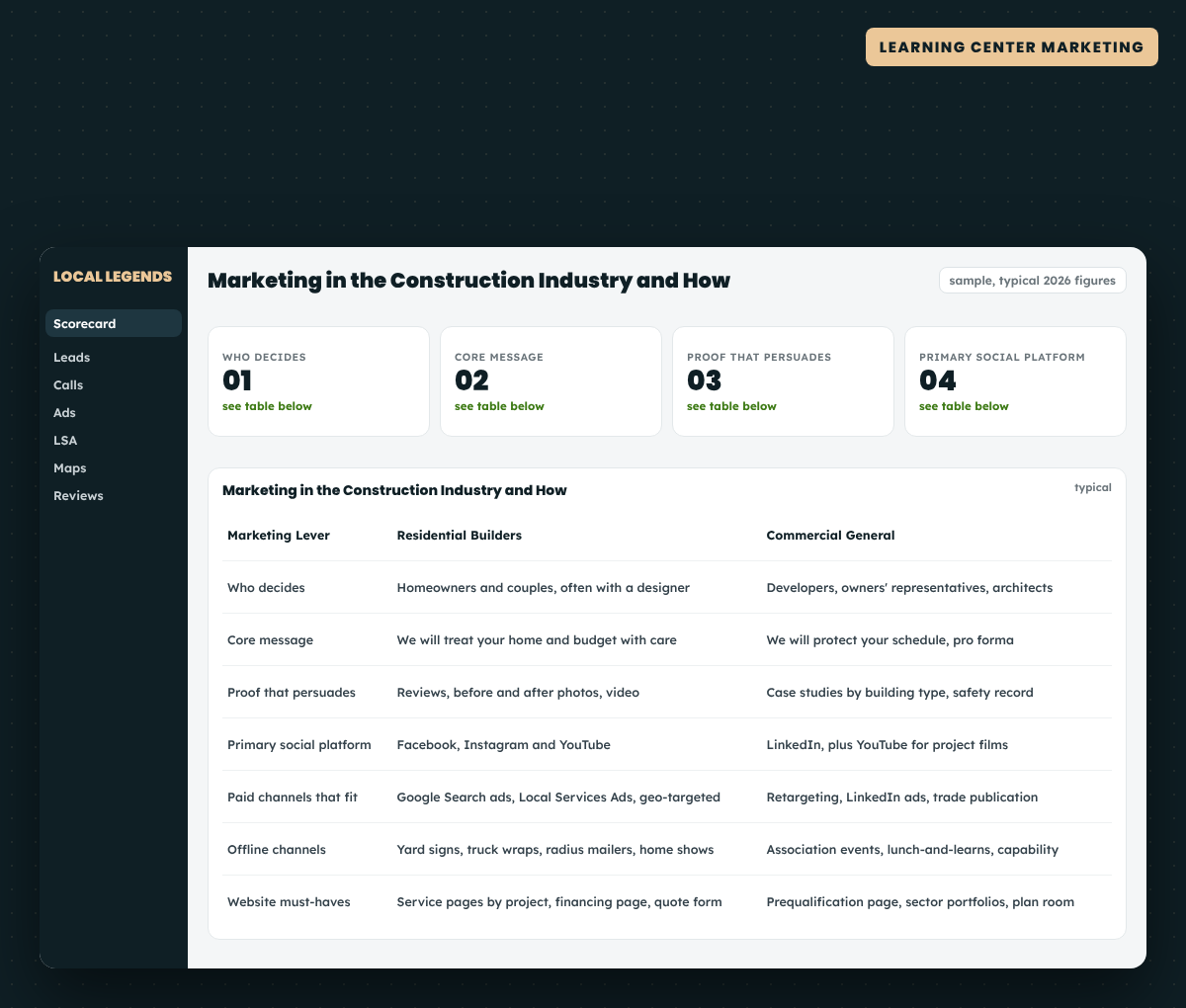
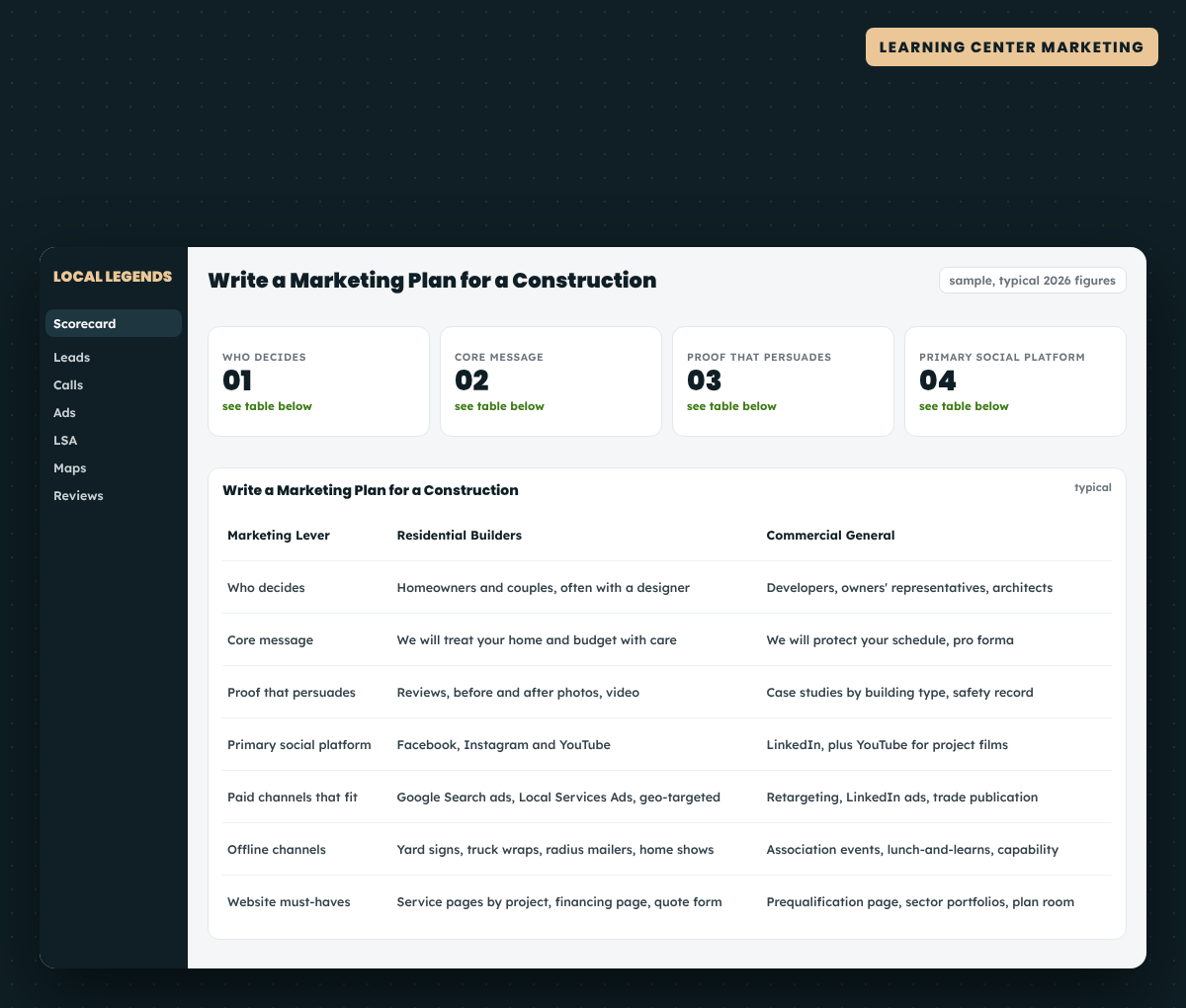
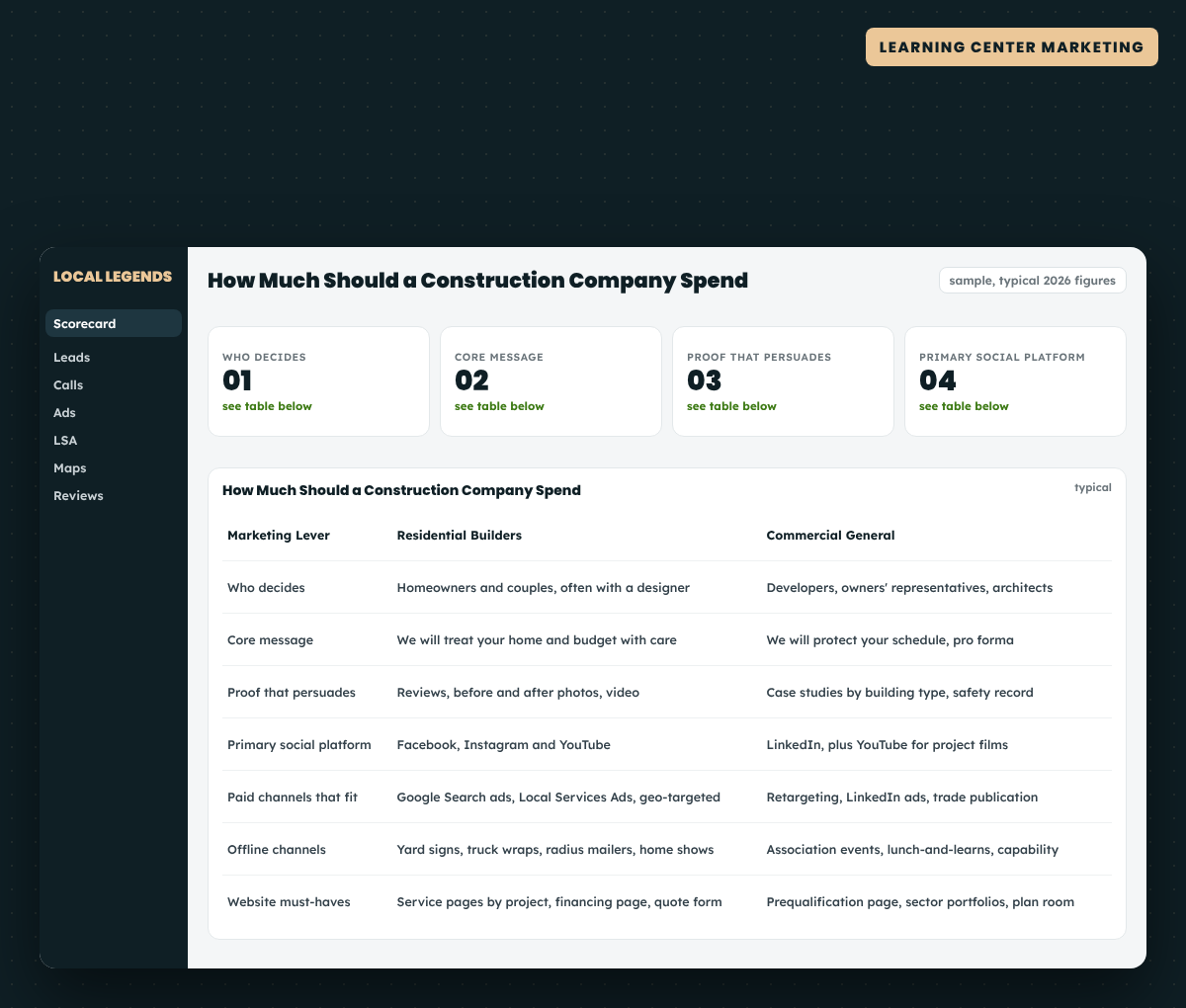
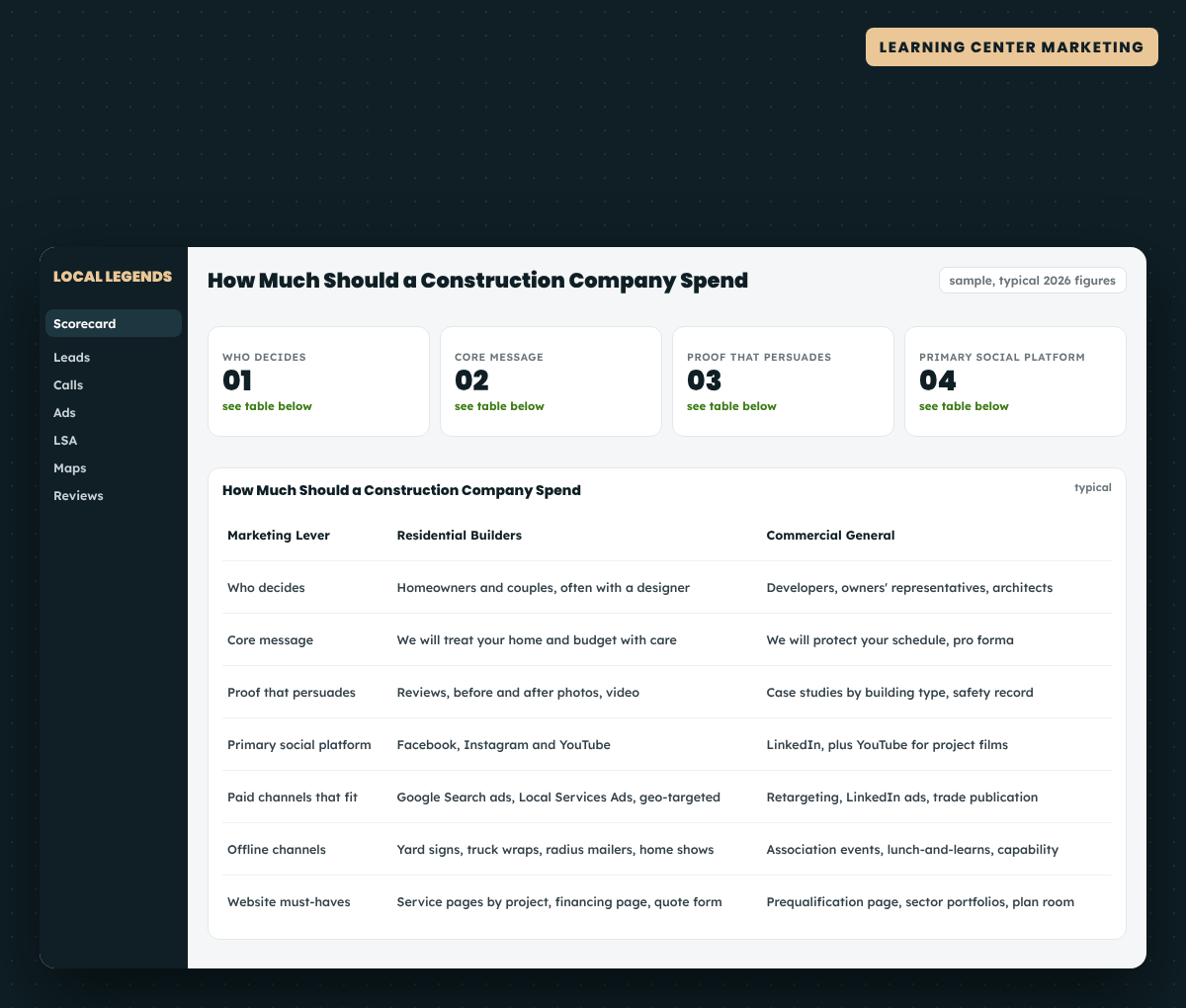
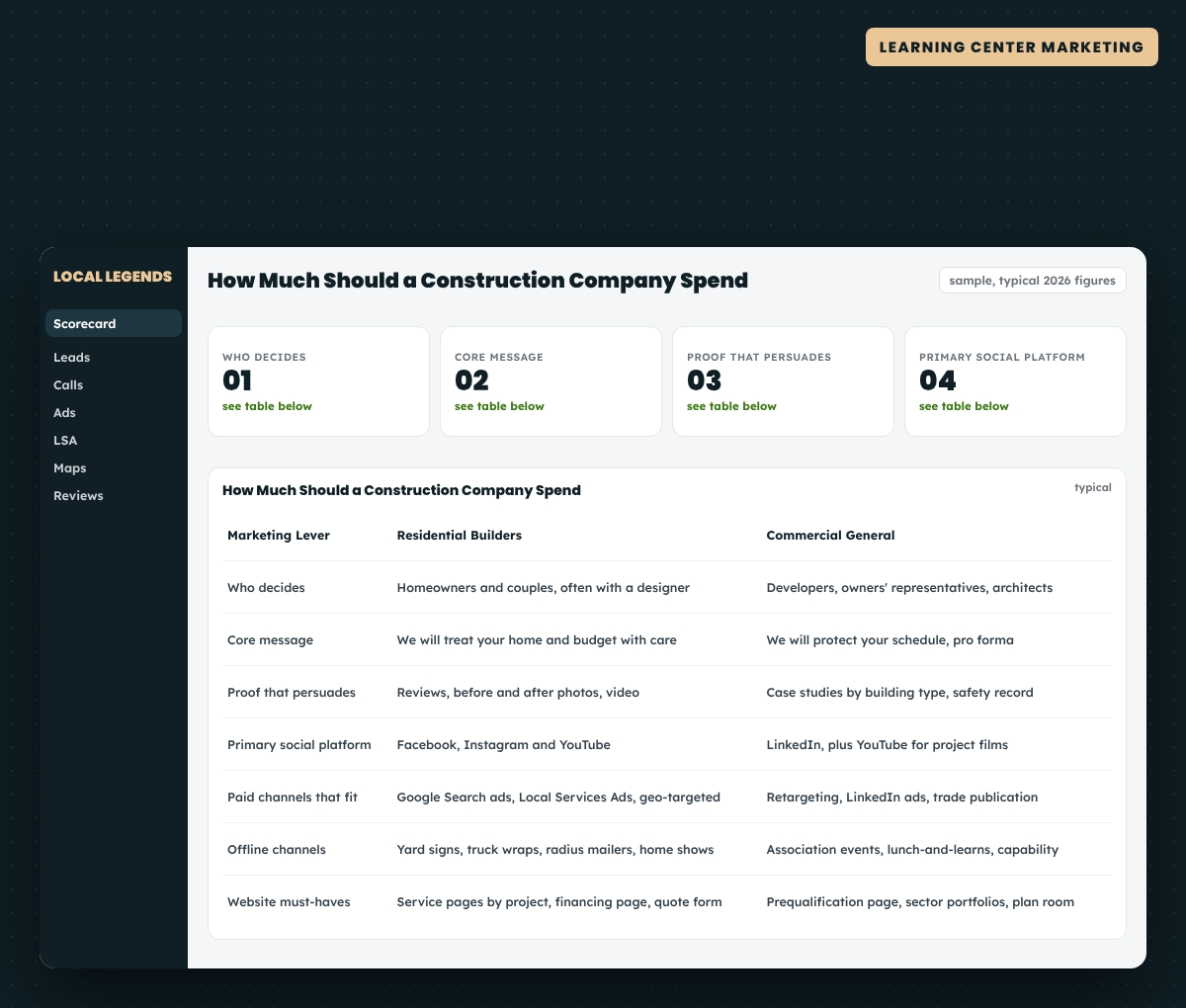
| Marketing Lever | Residential Builders and Remodelers | Commercial General Contractors and Subcontractors |
|---|---|---|
| Who decides | Homeowners and couples, often with a designer or agent | Developers, owners' representatives, architects, facility managers, estimators |
| Core message | We will treat your home and budget with care | We will protect your schedule, pro forma and reputation |
| Proof that persuades | Reviews, before and after photos, video walkthroughs, cost guides | Case studies by building type, safety record, bonding capacity, key personnel |
| Primary social platform | Facebook, Instagram and YouTube | LinkedIn, plus YouTube for project films |
| Paid channels that fit | Google Search ads, Local Services Ads, geo-targeted social ads | Retargeting, LinkedIn ads, trade publication sponsorships |
| Offline channels | Yard signs, truck wraps, radius mailers, home shows | Association events, lunch-and-learns, capability decks, pre-bid meetings |
| Website must-haves | Service pages by project, financing page, quote form | Prequalification page, sector portfolios, plan room or bid upload |
Why Word of Mouth Alone Caps Growth
Referrals close well, but they arrive on the referrer's schedule, not yours. A company that relies on them cannot add a crew, enter a new town or fill a slow quarter on purpose. Marketing turns reputation into something you can switch on.
Why Specialization Outperforms Being Everything to Everyone
AI Mode answers for this topic repeatedly advise picking one or two of your most profitable project types. A builder known for medical tenant improvements, or for whole-home remodels in older neighborhoods, gives buyers and search engines a clear reason to choose it.
How Do Commercial General Contractors Market to Developers, Architects and Facility Managers?
Commercial general contractors market to developers, architects and facility managers by proving risk reduction for each one, because each stakeholder judges a builder against a different fear, and most commercial work is awarded through bid invitations rather than ads.
- Developers: show on-budget delivery, value engineering savings and fast-track schedules in case studies tied to return on investment.
- Architects: show preconstruction collaboration, constructability input and photography of complex finishes that preserve design intent.
- Facility managers: show logistics plans for occupied buildings, dust and noise control, tenant safety and your safety rating.
- Executives on LinkedIn: owners and project executives post progress, milestones and lessons learned, tagging the design team.
- Qualification collateral: keep a statement of qualifications with bonding limits, safety records and key personnel resumes ready to send.
- Segmented email: send updates on lead times or cost trends by role, so estimators remember you between bid cycles.
Associations and Preconstruction Relationships
Commercial real estate, architecture and facility management associations are where many bid invitations begin. Sponsoring a chapter event or hosting an educational lunch for a design firm builds the familiarity that gets a builder onto a short list.
Digital Marketing in the Construction Industry: The Channels That Matter Most Each Channel Has One Job
Digital marketing in the construction industry is a set of channels that each do one job, from capturing urgent search demand to showing craftsmanship to staying remembered during a long decision, and a builder wins by running a few well instead of many poorly.
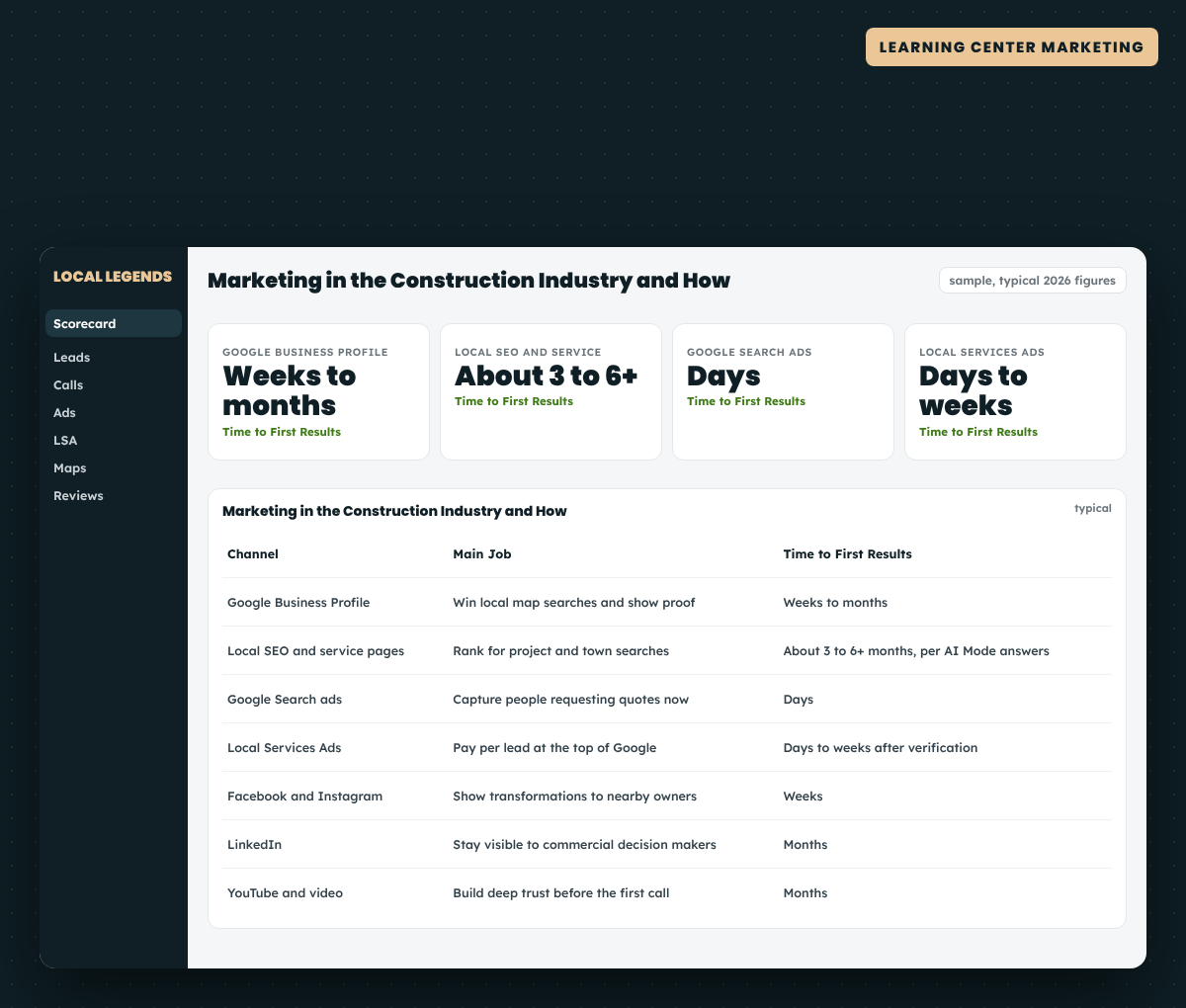
| Channel | Main Job | Time to First Results | Best Fit | What to Measure |
|---|---|---|---|---|
| Google Business Profile | Win local map searches and show proof | Weeks to months | Every builder with a local service area | Calls, direction requests, review count and recency |
| Local SEO and service pages | Rank for project and town searches | About 3 to 6+ months, per AI Mode answers | Remodelers, home builders, specialty trades | Organic calls and forms, pages ranking |
| Google Search ads | Capture people requesting quotes now | Days | Residential projects with clear search terms | Cost per qualified lead, cost per signed job |
| Local Services Ads | Pay per lead at the top of Google | Days to weeks after verification | General contracting, remodeling and trades with a category | Valid leads, booked estimates |
| Facebook and Instagram | Show transformations to nearby owners | Weeks | Residential remodels, custom homes, exteriors | Lead forms, messages, retargeting reach |
| Stay visible to commercial decision makers | Months | Commercial GCs, design-build, subcontractors | Bid invitations by source | |
| YouTube and video | Build deep trust before the first call | Months | Custom builds, additions, major renovations | Views by local viewers, calls after viewing |
| Email nurture | Stay remembered through long decisions | Weeks | Every builder with past clients and open bids | Replies, revived estimates, repeat work |
The Google Business Profile Comes First
Every AI Mode answer we captured for this topic started here. A complete profile with exact categories, service areas, weekly project photos and replies to every review is free and often the highest converting asset a builder owns.
Search Ads and Local Services Ads Fill Near-Term Gaps
Search campaigns built on tight, high-intent terms, strict location targeting and negative keywords for job seekers and do-it-yourself searches bring calls within days. Google Ads management at Local Legends includes the campaign landing pages.
Is SEO or Google Ads Better for a Construction Company?
Neither SEO nor Google Ads is better on its own for a construction company, because Google Ads rents attention that stops when spending stops, while SEO builds pages and rankings that keep producing, and most builders need both in a planned order.
- Start with the foundation: a fast mobile website, real project photos, a complete profile and recent reviews, so paid clicks land on proof.
- Turn on search ads for immediate demand: bid on quote-ready terms like a project type plus a town, not broad phrases.
- Keep match types tight early: broad match without negative keywords tends to pull in job seekers and do-it-yourself searches.
- Build SEO in parallel: one page per service, per project type and per town you truly serve, with cost and timeline answers.
- Shift budget as organic calls grow: let tracked results, not habit, decide how much stays in ads.
- Treat Local Services Ads as a middle step: you pay per lead rather than per click, once licensing and insurance are verified.
How Do Construction Companies Use Social Media and Video to Get Jobs?
Construction companies turn social media and video into jobs by documenting the work in progress and giving viewers a clear next step, since polished reveal photos earn likes while process footage, real faces and fast replies earn estimate requests.
- Film short, unscripted clips of a superintendent explaining a hidden problem, a waterproofing detail or an inspection.
- Post drone progress flights and timeline comparisons that show an organized, clean job site.
- Answer the questions owners ask at estimates: realistic timelines, permit delays and why one material costs more.
- Record a short testimonial with the client standing in the finished space.
- Tag the architect, designer, supplier and trade partners so the post reaches their networks.
- End each post with one instruction, such as booking a site walk, and reply to cost and service area comments quickly.
Match the Platform to the Buyer
Residential builders get the most from Facebook and Instagram reels and neighborhood groups. Commercial firms treat LinkedIn as a working channel. YouTube suits long walkthroughs and cost breakdowns for custom homes and large renovations.
How Do I Get My Construction Company Recommended by ChatGPT or Google AI Mode?
A construction company gets recommended by AI assistants by being easy to verify, with matching business details across the web, a steady stream of detailed reviews and website pages that answer the exact questions owners and developers type.
- Complete both the Google Business Profile and Bing Places, since AI answers we captured note that some assistants lean on the Bing index.
- Keep the company name, address and phone number identical on the website, profiles, directories and association listings.
- Ask clients to mention the project type and town in their reviews, and reply to every review.
- Publish local case studies with the neighborhood, scope, timeline and the problem your team solved.
- Add short, direct FAQ answers about cost, permits and schedules on each service page.
- Ask the assistants who the best builders in your area are, then note which sources they cite and get listed there.
- AI SEO is included in the Local Legends Sasquatch and Legend plans.
Construction Company Websites That Win Bigger Projects Proof of Capability Comes First
A construction company website wins bigger projects when it works as a prequalification tool, answering the vetting questions owners, developers and architects would otherwise email about before they ever invite a builder to bid.
What Should a Construction Company Website Include?
A construction company website should include proof of eligibility, detailed project stories, the people who run jobs and a contact path built for the buyer you want, in addition to the basics of fast mobile loading and a visible phone number on every page.
- Prequalification page: licenses, insurance coverage, bonding limits, safety program and certifications, ready to download as a capability statement.
- Case studies, not just galleries: square footage, duration, delivery method, budget tier, the site challenge and how the crew solved it.
- Sector and service pages: separate pages for each building type or project type, written in the words buyers use in requests for proposals.
- Service area and self-perform scope: the towns or counties you work in and which trades your own crews perform.
- Key personnel: project managers and superintendents with years of experience and notable builds.
- Buyer-specific contact paths: an estimating email, a drawing or bid upload option and a subcontractor prequalification form for general contractors.
- Financing page for residential work: a plain explanation of payment options, reviewed by your lender for compliance.
One-Time Website Pricing at Local Legends
Local Legends builds websites for a one-time price: $2,500 for 10 pages, $5,500 for 20, $7,500 for 40 and $15,000 for 80, with the site and domain owned by the client. Every site uses the Local Legends product-page layout.
Branding and Offline Marketing for Construction Companies Job Sites and Trucks Still Sell
Construction branding is the consistent look, message and behavior that makes a company recognizable from the street to the proposal, and offline marketing such as signs, wraps and mail now works mainly by sending people to search the company name.
Build a Visual Identity That Reads at a Distance
AI Mode guidance on construction branding favors an ownable logo that reads on a fence banner and an embroidered polo, two or three high-contrast colors applied everywhere and concrete strengths in place of slogans. Branding at Local Legends covers websites, profiles and social.
Replace Slogans With Operating Strengths
Phrases like "quality work" appear on nearly every builder's truck. A specific strength, such as occupied-building renovation experience or a documented closeout process, gives buyers a reason to remember one company.
Carry the Brand Into Proposals
A branded proposal template with a clear scope breakdown and timeline looks more established than a plain spreadsheet, and it is often the last marketing piece a buyer sees before signing.
Do Yard Signs, Truck Wraps, Direct Mail and Home Shows Still Work for Construction Marketing?
Yard signs, truck wraps, direct mail and home shows still work for construction marketing in 2026, but their main role has shifted to building local trust that sends people to the company's Google profile, reviews and website.
- Truck wraps: a bold logo, the specialty in a few words, a short web address and one phone number, readable from across a street.
- Yard signs: placed on active jobs with the owner's permission, and left up for a short period after completion when neighbors notice the finished work.
- Radius mailers: oversized postcards to the homes around an active job, which AI Mode answers describe as a strong fit for high-ticket remodeling.
- Door hangers: a courteous note to neighbors before loud exterior work builds goodwill and often leads to estimates on the same street.
- Home shows: worth the booth fee mainly for large projects, when the booth books in-home consultations instead of handing out brochures.
- Make online match offline: people who see a sign usually look up reviews next, so the profile must look as professional as the truck.
How Do I Write a Marketing Plan for a Construction Business? Work Backward From Signed Jobs
A construction marketing plan starts with the number of signed jobs the company needs next year, then sets the budget, the buyers, two or three channels and a quarterly calendar that matches when your buyers plan projects.
- Review last year: list which project types earned the best gross margin and where those clients first heard of you.
- Set the job goal: divide the new revenue target by the average project size. A $1M goal with $50,000 remodels means 20 signed jobs.
- Work back to leads: use your own estimate-to-contract win rate to find how many qualified leads and estimates those jobs require.
- Choose the buyer and towns: name the project types, the decision makers and the specific towns or ZIP codes to win.
- Lock the trust foundation: profile, reviews, project pages and a website that answers buyer questions.
- Pick two or three channels: the ones from the channel table that fit your buyer, funded properly rather than spread thin.
- Write the calendar: campaigns launch four to six weeks ahead of each busy and slow period.
- Set the review rhythm: a monthly or weekly scorecard that shows leads, estimates, signed jobs and cost per signed job.
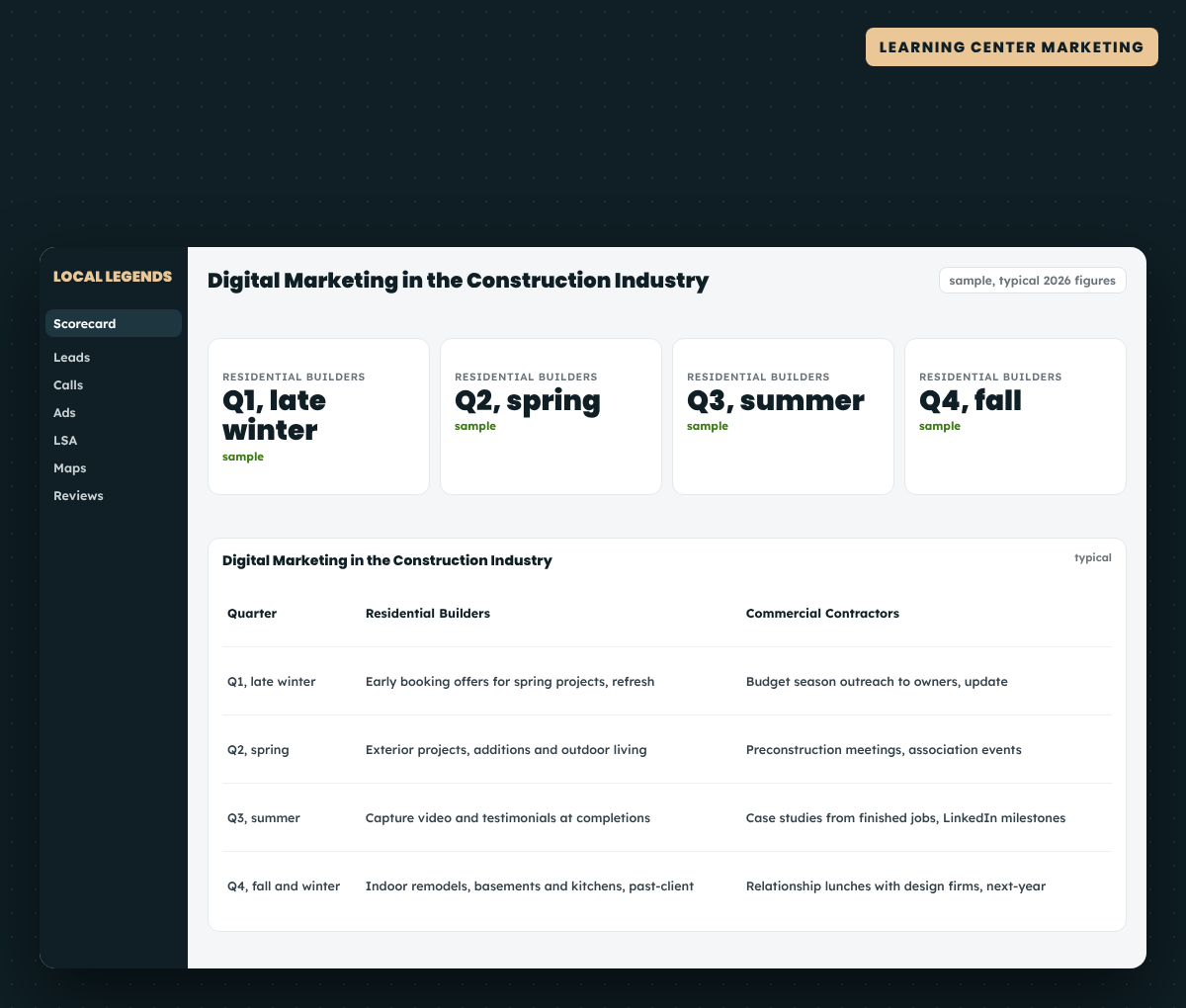
| Quarter | Residential Builders and Remodelers | Commercial Contractors | Runs All Year |
|---|---|---|---|
| Q1, late winter | Early booking offers for spring projects, refresh the project portfolio | Budget season outreach to owners, update qualification packets | Google Business Profile posts, review requests |
| Q2, spring | Exterior projects, additions and outdoor living, yard signs on every job | Preconstruction meetings, association events | Search ads, project photos and video |
| Q3, summer | Capture video and testimonials at completions, retarget site visitors | Case studies from finished jobs, LinkedIn milestones | Call tracking, lead response |
| Q4, fall and winter | Indoor remodels, basements and kitchens, past-client check-ins | Relationship lunches with design firms, next-year bid planning | Email nurture to open estimates |
A Worked Example of the Job Goal Math
A remodeler targets $1M in new contracts at a $50,000 average, so it needs 20 signed jobs. If one in four estimates signs in its own records, it needs about 80 estimates, and the plan budgets the channels that can produce them.
How Do I Market a Small Construction Company on a Small Budget?
A small construction company on a tight budget should spend time before money, starting with free local visibility and job-site marketing, then paying only for channels where the buyer is already looking for a builder.
- Fill out every section of the Google Business Profile and add finished-project photos every week.
- Make the review request part of the final walkthrough, sent by text with a direct link.
- Put a clean sign on every active job and a magnet or decal on every truck.
- Answer recommendation requests in neighborhood groups with photos of similar work, without spamming.
- Build two or three trade and real estate relationships that send repeat work.
- Add Local Services Ads or a small search campaign once reviews and verification are in place.
- Hold off on billboards, broad awareness ads and shared lead platforms until the basics produce.
Our Referrals Dried Up and Next Quarter Is Empty. What Marketing Should a Construction Company Start This Month?
A construction company facing an empty quarter should start with its past clients and high-intent search, because those two reach people who already trust the company or are ready to hire now, while new SEO content will not fill crews in time.
- Call past clients first: reach out to satisfied customers from recent years about smaller interior work or reserving a spring start.
- Ask for reviews on those calls: fresh reviews lift map visibility quickly.
- Tell partners you have capacity: architects, agents, property managers and other trades often hold projects waiting for a builder.
- Turn on search ads and Local Services Ads: tight local targeting on quote-ready project terms.
- Sell season-appropriate work: promote indoor renovations or a design agreement that holds a spring slot, rather than discounting.
- Answer every new inquiry fast: a missed call during an empty quarter is the most expensive kind.
How Much Should a Construction Company Spend on Marketing? Typical Ranges by Company Stage
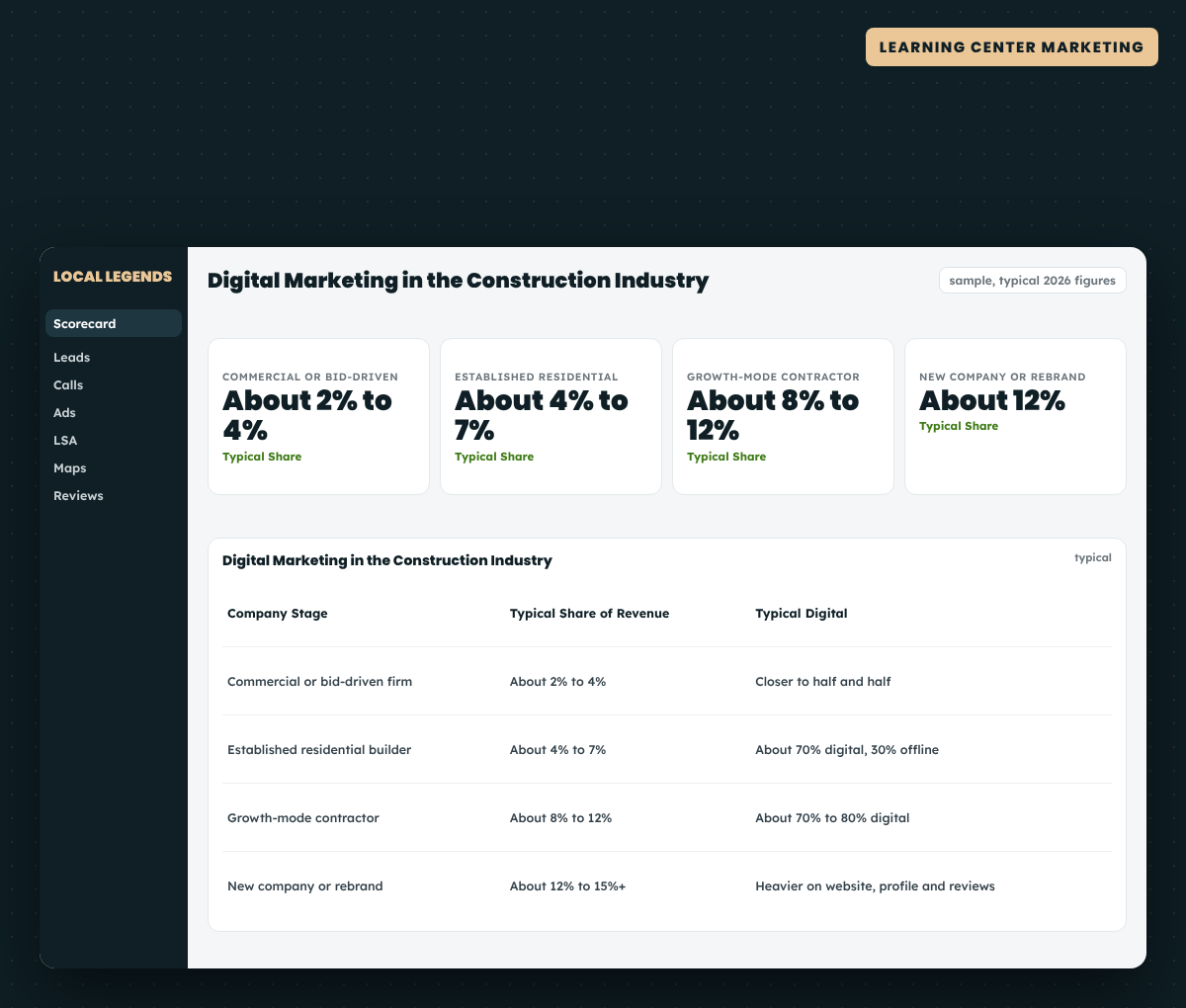
Construction companies typically budget a share of gross revenue for marketing, and that share rises with growth goals, from a few percent for established commercial firms to well above 10% for a new company building its name.
| Company Stage | Typical Share of Revenue (AI Platform Answers) | Typical Digital and Offline Split | Main Objective |
|---|---|---|---|
| Commercial or bid-driven firm | About 2% to 4% | Closer to half and half | Relationships, qualification materials, digital credibility |
| Established residential builder | About 4% to 7% | About 70% digital, 30% offline | Keep crews booked and protect rankings |
| Growth-mode contractor | About 8% to 12% | About 70% to 80% digital | Add crews, enter new towns |
| New company or rebrand | About 12% to 15%+ | Heavier on website, profile and reviews | Build awareness and review volume |
These are typical ranges that Google AI Mode answers and the budget guides they cite reported in November 2026, not rules. Fast-response trades such as roofing and restoration usually lean more digital; custom home builders lean more on relationships.
Split the Budget Into Fees and Ad Spend
Every construction marketing budget has two lines: the management fee paid to the people running the work and the ad spend paid to Google, Meta or a TV network. Comparing agencies on one blended number hides how much reaches the ads.
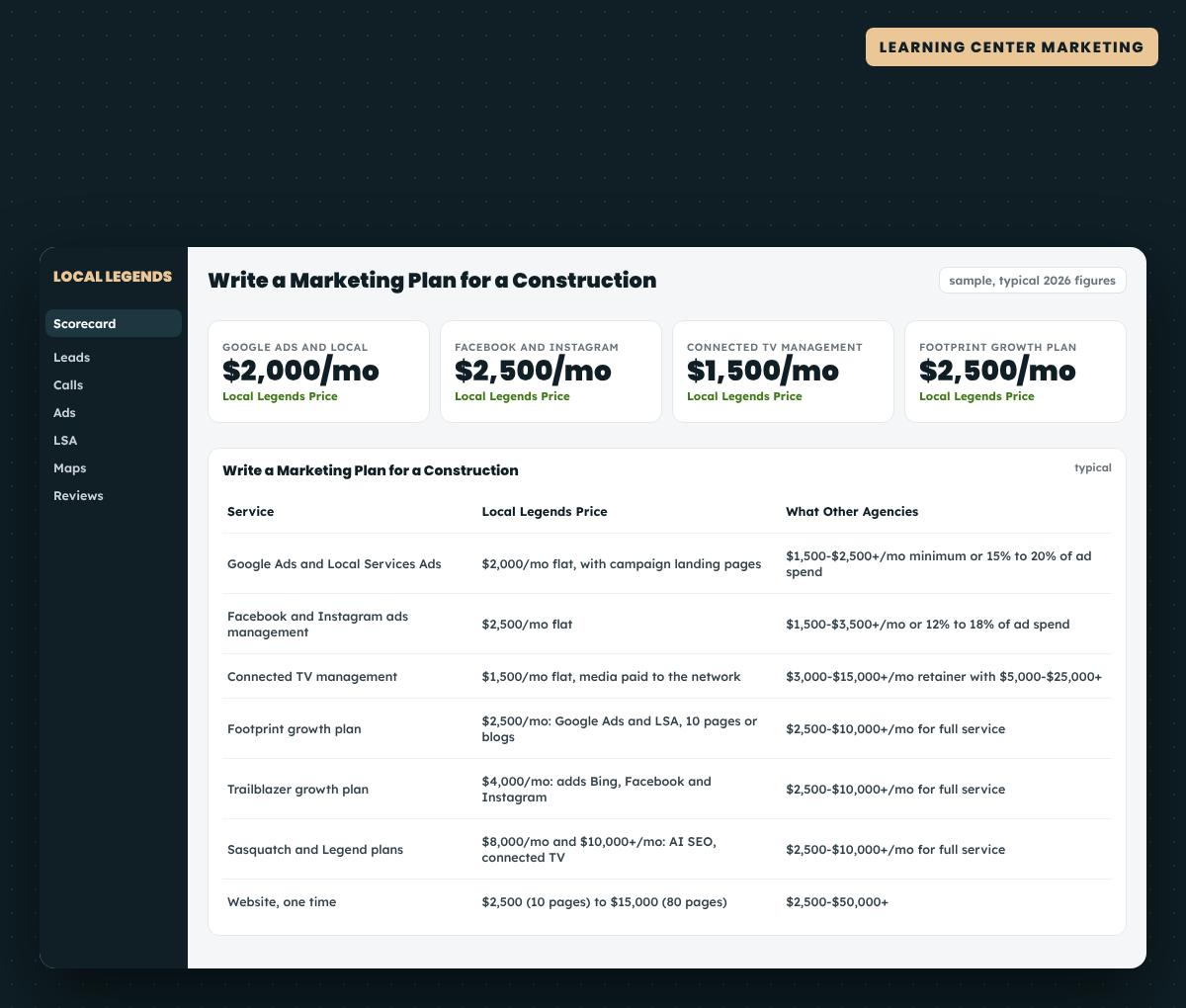
What Do Local Legends Prices Look Like Next to Typical Agency Pricing?
Local Legends charges flat monthly fees that never rise with your ad spend, while typical agencies quote retainers or a percentage of spend. There are no setup fees and no long-term contracts. [SOURCE: Levi Ostlund pricing decisions, Nov 8 and Nov 10 2026]
| Service | Local Legends Price | What Other Agencies Typically Charge |
|---|---|---|
| Google Ads and Local Services Ads management | $2,000/mo flat, with campaign landing pages and monthly Google Business Profile optimization | $1,500-$2,500+/mo minimum or 15% to 20% of ad spend |
| Facebook and Instagram ads management | $2,500/mo flat | $1,500-$3,500+/mo or 12% to 18% of ad spend |
| Connected TV management | $1,500/mo flat, media paid to the network | $3,000-$15,000+/mo retainer with $5,000-$25,000+ media minimums |
| Footprint growth plan | $2,500/mo: Google Ads and LSA, 10 pages or blogs a month, local SEO, call tracking, monthly scorecard | $2,500-$10,000+/mo for full service |
| Trailblazer growth plan | $4,000/mo: adds Bing, Facebook and Instagram, backlinks, review and email automations, weekly scorecard | $2,500-$10,000+/mo for full service |
| Sasquatch and Legend plans | $8,000/mo and $10,000+/mo: AI SEO, connected TV, geofencing, retargeting, PR and more pages | $2,500-$10,000+/mo for full service |
| Website, one time | $2,500 (10 pages) to $15,000 (80 pages) | $2,500-$50,000+ |
Full plan details are on the Local Legends pricing page.
Should a Construction or Remodeling Company Advertise Financing to Close Bigger Jobs?
Advertising financing can help a construction or remodeling company close larger residential jobs, because a monthly payment option reduces sticker shock and lets owners approve full scope, but it needs careful wording and pricing.
- Mention financing early, on the website, in ads and at the first consultation, rather than only after a price objection.
- Use general language in public ads, such as "financing available," and let the lender provide rate disclosures, since quoting specific rates or payments brings federal lending advertising rules into play.
- Build any lender dealer fee into your pricing so promotional terms do not erase margin.
- Pair financing messages with clear project minimums to keep lead quality high.
- Present a payment option on every proposal as a standard line, not a last resort.
Hiring a Construction Marketing Agency or Building an In-House Team Specialists Outside, Content Capture Inside
Most construction companies get further by hiring a specialized agency for search, ads and websites while someone inside captures job-site content, because one in-house marketer rarely masters SEO, paid media, web work, copy and video at once.
Should My Construction Company Hire a Marketing Agency or an In-House Marketer?
A construction company should hire an agency when the goal is lead generation and an in-house marketer when it needs daily job-site content, proposals and recruiting support, and many growing builders use both.
- Agency strengths: a team of specialists from day one, existing playbooks and no payroll overhead.
- In-house strengths: daily access to job sites for photos, walkthrough video and crew interviews.
- Hybrid model: a marketing coordinator captures content, manages reviews and runs events while the agency runs SEO, ads and the website.
- Fractional leadership: a fractional CMO sets strategy and holds the plan accountable without a full-time executive salary.
- Your time: either option needs a weekly hour from the owner to share jobs, approve content and review results.
What Should I Ask a Construction Marketing Agency Before Signing?
Before signing with a construction marketing agency, confirm that you will own every account and asset, how the agency handles competitors in your market and how it reports signed work, since those three answers protect your company if the relationship ends.
- Ownership: will the website, domain, Google Business Profile, ad accounts and analytics sit in accounts you own?
- Portability: if you cancel, do you keep the website, its copy and its design?
- Territory: does the agency work with other contractors in your trade and city?
- Reporting: does it report booked estimates, signed jobs and revenue, or only clicks and form fills?
- Fee clarity: how much of each month goes to the management fee and how much to ad spend?
- The team: who writes your pages and manages your ads day to day, and what construction experience do they have?
- Terms: what is the notice period, and is there a long lock-in or automatic renewal?
- Deliverables: is there a written scope listing monthly pages, posts and optimizations?
What to Look For in the Contract
Look for month-to-month or short terms, language stating that custom work and accounts belong to your company, an itemized scope of work and a written definition of a qualified lead that matches your trade, service area and project size.
Measuring Construction Marketing by Signed Contracts and Gross Profit Follow Every Lead to the Contract
Construction marketing is measured by tracing each lead from its first call or click through the CRM to a signed contract and the gross profit it earned, because long sales cycles and phone-heavy buyers leave website analytics blind to most results.
How Do I Measure Construction Marketing ROI by Channel?
Measure construction marketing ROI by tagging every lead with its source, carrying that source to the signed contract and comparing each channel's gross profit to what it cost, using a time window that matches your sales cycle.
- Tag calls: assign a tracking number to each channel, including yard signs and trucks where practical.
- Tag forms: add campaign tags to ad links and hidden source fields to website forms.
- Make the source mandatory: whoever answers the phone logs the lead source before saving a new prospect.
- Close the loop: mark each won job in the CRM with its contract value and estimated gross profit.
- Use gross profit, not revenue: a $100,000 contract at a 20% margin returns $20,000 to cover marketing and overhead.
- Judge by cohort: compare the leads a quarter produced with the contracts they signed months later.
- Ask how they first heard of you: that question captures signs, referrals and brand searches that tracking misses.
Connect Tracking to the Software You Already Use
Call tracking and CRM integration at Local Legends connects with ServiceTitan, Housecall Pro, JobNimbus, AccuLynx, Jobber, Buildertrend and GoHighLevel, so the source travels with the job.
What Construction Marketing Mistakes Waste the Most Money?
The costliest construction marketing mistake is paying for attention without a system to answer, qualify and close it, and several common habits make that worse.
- Letting paid inquiries wait in an inbox, or leaving forms unconnected to any CRM.
- Chasing lead volume from shared platforms that sell one homeowner to several builders.
- Marketing every service to everyone instead of the project sizes and towns you want.
- Running a website that shows galleries but gives visitors no clear next step.
- Pausing marketing when the schedule fills, which empties the calendar months later.
- Quitting SEO after a month or two, before it has time to build.
- Hiring separate vendors for each channel with no shared tracking, then raising spend on a funnel that leaks.
How Local Legends Marketing Supports Construction Companies Audit First, Then Build
Local Legends Marketing supports construction companies by auditing first and then running the channels that fit, with one scorecard measured by booked and sold jobs rather than impressions.
A Free Growth Audit Before Any Recommendation
Every engagement starts with a free growth audit of tracking, local SEO, Local Services Ads and the sales funnel, including Google Maps rank grids. [SOURCE: Levi Ostlund confirmation, Nov 10 2026; free audit confirmed Nov 28 2026]
One Contractor per Trade per City
For ongoing services such as SEO, ads and social, Local Legends takes only one contractor per trade per city, so the team never markets two rival builders in the same city. [SOURCE: Levi Ostlund, Nov 28 2026]
A Founder Who Worked in Construction
Founder Levi Ostlund sold driveway jobs door to door at 10, poured concrete with his father and ran a landscaping company in high school, then lost more than $30,000 to marketers who did not deliver before becoming a roofing company CMO. [SOURCE: client-confirmed founder story, BRIEF.md, Nov 2026]
That history is why clients own their website, domain, Google Business Profile, ad accounts and call data, why every engagement includes the Local Legends marketing course and why each client has a weekly project review meeting.
Local Legends reports 25,000+ appointments generated and $30M+ in revenue influenced for contractors (agency-reported). Learn more about construction company marketing or see Local Legends service areas.
Local Legends Marketing Reviews From Contractor CEOs Owners Who Worked With Levi
Contractor CEOs have shared video and written testimonials about working with Levi Ostlund and the Local Legends team, published on the Local Legends home page.
Levi has been absolutely outstanding to work with over the years... His creativity, responsiveness, and deep understanding of our marketing strategy have made a huge impact." Brad Beldon, CEO, Roofing Company. See it on locallegends.marketing
A long-running marketing relationship: Brad Beldon's written testimonial describes several years of marketing work with Levi for his roofing company. [SOURCE: written testimonial, locallegends.marketing home page, Nov 2026]
- Kyle Scott, CEO, Roofing Company (video testimonial)
- Jim Dodson, CEO, Roofing Company (video testimonial)
- Race Allen, CEO, Precision Restoration of Texas (video testimonial)
Frequently Asked Questions About Marketing in the Construction Industry Quick Answers for Builders and Trades
What Are Effective Digital Marketing Strategies for Construction Companies?
The most effective digital strategies for construction companies are a complete Google Business Profile, steady reviews, project-specific website pages, tightly targeted search ads and video that shows real work, all tracked to signed contracts.
What Is the 70:20:10 Rule in Digital Marketing?
The 70:20:10 rule puts about 70% of a budget into proven channels, 20% into promising ones and 10% into experiments. For a builder, that might mean search and the profile, then video, then a new platform test.
Is AI Replacing Digital Marketing for Construction Companies?
No, AI is changing where buyers find builders rather than replacing marketing. AI answers still draw on profiles, reviews and website pages, so the fundamentals now decide whether an assistant names your company.
What Is the Best Advertising for a Small Construction Company?
For a small construction company, the best advertising is usually free or close to it: an active Google Business Profile, job-site signs, truck lettering and past-client referrals, followed by Local Services Ads or a small search campaign.
What Are Good Construction Company Advertising Examples?
Strong construction advertising examples include a search ad for a project type in a named town, a radius postcard around an active job, a short reel of a crew solving a problem and a client testimonial filmed in the finished space.
Is a Construction Marketing Plan Template or PDF Worth Using?
A template helps organize a construction marketing plan, but the numbers must be your own: revenue goal, average project size, win rate, buyers, towns and the two or three channels you can fund well.
How Long Does Construction Marketing Take to Work?
Search ads and Local Services Ads can produce calls within days to weeks, while SEO, content and referral networks usually take several months. Most builders run both timelines at once.
Does a Construction Company Need LinkedIn?
Commercial general contractors, design-build firms and subcontractors benefit most from LinkedIn, where developers, architects and facility managers watch for project milestones. Residential builders usually get more from Facebook, Instagram and YouTube.
Reviewed by Levi Ostlund, Founder, Local Legends Marketing

Build Construction Marketing That Ends in Signed Contracts Book Your Free Growth Audit
Local Legends Marketing helps general contractors, home builders, remodelers and specialty trades build marketing they own, measured by booked and sold jobs, with flat fees, no setup fees and no long-term contracts.
Call (936) 900-1248, email levi@locallegends.marketing or book a free growth audit online. Our office is at 481 Stephen F Austin Dr, Conroe, TX 77302.