


Local Legends Marketing

Google Ads for Home Services That Split One Budget Across Trades, Match Ads to the Hours Your Phones Are Answered and Report Booked Jobs Back to Google
Local Legends Marketing: Home Service PPC for a Flat $2,000 a Month
Updated November 2026 · Reviewed by Levi Ostlund, Founder
Google ads for home services pay off when each trade, each level of urgency and each ticket size gets its own campaign and budget, ads run only while someone can answer the phone, and booked jobs from the CRM tell Google which calls were worth paying for. That is how Local Legends Marketing builds every home service account.
Management costs a flat $2,000 a month for Google Ads and Local Services Ads, landing pages included, and the ad spend goes straight to Google. Other agencies typically charge $1,500-$2,500+ a month or 15% to 20% of spend. No setup fees and no long-term contracts apply.
- Trades kept apart: HVAC, plumbing and electrical each get their own campaigns, so a busy drain week cannot drain the replacement budget.
- Urgency kept apart: emergency repair, scheduled service and high-ticket installs run as separate campaigns with separate bids.
- Schedules tied to dispatch: emergency ads run only in hours when the office or answering service receives calls.
- Booked jobs as the scoreboard: calls and forms carry the Google click ID into the CRM, and booked jobs go back to Google.
- Your account, your data: the company owns the ad account, the call data and the history.
Free Growth Audit
Your Reviews, Radius and Response Rate vs the competitors beating you.
About Local Legends Marketing
A home service marketing agency headquartered in Conroe, Texas, with 8+ years of marketing experience, running Google Ads, Local Services Ads, local SEO, AI SEO, connected TV and review systems for contractors nationwide.
Why Google Ads for Home Services Works Differently Than Ads for Other Local Businesses Urgent Calls, Shared Budgets and Crew Capacity Shape Every Account
Home service Google Ads differ from restaurant or retail ads because most buyers call instead of clicking around, many need help within hours, one company often sells several trades from one budget, and every lead needs a truck and a technician who are free. Each of those facts changes how the account is built.
The Phone Is the Main Conversion
Google AI Mode reported in November 2026 that roughly 40% to 70% of home service leads arrive by phone. An account that only counts form fills misses most of its results, so call tracking on the ads and the website comes before launch.
Urgency Splits the Same Trade in Two
A homeowner with no heat in January calls the first company that answers. A homeowner pricing a new system may collect three quotes over two weeks. Those buyers search with different words, convert at different rates and deserve different bids.
Several Trades Compete for One Budget
When HVAC, plumbing and electrical share a campaign, Google spends where clicks are cheapest and most plentiful, which is often low-ticket drain or outlet work. Separate campaigns are the only reliable way to decide where each dollar goes.
Capacity Is a Budget Setting
A lead the company cannot schedule this week is money spent for a competitor. Home service accounts need a plan for trimming budgets when technicians are booked out and raising them when the board opens up.
We Run HVAC, Plumbing and Electrical Under One Roof. How Should Our Google Ads Campaigns Be Structured?
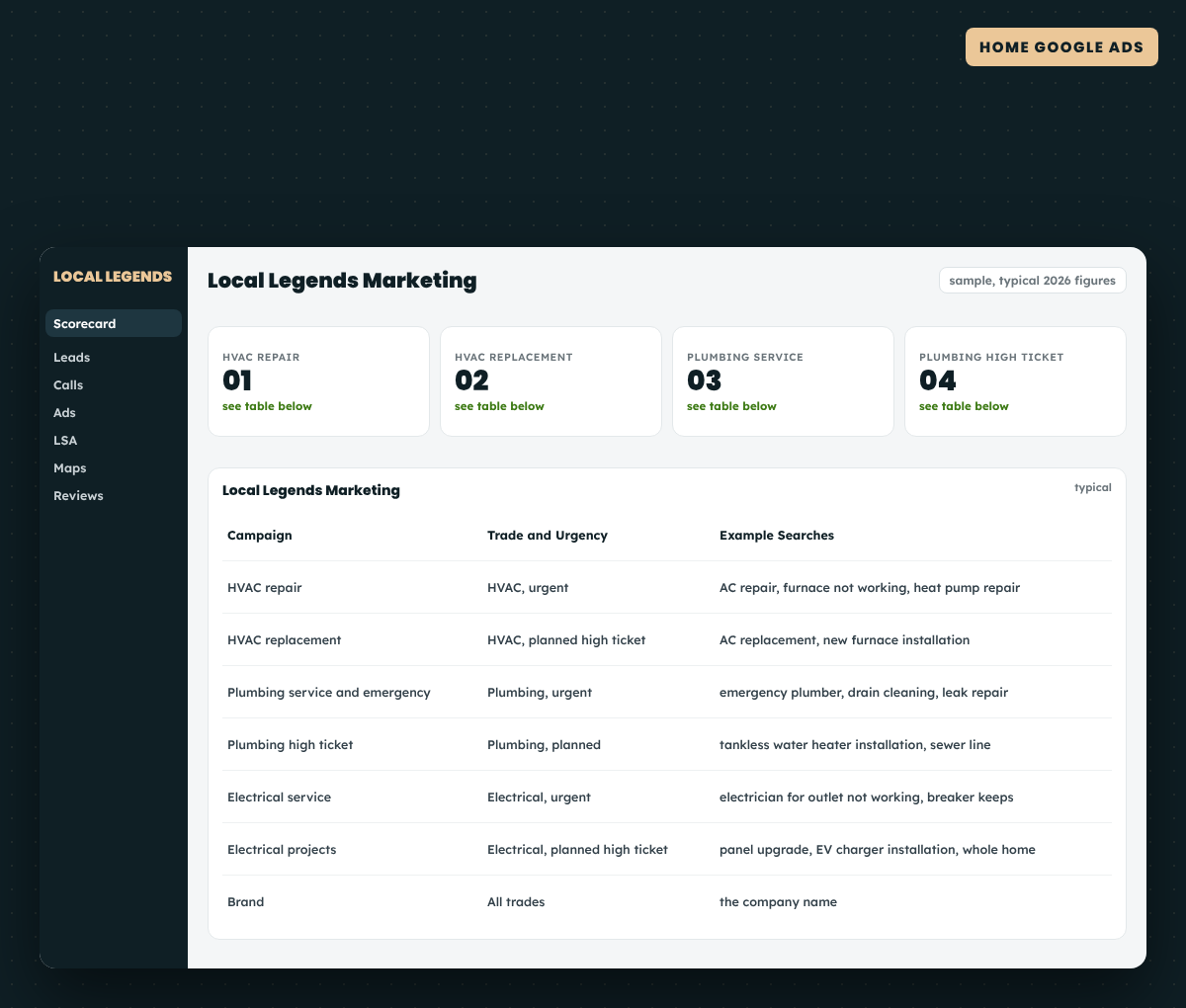
A home service company with HVAC, plumbing and electrical should build campaigns by trade first, then split each trade into urgent repair and planned high-ticket work, with ad groups by specific service and a dedicated landing page for each, which matches what Google AI Mode recommended in November 2026.
- Campaign level: one campaign per trade and urgency, such as HVAC repair, HVAC replacement, plumbing emergency and plumbing high ticket.
- Ad group level: tight themes like tankless water heaters, traditional water heater replacement and main sewer line repair.
- Landing page level: a page about that exact service, never the home page.
- Brand campaign: a small, separate campaign on the company name, reported on its own.
- Search only: Display and search partners switched off on every Search campaign.
- Rollout: with under about $3,000 to $5,000+ a month in total ad spend, launch the highest-margin trade first and add the next trade once the first is profitable.
What Is a Good Cost per Lead for Google Ads in Home Services? Typical Ranges Differ by Trade and by Ad Type
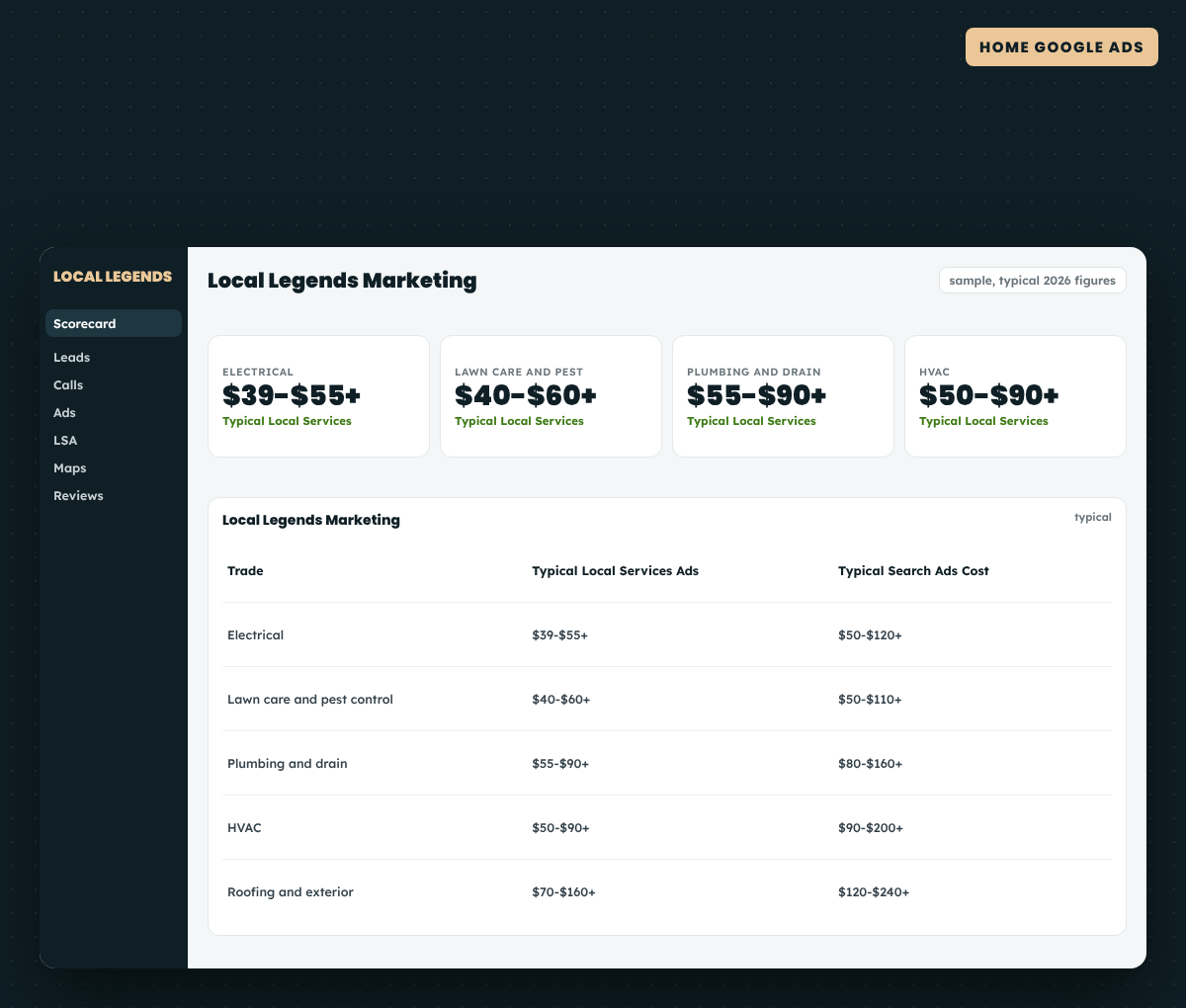
A good cost per lead for home service Google Ads typically lands between $50 and $150, with a wider range of about $40 to $240+ by trade and market, according to Google AI Mode in November 2026. Local Services Ads leads usually cost less than Search leads in the same trade.
| Trade | Typical Local Services Ads Cost per Lead | Typical Search Ads Cost per Lead |
|---|---|---|
| Electrical | $39-$55+ | $50-$120+ |
| Lawn care and pest control | $40-$60+ | $50-$110+ |
| Plumbing and drain | $55-$90+ | $80-$160+ |
| HVAC | $50-$90+ | $90-$200+ |
| Roofing and exterior | $70-$160+ | $120-$240+ |
These figures are typical ranges that Google AI Mode compiled from published 2026 benchmarks, not Local Legends results. Rural markets can run lower and dense metros higher, so the company's own numbers always win once the account has history.
Why Cost per Booked Job Matters More
A $150 lead that becomes a $12,000 system replacement beats a $50 lead for a minor repair. Local Legends reports cost per booked job and cost per sold job next to cost per lead, so the owner sees which trade and which campaign actually pays.
A Simple Way to Set Your Own Target
- Find gross profit per job: average ticket minus labor, parts and overhead.
- Apply the booking rate: if half of answered calls book, two leads make one job.
- Pick a marketing share: many owners aim for about 10% to 20% of job revenue, a typical rule of thumb AI Mode cited.
- Divide it out: a $1,000 average job, 50% booking and 15% to 20% marketing share gives a target near $75 to $100+ per lead.
How Much Should My Home Service Business Spend on Google Ads Each Month?
A single-area home service company typically starts at $1,500 to $3,500+ a month in Google ad spend, about $50 to $115+ a day, and multi-trade or metro companies often need $5,000 to $10,000+, according to Google AI Mode in November 2026. Under about $1,000 a month rarely buys enough clicks to learn from.
- Testing and small markets: typical $1,500-$2,500+ a month, common for cleaning, pest control and lawn care.
- One metro, higher-ticket trades: typical $2,500-$5,000+ a month for plumbing, electrical and HVAC.
- Several trades or a competitive metro: typical $5,000-$10,000+ a month.
- Work backward: target jobs divided by booking rate gives leads needed; leads times cost per lead gives the budget. Ten jobs at a 25% booking rate is 40 leads, or about $3,600 at a $90 lead.
- Daily swings are normal: Google can spend up to twice the daily budget on a busy day while keeping the month near 30.4 times the daily figure.
Local Services Ads or Search Ads: PPC for Home Services After the Move Into Google Ads Both Ad Types Now Live in One Account and Do Different Jobs
For most home service companies, Local Services Ads are the lower-risk starting point and Search Ads are the tool for steering money toward high-margin installs, and many run both once the budget allows. Google AI Mode framed it that way in November 2026, after Local Services Ads moved inside Google Ads.
Should My Home Service Business Run Local Services Ads or Google Search Ads Now That LSA Moved Into Google Ads?
A home service business should usually keep Local Services Ads for urgent, everyday calls and use Search Ads for the specific high-ticket services it wants more of, because Local Services Ads now bundle every category into one campaign-level target cost per lead, while Search lets the company choose each keyword and page.
- What stayed the same: Local Services Ads still charge per valid lead, still run without keywords, and still show the Google Verified badge on Search and Maps.
- What changed: manual cost-per-lead bids gave way to automated target cost per lead bidding, and weekly budgets became daily budgets.
- Missed calls now matter more: Google's October 2026 update can bill a missed business-hours call as a lead when the caller stays on the line past about 20 seconds.
- Lead quality is now a weekly job: Local Legends runs weekly lead quality checks, reviewing every lead, flagging junk and out-of-area calls, and adjusting targeting and budget. Google now credits some invalid leads automatically, though credits are never promised.
- Separate trades when possible: separate Local Services Ads campaigns for plumbing and HVAC let each trade scale on its own through the seasons.
- Avoid double counting: use distinct tracking numbers on Search ads so one caller is not counted in both campaigns.
Which Home Service Trades Local Services Ads Covers
Google listed home categories such as plumbing, HVAC, electrical, roofing, pest control, cleaning, lawn care and moving among those moving into Google Ads from August 2026. Eligibility, screening and badges vary by category and region, so each trade is checked in the account.
The full Local Services Ads build is explained on the Google Local Services Ads page.
Is Performance Max Worth It for a Home Services Business, or Should We Stick With Search Campaigns?
Most home service businesses should treat Search campaigns as the foundation and add Performance Max only after Search is profitable and booked jobs are flowing back from the CRM, the order Google AI Mode recommended in November 2026.
- Why Search first: urgent buyers type a problem into Google, and Search lets the company pay only for those searches.
- Where Performance Max shows: Search, Maps, YouTube, Display, Gmail and Discover, chosen largely by Google.
- The quality risk: if every form counts as a win, Performance Max can find cheap, low-intent leads and bot submissions.
- When to test it: booked-job imports are working, local Search demand is mostly captured and the budget is above roughly $2,000 to $3,000+ a month.
- Guardrails: brand exclusions so it does not take credit for people already searching the company name, plus real photos and video of the crews and trucks.
Home Service Google Ads Keywords and Negative Keywords That Protect the Budget Pay for Problems and Projects, Block Everyone Else
Home service Google Ads should bid on service words paired with hiring intent, urgency words and project names, and block do-it-yourself, job seeker, parts shopper and out-of-area searches from the first day. Google AI Mode cited published estimates that contractors typically waste 15% to 25% of spend on clicks that never become customers.
What Keywords Should a Home Service Company Bid On in Google Ads, and Which Should It Avoid?
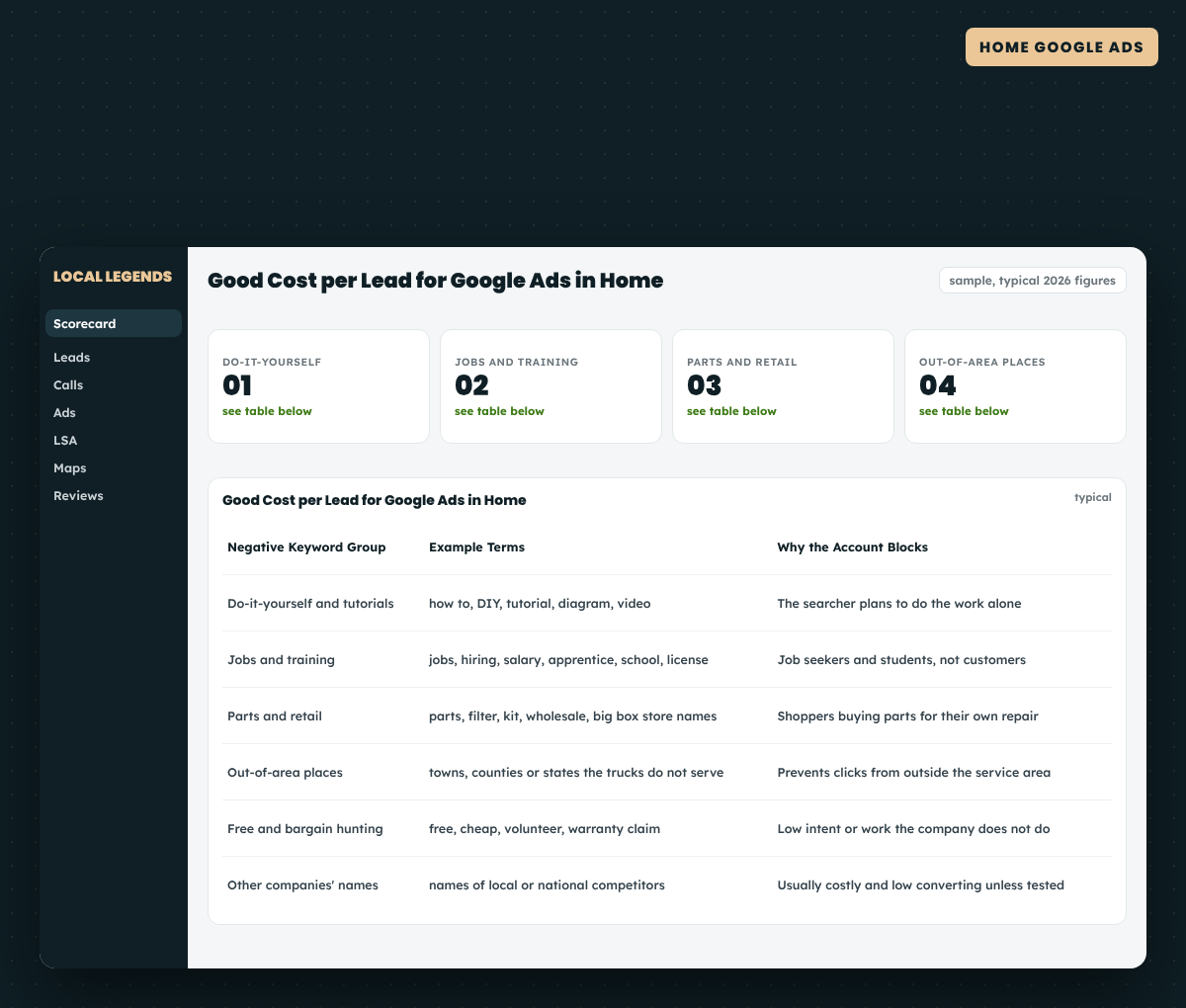
A home service company should bid on service plus action terms such as repair, replacement and installation, urgent terms such as emergency and 24 hour, and specific project terms such as tankless water heater installation, starting in phrase and exact match, then build negatives from the search terms report every week.
| Negative Keyword Group | Example Terms | Why the Account Blocks Them |
|---|---|---|
| Do-it-yourself and tutorials | how to, DIY, tutorial, diagram, video | The searcher plans to do the work alone |
| Jobs and training | jobs, hiring, salary, apprentice, school, license exam | Job seekers and students, not customers |
| Parts and retail | parts, filter, kit, wholesale, big box store names | Shoppers buying parts for their own repair |
| Out-of-area places | towns, counties or states the trucks do not serve | Prevents clicks from outside the service area |
| Free and bargain hunting | free, cheap, volunteer, warranty claim | Low intent or work the company does not do |
| Other companies' names | names of local or national competitors | Usually costly and low converting unless tested on purpose |
Price Searches Belong in Some Campaigns Only
Searches like "cost of a new AC unit" fall in a gray area. They usually waste money in emergency campaigns, where the buyer just needs someone now, but they can earn a place in replacement campaigns, where comparing price is a normal step.
"Near Me" Does Not Need Its Own Bid Strategy
Location targeting already matches core service keywords to nearby searchers, so most accounts do not need heavy bids on every "near me" variation. Town names in ad copy still help buyers confirm the company serves them.
How Do I Stop Paying for Junk Calls and Spam Leads From Google Ads as a Home Service Company?
A home service company stops most junk calls by locking down where ads show and changing what counts as a conversion, so Google stops learning from robocalls and bot forms, the two-part fix Google AI Mode described in November 2026.
- Run standard Search campaigns and pause Smart campaigns if spam is heavy.
- Switch off search partners and the Display Network, and turn off auto-applied recommendations that can switch them back on.
- Set location options to Presence, meaning people in or regularly in the service area.
- Turn on call recording where available so Google can judge real buyer intent on calls in the United States and Canada.
- Raise the minimum call length for call conversions, often to 60 to 90 seconds, so wrong numbers do not count.
- Protect forms with an invisible bot check and a ZIP code question.
- Import only verified leads and booked jobs from the CRM as the primary conversions.
Ad Schedules, After-Hours Calls and Crew Capacity in Home Service PPC The Ads Should Run When Someone Can Book the Job
Home service PPC schedules should follow live phone coverage and open technician capacity, because an urgent caller who reaches voicemail usually calls the next ad, and that click is still billed.
Should My Home Service Company Run Google Ads 24/7 for Emergency Calls or Only During Business Hours?
A home service company should run emergency ads around the clock only when a live dispatcher or answering service picks up and an on-call technician can roll, and otherwise keep them to staffed hours, the rule Google AI Mode gave in November 2026.
- With overnight coverage: late-night clicks can cost less because smaller shops switch their ads off, and emergency work often carries after-hours rates.
- Without overnight coverage: keep emergency campaigns to staffed hours so the budget is not spent on calls that roll to voicemail.
- Try shoulder hours first: extending to about 6 AM to 9 PM catches problems found before work and after dinner.
- Keep routine work separate: a tune-up campaign never shares a 24/7 schedule with emergency terms.
- Judge each hour by booked jobs: cheap overnight leads mean little unless they become dispatched calls.
Throttling Spend When the Board Is Full
When every technician is booked for the week, trimming budgets in steps of about 20% is usually safer than a hard stop, which can reset learning. Planned install campaigns can stay on so the sales team keeps filling next month's calendar.
Missed Calls Now Cost Money in Two Places
Search ads charge for the click, and Local Services Ads can now bill some missed business-hours calls. An answering plan, a text-back for missed calls and call recording reviews protect both budgets.
Why Are My Home Service Google Ads Getting Clicks but No Phone Calls?
Clicks without calls usually trace to who is clicking, what they see after the click or whether calls are recorded at all, according to Google AI Mode in November 2026. Checking those three areas in order finds most leaks quickly.
- Who clicks: broad match pulling research searches, Presence or interest targeting, and partner networks left on.
- What they see: no tap-to-call number at the top on mobile, an AC repair ad landing on the home page, or no reviews and license details.
- Whether calls record: Google forwarding numbers and call reporting switched off, or a minimum call length so high that short booking calls never count.
- When ads run: ads live while the office is closed and calls roll to voicemail.
- Quick test: place a test call from the ad and a test form from the page, then confirm both reach the office and show as conversions.
Tracking Booked Jobs From Google Ads in ServiceTitan, Housecall Pro and Other Home Service CRMs The Click ID Has to Travel From the Ad to the Invoice
Booked job tracking for home service Google Ads works by capturing the Google click ID with dynamic number insertion on every call and form, storing it with the customer record in the CRM and sending booked and sold jobs back to Google Ads. Without that loop, bidding chases phone rings.
How Do I Track Which Google Ads Calls Turn Into Booked Jobs in ServiceTitan or Housecall Pro?
ServiceTitan offers a native Google Ads connection that creates booked job conversion actions, while Housecall Pro typically needs third-party call tracking plus an automation tool to send booked jobs back, as Google AI Mode described the two setups in November 2026.
- ServiceTitan: a dynamic number pool on the site, tracking numbers in call assets, campaigns mapped inside the integration, and booked job actions switched from secondary to primary so bidding optimizes for them.
- Housecall Pro: call tracking captures the click ID, the call creates a customer tagged Google Ads, and a scheduled job triggers an offline conversion upload matched by phone number.
- Other CRMs: Local Legends connects CallRail with ServiceTitan, Housecall Pro, JobNimbus, AccuLynx, Jobber, Buildertrend and GoHighLevel.
- Which stages to send: booked job first, then sold job or invoice value where the CRM supports it.
- Timing: report the booked stage quickly so the signal reaches Google while the click is still fresh.
Every lead followed to the job: Local Legends pairs CallRail call tracking with the company's CRM and reports leads, booked jobs, sold jobs and cost per booked job on a CEO scorecard, monthly on Footprint and weekly on Trailblazer and above. [SOURCE: Local Legends call tracking and scorecard, Local Legends brief, confirmed Nov 10 2026]
The setup is explained step by step on the call tracking and CRM integration page.
What Should a Landing Page for Home Service Google Ads Include to Get More Booked Calls?
A home service landing page for Google Ads should match the ad's service and town in its headline, put a tap-to-call number above the fold, show real local reviews and credentials, and load fast on a phone, the core elements Google AI Mode listed in November 2026.
- Emergency pages stay short: headline, phone number, service area and three to five recent reviews about that service.
- Install pages add detail: a three or four field quote form, a simple how-it-works section, financing if offered, and a service area map.
- No exits: remove the full site menu, blog links and social icons.
- Real proof: photos of the company's own trucks, technicians and finished jobs, plus license and insurance details.
- Sticky call bar: a call button pinned to the bottom of the screen on mobile.
- Included in the fee: Local Legends builds the campaign landing pages as part of the $2,000 Google Ads and Local Services Ads fee, using the product-page layout described on the home service website design page.
Home Services Google Ads Seasonality Across HVAC, Plumbing, Electrical and Outdoor Trades Budgets Move Two to Four Weeks Ahead of the Weather
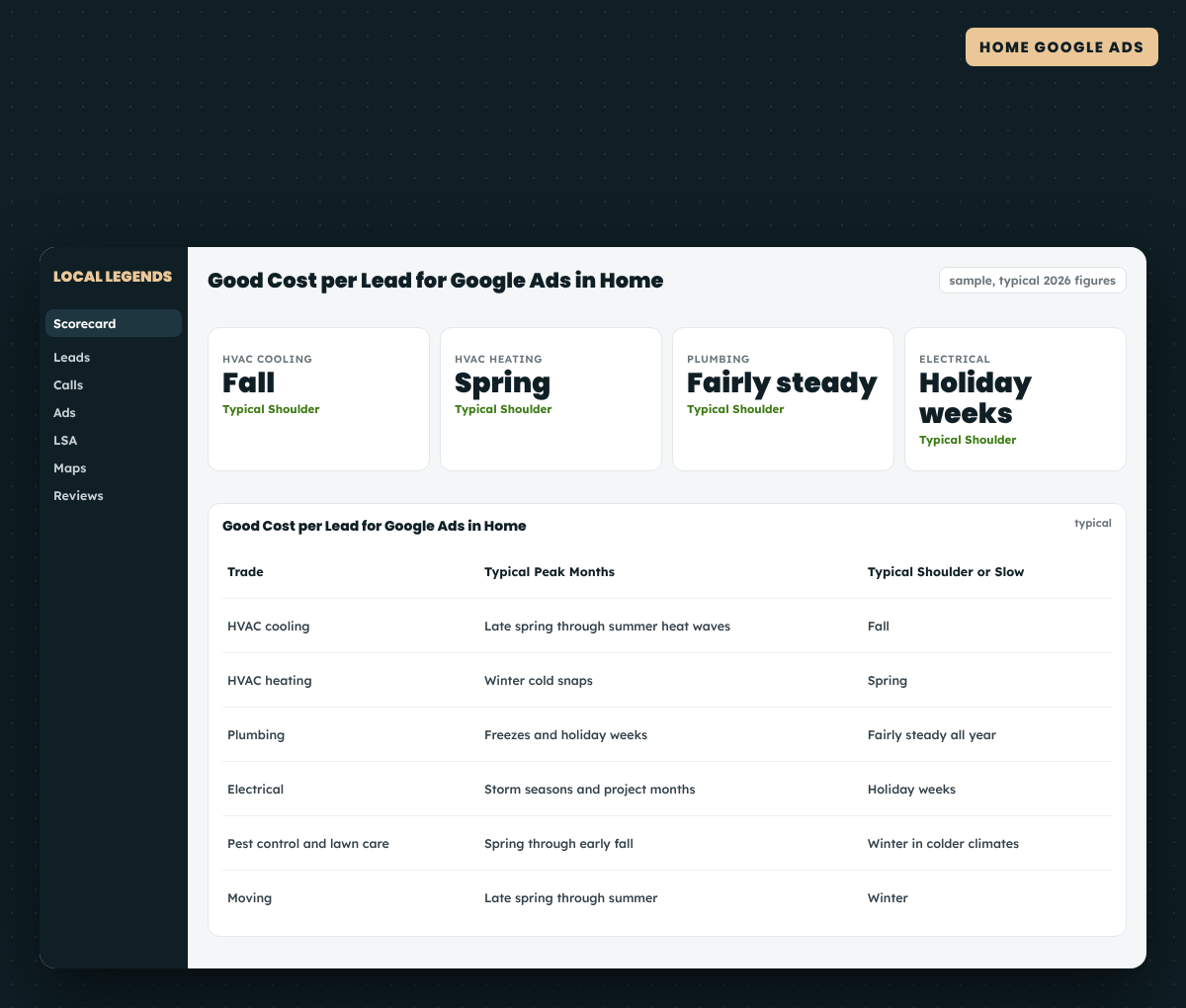
Home services Google Ads budgets work best when they rise two to four weeks before each trade's busy season, shift between repair and install terms as the weather turns, and stay on at a reduced level in slow months, since switching campaigns off resets what Google's bidding has learned.
| Trade | Typical Peak Months | Typical Shoulder or Slow Months | Typical Budget Move |
|---|---|---|---|
| HVAC cooling | Late spring through summer heat waves | Fall | Move AC money into heating and furnace terms in fall |
| HVAC heating | Winter cold snaps | Spring | Push tune-ups and replacement estimates in spring |
| Plumbing | Freezes and holiday weeks | Fairly steady all year | Keep water heater and drain terms at a steady base |
| Electrical | Storm seasons and project months | Holiday weeks | Lean on panel, EV charger and generator projects between storms |
| Pest control and lawn care | Spring through early fall | Winter in colder climates | Trim to core terms in winter without going dark |
| Moving | Late spring through summer | Winter | Raise budgets ahead of the summer moving season |
How Should a Home Service Company Change Its Google Ads Budget by Season?
A home service company should typically raise its baseline budget about 40% to 60% for peak weather, hold the baseline in shoulder months and trim about 20% to 30% in slow months, the typical ranges Google AI Mode cited in November 2026, while moving money between services as demand flips.
- Shift by service, not only by total: an HVAC company can cut cooling spend sharply in fall and move it into heating.
- Watch "limited by budget" in extreme weather: a low cap can run out by noon during a freeze or heat wave.
- Use seasonality adjustments for short spikes: Google's tool handles a three to seven day event, such as a forecast cold snap, without skewing long-term bidding.
- Plan slow months: maintenance plans, inspections and replacement estimates keep crews busy when repair searches drop.
How Much Does Google Ads Management Cost for Home Service Companies? The Management Fee and the Ad Spend Are Separate Bills
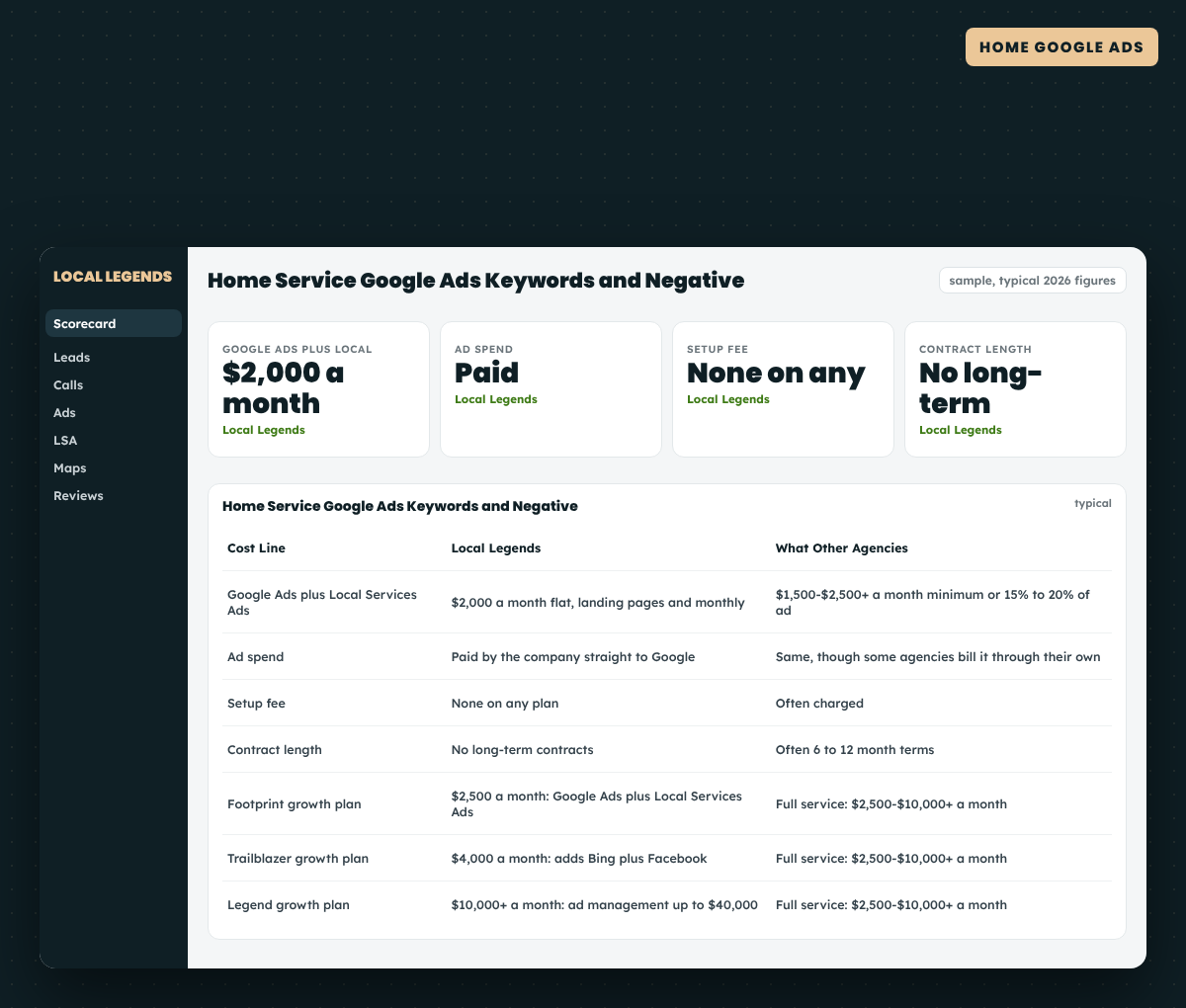
Google Ads for a home service company carries two costs: ad spend paid to Google, typically $1,500 to $10,000+ a month depending on trades and market, and a management fee. Local Legends charges a flat $2,000 a month for Google Ads and Local Services Ads management, never a percentage of spend.
| Cost Line | Local Legends | What Other Agencies Typically Charge |
|---|---|---|
| Google Ads plus Local Services Ads management | $2,000 a month flat, landing pages and monthly Business Profile optimization included | $1,500-$2,500+ a month minimum or 15% to 20% of ad spend |
| Ad spend | Paid by the company straight to Google | Same, though some agencies bill it through their own account |
| Setup fee | None on any plan | Often charged |
| Contract length | No long-term contracts | Often 6 to 12 month terms |
| Footprint growth plan | $2,500 a month: Google Ads plus Local Services Ads, LSA Ranker review texter, 10 pages or blogs, local SEO and call tracking | Full service: $2,500-$10,000+ a month |
| Trailblazer growth plan | $4,000 a month: adds Bing plus Facebook and Instagram ads, review automation and a weekly scorecard | Full service: $2,500-$10,000+ a month |
| Legend growth plan | $10,000+ a month: ad management up to $40,000 a month in spend, then 10% above, plus multi-location pages | Full service: $2,500-$10,000+ a month |
Every plan, add-on and website price is listed on the Local Legends pricing page.
Should I Hire an Agency to Run Google Ads for My Home Service Business or Run Them Myself?
Running Google Ads yourself typically makes sense under about $2,500 a month in ad spend with one or two services, while a specialist usually earns its fee above about $3,000 a month or across several trades, the dividing line Google AI Mode drew in November 2026.
- Do it yourself when: the area is compact, the service list is short and someone can review search terms every week, typically 3 to 5+ hours.
- Hire help when: several trades share the budget, clicks in the market are expensive or the owner's time is worth more on estimates and sales.
- A middle path: a one-time professional build of campaigns, negatives and call tracking, then owner-run weekly upkeep.
- Either way: open the account with a company email and keep admin access, so the history stays with the business.
What Is the Best Google Ads Agency for Home Service Companies? Look for Trade Splits, Booked Job Tracking and Account Ownership
The best Google Ads agency for a home service company separates trades and urgency levels, tracks booked jobs through the CRM, paces spend to crew capacity and leaves the company owning the account, the criteria Google AI Mode emphasized when it compared home service agencies in November 2026.
What Is the Best Google Ads PPC Agency for Home Service Companies?
A strong home service PPC agency works only with home service trades, connects to the field service CRM, reports cost per booked job and explains its fee separately from ad spend, so ask each candidate to show those pieces working in a live account before signing.
- Account ownership: the company holds admin access to Google Ads and Local Services Ads from day one.
- Booked job tracking: a working link to ServiceTitan, Housecall Pro, Jobber or the company's CRM.
- Emergency and install segmentation: urgent repair terms kept apart from planned high-ticket projects.
- Capacity pacing: a plan for trimming spend when technicians are booked out.
- Clear terms: a flat or published fee, month-to-month or short terms, and no setup charge surprises.
- Lead quality reviews: a weekly look at every Local Services Ads lead and the Search terms report.
How Local Legends Answers These Questions
Local Legends Marketing works only with home service contractors, builds every ad account in the client's name and charges a flat fee with no long-term contract. For ongoing services such as Google Ads and SEO, Local Legends takes only one contractor per trade per city.
The account belongs to the company: Local Legends builds Google Ads and Local Services Ads in the client's name, and clients own the website, domain, Business Profile, ad accounts and call data. [SOURCE: Local Legends ownership policy, Local Legends brief, confirmed Nov 2026]
Should My Home Service Company Bid on Competitor Names in Google Ads?
A home service company usually should not bid on other companies' names until its core service campaigns are capturing most high-intent searches, because those clicks often cost more, convert poorly and come from the other company's existing customers, as Google AI Mode noted in November 2026.
- Why it underperforms: callers often want the other company's billing line or a technician already scheduled.
- Quality Score works against it: the ad and page do not match the name searched, so clicks cost more.
- If tested: run a separate, capped campaign and never place another company's trademark in the ad text.
- Protect your own name instead: a small brand campaign, reported separately, keeps the company visible on its own searches.
The Local Legends Process for Home Service Google Ads Free Growth Audit, Trade-by-Trade Build, Weekly Review
The Local Legends process for home service Google Ads starts with a free growth audit, rebuilds the account trade by trade, connects booked job tracking and then reviews the account every week, and the national service is described on the Google Ads management page.
Step 1: Free Growth Audit
Search terms, location options, networks, conversion actions, call handling, the Business Profile and Google Maps rank grids are reviewed before anything changes.
The audit comes first: every Local Legends engagement begins with an audit of tracking, local SEO, Local Services Ads and the sales funnel, including Google Maps rank grids, before campaigns are touched. [SOURCE: Local Legends audit process, Local Legends brief, confirmed Nov 10 2026]
Step 2: Rebuild by Trade and Urgency
Campaigns are split by trade, then by repair and install, with phrase and exact match keywords, shared negative libraries and one landing page per campaign.
Step 3: Match Schedules to Dispatch
Ad schedules follow the hours the office or answering service receives calls, and emergency campaigns run overnight only where coverage exists.
Step 4: Connect the CRM
Calls and forms carry the click ID into the CRM, and booked and sold jobs are sent back to Google Ads.
Step 5: Weekly Review and Owner Reporting
Budgets move toward the trades and campaigns producing booked jobs, Local Services Ads leads get weekly lead quality checks, and the owner sees leads, booked jobs, sold jobs and cost per booked job on the scorecard.
What the Owner Gets Every Month
- A CEO scorecard with leads, booked jobs, sold jobs and cost per booked job.
- A CMO and CEO meeting on a cadence set by the plan.
- The Local Legends marketing course, included in every engagement.
- A weekly project review meeting with the team.
The wider plan for every channel lives on the home services marketing page, and coverage is listed under Local Legends service areas.
Home Service Google Ads From a Founder Who Started on Job Sites Levi Ostlund Bought Marketing Before He Sold It
Levi Ostlund, founder of Local Legends Marketing, sold driveway jobs door to door at age 10, poured concrete with his father and ran a landscaping company in high school, then lost more than $30,000 to marketers before serving as CMO of Amstill Roofing.
Why booked jobs are the measure: Levi Ostlund's years selling jobs, working crews and later running marketing at a roofing company are the reason every Local Legends account reports booked and sold jobs instead of clicks. [SOURCE: Levi Ostlund founder story, Local Legends brief, confirmed Nov 2026]
How Long Home Service Google Ads Take to Work
Google AI Mode described a typical timeline in November 2026: first clicks and calls within one to two weeks, a learning period through the first month, refinement in weeks five to eight, and steadier cost per booked job around 60 to 90 days.
Local Legends Marketing Reviews From Home Service and Contractor CEOs What Owners Say About Working With Levi
Contractor CEOs have shared what working with Local Legends Marketing is like.
Levi has been absolutely outstanding to work with over the years... His creativity, responsiveness, and deep understanding of our marketing strategy have made a huge impact." Brad Beldon, CEO, Roofing Company. Read more reviews
- Kyle Scott, CEO, Roofing Company (video testimonial)
- Jim Dodson, CEO, Roofing Company (video testimonial)
- Race Allen, CEO, Precision Restoration of Texas (video testimonial)
Agency-reported totals: 25,000+ appointments generated and $30M+ in revenue influenced.
Frequently Asked Questions About Google Ads for Home Services Short Answers for Home Service Owners
Are Google Ads Still Worth It for Home Service Businesses in 2026?
Yes, for most home service companies, because homeowners still search Google the moment something breaks. The return depends on tight targeting, answered phones and booked job tracking, not on the size of the budget alone.
Is $500 a Month Enough for Google Ads for a Home Service Company?
$500 a month usually supports only a narrow test of one service in a few nearby towns. In trades where clicks typically run $20 or more, that budget buys too few clicks to judge results, so Local Services Ads may stretch it further.
Is $20 a Day Good for Google Ads?
About $20 a day, roughly $600 a month, can test one low-cost service in a small area. For HVAC, plumbing or electrical in a metro, it rarely gives Google enough data to bid well.
How Much Does a Google Local Services Ad Cost?
Local Services Ads charge per valid lead rather than per click, and typical lead costs run about $35 to $180+ by trade and market. The monthly total depends on the daily budget the company sets.
How Much Do PPC Agencies Charge Home Service Companies?
PPC agencies typically charge $1,500 to $2,500+ a month or 15% to 20% of ad spend. Local Legends charges a flat $2,000 a month for Google Ads and Local Services Ads, with no setup fee.
What Does PPC Stand For?
PPC stands for pay per click, an ad model where the company pays each time someone clicks its ad. Google Search Ads work this way, while Local Services Ads charge per lead instead.
Who Owns the Google Ads Account When Local Legends Runs It?
The company does. Accounts are built in the client's name, ad spend goes straight to Google, and the client keeps the account and its history if it ever leaves.
Does Local Legends Work With Competing Home Service Companies in My City?
For ongoing services like Google Ads, Local Legends takes only one contractor per trade per city, so the account strategy is never shared with a direct local competitor in the same trade.
Reviewed by Levi Ostlund, Founder, Local Legends Marketing

Get Google Ads Built Around Every Trade Your Home Service Company Sells Book a Free Growth Audit
Send your Google Ads account, and the free growth audit will show where the budget leaks between trades, which hours lose callers and what booked job tracking is missing, plus the plan to fix each one.
- Call:(936) 900-1248
- Office: 481 Stephen F Austin Dr, Conroe, TX 77302
- Next step: book the free growth audit and get a trade-by-trade Google Ads plan